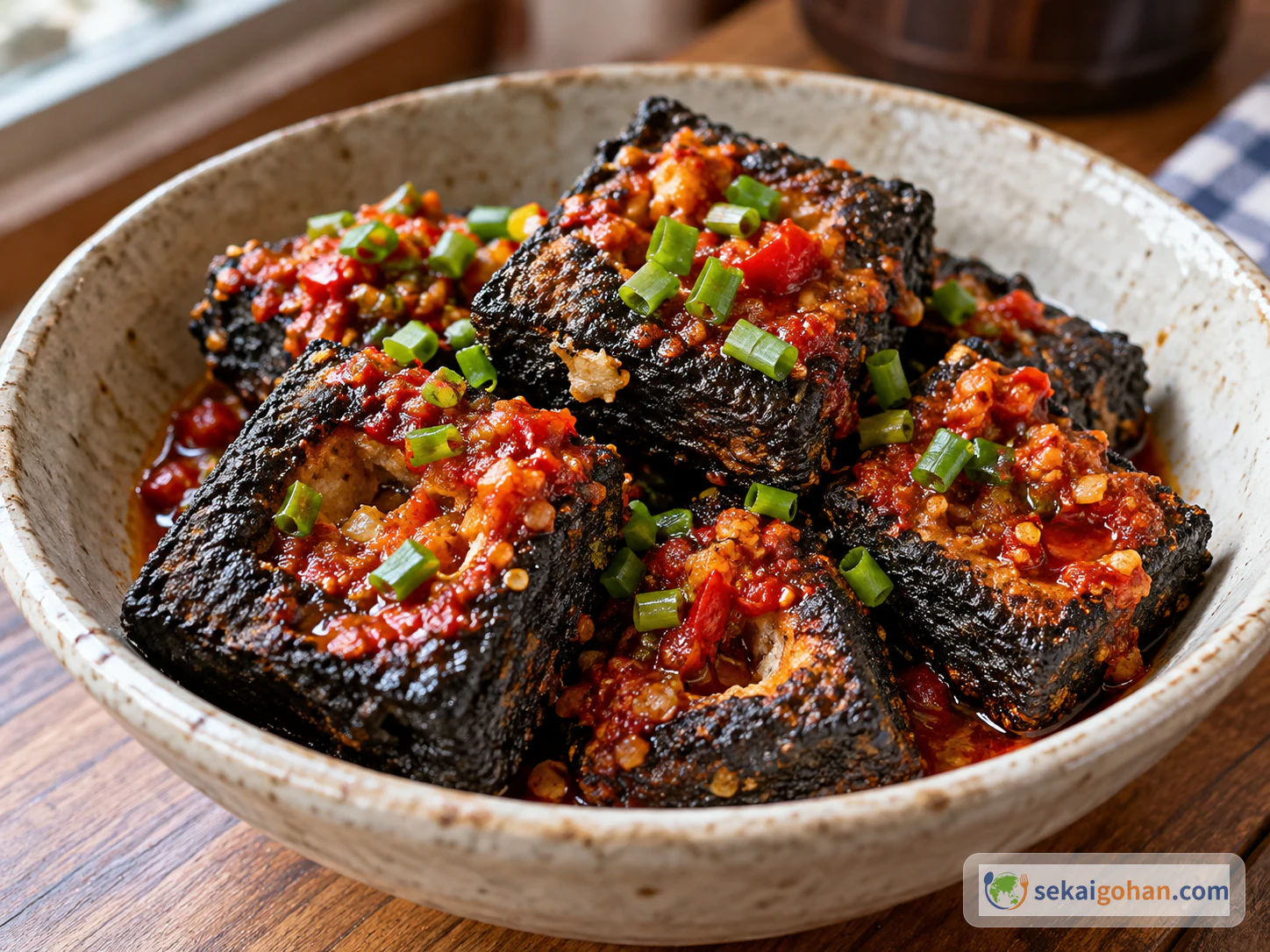
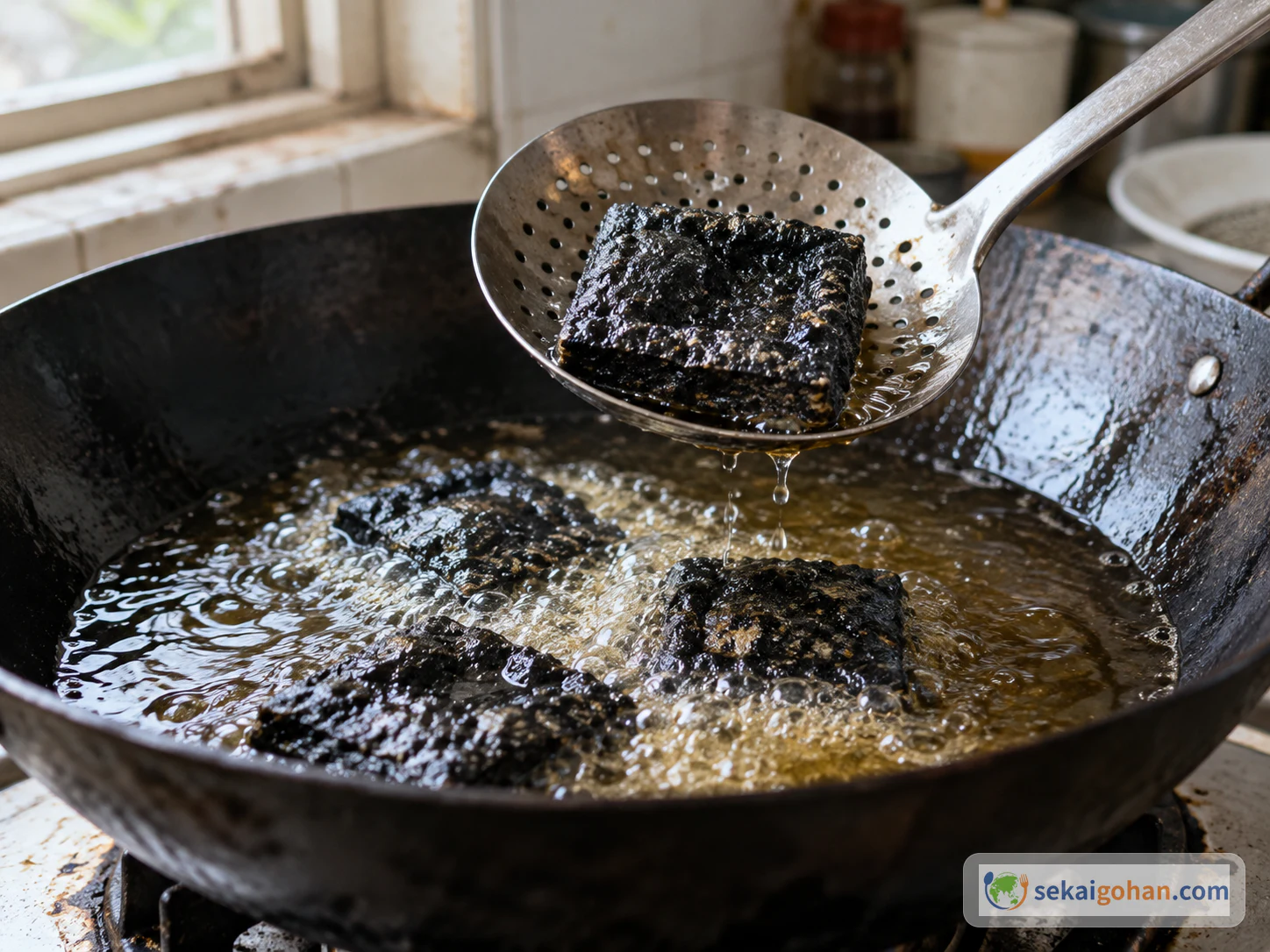
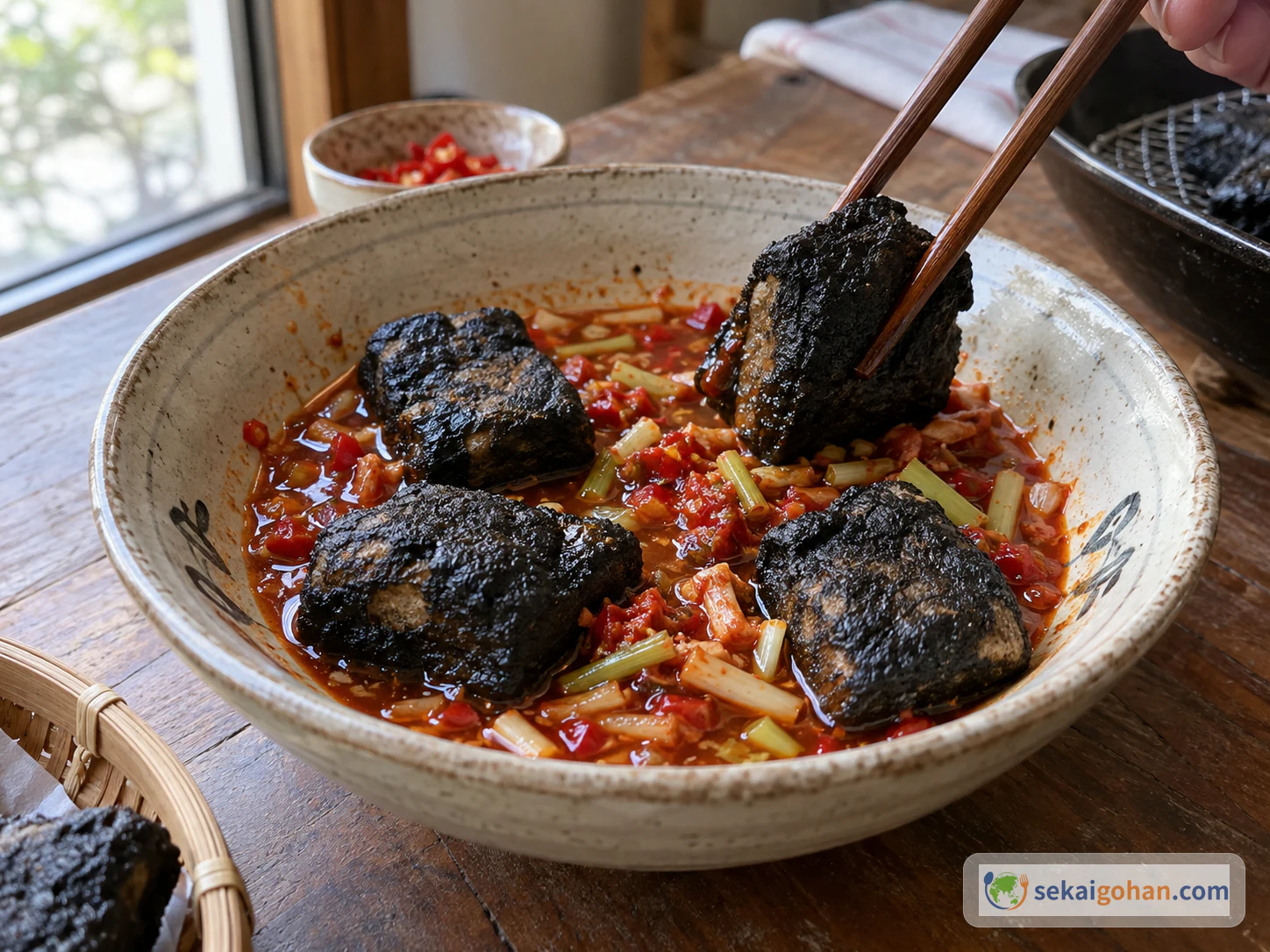
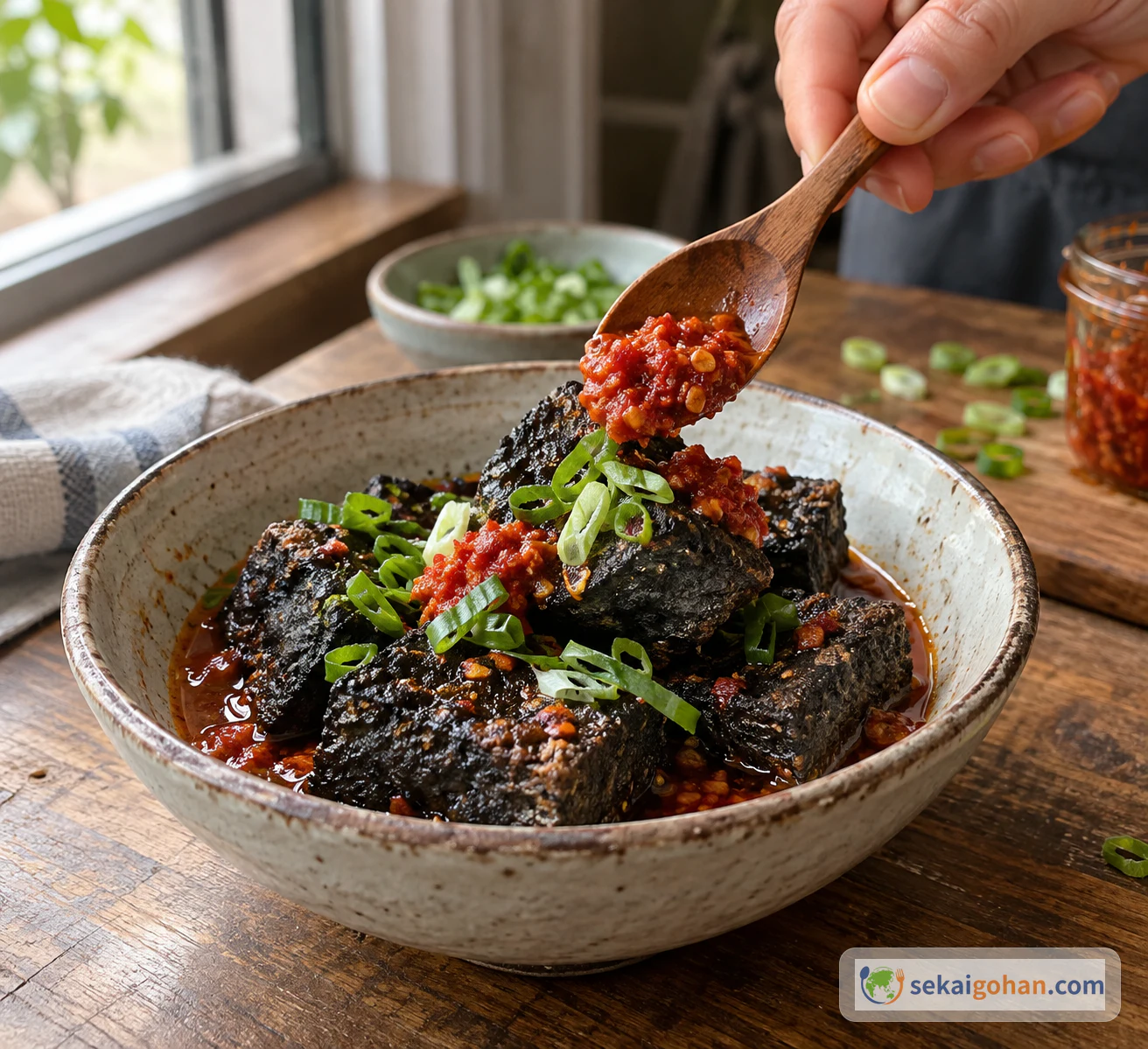
The pieces come out of the oil almost black, with a crisp skin. Set into a red sauce of chopped small chilies and thin celery, they bring chili heat and the tofu's fermented smell together in one bite. In Changsha this stinky tofu, called chòu gān zï locally, is a traditional, popular snack: black to look at, pungent to smell, and then spicy, crisp outside and tender inside once you eat it. That gap between how it looks and smells and how it tastes is the reason to make it.
Changsha Stinky Tofu and the Blank It Starts From
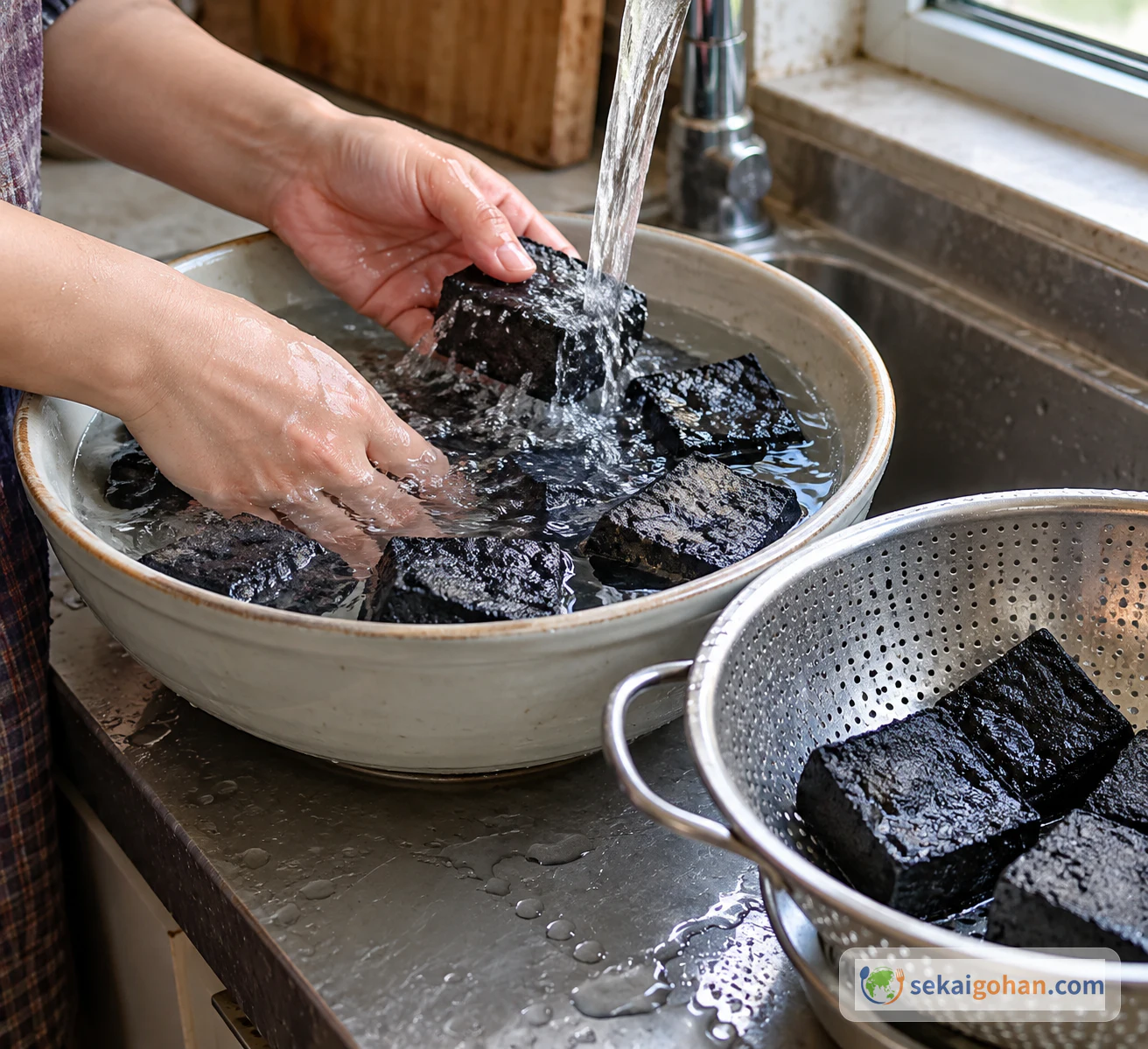
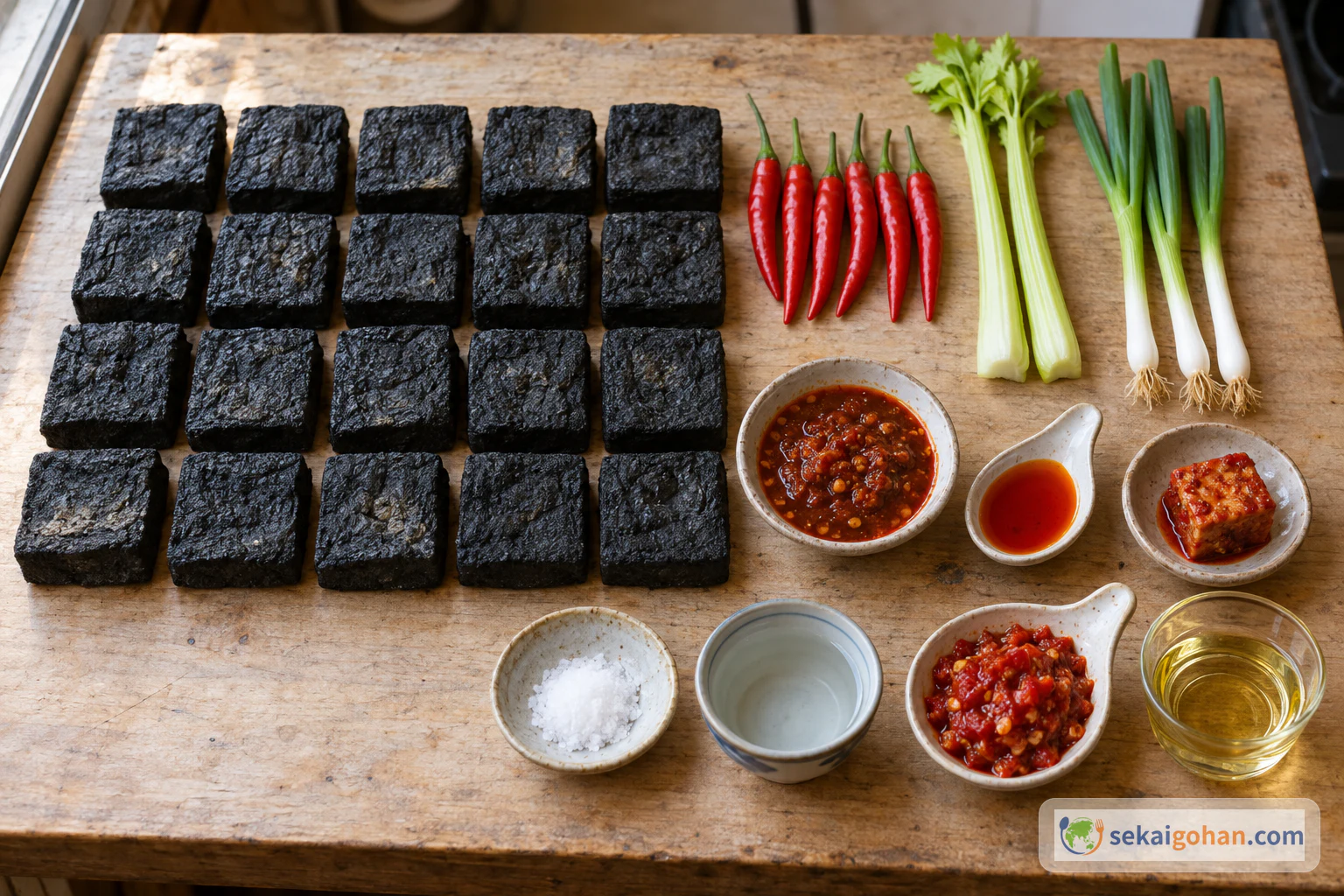
The main ingredient is a prepared product, not fresh tofu. The dish starts from 20 pieces of 长沙臭豆腐鲜胚, the Changsha stinky-tofu "fresh blank," which are tofu pieces already prepared for frying. Black is how the Changsha snack is known, so look for black blanks. You won't be brining or fermenting anything at home.
These blanks are a recognized product category. Hunan has a provincial food-safety standard for the production hygiene of pre-made Changsha stinky tofu, DBS43/011—2022, published on 2022-08-24 and in effect since 2023-02-24. It covers raw-material procurement, processing, packaging, storage and transport. Home kits of black Changsha fresh blanks with condiment sachets are sold too.
Home cooks in Changsha don't all make it the same way. Some fry the blanks crisp, rinse and soak them first, and serve them with a small set of garnishes. Some use generic blanks with a sauce of several seasoning powders, and others simmer already-fried tofu in a sauce with vinegar, soy sauce, starch and pickles. This version is a home preparation built on a prepared blank, fried twice and dressed in a fresh chili sauce.
"Stinky tofu" is also the name for foods from other parts of China and from Taiwan, made with different processes and served in different ways. For more dishes from the same country, see our China page.
Ingredients: 20 Fresh Blanks, One Sauce, Two Toppings
Equipment
- A pot deep enough to fry in safely
- Chopsticks
- A slotted skimmer or slotted spoon for lifting the pieces from the oil
- A rack or colander for draining
- A cutting board and knife
- A bowl for the sauce
- A serving dish
Choosing the Blanks and Condiments
Buy a prepared Changsha blank; don't make one. Search for 长沙臭豆腐鲜胚, 黑色长沙臭豆腐生胚 or "Changsha black stinky tofu fresh blank," and check that what you're getting is the Changsha prepared blank rather than a white blank, a Taiwan-style product, a ready-to-eat item or an unrelated fermented tofu. Choose a sealed, commercially prepared product whose label lists the producer, ingredients, storage directions and date, and follow that label.
There's no stand-in. Ordinary tofu combined with a jar of fermented tofu won't make this dish, so if you can't find the Changsha blanks, the recipe can't be reproduced faithfully.
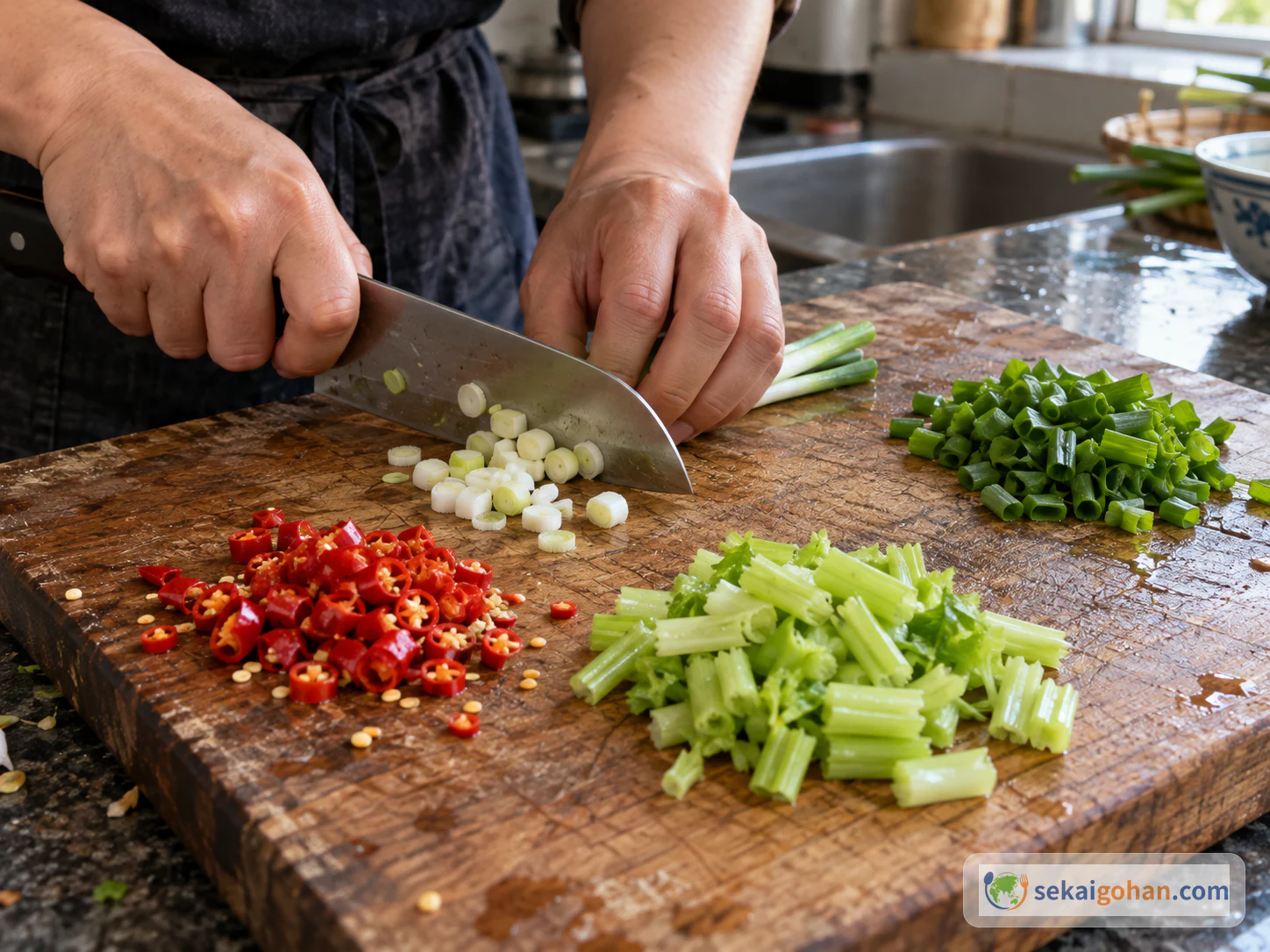
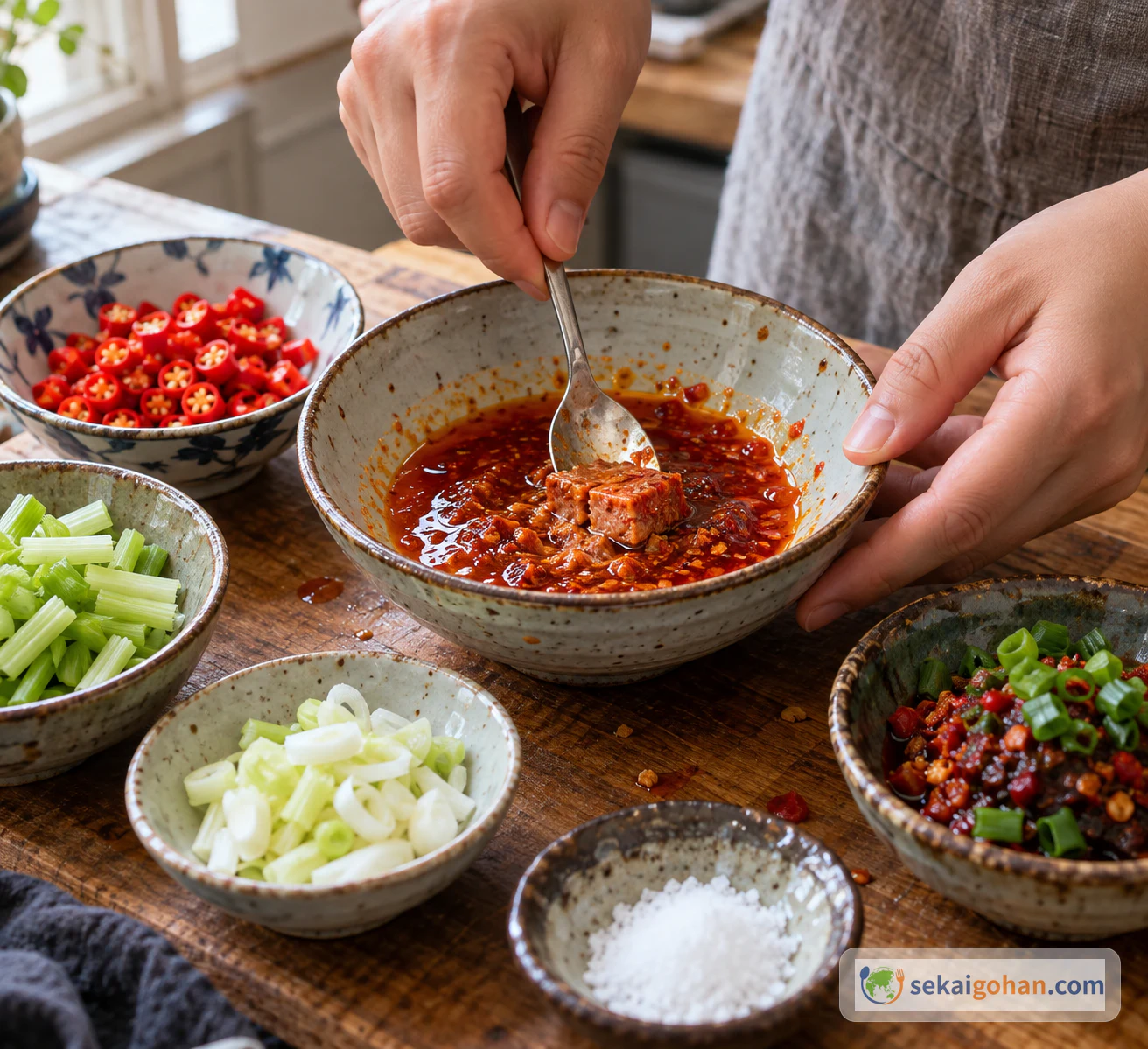
Keep the chili condiments apart. You need three: a spicy sauce (香辣酱), chili oil (辣椒油) and a chopped chili paste (剁椒酱). The spicy sauce and chili oil go into the sauce. The chopped chili paste stays out of the bowl and goes on top with the scallion greens once the tofu is in the sauce. The spoon measures in the recipe are read as written: 1大勺 is one large spoonful, 1勺 is one spoonful.
The one piece of chili-coated farmhouse fermented tofu (农家豆腐乳) belongs to the sauce, where it's mashed in to flavor it. Salt is to taste. Add it while you mix the sauce, or leave it out.
Do not ferment tofu at home or make your own brine for this dish. Puffing, floating and a firm surface are texture cues. They do not mean that frying makes an unknown or home-fermented product safe. Soy is in both the tofu blanks and the fermented tofu in the sauce, so people with a soy allergy should not eat this dish. Also check the labels of packaged chili sauces for other allergens.
Method: Rinse, Fry Twice, Sauce, Top
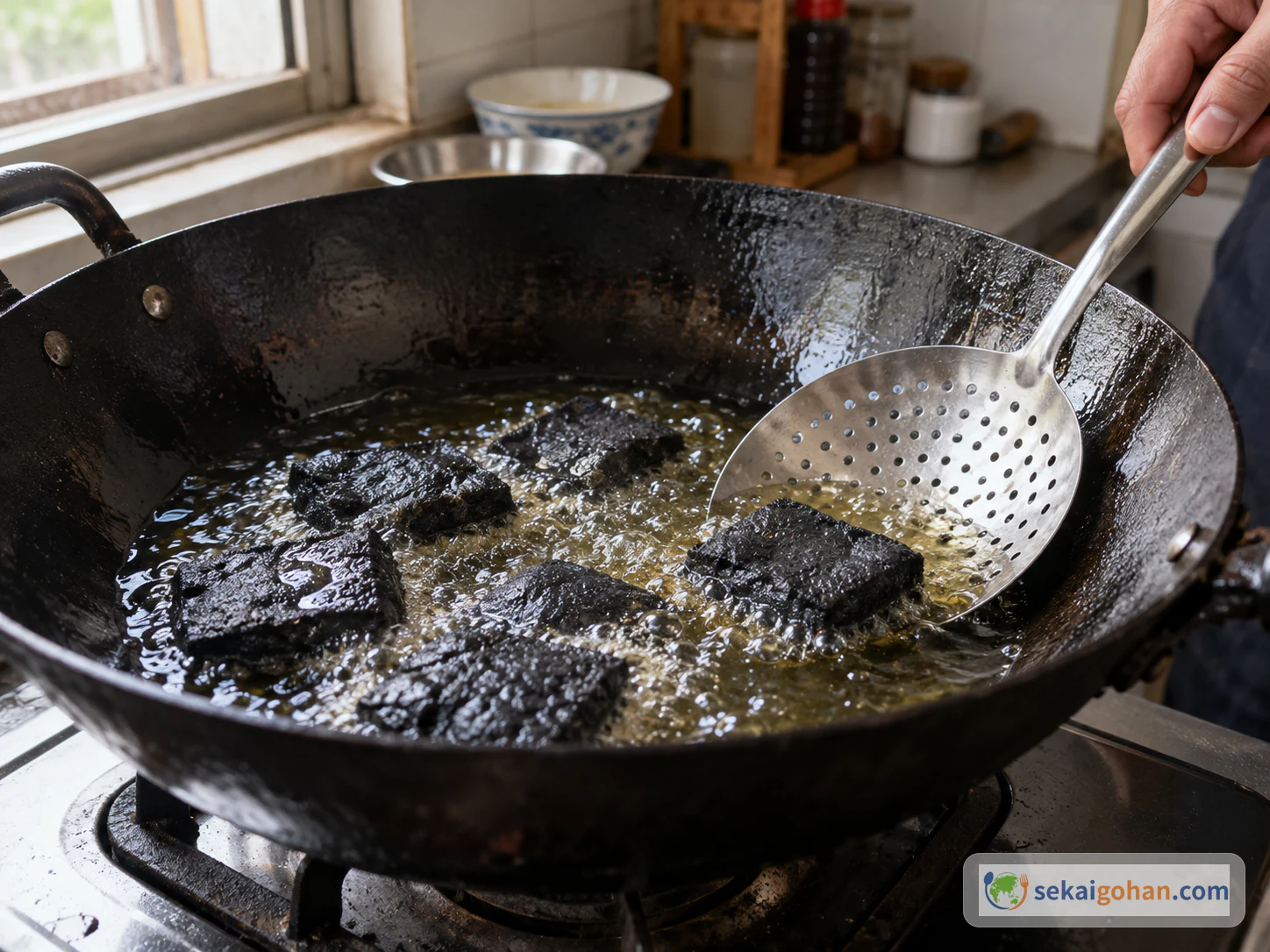
Oil heat is judged by how the tofu behaves, not by a number. In the first fry the pieces puff and float. In the second fry the surface feels firm when tapped with chopsticks.
Common Problems with Changsha Stinky Tofu
The two fries are what give the crisp crust over a tender inside: the first puffs the pieces, the second firms the surface. Use the cues below in place of an exact temperature. They tell you about texture, though, not about whether the tofu is safe.
| Condition | What to check | What to do |
|---|---|---|
| Blanks broke while rinsing | Were they squeezed or handled roughly? | Float and rinse gently, lift them out and let them drain on their own |
| Pieces don't puff or float in the first fry | Have they had long enough at the first-fry heat? | Keep frying over medium-low until they puff and float before lifting them out |
| Surface still soft after the second fry | Was the oil heat raised? | Return the tofu to the hotter oil and fry until a light chopstick tap finds the surface hard |
| Fermented tofu stays in lumps in the sauce | Was it mashed and loosened? | Mash it again and stir in a little more cooled boiled water |
| Sauce tastes too salty | Salt is optional | Next time add less salt or leave it out |
| Topping got mixed into the sauce | Chopped chili paste went in too early | Keep it aside and spoon it on only after the tofu is in the sauce |
Storage and Variations
Fry only as much as you'll eat right away, and store unopened blanks according to the package directions.
The sauce takes only small changes. A stalk of coriander or a little Wujiang preserved mustard (乌江榨菜) can go in if you like, and the salt can be adjusted or left out. Soy sauce, vinegar or broth would turn it into a different dish.
Frequently Asked Questions
Is Changsha stinky tofu always black?
The Changsha version is black, and the black blanks here follow that traditional look. Stinky tofu from other regions isn't always black.
Is the fermented tofu the main ingredient?
No. The main ingredient is the 20 Changsha stinky-tofu fresh blanks. The single piece of chili-coated farmhouse fermented tofu is mashed into the sauce until it disperses.
How hot is 六成热?
It's a traditional Chinese way of describing oil heat, literally "six-tenths hot," with no temperature in degrees. Go by the cues: in the first fry the pieces puff and float, and after the hotter second fry the surface feels firm when tapped.
Can I make the blanks at home?
Home fermentation and homemade brine aren't part of this dish. Buy a sealed product labeled with its producer, ingredients, storage directions and date, and follow that label.