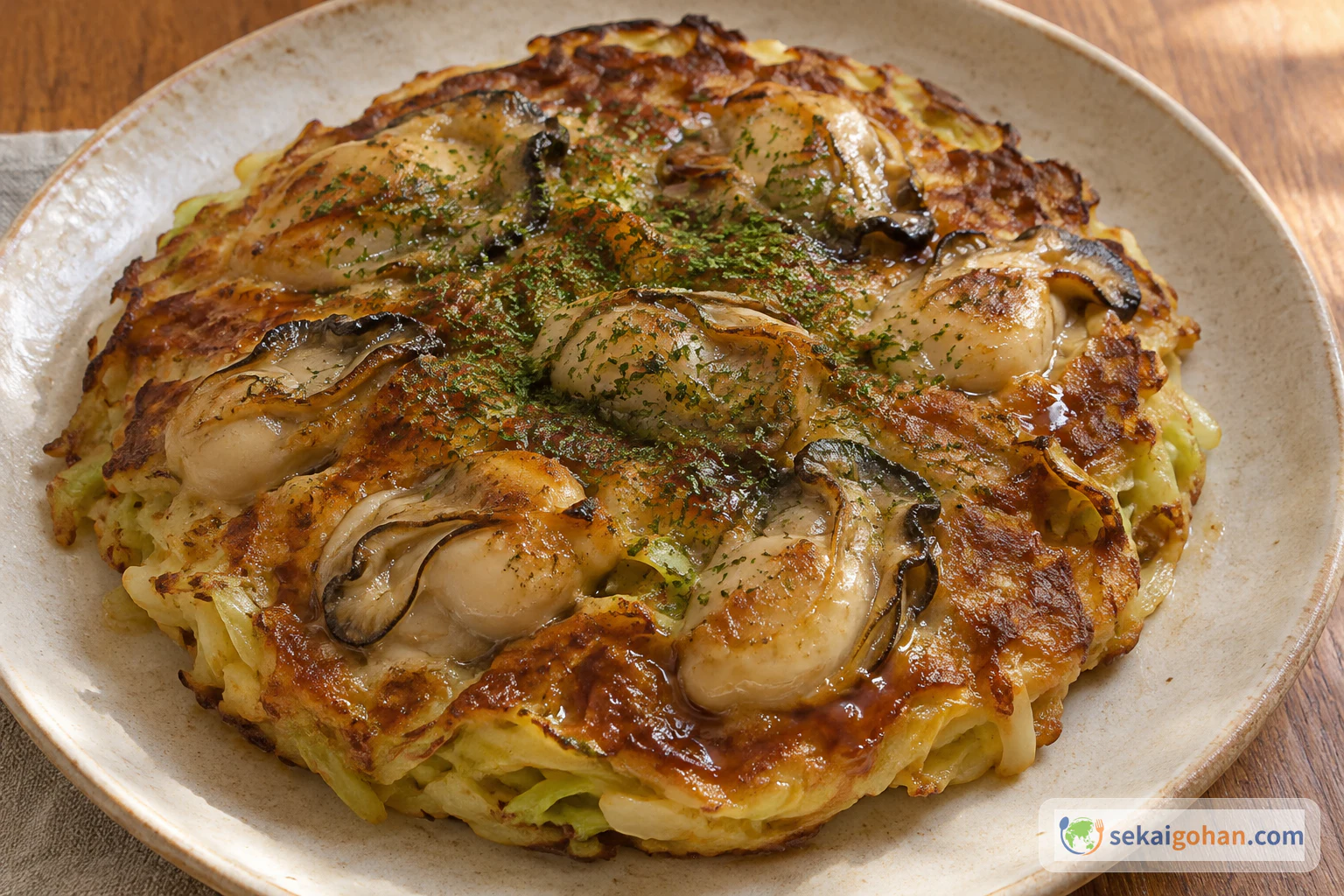
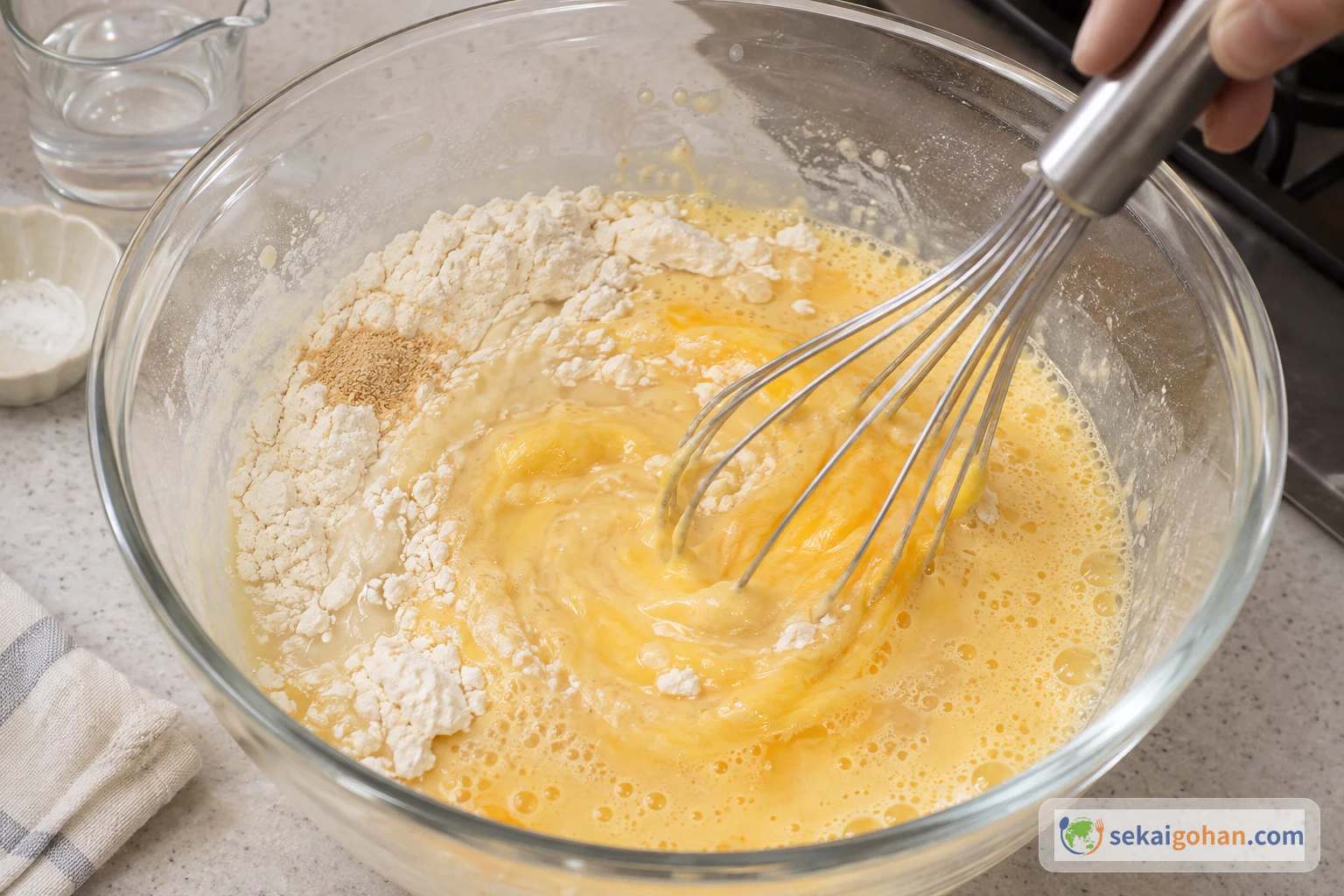
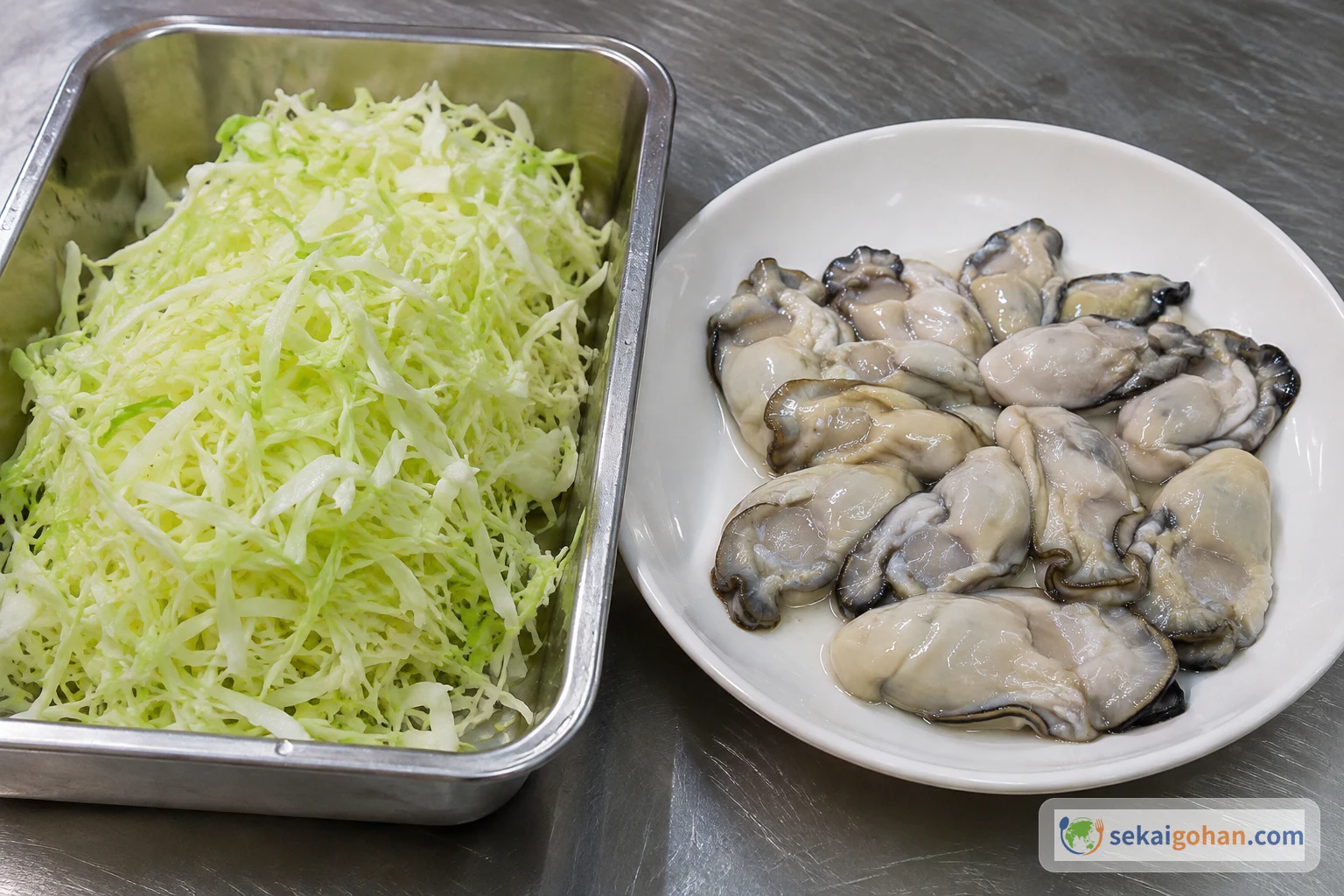
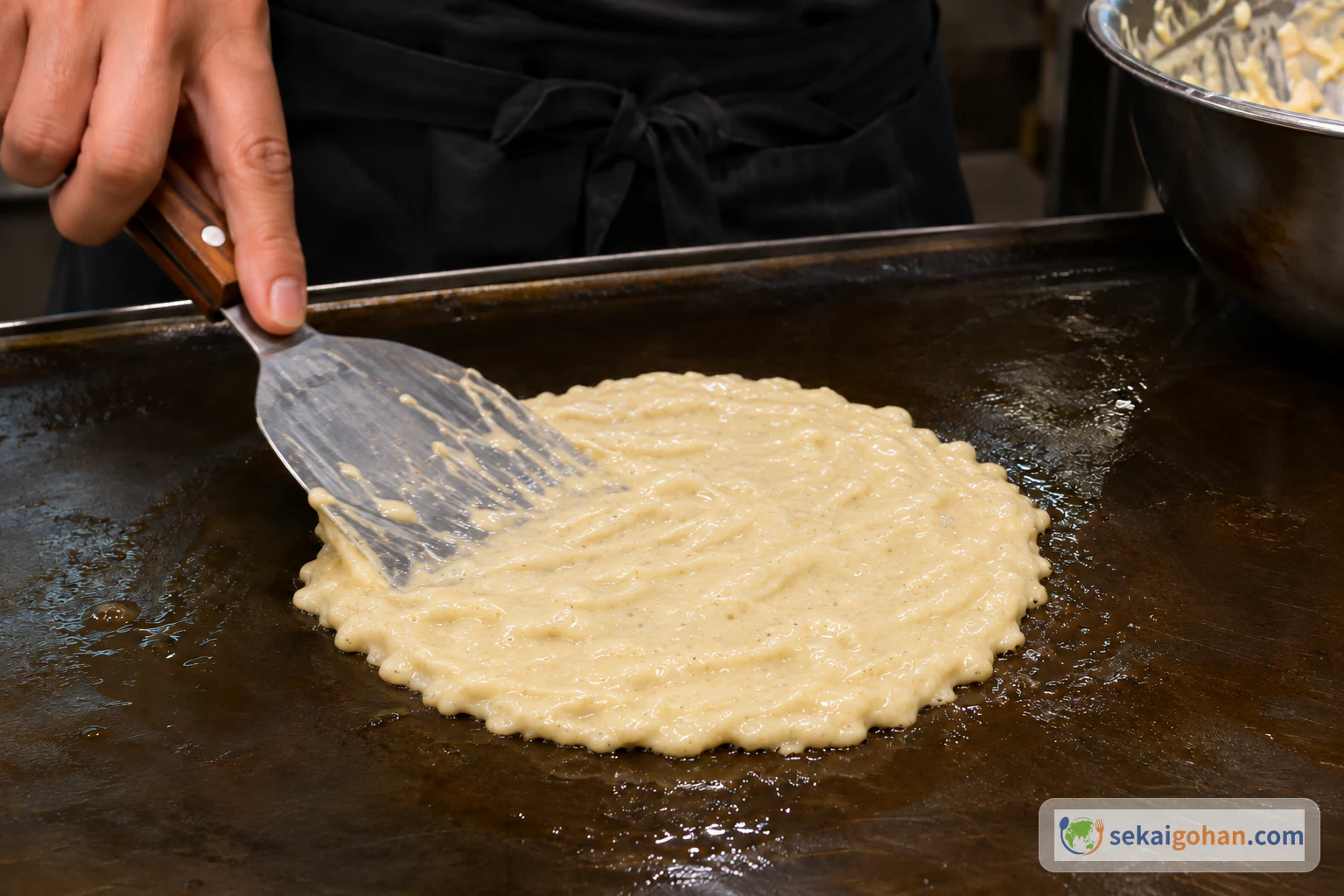
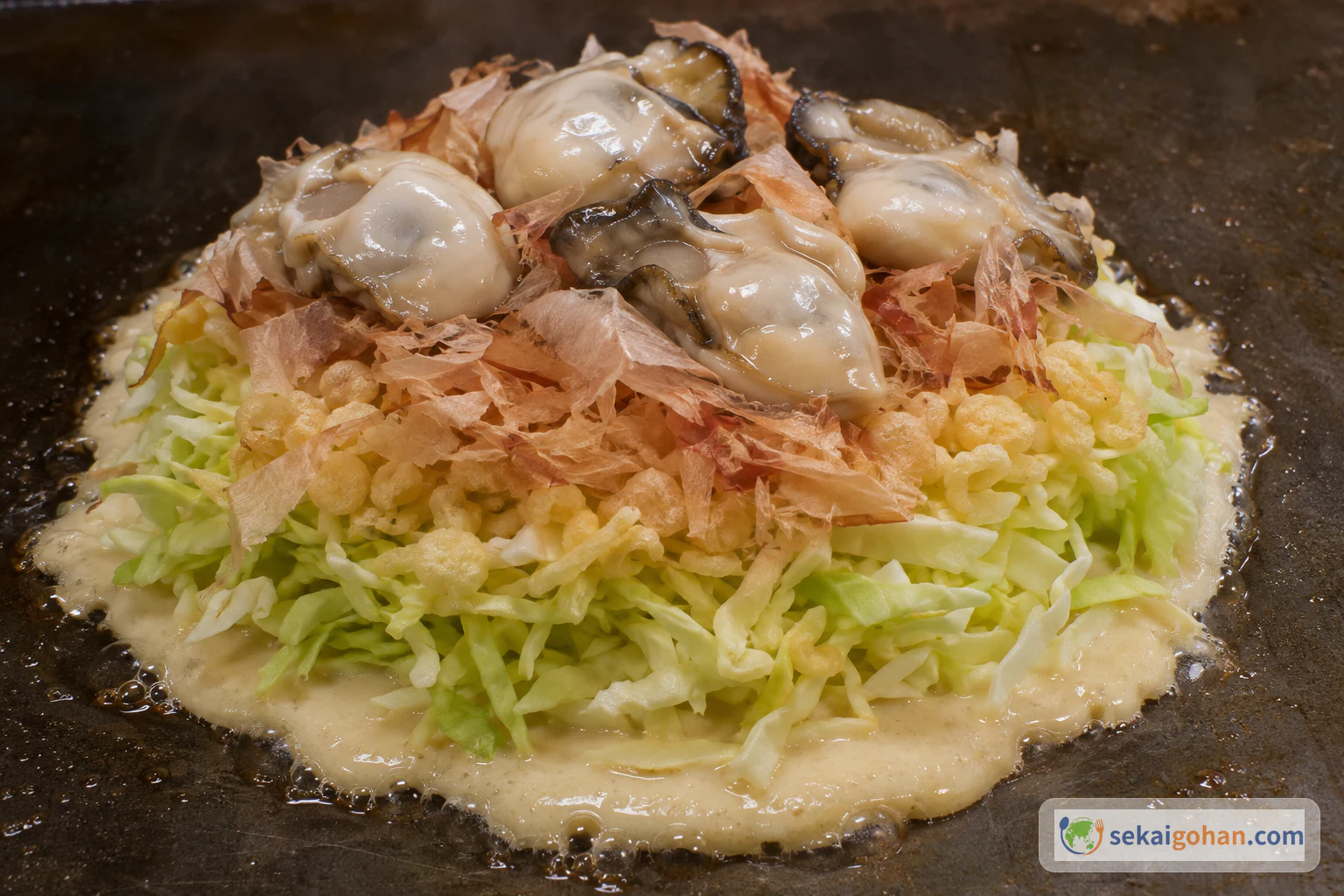
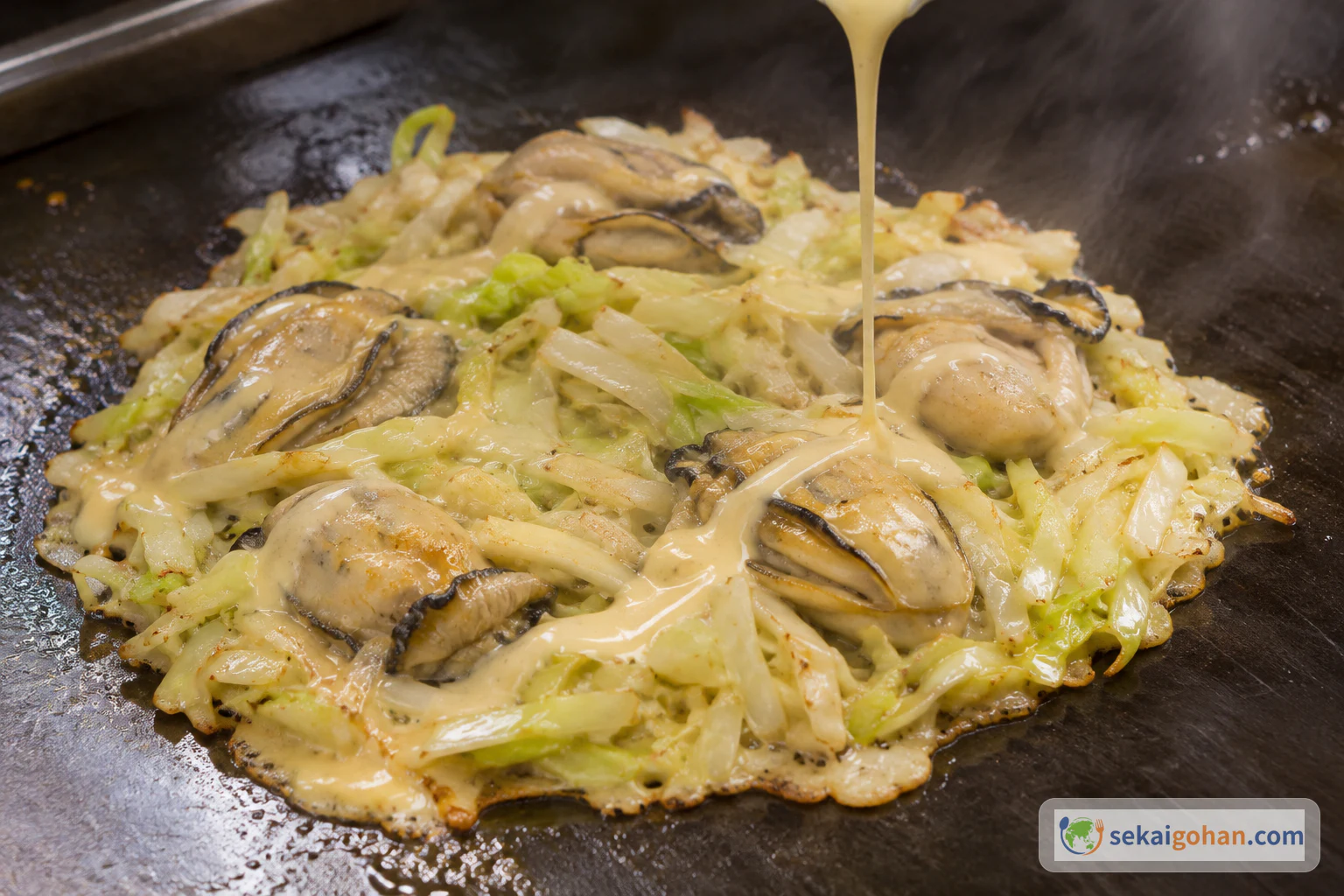
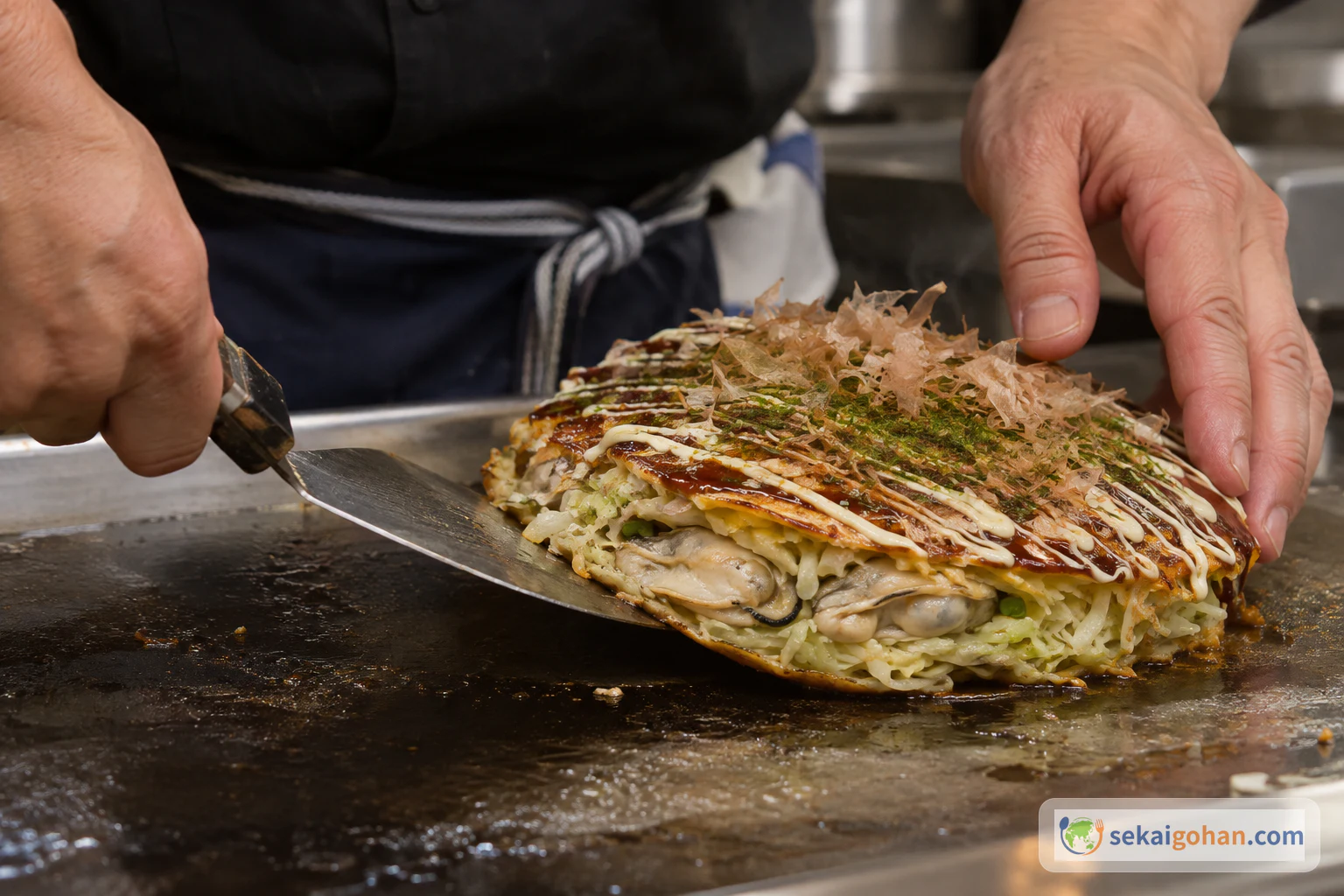
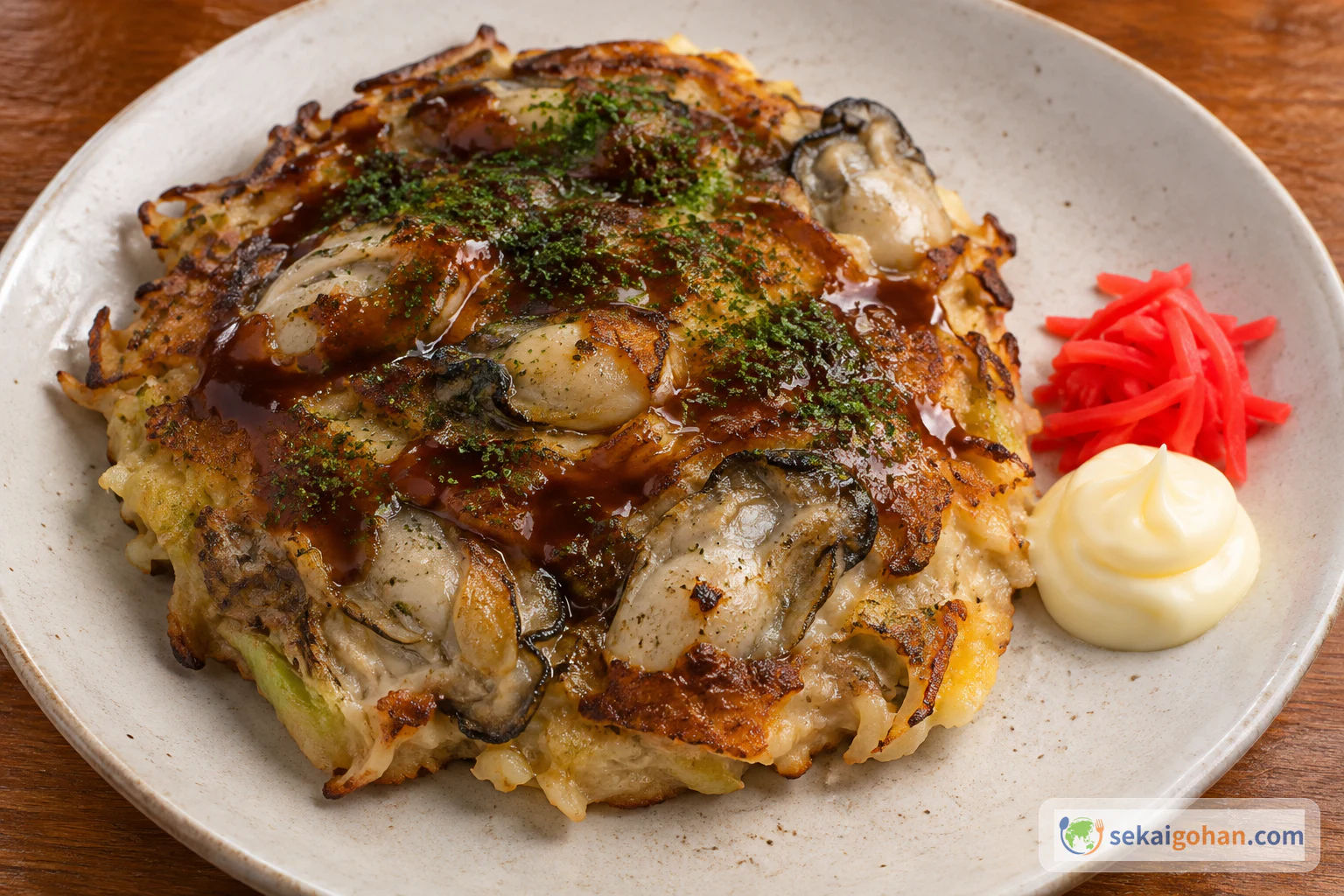
At Okonomiyaki Hori in Hinase, a loose batter with shredded cabbage mixed through it goes onto a hot griddle. Tenkasu and katsuobushi go on for flavor, then the oysters, and the whole thing steam-cooks slowly before it gets its sauce. This is kakioko, the oyster okonomiyaki of Hinase, a town in Bizen City, Okayama Prefecture. The name belongs to this one place, not to any savory pancake that happens to have oysters in it. In method it sits somewhere between Kansai-style mixed okonomiyaki and Hiroshima-style layered okonomiyaki.
Kakioko and the Oysters of Hinase
Kakioko has been handed down mainly in Hinase. By local tradition it dates from around the Showa 40s, the decade beginning in 1965, though that is a tradition rather than a precise founding date. A local group, the Hinase Kakioko Machizukuri no Kai (日生カキオコまちづくりの会), works to preserve and pass on the dish.
Freshly landed Hinase oysters are the star, joined by shredded cabbage and Okayama-made sauce. The batter is loose and topped with a generous heap of cabbage and oysters, then cooked on a griddle and handled with a griddle spatula called the kote or teko. A sauce made specially for Hinase kakioko is part of the local story, but at home ordinary okonomiyaki sauce works as an optional topping.
In this home version, the cabbage goes on as a separate filling between layers of batter instead of being mixed in, so the oysters stay at the center of things. You can find more dishes from the same country on our Japan page.
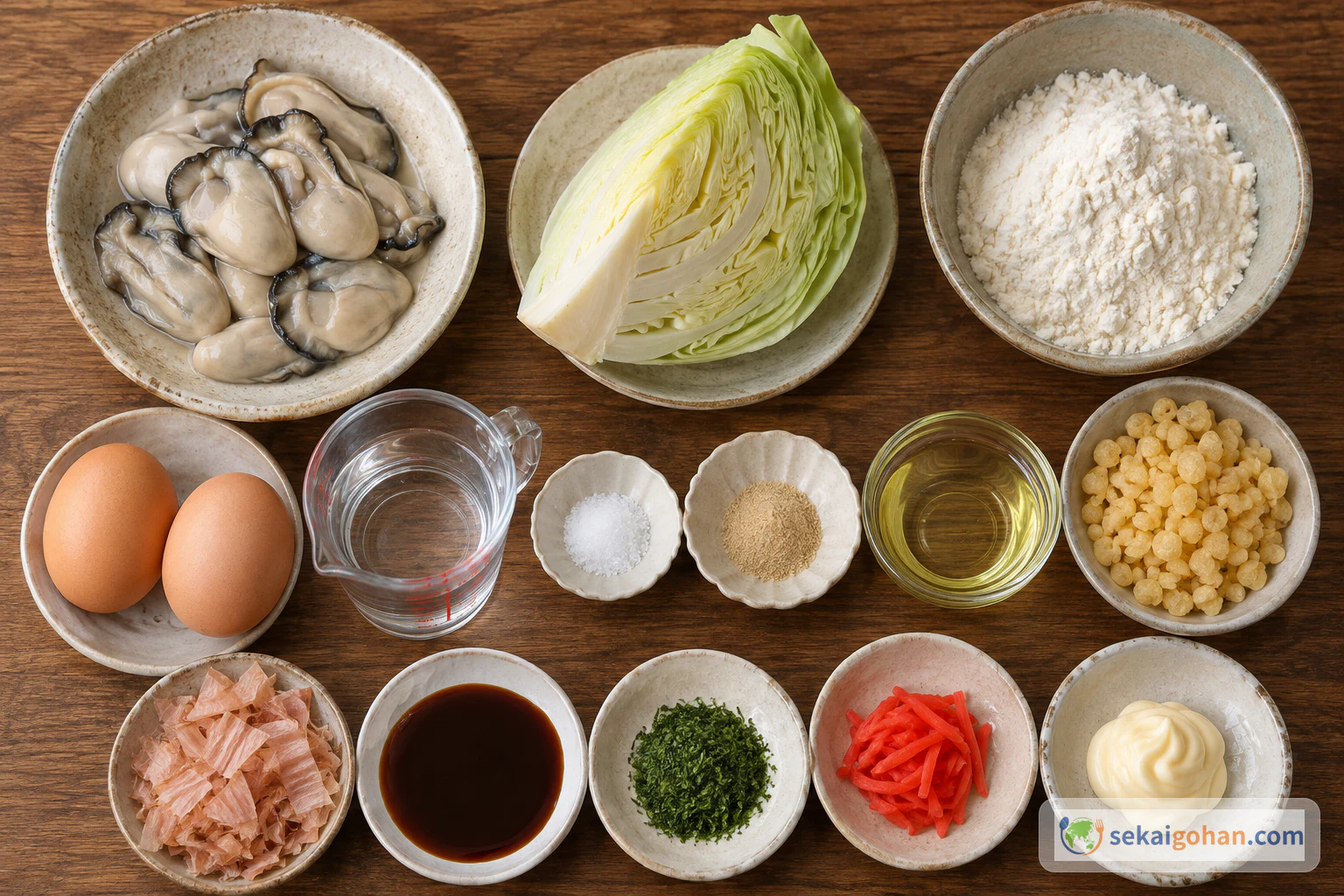
Ingredients for 2 Servings
Equipment
- Frying pan or griddle
- Broad spatula or turner
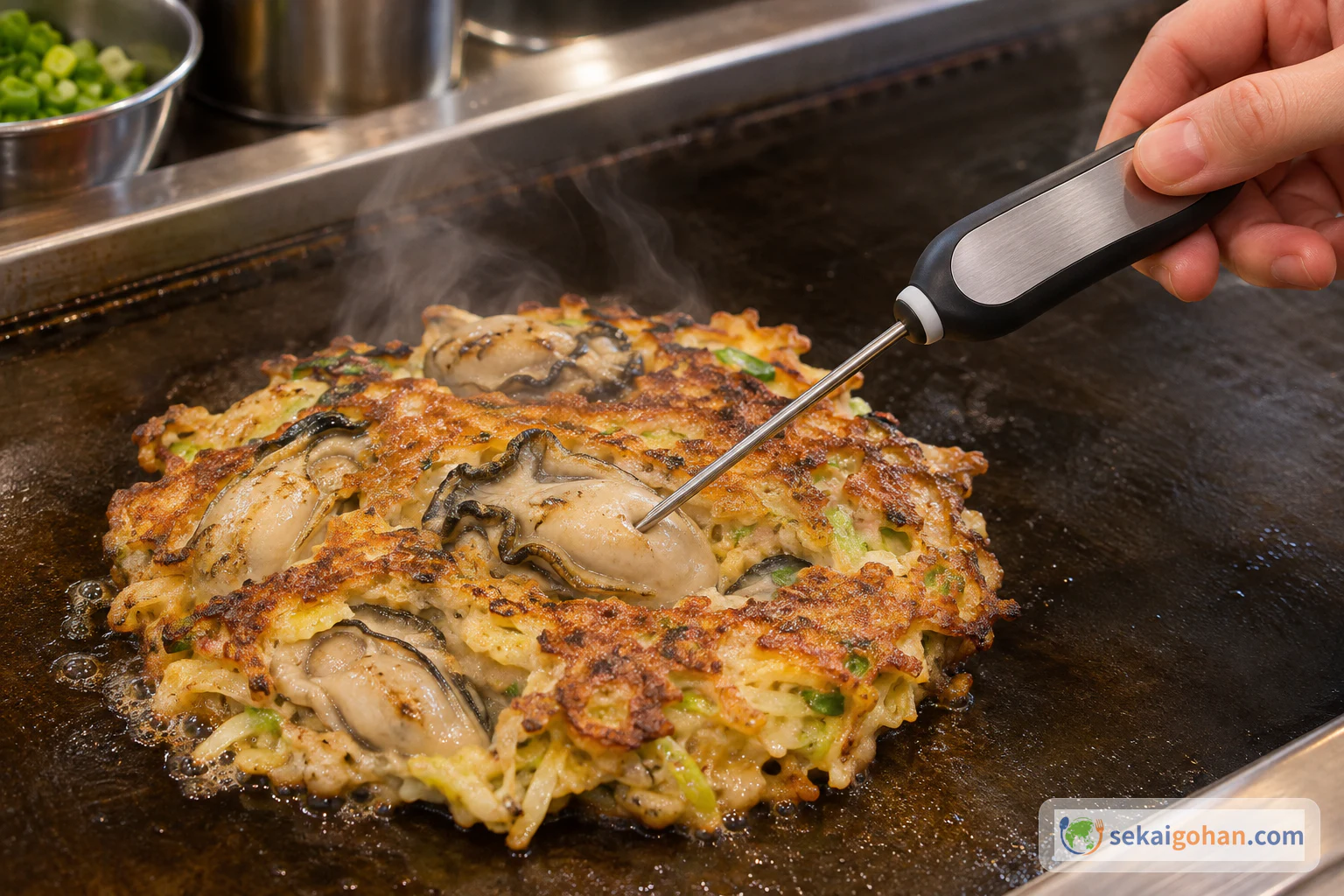
- Food thermometer
- Mixing bowl and whisk
- Knife and cutting board
- Strainer for draining the oysters
- Separate plates for raw oysters and for the finished pancake
Choosing Oysters, Cabbage and Toppings for Kakioko
- Oysters: Buy oysters labeled for cooking, and keep them refrigerated until you prepare them.
- Cabbage: How much a quarter head gives you depends on the size of the cabbage.
- Toppings: Choose the ones you like; sauce, aonori, beni shoga and mayonnaise are all optional, with no set amounts.
- Allergens: This dish contains oysters, egg, wheat and fish. Check the labels on the tenkasu, dashi, sauce and mayonnaise as well.
Method: Batter, Filling, More Batter, Both Sides
There is no fixed cooking time here because the heat of your pan and the thickness of your oysters decide how long it takes. Have the thermometer ready before you start cooking.
Cooking the Oysters Through and Fixing Common Problems
Bivalves such as oysters can carry norovirus, so heat them until the center reaches 185–194°F (85–90°C) for 90 seconds or longer. A brown crust, the pan temperature, a recipe's cooking time or a raw-eating label cannot stand in for this.
A well-browned crust tells you the pancake is cooking, but it tells you nothing about the oysters inside. Measure the center of the thickest oyster with a food thermometer, because the time it takes changes with your heat and the size of the oysters.
Keep raw oysters away from everything else. Use dedicated tools, such as a cutting board and knife, for bivalves, or wash and disinfect them after each use; hot water at 185°F (85°C) or above for 1 minute or longer disinfects utensils. Rinse raw vegetables well under running water, and wash your hands, tools and plates after they touch raw oysters and before they touch cooked food or toppings.
| Problem | What to do |
|---|---|
| The crust is brown, but the oyster center is below 185°F (85°C) | Keep cooking and measure again |
| The oysters vary in size | Measure the thickest one |
| You have no thermometer | Get one before making this recipe; a timer cannot replace the temperature check |
| The filling looks loose before turning | Pour a little more of the remaining batter over the gaps, then turn with a broad spatula |
| The oysters are dripping when you lay them on | Drain them again and remove the excess water |
| A plate or spatula touched raw oysters and you need it for the finished pancake | Wash it first, or use a clean one |
Kakioko Variations
| What changes | Options | What stays the same |
|---|---|---|
| Cooking surface | Frying pan or griddle | Check the center of the thickest oyster |
| Toppings | Sauce, aonori, beni shoga, mayonnaise or similar, in any combination | The pancake underneath is unchanged, and toppings do nothing for safety |
| Cabbage placement | Mixing it into the batter, like the Okonomiyaki Hori method | The same oyster heating advice applies; the amounts here were written for layered cabbage, so treat it as a separate dish |
Frequently Asked Questions
Why isn't the cabbage mixed into the batter?
In this version the cabbage goes on as a filling after the batter is spread. Okonomiyaki Hori mixes shredded cabbage into its batter, and neither method is the standard for all of Hinase.
How long should I cook it?
Cook both sides until browned, then check the center of the thickest oyster with a thermometer. Keep heating until it reaches 185–194°F (85–90°C), then hold it there for 90 seconds or longer.
Can I use oysters labeled for raw eating?
Yes, but cook them exactly the same way. A raw-eating label or a fresh look does not replace thorough heating, so take them to the same center temperature and time.