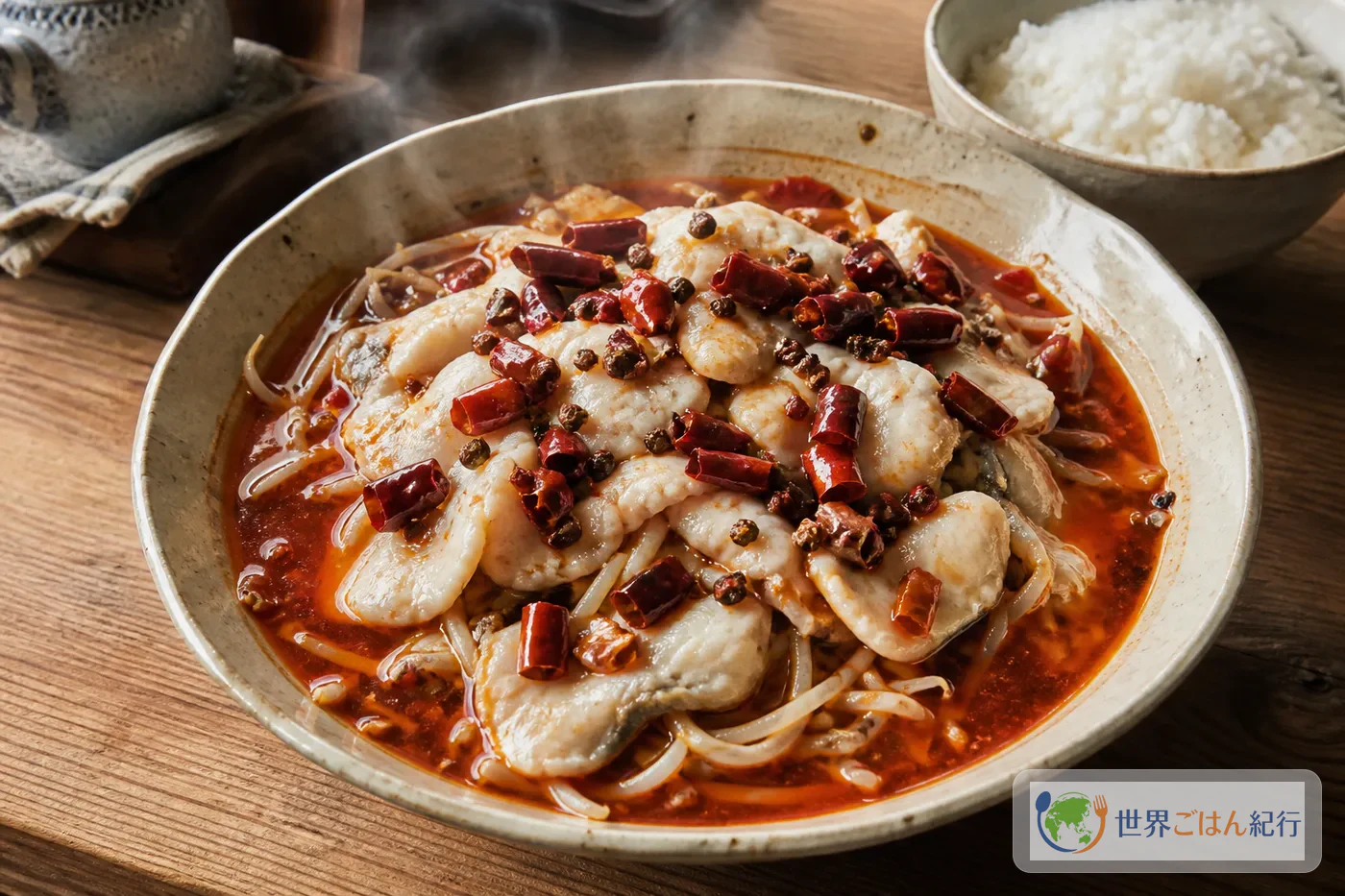
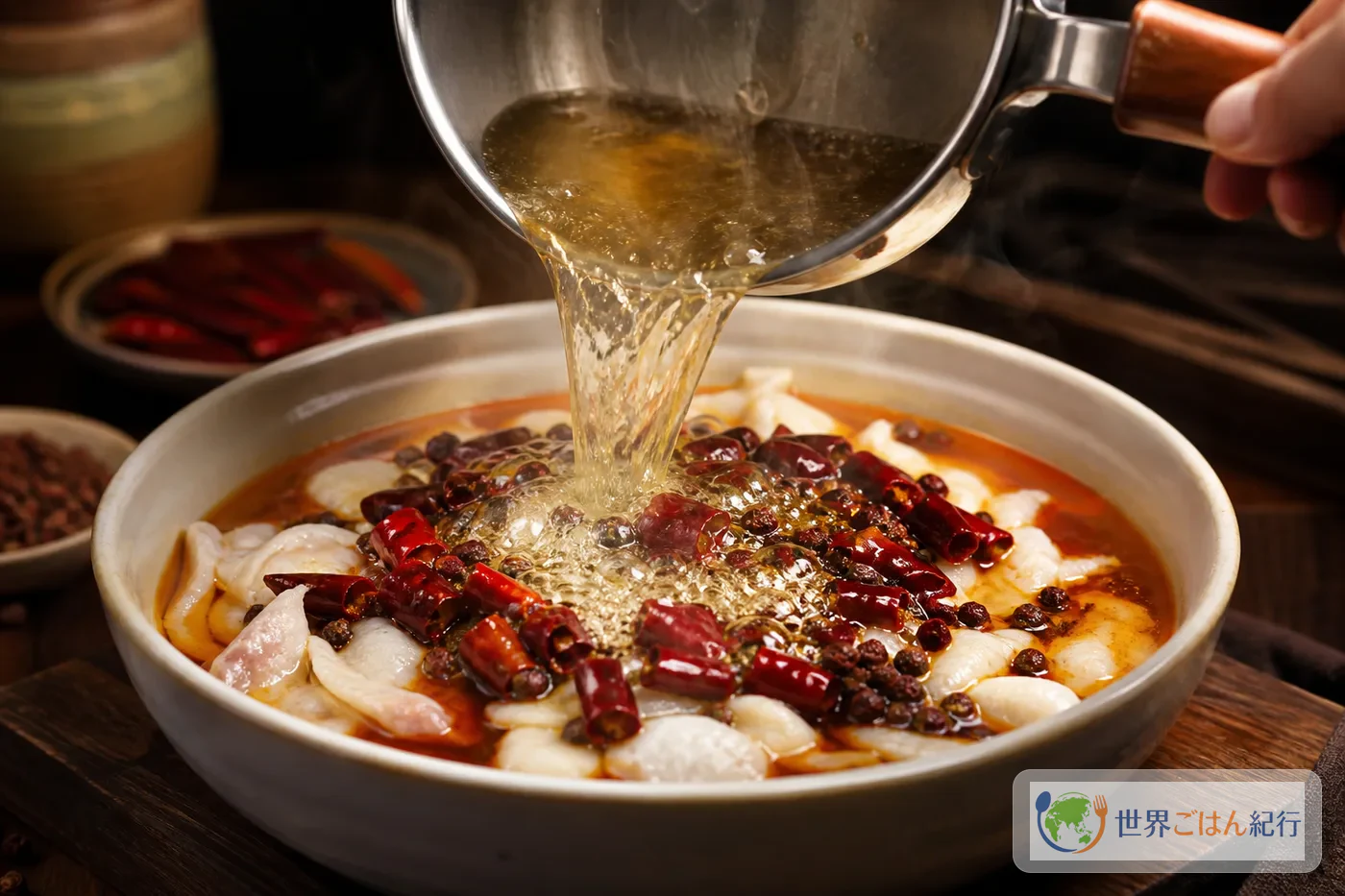
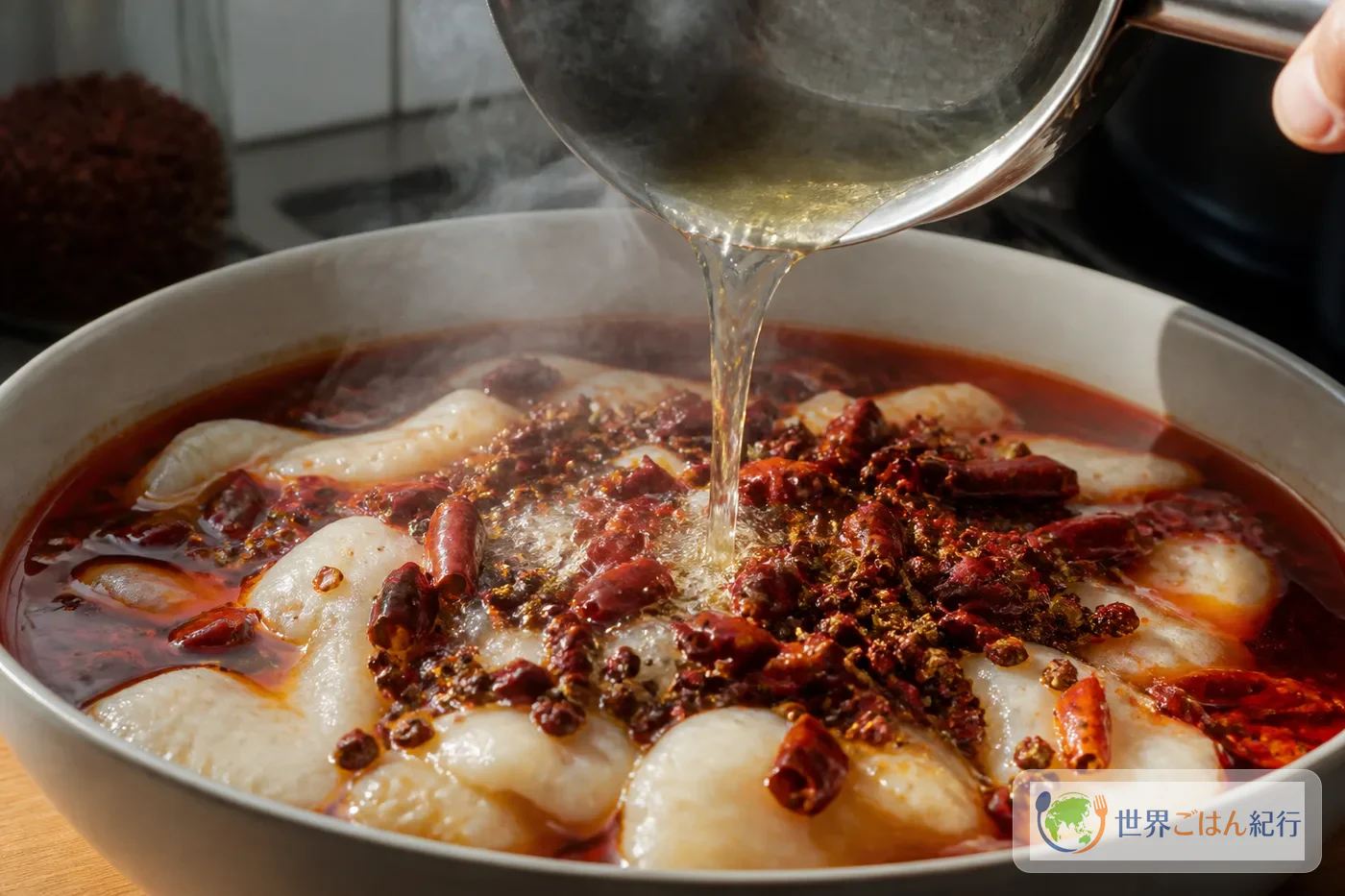
Scatter dried chiles and Sichuan peppercorns over a bowl of just-cooked fish, then pour a thin stream of oil from a separate small pan over the top. The tips of the chiles quiver and the peppercorns' aroma rushes up. The fish has cooked only briefly, yet the whole dish is wrapped in fragrance, and the white flesh carries a thin coat of red broth. This is shuizhu yu (水煮鱼, "water-boiled fish"), and the name suggests something milder than it is. In Sichuan cooking, "shuizhu" means cooking ingredients in a spicy broth and finishing them with hot oil poured over spices: the broth keeps the fish tender, and the oil opens up the aroma.
Shuizhu yu in Sichuan cooking
The broth and the finishing oil
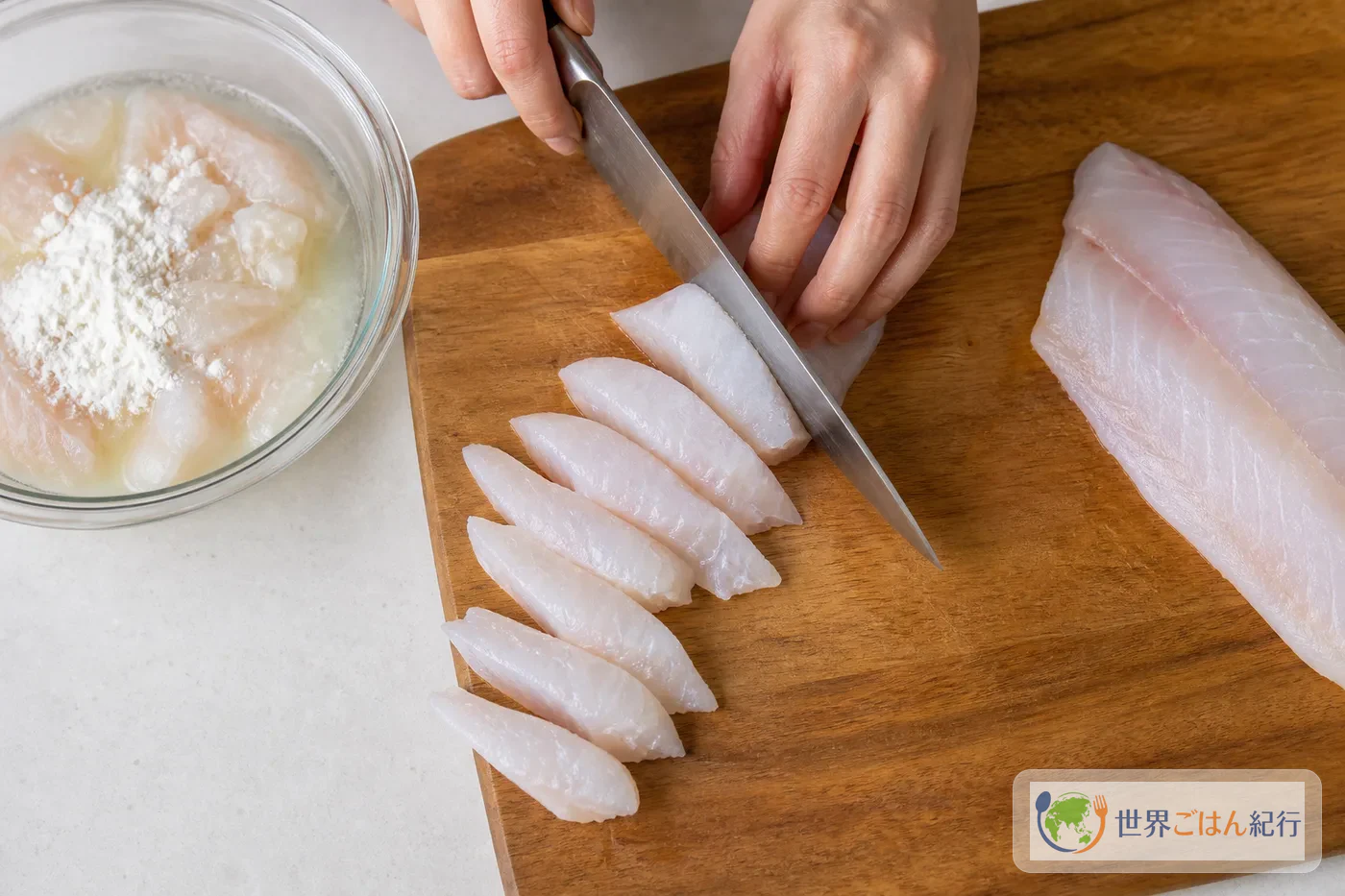
Shuizhu yu is served in big bowls at Sichuan restaurants, usually made with a whole fish: catfish, carp, or a freshwater fish similar to sea bass. This recipe uses 1.25 lb (600 g) of white fish fillets, so there's no whole fish to fillet. The essentials stay the same, though. Slice the fish on the diagonal to increase its surface area, and cook it in a short time.
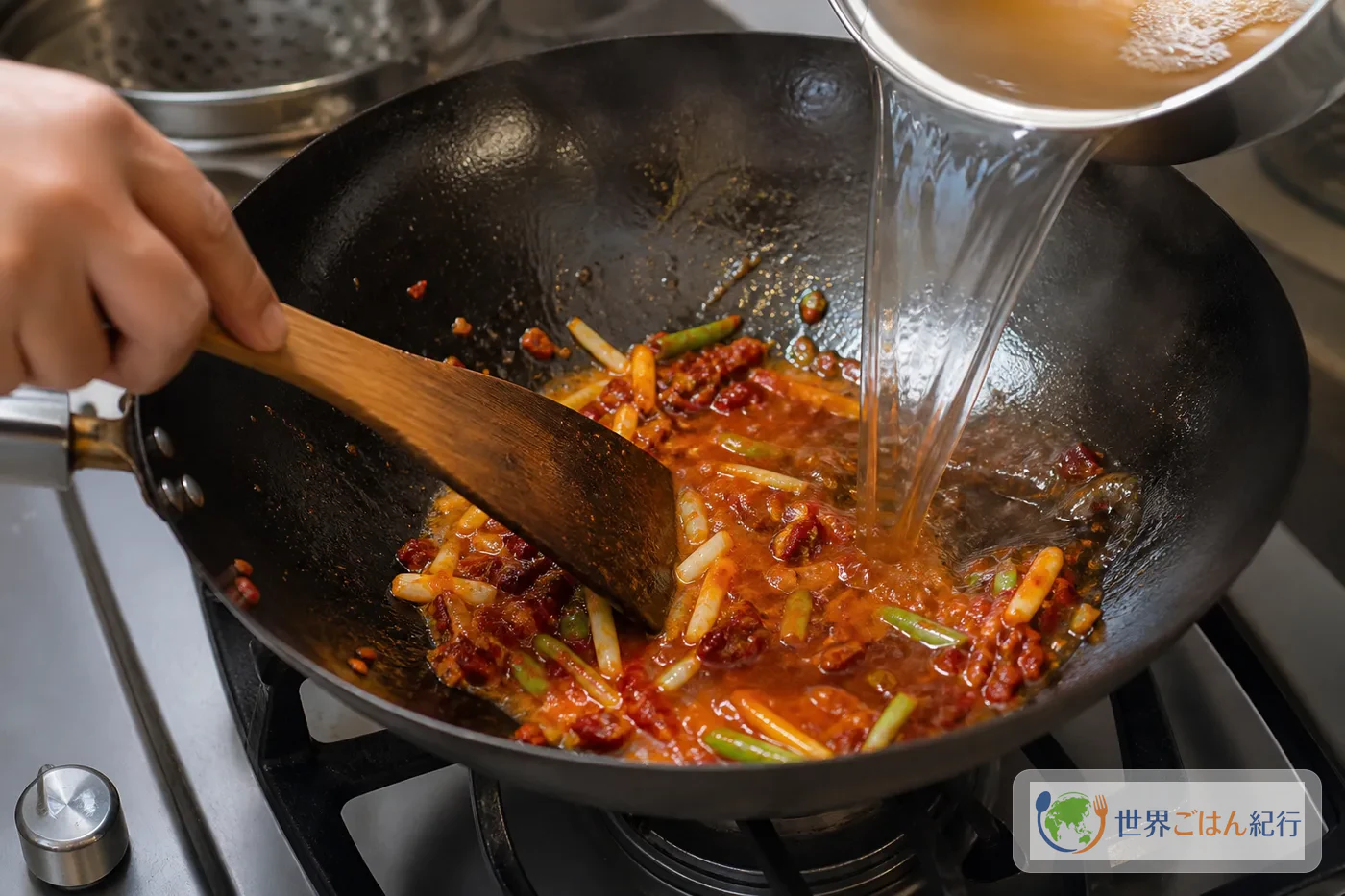
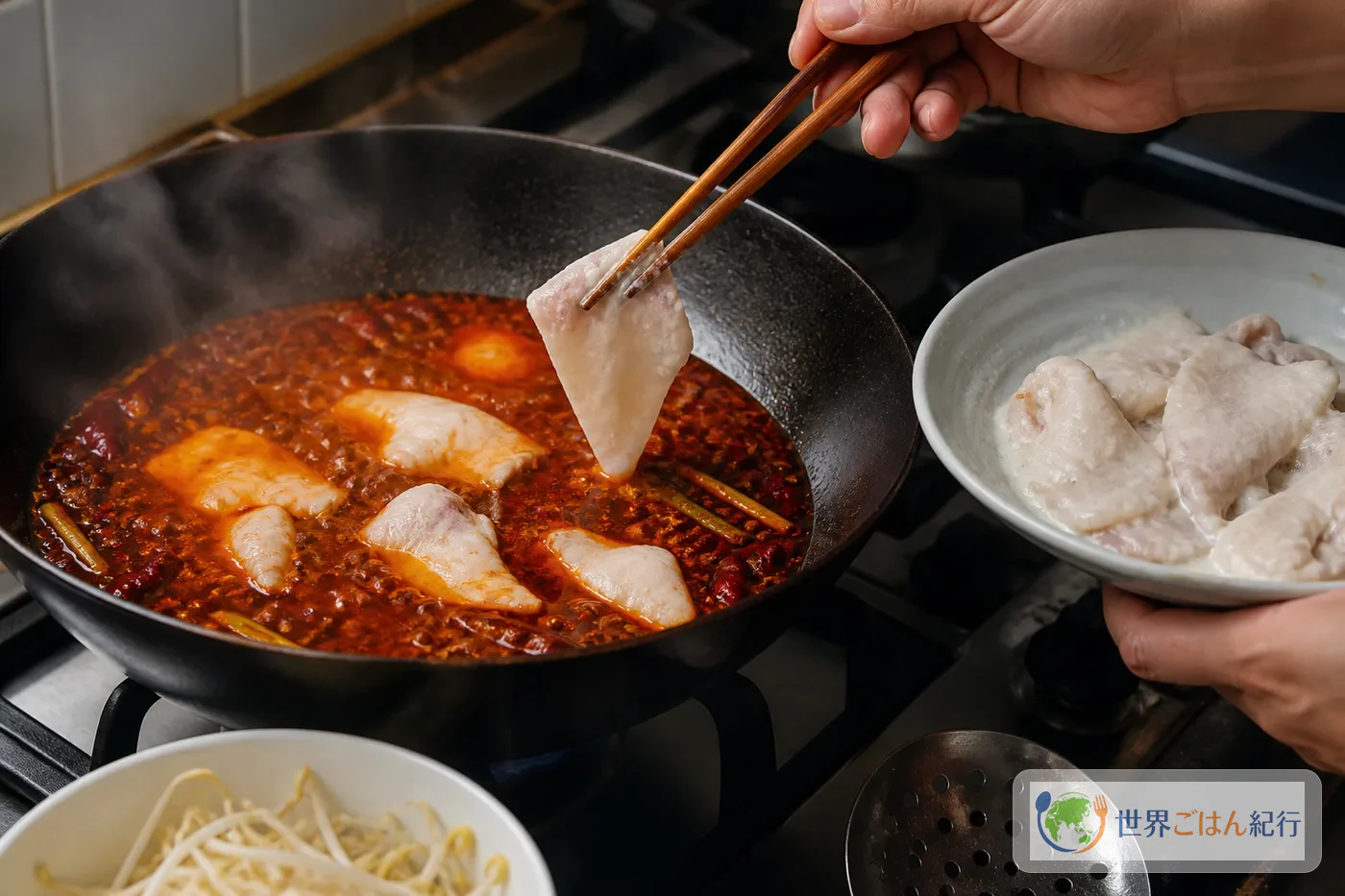
The broth is anything but weak. Doubanjiang, ginger, garlic, scallion and chiles are fried in oil, stock is poured in, and the fish is slipped piece by piece into the red liquid. An egg white and potato starch coating protects the surface and holds a little broth, so the fish keeps its moisture even when the hot liquid hits it. Aim for a spicy soup that cradles the fish, not a thick, oily sauce.
At home, two things matter most: don't drop the fish into the pot in a lump, and stop the oil before the Sichuan peppercorns burn.
Mala heat
Sichuan heat is called mala (麻辣), layering the burn of chiles with the tingling numbness of Sichuan peppercorns. Dried chiles give a heat the tongue recognizes easily, while Sichuan peppercorns leave a fine electric sensation on the tip of the tongue and a citrus-like aroma. Push just one of them and the dish turns either only hot or only fragrant, so even when you cut back on chiles, keep a little Sichuan peppercorn.
How it's eaten
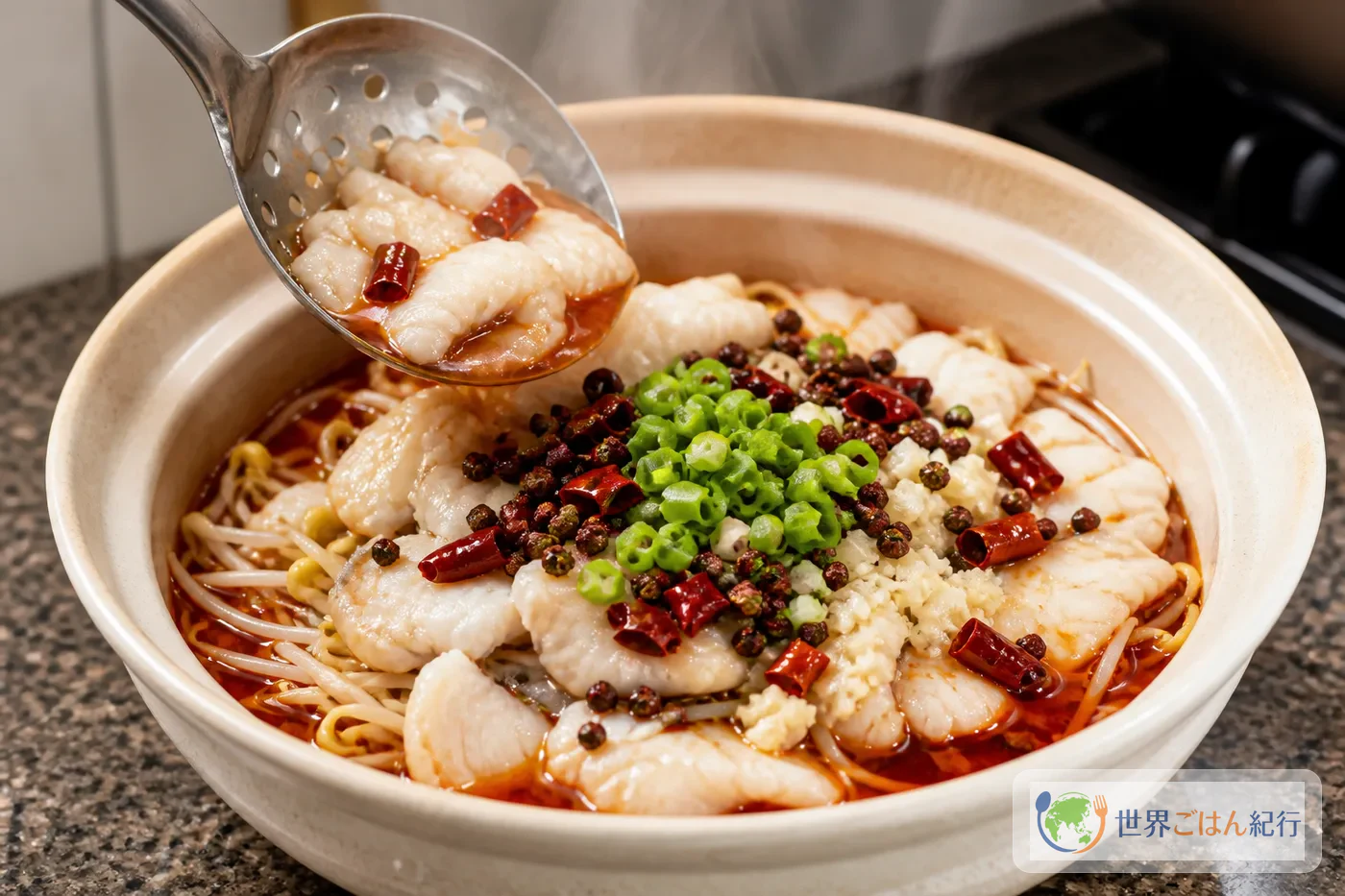
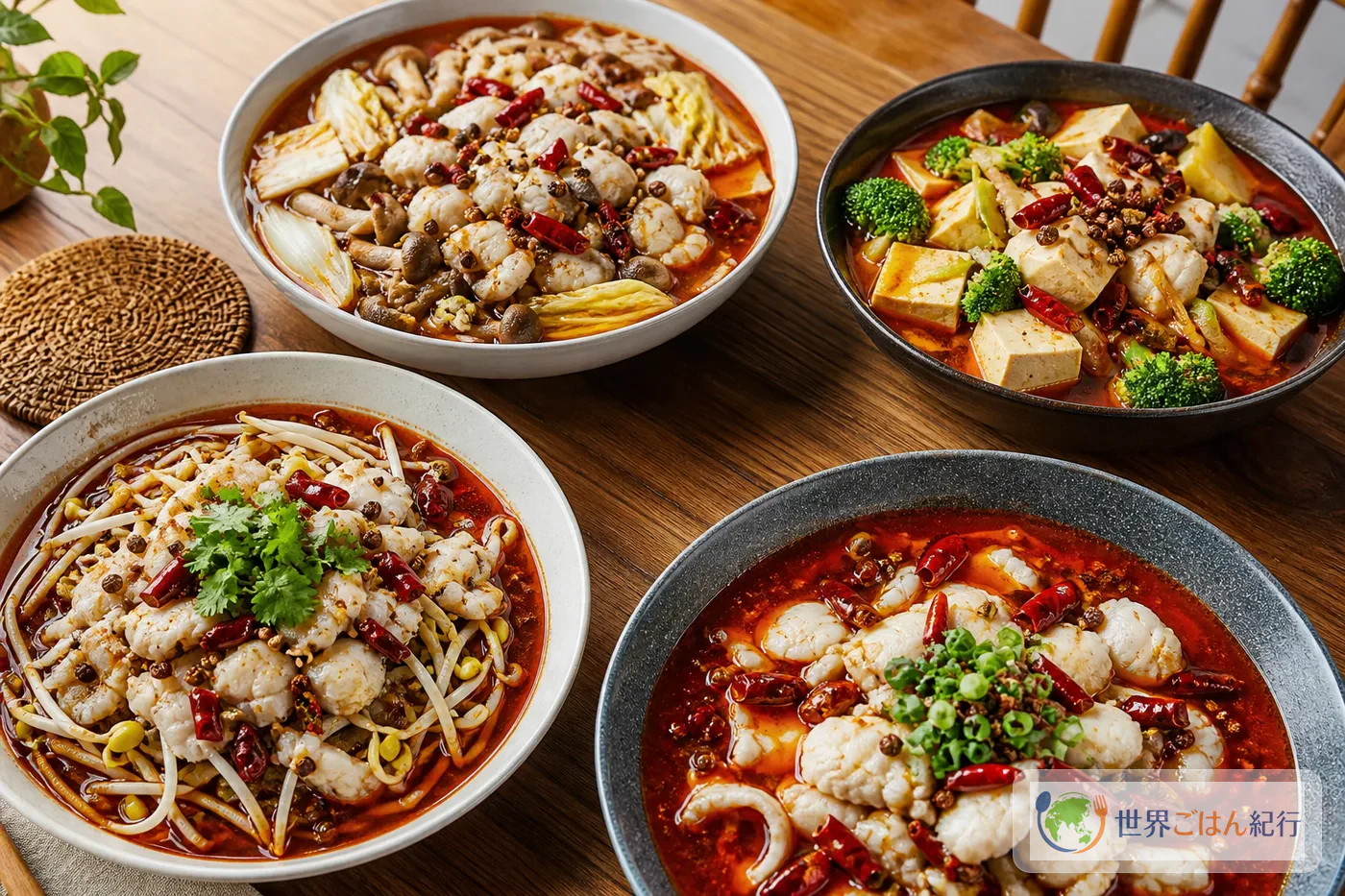
In Sichuan restaurants, soybean sprouts, celery, napa cabbage and mushrooms go under the fish and broth, and diners pick up vegetables along with the fish. The bowl sits in the middle of the table to share, and everyone helps themselves from it, skipping the chiles or scooping more broth as they like. White rice alongside soaks up the salt and oil of the red broth.
The cooking term shuizhu is used for beef and pork as well as fish, and it has spread through restaurants and homes around Sichuan and Chongqing, with ingredients that change from place to place. For the beef version, see shuizhu niurou (water-boiled beef). Fish cooks quickly, while beef, even sliced thin, handles the coating and broth differently, so you watch the pot in a different way.
Chengdu and Chongqing styles
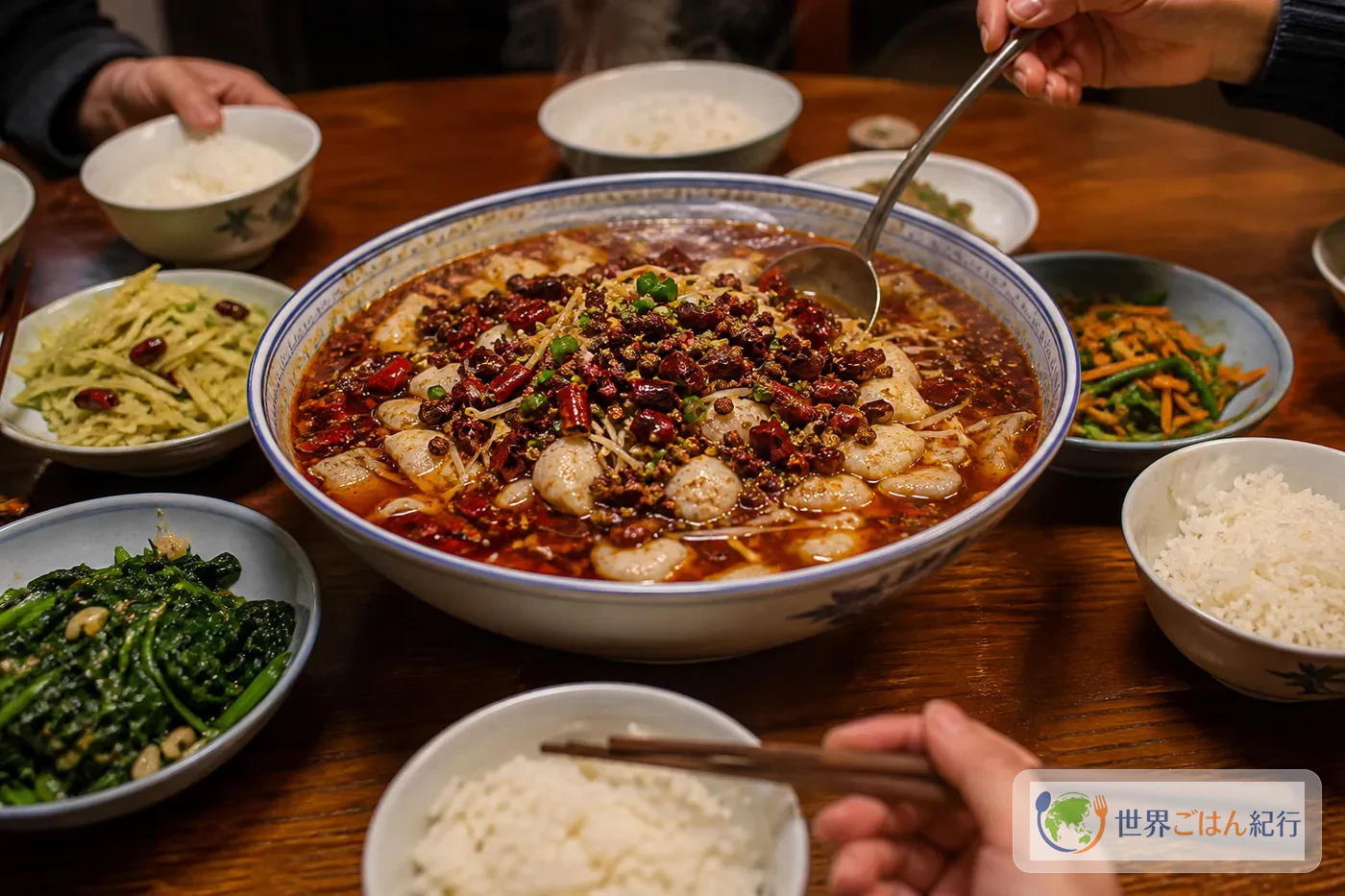
Sichuan cuisine covers Chongqing as well as Sichuan Province. It is divided into the Shanghebang style centered on Chengdu and Leshan, the Xiaohebang style linked to Zigong and Yibin in southern Sichuan, and the Xiahebang style that includes Chongqing and Wanzhou. Even under the same dish name, Chengdu and Chongqing differ in the aroma of the oil, the strength of the chiles and even how the vegetables are arranged. The Chengdu-Leshan style is relatively mild while layering spices; the Xiahebang style is known for big bowls and strong flavors.
To lean toward Chengdu, put the savory depth of doubanjiang at the center of the broth, and use Sichuan peppercorns and dried chiles as layers of aroma. To lean toward the big-platter dishes of Chongqing and Wanzhou, use a bit more finishing oil and push the dried chiles forward. On a home stove, more oil means more spattering, so this recipe sticks to ¼ cup (80 ml) of finishing oil. The goal is aroma with each spoonful of fish, not the look of a red sea.
Ingredients (serves 4)
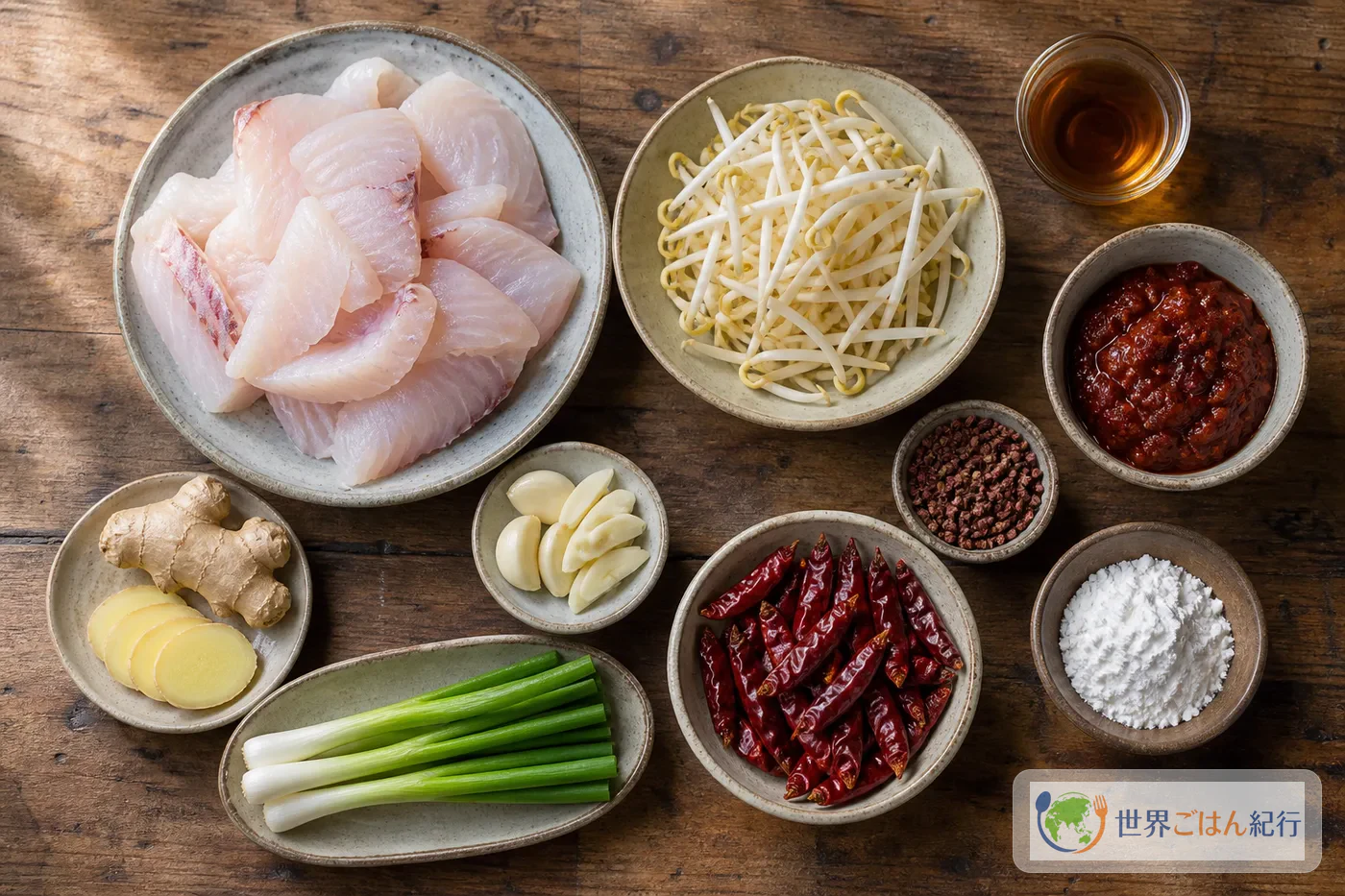
Before cutting the fish, set out all the seasonings and the serving bowl. If you're hunting for the Sichuan peppercorns after turning on the heat, the broth boils too hard and the fish's coating comes off. Warm the deep heatproof bowl with boiling water for 1 minute and wipe it dry so the dish doesn't cool down after plating.
Doubanjiang, chicken stock and soy sauce each bring their own salt. The only salt listed in the ingredients is the 4 g for the marinade, so add salt to the broth only after tasting. Before the fish goes in, the broth should be slightly stronger than a soup you'd drink.
Choosing fish, doubanjiang and Sichuan peppercorns
Fish
In order of availability, basa, sea bass, red sea bream and cod fillets all work. Basa is easy to cut to an even thickness and holds its coating well, but its flavor is mild, so make the broth a little stronger. Sea bass and sea bream have firm flesh that stays intact even when sliced thin. Cod releases water and splits easily, so salt it, let it sit 10 minutes and pat the surface dry before using. Salmon's strong fat and aroma pull away from the idea of a Sichuan white fish; save it for later experiments, if at all.
Doubanjiang
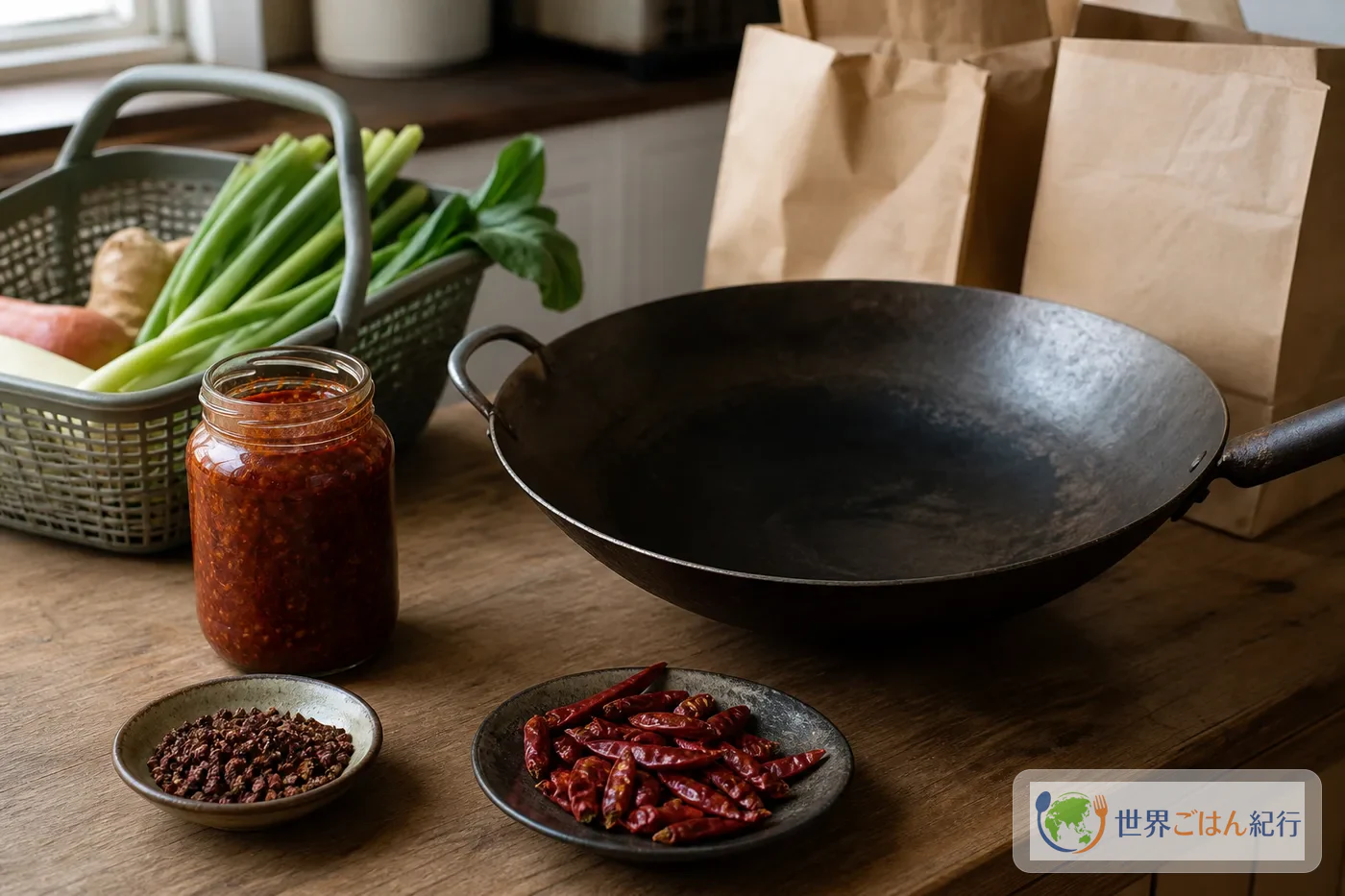
The product name alone won't tell you the heat, whether the peppercorns are whole, or how strong the fermented aroma is. For a first try, use the doubanjiang you can get nearby. The second time, if you want to taste the difference, look for Pixian doubanjiang at Chinese or Asian grocers, checking that it's labeled as a fermented broad-bean paste. It's worth buying for the red oil and fermented-bean aroma it releases when fried, more than for heat.
If you skip Pixian, use 1.5 oz (45 g) of the doubanjiang you have and add a few more drops of black vinegar at the end. Korean gochujang, or a mix of miso and chile, can stand in, but the saltiness and savory depth of fermented broad beans won't be the same. Gochujang alone is too sweet, and even 2 tsp miso with some ground chile is only an approximation.
Sichuan peppercorns and wine
Whole Sichuan peppercorns release their aroma when they hit the oil, creating a tingle that ground pepper can't; black pepper or Japanese sansho change the quality of the numbness. Buy a bag labeled Sichuan peppercorns, whole, rather than leaves or peppercorn salt. If you dislike strong numbness, coarsely crush only half the peppercorns and keep the rest whole for finishing, which keeps the aroma while reducing how much you bite into. To lower the heat, reduce the chiles and don't remove the Sichuan peppercorns entirely; that keeps the backbone of the dish.
In place of Shaoxing wine, reach for a plain cooking wine without added sweetness rather than sake. It keeps the broth more coherent.
Pans
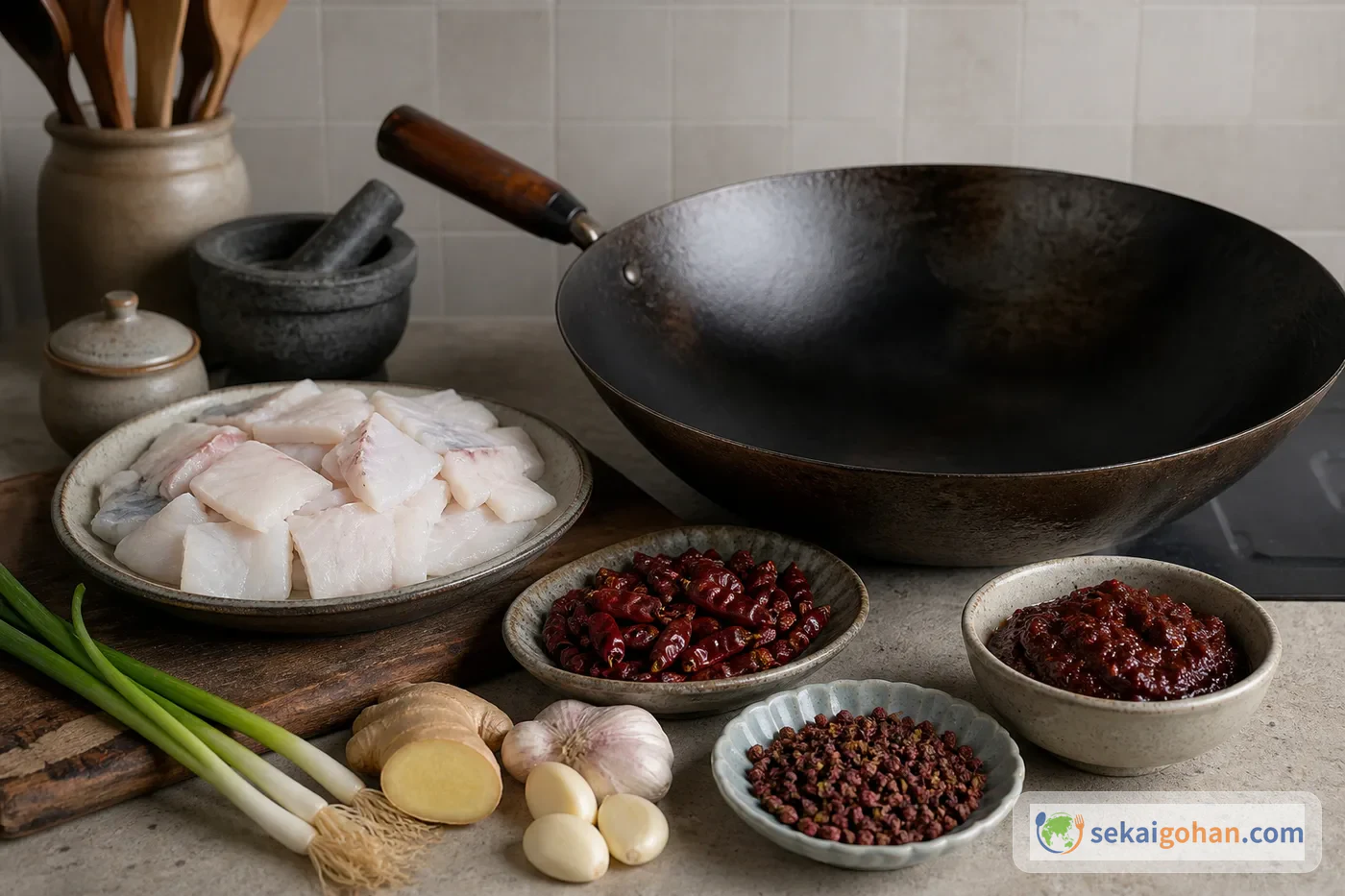
An ordinary skillet works fine. Since you heat the finishing oil separately while keeping the broth hot, though, depth and an easy handle help. If you're tempted by a hammered iron wok, look for one about 13 inches (33 cm) across that sits stably on your stove, and only if you'll keep up with the seasoning and oiling it needs. Otherwise, a deep saucepan and a small pan for the oil do the job.
Method
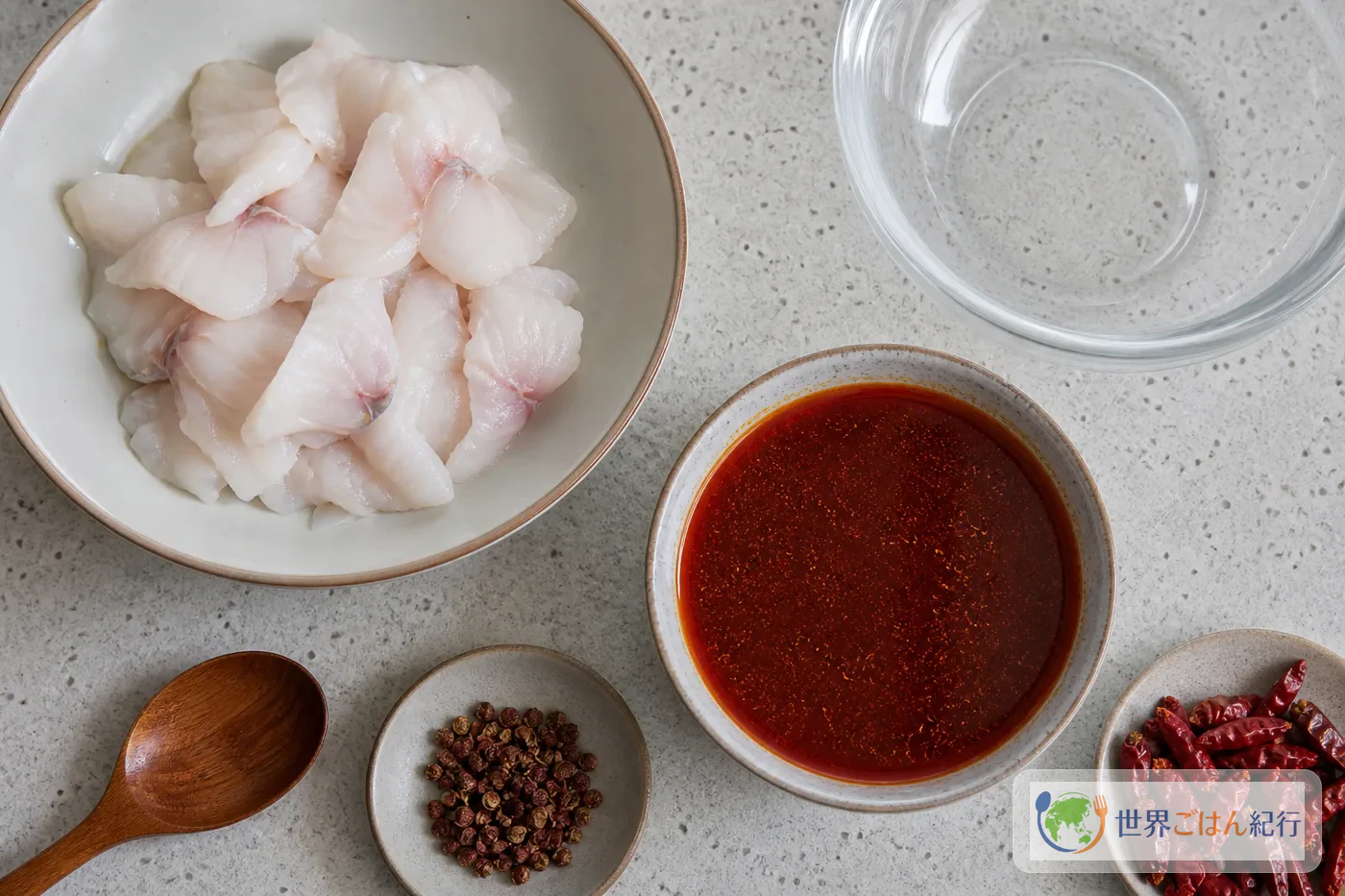
Handle the white fish cold, straight from the fridge, and cut all the ingredients before turning on the heat. The time from adding the fish to the pot to plating is short, so keep a deep heatproof bowl, a slotted ladle and a small pan for the finishing oil near the stove.
Fixing common shuizhu yu problems
The fish fell apart
Stirring with chopsticks after adding the fish, or boiling too hard, breaks it up. Don't try to scoop up the broken fish; move the remaining pieces with the slotted ladle. Next time, add the fish one piece at a time and keep the heat low enough that the surface of the broth doesn't churn. A thicker starch coating won't help, since it just absorbs more broth.
The broth is too spicy
Adding water all at once dilutes only the salt and erases the layers of aroma. Instead, move the fish to the bowl, add unsalted stock to the broth 3.5 tbsp (50 ml) at a time and warm over low heat for 2 minutes. If you add sweetness, stop at 2 g of sugar, and finish with a few drops of black vinegar. Cutting the finishing oil won't touch the heat that comes from the doubanjiang.
The broth is weak
Before the fish goes in, reduce the broth uncovered over medium heat for 3–5 minutes until red oil returns to the surface, and only then adjust the salt. If the fish is already in, take it out first; reducing with the fish in the pot makes the flesh tough.
The Sichuan peppercorns taste bitter or have no aroma
Frying the peppercorns for a long time with the doubanjiang burns them, and their aroma is gone before the oil is poured. Pick out the burnt ones and scatter a few fresh peppercorns for finishing. If the aroma is weak, crush the peppercorns lightly with your fingers before pouring the oil; this opens them up without grinding.
The center of the fish is still translucent
Bring the broth back to a gentle simmer, return the fish and cook it 30 seconds more at a time, until the center turns white and the flesh flakes apart with chopsticks. Pouring hot oil over the fish after plating doesn't make undercooked fish safe. If you can't cook it through, don't eat it; make it again.
Ways to adapt shuizhu yu
Split the heat at the table
Take half the dried chiles out of the broth and place them on only one side of the finished dish. Children or anyone sensitive to heat still get the doubanjiang's savoriness in the broth, plus an area where they can scoop fish without picking up chiles. Leaving the chiles out completely pushes the Sichuan peppercorns too far forward, so keep 2–3 for color.
Switch from basa to sea bass
Basa comes as frozen fillets of even thickness and suits a first practice run; sea bass has springy flesh and a flavor that holds its own in the broth. If the sea bass fillet is thick, slice on the diagonal from the thicker side rather than from the skin side, keeping the pieces under 0.5 inches (1 cm). Thaw frozen fish slowly in the fridge and wipe off the released water before marinating.
Use napa cabbage and mushrooms
If you don't like the crunch of soybean sprouts, use 9 oz (250 g) napa cabbage and 7 oz (200 g) enoki. Cut the cabbage stems into thin strips and blanch 1 minute, add the leaves and blanch 30 seconds more, and warm the mushrooms in the broth for 3 minutes. The vegetables release water, so hold off on extra stock and just taste for salt at the end.
Lean toward the aroma of Sichuan peppercorns
Of the 5–7 g of whole peppercorns, put only 1 g in the broth and keep the rest for finishing. This holds back the numbness while keeping the citrus-like aroma the oil opens up. For more numbness, crush whole peppercorns lightly and add them little by little at the end rather than piling on ground pepper. Sichuan peppercorns lose aroma over time, so seal the bag after opening and take out only what you need.
Skip the fish and make shuizhu vegetables
Warm mushrooms, napa cabbage and tofu in the broth and finish by pouring oil over the chiles and peppercorns. Without the fish's protein and coating, it becomes a vegetable dish built on the same Sichuan flavor backbone. If someone with a fish allergy is eating from the same pot, set their portion aside before the fish goes in and use separate utensils.
Storage and serving
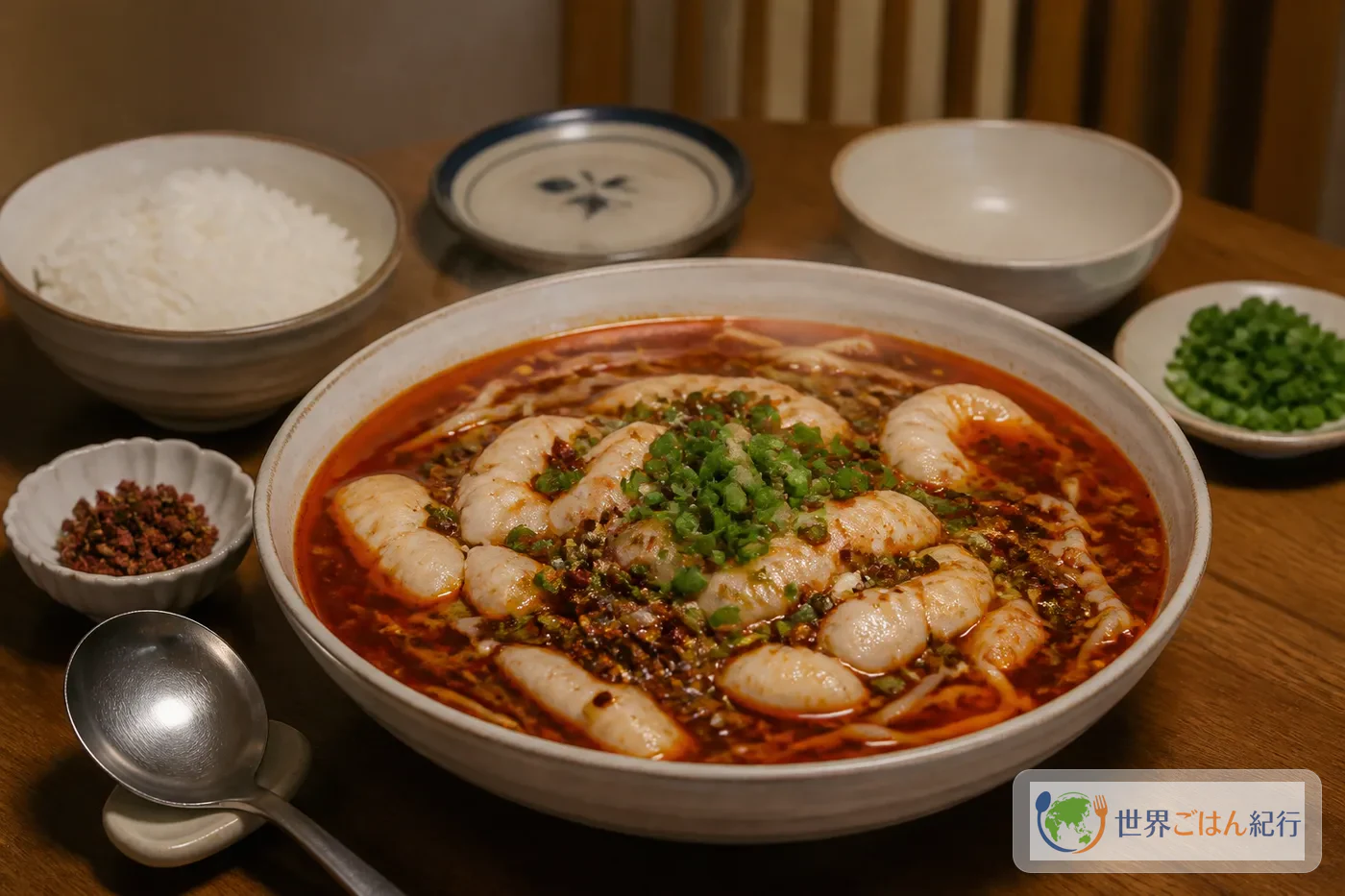
Shuizhu yu is at its best when the deep bowl sits in the middle of the table and everyone takes vegetables and broth along with the fish, rather than getting neat individual plates. White rice does more than put out the heat; it catches each mouthful of oil-laden broth. Pour too much broth over the rice and it turns salty, so take a little fish, soybean sprouts and broth at a time and let them come together in your mouth.
Divide up leftovers the same day you pour the finishing oil. Move the fish and broth into shallow storage containers and refrigerate once they've cooled slightly, keeping the time at room temperature within 2 hours, and finish it by the next day. Freezing changes the fish's coating and the vegetables' moisture, so don't plan on it.
To reheat, warm it to the center over low heat rather than boiling it, so the fish doesn't break. In a microwave, spoon broth over the fish, cover with a lid or plastic wrap and heat in short bursts. The aroma of the peppercorns and chiles fades overnight, so scatter a few fresh peppercorns and some scallion greens over the next day's portion. If you want more oil, warm just a little in a small pan and pour it at the table; overheating it burns the spices.
Wash the cutting board, knife and bowl used for the fish separately from your serving utensils. Cook the fish thoroughly to the center, and pour hot oil only into a heatproof bowl that can withstand sudden temperature changes. Any water in the oil makes it spatter violently, so make sure the pan, the fish and the spices are dry on the surface before turning on the heat.
Q1. Can people who dislike Sichuan peppercorns eat it?
Start by reducing them to 3 g, leaving them out of the broth and gathering them in one corner of the finished dish. Without any Sichuan peppercorns, only the chile heat comes forward, so keeping a small amount on the side lets people avoid them while the dish keeps its balance. Ground pepper mixed into the broth is hard to remove, so use whole peppercorns the first time.
Q2. The potato starch coating comes off. What should I do?
Wipe the moisture off the fish's surface, coat it with the egg white first, then add the potato starch. Mixing for a long time after adding the starch makes the coating absorb water and turn heavy before it reaches the pot. Keep the broth from boiling hard, and once the fish is in, just spoon broth over it with the slotted ladle. A thin coating is enough.
Q3. Can I use less finishing oil?
You can reduce it from ¼ cup (80 ml) to 3.5 tbsp (50 ml), but tilt the bowl slightly and pour in a thin stream so it reaches the peppercorns and chiles evenly. With too little oil, only some of the spices heat up, leaving a mix of burnt and raw pieces. Spreading the spices out is safer than making the broth stronger to make up for less oil.
Sources
The structure of the dish, choice of fish, handling of the spices, regional differences and food safety were cross-checked against the following English-language sources and restructured for home cooks. The recipe's quantities and heat levels are the common ground among several sources, plus a safe way to check doneness when using fillets.
- Sichuan Boiled Fish (Shui Zhu Yu, 水煮鱼) | The Woks of Life (whole fish vs. fillets, diagonal slicing, egg white and starch marinade, lining the bowl with vegetables, finishing oil; accessed and checked August 19, 2026)
- Water boiled fish (Shui zhu yu) recipe | SBS Food (white fish for home cooks, the order of frying doubanjiang, Sichuan peppercorns and chiles, simmering the fish over low heat, serving immediately; accessed and checked August 19, 2026)
- Shui Zhu Yu, 水煮鱼 | Wisconsin Department of Health Services (the basic structure of fish fillets, Sichuan doubanjiang, Sichuan peppercorns, vegetables, broth and pouring hot oil; accessed and checked August 19, 2026)
- Sichuan Cuisine – Most Popular Cuisine in China | TravelChinaGuide (Sichuan cuisine eaten around Sichuan and Chongqing, characteristics of its spices, and the regional division into Chengdu-Leshan, southern Sichuan and Chongqing-Wanzhou; accessed and checked August 19, 2026)
- Selecting and Serving Fresh and Frozen Seafood Safely | U.S. Food and Drug Administration (fish internal temperature of 63°C/145°F, how to tell when fish is cooked, time out of refrigeration, washing utensils; accessed and checked August 19, 2026)