Okonomiyaki: Osaka-Style Savory Cabbage Pancakes (お好み焼き)

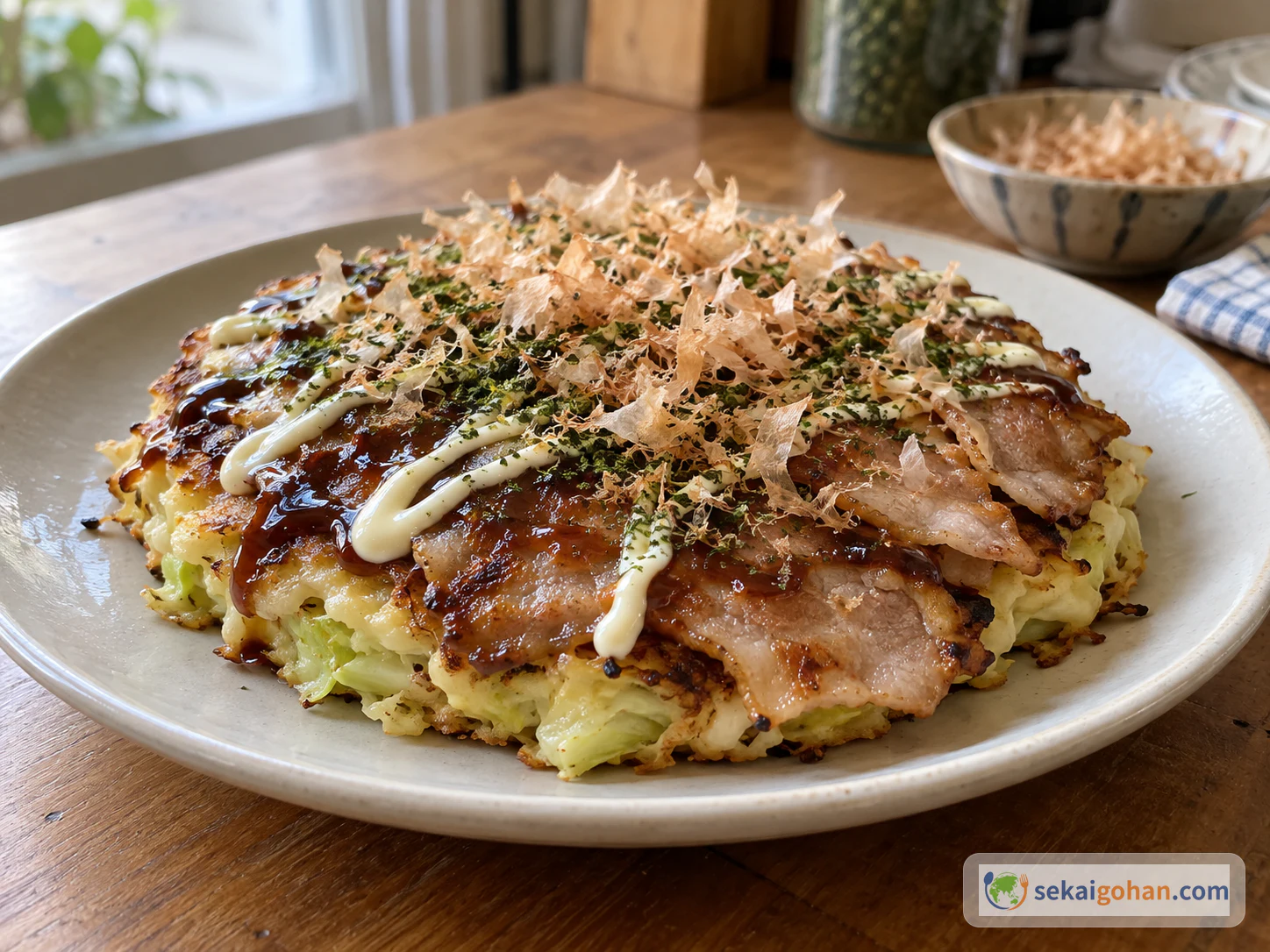
Osaka-style okonomiyaki topped with pork belly and sauce
Serves
2 servings
Cuisine
Japanese

How to make Osaka-style okonomiyaki in a frying pan from a recipe published by Japan's Ministry of Agriculture, Forestry and Fisheries: a dashi batter with grated nagaimo, cabbage folded in briefly, pork belly laid on top, and a covered, low-heat cook. Covers when to flip, how to tell it's done, troubleshooting, toppings, and how it differs from Hiroshima style.

Cooking flow

Cooking steps

STEP11 / 7

Make the batter

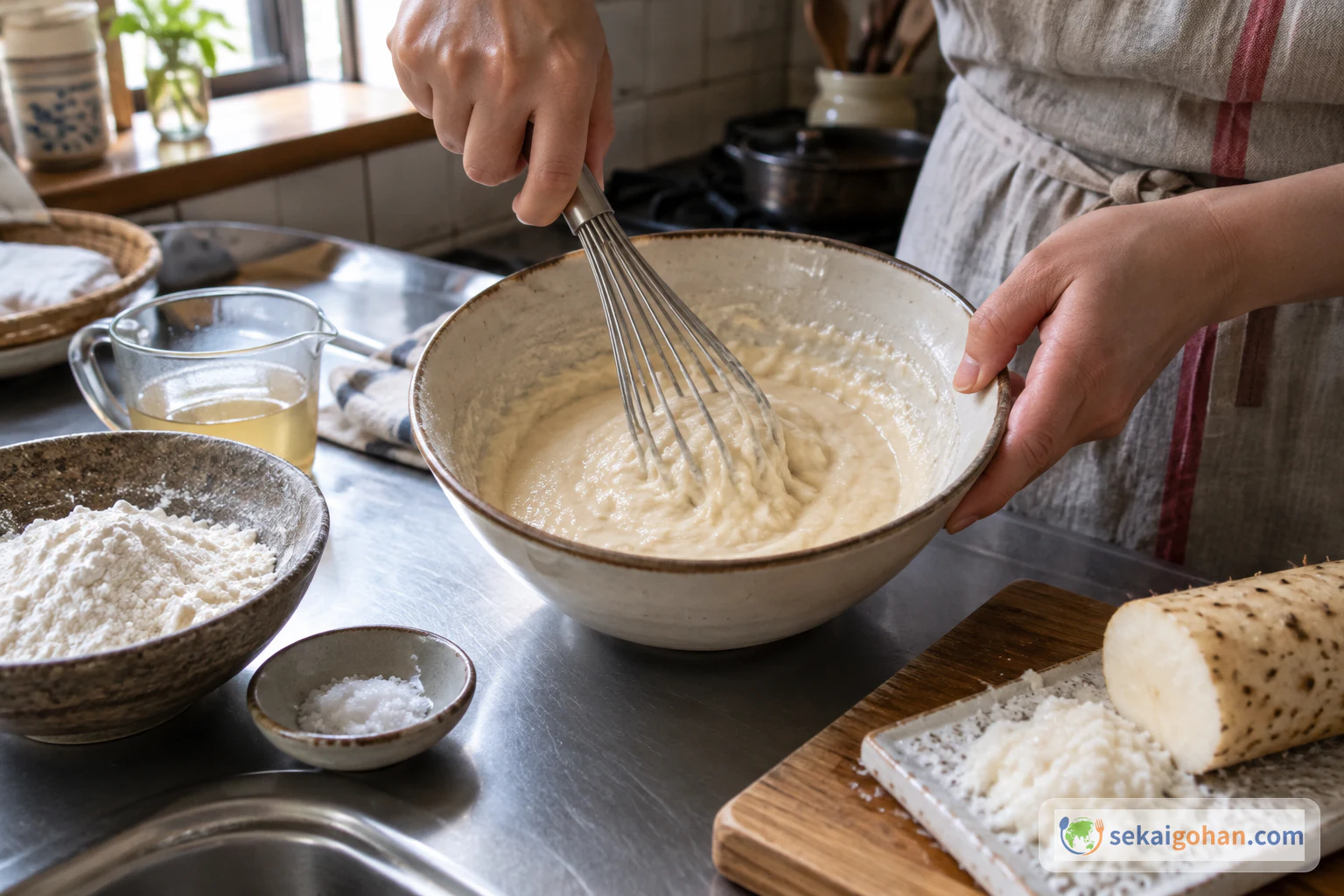
Okonomiyaki batter of cake flour, dashi, grated nagaimo and salt being mixed
Mix until no lumps of flour remain

In a bowl, combine 3.5 oz (100g) cake flour, ½ cup (100ml) dashi, 1.5 oz (40g) grated nagaimo and a pinch of salt. Mix until no lumps of flour remain and the batter is smooth.

STEP22 / 7

Combine one pancake's fillings just before cooking

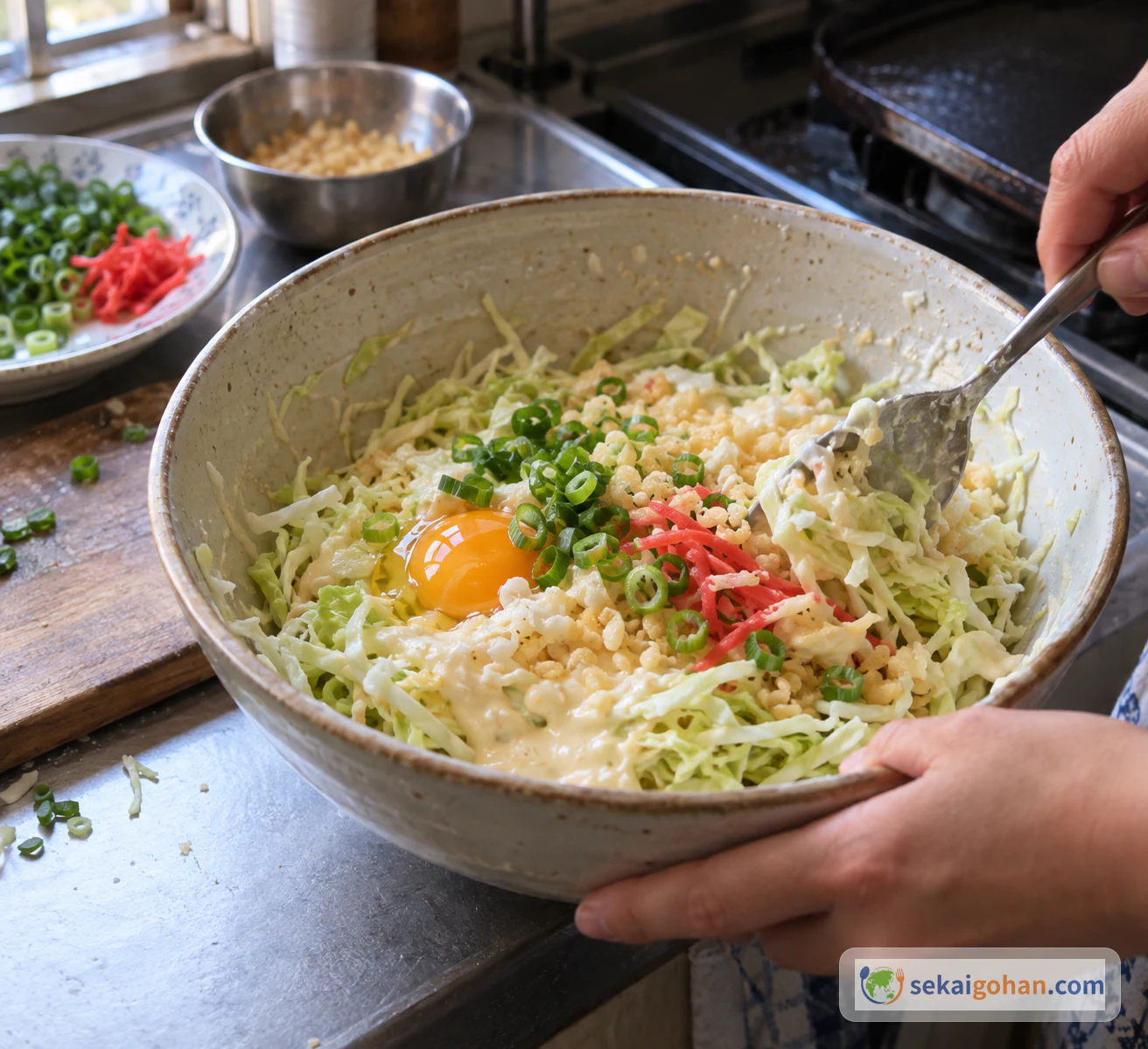
Cabbage with batter, egg and tenkasu being folded together just before cooking
Fold only until the cabbage is coated; the strands should still be visible

Put half the cabbage in a bowl. Top it with half the batter, 1 egg, 2 tbsp tenkasu, and half the green onion and beni shoga if using. Each pancake takes about 4 oz (120g) of batter. Divide the batter into two equal portions, and don't add water or flour to reach that number.

With a spoon, lift and turn the mixture from the bottom about 5–6 times. Stop as soon as the cabbage is coated with batter. Don't stir it hard or leave it sitting, because the cabbage releases water and the pancake turns heavy.

STEP33 / 7

Spread it into a round in the pan

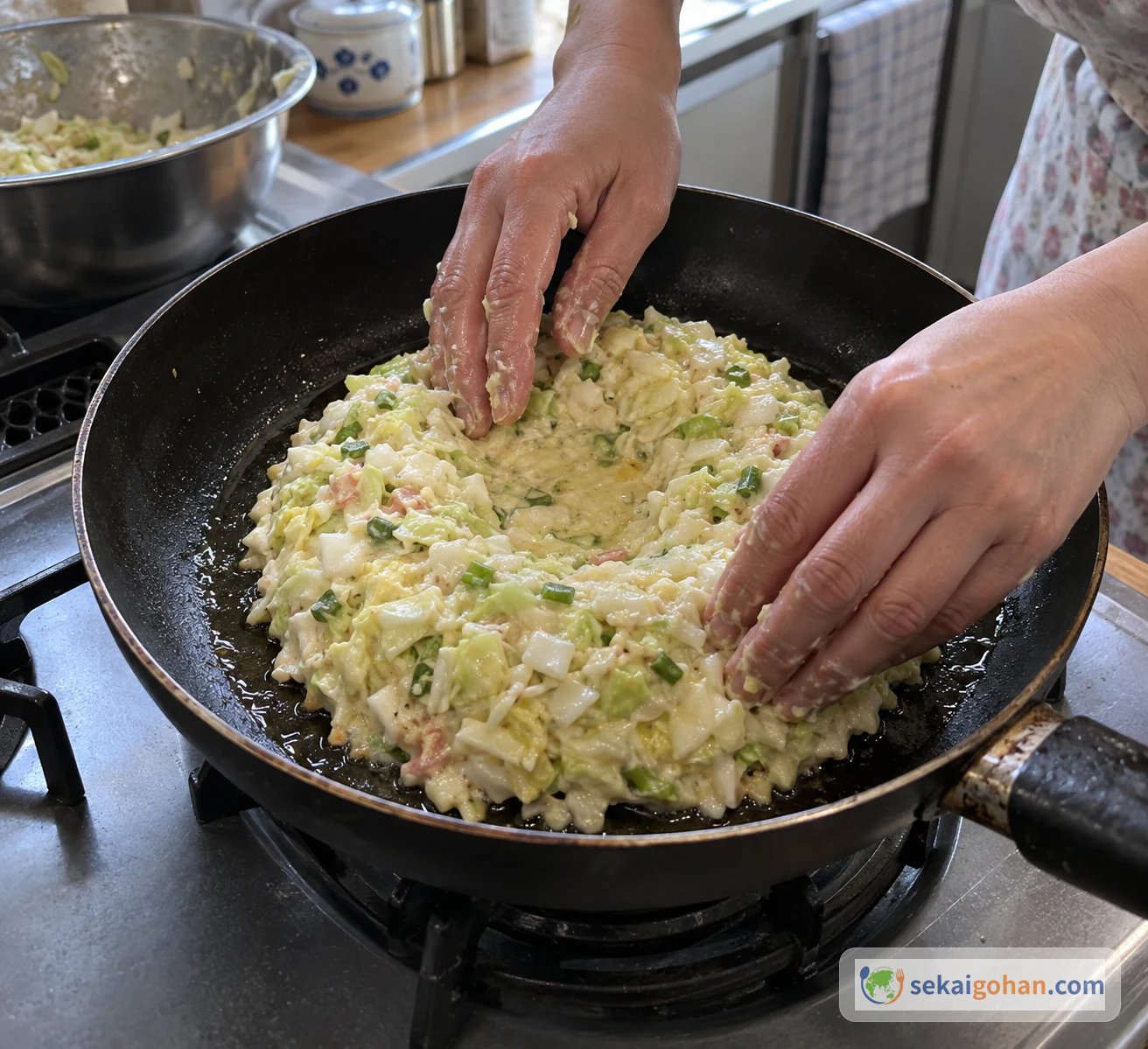
The cabbage mixture spread into a 15–16 cm round in an oiled frying pan
Shape a 15–16 cm round without pressing down the thickness

Heat the frying pan over medium heat and coat it thinly with oil. If you use a hot plate, set it to 425°F (200–220°C). Put the mixture in the center and spread it out into a round 6.5 inches (15–16 cm) across. Make a slight dip in the middle, and don't press the pancake flat.

STEP44 / 7

Cook the underside, then lay the pork on top

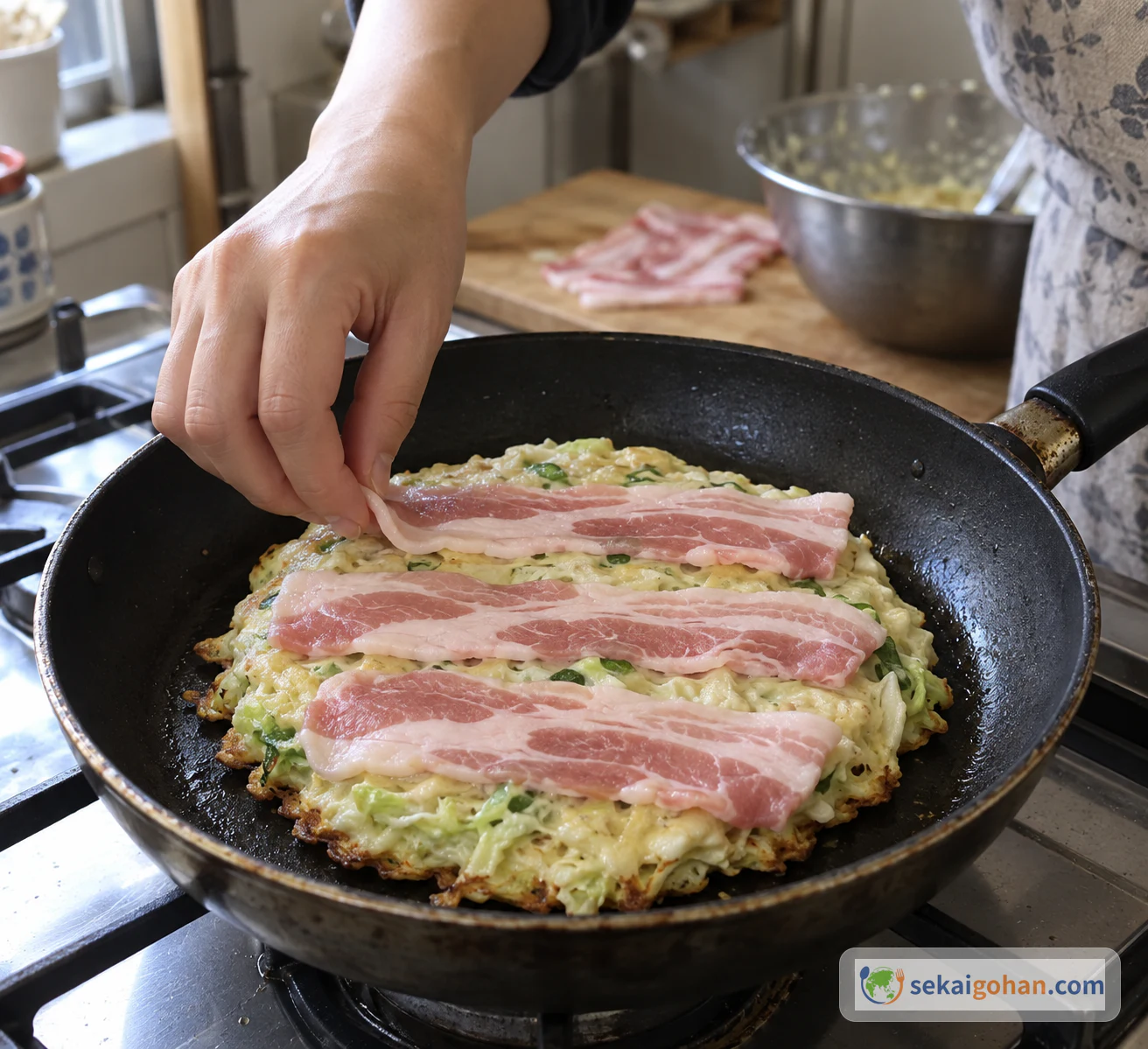
Pork belly arranged on the uncooked top of a pancake whose underside has browned
The browning is on the underside; the pork goes onto the still-raw top

Cook for about 3 minutes. Check that the underside has browned and set enough to turn. The top is still uncooked at this point.

Lay this pancake's share of pork, about 2.75 oz (80g) or 2 slices, across the uncooked top in three rows, cutting the slices if needed. Place the fat toward the outer edge.

STEP55 / 7

Flip, cover and cook on low

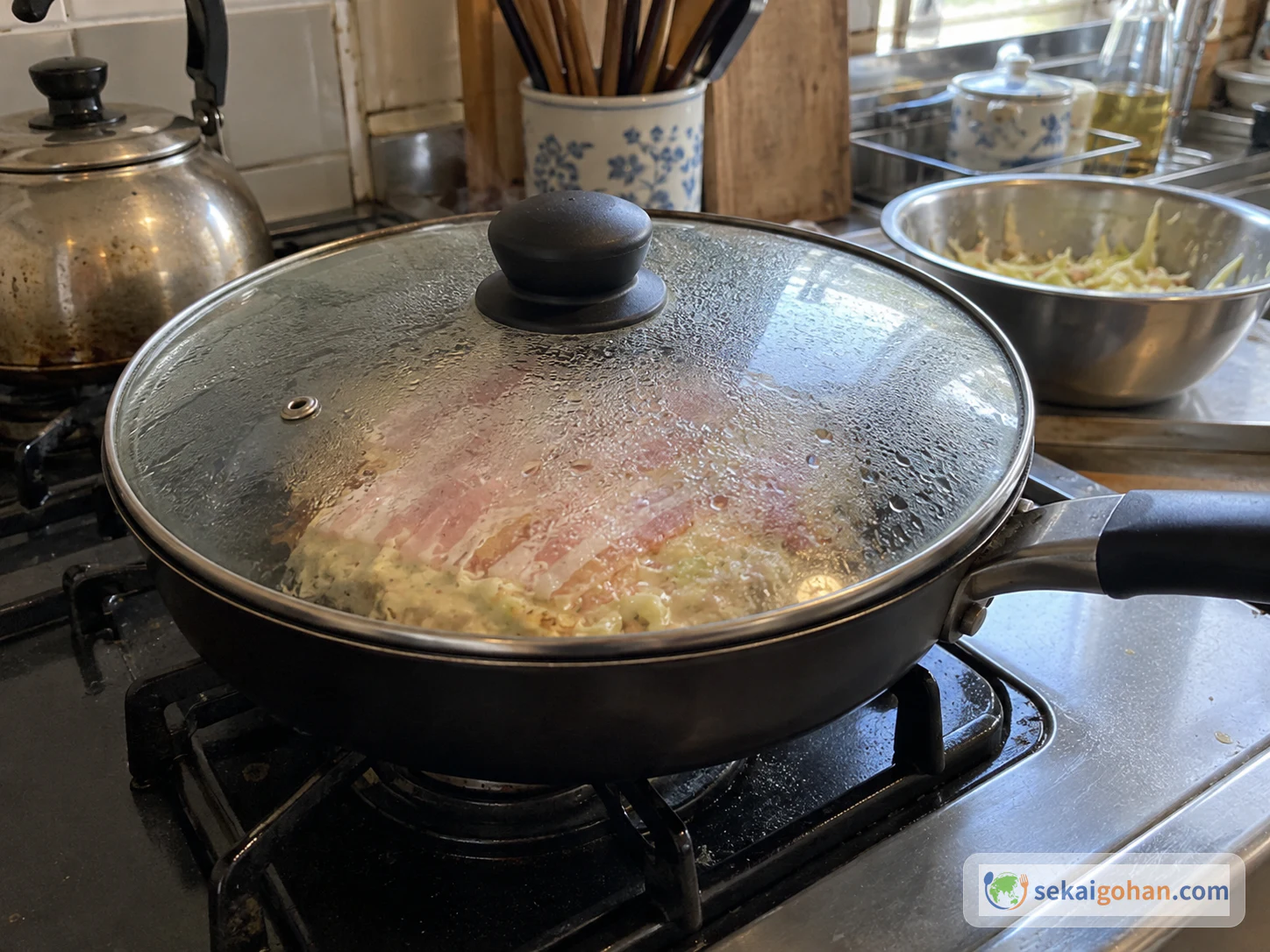
Okonomiyaki cooking pork-side down under a lid on low heat
Cover and cook on low so the center cooks through

Turn the pancake over so the pork is underneath. Cover with the lid and cook on low heat for about 4 minutes. The lid traps steam so the thick center cooks through without the outside burning.

STEP66 / 7

Uncover, flip again and make sure it is cooked through

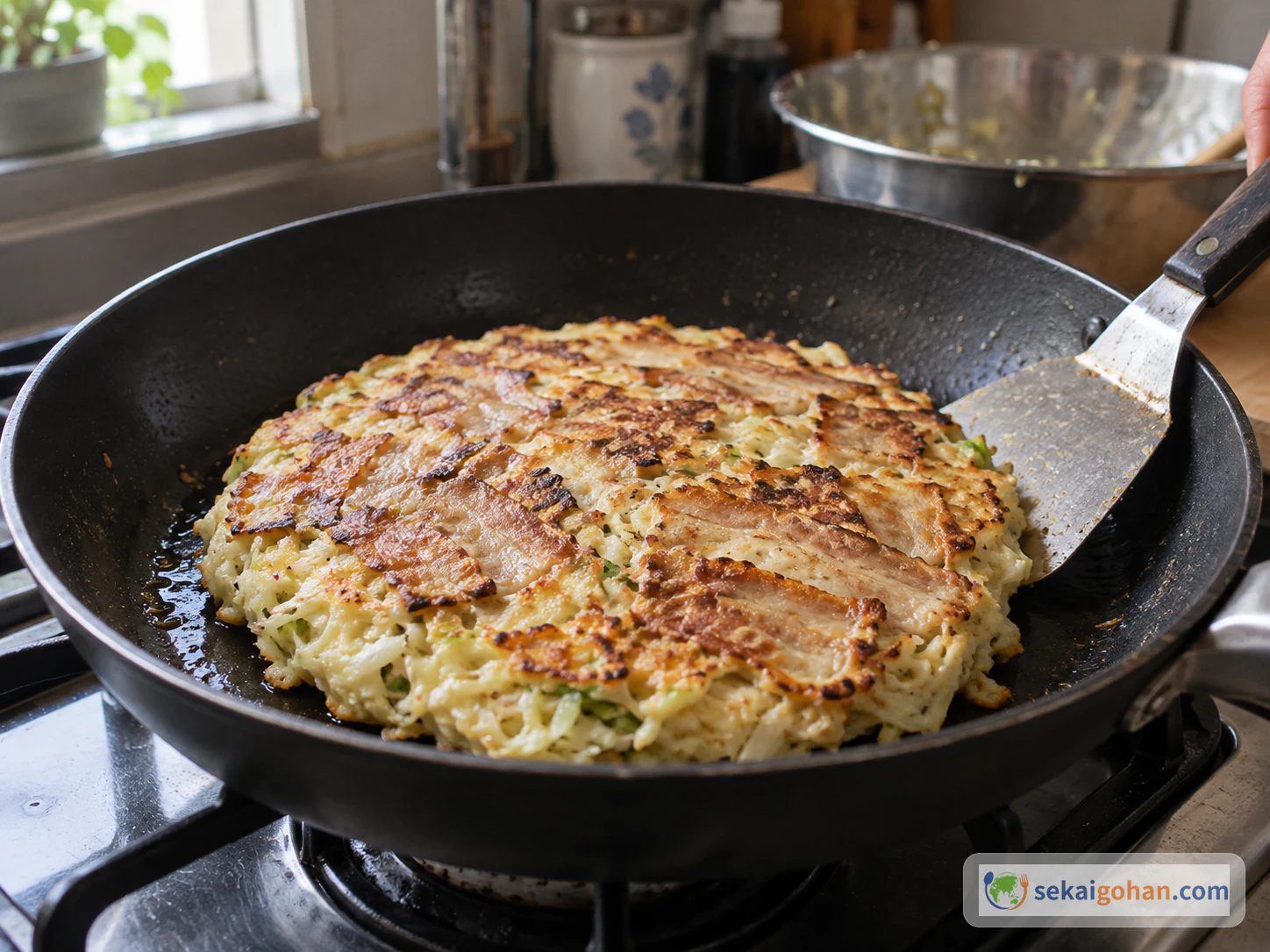
Okonomiyaki turned again after the lid comes off, pork side browned
After the covered stage, turn once more and finish the pork side

Remove the lid, turn the pancake over once more and cook for about 1 minute. Both the pork and the egg batter must be fully cooked in the center.

Don't rely on time or color alone. Heat the center to 167°F (75°C) for at least 1 minute. If it isn't done, keep cooking on a heat low enough not to scorch it.

STEP77 / 7

Add the toppings and serve

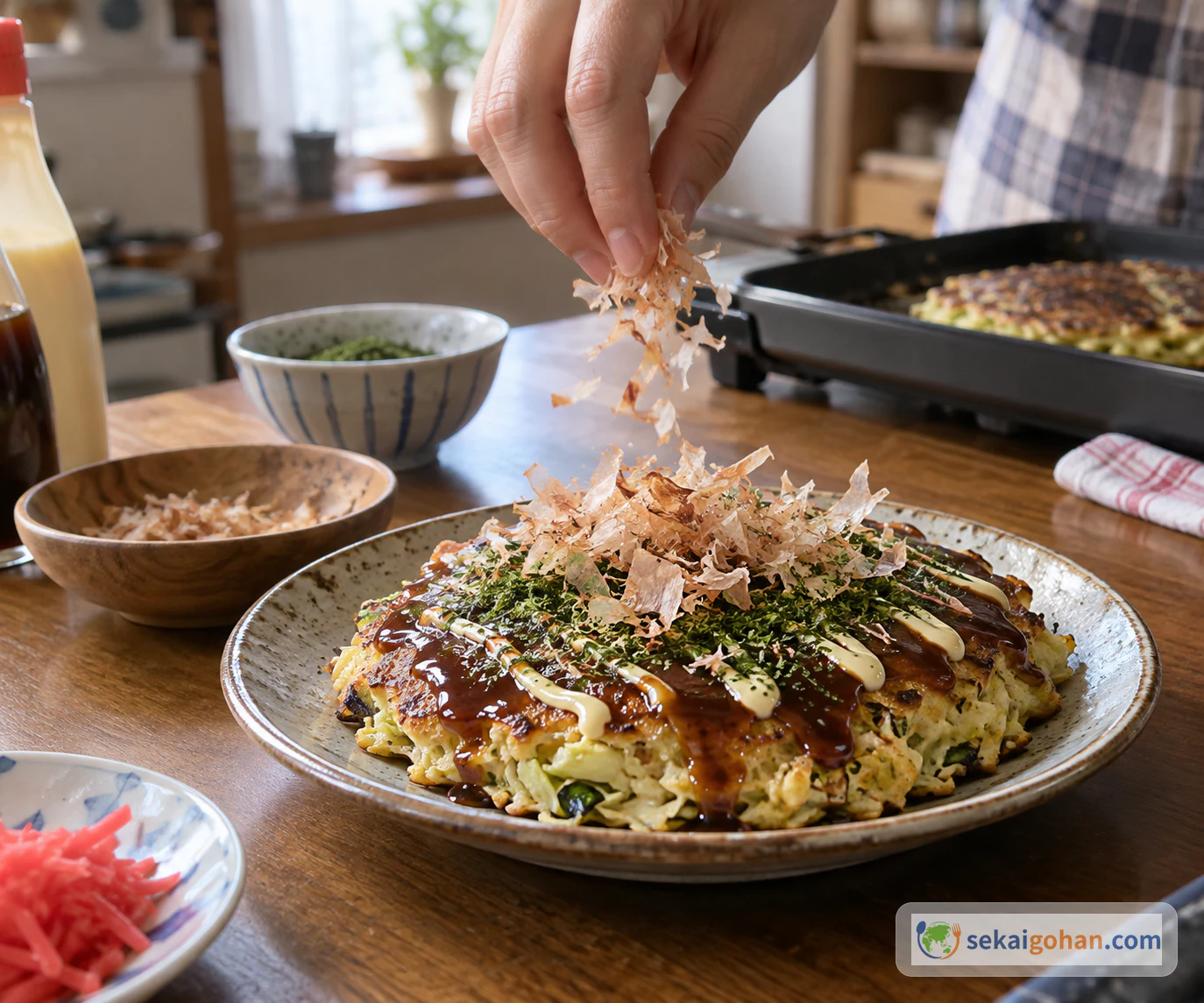
Sauce, aonori and bonito flakes going onto a finished okonomiyaki
Add the toppings at the end and eat it hot

Move the pancake to a plate and top it with okonomiyaki sauce, aonori and katsuobushi. Add mayonnaise if you like. Serve it while it is hot, then mix and cook the second pancake from step 2 in the same way.

0 / 0
Ingredients

Ingredients

1 / 3

Batter

Ingredient Amount Role and how to handle it
Cake flour (Japanese hakurikiko) 3.5 oz (100g) The structure of the batter
Dashi ½ cup (100ml) Loosens the flour and adds savory depth
Nagaimo, grated 1.5 oz (40g) Holds the batter together and keeps it soft
Salt a pinch Seasons the batter
2 / 3

Fillings and pork

Ingredient Amount Role and how to handle it
Cabbage, cut about 0.25 inch (5 mm) wide 8.5 oz (240g) The main filling. It releases water once mixed, so cook it right away
Eggs 2 One per pancake
Tenkasu (tempura crumbs) 4 tbsp Toasty flavor and richness. Split between the two pancakes
Green onion 4 tbsp Aroma. Split between the two pancakes
Pork belly, thinly sliced about 0.125 inch (3 mm) thick 4 slices (about 5.5 oz / 160g) This is the total for both pancakes. Use about half on each, and arrange it with the fat toward the outer edge
Beni shoga (red pickled ginger) to taste Optional. Split between the two pancakes
3 / 3

For cooking and finishing

Ingredient Amount Role and how to handle it
Vegetable oil as needed A thin coat on the cooking surface
Okonomiyaki sauce as needed Topping
Aonori (green laver flakes) as needed Topping
Katsuobushi (bonito flakes) as needed Topping
Mayonnaise as needed Optional topping
0 / 0

At an okonomiyaki restaurant in Osaka, Japan, the pancake often arrives on a hot griddle set into the table. Diners cut it into bite-size pieces with small metal spatulas and eat straight from the griddle while the sauce sizzles at the edges. Okonomiyaki is just as much a home dish, eaten all year round, and a leading example of the area's konamon (flour-based food) culture. This is the Osaka, or Kansai, style: a savory cabbage pancake bound with dashi batter, browned on both sides and finished with sauce.

Osaka-Style Okonomiyaki

In Osaka-style okonomiyaki, the cabbage and other fillings are mixed into the batter, and the pancake is then cooked on both sides. Cabbage makes up most of the pancake, and pork belly is a popular choice. Grated mountain yam (here, nagaimo) gives it a fluffy texture, and tenkasu, green onion and beni shoga (red pickled ginger) are common additions.

Hiroshima style is built differently. Its ingredients are layered in the pan rather than mixed, and it often includes noodles such as yakisoba or udon along with an egg. The Osaka version has no noodles.

The name roughly means "grilled as you like it," and restaurants and households each have their own mix of fillings and toppings. One Osaka restaurant, for example, uses a lot of cabbage and comparatively little batter.

Where it comes from

There is no single, settled origin story. The dish has roots in older flour-based foods such as fu-no-yaki, and the present-day style took shape after the Second World War, when cabbage made it more substantial and grated yam made it fluffy. Eating okonomiyaki with rice is a familiar habit in Osaka, though it tends to surprise people from other parts of Japan.

Ingredients for 2 Pancakes (Serves 2)
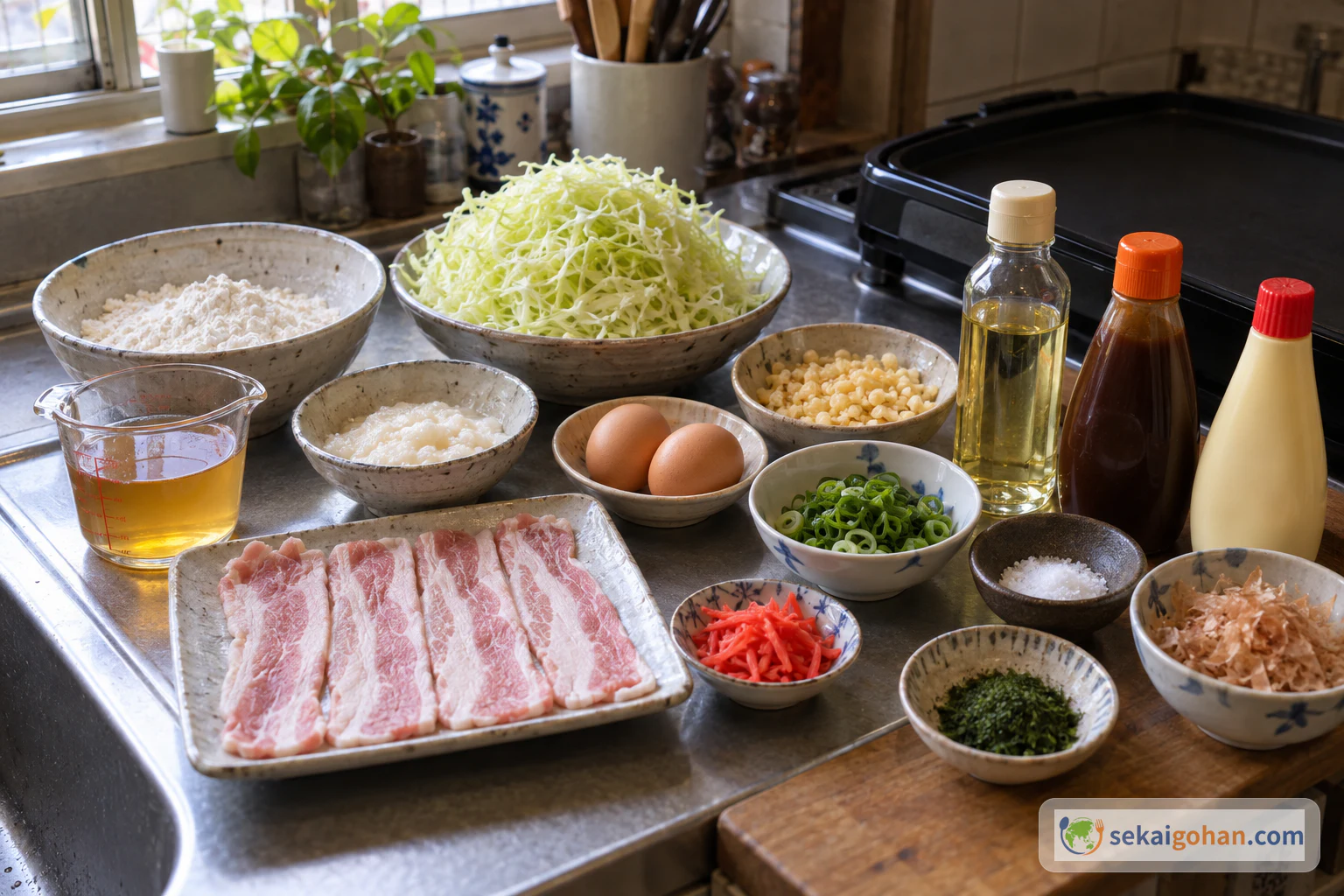
Cake flour, dashi, nagaimo, cabbage, eggs, tenkasu, green onion and pork belly for Osaka-style okonomiyaki
Make the batter first, but keep the cabbage separate until just before cooking

These amounts serve 2 and make two pancakes about 6.5 inches (15–16 cm) across.

Equipment

  • Frying pan with a lid (or a tabletop hot plate)
  • Mixing bowl for the batter
  • Bowl and spoon for mixing each pancake
  • Spatula (turner) for flipping
  • Separate cutting board and utensils for the raw pork

Choosing Ingredients for Okonomiyaki

Nagaimo. You can leave it out, but the pancake will feel less light and hold less moisture. No substitute gives quite the same result.

Dashi, tenkasu and the sauce. Ordinary Japanese products are fine. Okonomiyaki sauce is sold as its own product in Japanese and Asian grocery stores.

Cabbage. Cut it about 0.25 inch (5 mm) wide so it keeps its shape in the batter instead of turning to mush.

Allergy and food safety

This recipe contains wheat, egg and pork. Depending on the product, dashi, tenkasu, okonomiyaki sauce and mayonnaise can also contain fish or seafood, soy, egg or other allergens, so check each label. Keep utensils for raw meat separate from those used for other foods. Use a separate board and utensils for the pork belly, or wash them before using them for anything else.

Method: Fold Briefly, Wait for Color, Cover to Cook Through

A note on timing

Adjust the times to your pan and heat source. Judge each stage by the underside color, how firm the pancake is, and whether the center is cooked through.

Make the batter for both pancakes first. Then mix and cook one pancake at a time, combining its cabbage with batter only when you are ready to put it in the pan.

Okonomiyaki Problems and Fixes

Problem Likely cause What to do
The pancake is heavy and wet The cabbage sat in the batter, or it was mixed too much Mix one pancake at a time, only about 5–6 turns, and put it straight into the pan
It breaks when you flip it It was turned before the underside had set Lift an edge with the spatula and check the color and firmness first. Keep the round to 6.5 inches (15–16 cm) so it isn't too wide to turn
The outside burns, but the center is raw The heat was too high, or the pan wasn't covered After the first flip, cover and cook on low. Adjust the time for your pan's thickness and heat source
The pork is pale or still raw The final stage was too short Cook the pork side a little longer on moderate heat until the center is fully cooked

Serving, Leftovers and Variations

In Osaka, okonomiyaki is cooked by restaurant staff, by diners themselves at the table, and at home. Some people eat it as a side to rice; others treat it as a meal in itself. At home, cooking it in a pan and sliding it onto a plate works just as well as a tabletop griddle.

It is best eaten fresh from the pan. To keep leftovers, cool them quickly in a shallow container, refrigerate them, and reheat them thoroughly before eating.

Keep the base intact

Make the base recipe first, then try these variations.

  • Shrimp or squid. Replace part of the pork with seafood. Pat it dry first so it doesn't make the batter watery.
  • Mochi or cheese. Okonomiyaki restaurants offer these as extra fillings. They add saltiness and a chewy or melting texture.

Frequently Asked Questions

Do I need a griddle?

No. This recipe is written for a frying pan over medium heat. A hot plate also works, set to 425°F (200–220°C).

Can I mix the cabbage and batter ahead of time?

It's better not to. The cabbage releases water and the batter gets heavy, so mix each pancake just before it goes into the pan.
Sources

  • Ministry of Agriculture, Forestry and Fisheries (Japan), "Okonomiyaki | Our Regional Cuisines" (recipe provider: Japan Konamon Association). Source for the recipe amounts, method, timings and pan/hot plate heat. Also the source for okonomiyaki as a regional dish of Osaka Prefecture, its place in konamon culture, and its year-round place at home and in restaurants. Origins are presented as "said to trace" to earlier dishes. https://www.maff.go.jp/e/policies/market/k_ryouri/search_menu/5798/index.html
  • Osaka Convention & Tourism Bureau (OSAKA-INFO), "A comprehensive guide to Osaka okonomiyaki!" Source for the Osaka food-culture context, the essential role of cabbage and the popularity of pork, the dashi batter, and mountain yam for fluffiness. Also the source for the multiple origin theories, the present style taking shape after the war, and the rice pairing familiar in Osaka. https://osaka-info.jp/en/gourmet/gastronomy-okonomiyaki/
  • Japan National Tourism Organization (JNTO), "The Original Have It Your Way!" Source for the comparison of mixed Osaka/Kansai style with layered Hiroshima style, common ingredients, eating from a tabletop griddle with spatulas, and restaurant examples of fillings. https://www.japan.travel/en/gastronomy/article-the-original-have-it-your-way/
  • Ministry of Health, Labour and Welfare (Japan), "家庭でできる食中毒予防の6つのポイント" (Six points for preventing food poisoning at home; in Japanese). Source for the general guidance on heating food to 75°C at the center for at least 1 minute, keeping utensils separate, and cooling in shallow containers and reheating. https://www.mhlw.go.jp/stf/seisakunitsuite/bunya/kenkou_iryou/shokuhin/syokuchu/01_00006.html