Kasutera: Japanese Home-Style Castella with Coarse Sugar on the Bottom (カステラ)

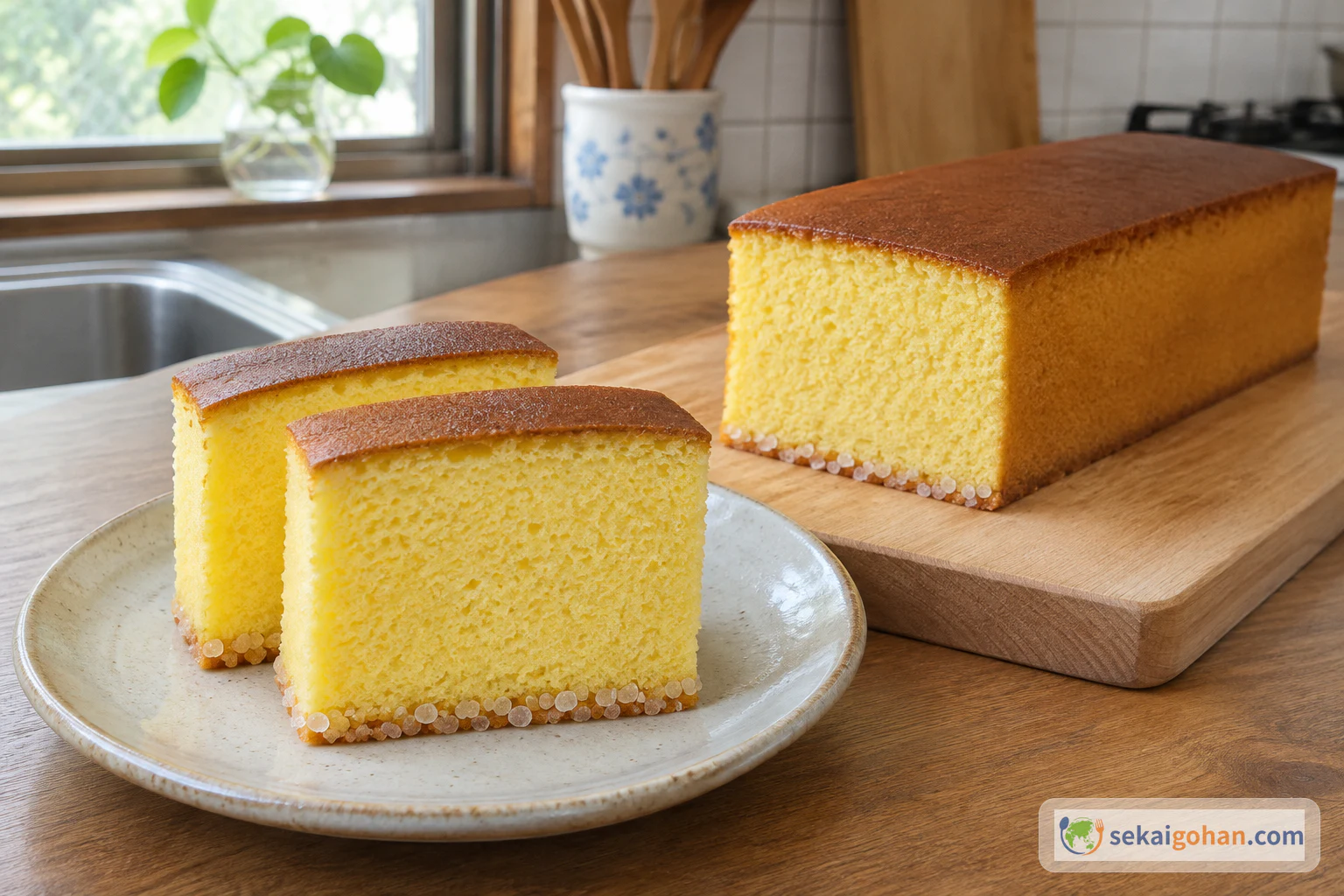
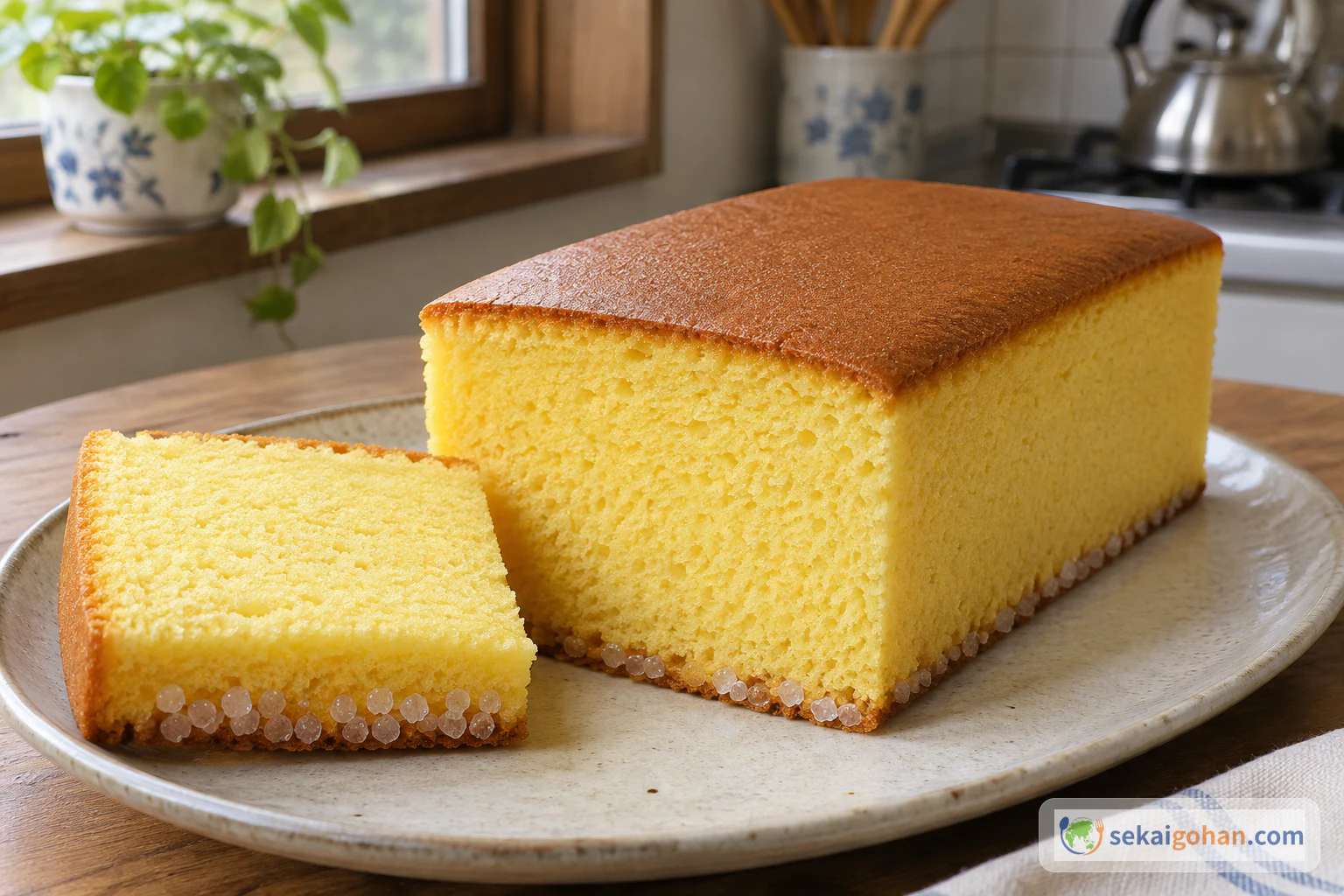
Home-style castella with the coarse sugar visible along its bottom
Serves
One 24 × 13 × 4 cm pan
Cuisine
Japanese

How to make kasutera (カステラ), Japanese castella, from a home recipe published by Japan's Ministry of Agriculture, Forestry and Fisheries: eggs and sugar whipped to a ribbon, honey, milk and cake flour, baked in a 24 × 13 × 4 cm pan over a layer of coarse sugar. Covers the six ingredients, how to judge each stage, the skewer test, how this version differs from Nagasaki makers' methods, and why it must not be given to babies under one.

Cooking flow

Cooking steps

STEP11 / 6

Line the pan, sugar the bottom and preheat the oven

STEP 1

Line the 9.5 × 5 × 1.5-inch (24 × 13 × 4 cm) pan with parchment paper. Spread 1 tbsp coarse sugar evenly over the paper on the bottom. Sift the 2.75 oz (80g) cake flour. Preheat the oven to 350°F (170°C).

STEP22 / 6

Whip the eggs and sugar until they hold a trail

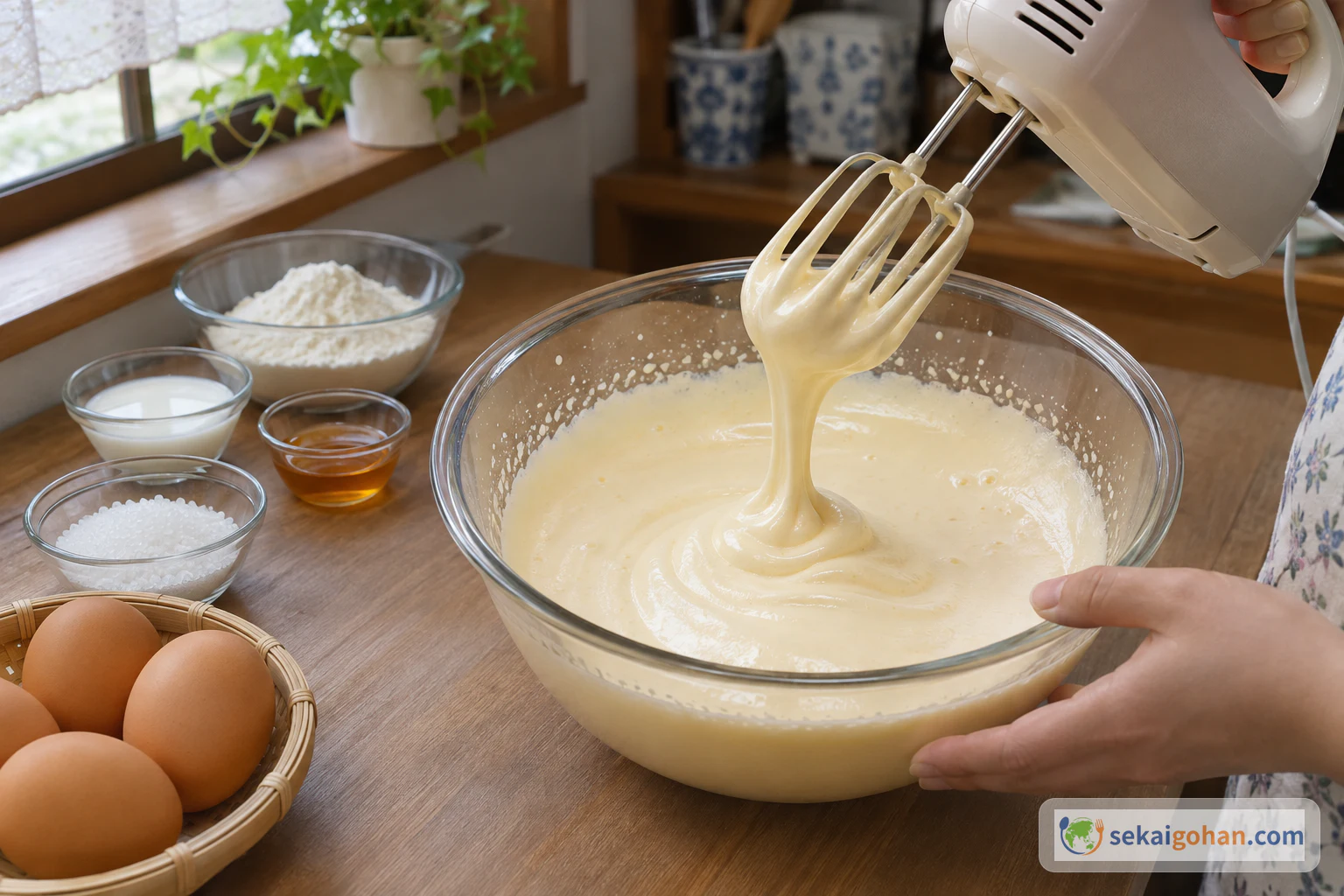
Whipping whole eggs and granulated sugar with a hand mixer
Whip until the batter falling from the beaters leaves a trail

Put the 2 whole eggs and 2.75 oz (80g) granulated sugar in a bowl and whip with a hand mixer. Keep going until the batter turns pale and thick and, when you lift the beaters, the batter that falls back leaves a trail on the surface.

STEP33 / 6

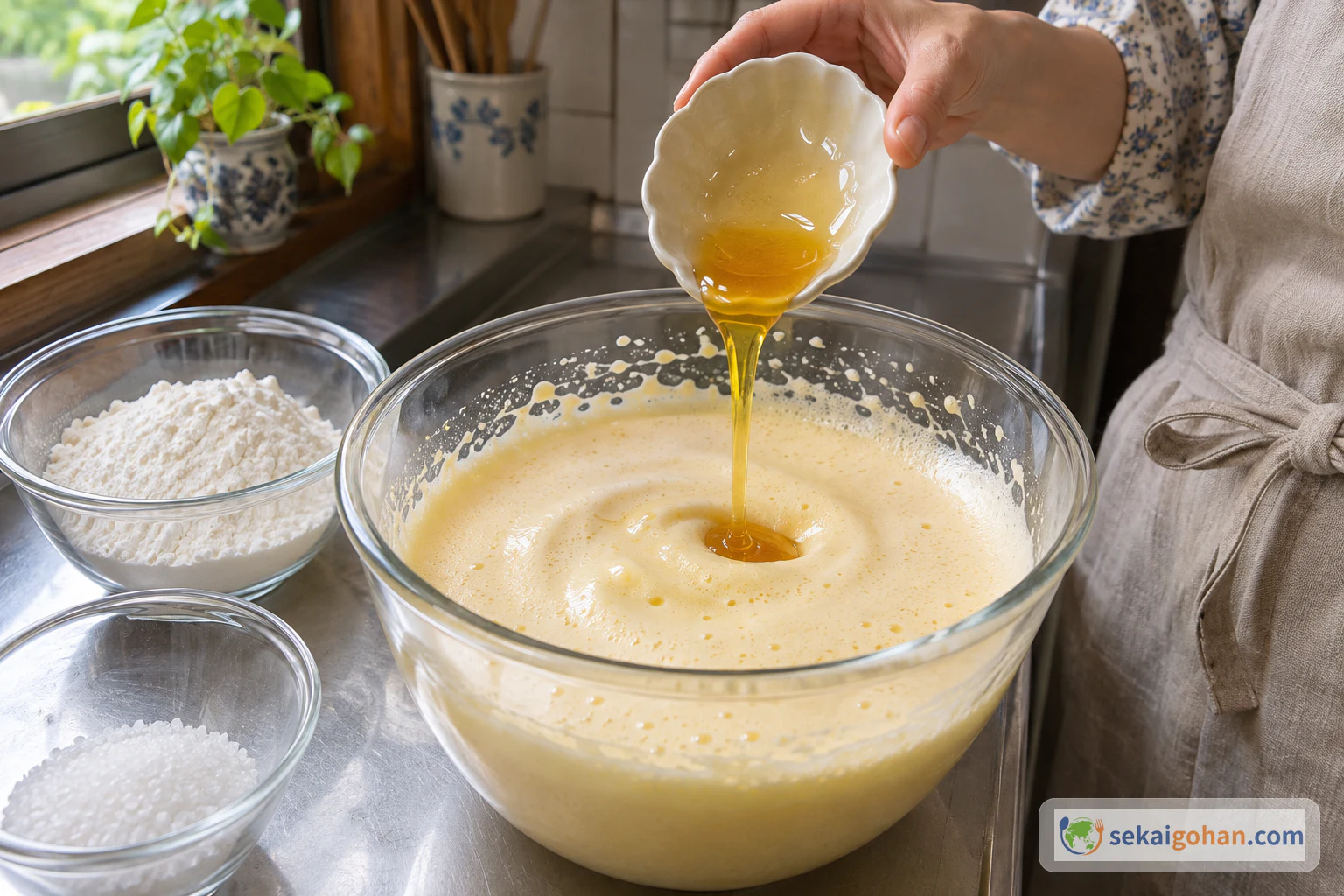
Add the honey and milk

Adding honey to the whipped egg batter
Add the honey and milk to the whipped eggs and mix in quickly

Add 2 tbsp honey and 1 tbsp milk to the whipped eggs and mix in quickly.

STEP44 / 6

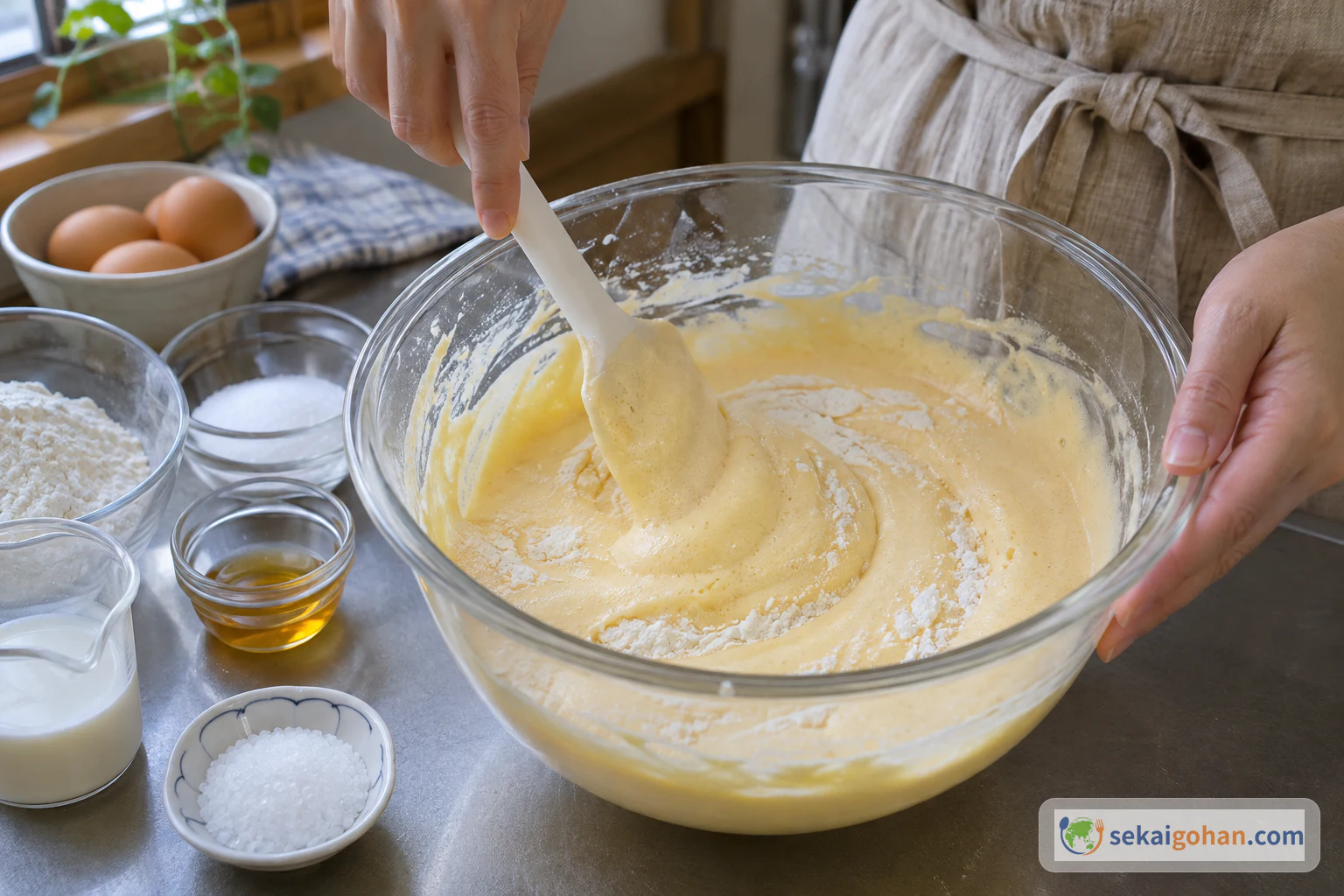
Fold in the flour in two additions

Folding the added cake flour in gently with a rubber spatula
Fold lightly; do not knead the batter

Sift in the flour in two additions. After each, fold it in lightly with a rubber spatula, cutting through the batter rather than stirring or kneading, so you do not press out too much of the foam.

STEP55 / 6

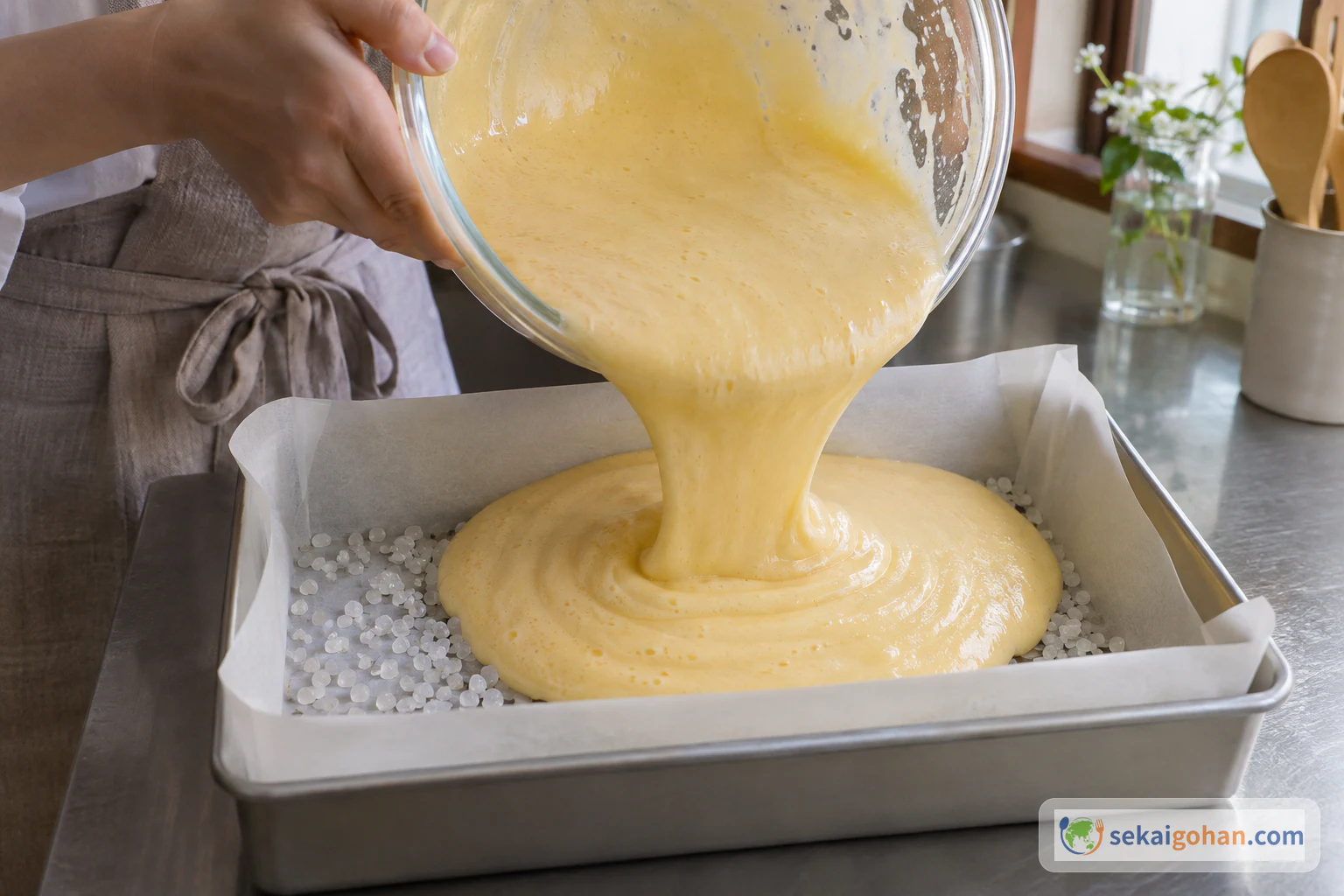
Pour into the pan and bake

Pouring castella batter into a pan lined with coarse sugar
Pour the batter over the coarse sugar already spread on the paper

Pour the batter into the lined pan, over the coarse sugar.

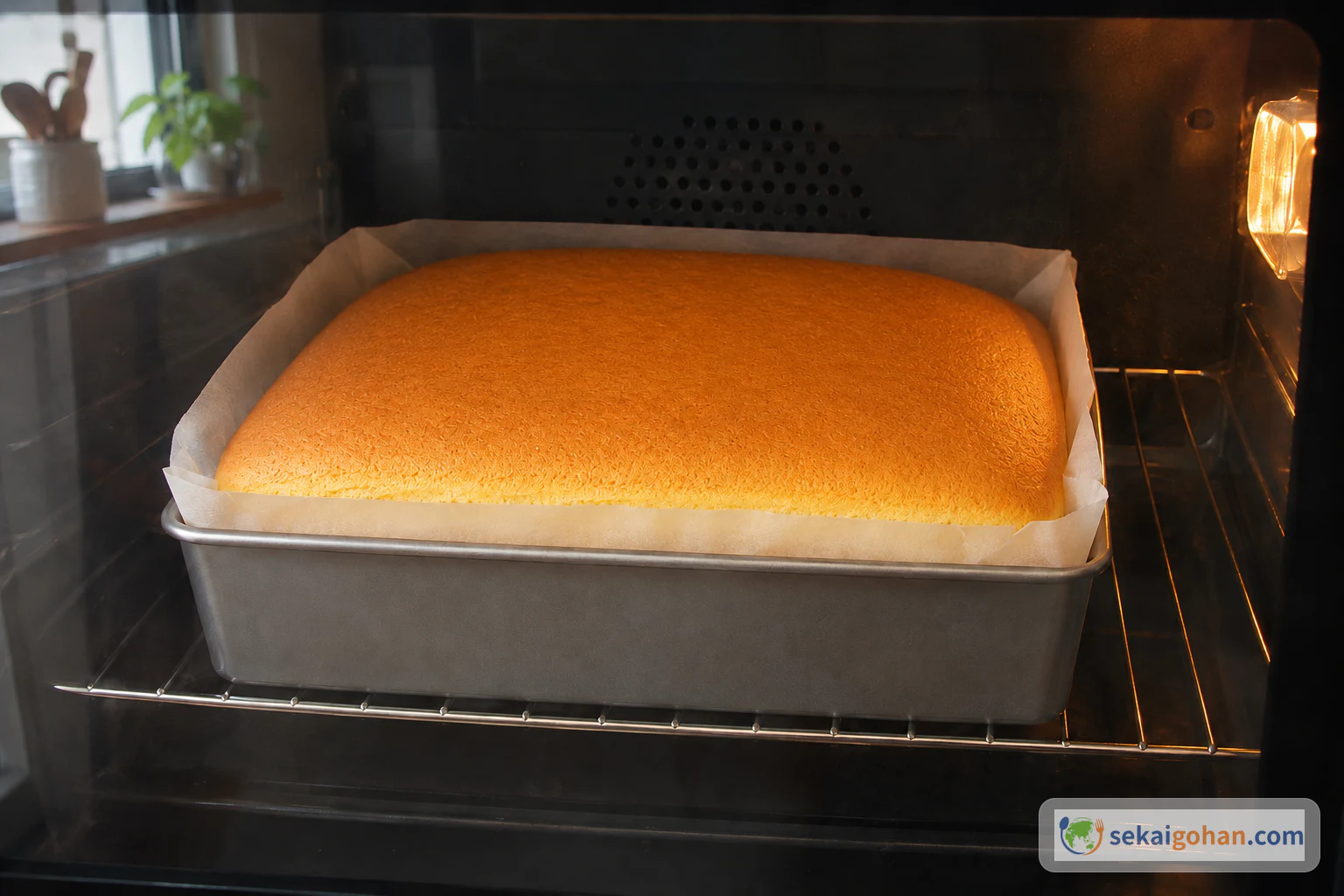
Bake in the oven preheated to 350°F (170°C) for about 30 minutes.

Castella baking in its pan in a home oven
Bake at 170°C for about 30 minutes
STEP66 / 6

Test with a skewer, cool and unmould

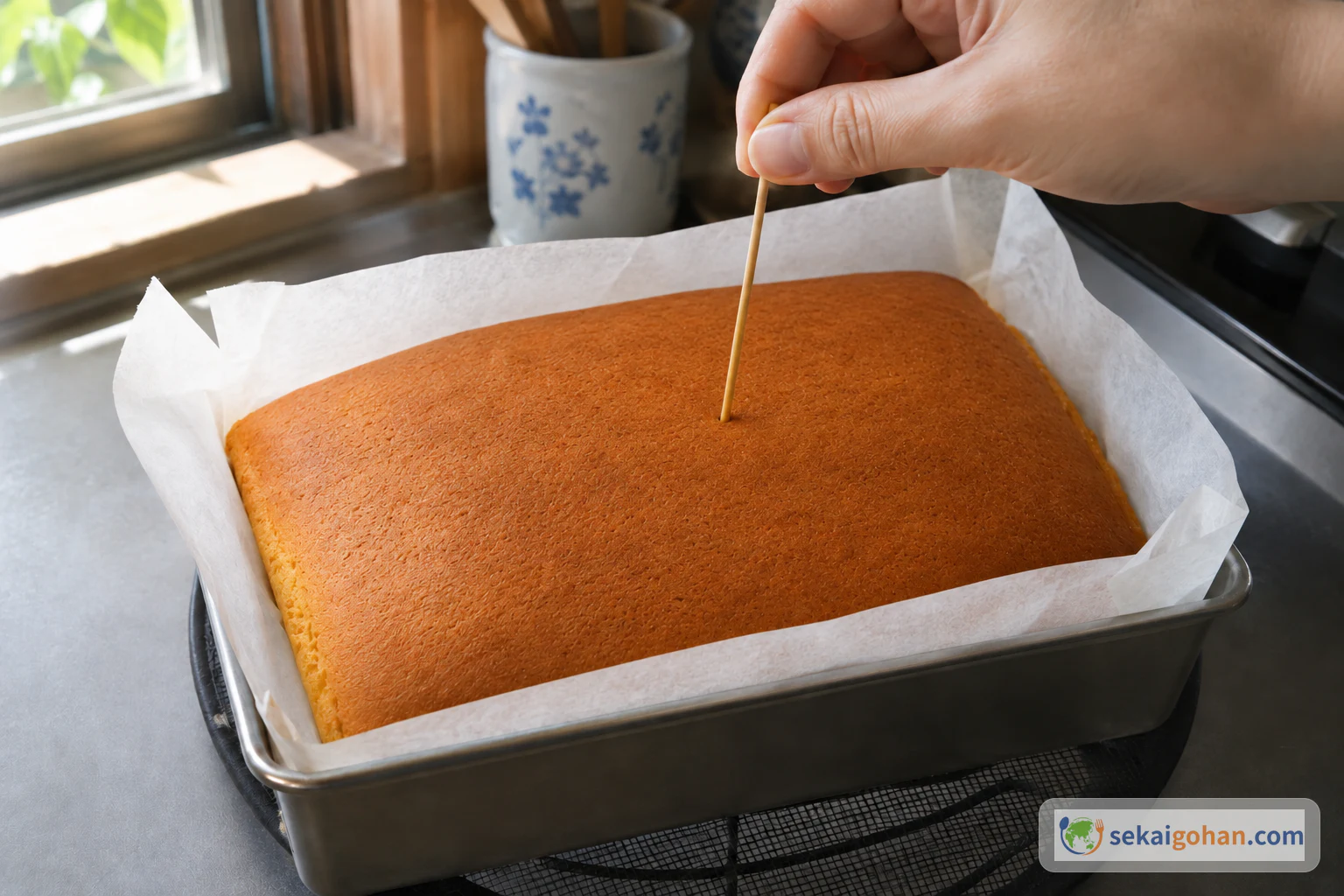
Checking the baked castella in its pan with a bamboo skewer
When no batter clings to the skewer, the cake is done

Insert a bamboo skewer into the center of the cake while it is still in the pan. If no batter clings to it, the cake is done. If batter does cling, bake a little longer and test again with the skewer.

Let the cake cool until it is no longer hot, remove it from the pan and slice.

0 / 0
Ingredients

Ingredients

1 / 1

Ingredients

Ingredient Amount Role
Cake flour (hakurikiko, 薄力粉) 2.75 oz (80g) Sifted and folded in, in two additions, after the eggs are whipped
Granulated sugar (guranyūtō, グラニュー糖) 2.75 oz (80g) Whipped together with the eggs
Eggs (tamago, 卵) 2 Whole eggs, whipped with the sugar
Honey (hachimitsu, はちみつ) 2 tbsp Added with the milk to the whipped eggs
Milk (gyūnyū, 牛乳) 1 tbsp Added with the honey to the whipped eggs
Coarse sugar (chūzaratō / zarame, 中ざら糖/ざらめ) 1 tbsp Spread over the paper on the bottom of the pan; not mixed into the batter

Use whole eggs. No butter, oil, salt, baking powder or starch syrup goes into this cake.

0 / 0

Cut a slice of castella and the first thing you notice is the crumb: small, close bubbles and a yellow color that comes from whole eggs, under a gently browned top. Turn the slice over and there's the second thing, a thin layer of coarse sugar crystals baked onto the base, which gives a little crunch against the soft cake. In Japanese the cake is called kasutera (カステラ), and this is a home-style version from Japan, made with just six ingredients and an ordinary hand mixer.

Castella in Nagasaki and at Home

Castella in Nagasaki is often made with coarse sugar on the bottom. One Nagasaki maker lists eggs, white sugar (jōhakutō), coarse sugar, wheat flour, starch syrup and honey as its basic ingredients. Whipping the eggs, choosing the flour and getting the texture of the coarse sugar right are the key techniques, and the cake rests overnight after baking so the crumb can settle.

At a castella-making experience in Nagasaki, you can watch the whole process. Starch syrup, sugar and eggs are mixed and whipped over hot water, then poured into a pan lined with coarse sugar. The bubbles in the batter are broken up (awakiri) before the cake is baked and unmolded.

This home version is simpler. It uses a small rectangular pan and a single bake, with no water bath, no starch syrup and no overnight rest. Some home recipes take a different route: a Nagasaki-style castella made with bread flour, kibi (cane) sugar and salad oil, with the eggs whipped over hot water and the flour added in three parts, is a separate recipe with its own proportions. Gosanyaki and Taiwanese castella are different cakes altogether.

For more dishes from the same country, see Japan.

Ingredients: Six Items for One 9.5 × 5 × 1.5-inch (24 × 13 × 4 cm) Pan
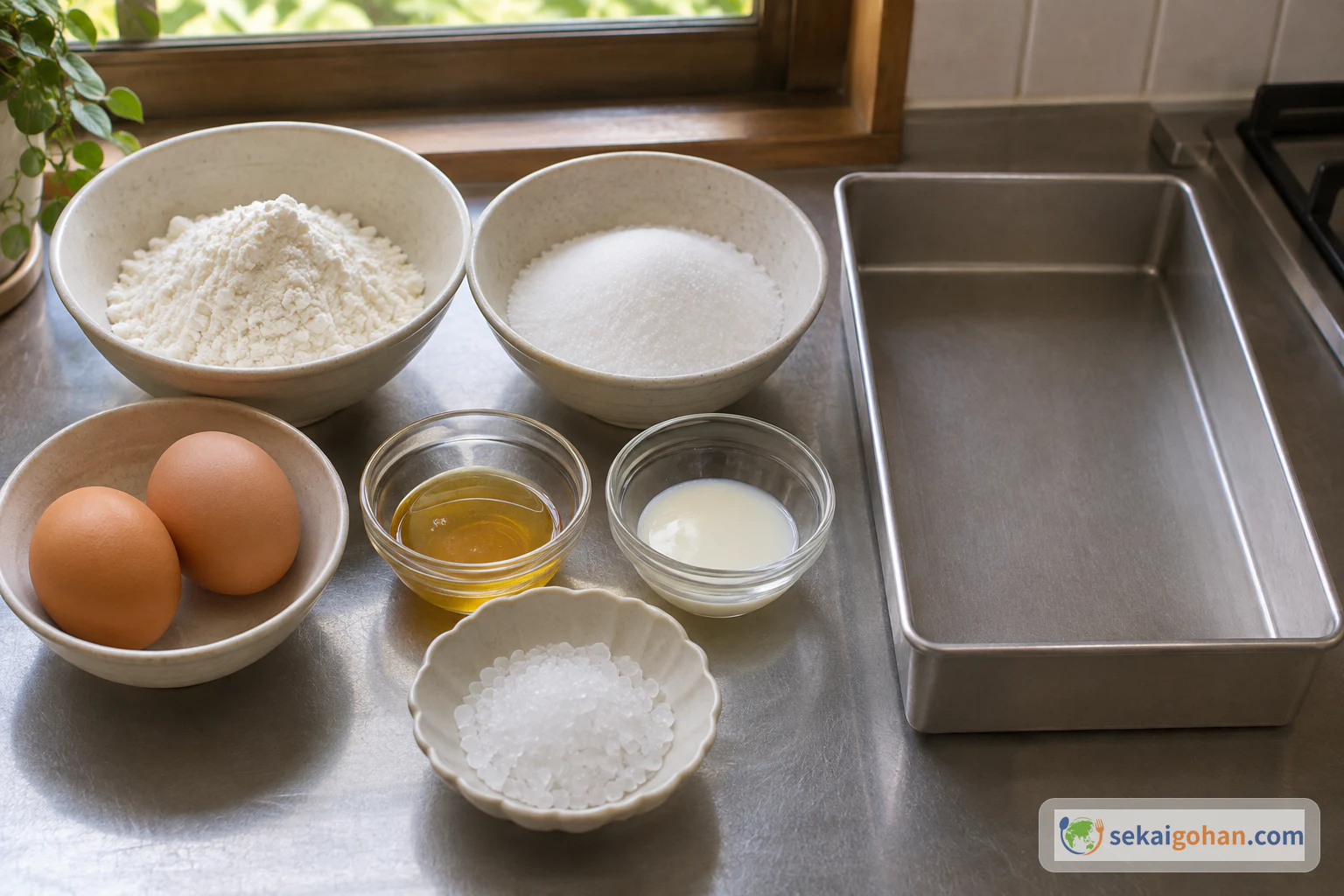
Cake flour, sugar, whole eggs, honey, milk and coarse sugar for castella
Six ingredients, each in its own dish, beside the rectangular pan

This makes one pan measuring 9.5 inches (24 cm) long, 5 inches (13 cm) wide and 1.5 inches (4 cm) deep.

Honey, babies and allergens

Do not give this cake to babies under one year old. Honey and foods containing honey must not be given to infants under one, even after normal baking. The cake also contains egg, wheat and milk.

Equipment

  • Rectangular cake pan, 9.5 × 5 × 1.5 inches (24 × 13 × 4 cm)
  • Oven
  • Parchment paper (oven sheet) to line the pan
  • Mixing bowl
  • Hand mixer
  • Sieve for the flour
  • Rubber spatula
  • Bamboo skewer

Choosing Ingredients for Kasutera

Cake flour. Use cake flour here. With so few ingredients, each one shows in the finished cake.

Coarse sugar is for the bottom only. Chūzaratō, often simply called zarame, is a large-crystal sugar. It is spread over the paper in the pan rather than stirred into the batter, and it's what gives the cake its crunchy base. Leave it out and the base stays soft.

Keep the honey, milk and sugar as listed. Anyone who cannot have honey, egg, wheat or milk should choose a different recipe rather than adapt this one.

Pan size matters. The baking temperature and time are set for a 9.5 × 5 × 1.5-inch (24 × 13 × 4 cm) pan and cannot be converted for a different size or depth, so use a pan as close to these dimensions as you can.

Method: Whip, Add, Fold, Bake, Test

The checks that matter

Whip until the batter holds a trail, fold the flour without stirring hard, and decide when the cake is done with a skewer, not only by the clock.

Kasutera Troubleshooting

Success depends on reading the batter at each stage: how thick the whipped eggs are, how gently the flour goes in, and whether the skewer comes out clean.

What you see What to check What to do
The whipped eggs do not leave a trail Whether the batter has turned pale and thick Keep whipping until the batter falling from the beaters leaves a trail on the surface
Streaks of flour remain Whether you have folded through to the bottom of the bowl Keep folding lightly with the spatula rather than stirring hard or kneading
The batter has become loose and runny after adding the flour How hard it was mixed Next time, fold with cutting strokes without kneading
Batter clings to the skewer after about 30 minutes Ovens differ Bake longer and test again with the skewer; go by the skewer, not the clock
The coarse sugar is scattered through the cake Whether it was mixed into the batter Spread it on the paper in the pan before pouring, and leave it there
Your pan is a different size The dimensions Use a pan as close to the listed size as you can, and rely on the skewer test

Serving Kasutera

Cooled castella cut into slices for serving
Cut the cooled cake so the yellow crumb and the sugar on the bottom show

Wait until the cake has cooled, then slice it to whatever size you like. Each slice should show the yellow crumb, the browned top and the line of coarse sugar along the bottom.

Frequently Asked Questions

Can I give this castella to a baby?

Not to a baby under one year old. In Japan, honey and foods containing honey must not be given to infants under one. Botulinum spores are not killed by ordinary heating or cooking, so this applies to baked foods like this cake too.

Why is the pan lined and sugared in step 1?

So the whipped batter doesn't sit waiting while you prepare the pan.

Does it matter whether the honey or the milk goes in first?

Add the milk and honey together at the same stage, in either order. Step 3 shows the honey going in after the milk.

How many servings does it make?

One 9.5 × 5 × 1.5-inch (24 × 13 × 4 cm) pan.
Sources

  • Ministry of Agriculture, Forestry and Fisheries (MAFF), "Furusato no aji jiman: Satō o tanoshimu kyōdo no kashi — Kasutera" (Hometown flavors: regional sweets that celebrate sugar — Castella). The recipe used in this article: the 24 × 13 × 4 cm pan, the six ingredients and amounts, the order of whipping, adding the honey and milk, folding in the flour in two additions and spreading coarse sugar on the bottom, baking at 170°C for about 30 minutes, and the skewer test. https://www.maff.go.jp/j/pr/aff/2111/spe1_04.html
  • JA Zen-Noh Tamago, "Gotōchi recipe! Nagasaki-ken kasutera" (Local recipe: Nagasaki castella). The note that coarse sugar is often used in Nagasaki castella, and a separate home recipe with bread flour, kibi sugar, salad oil, a hot-water bath and flour in three additions, used for comparison only. https://www.jz-tamago.co.jp/customer/atoz/recipe/a2z00016792/
  • Fukujuya Honpo, "Kodawari" (Our approach). A Nagasaki castella maker's basic ingredients, its explanation of egg whipping, flour choice and coarse sugar, and its overnight rest after baking. https://fukujuya-honpo.co.jp/kodawari.html
  • Izumiya, "Nagasaki kasutera-zukuri taiken" (Nagasaki castella-making experience). The steps of the facility's castella-making experience, used as a process comparison only. https://www.n-izumiya.com/castella-taiken/
  • Ministry of Health, Labour and Welfare, "Hachimitsu o ataeru no wa issai o sugite kara" (Give honey only after age one). The caution that honey and honey-containing foods must not be given to infants under one, because botulinum spores are not killed by ordinary heating. https://www.mhlw.go.jp/stf/seisakunitsuite/bunya/0000161461.html