The square dish comes out of the oven with the sour cream on top browned in spots and small bubbles only at the edges. Cut in and you find thin dough outside and crumbly white cheese inside; hot, it collapses softly, and as it cools a little the layers settle and lift easily with a fork. This is štrukli (Zagorski štrukli / Zagorski štruklji), loved in the Zagorje region of northwest Croatia and around the capital, Zagreb. A dough of flour, water, and a little oil is stretched thin and wrapped around fresh cheese, egg, and sour cream, then boiled, baked, or boiled and then baked. It's a meal built from the tang of dairy and the softness of wheat: white, gentle, and quick to turn watery the moment you cut corners.
Zagorski Štrukli in Zagorje and Zagreb
Zagorski means "of Zagorje," and štrukli means a dish of filled thin dough. Zagorje is a hilly region spreading north of Zagreb, with many home dishes made from familiar ingredients like dairy, flour, and eggs.
The dish name was registered in 2022 as a Protected Geographical Indication (PGI; ZOZP in Croatian) under Regulation 2022/377. The registration protects the name's link to Zagorje and leaves the home method open, so boiled or baked, savory or sweet, all still count.
There is no single way to eat it. Savory versions are served at meals, and sweet ones come with sugar or cinnamon. There is boiled-only kuhani štrukli, baked pečeni štrukli, and versions served in soup. In Zagreb restaurants the baked kind is easy to find, while the sweet version turns up in mountain huts and homes.
Next to its Croatian neighbors, štrukli has its own character. Soparnik of Croatia is a thin pie eaten with greens and garlic oil, and the meat stew pašticada sits at the other end of the table from this mild, dairy-led dish.
Ingredients (serves 4, one 8 inches (20 cm) square dish)

This dish contains wheat, egg, and dairy. Swapping the dairy greatly affects the moisture of the dough and the result of baking, so if you have an allergy, do not force a substitution; choose a different dish.
Where to Draw the Line on Substitutions
Cottage cheese alone can be too crumbly after baking. A little cream cheese gives cohesion, but too much moves it toward an American-style cheesecake. Here, cottage cheese is the star, and the cream cheese is kept under 20 percent of the total.
| What you want to replace | Possible substitute | Effect on the result |
|---|---|---|
| Cottage cheese | 10.5 oz (300g) ricotta | Brings out a dairy sweetness. If it is wet, drain lightly |
| Sour cream | 5.5 oz (150g) strained yogurt and 1 oz (30g) heavy cream | Tang is close but browning is paler |
| Cream cheese | 1.5 oz (40g) feta | Saltier. Soak in water for 10 minutes before using |
| Bread flour and all-purpose flour | 10.5 oz (300g) medium-strong flour | Holds together easily. Start with ½ cup (135ml) water and watch |
| Butter | 2 tsp (10ml) rice bran oil | Weaker aroma, but it still releases from the dish |
What to protect is the thin dough, the tangy dairy, and a short set in hot water before baking. Adapt the cheese to what you can buy, but if you use only pizza cheese, it just melts and you lose the white crumble. Keep it from becoming a melted-cheese dish. That line is what makes it štrukli.
Tools Worth Buying

Flour, eggs, cottage cheese, and sour cream are all available at a regular supermarket. What is worth buying extra is not a rare ingredient but tools for handling thin dough. Start with a short rolling pin, a dish that is too deep, or water whose temperature you cannot read, and the failures pile up: dough that is thick, a heavy center, tearing while boiling.
A rolling pin around 12 inches (30 cm) is a comfortable length for stretching dough over a cloth. If only the center stays thick, the mouthfeel will be heavy after rolling.
A 20 cm square baking dish is a comfortable size for lining up 8 to 10 štrukli without cramming them. If it is too wide the cream on top runs and dries, and if it is too deep the center stays white and heavy.
If you are uneasy judging the temperature of the lukewarm water and how warm the center is when baked, a slim cooking thermometer helps. It also works for bread dough and meat, so it is useful beyond štrukli.
| Priority | What to have | What to look for | Substitute |
|---|---|---|---|
| High | A rolling pin around 12 inches (30 cm) | Lets you roll the dough large and thin | A clean wine bottle. It is heavy, though, and the edges tend to stay thick |
| High | A 8 inches (20 cm) square baking dish | Keeps the filling and cream from spreading too far | An 7 inches (18 cm) round pan. Allow 5 minutes more baking |
| Medium | Cooking thermometer | Lukewarm water, boiling water, checking doneness | Judge the water by gentle bubbling and doneness by bubbles at the edge and a wobble at the center |
| Medium | A clean kitchen towel | Used when rolling the dough | A large sheet of parchment paper. It tears easily, so handle with care |
Choosing Cheese and Dough for Štrukli
The fresh cow's-milk cheese used locally, "svježi kravlji sir," is hard to find outside Croatia. Cottage cheese, a little cream cheese, and sour cream together get close to its tang and crumble. Fancier cheese won't improve things much; technique matters more.
The most common mistake at home is adding melting cheese to make it luxurious. The charm of štrukli lies in the crumbly white grains of dairy and the tang of sour cream, with no stretchy cheese. If you want to add mozzarella anyway, manage the moisture of the cottage cheese first and keep the sour cream in check.
| What you decide | Protect | May be replaced |
|---|---|---|
| Dough | A thin dough that is stretched and rolled | Store-bought phyllo, brushed with a thin coat of oil since it dries easily |
| Cheese | Fresh, tangy white cheese | Cottage cheese, ricotta, strained yogurt |
| Cream on top | The tang of sour cream | A mix of strained yogurt and heavy cream |
| Cooking | Boiled or baked, or both | For a first try, boil and then bake |
| Dish | A shallow baking dish | A round pan is fine. Avoid a deep, pot-shaped one |
If you use store-bought phyllo, stack two sheets (it's fine if they tear), brush the surface with a thin coat of oil, and then add the cheese. You lose the fun of rolling with a cloth as local homes do, and the chewy bite along with it. A sensible split: make the dough on days you have time, and a phyllo "close cousin" on weekdays.
Method: Stretch Thin, Boil Briefly, Then Bake
Štrukli does not need a perfect rectangle of dough. A small tear at the edge disappears as you roll and cut. What matters is leaving no thick spots and not adding too much moisture to the cheese.
Common Štrukli Problems and Fixes

Štrukli is more about moisture than looks. Three habits do the most for it at home: stretch the dough thin, keep the water at a gentle bubble, and let the finished dish rest. A thick dough makes it heavy, loose cheese runs to the bottom, and hard boiling opens the cut ends. Baking directly works too, but in a home oven the center can stay floury, so boiling first and then baking in the dish is the safer route, even in a square baking dish.
When something goes wrong, remove one cause at a time rather than changing everything.
| Condition | Main cause | Immediate fix | Adjustment for next time |
|---|---|---|---|
| White liquid runs out when cut | Wet cheese, not enough rest | Leave it in the dish 10 more minutes | Drain the cottage cheese for 5 minutes |
| Tears while boiling | Water too vigorous, cut ends pressed too hard | Move torn pieces to the dish first for baking | Gentle bubbling over medium heat, press cut ends lightly |
| Dough is tough | Not rested enough, too little all-purpose flour | Serve with sour cream alongside after baking | Rest 40 minutes and add 20g all-purpose flour |
| Heavy center | Too much cream on top, deep dish | Bake 5 minutes more at 180 degrees C | Use a shallower dish and a thinner topping |
| Flavor is blurry | Not enough tang or salt in the cheese | Serve with a little sour cream and salt at the table | Add 1 tsp (5ml) lemon juice and 1g more salt |
| Only the surface burns | Top heat too strong, rack too high | Loosely cover with aluminum foil | Bake on the middle rack and lower from 190 to 180 degrees C |
If the dough tears while you work, keep going. As long as there's no large hole on the outside, roll the torn part inward, cut short pieces, and boil. The wrinkles in thin dough hold the sour cream when baked and honestly taste better.
Serving and Storing Štrukli

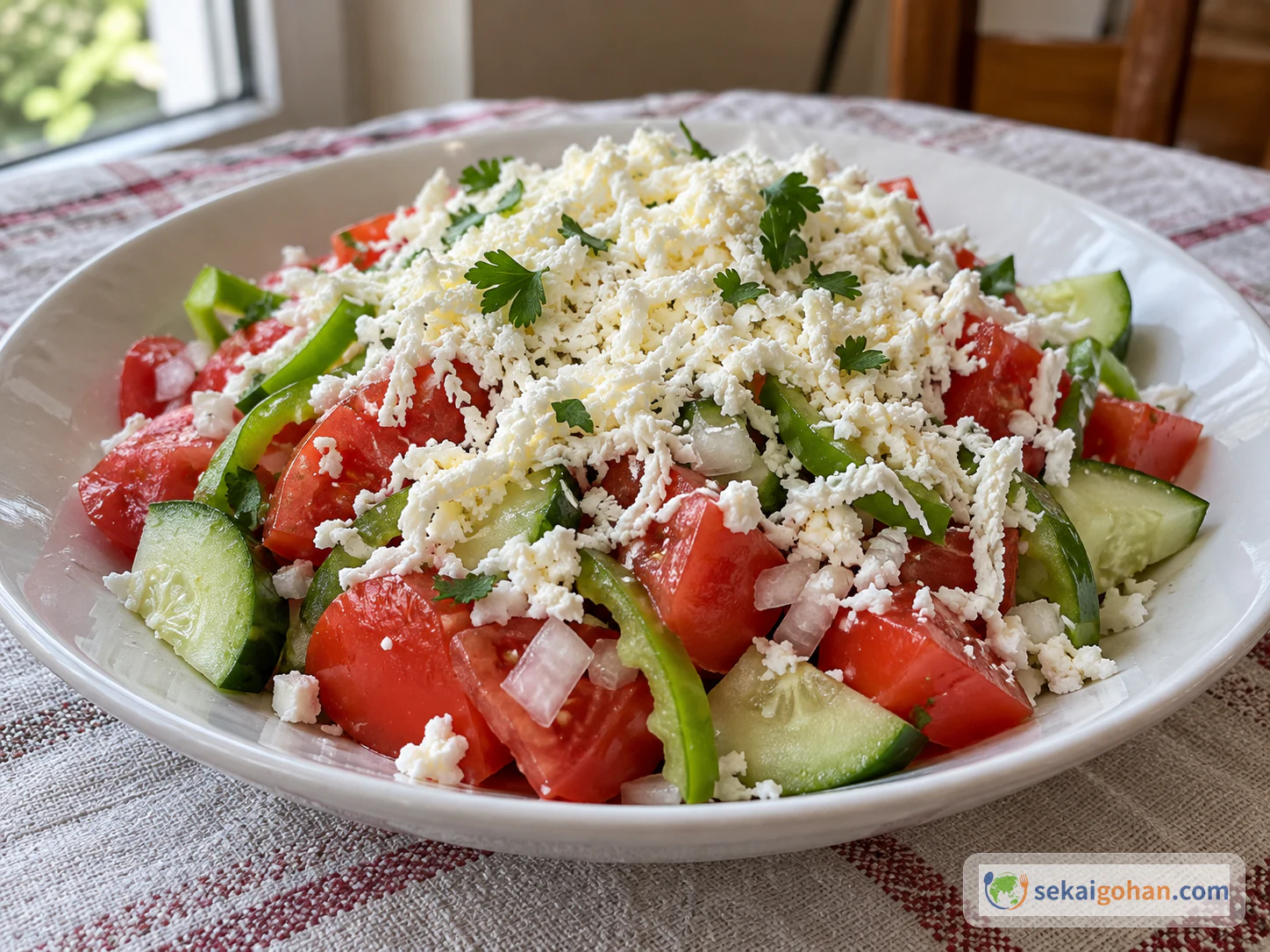
Fresh from the oven, štrukli works as a starter or a light lunch, and it's fair to think of it as a warm dairy dish that can also stand in for a staple. A small salad of cucumber, tomato, and onion, or a clear soup, brings out the tang of the white cheese better than a heavy meat sauce. For a Croatian meal, the greens-filled soparnik or a bean dish keeps things lighter than pašticada.
Compared with Georgia's achma, which is heavy with cheese, štrukli is lighter, so keep the other sides free of extra dairy and the meal stays easy to finish. With the sweet version, strong coffee or tea is the natural partner.
| Occasion | What to serve alongside | Why |
|---|---|---|
| Lunch | Salad of cucumber, tomato, and onion | Loosens the weight of dairy with tang and moisture |
| Starter | Clear chicken or vegetable soup | Lets the aroma of the white cheese come through |
| Sweet version | A little powdered sugar, cinnamon, strong coffee | Adds aroma just before eating instead of sugar in the filling |
| Leftovers | Warm in a toaster oven and add a little sour cream | Revives the surface of the dough and makes up for dry edges |
To store, cool it completely, wrap each piece in plastic wrap, and refrigerate for about 2 days. Reheat for 8 to 10 minutes in a toaster oven or oven at 180 degrees C. A microwave alone makes the dough too soft, so warm it at 600W for 40 seconds and then bake 2 minutes in the toaster oven.
It can be frozen, though some moisture seeps from the cheese. Cut it after baking, wrap each piece, and finish it within 2 weeks. Heat from frozen in a 180 degrees C oven for 15 to 18 minutes and check that the center is hot.
FAQ
Is štrukli the same as Slovenian štruklji?
They are close dishes, but the region and the way of eating differ. Croatia's Zagorski štrukli belongs to Zagorje and the area around Zagreb, and the cheese-filled form, boiled, baked, or boiled and then baked, is the common one. Slovenian štruklji have a wider range of fillings and are sometimes served as a side. For a dish that pours flour and dairy into a pan instead of wrapping them, compare Prekmurje's zlevanka, and the difference becomes clear.
Can I use store-bought spring roll wrappers or dumpling wrappers for the dough?
I don't recommend it. Dumpling wrappers are too small and thick, and spring roll wrappers tear easily once they absorb moisture. Store-bought phyllo is easier to work with; brush it with a thin coat of oil and roll it promptly.
Can I bake it without boiling?
Yes. Arrange it in the dish, spoon over the sour cream, and bake at 180 degrees C for 35 to 40 minutes. If the dough is thick, though, the center tends to stay floury, so for a first try a brief boil before baking gives a steadier texture.
What do I change to make a sweet version?
Reduce the salt in the filling to 2g, omit the black pepper, and add 1 tsp (5ml) lemon juice. Sprinkle a little powdered sugar and cinnamon after baking, and you're close to the sweet version served at mountain huts. A lot of sugar in the filling tends to draw out moisture, so add sweetness just before eating; the dairy's tang stays, and restrained sweetness suits it.
For make-ahead, is it better before boiling or after baking?
After baking is safer. Left for a long time before boiling, the dough absorbs moisture from the cheese and tears easily. If preparing the day before, finish through baking, refrigerate, and reheat in the oven before eating.