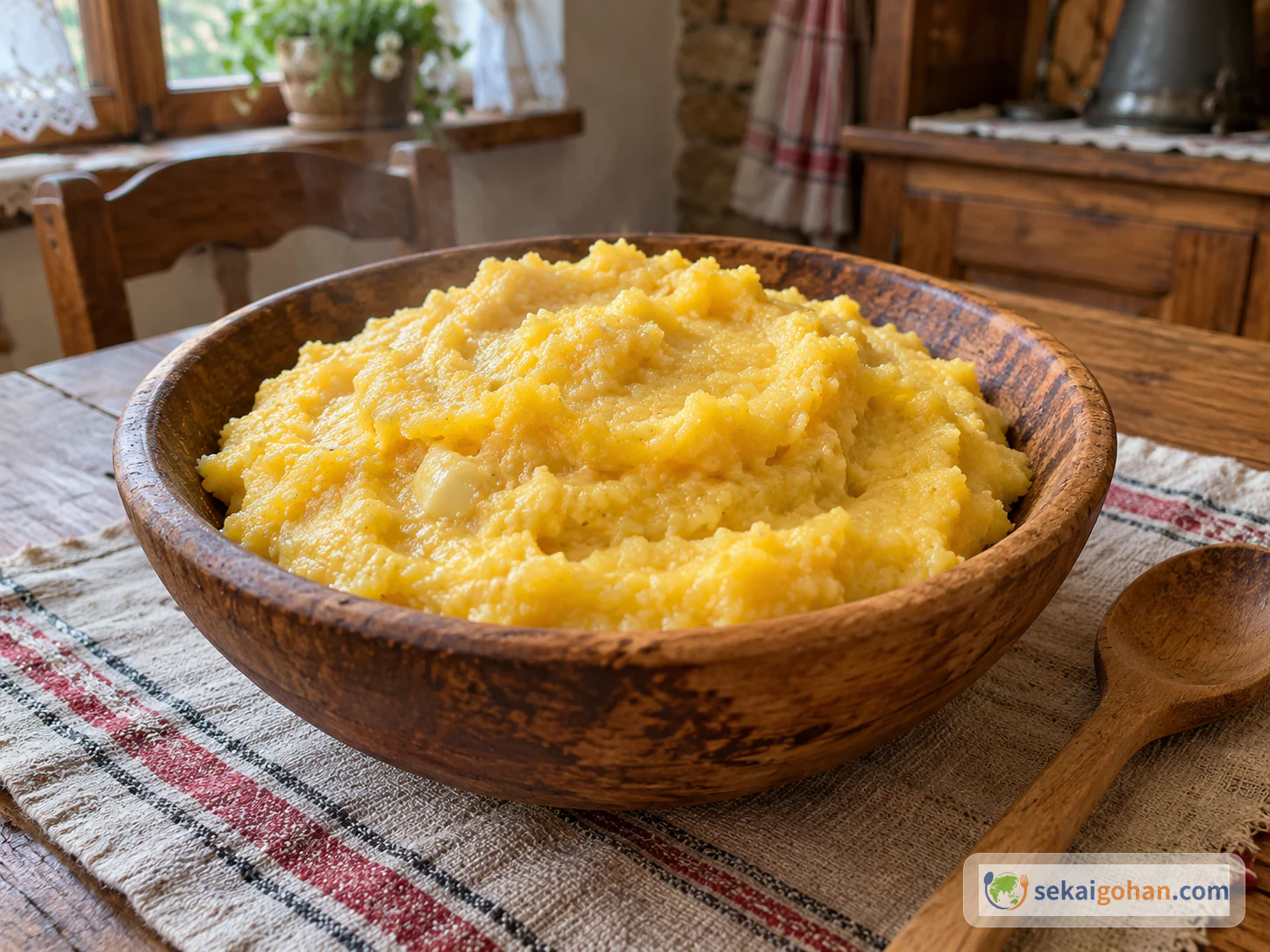
When you pour the yellow batter into a hot pan, only the edge sizzles. In the oven the flat surface slowly rises, and the sweet smell of baked corn takes over from the softer smell of milk. Zlevanka is an everyday sweet from northeastern Slovenia, and it comes with no fancy decoration. You pinch off a slightly scorched edge and eat the center while it's still warm. It's too thin to call a cake and too soft to call bread. With so little sugar, it tastes mostly of corn and milk.

Zlevanka in Prekmurje and Prlekija
Zlevanka comes from Prekmurje and Prlekija in northeastern Slovenia. Its name comes from the Slovenian zlivati, "to pour," and that is the whole method. A pourable batter goes into a hot pan and bakes. There's no kneading, no waiting for it to rise like bread and no stretching like a layered pastry.
The standard spelling is zlevanka, and in Prekmurje you'll also see zlejvanka. Related names zlijevka and zlevenka appear in northern Croatia, and the ingredients and names change slightly across the border.
Why Prekmurje bakes with cornmeal and buckwheat

Open the bags and the cornmeal is bright yellow, the buckwheat flour a cloudy-sky gray. Prekmurje, where these two flours sit side by side, lies on the Pannonian plain across the Mura river, at the far northeastern edge of Slovenia. It is close to Austria, Hungary and Croatia, and its cooking took in dairy, pork and pumpkin seeds from all of them. Zlevanka has never settled into one fixed recipe, because households switched between sweet and savory depending on the flour they had and the work of the season.
The sweet koruzna zlevanka is a simple bake of cornmeal or polenta meal, milk, egg and cream. Ajdova zlevanka is made with buckwheat flour, which people relied on even when white wheat flour was scarce. It used to be served beside soup and today is eaten as a warm starter or a light meal, often topped with pumpkin seed oil that adds a near-black green color and a roasted aroma. There's also a version layered with yogurt or sour cream. Under one name you get a pale yellow sweet and a grayish savory dish, and people eat them at different times.
What all of them share is how easy they are to make. You mix the batter to the right consistency in a large bowl while the pan heats, then pour and bake, so it fits in between other jobs. It works just as well in a modern kitchen. About an hour after you start measuring, you can be eating a warm slice with the powdered sugar still unmelted on top.
How zlevanka differs from similar dishes
Moldova's Mămăligă is stirred in a pot, but zlevanka is never stirred. It's poured and sets from the edge in. Across the border, Croatia's Zagorski Štrukli also uses dairy and flour, but its dough is stretched and wrapped around a filling. Paraguay's Sopa Paraguaya is another baked corn dish, but it's a rich meal bread with onion and cheese. Zlevanka is a thin, sweet bake that keeps the lightness of milk.
Ingredients and choosing flour: fine-ground keeps the center from getting heavy

This makes one 10 inches (26 cm) skillet or one 9.5 inches (24 cm) square metal baking pan. Cut it into 8 pieces, 2 pieces each for 4 people.
This recipe uses egg and dairy. Cornmeal itself has no wheat, but some products are made in a facility that handles wheat. If you need to avoid gluten, check the allergen label on the bag.
Corn flour, cornmeal and cornstarch
The yellow powders on the shelf are easy to mix up. This recipe uses corn flour: corn ground finely, or fine-grained cornmeal. White cornstarch is only the starch, so it gives neither the aroma of baked corn nor the soft, crumbly texture of flour.
If you use fine cornmeal, use up to 2.75 oz (80 g) of the 9 oz (250 g) for a slightly grainy, farmhouse texture. If you use coarse-ground for the whole amount, the grains cannot absorb all the liquid in a 20 to 30 minute bake, and the center stays firm. If the flour in the bag is clearly coarser than sugar, use fine corn flour as the main flour.

Milk and egg are easy to find. The flour and the pan need more thought. Fine corn flour alone is enough. For a fragrant edge, use a heavy skillet that can go in the oven. If you use a thin aluminum pan, do not preheat it. Oil it, pour in the batter, and extend the bake by about 3 minutes.
Choosing flour and substitutes for zlevanka
The grind of the flour matters most. Fine flour gives a batter that pours smoothly and bakes up moist, so check the bag and make sure the ingredient list says corn (see the FAQ on cornstarch below). Cornstarch can't give you the smell of ground corn.
Everything else is more flexible. The brand of dairy doesn't matter, cream can be swapped for yogurt, and a metal pan can stand in for an iron one. Look for the right flour and keep the two baking temperatures, and you have what matters in the local recipe.
How to make it: lift at 400°F (200°C), set the center at 350°F (175°C)
The temperature of the pan matters more than the batter. Preheat the oiled skillet so the edge sets first. If you use a thin metal pan or heatproof glass, do not preheat it empty unless the label confirms it is safe. Pour in the batter, then put it in the oven.
Unless the product label confirms that heatproof glass or a thin metal pan can be heated empty, do not preheat it. Pour the batter into a room-temperature oiled pan and bake at 400°F (200°C) for 10 minutes, then at 350°F (175°C) for 18 to 23 minutes. The edge sizzles less, but avoiding cracks matters more.
Zlevanka failures and fixes
Zlevanka is thin, so if you watch only the browning it can dry out quickly. Judge it by the center, not the edge. A good cross-section has fine holes and springs back, still moist, when you press it. If it's underbaked, liquid seeps out at the center. If it's overbaked, the cut edge crumbles like sand.

| State | Cause | What to change next |
|---|---|---|
| Center is wet and sticks to the spatula | Lowered to 350°F (175°C) too early, pan too small so batter too thick | Add 5 minutes at 350°F (175°C), and next time use a pan of 9.5 inches (24 cm) square or larger |
| Only the edge is black, the center white | Pan preheated too long, too much oil | Preheat 3 minutes and reduce the pan oil to 2 tsp (10 ml) |
| Crumbles apart everywhere | Too much coarse flour, overbaked | Keep coarse flour to 2.75 oz (80 g) or less and shorten the 350°F (175°C) time by 3 minutes |
| Bottom is sticky | Pan was cold, cut without resting | Use a pan that can be preheated and wait 10 minutes after baking |
| Heavy like mochi | Used cornstarch, flour lumps remained | Switch to a yellow flour whose ingredient list says corn, and mix in 3 portions |
Don't pour milk over an overbaked piece to save it, because it will fall apart. Instead, cut it into 0.5 inches (1 cm) cubes and scatter a few under plain yogurt and fruit, where the dry, floury texture works well. Leave an underbaked one uncut: put it back in the pan and keep heating at 350°F (175°C) in 5-minute steps.
Your pan changes things too. At the same temperature, a black iron skillet browns the edge and bottom faster, while a thin silver pan takes a little longer to heat through to the center. If the edge darkens first even when you follow the times, cover the rim with thin strips of aluminum foil for the second half of baking. If the bottom stays pale, use the lower oven rack next time. Moving the pan and adding time in 5-minute steps works better than big temperature changes, and it won't dry out the center.
Serving, variations and storage

Sweet and savory serving
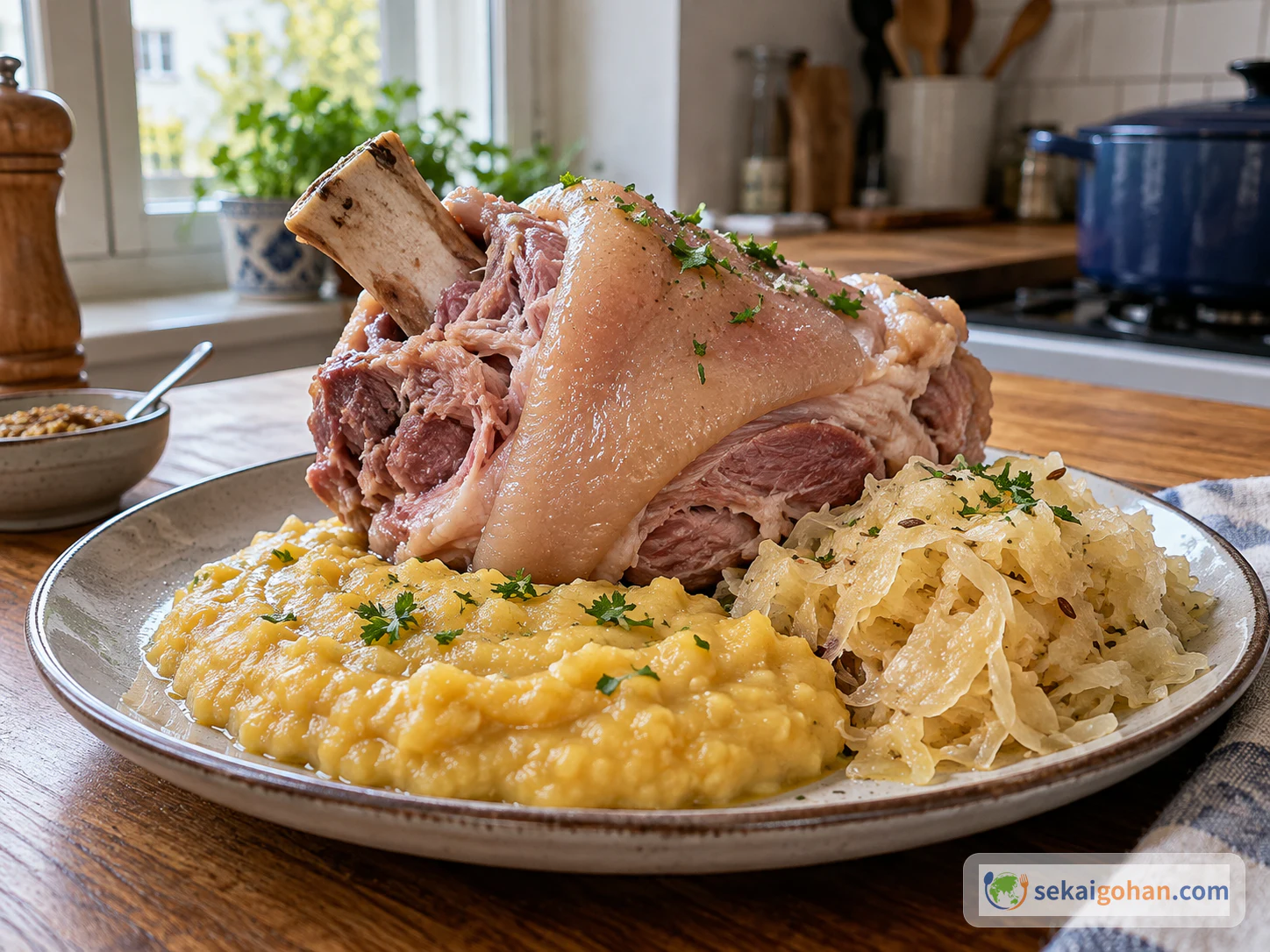
This koruzna zlevanka is the sweet version, dusted lightly with powdered sugar and eaten with coffee or milky coffee. With only 24 g of sugar, it feels more like breakfast or a light snack than cake. Skip the powdered sugar and it also goes well with a salty soup. To serve it with vegetable soup, a bean stew or Hungary's Goulash, cut the sugar to 8 g and leave off the powdered sugar. Don't drop the sugar entirely: with none at all, the green, raw-corn taste stands out, and 8 g is enough to fit a savory plate. It's light enough to eat with eggs the next morning, too.
Buckwheat ajdova zlevanka
The buckwheat version is the same shape but a different dish, with its own recipe. Use 10.5 oz (300 g) buckwheat flour and 2 eggs, and add milk until the batter is just a little thicker than pancake batter. Pour it into a hot pan and bake briefly at high heat. Finish it with crisp pork cracklings or pumpkin seed oil and serve it warm, beside soup or as a starter. Don't just swap buckwheat flour for the cornmeal in equal amounts.
Storage and reheating

Once the pieces are completely cool, lay them in an airtight container lined with parchment, without overlapping. They keep for 2 days in the refrigerator or 2 weeks in the freezer. To freeze, put parchment between the pieces. Dust with powdered sugar only after reheating, since it soaks up moisture.
Zlevanka firms up in the refrigerator. Reheat it in a dry skillet over low heat, 2 minutes per side, and don't pour water on top. Leave the lid off at first, because trapped steam makes the edge soggy. If only the center is still cold, cover it for the last 30 seconds. Thaw frozen pieces in the refrigerator for 6 hours, then warm them the same way. The microwave alone isn't ideal: more than 20 seconds at 600 W makes the center tough. If you do use it, crisp the edge in a low-heat skillet for the last 30 seconds so it tastes closer to fresh-baked.
Frequently asked questions: substitutes, storage, serving
Can I make it with cornstarch?
No. Cornstarch is a white powder made from only the starch of the corn, and it behaves differently from corn flour. It makes zlevanka very springy, and it turns dense and gummy, like mochi, as it cools. Check the ingredients and the color on the bag, and choose yellow corn flour or fine cornmeal.
Can I make it without cream?
Yes. Use 1.5 oz (45 g) plain unsweetened yogurt instead. It adds a little tang, which brings it closer to another local style of zlevanka. Keep the milk the same, and add 1 tbsp (15 ml) more only if the batter is heavy. Butter makes it hard once cool, so stick with oil and dairy.
Can I make it without a skillet?
Yes. Use a 9.5 inches (24 cm) square metal cake pan or a baking dish of about 8 inches (20 cm) x 11 inches (28 cm). If the pan is thin, don't preheat it empty. Oil it, pour in the batter, then put it in the oven. Extend the 400°F (200°C) stage to 10 minutes, then switch to 350°F (175°C) and check whether the center springs back. Some heatproof glass can crack with sudden temperature changes, so put a glass dish in the oven at room temperature.