Drop yellow meal into hot water a little at a time, and what began as a thin gruel turns into a heavy dough that pushes back against the wooden spoon. The sweet smell of corn fills the kitchen, and when the dough starts pulling away from the sides of the pot, the mămăligă is ready. Made from nothing more than cornmeal, water, and salt, this golden staple has long stood in for bread on Moldovan tables. It's simple and sweet with corn, and it soaks up whatever stew, cheese, or sour cream you put beside it.
About mămăligă
Mămăligă in Moldova and beyond
Mămăligă is the Romanian word for cornmeal porridge, and the name is the same in Moldovan (the Moldovan variety of Romanian). It is widely eaten in Romania, Moldova, western Ukraine, and parts of Serbia. Cooked cornmeal staples turn up all over the world, from Italian polenta to Ghanaian fufu and Tanzanian ugali.
Mămăligă is close to Italian polenta, but Moldovan cooks make it firmer, turn it out in a dome, and cut it with thread (ata). Thread doesn't crush the cut surface the way a knife does, so even hot dough divides cleanly. On the table it is the staple itself, eaten in place of bread.

People often ask whether mămăligă is just polenta. The raw material is the same, but the two differ in several ways:
- Firmness: polenta is prized for creamy softness, while mămăligă is stirred until "the wooden spoon stands up"
- Cutting: polenta is scooped with a spoon or cooled and sliced. Mămăligă is cut with thread while warm
- How it is eaten: polenta is a side (next to a meat dish). Mămăligă is the staple itself (in place of bread)
- Cultural position: polenta is a regional dish of northern Italy. Mămăligă is the national staple of Moldova and Romania
How corn reached Moldova
Corn came to Europe from the New World in the 16th century. It reached Moldova (then the Principality of Moldavia) in the early 17th century, and because the fertile black-earth region (chernozem) and temperate continental climate suited it so well, it spread rapidly. Before then, Moldovans lived on millet and buckwheat porridges, but corn out-yielded the older grains, and within about 100 years mămăligă had moved to the center of the table.
From the poor man's bread to a national dish
For a long time, mămăligă was also a symbol of poverty. In the serfdom era in Moldova (18th and 19th centuries), landowners ate wheat bread while peasants filled their stomachs with mămăligă, and "can only eat mămăligă" was a byword for being poor.
That meaning flipped after the fall of the Soviet Union and Moldovan independence (1991). A movement arose to revive traditional culture suppressed in the Soviet period, and mămăligă was reclaimed as a dish of Moldovan identity. Much like Brazilian feijoada, which rose out of the history of slavery to become a national dish, mămăligă came through hard times to become a source of national pride.
Ingredients (serves 4)
Ingredients and tools for this dish
When shopping for mămăligă, focus on the meal and the pot more than the dairy. Feta and sour cream from an ordinary grocery store are fine, but the grind of the cornmeal and the thickness of the pot greatly affect the result. If you will serve tocană too, paprika adds color and aroma to the table.
Choosing cornmeal and substitutes for mămăligă
With so few ingredients, only three things really matter: cornmeal of medium grind or coarser, low heat in a heavy pot, and cutting with thread while hot. Hold to those and you can swap feta for cottage cheese, or sour cream for strained yogurt, without changing the meal much.
Medium grind has the best balance, finishing chewy while still showing its grain. Coarse grind leaves grittiness, and fine grind is so smooth it lacks elasticity. Many polenta meals are close to medium grind, so they make a good first choice. Avoid instant polenta: it cooks in 5 minutes but never develops the chewy elasticity mămăligă needs, so choose a package that does not say "instant" or "quick cook."
Use less water for firmer mămăligă and more for softer. 3¼ cups (800 ml) makes firm mămăligă for slicing, 1 quart (1 L) makes standard, and 1.25 quarts (1.2 L) makes soft, porridge-style mămăligă, which Moldovans sometimes eat for breakfast with milk. If you are making it for the first time, start with a slightly softer 1.25 quarts (1.1 L); lumps are easier to crush and there's less that can go wrong.
If you add tocană as an accompaniment
Time required: 45 min
Mămăligă alone can be a staple, but for dinner a pork tocană adds satisfaction. Heat 2 tbsp vegetable oil in a separate pot and cook the onion over medium heat for 8 minutes until pale golden brown. Add the garlic and cook 2 minutes, then add 1 tbsp paprika and stir for only 30 seconds. If it scorches here it turns bitter, so move on as soon as the powder has blended into the oil.
Add bite-size pork shoulder and brown the surface over medium heat for 5 minutes. Add ½ cup (100 ml) white wine and simmer 1 minute, then add the canned tomatoes and bay leaves. Cover and simmer over low heat for 30 minutes at a gentle bubble, and when the meat is tender enough to fall apart with a fork, adjust with salt and pepper.
Serving at the table
Time required: 5 min
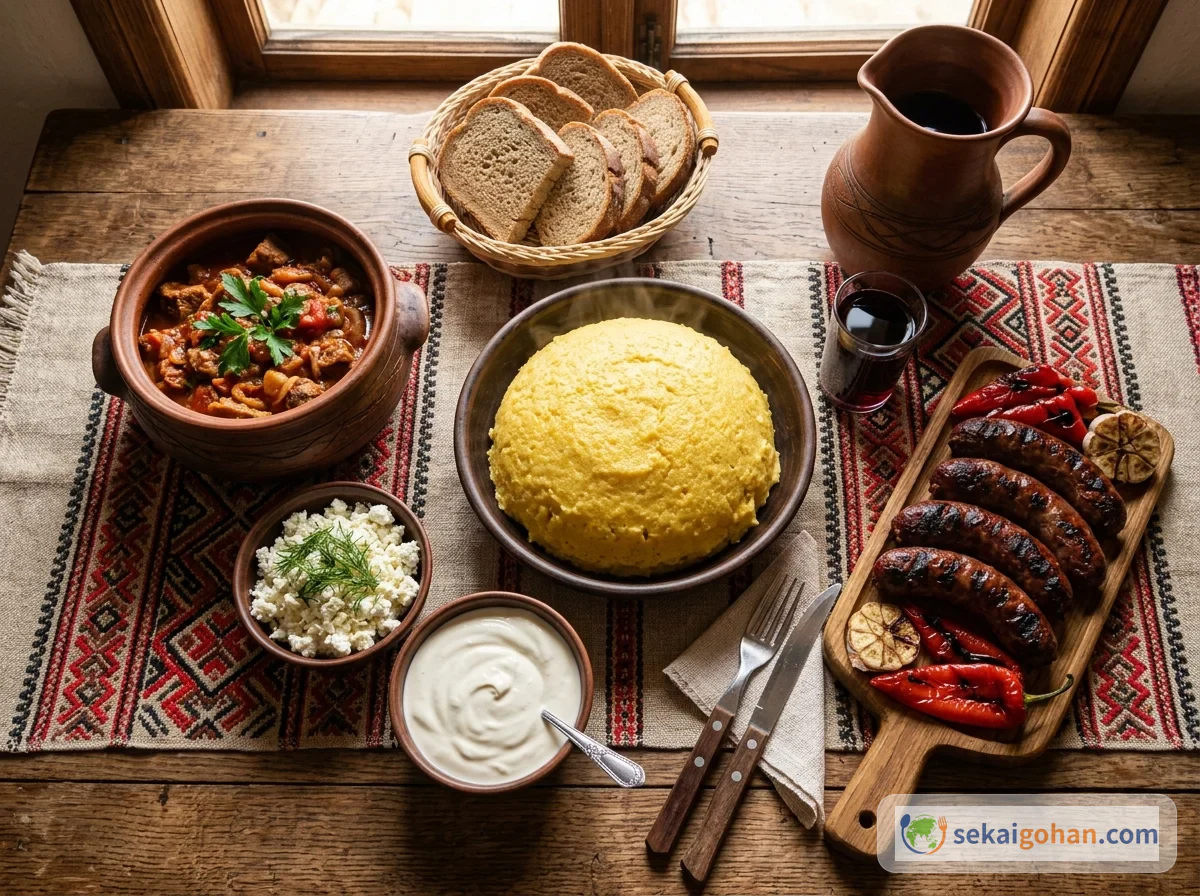
Arrange slices of mămăligă on a large platter and put the tocană next to them. Crumble feta over the mămăligă and add sour cream. In the Moldovan style, you tear off mămăligă by hand and dip it into the tocană. You can use a knife and fork, but while it is hot, crumbling it with a spoon and scooping up the stew also suits it well.
Mămăligă failures and fixes
The hard part at home is the heat, not the ingredients. In a thin pot over strong heat the bottom scorches, and adding the meal all at once leaves lumps. Stirring hard over high heat in a thin saucepan also costs you the elasticity that makes mămăligă what it is. Many stoves run hot, so if the bottom starts to feel heavy once you begin stirring, drop a notch below low heat.
The thin layer stuck to the bottom of the pot after stirring is called răscotură, and in Moldova it is sometimes enjoyed rather than thrown away. It's crisp, with a faint toasted aroma, and dipped in sour cream it makes a nice little bonus. Black scorched patches are strongly bitter, though, so eat only the thin brown film.
Add the butter just before turning off the heat, since long heating drives off its aroma. Cutting cold butter into 0.5 inches (1 cm) cubes and mixing it into the dough brings out the sweetness of the corn as it melts. When serving with a paprika-forward stew like Hungarian goulash, a little lard in place of butter adds more richness.
Serving, nutrition, and variations
Serving mămăligă the Moldovan way
In Moldova, mămăligă sits at the center of the table with stews, white cheese, sour cream, and wine. As with Romanian plăcintă, flour and dairy are part of everyday eating here. Moldova is also a notable wine-producing country, and red Fetească Neagră with mămăligă and tocană is one of the pairings that best represents its food culture.
Nutrition (per serving of 4, about 3 slices)
Mămăligă itself is only cornmeal, water, and salt. It is gluten-free and provides B vitamins and fiber from the corn. The accompanying cheese and sour cream supplement protein and fat.
| Nutrient | Amount |
|---|---|
| Calories | 310 kcal |
| Protein | 7 g |
| Fat | 8 g |
| Carbohydrates | 2 oz (54 g) |
| Fiber | 3 g |
| Sodium | 380 mg |
Cornmeal contains vitamin B1 and B3 (niacin), but the niacin in untreated corn is hard for the body to use. That's why the traditional Moldovan meal pairs mămăligă with dairy and meat. Mexican sope takes a different route, using masa treated with lime; both cultures build the rest of the meal around a corn staple to make up for what it lacks.
Variations

Fried mămăligă. This is the classic use for leftovers. Slice the cold mămăligă from the day before 0.5 inches (1 cm) thick, heat 2 tbsp butter in a frying pan, and cook 3 minutes per side until crisp outside and chewy inside. In Moldova it is called mămăligă prăjită and is classically eaten with eggs, for breakfast or a snack.
Mămăligă with cheese (mămăligă cu brânză). Crumble 3.5 oz (100 g) feta into the finished mămăligă, mix it in, and bake at 400°F (200°C) for 15 minutes. The cheese melts all through and the top browns nicely, a cheese-and-grain pairing in the spirit of Georgian khachapuri.
Sweet mămăligă (breakfast version). Make the mămăligă softer (using 1.25 quarts (1.3 L) water), spoon it into a bowl while warm, pour over ¾ cup (200 ml) milk, and drizzle with 2 tbsp honey. This is a traditional breakfast in rural Moldova, and on a winter morning it warms you right through. It has the same everyday comfort as Nepali dal bhat, another dish built on a daily grain.
Mushroom tocană (vegetarian version). Instead of pork, use 7 oz (200 g) shimeji, 7 oz (200 g) king oyster mushrooms, and 3.5 oz (100 g) button mushrooms. Brown them over high heat before stewing to concentrate their savor. Moldova's forests are rich mushroom country, and in autumn mushroom tocană is a staple of home cooking.
Miso-butter mămăligă. Mix miso butter (20 g butter plus 1 tbsp white miso) into the finished mămăligă in place of plain butter, and serve it with ginger-fried pork belly instead of tocană for an East-meets-West plate. The sweetness of corn and the savor of miso are surprisingly well matched.
Frequently asked questions
Q1. I got lumps. Can I recover?
Yes. Keep stirring over low heat, pressing the lumps against the pot with the spatula; about 10 minutes of stirring removes most of them. If some remain, about 5 seconds with a hand blender clears them. Next time, add the cornmeal in smaller amounts and stir faster.
Q2. Can I make it ahead?
Leftover mămăligă keeps in the refrigerator for 3 days wrapped in plastic wrap, and it can be frozen for 1 month. It turns hard as it cools, which makes it perfect for fried mămăligă, the tastiest way to use it up.
Q3. The bottom of the pot scorches. What should I do?
The main cause is heat that is too strong. Medium heat is fine for the first 10 minutes of stirring, but once the porridge thickens, always drop to low. Stir in big strokes that scrape the bottom of the pot, and if you can, use a cast iron or enameled pot, which spreads heat evenly and scorches less.
Q4. What is the difference between mămăligă and ugali?
Both are staples of cornmeal cooked with water, but the method and texture differ. Mămăligă is stirred for a long time (20 to 25 minutes) to a smooth finish, while ugali is cooked quickly and firmly into a mass you tear off by hand. Mămăligă belongs to a dairy culture that pairs it with butter and cheese; ugali is eaten dipped in stews.
More Eastern European dishes
- Plăcintă: A Romanian pie of thin pastry wrapped around cheese or apples, a staple of Romania and Moldova alongside mămăligă
- Goulash: Hungarian paprika stew, and a good mămăligă accompaniment
- Pierogi: Polish dumplings, a leading example of Eastern Europe's wrapped foods
- Burek: Bosnian spiral pie from the flour-based kitchens of Eastern Europe and the Balkans
- Georgian cuisine introduction (in Japanese)
- Fergesë
- Piti
- Kurnik
Sources
Recipes and cooking methods
- Kollegaeva, K. (2023). "Authentic Moldovan Mamaliga: Traditional Cornmeal Porridge." Eastern European Food. https://easterneuropeanfood.com/moldovan-mamaliga/ (an authentic recipe by a food writer from Moldova)
- "Mămăligă: The Golden Porridge of Moldova and Romania." (2024). 196 Flavors. https://www.196flavors.com/moldova-mamaliga/ (an explanation of mămăligă from a site presenting traditional dishes of countries around the world)