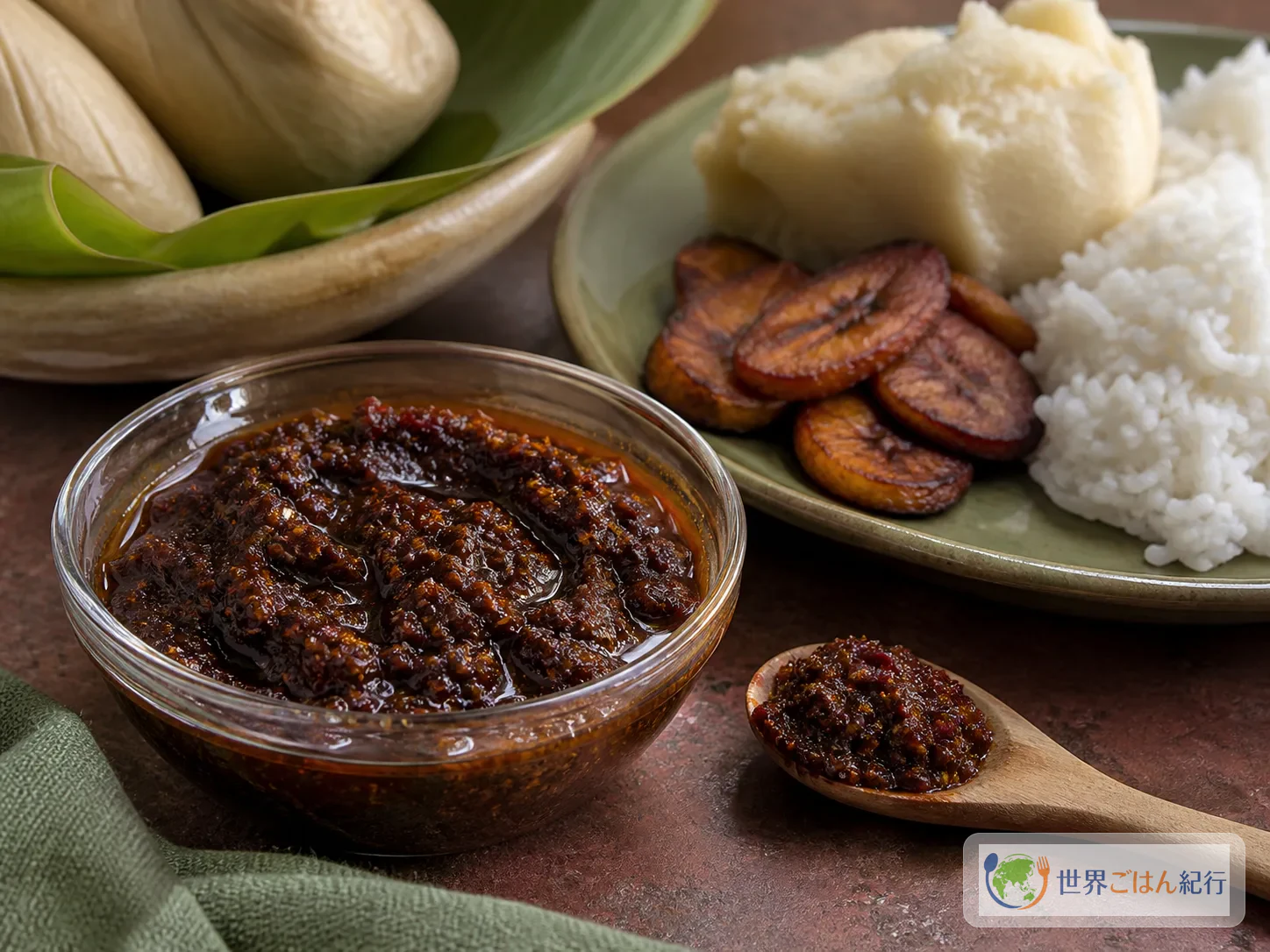


Thud, thud, scrape. In a wooden mortar, a pestle pounds freshly boiled starchy roots while another pair of hands quickly turns the dough, over and over, until the lumps disappear and it becomes a glossy, smooth mass. That mass is fufu (also fufuo), a dish handed down in Ghanaian kitchens. It is a staple eaten with soup: a springy, mildly flavored mound of pounded cassava and green plantain that you tear and dip into a red chicken light soup as you eat.
Quick answer: Ghanaian fufu is a soft, stretchy dough made by boiling cassava and green plantain and pounding (or mashing) them until smooth. It is eaten with soup rather than on its own: you tear off a bite, dip it in the broth and swallow it with the soup. This recipe uses peeled cassava and green plantain, with a chicken light soup, and takes about an hour.
What is fufu?
Fufu is a West African staple, a smooth dough made from boiled starchy roots or plantains, and in Ghana it is most often cassava and green plantain. It has a mild flavor of its own and a springy, stretchy texture; the soup supplies the seasoning. Spellings vary (fufu, fufuo, foufou), but in Ghana they point to the same pounded dough. Fufu is not the same as fufu flour or cassava flour: the flour products are convenient shortcuts, and not every cassava flour works (see the FAQ below).
Fufu in Ghana

Pounding boiled roots and plantains is hard work. You crush them with the pestle, turn the dough, and keep gathering it until it turns smooth and springy, so at home families share the work.
What goes into the mortar changes by region and household. One Ashanti family combines cassava and plantain; regional examples include cassava among the Ga people and yam among the Ewe. Kwahu, in the Eastern Region, is a forested area spreading west of Lake Volta, where cassava, plantain, yam and cocoyam grow in the fields and fufu pounded from yam or cocoyam is also popular. There it comes with the leafy abunuabunu, or with soups made from groundnuts or palm fruit. Because crops and soups differ from area to area, the pairing of starch and soup follows no single template.
The basic Ghanaian version made here is simply boiled and pounded, with no fermentation step at home. In Nigeria, a moist paste of fermented cassava is also eaten under the names fufu or akpu. Even with the same name, the ingredients and sourness can differ across borders.
Ghana has other staples made from flour, grain or rice. Banku is cooked from a fermented corn and cassava dough, a different process from pounded fufu, and the north has its own grain dumplings.
How to make banku — a Ghanaian staple made by stirring a fermented dough in a pot.
How to make tuo zaafi — grain dumplings with leafy soup from northern Ghana.

Ingredients (serves 4)
This formula is adjusted for home cooking and makes 4 servings of staple and soup combined. Weigh the fufu ingredients after peeling, and use edible cassava with cooking instructions on the label. Measure the water added to the fufu and the water for the soup separately, and don't use the cassava cooking water.
The formula with dried shrimp contains shellfish (crustaceans). If anyone avoids shellfish, leave the dried shrimp out from the start and cook their portion separately. Bouillon ingredients vary by product, so check the allergen labeling. Don't swap in bonito flakes (katsuobushi) to make it safe for everyone; guests who can't eat fish need to be considered too. If you serve eggs, the dish contains egg. Check whether anyone avoids specific foods, such as taro.
Choosing cassava, plantains and substitutes for fufu
The base ingredient is peeled frozen edible cassava sold for home cooking, with cooking instructions on the package. Look for it at Brazilian and other imported-food grocers or at African grocers. Frozen does not necessarily mean precooked, so follow the heating and thawing instructions on the product you buy, and use only roots whose variety, processing and cooking method you know.
Cassava contains cyanogenic glycosides, which can produce hydrogen cyanide, so never eat it raw. Treatment depends on variety and processing. Peeling and boiling for a set time doesn't make every root safe. Follow the labeling on edible products intended for home cooking, and don't use anything whose cooking method is unknown. The 25–30 minutes in this recipe is the time for the roots to become tender; it does not by itself remove the toxins. Discard the cooking water rather than returning it to the dough or the soup, and use separately boiled water to work the dough.
The plantains for pounded fufu are green. Ripe plantains, and ordinary bananas, differ in sweetness and moisture, so treat them as a different ingredient; ripe plantains are better fried.
How to make kelewele — ripe plantains fried with aromatics and chile.

Search online for "cassava flour" and you'll find a long list of processed products with different properties. Fufu flour, general cassava flour and tapioca starch are three different things, and farinha de mandioca torrada (tostada) is a toasted cassava product meant for sprinkling over bean or meat dishes. Choose a bag labeled for fufu, check the ingredients, and use the water amount and cooking method printed on it, since these vary by product.
Taro makes a home-style alternative, though it lacks the flavor and spring of cassava. If only plantains are missing, another formula combines 1 lb (500 g) cassava with 7 oz (200 g) peeled taro; it yields less than the basic version. For the soup, dried shrimp adds savory depth, but it does not replace prekese, the plant used for its aroma. And if you'd rather skip the hunt for roots altogether, rice works too.
How to make omo tuo — rice cooked soft and pounded into balls to serve with soup.
Method
Start the soup first so the fufu doesn't go cold waiting. While the soup simmers, boil the fufu ingredients in a separate pot. If the edible cassava's label calls for any pretreatment, do it beforehand. Have separately boiled water, a wooden spatula, a masher and a deep bowl ready, because the dough should be mashed as soon as it's boiled. There's no need to cut through bones yourself; buy the bone-in meat already chopped.
If you use a food processor, check the manual first to make sure it can handle sticky doughs and hot ingredients. Not every model can. Work in small batches with short pulses, and turn the dough with a spatula only after the machine has stopped. Never insert a spatula or your hand while it's running. If the motor starts to labor, stop, don't force continuous operation, and finish with a bowl and wooden spatula.
Store-bought fufu flours differ in ingredients and manufacturing, so follow the quantities, order of adding, heat level and cooking time on the bag. Knead until the raw-flour taste is gone and the dough is smooth. Mixing with hot water without cooking is not enough. Don't replace the basic version's 1 lb (500 g) cassava and 14 oz (400 g) plantain with the same weight of flour.

Fixing lumpy or too-soft fufu
Lumps in fufu won't disappear with seasoning. They usually come from a tough core and fibers left in, roots that weren't tender enough, or dough that cooled and stiffened before mashing, so mash while hot. Check the core and tenderness first, then adjust the amount of water.
| Problem | Likely cause | Fix |
|---|---|---|
| Lumps of root remain | Tough central fibers, undercooking, not enough mashing | Remove the fibers. For hard roots, follow the label, then boil 5 minutes more at a time and mash |
| Sticky and won't form a ball | Too much water added at once | Return to a heavy pot and knead over low heat 1 minute at a time. Scrape the bottom and stop before it scorches |
| Crumbly and cracking | Dough has cooled, not enough moisture | Rewarm, add separately boiled water 2 tsp at a time, and knead again with a spatula |
| Soup is watery | Too much water, aromatics not simmered enough | Uncover and simmer over medium heat for 5–8 minutes. Keep enough broth to cling to the fufu; adjust salt last |
| Soup is too concentrated | Over-reduced | Add water ½ cup (100 ml) at a time and bring back to a boil. Taste and adjust salt |
| Too spicy | Too much chile | Add 3.5 oz (100 g) canned tomatoes and ½ cup (100 ml) water and simmer 5 minutes. This tones it down but won't remove the heat entirely |
Making it with taro
Cut 1.25 lb (600 g) peeled taro into roughly 1 inch (3 cm) pieces and boil over medium heat for about 20–25 minutes, until tender to the center. Drain and mash, then mix in 1 tbsp potato starch dissolved in 3 tbsp separately boiled water. Keep cooking over low heat for 3–5 minutes, scraping the bottom of the pot, until no raw-starch taste remains, and add a little more water (up to 3–6 tbsp in total) only if it's too dry. The result is a sticky root dumpling without the aroma or spring of cassava fufu, so enjoy it as a different dish.
Serving, eating and storing fufu

Fufu always arrives with a soup: thin tomato broths, groundnut, palm fruit, leafy greens. Picture a table where the staple and the soup are prepared together, and you eat by matching small bits of smooth fufu with orange tomato broth. Individual bowls are fine too.
If you eat with your hands, wash them with soap first, then tear off a bite about the size of your thumb tip. Press a little dent into it and coat it with soup, which makes it easier to eat; a spoon is perfectly fine as well. Keep the pieces small and chew them, and put temperature and comfort first. Don't force yourself to swallow.
Pounding in a wooden mortar is a different method from using a flour product or a labor-saving home recipe, but every version plays the same role alongside soup, and the flour version is a real fufu in its own right. Whichever method you use, check the ingredients and the specified cooking, and enjoy the differences in texture.
Soups and dishes to try next

Once you're comfortable, change the soup rather than the fufu. Start with the chicken light soup, then branch out to a rich groundnut soup; the Kwahu leafy soup shows that regional differences in soup go beyond the meat. (One note on the image above: the purple isn't the color of cocoyam in general.)
How to make groundnut soup — a Ghanaian soup that pairs fufu with the richness of unsweetened peanuts.
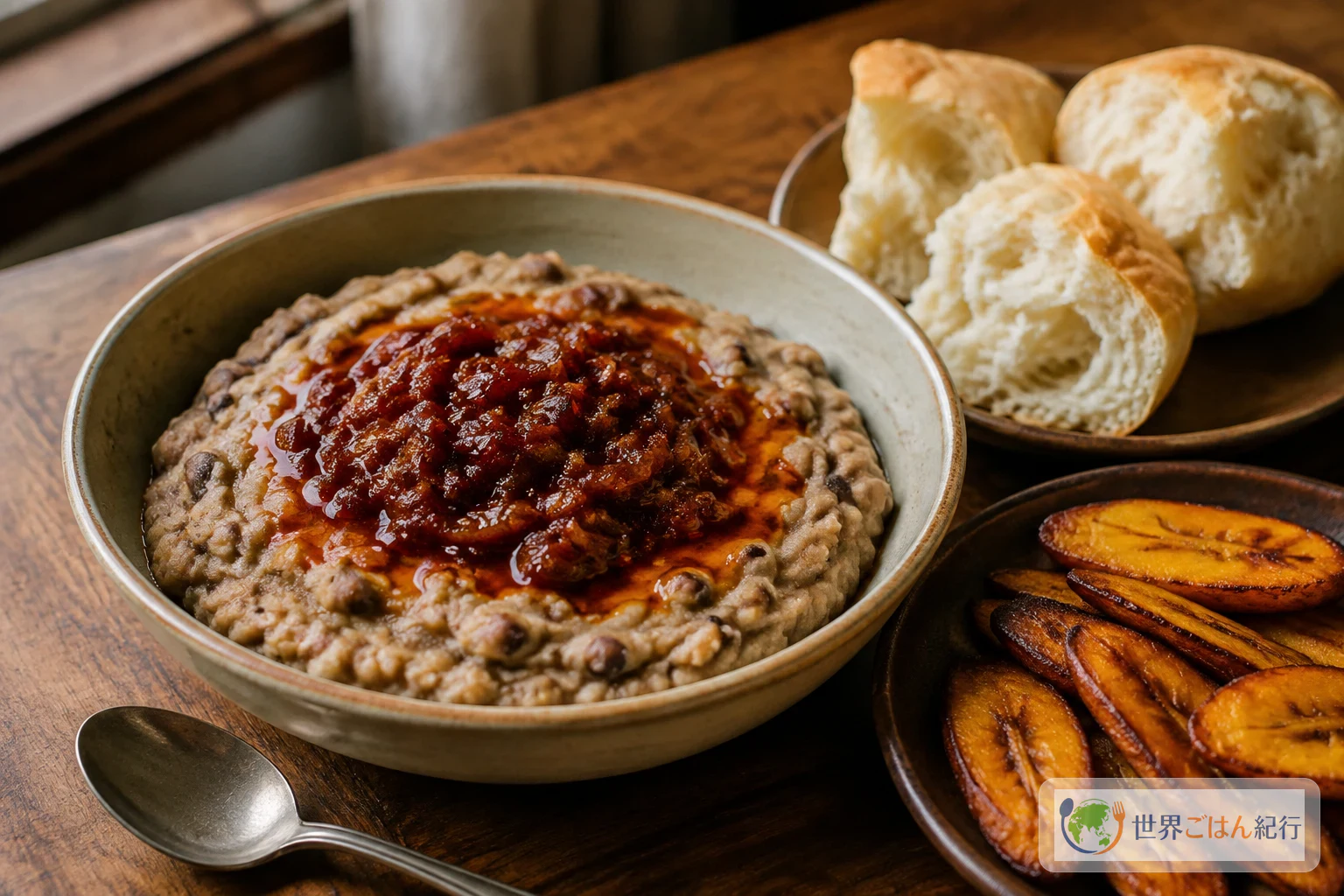
Plantains turn up elsewhere at the same table, too: ripe ones are fried and served alongside bean dishes. Red palm oil belongs to that bean dish rather than to this light soup.
How to make red red — bean stew with fried plantains, for another Ghanaian table.
Storage and reheating
Fufu is best freshly made. Wrap leftovers one serving at a time in a clean container or plastic wrap, divide the soup into shallow containers, and refrigerate at 0–5°C (32–41°F) within 1–2 hours of cooking. Use leftovers within 48 hours, though the fufu has the best texture if you finish it by the next day. To freeze, cool and seal it promptly, write the date on it, and keep it for up to two weeks. Thaw frozen portions in the refrigerator rather than at room temperature, and eat within 24 hours of thawing.
To reheat, sprinkle the fufu with 2 tsp water, cover loosely, and microwave at 600 W in 40-second bursts, turning it partway through. Reheat it all the way to the center, and use a thermometer to confirm it reaches about 74°C (165°F). Bring the soup to a boil throughout in a pot and check the temperature at the center of the meat as well. Reheat only what you'll eat, and only once.
Frequently asked questions
What is fufu made of, and what does it taste like?
The basic Ghanaian example uses cassava and plantain, and some regions and households use yam or cocoyam. The staple itself is mildly seasoned; you enjoy a smooth, springy texture together with the aromatics of the soup.
Can I make it with any cassava flour or tapioca flour?
No. Fufu flour, general cassava flour and tapioca starch differ in processing and formulation, and some toasted granular cassava products are for sprinkling. Use a product labeled for fufu and follow the water amount and cooking time on that bag.
What is Ghanaian fufu, and how is it different from other fufu?
Ghanaian fufu is pounded from boiled cassava and green plantain (some households use yam or cocoyam) and has no fermentation step at home. In Nigeria, a fermented cassava paste is also called fufu or akpu, so the same name can mean a different ingredient and a more sour taste.
Can you use cassava flour to make fufu?
Not safely by simply swapping it in. General cassava flour and tapioca starch are different products from fufu flour. If you want a flour shortcut, buy a bag labeled for fufu and follow its water amount and cooking time; for the full recipe, see the cassava, plantain and substitutes section above.
What else goes with it besides light soup?
In Ghana, fufu is also served with soups made with groundnuts, palm fruit or leafy greens. Try groundnut soup for a richer bowl, or the cocoyam-leaf kontomire stew, which is served with fufu or banku. At home, a chicken tomato soup is a good place to start; making it saltier won't bring it closer to the local flavors.
Further reading
- Omo tuo — a Ghanaian staple of pounded rice balls.
- Groundnut soup — for days when you want the richness of groundnuts with your fufu.
- Tuo zaafi — compare it with the grain dumplings and leafy soup of northern Ghana.
- Kontomire stew — a Ghanaian cocoyam-leaf stew that is eaten with fufu or banku.
- Banku — compare it with fufu: a fermented corn and cassava dough stirred in a pot.
- Waakye — a rice and black-eyed pea dish for a different Ghanaian meal.
- Kelewele — how to use ripe plantains in a spicy fried dish.