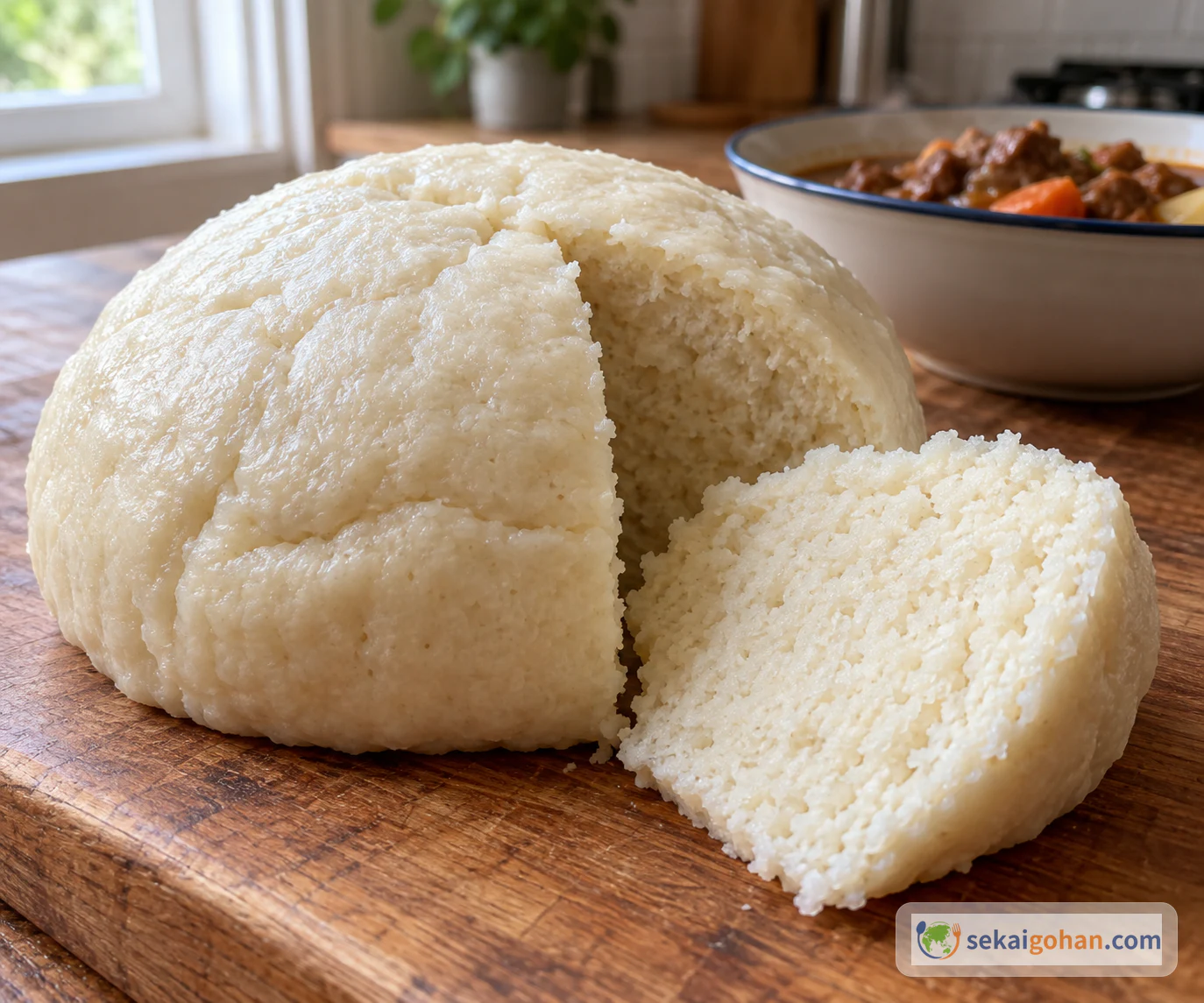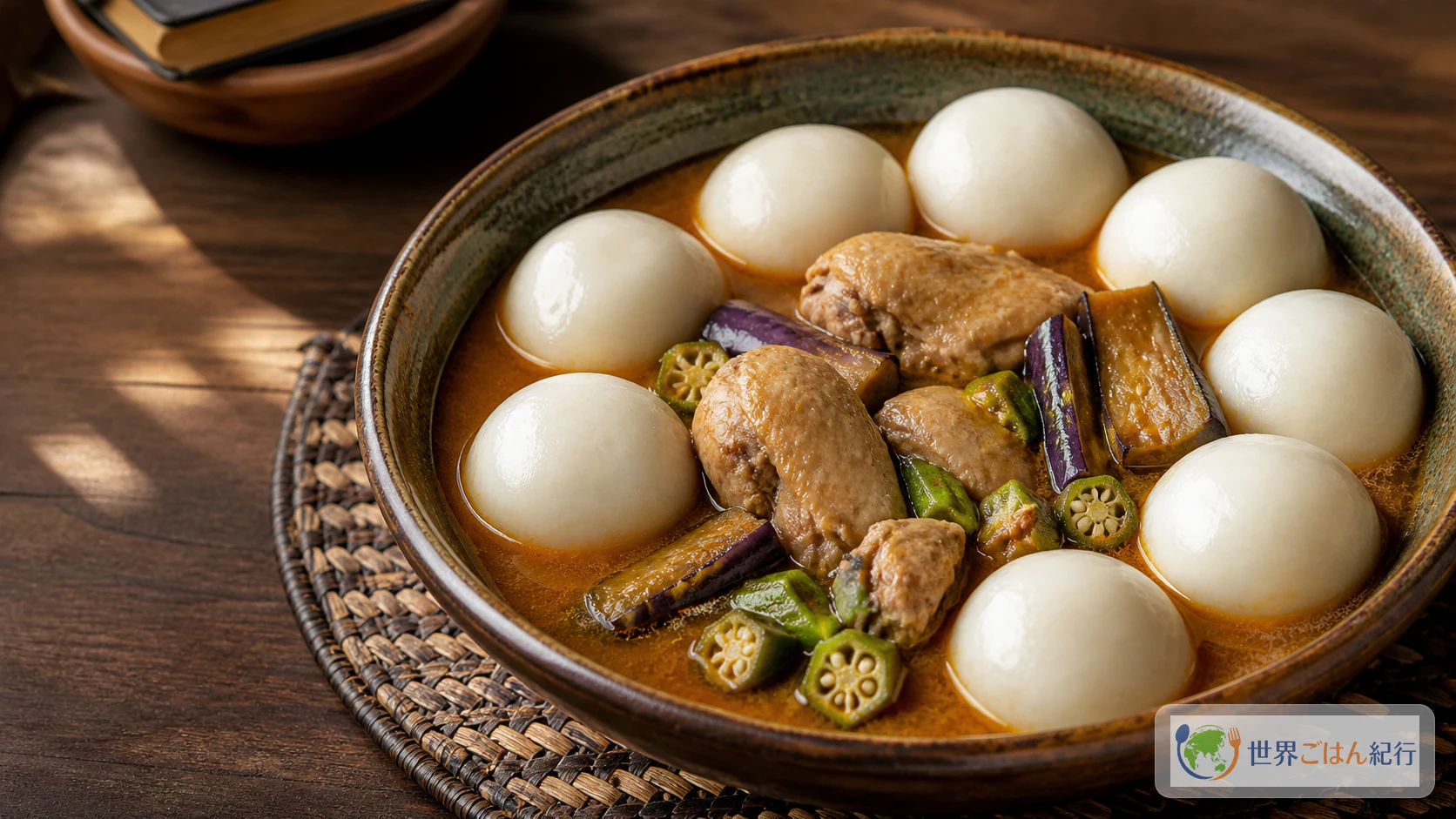
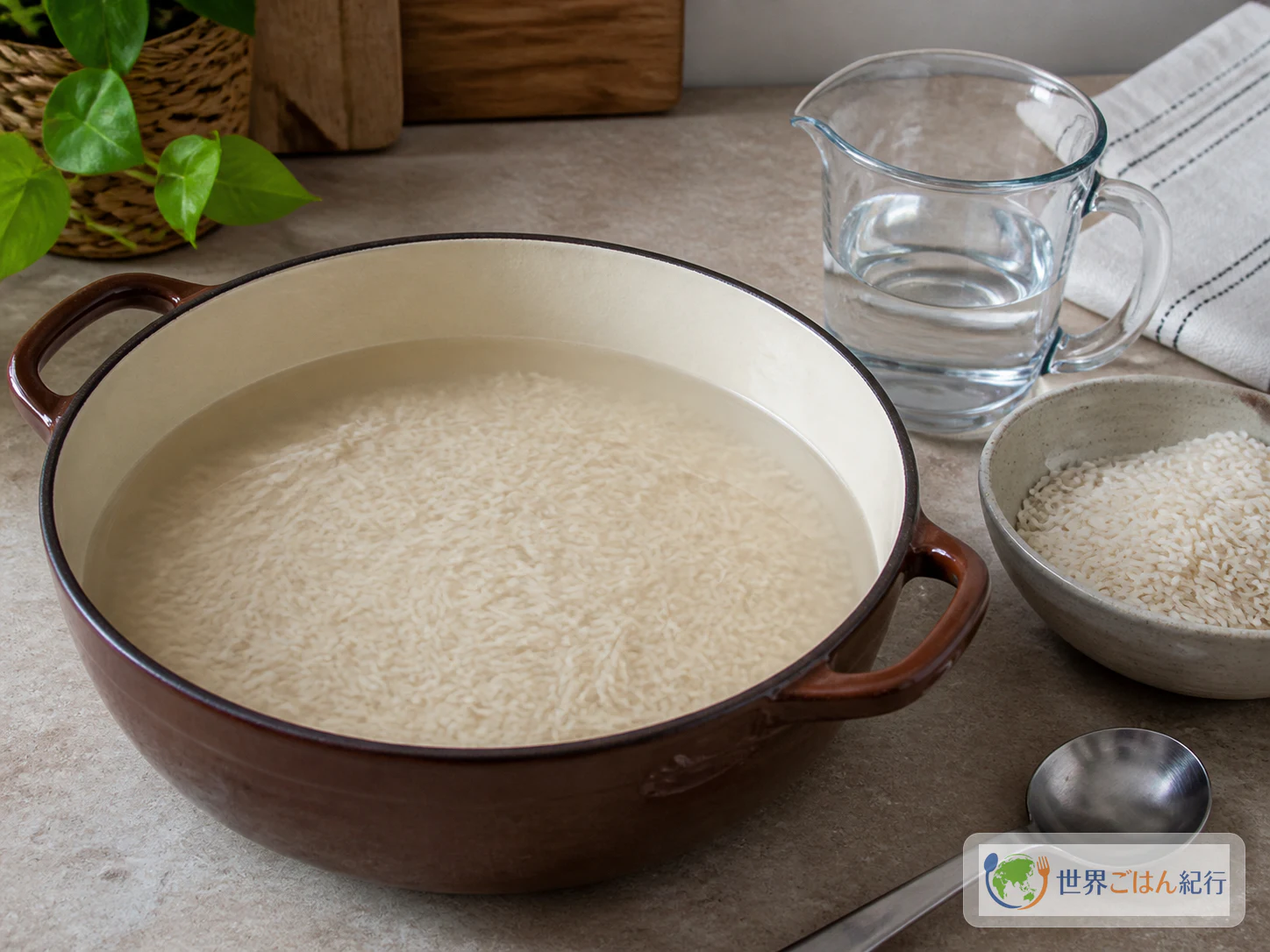
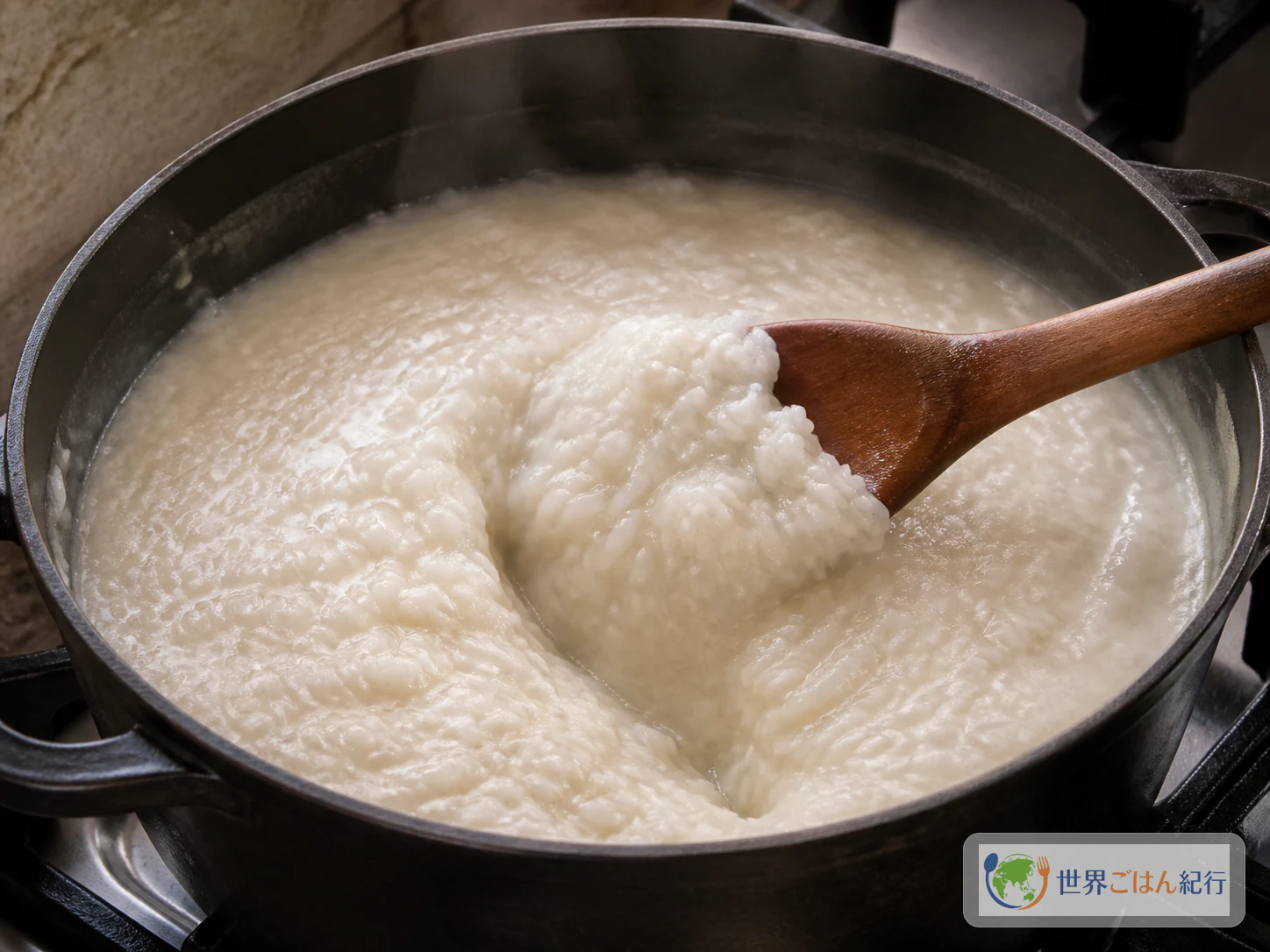
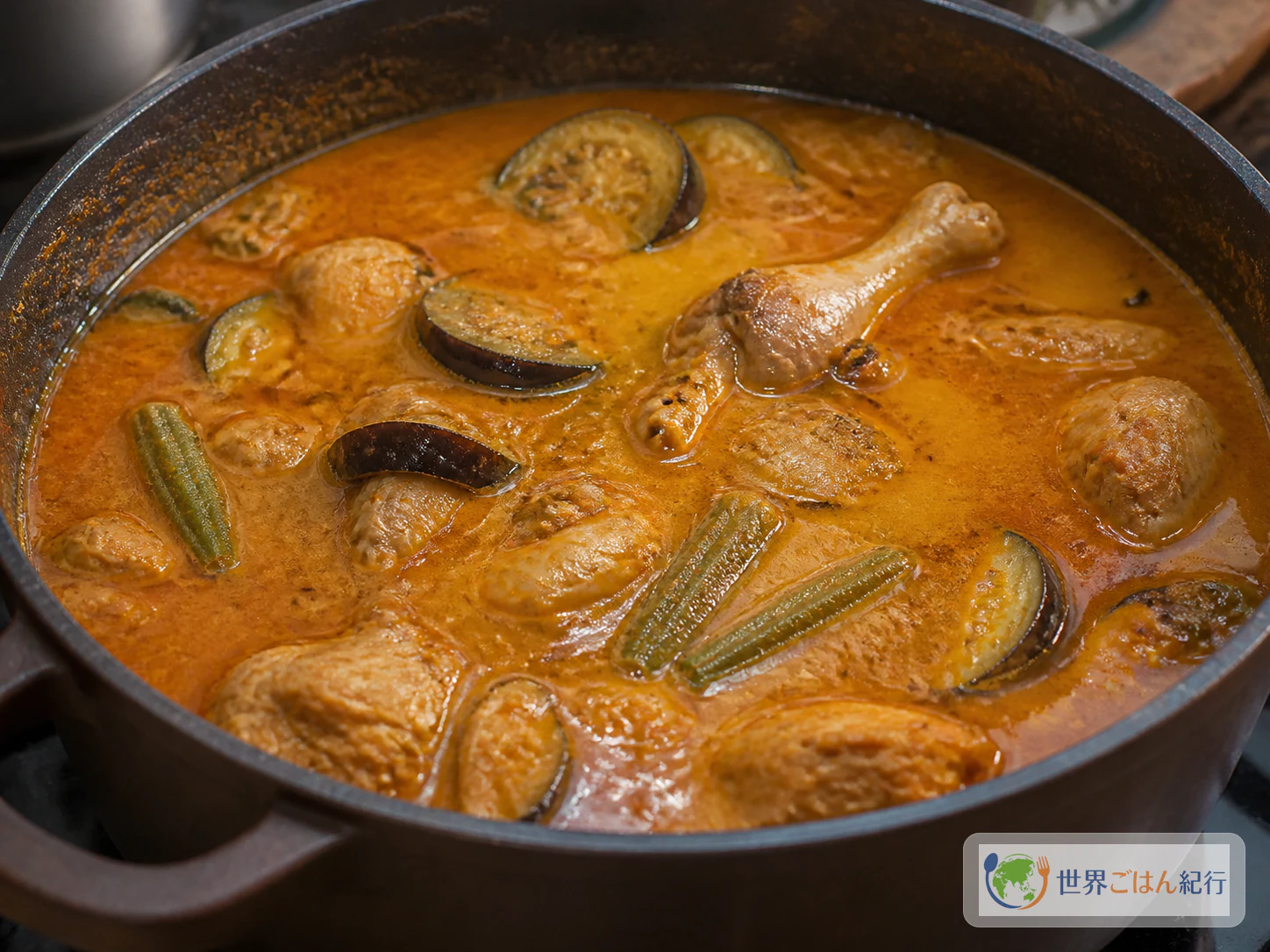
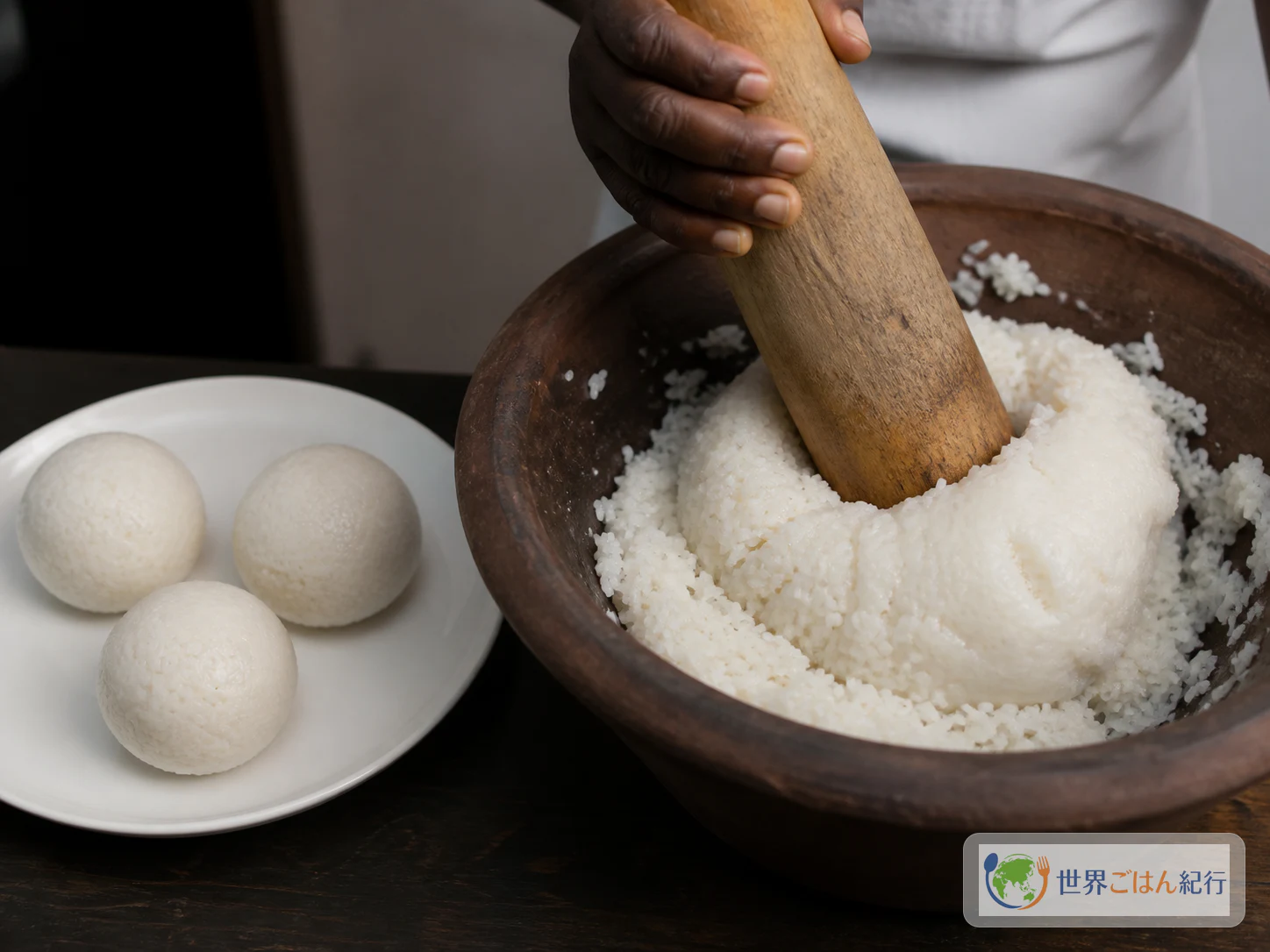
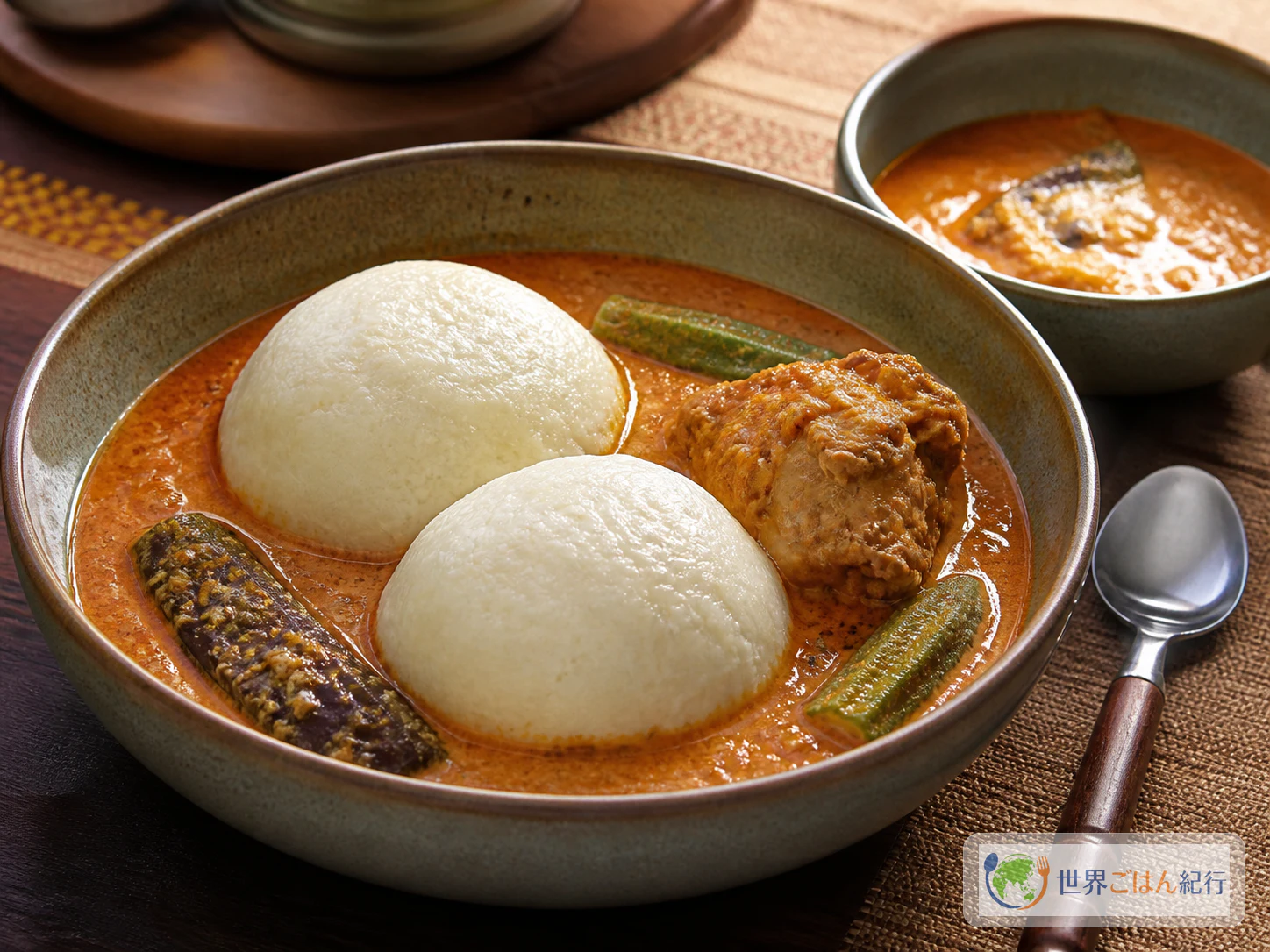
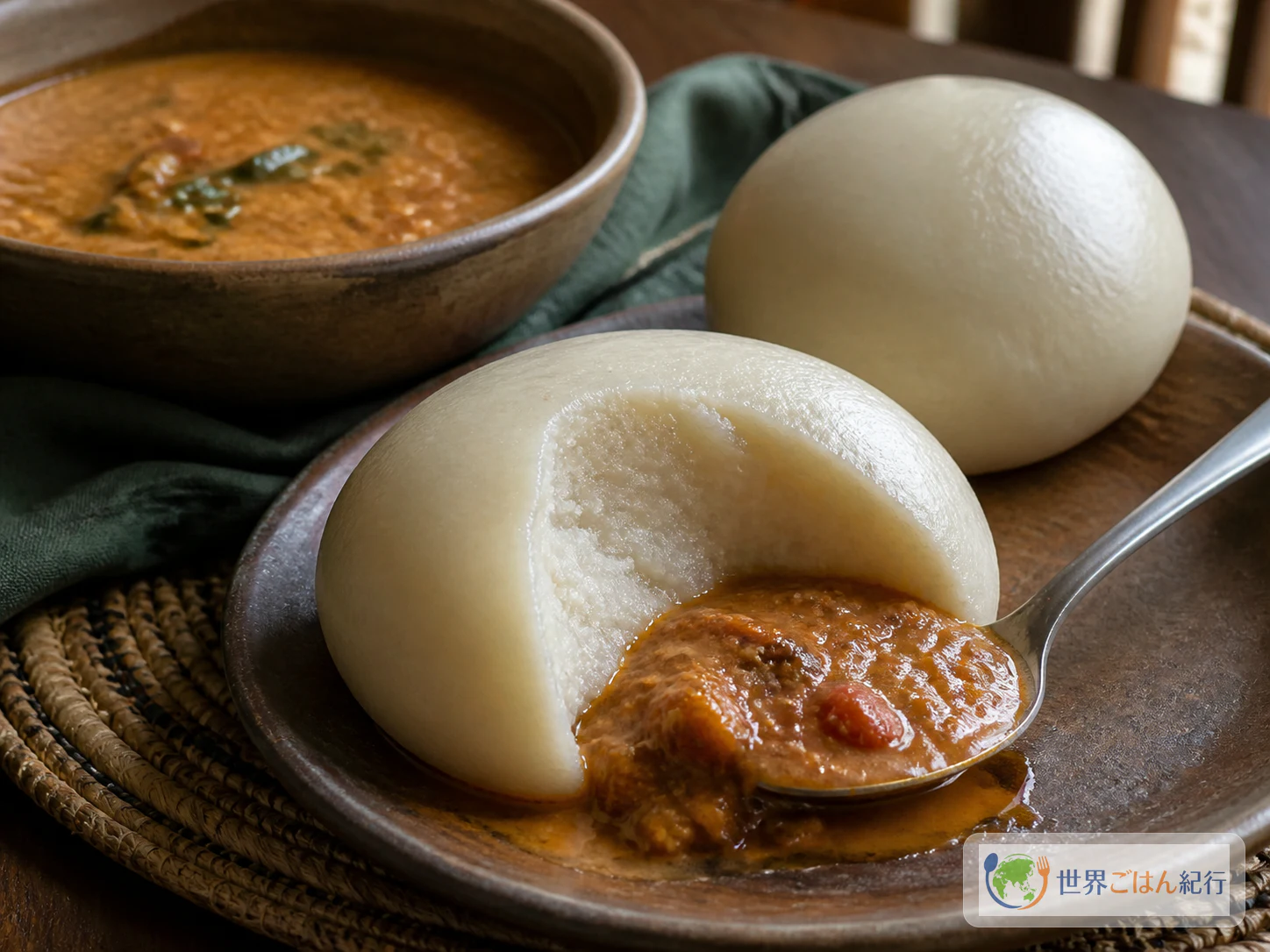
Press the bottom of the pot with a wooden spoon and the whole grains slowly give way, turning into a glossy white mass. Wet your hands, scoop up the rice while it still holds its steam, and it comes together in your palm into a round ball. That's omo tuo, the Ghanaian staple of rice cooked soft and pounded, served with groundnut soup or palm nut soup. Here it comes with a groundnut soup of chicken, eggplant and okra, built on unsweetened peanut butter: rich with peanut, bright with tomato, warm with chili.
| Item | Guide |
|---|---|
| Yield | 4 servings (8 rice balls) |
| Prep | 25 minutes |
| Cooking | 50 minutes |
| Total | about 1 hour 15 minutes |
| Flavor axis | Peanut richness, tomato acidity, chili heat |
| Heat | Medium-hot. Adjust with the amount of chili |
Omo tuo on the Ghanaian table
Staple and soup
A Ghanaian meal is built from a starchy staple such as rice, yam or cassava, paired with a soup or sauce and some meat or fish. Crops differ with climate and region, so the cooking differs too, and dishes change with the mealtime and the occasion. What stays constant is the partnership between staple and soup.
Omo tuo is made for that partnership. A Japanese onigiri wraps a filling and travels with you; omo tuo trades the separate grains for a sticky surface that catches a peanut or tomato soup.
Regional pairings
What goes alongside omo tuo depends on where you are. Around Accra, rice balls go with groundnut soup or fish dishes, and in Ashanti groundnut soup is one of the regional dishes. In the north, omo tuo meets leafy-green soup, beans and dishes made with shea nut oil, and in the northeast and northwest rice balls and tuo zaafi share the table. The ball itself barely changes from region to region. The soup is what changes.
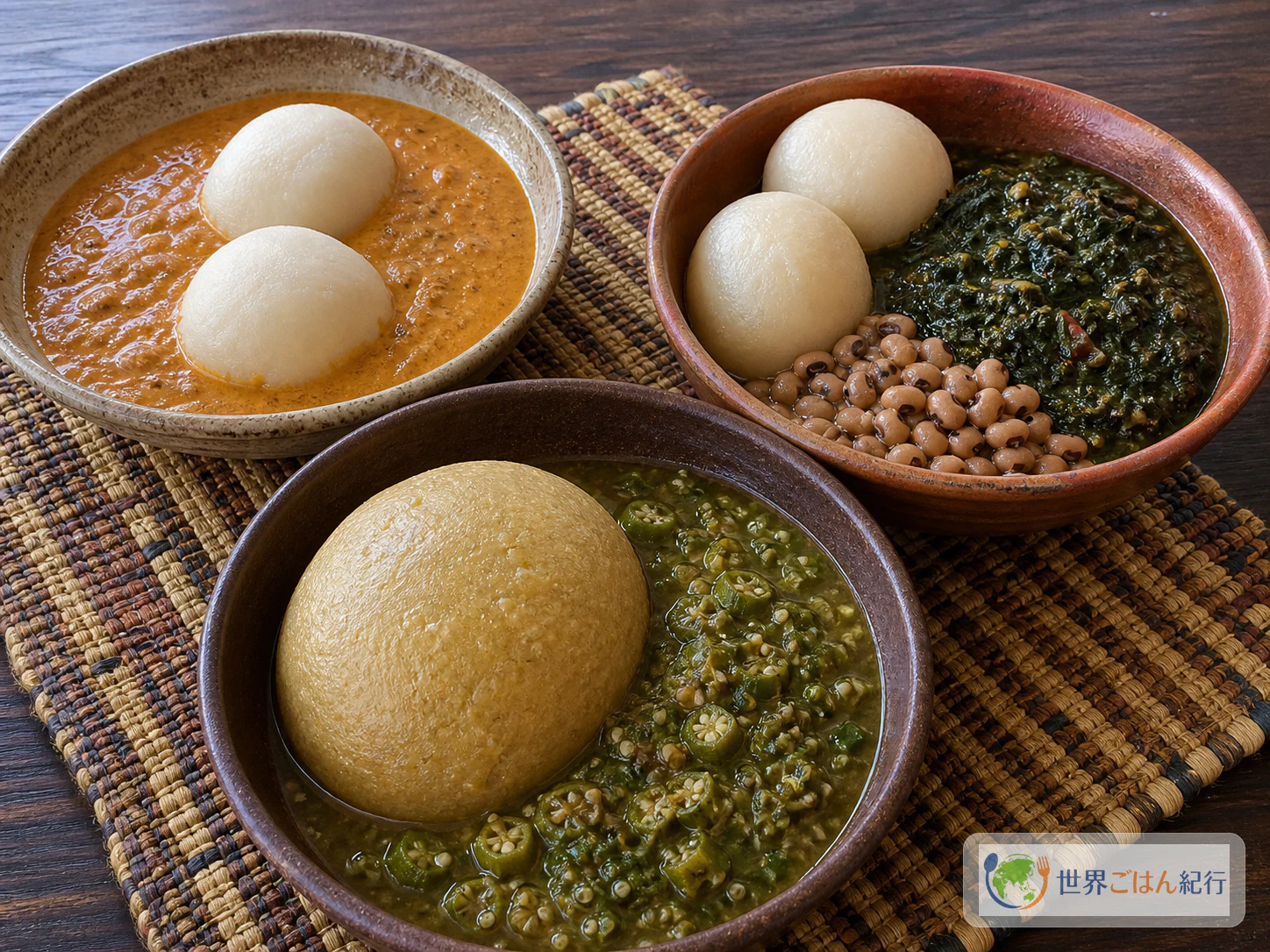
Local eateries called "chop bars" serve plates that pair a staple with a soup, alongside grilled fish, banku and fufu. Serving food to a guest is also a way of expressing the relationship between people.
Omo tuo and tuo zaafi
Northern Ghana's tuo zaafi shares the name "tuo," but it is stirred from corn, cassava or millet-type flour. Omo tuo starts from rice cooked soft and pounded, so the skill lies in cooking the rice and judging the water.
Ingredients (serves 4)
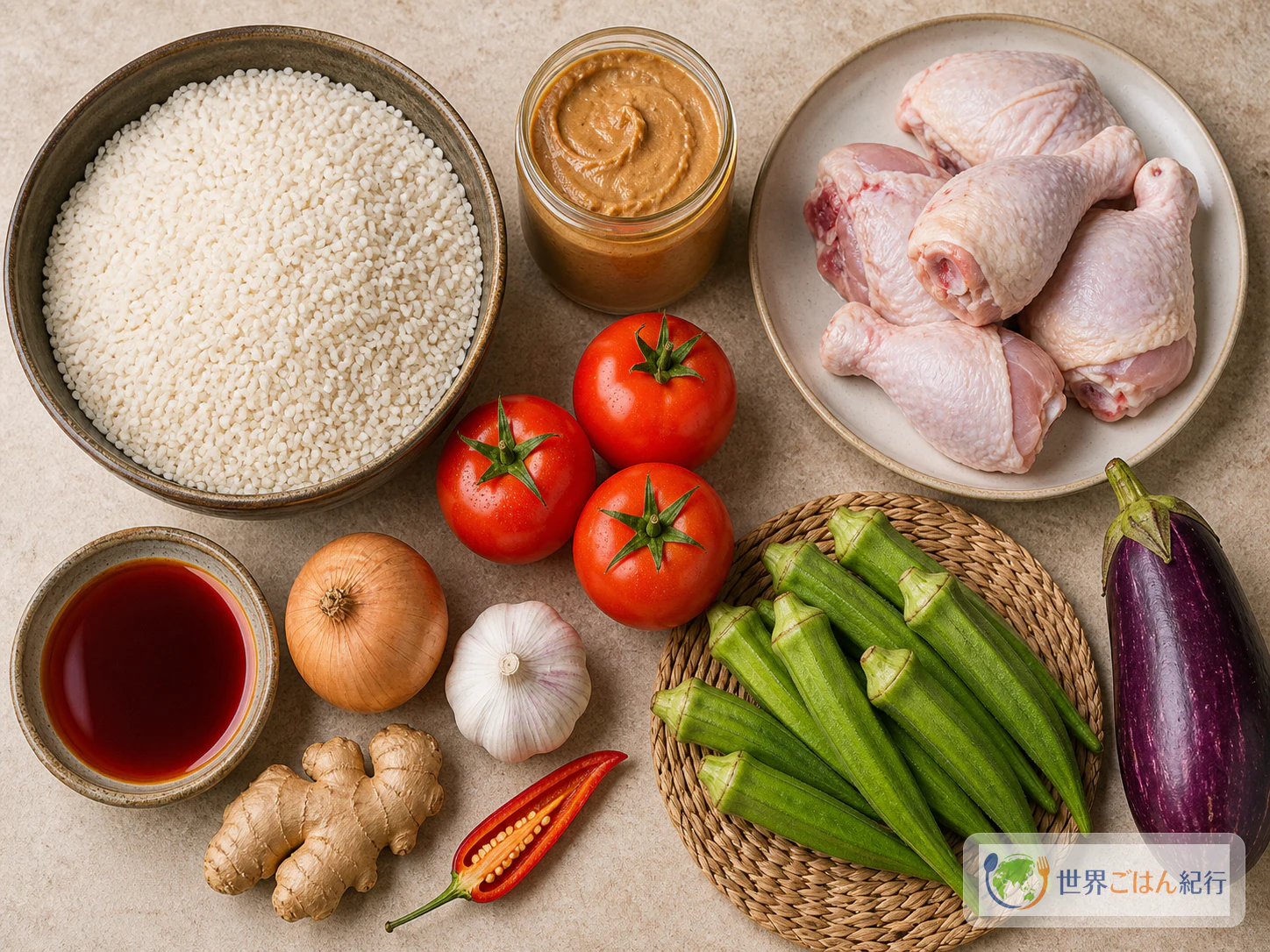
This dish uses peanuts and chicken. This version has no shellfish or dried fish and is built on chicken stock alone. If you have a peanut allergy, don't swap the peanut butter for another nut paste; treat that as a different dish. Habanero is hot even in small amounts, so start with half or less the first time.
Choosing ingredients for omo tuo and groundnut soup
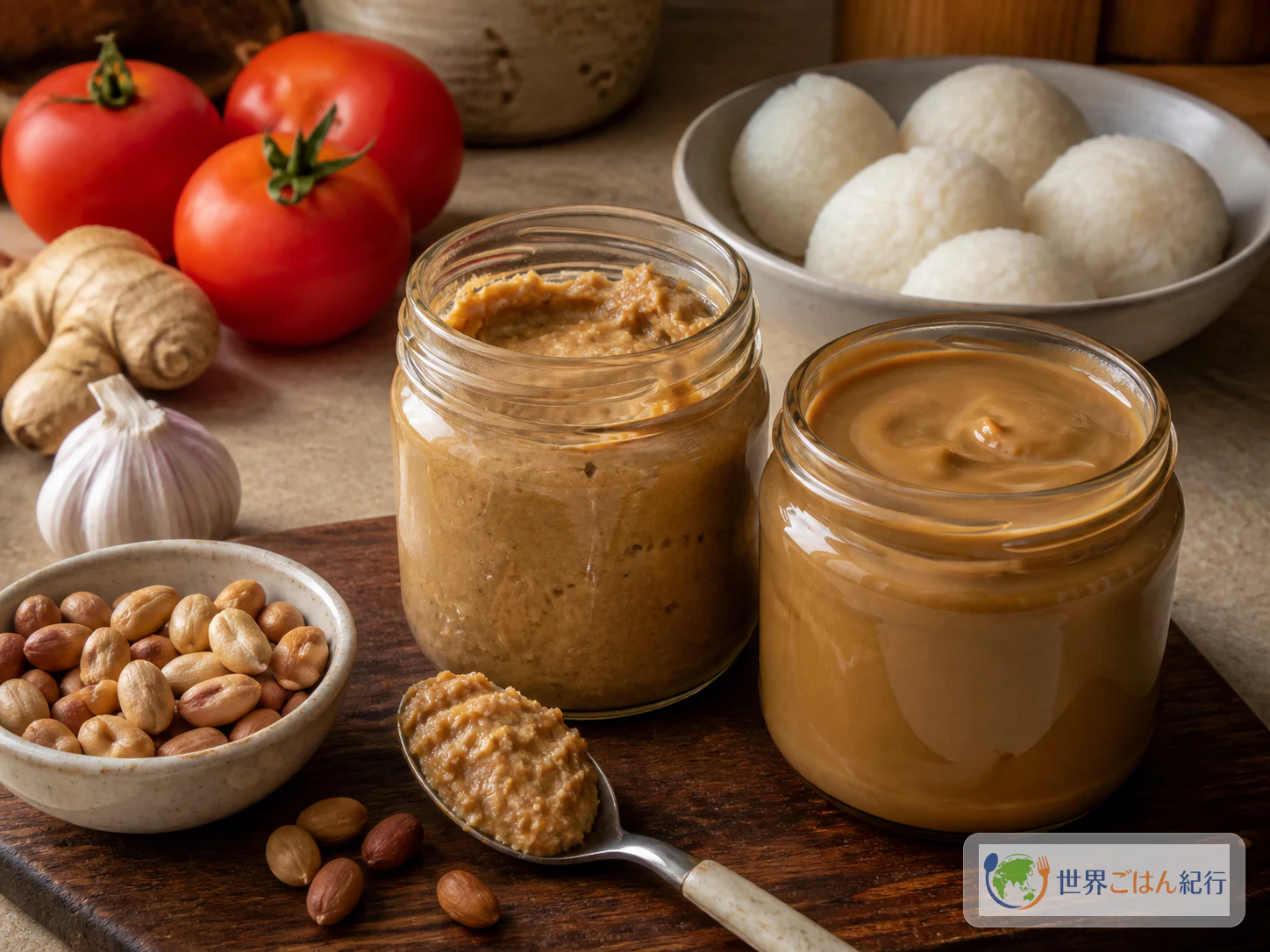
Unsweetened peanut butter
The peanuts in groundnut soup are a paste melted into a savory dish, closer to a cooking ingredient than a sandwich spread. Salt and added vegetable oil vary by brand, so read the label and make sure there is no sugar or syrup; sugar's sweetness lingers even after simmering and blurs the tomato and chili. A jar of about 5.5 oz (150 g) gets used up in this one soup, so nothing is left lingering in the refrigerator.
If your peanut butter is salted, reduce the salt in the recipe by 1/2 tsp and taste at the end. Chunky types work too, though a smooth soup coats the rice balls more easily.
Red palm oil or a neutral oil
In palm nut soup the oil is the star. Here it plays a supporting role, adding red color and an earthy aroma between the tomato and the peanut. A little goes a long way, so keep it under 2 tbsp the first time. When buying, choose an unrefined oil sold for eating and check the size of the bottle.
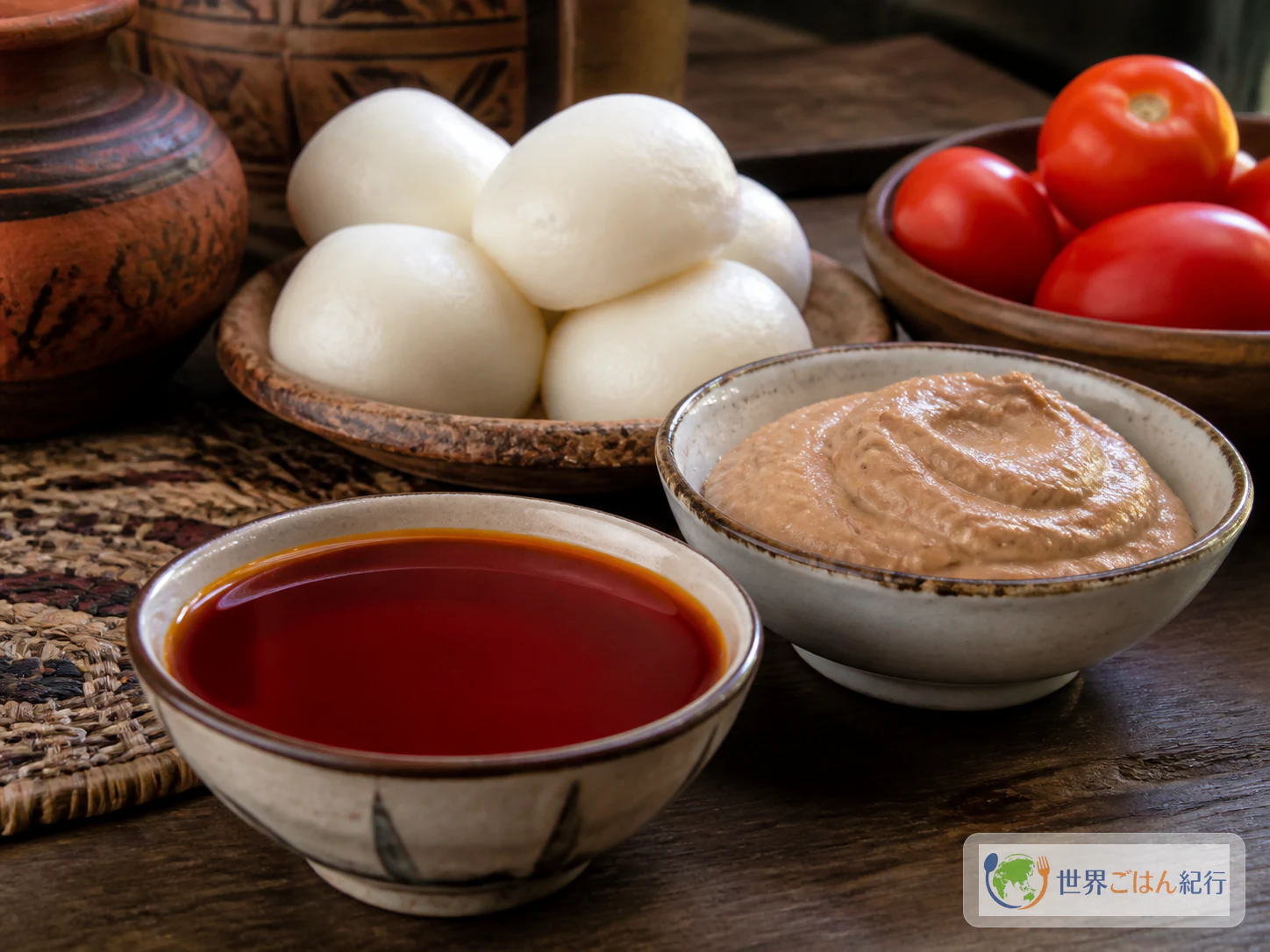
With a neutral oil the soup tastes lighter, and the peanut and tomato come forward. Reduce the tomato 5 minutes longer to make up some of the red color. Paprika won't reproduce the oil's aroma, and if you dislike aromatic oils, simply leave it out.
Mortar or blender
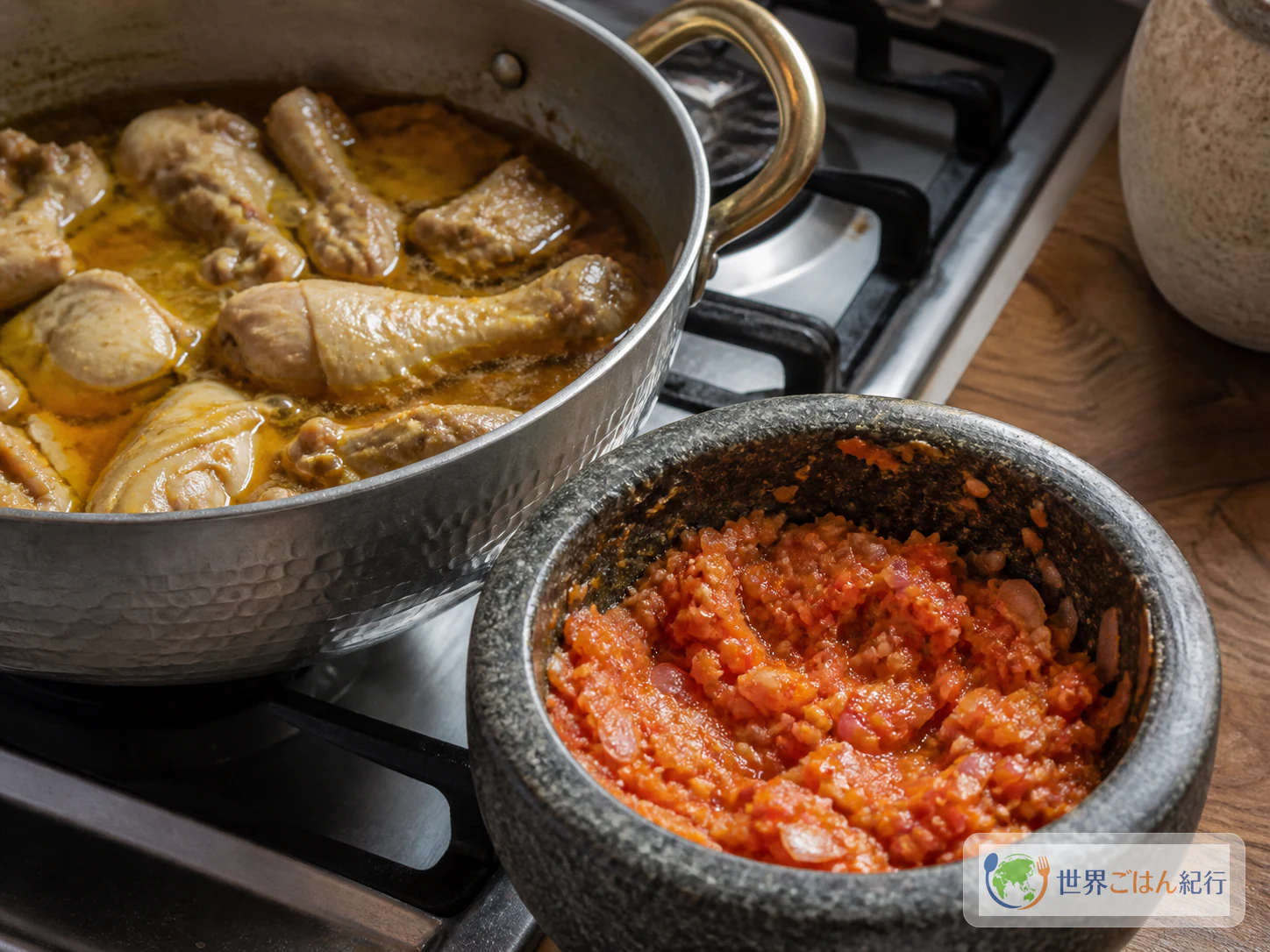
A blender turns tomato and onion smooth in no time. An earthenware mortar with a wooden pestle lets you decide by hand whether to leave bits of chili or some tomato pulp. If you shop for one, check the inner diameter of the bowl, whether a pestle is included, and the weight: tomato escapes from a bowl that's too small, and a large stone bowl needs somewhere to be washed and stored.
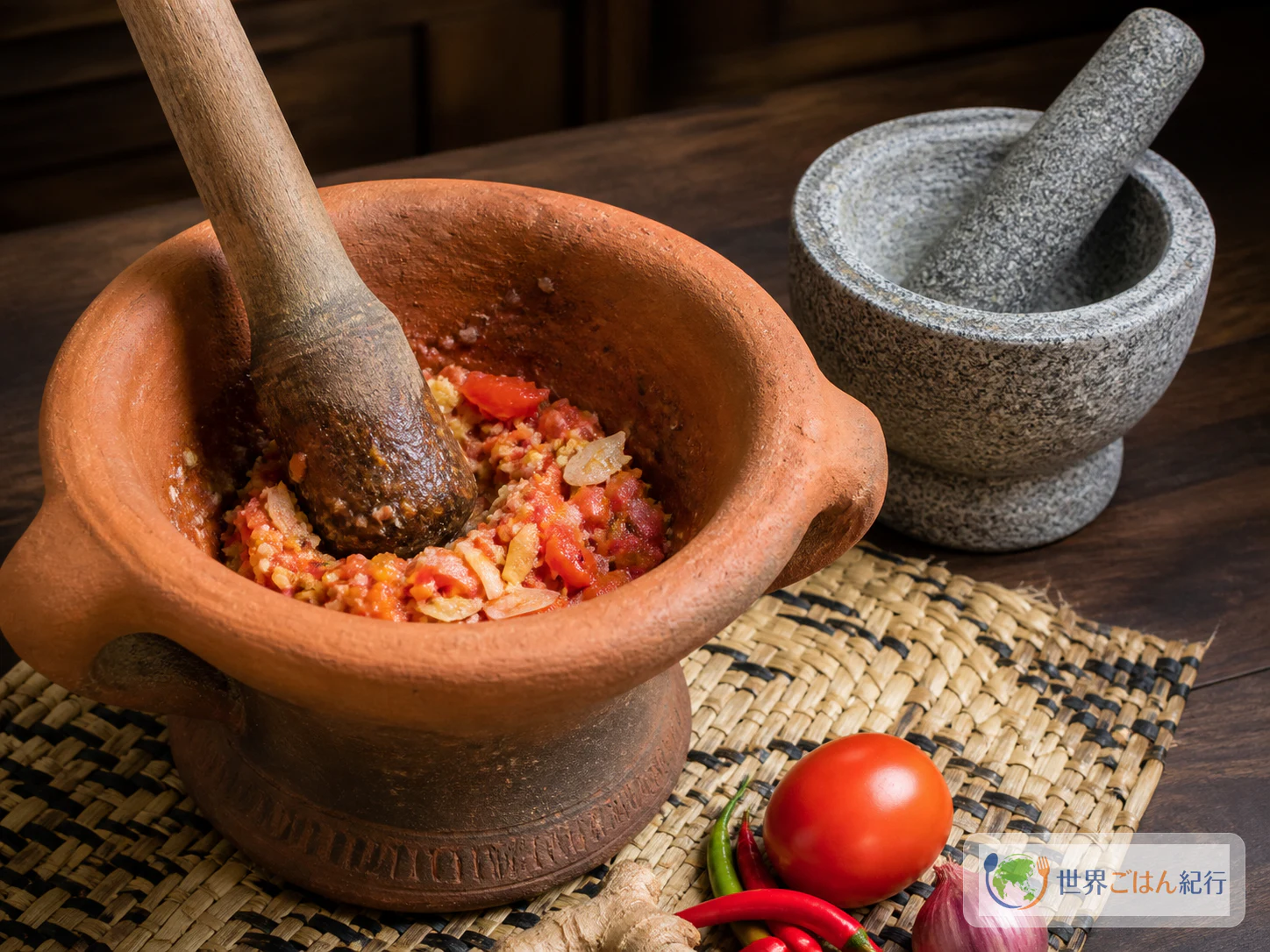
In a blender, start without water. Add 1 tbsp at a time only when the tomato's own liquid won't turn the blades, and stop when the paste runs from the spoon in a thick stream.
Swapping the chicken
Fish breaks apart easily, so add it in the second half, after the tomato and peanut have simmered. Goat brings a different aroma and more toughness; in a home kitchen it's easier to simmer it in plain water until tender before adding it to the soup. For a plant-based version with mushrooms, there's no chicken stock to lean on, so cook the onion and tomato a little longer.
How to make it
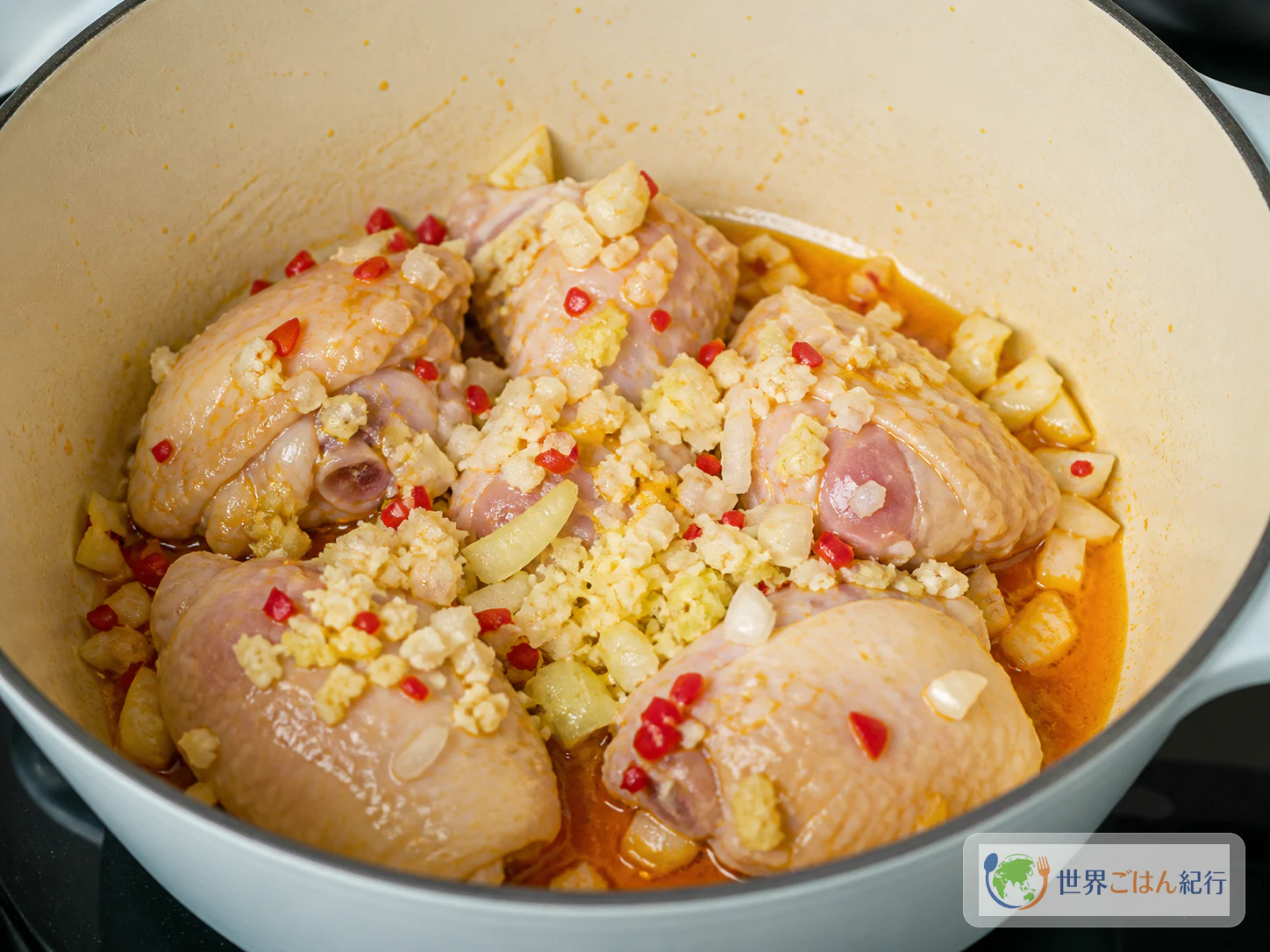
Make the rice and the soup in the same window of time. If you start simmering the chicken soup while the rice is cooked and resting, and overlap the last low heat of the soup with the time you pound the rice, the rice balls cool less.
Omo tuo troubleshooting
Success with omo tuo depends less on skill at shaping the rice than on cooking it past whole grains. Use plenty of water so there's no hard center, and pound it while hot. Follow that order and even short-grain rice becomes easy to shape in a home kitchen.
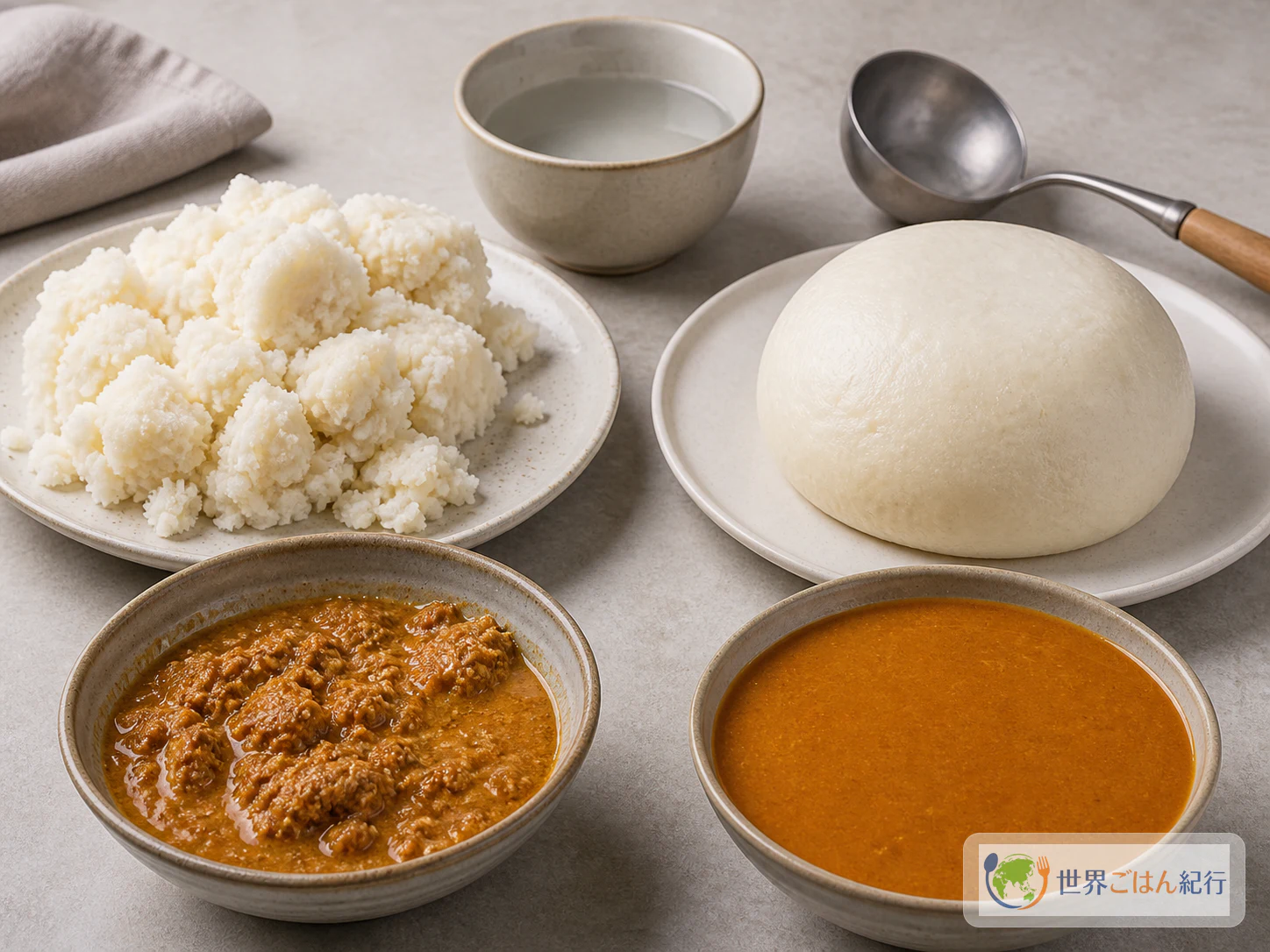
When something goes wrong, more seasoning is rarely the fix. Look at where it drifted: the water in the rice, the temperature you pounded at, or how quickly the peanut went into the pot.
| Condition | Main cause | How to fix |
|---|---|---|
| Rice cracks as you shape it | Undercooked, cooled, not pounded enough | Add 1 tbsp boiling water, knead 2–3 minutes over low heat, then pound while hot |
| Rice runs in the hand and won't form a ball | Too much water | Return it to the pot and knead 2 minutes at a time over low heat with the lid off. Don't add flour or potato starch |
| Grains remain on the surface of the ball | A hard center remained in the rice | Add 3.5 tbsp (50 ml) boiling water, cover, cook 5 more minutes over low heat, then pound |
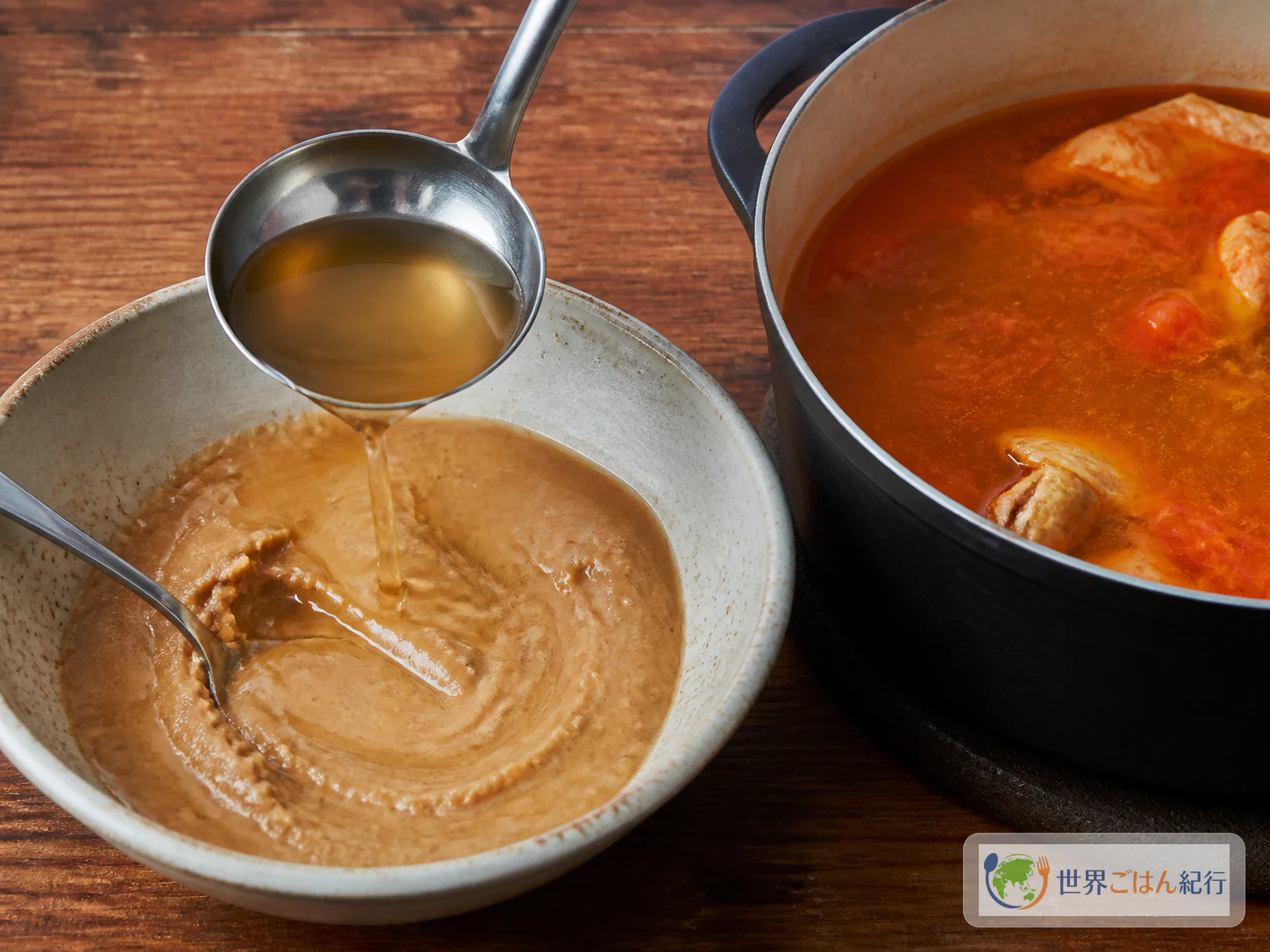
| Lumps of peanut in the soup | Liquid was added all at once | Mix a ladle of hot soup in a separate bowl until smooth, then return it to the pot |
| Burnt smell from the bottom of the pot | High heat, sediment of paste, not enough stirring | Don't scrape the bottom; move only the top soup to another pot, add 3.5 tbsp (50 ml) boiling water and bring back over low heat |
| Oil floats like a large pool | Too much red palm oil, boiled too hard | Add 3.5 tbsp (50 ml) boiling water and stir slowly over low heat for 3 minutes. Stop when it is back to small beads of oil |
| Chili too strong | Used with seeds, too much | Add 3.5 oz (100 g) tomato and ½ cup (100 ml) water and simmer 5 minutes. Adjust the salt last |
Leave a scorch where it is. Stirring the burnt layer in spreads bitterness, not toastiness, through the whole soup. Taste the soup in its new pot: if it's thin, cook off some liquid; if it's heavy, add boiling water a little at a time.
Serving, pairing and storing omo tuo
Pairings
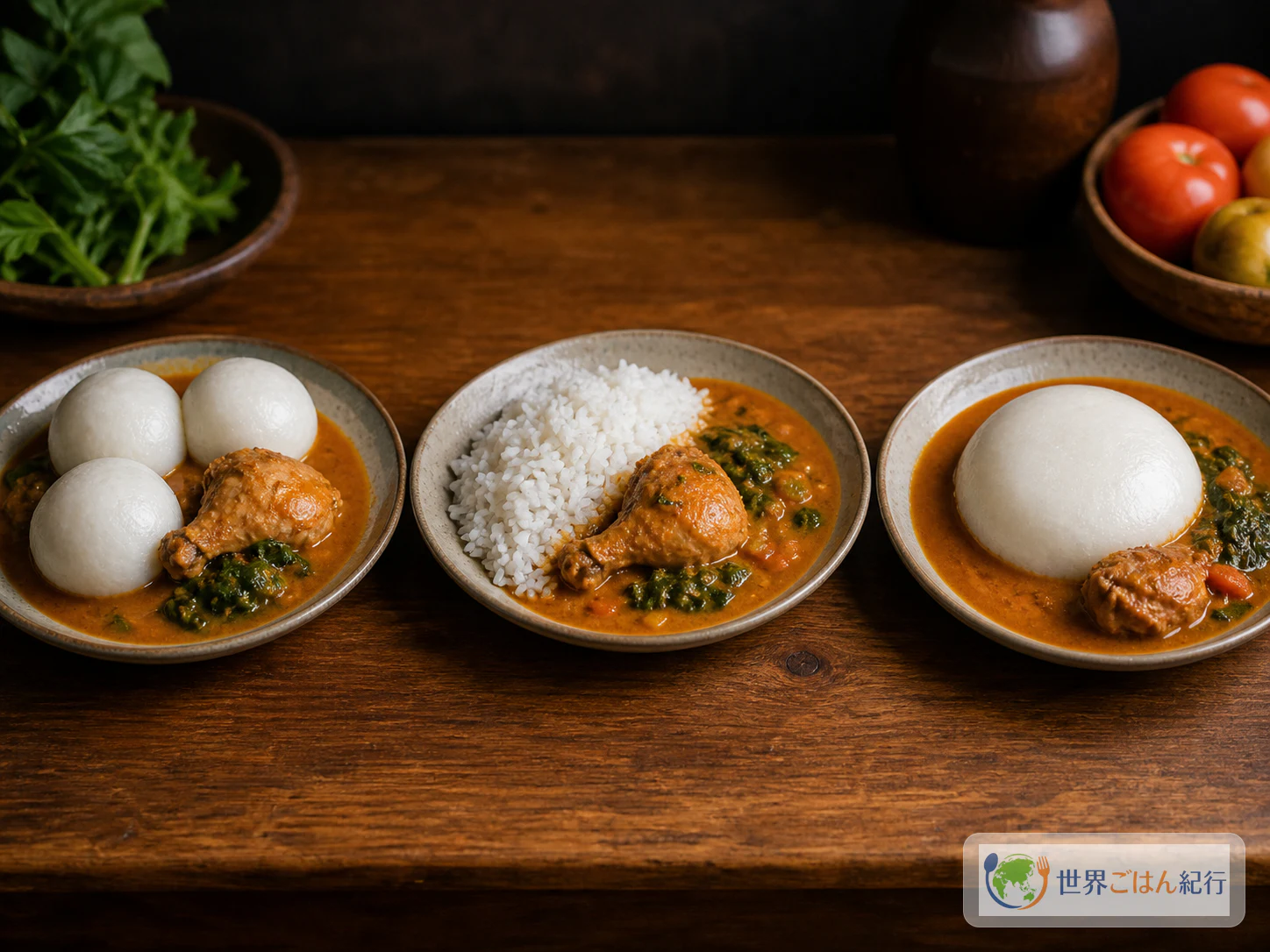
At home, set the rice ball on the plate first and pour the soup in from the side. Groundnut soup is rich, and it's most satisfying when it's thick enough to cling slowly to the rice balls. Palm nut soup, the other classic partner in Ghana, is a different soup altogether, so make it on its own, without peanut butter.
If you change the staple, it's easier to adjust the soup's thickness than to remake the rice.
| Paired with | Where the soup ends | How to handle it at the table |
|---|---|---|
| Omo tuo | Falls from the spoon in a thick line | Pour over half of the ball and coat small amounts as you break it |
| White rice | Slightly thicker. Doesn't run on the plate | Spoon over only one side of the rice and add more as you go |
| Fufu | Falls thick and slowly | Tear off fufu and coat it with soup |
| Banku | A little looser than for omo tuo | Match the fermented tang, keep the tomato aroma |
Storage
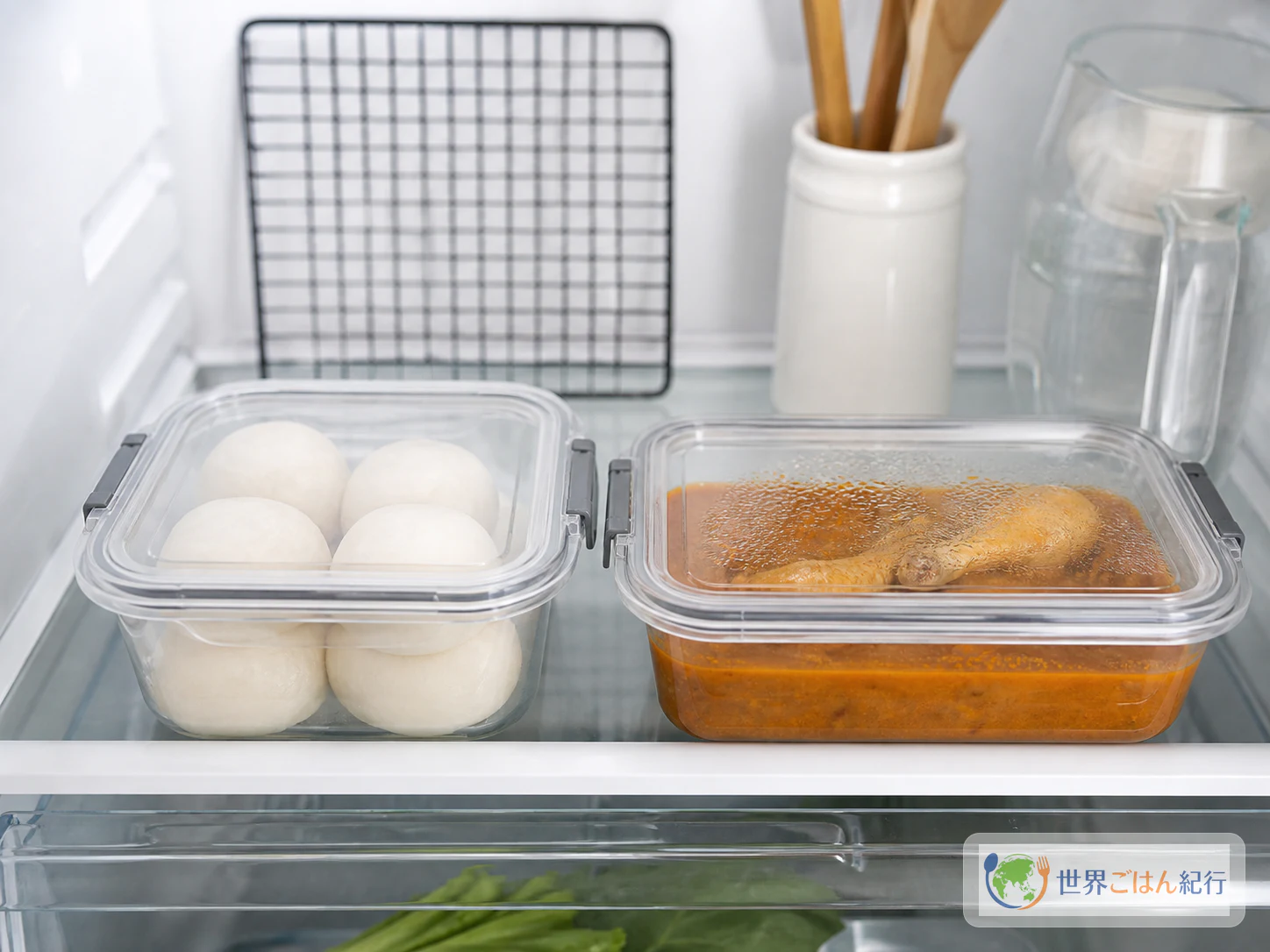
Store the rice balls and soup separately. The rice is easiest to shape while hot and firms up and cracks once refrigerated, so wrap any leftover balls one by one in plastic wrap and set them in a shallow container. Move the soup out of the deep pot into shallow containers so it cools fast.
Don't leave cooked food or rice at room temperature for more than 2 hours. When the temperature is above 32 °C (90 °F), refrigerate within 1 hour. Keep the refrigerator at 4 °C (40 °F) or below. When eating, warm the soup to just short of boiling and heat the rice balls through to the center; in a microwave, turn them partway and heat until the center reaches 74 °C (165 °F) or higher.
For the best texture, eat leftovers by the next day. Sprinkle refrigerated rice balls with a little water, cover and microwave them, then tidy the surface lightly by hand. If the soup has thickened, add boiling water 3.5 tbsp (50 ml) at a time, stopping before the peanut aroma gets washed out.
Frequently asked questions
Can I shape it with short-grain rice?
Yes. Use more water than for ordinary cooking and cook until soft through the center. Long-grain rice works too, but the grains loosen and are harder to shape; add 3.5 tbsp (50 ml) water when cooking and pound 2–3 minutes longer.
Can I pour leftover soup over white rice?
Yes. The next day, white rice is easier to handle than the rice balls; warm the soup and loosen it a little. For a closer look at the soup itself, see Ghanaian groundnut soup.
Is it not authentic unless you eat with your hands?
A spoon is perfectly fine. When the rice balls are hot, it's safer to break them with a spoon and scoop up a little soup with each piece. What matters more is breaking the ball bit by bit and coating each piece's surface with soup.
Sources
- Ghana National Commission on Culture: The Ghanaian Kitchen (composition of staple and soup, dish examples from Accra, Ashanti, the north and elsewhere. Published: 2020-11-15. Accessed and checked: 2026-08-28 JST)
- Ghana National Commission on Culture: Regional Representation and Diversity (differences in staples, soups and crops by region. No publication date listed. Accessed and checked: 2026-08-28 JST)
- George Amponsah Annor, Kwaku Tano Debrah, Allen Essen: Mineral and phytate contents of some prepared popular Ghanaian foods (definitions of omo tuo and groundnut soup, cooking and survey method at the University of Ghana. SpringerPlus 5:581, 2016. Accessed and checked: 2026-08-28 JST)
- Pulse Ghana: DIY Recipes: How to make Nkatiekonto (Groundnut soup with greens) (pairing with omo tuo, loosening the peanut with cooking liquid, using a mortar versus a blender. Published: 2021-12-08. Accessed and checked: 2026-08-28 JST)
- The Guardian: Ghanaian groundnut soup – recipe (ingredients of Ghanaian groundnut soup, and the step of loosening the peanut sauce separately and simmering until the oil floats. Published: 2013-04-24. Accessed and checked: 2026-08-28 JST)
- The Vegetarian Resource Group: Ghanaian Cuisine (terminology of om tuo and nkatenkan, examples of Ghanaian tables. Vegan Journal Vol. 44, Issue 2, 2025. Accessed and checked: 2026-08-28 JST)
- FoodSafety.gov: 4 Steps to Food Safety (chilling cooked food and rice, time at room temperature, refrigerator temperature, and the approach to reheating. Last checked: 2023-09-18. Accessed and checked: 2026-08-28 JST)