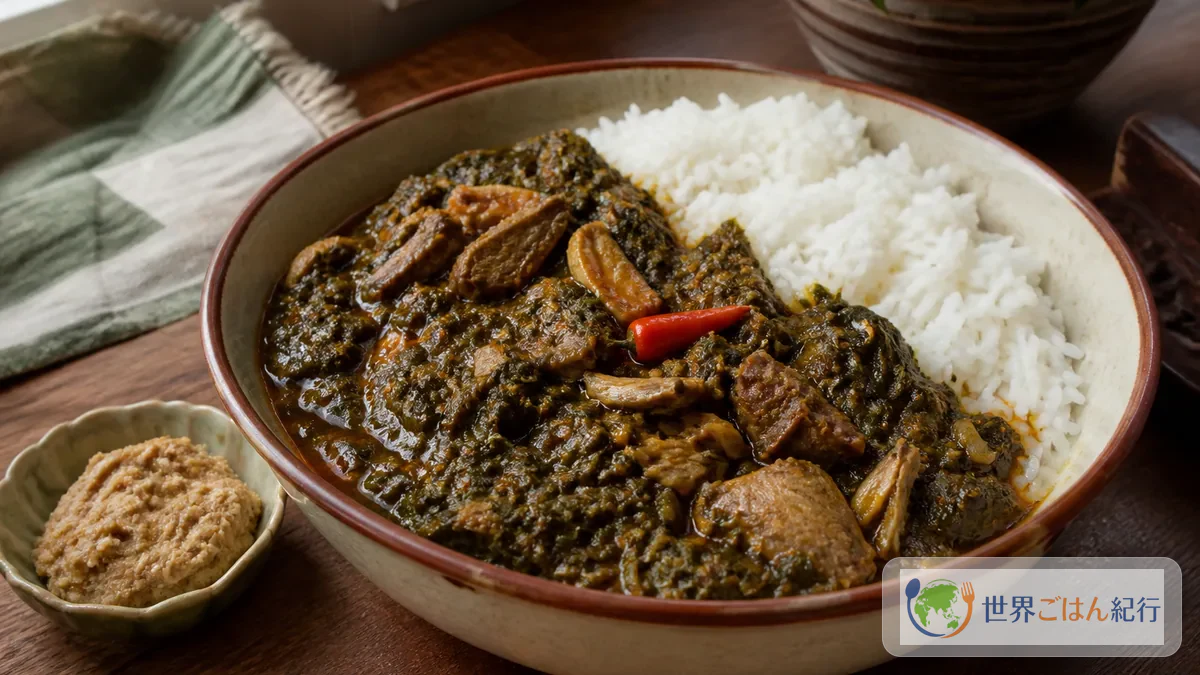
The moment a wooden spoon goes into the pot, the white batter, loose as porridge until then, suddenly turns heavy. Push back with your arm and the dough gathers along the sides of the pot and takes on a sheen. That moment, when flour becomes a staple, is what making Tuo Zaafi comes down to. In northern Ghana it lands on everyday tables as a soft grain dumpling with the gentle sweetness of corn, served with a green, slippery soup of ayoyo or okra.
Tuo Zaafi in northern Ghana
In Ghana you'll see it written TZ, T-Zed or Tuo Zaafi, and city people often shorten it to TZ. Tuo is usually explained as porridge or a mass of cooked grain, and Zaafi as "hot," so the name describes the method: grain flour worked with hot water. It is eaten mostly in the north, with a green soup made slippery by ayoyo (jute mallow) or okra, a red tomato-and-oil sauce, and sometimes a meat or fish stew.
The dish comes from a region where corn, millet, sorghum and cassava, rather than rice or wheat, are the daily staple. The flour first holds plenty of water as a porridge. Then more flour is worked in until the mass is firm enough to scoop up soup. Tuo Zaafi is an everyday staple, not a special-occasion food, and it appears at home and in school feeding. Made at home, it doesn't need rich meat. Work the flour smooth, make plenty of green soup, and add aroma with a little oil sauce. It looks plain, but the dumpling and the soup together make a filling meal.
On its own, Tuo Zaafi isn't finished. It becomes a dish only with the sliminess of ayoyo or okra, the savoriness of dawadawa or dried seafood, and the heat of the red oil sauce. It's often called simply a "Ghanaian dumpling," but it is really a staple eaten together with soup.
West Africa has many similar grain dumplings, and TZ is related to ugali from East Africa as well. Banku stands out for the sourness of fermented corn dough, and fufu for the elasticity of pounded yam or flour. To from Burkina Faso is a light grain dumpling made to receive sauce. Tuo Zaafi sits between them. It has no sourness and less stretch, and it is soft without collapsing, so the green soup can coat it.
Ingredients (serves 4)

This recipe uses dried seafood. If anyone reacts to dried small fish powder, dried fish powder or dried shrimp powder, do not cook it in the same pot; make a separate seafood-free version with a little miso. Use commercially sold, processed cassava flour for food. Do not try to reproduce this by preparing raw cassava at home.
Nutrition at a glance
A serving is roughly 420 kcal, 9 g protein, 8 g fat and 3 oz (82 g) carbohydrate. Because it is a flour-based staple, it is very filling. For dinner, rather than stacking red red, another Ghanaian dish built on beans and oil, on the same day, pairing it with greens, grilled fish and a light soup is easier on the appetite.
Choosing flour and substitutes for Tuo Zaafi
The three things to shop carefully for are fine cornflour, cassava flour, and red palm oil. Ordinary soft wheat flour won't work. Molokhia, okra, tomato and onion are easy to find at any grocery store.
Cornflour gives the dough its aroma. Coarse, polenta-style meal leaves grains in the dough, so for a first attempt choose finely ground corn flour. Cassava flour holds everything together. Too much makes the dough heavy, like rice cake, and too little lets it dissolve into the soup. For a first batch, aim for just under 1 part cassava flour to 3 parts cornflour.
Red palm oil doesn't go into the dumpling itself. It goes into the oil sauce served beside it and brings that sauce closer to the local one. Buy a small bottle; you won't use it in bulk like frying oil.
| Ingredient in question | Role to preserve | Practical answer elsewhere |
|---|---|---|
| Cornflour | Staple aroma, grain character | Choose fine grind. If coarse, up to 1/3 of the total |
| Cassava flour | Binding, stickiness, resistance to breaking | Start at 3.5 oz (100 g). With tapioca starch, up to 2.75 oz (80 g) |
| Sorghum flour, millet flour | Northern-style grain aroma | Replace only 1.75 oz (50 g) of the cornflour |
| Ayoyo | Green sliminess, green aroma | Substitute molokhia and okra |
| Dawadawa (fermented locust bean) | Fermented savoriness | 1 tsp miso or 1/2 tsp fish sauce in the soup |
| Red palm oil | Aroma and color of the oil sauce | Use just 1 tbsp. Do not add too much |
For a more northern flour aroma, replace 1.75 oz (50 g) of the 11.5 oz (320 g) cornflour with sorghum flour. A large amount on the first try changes how the dough absorbs water and makes it crack on the sides of the pot. Once you're used to it, you can go up to 2.75 oz (80 g).
Method
Rather than adding all the flour at once, make a loose porridge first and then work in the remaining flour, which reduces lumps. A wooden spoon with a wide, stiff head is easier for turning the dough off the side of the pot than a thin one.
Common Tuo Zaafi problems and fixes

On a first try, it's tempting to add extra flour to keep the dough from breaking. Tuo Zaafi is eaten with soup, though, so it doesn't have to hold together on chopsticks. Aim for dough that lifts on the spoon as one large mass yet still breaks apart easily with the spoon.
Lumps remain
Either the flour went in all at once or the porridge was too hot. Mix the cornflour and cassava flour evenly in a separate bowl first, which is the best prevention. Then add the mix in 4 portions and work each in until the white streaks disappear. Small lumps can be crushed against the side of the pot, but large ones won't go away later.
Too loose to round
Too much water went in. Working the dough on low heat for 2 to 3 minutes tightens it a little. If it's loose enough to dissolve into the soup, sift in 2 tbsp cornflour through a tea strainer and work it another 3 minutes. Then steam it as below, because freshly added flour tastes raw.
Too stiff for the spoon
There's too little water for the amount of flour, or the heat was too high and too much water evaporated. Add the reserved porridge back 3 tbsp at a time and work it on low heat. Porridge keeps the flour aroma from thinning the way plain water would. If the spoon feels ready to snap, take the pot off the heat for 30 seconds, and the dough will be easier to stir.
A floury smell remains
The dough wasn't steamed long enough. After working it, leave it on low heat for 5 minutes with the lid slightly ajar. Turning off the burner and letting it sit leaves the center floury for longer. If you smell scorching, turn the bottom over, switch off the heat, cover, and rest it for just 2 minutes.
The soup is thin and doesn't cling
There wasn't enough okra and molokhia, or the soup simmered so long that the sliminess broke down. Add okra sliced 0.25 inch (5 mm) thick and molokhia that isn't chopped too fine, and stop after 4 to 5 minutes over medium-low heat. Keep baking soda to 1/8 tsp at most. More makes the color prettier but blurs the flavor.
Serving and storing Tuo Zaafi

At a Ghanaian table, you pinch off a small piece of Tuo Zaafi by hand and use it to scoop up the soup. A spoon is fine while you get the hang of it. Pour on plenty of green soup and set a little red oil sauce beside it. Each bite gives you the soft sweetness of the flour, then the green aroma, then the spicy oil.
When planning a Ghanaian meal, don't stack up several staples. Save waakye and kelewele for another day, and let the soup be the star alongside Tuo Zaafi. If you want a deeper, nutty note, a small plate of groundnut soup rounds out the table.
| State | Storage guide | Reheating |
|---|---|---|
| Freshly made | Within 2 hours | Eat while warm |
| Refrigerated | Until the next day | 50 seconds at 600 W after adding a little water with a spray bottle, then 20 seconds more |
| Frozen | Not recommended | The flour tends to crack and turn crumbly |
| Soup only | 2 days | Warm on low heat for 3 minutes; if the sliminess has weakened, add 20 g chopped okra |
If you make it ahead, always store the dumpling and the soup separately, because the surface softens and falls apart when left in soup. Press plastic wrap directly onto leftover dumpling before refrigerating so it doesn't dry out.
FAQ
Q1. Can I make it with cornmeal?
You can, but coarse cornmeal feels gritty. Use 8.5 oz (240 g) cornflour with 2.75 oz (80 g) of finer cornmeal, and bind it with 3.5 oz (100 g) cassava flour. Coarse grains take longer to cook, so extend the porridge stage by 2 minutes.
Q2. If I have no cassava flour, can I use tapioca starch?
Yes, but it gets very sticky. Use 2.75 oz (80 g) tapioca starch in place of 3.5 oz (100 g) cassava flour. If the dough stretches like rice cake, add 20 g more cornflour next time. Potato starch isn't suitable, since it turns too translucent and hardens as it cools.
Q3. Without ayoyo, will it taste authentic?
Ayoyo is ideal if you can find it, but molokhia and okra get you quite close. The soup needs sliminess and a green aroma. Spinach alone isn't sticky enough, so keep either okra or molokhia.
Q4. Is red palm oil essential?
Not for the dumpling itself. In the oil sauce it brings a local aroma and color, but you can substitute 1 tbsp neutral oil plus 1/2 tsp paprika. Plain vegetable oil alone leaves the aroma flat, so make up for it with chili and tomato paste.