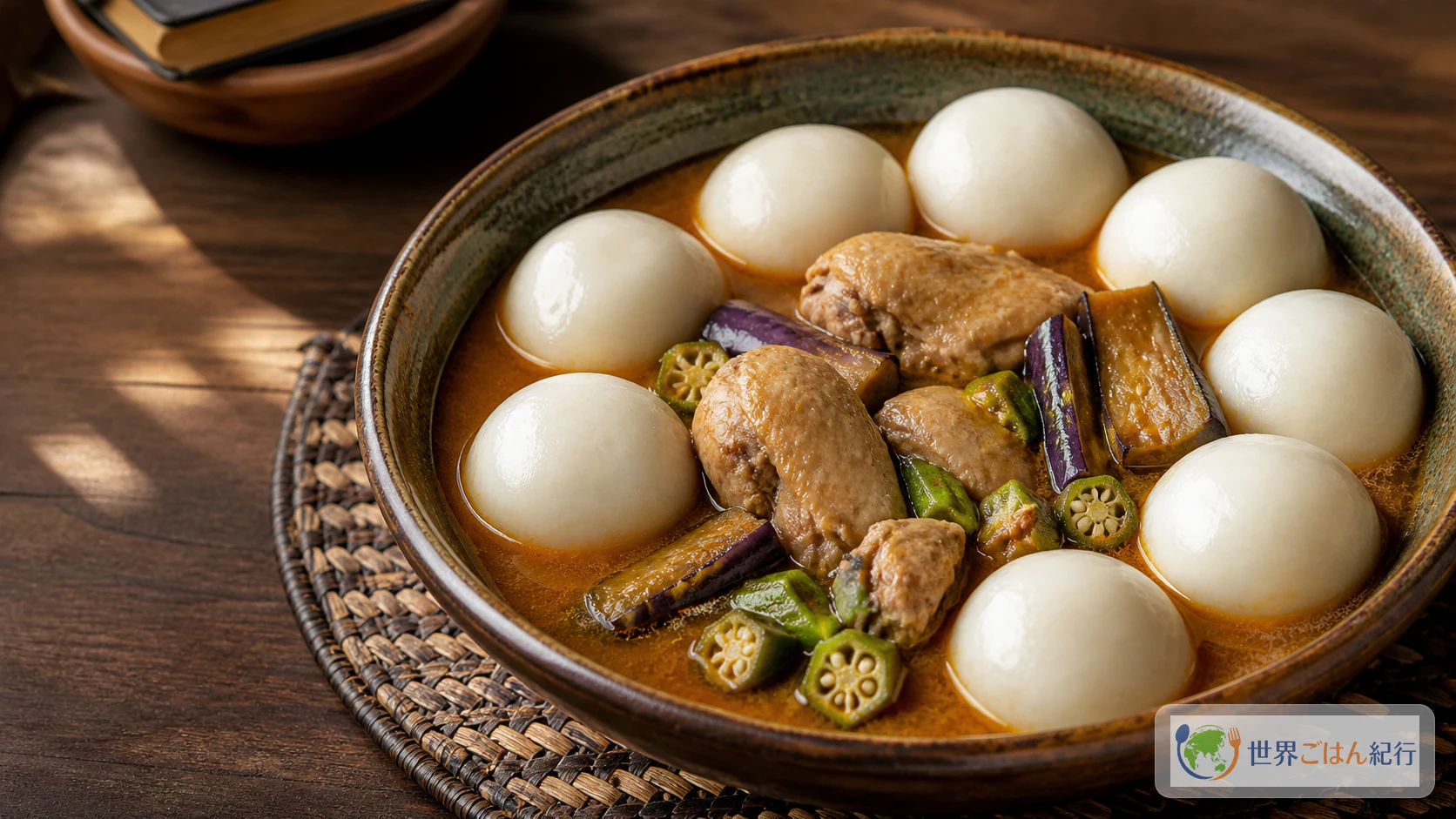
Tear off a piece of tô and it gives a little, chewy and soft, somewhere between Japanese mochi and the ugali of East Africa. Then the plain sweetness of the grain spreads slowly in your mouth. In Burkina Faso this kneaded sorghum staple is on the table morning, noon, and night, and it is always eaten with a sauce, most often okra sauce (sauce gombo) or baobab-leaf sauce (sauce de feuilles de baobab). It is simple food, built from a single grain and a lot of patience at the stove.
Tô in Burkina Faso
Tô is a chewy staple made by cooking sorghum or millet flour in water and kneading it. Burkina Faso, whose name means "land of upright people," is a landlocked country in West Africa, and most of it is covered with the dry grasslands of the Sahel. On the southern edge of the Sahara, with alternating rainy and dry seasons and a harsh climate, its people have built a surprisingly rich food culture from a limited range of grains, and tô is at the center of it.
Similar dishes are known as tô in francophone West Africa, TZ in Ghana, and tuwo in Nigeria. The grain can be sorghum, millet, or corn flour. In Burkina Faso, sorghum flour is the most traditional choice, giving a reddish-brown finish. It belongs to the same family of kneaded staples as fufu from Ghana and ugali from Tanzania, but the grain and the kneading differ, and so do the texture and flavor.
Tô gets little attention outside West Africa, even though dishes like maafe from Mali and thieboudienne from Senegal draw plenty of interest. That's a shame, because it is easy to make with ingredients you can find almost anywhere.
The grain culture of the Sahel

With so little rain, the Sahel is not suited to growing wheat or rice. Drought-tolerant sorghum and millet have been grown here for thousands of years, and they remain the region's central staples.
West Africa's kneaded staples fall broadly into three lines: root-based (cassava, yam), as in fufu; grain-based (corn), as in ugali; and millet-based (sorghum, millet), of which tô is the purest form.
Sorghum as a food
Sorghum is gluten-free, so it is a safe grain for people with celiac disease or gluten sensitivity, and it supplies fiber and minerals. The red sorghum used for traditional tô is rich in polyphenols, and sorghum is also a low-GI food that helps temper sharp rises in blood sugar.
Sorghum is being reassessed around the world as a crop adapted to climate change. It is highly drought tolerant. In the United States and elsewhere, the market for sorghum flour as a gluten-free grain is growing, and white sorghum has begun to enter the gluten-free market in other countries as well.
The bâton de tô
The traditional tool for making tô is a wooden stick called the bâton de tô, about 31.5 inches (80 cm) to 1 m long. Its tip flares slightly, and it uses leverage to work the heavy dough efficiently.

Ingredients (serves 4)

A traditional West African umami seasoning made by fermenting the seeds of the néré tree (Parkia biglobosa). Beneath a powerful smell lies a deep savoriness resembling cheese or miso, and it is essential to Burkinabè sauces. It is called dawadawa in English and soumbala in French. It is hard to find outside West Africa, but miso is the closest substitute as a fermented food: the soy umami and saltiness do the job of soumbala.
Choosing Flour for Tô
Store-bought sorghum flour comes in fine and coarse grinds, and for tô you want the fine one. A coarse grind forms lumps easily and leaves a gritty finish, so check the label for "fine" or "finely ground."
Millet flour works in place of sorghum and gives a brighter yellow tô. Millet is sweeter than sorghum and finishes lighter in texture; look for it in the grain section or at natural food stores.
If you cannot get either, cornmeal can stand in. Corn tastes different, though, so mixing in 30 percent whole wheat flour brings back some of sorghum's grain complexity. Cornmeal also absorbs less water than sorghum flour, so cut the water by about 3.5 tbsp (50 ml).
Keeping Tô from Scorching
During the kneading, hold the heat low. At medium or above the bottom scorches instantly and the bitterness spreads through the whole batch. Tô is a dish of low heat and patience; once you smell scorching, it is too late. A heavy-bottomed enameled pot or Dutch oven is ideal.
Sauces and Ways to Serve Tô
Okra sauce is the classic, but tô happily takes other partners. Because its own flavor is just the plain sweetness of the grain, it goes with almost anything you can scoop up.
Baobab-leaf sauce
In place of the okra sauce, rehydrate 3 tbsp dried baobab leaf (powder) in 1¼ cups (300 ml) water to make the sauce. Baobab leaves have a slime like okra and a refreshing, lemony sourness, which wakes up the appetite in the hot season. Look for "baobab leaf powder" at African grocers and online.
Peanut sauce
The peanut sauce of maafe from Mali is also a common pairing in Burkina Faso. Tear the tô and dip it, and the sweetness of the grain meets the richness of the nuts. Just make the sauce part of the maafe recipe.
Spinach sauce
If okra's sliminess isn't for you, make the sauce with 10.5 oz (300 g) spinach and 7 oz (200 g) canned tomatoes. Boil the spinach for 5 minutes, chop it finely, and simmer for 10 minutes with onion, garlic, and tomato sautéed in palm oil. It is a leafy-green sauce in the manner of isombe from Rwanda.
With curry
Serve tô next to a curry in place of rice, then tear it off and dip, like a gluten-free version of curry and naan. The chewiness of the sorghum holds up well to the spices.
More African Recipes
- Fufu (Ghana) — a kneaded staple of pounded cassava and plantain, the root-based classic
- Ugali (Tanzania) — a kneaded staple of corn flour from East Africa
- Maafe (Mali) — a peanut-sauce stew that pairs beautifully with tô
- Thieboudienne (Senegal) — a West African stew of fish and rice
- Ndolé (Cameroon) — bitterleaf and peanut stew
- Muamba de galinha
- Ful medames
- Kitfo
- Eba
Frequently Asked Questions
What is the difference between tô and ugali?
Ugali is made mainly from corn flour, while tô is made mainly from sorghum flour. Ugali is a little firmer and cleaner in taste, whereas tô is chewier with a richer grain flavor. The method differs too: tô starts with a slurry and then adds flour, whereas ugali adds flour directly to boiling water.
Can I keep it in the refrigerator?
Tô keeps for 2 days in the refrigerator. Put it in an airtight container with plastic wrap pressed against the surface. It firms up as it cools, which is normal. To reheat, put the amount you need in a pot with 2–3 tbsp water and knead it again over low heat, or heat it in the microwave for 30 seconds first and then knead. The okra sauce keeps 3 days refrigerated and 1 month frozen.
Nutrition (per serving, one of 4)
| Nutrient | Amount |
|---|---|
| Energy | 420kcal |
| Protein | 0.5 oz (12g) |
| Fat | 0.5 oz (14g) |
| Carbohydrate | 2.5 oz (65g) |
| Fiber | 0.5 oz (8g) |
| Sodium | 480mg |
| Iron | 4.2mg |
| Magnesium | 98mg |