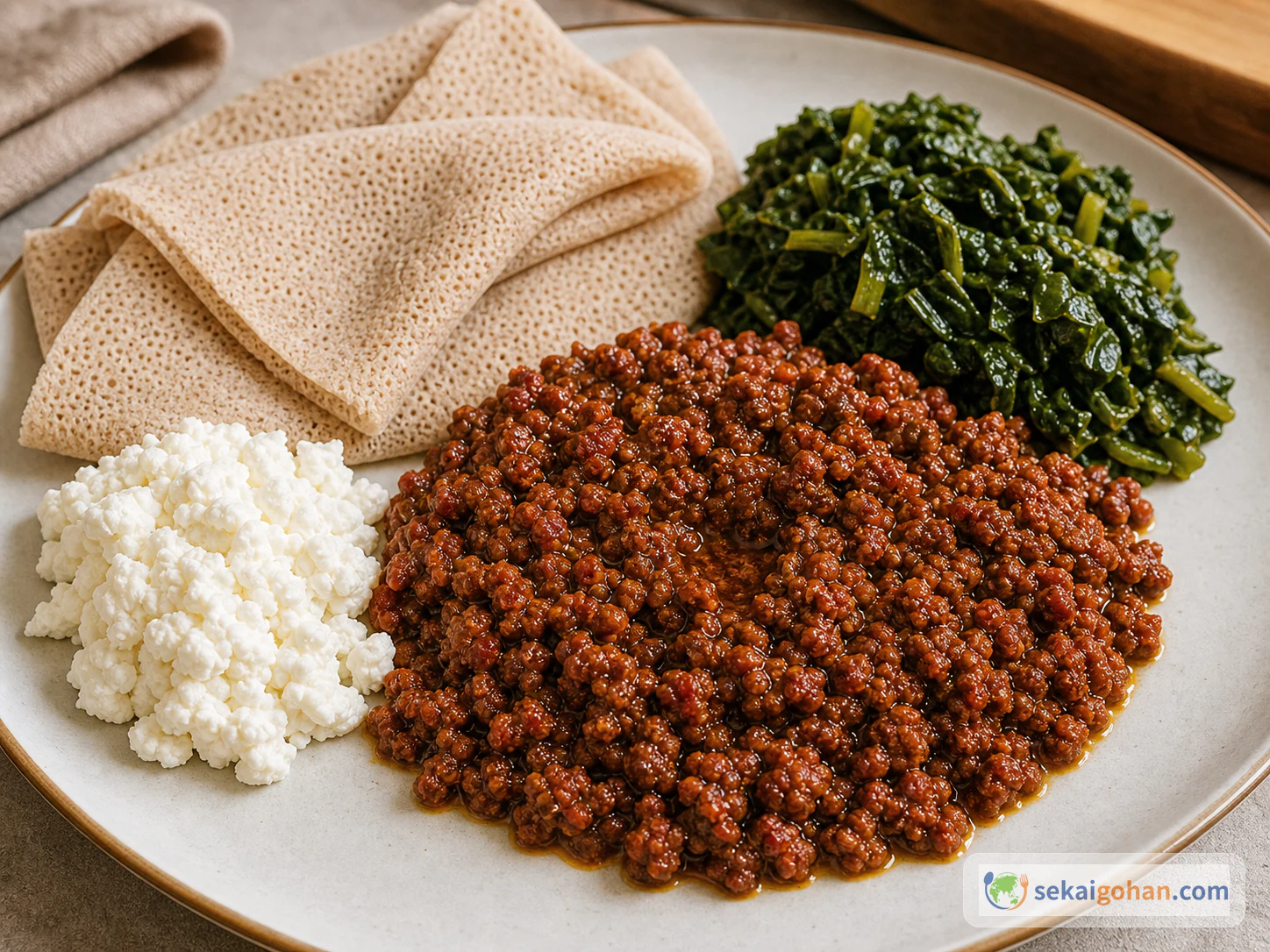
Spoon warm clarified butter, infused with ginger and cardamom, over finely minced cold beef and a little red mitmita, and the surface of the meat turns glossy. This is kitfo (ክትፎ), a beef dish closely tied to the Gurage people of central Ethiopia. Lean beef is minced with a knife and dressed with mitmita, a hot spice blend, and niter kibbeh, a spiced clarified butter. The heat is sharp and the butter is fragrant. On the side come ayib, a mild fresh cheese, gomen, cooked leafy greens, and injera or kocho to catch the heat and the fat as you eat.

About Kitfo: Gurage Meat, Kocho, and the Celebration Table

The name kitfo comes from an Ethio-Semitic root meaning "to chop finely," so the name itself describes the work. You chop lean meat finely with a knife for a smooth texture. Ground meat bought ready-made won't give you that texture.
The sides are gentle, and that is part of the appeal. Ayib is a low-salt fresh cheese that softens the mitmita, and gomen is braised greens that take on the fat. Hot red meat, white cheese, green leaves, sour injera: that color combination is the Ethiopian table. Among the Gurage, kocho is more of a local staple than injera. It is a bread made by fermenting the stems and leaf sheaths of enset, the so-called "false banana," and it is nearly impossible to find elsewhere.
Kitfo also differs from other Ethiopian meat dishes. Tibs is about browning and the toasty aroma of onion, and the stewed doro wot takes time. Kitfo builds no toastiness with fire and sets its aroma in a few minutes. The minced meat is coated in spiced butter and eaten while the butter is still warm. If you already know doro wot and injera from the Ethiopian cuisine overview, kitfo is the natural next dish. Treat the meat, the heat, the butter, and the cooling sides as separate parts, and you can get quite close in a home kitchen.
The magic of kitfo lies in the niter kibbeh. Western tartare is bound with egg yolk. Kitfo's character comes from wrapping the meat in warm aromatic butter, so plan the butter's aroma first, not just the meat.
Raw Kitfo and Food Safety at Home

Don't eat raw ground beef at home. Cook it to an internal temperature of 160°F (about 71°C). Always serve the fully cooked version to older adults, pregnant women, children, and anyone with a weakened immune system.
Traditional kitfo includes a near-raw way of eating it. In Ethiopian restaurants and specialty shops, that tradition rests on how the meat is sourced, handled, and served, and those conditions are hard to reproduce at home. Store-bought ground beef is a different matter. Grinding mixes bacteria from the surface all the way through, and you can't judge safety by look or smell. Cook ground beef to an internal temperature of 160°F (about 71°C).
This recipe is built around a lightly cooked, leb leb-style version, with a fully cooked version for family meals or anyone with health needs.
| Finish | State of the meat | Suited to |
|---|---|---|
| Leb leb-style | Cooked briefly, just until the surface lightly colors | Adults who want a little of the traditional texture and understand the risk |
| Fully cooked | Cooked through the center. About 160°F (71°C) by thermometer | Family dinners, tables with older adults, children, or pregnant guests |
Leb leb-style kitfo is warmed just enough to color the surface and leave a little pink in the center. That brings it closer to the traditional texture, but it isn't automatically safe. If you make it, mince a block of lean beef just before cooking, use clean tools, finish it right away, and don't serve it to older adults or children. The fully cooked version looks more like spiced crumbles. With the aroma of niter kibbeh and mitmita and the ayib and greens alongside, it still tastes like kitfo, and it is the one to start with for a family dinner.
Do not eat commercial ground beef raw or rare. If you make the leb leb-style version, buy a block of lean beef, keep it cold until just before cooking, mince it with a clean knife and board, and cook and finish it right away. If in doubt, make the fully cooked version.
Ingredients (serves 4): Decide the Heat and the Sides Before the Meat

This makes a small main dish for 4. If you are serving it with doro wot or a lentil wot on an Ethiopian-food day, this amount is enough. If kitfo is the star, raise the beef to about 1.5 lb (700 g) and increase the ayib and greens.
This dish contains beef and dairy (butter, cottage cheese). Some injera and store-bought tortillas contain wheat. If you avoid dairy, replacing the niter kibbeh with vegetable oil changes the aroma, but you can still build the meal around the heat and the greens.
Ingredients and Tools for This Dish
Because kitfo cooks so quickly, have the mitmita, butter, and a thermometer ready before you start. The thermometer matters most, because it keeps you on the safe side.
Choosing Ingredients and Substitutes for Kitfo
Most of what goes into kitfo has a workable stand-in outside Ethiopia. The beef is the one part not to compromise on: buy a block and mince it yourself.
| Local element | Role | Realistic swap in a home kitchen |
|---|---|---|
| Finely minced lean beef | The star. Brings out the sweetness of the meat rather than fat | Hand-mince a block of round, rump, or tenderloin |
| Mitmita | Heat and a sharp aroma | Order mitmita online, or berbere plus cayenne plus cardamom |
| Niter kibbeh | Aromatic fat that rounds out the meat | A simple spiced butter made with unsalted butter |
| Ayib | A dairy to cool the heat | Cottage cheese, strained yogurt, ricotta |
| Gomen | Bitterness and fiber from greens | Collards, kale, spinach |
| Kocho | Gurage fermented bread | Injera, tortillas, thin flatbread |
Go easy on the mitmita. Berbere has a broad aroma suited to stews. Mitmita is a sharper heat, and with cardamom and cloves in the blend, even a little lingers on the tongue. Two teaspoons can make the dish too hot for the whole family, so start with 1 tsp and add more at the table.
Method: Mince, Infuse the Aroma, Finish Briefly
The order of work is greens, ayib, niter kibbeh, then meat. If you make the sides after mincing the meat, the meat waits at room temperature longer. Prepare the receiving dishes first and touch the meat last; it is easier for both safety and flavor.
If you use ground beef
If you must use store-bought ground beef, cook it all the way through. The texture moves away from traditional kitfo, but the combination of niter kibbeh, mitmita, ayib, and gomen still points it toward Ethiopian food.
Common Kitfo Mistakes and Fixes

Most kitfo problems come from the fat and the heat rather than from cooking the meat. If the butter is too hot, the meat tightens at once. If it is too cool, the fat just feels heavy. Too much mitmita, and the heat drowns out the sweetness of the meat.
Niter kibbeh should be warm
Niter kibbeh coats the meat in aroma; it doesn't fry it. Poured on piping hot, it firms up the surface suddenly and the butter turns harsh. Infuse it over low heat, add the meat, and mix briefly.
Keep the meat cold and serve it right away
Cold meat is easier to chop and safer to handle. Don't let finished kitfo sit at room temperature. Set the table before you start the meat and serve the moment it's done. Treat it as a sprint, not a make-ahead dish.
Do not judge doneness by color alone. Check with a thermometer, not color or texture, to confirm the food is cooked safely. For minced beef especially, a thermometer is the most reliable way to check at home.
Serving, Storing, and Varying Kitfo

Kitfo goes better with a slightly sour bread than with white rice. Injera is best, but it takes time to ferment. On weeknights, a tortilla, thin naan, or tangy rye bread is enough.
How kitfo is eaten in Ethiopia
Tear off a small piece of injera and pick up a little kitfo, a little ayib, and a little gomen. The cheese cools the heat, the greens cut the fat, and then you go back to the meat. Because of that back-and-forth, a small amount is satisfying.
Building a dinner around kitfo

Fully cooked kitfo with injera or tortillas, greens, cottage cheese, and a lentil stew makes a meal that doesn't rely only on meat. On a doro wot day, a little kitfo as an appetizer shows the difference between "stewed red" and "minced red" in the same cuisine.
Storage and leftovers
Kitfo is not for making ahead. Cool the fully cooked version slightly, refrigerate it, and eat it by the next day, reheating it in a skillet until hot all the way through. Leb leb-style kitfo should not be stored; finish it on the spot. Leftover fully cooked kitfo works well as spiced crumbles with rice or bread. Stir-fry it again with a little onion and serve it with lemon and yogurt. It won't taste much like kitfo anymore, but it uses up the leftovers.
Kitfo variations

Kitfo changes a lot with the degree of cooking and the sides. The first time, learn the basic flavor with the fully cooked version. After that, try adjusting the heat and the sides.
For a milder family version, cut the mitmita to 1/2 tsp and make up the aroma with 1 tsp berbere. Use more cottage cheese and add a little lemon to the greens. As long as the aromatic butter goes in properly, it rarely tastes like anything is missing.
If you dislike rawness, cut the beef into small cubes instead of mincing, sear it hard, and toss it with mitmita and niter kibbeh. Strictly speaking, that moves away from kitfo toward tibs, but it's easy on a weeknight.
For a lighter dairy-free version, replace the butter with vegetable oil and leave out the cottage cheese. This leans toward Ethiopian fasting-period cooking, though kitfo is still a meat dish and not a true fasting food. Add more greens and lemon to make up for the missing fat.
Once niter kibbeh and mitmita feel familiar, try the stewed doro wot, the grilled-meat tibs, and the fermented bread injera. From the African cuisine overview you can branch out to West Africa's waakye or South Africa's bunny chow.
Frequently Asked Questions

Can I make it with berbere if I have no mitmita?
Yes. Add a little cayenne, cardamom, and cloves to 2 tsp berbere to bring it closer to mitmita's sharp heat. You can always add heat later, so start light.
What can I serve in place of ayib?
Cottage cheese is the most practical substitute. Use ricotta for a smoother texture or strained yogurt for a little tang. Feta is very salty, so use only a little.
Is there little point without injera?
Injera's sourness and texture suit kitfo well, but you can skip it the first time. A somewhat tangy or chewy staple such as a tortilla, thin naan, or rye bread works fine. Once you're comfortable with kitfo, try how to make injera too.
Sources
For the origin of kitfo and the explanations of mitmita, niter kibbeh, ayib, kocho, and leb leb, I consulted English-language food articles and Wikimedia Commons dish image information; for food-safety cooking temperatures I gave priority to the CDC and USDA FSIS guidance for ground beef.
- Allrecipes, "What is Kitfo? And Can You Make It at Home?" https://www.allrecipes.com/article/what-is-kitfo/
- Epicurious, "The Path to Niter Kibbeh Starts With Herbs and Spices" https://www.epicurious.com/recipes-menus/niter-kibbeh-herbs-spices-article
- CooksInfo, "Kitfo" https://www.cooksinfo.com/kitfo
- My African Food Map, "Ethiopia: Kitfo" https://www.africanfoodmap.com/recipes/kitfo/
- CDC, "Ground Beef Handling" https://www.cdc.gov/restaurant-food-safety/php/practices/ground-beef-handling.html
- USDA FSIS, "Ground Beef and Food Safety" https://www.fsis.usda.gov/food-safety/safe-food-handling-and-preparation/meat/ground-beef-and-food-safety
- USDA FSIS, "Safe Minimum Internal Temperature Chart" https://www.fsis.usda.gov/food-safety/safe-food-handling-and-preparation/food-safety-basics/safe-temperature-chart