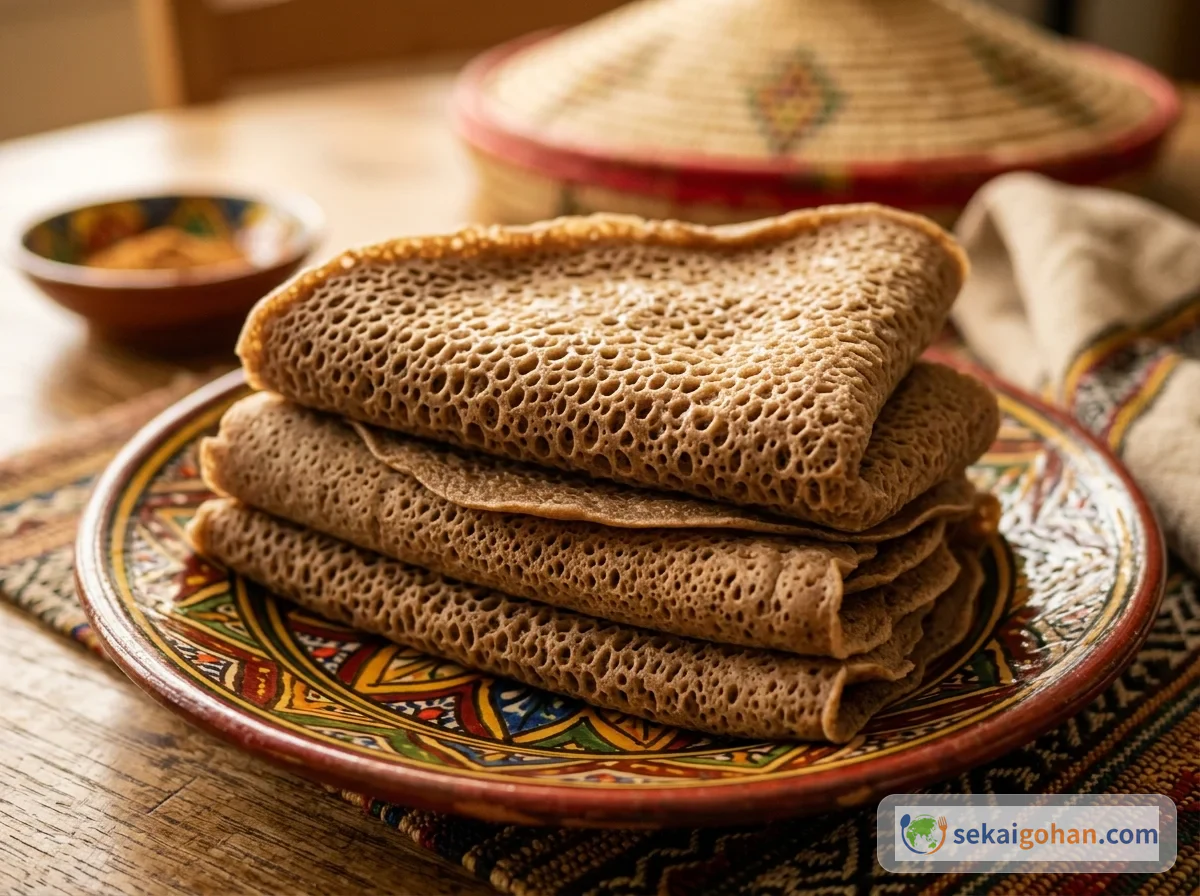
On the Ethiopian highlands, 2,400 meters above sea level, women pour thin batter onto a large clay griddle (mitad) in the morning mist, a scene that has been part of daily life for a very long time. What comes off the griddle is injera (ənǧära / እንጀራ), the staple of Ethiopia and Eritrea and the foundation of Ethiopian cuisine. It looks a little like a crêpe, but its surface is covered in countless tiny bubble holes that give it a spongy texture, and it tastes pleasantly sour from fermentation. You can make it with ingredients from an ordinary supermarket, and even without teff flour, buckwheat flour gives a surprisingly authentic result.

About Injera
Injera is plate, spoon, and staple all at once. It is made from a grain called teff, fermented naturally, and cooked on one side only, and few other breads combine all three. Because teff is gluten-free, injera has also drawn attention from health-conscious eaters in the West. If you want to compare it with flavors from elsewhere on the continent, Moroccan tagine shows how differently the spice cultures of East and West Africa developed.
The mesob and eating by hand
At a traditional meal, injera is spread over a round woven table called a mesob, and several wats (stews) are set on top. Everyone sits around it and tears pieces by hand from the same injera. The moment the lid of the mesob is lifted is the highlight of the meal: red doro wat, yellow alicha, and green gomen laid out on one big round of injera.

The most important act at the table is gursha. You wrap food in injera and feed it directly into another person's mouth as an expression of affection, respect, and friendship: a parent to a child, a husband to a wife, friends to one another. The larger the gursha, the deeper the affection, and offering one to a guest you have just met is the highest form of hospitality.

Fasting and plant-based cooking
Members of the Ethiopian Orthodox Church keep many fasting days each year, when they eat no animal foods. Injera itself is entirely vegan, and on fasting days it is eaten with misir wat (a red lentil stew) and shiro wat (a chickpea-flour stew). This tradition has pushed Ethiopia's plant-based cooking to a level found almost nowhere else. A similar ingenuity shows up in Middle Eastern falafel, eaten often in Lebanon around Lent.
Teff, the world's smallest grain
Teff (Eragrostis tef) is native to Ethiopia, with kernels under 0 inch (1 mm) across, one of the smallest grains in the world. One theory links the name to an Amharic word meaning "lost." It has been grown on the highlands for a very long time and is still one of the country's main grains. After domestic prices rose, the Ethiopian government banned teff exports in 2006 for food security; the restriction was later partly eased, and teff spread quickly through the Western gluten-free market.
Ingredients (serves 4, about 8 pieces)
- Online and import grocers: Search for "teff flour." It is sometimes sold as an imported baking grain
- Substitute (buckwheat plus rice flour): Both are easy to find in the baking aisle of most supermarkets. The distinctive flavor of buckwheat comes close to the earthiness of teff, and rice flour supplies the chew
Nutrition (per piece, approximate, with teff flour)
This is an estimate for 10.5 oz (300 g) of teff flour baked into 8 pieces (about 1.25 oz (37 g) of teff flour per piece). Injera is gluten-free and low in fat.
| Nutrient | Per piece |
|---|---|
| Calories | about 140 kcal |
| Protein | about 5 g |
| Fat | about 1 g |
| Carbohydrates | about 27 g |
| Fiber | about 3 g |
| Iron | about 2.8 mg |
| Calcium | about 65 mg |
Teff contains 7.6 mg of iron per 3.5 oz (100 g), about six times the 1.2 mg in wheat flour. It is a mineral-rich, gluten-free grain, and it is drawing attention as an alternative for people with celiac disease. This nutrient profile does not apply if you substitute buckwheat flour.
Choosing Flour for Injera
If you can get teff flour, try a batch made entirely with it. Pure teff injera has a faintly sweet, earthy aroma, a softer sponge, and a darker brown color than the buckwheat version. It takes well to wild yeast, and 2 days is enough fermentation.
If you cannot get teff flour, mixing buckwheat flour and rice flour 2:1 gives a flavor and texture close to teff. The bitterness of buckwheat recreates teff's earthy flavor, and the chew of rice flour supplies its suppleness. The sourness is somewhat weaker, but the texture and look come quite close. Fermentation is a little slower, so leave it at least 3 days.
With neither buckwheat nor rice flour on hand, use 7 oz (200 g) whole wheat flour and 3.5 oz (100 g) potato starch. It ferments less readily than teff, but the nuttiness of whole wheat gives it an injera-like character, and 1 tbsp lemon juice stirred in just before baking brings the sourness closer to the real thing. As a bread from a fermented batter, it has something in common with the yeast dough of Georgian khachapuri.
Method
With injera, everything depends on fermentation. Mixing the batter takes 5 minutes, but natural fermentation takes 2–3 days. If you want to eat it on the weekend, start the batter on a Wednesday or Thursday evening.
Step 1: Mix the batter and ferment it (48–72 hours)
Put 10.5 oz (300 g) teff flour (or 7 oz (200 g) buckwheat flour plus 3.5 oz (100 g) rice flour) into a large glass bowl (avoid a metal bowl, which can affect fermentation). Add 2 cups (500 ml) lukewarm water a little at a time, whisking until no lumps remain. The target is a thick, flowing batter, slightly looser than pancake batter.

Cover loosely with plastic wrap (or parchment) and leave at room temperature (77–86°F (25–30°C)). Do not refrigerate. For 2–3 days, stir gently once a day with a clean spoon. When small bubbles increase on the surface, a faint sour aroma appears, and the whole batter has risen a little, it is ready to bake.
In Ethiopian homes, a little of the previous batch of batter is kept as a starter and mixed into the next. If you are making it for the first time, you have no starter and rely on the wild yeast and lactic acid bacteria in the air. Use a clean bowl and do not seal the wrap, leaving a gap so the yeast can breathe.
- Mold (black, green, or pink) has grown: Discard everything and start over. The container was not clean
- A rotten smell (like garbage): This is spoilage rather than sourness. Discard it
- Almost no bubbles after 3 days: The room is too cold. Putting the bowl in an oven with only the oven light on (about 86°F (30°C)) can help
Step 2: Make absit and adjust the consistency (about 10 min)
This is a traditional Ethiopian technique. Take about ½ cup (150 ml) of the fermented batter (about 1/5 of the total) into a small pot, add the same amount of water, and set it over medium heat. Stirring constantly, heat 2–3 minutes until it thickens to a paste. The signs are fine bubbles and a line that remains when you drag a spatula across the bottom of the pot.
This paste is called absit. Mix it back into the rest of the batter. Adding absit makes it easier to get even bubbles (called "eyes") on the surface of the injera.
If you skip this step, the bubbles will be uneven and the sponginess weaker. Add 100 ml–¾ cup (200 ml) water a little at a time to the batter with the absit mixed in. The target is slightly thinner than crêpe batter. When you scoop it with a spoon and let it fall, it should run in a thin thread.
Add 1/2 tsp salt here and mix well.

Step 3: Preheat the pan and pour the batter (5 min)
Preheat a nonstick skillet 10–11 inches (26–28 cm) in diameter over medium heat for about 2 minutes. Do not oil it. Flick a few drops of water on it; if they evaporate right away, the temperature is right (about 180–200°C).
In Ethiopia a large clay griddle called a mitad is used, but a nonstick skillet reproduces it well enough.
- Nonstick is a must: Injera is baked without oil, so it has to resist sticking
- A larger pan is recommended: Use a pan of 10 inches (26 cm) or more to bake injera about 8 inches (20 cm) across
- A lid is required: Have a glass lid that fits the pan (used for steaming)
Pour about ¼ cup (80 ml) batter (a little less than one ladle) into the preheated pan. Tilting the pan, spread the batter in a spiral from the outside in. The method is the same as for a crêpe, but make it slightly thicker.

Cover right away and steam over the same medium heat for 2–3 minutes.
Step 4: Check the bubbles and finish baking (30 sec)
Watching through the lid over medium heat, you will see countless tiny bubbles appear on the surface and open into holes. These holes are the "eyes" of injera. It is done when holes cover the entire surface and the top is dry and no longer shiny.

Do not flip it. Injera is cooked on one side only. The underside, touching the pan, is smooth, and the top is a sponge full of bubble holes. That is correct.
Step 5: Remove and cool (30 sec)
Carefully lift the injera out of the pan, spread it on a clean kitchen towel, and leave it about 30 seconds to cool a little. It tears easily while hot, so fold it in quarters once it is cool enough to touch.

Make the rest of the batter the same way. A batch for 4 people (about 8 pieces) takes about 30 minutes.
Injera Troubleshooting and Tips
Most problems with injera come down to fermentation and heat. The Ethiopian highlands stay around 68–77°F (20–25°C) all year, so a cold kitchen is the usual reason no bubbles appear.
In hot weather (over 86°F (30°C)) fermentation speeds up, and 1–2 days is enough. If the room is below 68°F (20°C), place the bowl in an oven with only the light on (about 86°F (30°C)), in a foam box with a hot-water bottle, or near a rice cooker on warm mode (with the lid open). Use a glass or plastic bowl: in a metal container, acid can inhibit fermentation.
- Do not skip the absit (step 2). It decides how even the bubbles are
- Do not overmix the batter. A light stir right before pouring is enough
- Keep the pan at medium heat. High heat makes the bubbles too large and holey
- Once the batter is poured, do not move the pan. Careless shaking makes it uneven
Injera does not brown. A finished one is white to cream (light brown if made with teff flour). If the underside browns, the heat is too high, so drop to medium-low. It is a very different feel from stir-fries such as nasi goreng or pad thai.
Keep about 3.5 tbsp (50 ml) of batter unbaked in the refrigerator, and it becomes the starter for your next injera. With a starter, fermentation finishes in a day and the sourness is steadier. In Ethiopian homes, a starter is sometimes passed down for years as "the family's taste."
Serving Injera and Variations
Once the injera is baked, start on the wat to go with it. For a milder vegetable side, the yellow sauce of atakilt wat suits the sour bread, and the guide to Middle Eastern cuisine has tips on using spices.

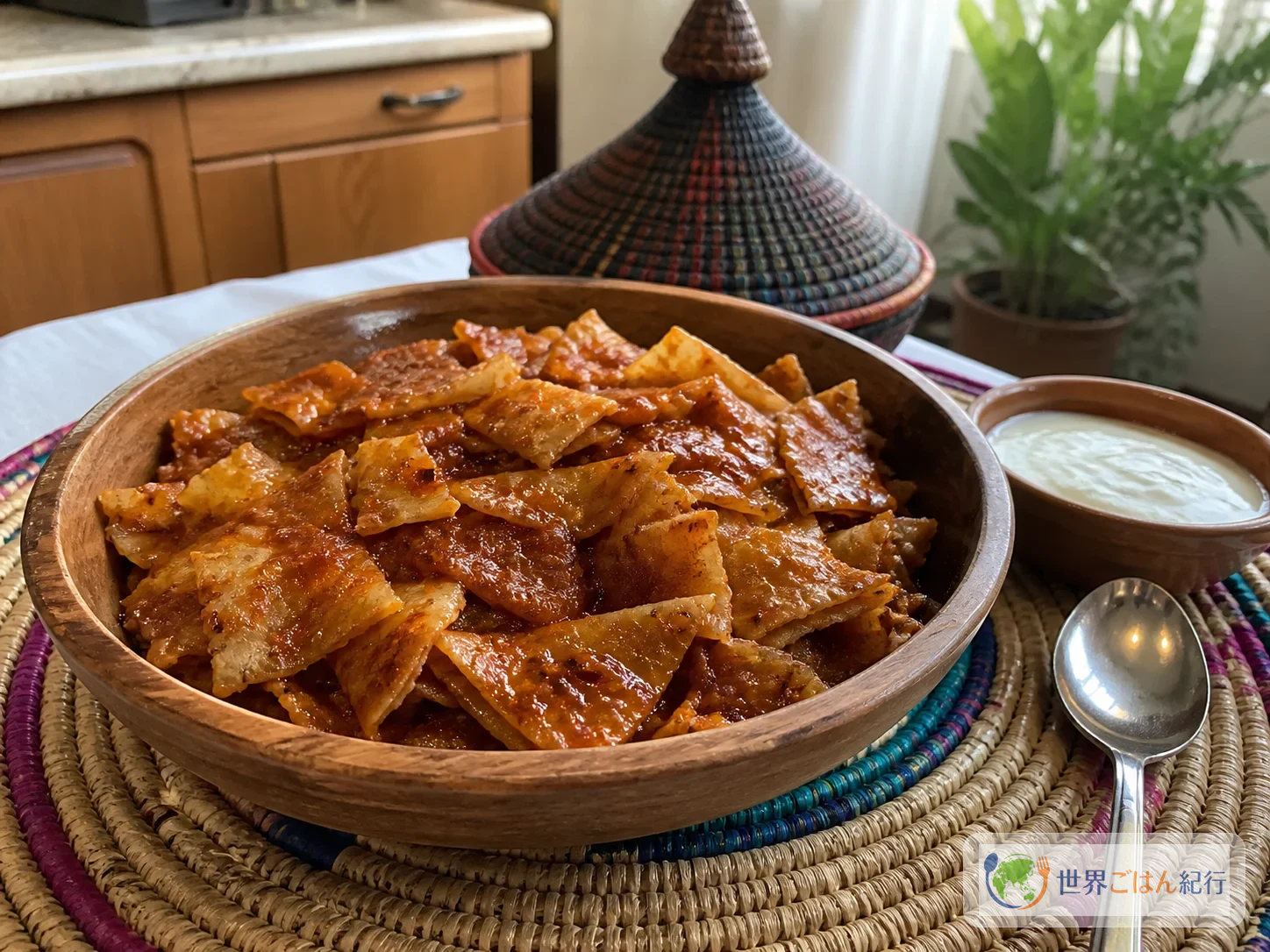
On mornings when you want Ethiopian bread without waiting for fermentation, try chechebsa, thin kita flatbread torn up and mixed with berbere, or genfo, flour stirred in a pot with spiced butter poured into a well in the center. Their browned edges, stickiness, and buttery aroma make a nice contrast with sour injera.

Spiced injera
Adding spices to the batter is also done in Ethiopia. Stir these in after fermentation:
- Nigella seeds (black cumin), 1 tsp: A faint bitterness and nutty flavor
- Fenugreek, 1/2 tsp: A sweet aroma close to curry
- Rosemary (chopped), 1 tsp: A Mediterranean twist that also goes with Moroccan tagine
Mini injera and banana pancakes
Bake small rounds about 4 inches (10 cm) across and top them with bite-sized doro wat (chicken stew) for party finger food. They are also very good with Middle Eastern hummus and falafel.
For breakfast, stir 1 mashed banana and 1/2 tsp cinnamon into fermented batter and bake small rounds for a sour, gluten-free pancake, served with maple syrup. It is a popular adaptation in Ethiopian American communities.
FAQ
What if the injera is too sour?
The fermentation ran too long, so bake a day earlier next time. For batter that is already too sour, a tiny pinch of baking soda (about 1/8 tsp) neutralizes some of the sourness, but too much makes it taste of soda. If you like sour flavors, the tomato acidity of shakshuka makes a good side.

How long does it keep?
Baked injera keeps 3 days in the refrigerator and 1 month in the freezer, wrapped in plastic. Refrigerated injera firms up a little, but warming it in the microwave for about 20 seconds or in a steamer for 1 minute brings back its suppleness.
What if I have a buckwheat allergy?
Use 10.5 oz (300 g) rice flour (the same weight as the teff flour). Rice flour alone turns very sticky, so use more water (about 2½ cups (600 ml)) and bake it thin. The flavor differs from teff, but you still get plenty of the sponge texture.
Sources
The works below are academic papers and books on teff and injera published in English. Because information in Japanese on this subject is extremely limited, these are used as the primary sources.
Books and academic papers:
- McCann, James. Stirring the Pot: A History of African Cuisine. Ohio University Press, 2009 (https://www.ohioswallow.com/book/Stirring+the+Pot). Accessed 2026. A comprehensive study of the history of Ethiopian food culture, covering the historical origins and social role of injera.
- Baye, K. "Teff: nutrient composition and health benefits." European Journal of Clinical Nutrition 68, 1209-1214 (2014) (https://www.nature.com/articles/ejcn2014050). Accessed 2026. A nutritional analysis of teff; the source for iron and calcium content.
- Hopman, E. et al. "Tef in the diet of celiac patients in The Netherlands." Scandinavian Journal of Gastroenterology 43(3), 277-282 (2008) (https://pubmed.ncbi.nlm.nih.gov/17852841/). Accessed 2026. A clinical study of teff's gluten-free properties.
- U.S. Department of Agriculture. FoodData Central (https://fdc.nal.usda.gov/). Accessed 2026. Nutrient values for raw teff.
Statistics:
- Ethiopian Central Statistical Agency (CSA). Agricultural Sample Survey 2021/22 (https://www.statsethiopia.gov.et/). Accessed 2026. Statistics on teff acreage and production.