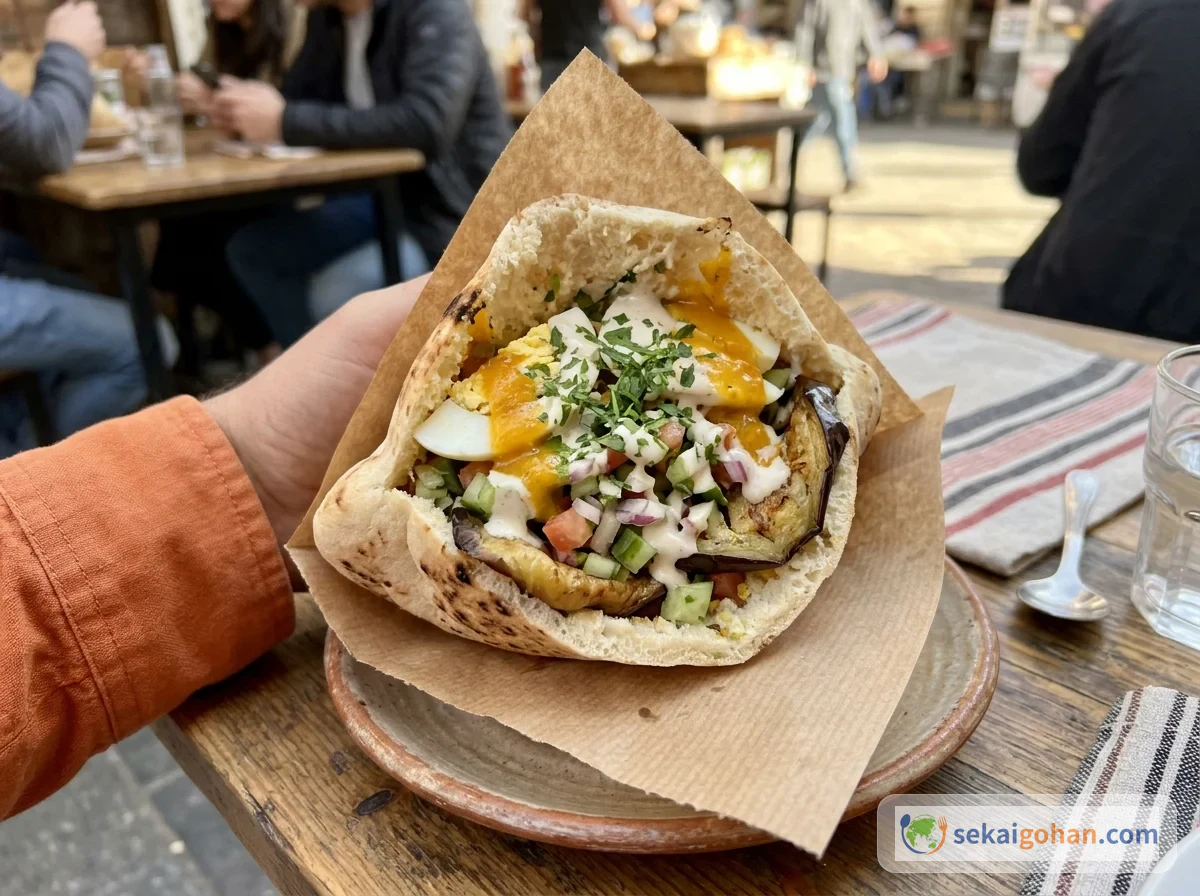
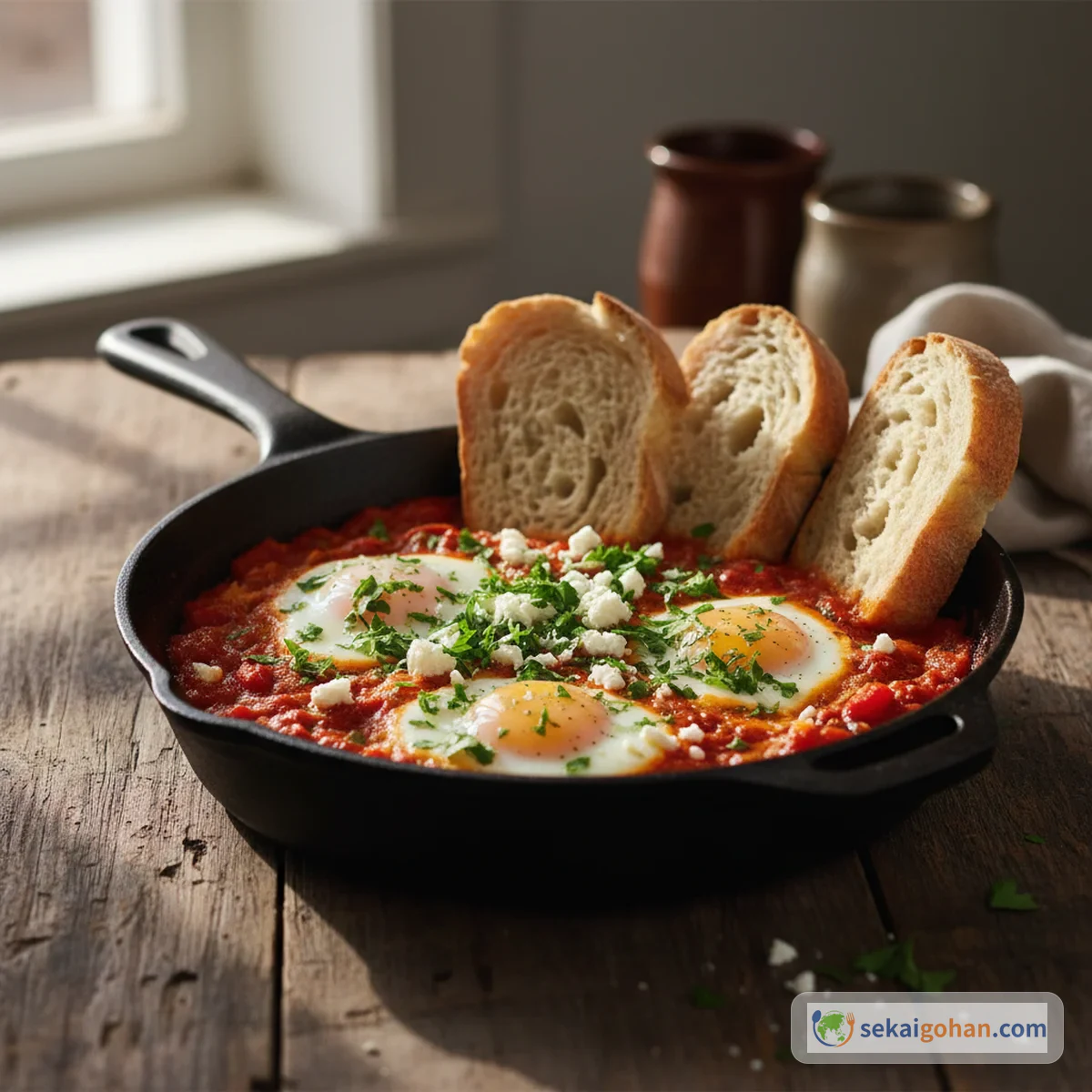
On a morning in Tel Aviv, you'll see the same thing in every café: a black cast-iron pan set straight on the table, eggs with whites still quivering in tomato sauce, and guests tearing off bread to scoop up the sauce. This is shakshuka (שקשוקה / شكشوكة). It began as home cooking in North Africa, became a staple in Israel, and over the past decade has turned into a brunch standard on café menus in Europe and the United States. It takes one pan and 35 minutes, and the flavor is built from layers of spice.
Shakshuka's origins and history

Where shakshuka comes from
The name comes from an Amazigh (Berber) word meaning "mixture." The dish was born in the "Amazigh triangle," which runs from eastern Algeria to northwestern Libya, and was cooked at home around Tunisia and Libya. It couldn't have existed before tomatoes arrived from the New World in the 16th century, and it first appears in writing in 1894. That makes shakshuka's history surprisingly short, only about 130 years, compared with the thousands of years behind hummus and falafel.
One leading theory traces shakshuka to the Tunisian dish ojja. In ojja the eggs are stirred into the sauce. In shakshuka they are dropped on top of it.
It is also easy to confuse with the Chinese-style tomato and egg stir-fry (fānqié chǎodàn). The spices and the way the tomato sauce is simmered are completely different, and shakshuka has the depth of flavor typical of Middle Eastern cooking.
From Israel to the world
After Israel was founded in 1948, North African Jews (Mizrahim) emigrated there, and in the 1950s they brought this dish with them. Made easily from inexpensive ingredients, shakshuka suited the limited food supply of the new state and spread across the country. It only appeared in restaurants from the 1990s, though.
From the 2010s, shakshuka spread fast through brunch menus in New York, London and Paris. Red sauce and white eggs in a cast-iron pan look great on Instagram and Pinterest, and that helped in the social media era. For a broader look at the region's food, see the guide to the appeal of Middle Eastern cuisine and classic recipes (in Japanese).
Ingredients (serves 2)
A detailed guide to choosing ingredients
Canned tomatoes are the foundation of shakshuka's flavor. Chopped and whole are both available, but chopped needs less simmering time. If possible, choose a good brand, such as San Marzano tomatoes from Italy. Cheap canned tomatoes tend to have more water and stronger acidity. In summer, 5 ripe fresh tomatoes, roughly chopped, make a shakshuka that highlights fresh tomato sweetness.
Eggs should be brought to room temperature before use. Cold eggs straight from the refrigerator drop the sauce's temperature at once and cook unevenly. Cracking each egg into a small bowl first before sliding it into the sauce prevents broken yolks.
Feta cheese is traditionally crumbled by hand and scattered over, but if hard to find, cottage cheese, ricotta or drained firm tofu can substitute. The cheese's saltiness balances the tomato's acidity.
Smoked paprika gives the sauce a much deeper flavor. Sweet paprika also makes it tasty, but the smoky aroma makes a real difference.
Eggs are the star of shakshuka. For people with an egg allergy, try "tofu shakshuka": crumble drained tofu into the sauce instead. It is a popular vegan variation. You can still enjoy the spices and tomato sauce as they are.

Nutrition: a well-balanced breakfast
Shakshuka has an ideal makeup for breakfast in nutritional terms too.
Two eggs (one serving) contain about 12 g protein, vitamin D, vitamin B12, choline and selenium. Choline in particular is important for brain function.
Tomatoes are rich in lycopene, and cooking increases lycopene's bioavailability. Cooked tomatoes absorb lycopene better than raw ones, and eating them with olive oil lets the fat-soluble lycopene be taken up efficiently. Shakshuka meets exactly this condition.
One serving (2 eggs plus sauce) is about 380 kcal, with 18 g protein, 22 g fat, 1 oz (28 g) carbohydrate and 6 g fiber. Even with a slice of bread, it comes to about 500 kcal, a well-balanced calorie level for breakfast.
In addition, vitamin C in bell peppers is so abundant that one red bell pepper covers nearly the whole daily recommended amount. Quercetin (a type of flavonoid) in onions is linked to anti-inflammatory effects, and cumin is known to aid digestion. Shakshuka is not just delicious; it is a nutritionally sensible combination.
Choosing the pan and tomatoes for shakshuka
A cast-iron skillet is the best pan for shakshuka. It holds heat so well that the sauce stays at a steady temperature even after the heat is off, and the eggs finish soft-set. A nonstick pan works, but a skillet is better, not least because you can serve straight from it. Acidic tomato sauce can strip the seasoning if it sits in cast iron for long, so wash the pan soon after eating.
If you don't have canned tomatoes, 1¾ cups (400 ml) unsalted tomato juice works; simmer about 5 minutes longer to drive off the water. In summer, 5 ripe fresh tomatoes, roughly chopped, are the best substitute. Ketchup tastes completely different and won't do.
Common shakshuka problems and fixes
Most problems come down to the sauce: how long it simmers and how hot the pan is when the spices go in.
| Problem | Cause | Fix |
|---|---|---|
| Sauce is watery | Not simmered long enough | Reduce it well, to two-thirds of the volume |
| Eggs sink | Sauce is too thin | Reduce another 1–2 minutes before adding the eggs |
| Spices scorched | Heat too high during blooming | Stir quickly over medium heat or lower; scorched spices turn bitter, so if they burn, it's best to start over |
| Sauce too acidic | Tomato acidity | Add 1/2 tsp sugar, simmer 10 minutes or more, or stir in 10 g butter at the end for richness |

The time after covering decides how the eggs turn out: 5 minutes = soft and runny (best for scooping with bread), 7 minutes = just set (the yolk barely flows), 10 minutes = fully cooked (yolk firm). No lid? Cover the pan with aluminum foil. Trapped steam cooks the tops of the eggs evenly; without a cover, the whites stay unset on top while the bottom burns.
Serving, storing and variations
Serving shakshuka
Bring the pan to the table and let everyone tear off bread. In Israel it is often served with challah, a braided bread, but baguette, ciabatta and naan all go well, and thick-sliced toast is fine too. What matters is that the bread can scoop up the sauce; thin sandwich bread gets overwhelmed, so pick one with a sturdy crumb. Add falafel and hummus and your home becomes a Middle Eastern café.
Making it ahead and storing
Tomato sauce made the day before has time to blend and tastes even better the next morning. Just warm it and drop in the eggs. The sauce keeps 3 days refrigerated or 1 month frozen; add the eggs just before eating.
Shakshuka variations
Green shakshuka (shakshuka khadra): built on spinach or greens instead of tomato sauce, and a standard menu item in Israel alongside the red version. Use 7 oz (200 g) spinach, plenty of feta and za'atar in place of cumin for a flavor closer to the real thing. Cook the spinach briefly first to drive off its moisture before dropping in the eggs.
Mexican-style (huevos rancheros-style): jalapeño, cilantro and lime juice go into the tomato sauce. Add avocado and sour cream and it feels like a Mexican breakfast table.
Miso twist: a fusion version that stirs in 1 tbsp miso instead of paprika and is topped with shiso and bonito flakes. Miso works with the glutamate in tomato for deep umami, and like gapao rice, it goes well with rice.
Cheesy version: scatter mozzarella over the sauce before dropping in the eggs, then cover to melt it. It has a pizza-like satisfaction and is popular at American brunch cafés.
With sausage: merguez (North African lamb sausage) or chorizo makes a substantial dish, and the fat adds richness to the sauce. Sliced coarse-ground sausage works well too.
With beans: drained canned chickpeas or white beans add plenty of protein and fiber. Chickpeas, the base of hummus, go very well with tomato sauce.
FAQ
Can I make a non-spicy version?
Leaving out the cayenne makes it mild enough. For children, use sweet paprika and top with extra feta, which also tames the acidity.
How do I reheat leftover shakshuka?
A microwave can make eggs burst, so reheat in a skillet over low heat. Better still, set the eggs aside, warm only the sauce, and drop in fresh eggs.
What if I want to use more than 4 eggs?
Match the number of eggs to your pan. In a 10-inch (26 cm) skillet, 4–5 is the limit. For 6 or more, use a larger pan (28–30 cm / 11–12 in), or increase the sauce 1.5 times and make it in a deeper pot. If the eggs crowd each other, the whites merge into one.
Can I make a single serving?
Halve the sauce and make a mini shakshuka with 2 eggs in a small 6–7 inches (15–18 cm) skillet. It's the right amount for a solo breakfast or a snack with drinks.
Can I eat shakshuka without bread?
Yes. It goes well with rice, especially the miso variation. Couscous or bulgur is another Middle Eastern way to serve it, and there is also an Italian-style variation that uses it as a pasta sauce.