On street corners across the Middle East, the crackle of frying oil and the scent of spices drift out of the back alleys. Follow them and you'll usually find falafel (فلافل): chickpeas or fava beans mashed with spices, rolled and fried into something like a small croquette. Good falafel is crisp outside, with a vivid green, fluffy and light interior. You can make it at home with ingredients from an ordinary supermarket.

Falafel in the Middle East and beyond
Falafel is loved as a national dish across a wide area of the Middle East, including Lebanon, Syria, Palestine, Egypt and Israel. In the English-speaking world it's called "the king of Middle Eastern street food." In the West, where vegan and vegetarian food culture is spreading, it has drawn even more attention in recent years as a meatless source of protein.
The origin of falafel
The leading theory is that falafel was born in Alexandria, Egypt. Coptic Orthodox Christians first made it with fava beans as a protein-rich replacement for meat during the long fast of Lent. As it spread from the port city along the Mediterranean coast to the Levant (today's Lebanon, Syria and Palestine), the main ingredient changed to chickpeas, giving the falafel we know today. The name is often traced to the Arabic "filfil" (pepper) or to a Coptic phrase meaning "many beans," but the question is still open.
A disputed national dish

Falafel is also caught up in the Middle East's complex politics and culture. Israel, Palestine, Lebanon and Egypt each claim it as their own, and the debate over who owns the food continues. After the founding of Israel (1948), Jewish immigrants adopted the dish, so it also spread as an Israeli dish.
Falafel around the world
Today falafel is a staple street food in major cities around the world, a common sight at stalls run by Middle Eastern immigrants. As noted in the overview of Middle Eastern cuisine, Middle Eastern cooking grew out of cultural connections that cross borders, and falafel is the most familiar way into it.
Ingredients (serves 4, about 20 pieces)
A detailed guide to choosing ingredients
Dried chickpeas are the foundation of falafel. Choose ones that are large and even, with no cracks or mold. Turkish and Indian are the mainstream, but the difference in taste by variety is not so large. Stored in an airtight container in a cool, dark place after purchase, they keep for over a year.
Parsley and cilantro are the leading players that make the inside of falafel a vivid green. Use both fresh, and use the leaves rather than the stems. If you dislike cilantro, use all parsley. Adding a little dill (about 5 g) is also a good variation.
Spices: cumin and coriander are essential. If possible, dry-toast whole spices lightly in a frying pan and grind them in a mortar, which gives an aroma worlds apart from commercial powders. If short on time, powder is plenty.
The number one cause of falafel failure is using canned chickpeas. Canned chickpeas are already cooked and hold a lot of water, so even if you shape them, they fall apart the moment they hit the oil. Be sure to use dried chickpeas soaked overnight.
Dried chickpeas are sold at most supermarkets, Middle Eastern groceries and online. Buying in bulk online is more economical.

Nutrition and health benefits
Though vegan, falafel is a well-balanced food rich in protein and fiber. Every 3.5 oz (100 g) of chickpeas contains about 19 g protein, about 17 g fiber, about 6.2 mg iron and about 557 μg folate.
Though fried, the fiber and protein in chickpeas keep you full, so you tend to be satisfied with a small amount. Adding tahini sauce also supplies calcium and magnesium.
Four pieces of falafel (equivalent to one pita sandwich serving) come to about 480 kcal, about the same as one hamburger, but falafel is overwhelmingly better in plant protein, fiber and minerals.
Choosing chickpeas and frying oil for falafel
Use dried chickpeas, soaked only, never boiled. Their natural starch holds the falafel together, while canned or boiled chickpeas carry too much moisture and fall apart in the oil.
A vegetable oil with little character suits falafel: canola, sunflower and rice bran oil are good choices. Sesame oil and olive oil have a low smoke point, and their flavor gets in the way of the falafel itself. After use, let the oil cool, strain it and store it in an airtight container in a cool, dark place; it can be reused 2–3 times.
Why falafel falls apart and how to fix it
The most common cause of falafel breaking up in the oil is canned chickpeas, or a dough that holds too much moisture. Drain the soaked chickpeas well and rest the dough in the refrigerator at least 30 minutes before frying. If it still falls apart, add 1 tbsp okonomiyaki flour (a Japanese pancake flour mix) to the dough to stabilize it.
1. Soak the dried chickpeas, don't boil them: Boiling adds too much moisture and they collapse. 2. Keep the texture coarse in the food processor: You want crumbs, not a paste. 3. Baking powder just before frying: Mixing it in at the last moment maximizes the CO₂ bubbling and leaves the inside fluffy. 4. Hold the oil at 375°F (190°C): Too low and they soak up oil and turn soggy; too high and the outside burns while the inside stays raw. 5. Leave them alone at first: A crust forms in the first 2 minutes, and touching them before then breaks them apart.
Serving, storing and varying falafel
How to serve falafel
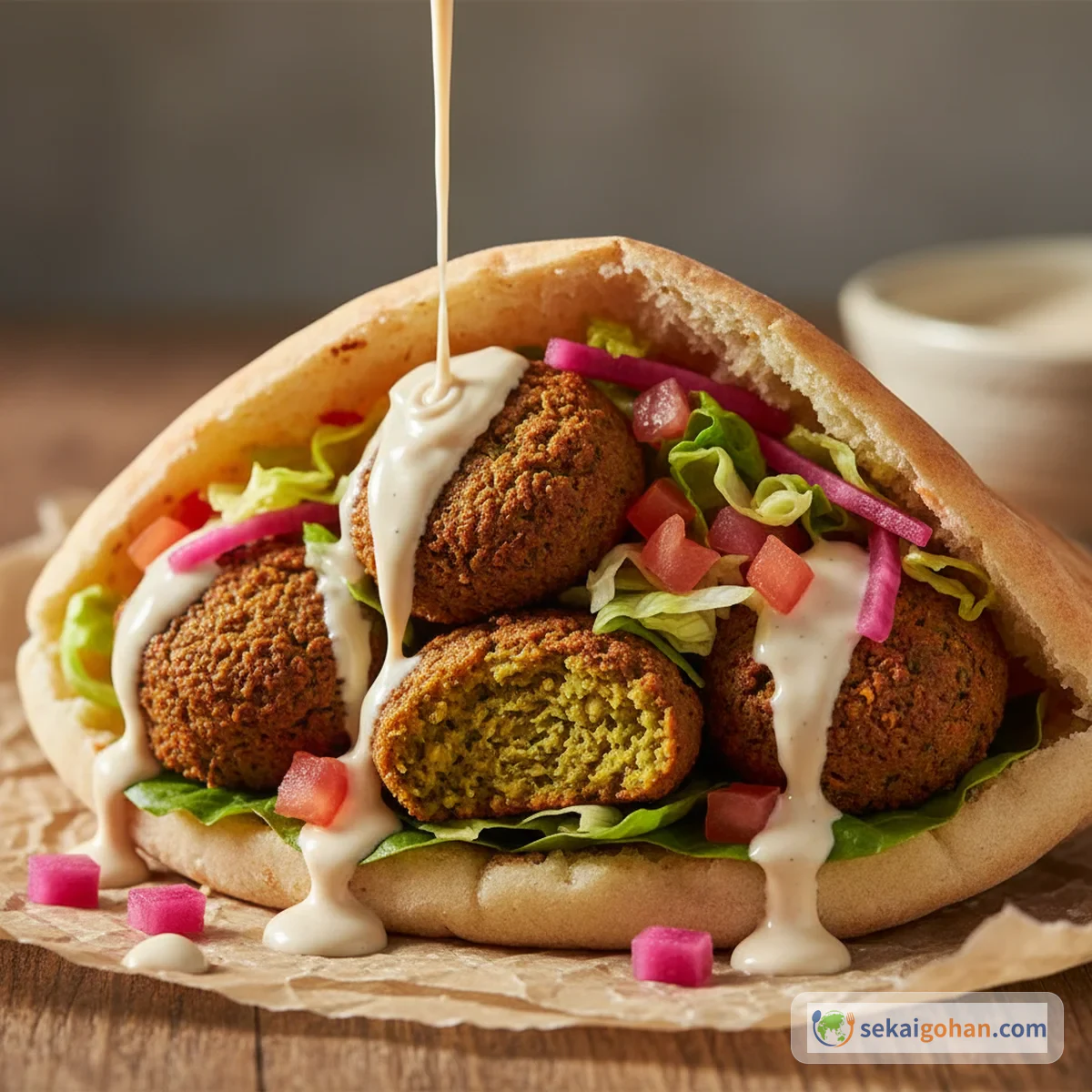
Tucking falafel into pita with the staples (tahini sauce, hummus, tabbouleh, pickles, especially turnip pickles, and a tomato and cucumber salad) is the most popular way to eat it. It also works as a salad bowl topping or as a side with rice. Set it out with hummus, shakshuka and tabbouleh, and your table turns into a Middle Eastern meze bar. Serving it with kebab as a grill plate is standard too; a mixed plate of grilled lamb or chicken and falafel is a popular restaurant style.

Mix 4 tbsp tahini, 2 tbsp lemon juice, half a clove of grated garlic, 3–4 tbsp water and 1/2 tsp salt, adjusting the thickness with the water. It lifts the flavor of falafel a long way. The tahini stiffens when the water first goes in, but keep stirring patiently: as the fat and water emulsify, it turns smooth again.
Fried falafel keeps 3 days refrigerated and 1 month frozen. To reheat, a toaster oven or oven at 350°F (180°C) for 5 minutes best restores the crispness. Avoid the microwave, which makes the surface soggy.
Falafel variations
Milder version: Leave out the cayenne for a mild taste that even children can eat easily, and swap the cilantro for parsley to suit everyone.
Egyptian style (ta'amiya): The traditional version made with dried fava beans instead of chickpeas. Called "ta'amiya (طعمية)" in Egypt, where it's a breakfast staple, it has a moister texture, a deeper green color and a slightly sweeter, more delicate flavor.
Japanese-style variation: Mix chopped perilla (shiso) leaves into the dough and serve with yuzu kosho. A small amount of edamame improves the color. It makes an excellent snack with beer.
Extra-herby version: Doubling both the parsley and cilantro (1.5 oz (40 g) parsley, 20 g cilantro) makes the cross section a more vivid green and lets the herbs stand out.
Cheese-filled version: When shaping, tuck a small piece of feta into the center and wrap it. The cheese melts as it fries, a nice surprise in the first bite.
Oven-baked version: Line a baking sheet with parchment, arrange the shaped falafel and spray them with olive oil. Bake at 400°F (200°C) for 15 minutes, turn and bake another 10 minutes. You won't get the crispness of frying, but they're plenty delicious.
Air fryer version: Cook at 350°F (180°C) for 12 minutes, turning partway so they crisp evenly, with far less oil. A spray of olive oil before cooking makes them crisper.
FAQ
Can I freeze the falafel dough?
Yes. Arrange the shaped pieces on a tray lined with parchment, freeze them, then move them to a freezer bag, where they keep for 1 month. Fry them straight from frozen without thawing, adding 1–2 minutes to the frying time. You can also freeze falafel after frying, but it reheats less crisp than dough fried from frozen. Shaping a batch on a day off and frying only what you need on weekdays is efficient.
What if I don't have a food processor?
A blender can substitute if you process in small amounts. Use short pulses to keep the dough coarse, since a smooth dough falls apart easily. A mortar or masher also works, but it takes considerable effort.
Is it all right not to add flour?
Yes. Authentic falafel has no flour; the natural starch of dried chickpeas binds it. Flour makes it too dense, with a texture like "fried dumplings" instead of a light, fluffy inside.
Is falafel safe for people with allergies?
Falafel itself is gluten-free (no wheat), but commercial pita contains wheat, so use lettuce wraps or gluten-free flatbread instead. For a sesame (tahini) allergy, serve a yogurt sauce in place of tahini sauce.
How many calories is falafel?
One piece (about 1 oz (30 g)) is about 60 kcal, or about 35 kcal oven-baked. One pita sandwich serving (4–5 pieces of falafel plus vegetables and tahini sauce) comes to about 480–550 kcal.