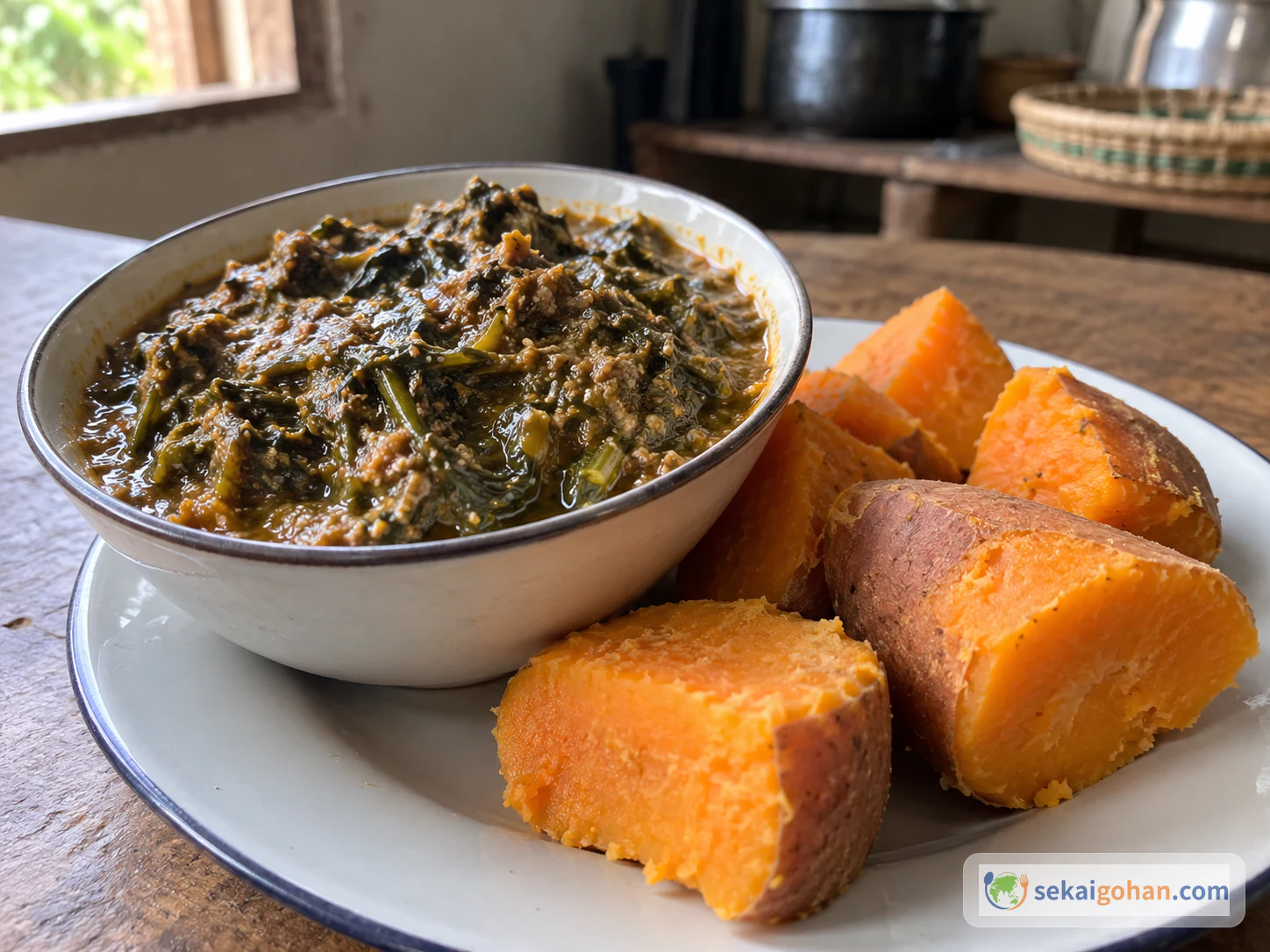
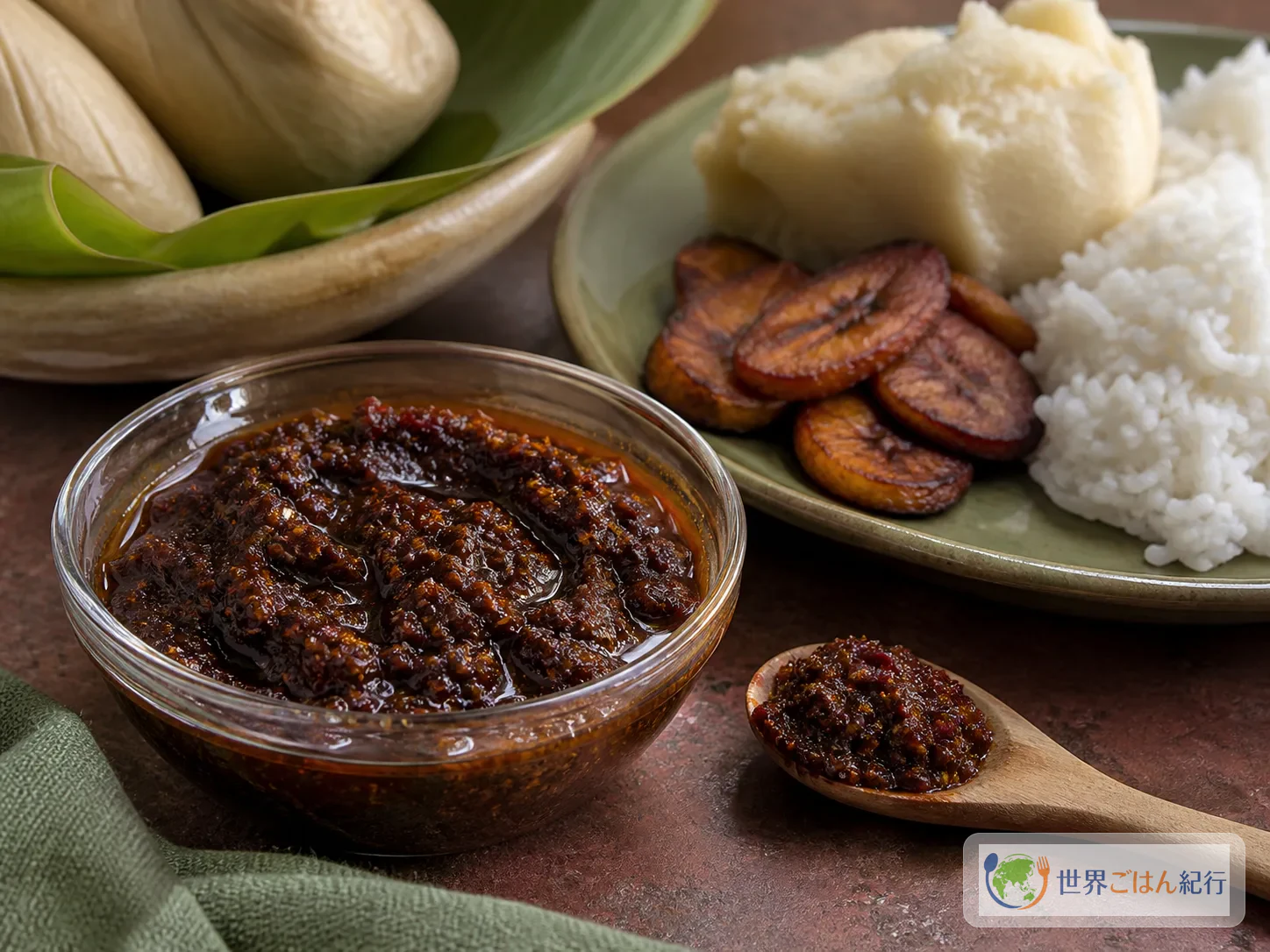
Morning, noon, and night, one dish sits at the center of the table in Sudan, the country where the White Nile and the Blue Nile meet at the capital, Khartoum. It is kisra (Kisra / Kissra / كسرة), a crêpe-like bread made by mixing sorghum flour with water, fermenting the batter for at least a night, and baking it thin. It looks a lot like a French crêpe or Ethiopian injera, but the taste is its own: the grainy sweetness of sorghum meets the mild sourness of lactic fermentation, and even eaten plain it has real depth. Here is how to make it with ingredients you can find outside Sudan, and how to set up a Sudanese table.
Kisra on the Sudanese Table
Eating kisra around the sufra
The name comes from an Arabic verb meaning "to break or tear," and that is exactly how kisra is eaten: torn by hand and used to scoop up each dish. Sudanese meals center on a large round tray called a "sufra." Kisra is spread across it, the mulah (stew) and salads go on top, and family and guests gather around to tear the kisra with the right hand and dip it in the mulah.
Its closest relative is Ethiopian injera, which uses teff flour where kisra uses sorghum. As African fermented foods such as injera and Moroccan tagine get more attention, kisra is well worth learning.
Sorghum and the Nile Valley
Sorghum (Sorghum bicolor) is a grain native to northeastern Africa, and it has long been a staple across the Nile region and much of the continent. Archaeological research in eastern Sudan shows that people there used and cultivated it in ancient times. Sorghum is also extremely drought resistant, so it can be harvested in the semi-arid Nile climate where wheat and rice will not grow, which is the main reason it has stayed at the heart of Sudanese cooking.
Ajin, the kisra starter
Fermentation is part of everyday food in Sudan, and kisra is at the center of it. The batter is traditionally fermented with a starter called "ajin" (ajin / عجين): leftover batter from the day before goes into the next batch, much like sourdough. Lactic acid bacteria and yeasts work together in it, giving kisra its flavor and texture. Handing a starter down from batch to batch this way is much like the house microbes of Japanese miso and soy sauce breweries.
Ingredients (serves 4, about 12 crêpes)
Sorghum flour is sold in natural food stores and online, under names such as sorghum flour, milo flour, and white sorghum flour. White sorghum flour for baking is the most widely sold. If you cannot find it, a combination of 7 oz (200 g) whole wheat flour and 3.5 oz (100 g) buckwheat flour reproduces the grainy character and slight bitterness of sorghum. Millet flour also works, but the flavor is somewhat different.

This dish contains ingredients that are common allergens. It contains wheat (all-purpose flour), peanuts (peanut butter), buckwheat (listed as a substitute), and milk (yogurt). If you have a wheat allergy, you can leave out the all-purpose flour and make it with only sorghum flour (gluten-free). If you have a peanut allergy, use sesame paste in place of the peanut butter.
Kisra batter needs at least 12 hours of fermentation, and ideally 24. Mixing it the night before and baking it the next day is the most efficient. In winter, when room temperature is low, fermentation slows, so use the oven's proofing function (around 95°F / 35°C) or a yogurt maker. Adding yogurt makes fermentation start earlier, but without it the batter will still ferment naturally at room temperature.
Sorghum Flour and Substitutes
Sorghum is a naturally gluten-free grain. If you cannot find sorghum flour, the closest substitute is a combination of 7 oz (200 g) whole wheat flour and 3.5 oz (100 g) buckwheat flour: the whole wheat supplies the grain character, and the buckwheat adds its distinctive flavor and color. Millet flour and foxtail millet flour also work, but on their own the flavor is different, so blend them half and half with whole wheat. Fermentation works the same in every case.

Millet flour
You can make kisra with pearl millet flour instead of sorghum. Use 10.5 oz (300 g) of millet flour and proceed the same way; the result is somewhat sweeter, with a brighter yellow color. Look for millet flour in natural food stores and online.
Wheat blend for beginners
If you are not set on the authentic flavor, a blend of 5.5 oz (150 g) all-purpose flour and 5.5 oz (150 g) sorghum flour is a good place to start. The gluten in the all-purpose flour acts as a binder, so the kisra tears less and is easier to handle. For a first attempt, this blend means fewer failures.
Buckwheat flour
With 10.5 oz (300 g) buckwheat flour in place of sorghum, the result comes close to a Breton galette (buckwheat crêpe). Buckwheat is also gluten-free and takes well to fermentation, and its toasty aroma suits the spices of the mulah, the same easy partnership of grain and spice you find in Indian khichdi. It rises more than sorghum, though, so add 3.5 tbsp (50 ml) extra water to loosen the batter.

Getting Kisra Right
Fermentation temperature
Eighty percent of success with kisra is decided in fermentation, and the ideal temperature is 25–35°C. In winter (room temperature 15–20°C) fermentation slows, so keep it warm in one of these ways: (1) a yogurt maker, the steadiest option; (2) the oven's proofing function set to 95°F (35°C); or (3) a damp cloth laid over a rice cooker on warm mode, for indirect heat. In summer, keep the batter out of direct sunlight in a cool, dark place.
If no bubbles appear after 12 hours, the temperature is too low. Move the batter to a yogurt maker, or set its bowl in a bowl of lukewarm water (about 95°F / 35°C). Stirring in 2 tbsp plain yogurt also speeds things up. If it still hasn't fermented after 24 hours, don't throw it out; add a small amount of dry yeast (1/4 tsp) and wait 4–6 hours.
Batter thickness
The batter should be "slightly thicker than coffee cream": lift a spoonful and it should fall in an unbroken thread. Too thick and the kisra bakes thick; too thin and it tears. Fermentation adds water, so mix the batter "a bit on the thick side" before fermenting.
Pan temperature
An even, thin kisra needs a steady pan temperature. Over high heat the batter sets before it can spread, and over low heat it stays sticky and won't peel. Keep medium-low heat (a drop of water evaporates slowly on the pan), and lift the pan off the heat for about 10 seconds after each one to steady it.
Serving and Variations
Kisra with mulah
On its own, kisra is subdued. The sourness of fermentation and the sweetness of the grain are a flavor that is completed only when paired with a fatty, spiced stew (mulah). The peanut oil soaks into the bread, and the kisra carries the spices to your mouth, much the way injera and doro wat work together.
Chicken and vegetable mulah
Use 4 bone-in chicken thighs in place of beef and add 2 eggplants and 1 zucchini. Brown the chicken first, then simmer; the gelatin in the skin thickens the soup. It has a lightness like the light soup served with Ghanaian fufu.
Sweet kisra
Add 2 tbsp sugar and 1 tsp cinnamon to the batter, then sprinkle the baked kisra with honey and ground sesame. Children love this dessert version.
Nutrition (per 3 kisra)
| Nutrient | Amount |
|---|---|
| Calories | 285 kcal |
| Protein | 8 g |
| Fat | 4 g |
| Carbohydrates | 2 oz (56 g) |
| Fiber | 5 g |
| Sodium | 320 mg |
Sorghum is rich in B vitamins (especially B1 and B3) and iron. With the beef and peanuts of the mulah adding protein and fat, it makes a nutritionally balanced meal.
More African Dishes
- Injera: Ethiopia's fermented teff bread, kisra's "cousin"
- Doro wat: Ethiopia's spiced chicken stew, superb with injera and kisra
- Tibs (in Japanese): Ethiopia's stir-fried meat dish, ideal alongside injera or kisra
- Ugali: East Africa's cornmeal staple, an unfermented type that is kneaded and shaped
- Fufu: Ghana's yam staple, torn off by hand just like kisra
- Egbo
- Introduction to African cuisine
- Introduction to Ethiopian cuisine
- Introduction to Moroccan cuisine
FAQ
Q1. How many days does kisra keep?
Baked kisra, wrapped airtight in plastic wrap, keeps 3 days in the refrigerator. Before eating, microwave it for 10 seconds or warm it lightly on both sides in a frying pan to bring back the softness. It can be frozen for 1 month. Wrap each one in plastic wrap, put them in a zip bag, and freeze; let them thaw naturally, then warm before eating.
Q2. Is it safe when kisra is baked on only one side?
Yes. Kisra batter is thin, so the residual heat on one side cooks it all the way through. It is done when the surface is completely dry and matte. If you are concerned, bake 30 seconds longer or cover with a lid to steam-bake.
Q3. What is the difference between kisra and injera?
The main differences are ingredients and texture. Kisra uses sorghum flour and is baked into a thin, supple crêpe, while injera uses teff flour and is baked thick and spongy. Kisra is often folded or rolled to eat; injera is laid under the stew as a plate. Both ferment for a similar 1–3 days.