Slide the lid aside a little, and steam stained yellow with turmeric rises from the pot. The rice grains have loosened and the mung dal has lost its corners. Turn it from the bottom with a wooden spoon and it slowly settles back, somewhere between porridge and dal soup. Pour cumin popped in ghee over the top at the end, and a quiet dish suddenly smells like an Indian kitchen. Khichdi (खिचड़ी) is rice and lentils cooked together, eaten across the Indian subcontinent. It resembles Japanese okayu, but with lentils in the pot, one bowl sits somewhere between a staple and a dal dish.
Khichdi at Home and Across India
An everyday comfort food
Khichdi is everyday food, often called comfort food. In households it turns up on mornings when appetite is low, at lunch when you want something light, and at night when you want to settle down with beans and rice. You'll see it spelled khichdi, khichri, khichuri and more. The kind of dal, the thickness and whether you add a tadka are all up to the cook.
It's also easy to adjust, by taking spices away as well as adding them. Leave out the red chile and garlic and use less ghee, and rice, dal, turmeric and salt still make a dish. If there are odd vegetables in the refrigerator, add a few. On a day you want it lighter, skip the tomato and garlic. That room to bend to the day's kitchen is what makes khichdi so easy to use. For the bigger picture of how Indian food changes from region to region, see the introduction to Indian cooking.
Origins and history

Old South Asian texts describe rice or grains simmered with lentils, and some connect the name to the Sanskrit kṛśara. In the 14th century, a foreign traveler to India recorded a dish of mung beans and rice, one of the earliest known records of khichdi. At the Mughal court it was refined further, and luxurious versions with saffron and dried fruit reached the emperor's table.
In the 18th century, the British of the East India Company took khichdi home to Britain, where it became something quite different. Rice with smoked haddock, hard-boiled egg and parsley turned into "kedgeree," a standard of the Victorian breakfast. It has no dal, and the spice was simplified to curry powder.
Khichdi in Ayurveda
In Ayurveda, India's traditional medicine, khichdi is sometimes called a gentle meal. The rice and dal are cooked soft and the spices can be kept mild, so people often choose it on days when they want to avoid heavy food. If you are unwell or on a restricted diet, follow your doctor's or dietitian's instructions.
Regional variations

Khichdi is eaten all over India, and each region has its own style. In northern homes it is light and smells of ghee and cumin. In the south you meet it in a form close to pongal.
Gujarat is a center of khichdi culture. The standard set is khichdi-kadhi, khichdi served with a yogurt soup, and some versions add a little jaggery for a touch of sweetness. Gujarat's other home staple is thepla, a flatbread of flour kneaded with fenugreek. If khichdi is the gentle porridge, thepla is the travel food: it does not crack when cold.
In West Bengal and Bangladesh it is called "khichuri," and it's traditionally eaten on rainy days. The Bengali style uses ghee generously and is served with fried hilsa fish. It also appears as a festive meal during Durga Puja, the autumn festival.
In Tamil Nadu it becomes ven pongal, finished with ghee, black pepper, cumin and curry leaves. It gave its name to the harvest festival Pongal (January) and is also served as temple food (prasadam). It is whiter than the north Indian version, and with the pepper coming forward it has a breakfast-like lightness.
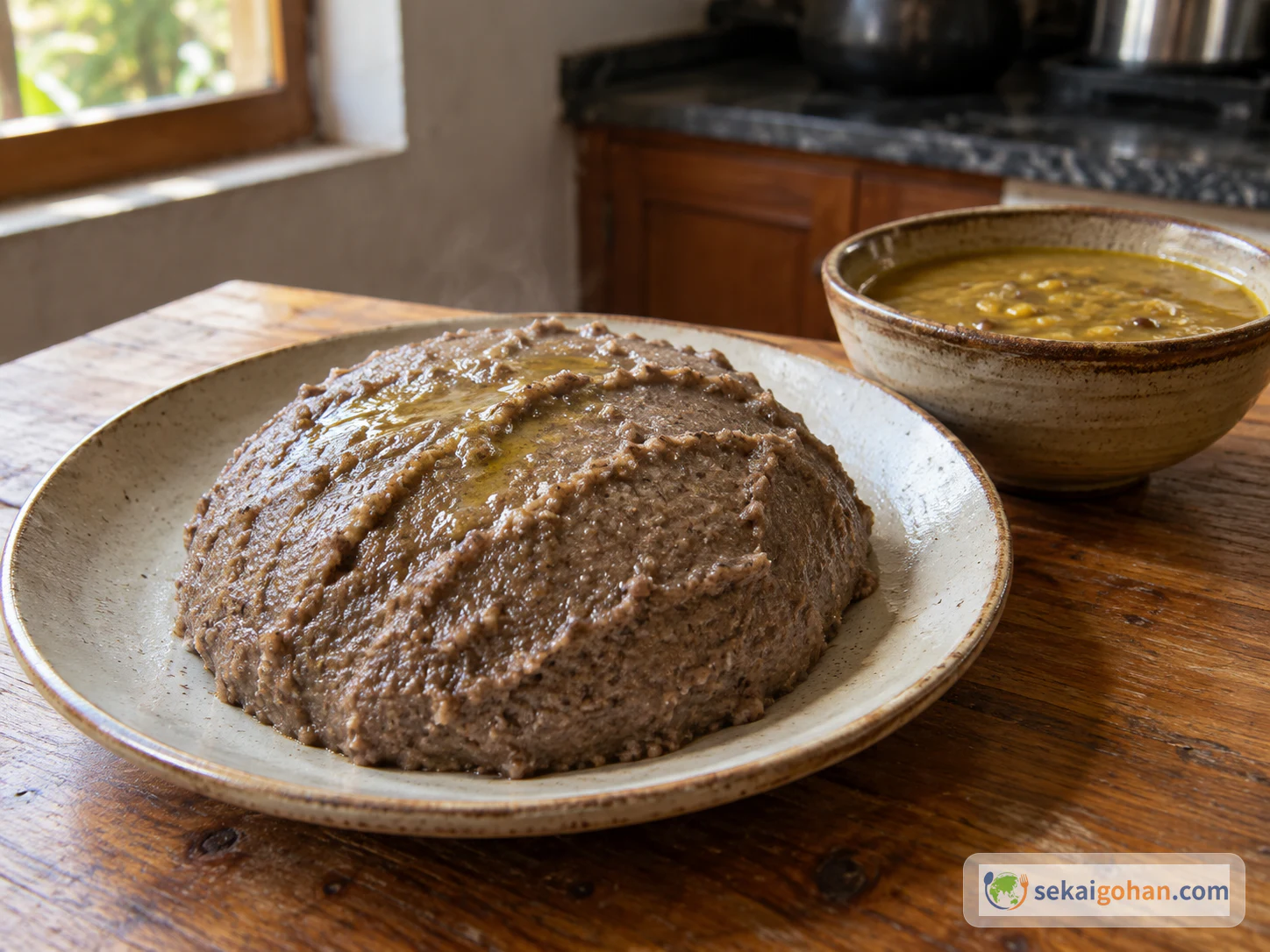
In the desert state of Rajasthan, there is a khichdi made with bajra (pearl millet) instead of rice: just millet and dal, suited to a dry place with little water. Just as Ethiopian injera is made from a grain called teff, each region's staple grain shapes its khichdi.
Ingredients (serves 4)

Hulled and split mung dal (yellow) cooks in a short time without soaking. If you use whole green mung beans with the skin on, however, they need to soak at least 4 hours. For your first khichdi, use the hulled split type.
Choosing Ingredients for Khichdi
Shopping can stay simple. Onion, ginger, garlic and tomato are all easy to find at a regular grocery store. Basmati rice gives the grains a clearer texture. If you can't find moong dal right away, make it once with red lentils. They break down quickly and thicken the porridge easily, and they work for dal tadka too.
Turmeric gives the dal its beautiful yellow, and a small supermarket jar is enough. If you plan to make khichdi, dal tadka and aloo gobi one after another, buy a somewhat larger jar.
Whole cumin seeds decide the aroma of the tadka. Popped in oil instead of used as powder, they make the khichdi smell a notch clearer. They also go into bhindi fry and aloo gobi, so get them first if you plan to keep cooking Indian food.
Curry leaves add a green South Asian note at the finish, and a few go a long way. Dried leaves work, but frozen ones keep more of the green aroma. Use them in the tadka for khichdi, in avial, and to finish dosa.
Ghee and other fats for the tadka
Tadka (tempering; also called baghar or chaunk) means adding whole spices to hot fat to draw out their aroma and flavor. Many of the aroma compounds in spices dissolve in fat. Cumin's cuminaldehyde, for example, moves into ghee or oil as it heats and spreads through the whole dish.
| Fat | Smoke point | Flavor | Fit with khichdi |
|---|---|---|---|
| Ghee | around 475°F (250°C) | Sweet, nutty aroma | The most authentic |
| Butter | 350°F (177°C) | Creamy | Can stand in, but scorches easily |
| Vegetable oil | 450°F (230°C) | Neutral | Dairy-free option, lighter aroma |
| Coconut oil | 350°F (177°C) | Coconut flavor | Suits the south Indian style |
With its high smoke point, ghee resists scorching even when you fry spices hard. The milk solids have been removed, so it keeps well and can be stored at room temperature for several months.
Getting Khichdi Right
Three things matter most: don't leave a hard core in the dal, leave room to add water back at the end, and don't scorch the spices. Cook the dal until it's soft all the way to the center, and the porridge will come together even in an ordinary pot.
Start simply. Cook the rice, dal, turmeric and salt until soft, and if you have the energy, pour a tadka of ghee and cumin over the top. That's enough for a convincing result.
Serving and Storing Khichdi
Accompaniments

Khichdi is a complete dish on its own, but a few accompaniments add sourness and texture to the soft porridge.
| Accompaniment | Role | Where to find |
|---|---|---|
| Achar (Indian pickle) | A sour and spicy accent | Indian grocery stores or online. Mango achar is the standard |
| Papad (papadum) | Crisp texture against the soft khichdi | Indian grocery stores. Puffs in 30 seconds in a microwave |
| Yogurt (raita) | Sourness and cooling | Just mix plain yogurt with cumin and salt |
| Ghee (additional) | Richness and aroma | A little poured over at the end rounds out the dal aroma |
A spoonful of raita with achar and papad is the classic combination. Khichdi with pickles has a lot in common with the accompaniments served with dal bhat. Across South Asia, a simple staple gets livened up with a little of something strong.
Serving it thali-style

In Indian homes, the khichdi often sits in the center of a large round plate called a "thali," surrounded by small dishes (katori). It's a way to enjoy many flavors in small amounts.
Building a meal around it
If you want a chicken dish alongside, serve a small portion of butter chicken, rich with tomato and butter, and put the khichdi in a smaller bowl. That way the soft staple and the rich main each have their own job. To finish, north India's phirni, coarsely ground rice simmered in milk and chilled, settles the mouth after a spicy main. And if you want to go further, dal tadka leans toward dal, while biryani shows how rice dishes change from region to region.
Storage and reheating
| Storage | Shelf life | Notes |
|---|---|---|
| Refrigerator (airtight container) | 2–3 days | Add water when reheating to adjust the thickness |
| Freezer | about 2 weeks | Slightly watery after thawing, but fine |
| Reheating | Pot over low heat | Microwave is fine. Add 2 tbsp water, cover with plastic wrap, and heat at 600 W for 2 minutes |
Khichdi stiffens as it cools, because the starch in the rice and mung dal sets. When you reheat it, add 2–4 tbsp water to bring it back to a porridge.
FAQ
Q1. I cannot get mung dal. Can I use another lentil?
Red lentils (masoor dal) are the closest substitute. They break down easily and make a thick porridge, just like mung dal. Toor dal also works, but it takes longer to cook, so it's better in a pressure cooker. Chickpeas and kidney beans hold their shape and don't suit khichdi. When shopping online, search for "moong dal," "hulled mung beans," or the Japanese term for skinless green gram.
Q2. Can I substitute butter if I have no ghee?
Yes, though you'll lose some of ghee's nutty aroma. Choose unsalted butter and cook over low heat so it doesn't scorch. For a dairy-free version, coconut oil gives a south Indian-style aroma. Ghee is sold at import grocers, baking supply stores and online.
Q3. Can I make it with Japanese rice (japonica)?
Yes. Basmati cooks up loose and separate, while Japanese rice turns sticky and risotto-like, so choose by taste. If you want the grains to come apart, use basmati. Import grocers and online shops sell it in small packs.
Q4. Is khichdi safe as a baby food?
Indian families sometimes give soft rice and dal to young children, but don't use this recipe as is for a baby's weaning food. The right amounts of spice, salt, ghee and dal depend on the child's age in months and constitution. Follow the advice of your pediatrician or a dietitian.