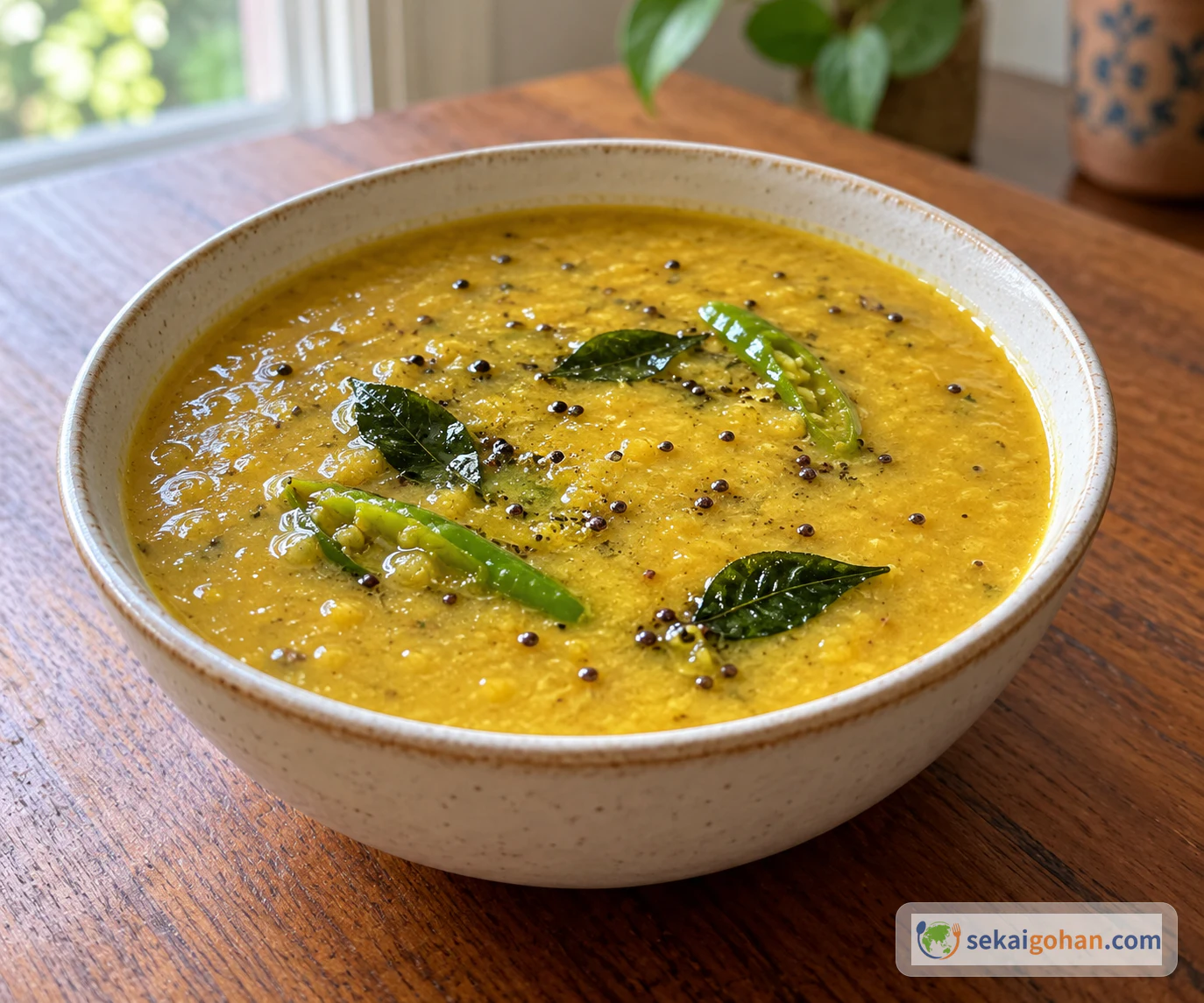
In the kitchen, cut a green chili and grind cumin with shaved coconut, and a green, sweet aroma rises that is nothing like curry powder. In the pot, long strips of carrot, green beans, taro and green banana turn pale yellow with turmeric. Stir in yogurt at the end, set curry leaves crackling in coconut oil, and an ordinary vegetable stew lands on the South Indian table. Avial is a mixed-vegetable dish from Kerala and Tamil Nadu, bound with coconut and soured with yogurt. It's gentle rather than hot, and it keeps you reaching for more rice.
About avial and the sadya
Avial (Avial / Aviyal, Malayalam: അവിയൽ, Tamil: அவியல்) is loved in both Kerala and Tamil Nadu. In Kerala you'll usually see it spelled Avial; in the Tamil-speaking region it is often written Aviyal. Many vegetables are cut into long strips and bound with a paste of coconut, cumin and green chili, with yogurt, tamarind or unripe mango for sourness. Unlike a typical curry, it has little liquid. The vegetables keep their shape under a coating of white coconut sauce.
In Kerala's festival food, especially the sadya of Onam, avial is served on a banana leaf with rice, sambar, rasam, papadum, pickle and sweet payasam. It wins you over with its sourness, the roundness of coconut and the aroma of curry leaves rather than with heat. If you've made a gentle rice-and-lentil plate such as khichdi or a dairy side such as raita, avial is a natural South Indian vegetable to add.
The ingredients change from region to region, and so does the souring agent. What stays constant is the long vegetable cut, coconut, cumin, a sour note and curry leaves.
Ingredients (serves 4) | Gather vegetables, coconut and aroma separately

This makes four servings. As a side dish for rice, it is plenty. On a South Indian-style table, it is a lighter vegetable dish than chana masala or aloo gobi.
This recipe contains dairy and coconut. For a dairy-free version, use 4 oz (120 g) unsweetened soy yogurt. The sourness and richness will be lighter. Refrigerate in a clean container for no more than 2 days. Because it uses yogurt, don't leave it long at room temperature, and reheat only gently over low heat.
Choosing ingredients for avial
What to buy first
Look for curry leaves, cumin seeds and a small food processor that can make a coarse paste. The vegetables and yogurt come from any nearby store, but those three are what take you from "white vegetable stew" to avial.
Curry leaves give a lot of aroma for the amount you use. Frozen keeps the green aroma better than dried, and if you go on cooking South Indian food they also go into kukul mas curry. Keep cumin whole rather than ground, so you can use it for dry roasting, tempering and grinding into pastes. In avial it adds a slightly earthy core to the sweetness of coconut.
The coconut paste is more authentic when it isn't a complete puree. A mortar works, but for your first time, stopping a small food processor at a "coarse miso" texture helps the paste cling to the vegetables.
South Indian character at home
| What to look at | To bring out South Indian character | Home kitchen option |
|---|---|---|
| Cutting the vegetables | Thin sticks of 2–2.5 inches (5–6 cm) | Cut carrot, green beans, taro, cucumber and daikon radish to the same length |
| Coconut | Fresh shaved coconut | Frozen, or unsweetened desiccated coconut rehydrated in hot water |
| Sourness | Yogurt, tamarind, unripe mango | Unsweetened yogurt, mixed in after turning off the heat |
| Aroma | Curry leaves and coconut oil | Prioritize curry leaves; a mix of neutral oil and coconut oil also works |
| Liquid | Almost no cooking liquid left | Stop when a little white sauce remains at the bottom of the pot |
Substitutes
Drumstick pods and green bananas are hard to find every time, so focus on three things instead: cut the vegetables long and thin, grind coconut and cumin together coarsely, and keep the yogurt from boiling.
| Ingredient or step in question | What to protect | A realistic solution | Effect on the result |
|---|---|---|---|
| Drumstick pod | A faint green aroma and a stringy texture | More taro and green beans | The aroma is weaker but the texture holds |
| Green banana | A starchiness that holds when simmered | 1 small potato | Sweetness comes out, so don't overcook |
| Shaved coconut | White grain and fat | Frozen coconut, unsweetened desiccated coconut | Canned coconut milk alone changes the texture |
| Yogurt | Gentle sourness | Regular unsweetened yogurt | Low-fat splits more easily |
| Curry leaves | The green aroma of South India | Frozen curry leaves | Dried has a lighter aroma |
| Heat | Coat with sauce without breaking the vegetables | Lower from medium to low | Boiling hard makes the white sauce grainy |
On days you can't get shaved coconut, use ¼ cup (80 ml) coconut milk, 1 tsp cumin and 1 green chili. The grainy white texture characteristic of avial will be weaker. Reduce the water to ¾ cup (200 ml), and in step 5 let it blend over low heat until the sauce at the bottom of the pot is 3–4 tbsp. Using cumin seeds and finishing with the curry leaf oil keeps the South Indian outline.
Instructions | Don't boil it hard, and open the aroma at the end
There are seven steps. The difficulty is not the number of spices but not breaking the vegetables, not boiling the yogurt, and not losing the final aroma. When the aroma rises from the small pot with the curry leaves, turn off the heat right away and pour it onto the main pot.
Avial problems and fixes
Avial looks plain, but heat control decides the result. Cut the vegetables into even long strips, add the firmest first, keep the pot at a gentle heat once the coconut paste goes in, and protect the finishing yogurt from splitting.
Simmering avial with yogurt makes it split. Turn off the heat, loosen the yogurt with a little of the warm sauce, then return it to the pot. This one step gives you a smooth side dish instead of a grainy white stew.
| Problem | Likely cause | Fix |
|---|---|---|
| The yogurt splits | Added with the heat on, or used low-fat yogurt | Turn off the heat, loosen it with sauce, then return it. Next time use the regular type |
| The vegetables break | Put them all in at once, or boiled hard | Cook the firm vegetables 5 minutes first, add the rest later. Turn broadly with a spatula instead of shaking the pot |
| Watery | Too much water, or the vegetables released water | Take off the lid and let it blend over low heat for 2–3 minutes. Next time use 1 cup (220 ml) water |
| Flavor is vague | Weak aroma from curry leaves and oil | Make the finishing oil in a separate small pot and pour it over while hot |
| The coconut is powdery | Desiccated coconut used without rehydrating | Rehydrate in ¼ cup (80 ml) hot water for 10 minutes before grinding into a coarse paste |
| The sourness is too sharp | Sour yogurt, or too much lemon | Mix 1 tbsp coconut paste and 1 tbsp water and let it blend over low heat for just 1 minute |
Serving and storing avial

Avial is best a little below piping hot, so pour on the finishing oil and let it rest for 5 minutes. White rice is fine, but beside red rice, basmati or lemon rice the coconut aroma stands out more. A full sadya spread of rice, sambar, rasam, papadum, pickle and sweet payasam is a festival table; at home, one dish each of rice, lentils, vegetables and something sour is plenty. For more menu ideas, see the introduction to Indian cuisine.
Refrigerate for no more than 2 days. Let it cool before moving it to a storage container, and stir lightly if the curry leaves have clumped on the surface. To reheat, warm it in a small pot over low heat for 2–3 minutes, just until the edge of the pot warms, or microwave for 1 minute 30 seconds at 600 W, stirring once midway. Hard boiling splits the yogurt, so aim for a warm side dish rather than piping hot.
Avial doesn't freeze well: the taro and daikon radish lose water and the yogurt sauce turns grainy. To make it ahead, refrigerate it after step 5, before the yogurt goes in. Just before eating, warm it over low heat, then turn off the heat and add the yogurt and finishing oil. That way the aroma holds even the next day.
Frequently asked questions
Can I make it without yogurt?
Yes. Dissolve 1/2 tsp tamarind paste in 1 tbsp water and add it in step 5 for a South Indian sourness. When unripe mango is in season, you can also simmer 1.75 oz (50 g) thin slices with the vegetables. For a light result, 2 tsp lemon juice alone will do.
What can I use if I don't have curry leaves?
There's no true replacement, since bay leaf or basil pull the aroma in a different direction. On those days, lean carefully on coconut oil and cumin, and pick up curry leaves for next time.
How many kinds of vegetables do I need?
This recipe uses six, but four also work. Carrot, green beans, taro and daikon radish give you a range of textures. Cut them all into sticks of the same length and add the firmest first. For your first time, skip vegetables that break easily, like eggplant or tomato.
Can I make it vegan?
Use 4 oz (120 g) unsweetened soy yogurt, and add 1 tsp lemon juice if the sourness is weak. Everything else is already plant-based, so the method stays the same. The sauce comes out a little lighter than with regular yogurt.
Related articles
- Aloo gobi: North Indian potato and cauliflower stir-fry, for comparing how vegetables are cooked.
- Chana masala: make the bean curry the main and avial the side.
- Raita: a side dish that teaches you to handle yogurt without splitting it.
- Khichdi: a gentle rice-and-lentil plate; with avial beside it you get a light South Asian menu.
- Introduction to Indian cuisine: the differences between North and South India and the thinking behind rice, lentils and spices.