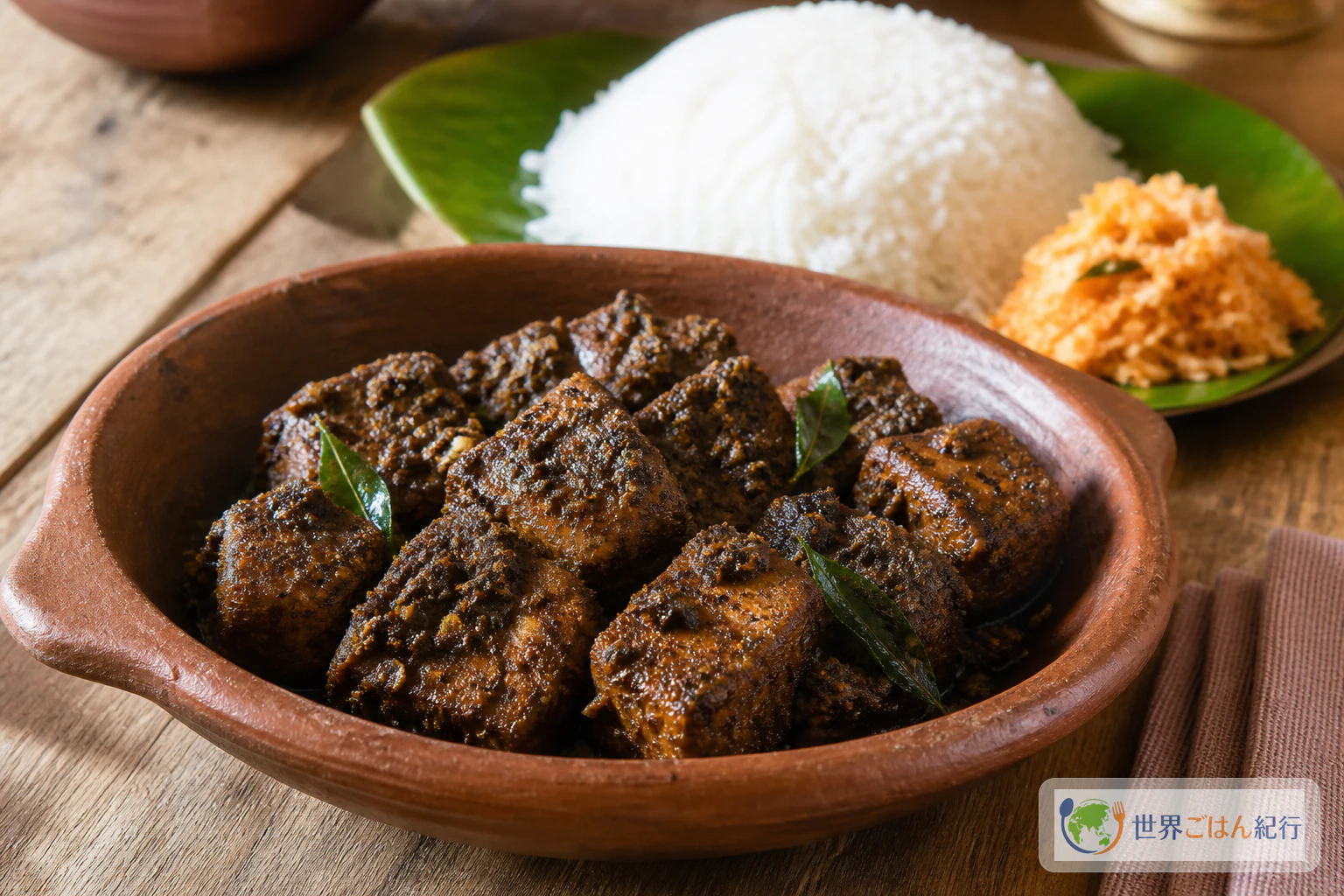
Put coriander, cumin and fennel in a small skillet over low heat and the air in the kitchen changes. First comes a dry smell of grain, then a sweet, nutty aroma, and finally a faint bitterness that warns you the spices are about to scorch. Take the pan off the heat at the sweet, nutty stage. That one decision matters more than anything else in kukul mas curry. This is Sri Lankan chicken curry. The roasted spices give it a toasty base, and compared with many Indian chicken curries, it puts curry leaves, rampe (pandan) and coconut milk further forward.
Kukul mas curry on the Sri Lankan table

The name and the rice-and-curry meal
Kukul mas is Sinhala for chicken, so kukul mas curry simply means chicken curry. On menus you'll see it as kukul mas curry, chicken curry or Sri Lankan chicken curry. It turns up again and again in home-style rice and curry, and Sinhala, Tamil and Muslim home kitchens each give it their own spices and their own level of heat.

In Sri Lankan rice and curry, small portions of meat or fish curry, dal, pol sambol, a mallung of greens and pickles are set around the rice. You mix them as you eat, with your fingertips or a spoon. In that spread, kukul mas curry is the main dish, and it carries the salt, fat, heat and aroma.
If you want to keep cooking from the island, try the batter pancakes called hoppers, the celebration rice kiribath, or the chopped street-food roti, kottu roti. Kukul mas curry goes with all three, and it's just as good at the center of an everyday home meal.
Roasted curry powder and the other key aromas
Sri Lankan roasted curry powder is made by toasting spices such as coriander, cumin, fennel, fenugreek, black pepper and cinnamon before grinding them. The aroma is deep and the color leans reddish-brown. You're after a toastiness close to roasted beans or nuts, never a burnt-powder taste.
A home version with store-bought curry powder, a little garam masala and black pepper still tastes clearly Sri Lankan, as long as you handle the curry leaves and coconut milk well. In a real kitchen, it's more useful to decide which aromas matter most than to try to reproduce everything perfectly.
| Element | Role in Sri Lanka | What to get right at home |
|---|---|---|
| Curry leaves | Infuse the oil with a fresh green aroma | Frozen is fine; bloom them in the oil first |
| Rampe (pandan) | Adds a sweet, grassy aroma | If you can't find it, use a bay leaf instead |
| Roasted curry powder | Builds the toasty base | Dry-toast without scorching, and treat it separately from chili powder |
| Coconut milk | Rounds off the edges and binds the sauce | Finish over low heat without boiling hard |
| Acidity | Cuts the richness of the meat | Use coconut vinegar, rice vinegar or lime |
Ingredients (serves 4)

Bone-in chicken gives you more stock, but boneless thighs are easier to work with in a home kitchen. Taking off all the skin makes the flavor flat, so if you don't mind the fat, leave about half of it on.
| Ingredient | Amount | Substitutes & notes |
|---|---|---|
| Boneless chicken thighs | 700 g | Bite-size, about 4 cm (1 1/2 in) pieces. If bone-in, 900 g |
| Onion | 1 (200 g) | Coarsely chopped |
| Tomato | 1 (150 g) | 1 cm dice. If canned, 120 g diced tomatoes |
| Garlic | 3 cloves (15 g) | Grated or minced |
| Ginger | 20 g | Grated |
| Green chili | 1 | If you don't like heat, seed it and use half |
| Curry leaves | 12 leaves | Frozen is fine. If dried, 1 tsp |
| Rampe (pandan leaf) | 8 cm | Optional. Use 1 bay leaf for aroma |
| Coconut milk | 200 ml | Unsweetened canned cooking coconut milk (about 3/4 cup + 1 tbsp) |
| Water | 180 ml + 1 tbsp | 180 ml (about 3/4 cup) for simmering. Use the 1 tbsp if the paste starts to catch |
| Coconut oil | 2 tbsp | Rice bran or canola oil also works |
| Coconut vinegar | 1 tbsp | Substitute 2 tsp rice vinegar + 1 tsp lime juice |
| Salt | 1 tsp | 3/4 tsp for the marinade, 1/4 tsp for the final seasoning |
Spices
| Ingredient | Amount | Substitutes & notes |
|---|---|---|
| Coriander seeds | 1 tbsp | If ground, 2 tsp |
| Cumin seeds | 1 tsp | If ground, 3/4 tsp |
| Fennel seeds | 1 tsp | If you don't have any, don't just skip them; add 1/2 tsp curry powder |
| Fenugreek seeds | 1/4 tsp | Too much turns bitter |
| Black peppercorns | 1/2 tsp | 1/3 tsp coarsely ground black pepper also works |
| Cinnamon stick | 2 inches (5 cm) | If ground, 1/4 tsp |
| Cardamom | 3 pods | Lightly cracked |
| Cloves | 3 | Don't overdo it |
| Mustard seeds | 1/2 tsp | Optional, but the aroma becomes rounder without them |
| Turmeric | 1/2 tsp | Color and an earthy aroma |
| Chili powder | 1–2 tsp | 1 tsp for the marinade; for more heat, add the rest to the paste. If using Korean chili flakes (gochugaru), 1 tbsp |
| Store-bought curry powder | 1 tsp | Backup for when the roasted aroma is weak |
Choosing ingredients and substitutes for kukul mas curry
The three ingredients most worth hunting down are curry leaves, coconut milk and fenugreek. You can get chicken and onions anywhere, but these three shape the aroma. Curry leaves in particular push the dish toward South Asia right away, even though they share the word "curry" with everything else on the shelf. Look for them fresh or frozen at South Asian or Indian grocery stores.
Coconut milk is hard to replace with milk or cream. Buy unsweetened canned coconut milk for cooking, not a sweetened coconut drink in a carton, and the sauce will come out rounder and more fragrant. Fenugreek brings bitterness and a sweet aroma even in small amounts. You only need 1/4 tsp here, so use the rest in Ethiopian berbere spice or a lentil curry.
Gathering every Sri Lankan ingredient is fun, but in an everyday kitchen you'll keep cooking this longer if you set priorities. Here's how each substitute changes the dish:
| Choice | Closer to Sri Lanka | Practical at home | Verdict |
|---|---|---|---|
| Chicken | Bone-in pieces | 1.5 lb (700 g) boneless thighs | Bone-in gives stock. With thighs, sear carefully |
| Curry leaves | Fresh curry leaves | Frozen curry leaves | Frozen is closer than dried. If you have none, a little bay leaf beats leaving it out |
| Rampe | Fresh rampe | Leave out, or 1 bay leaf | The sweet grassy aroma changes, but the dish still works |
| Roasted curry powder | Homemade or Sri Lankan-made | Store-bought curry powder plus toasted spices | Treat it as the toasty base, not as a source of heat |
| Coconut milk | Freshly pressed | Unsweetened canned | Nearly irreplaceable. With dairy milk it becomes a different dish |
| Acidity | Coconut vinegar | Rice vinegar and lime juice | Add a little to cut the richness of the meat |
| Oil | Coconut oil | Rice bran oil, canola oil | The aroma gets lighter; make up for it with curry leaves |
Method: layer the roasted aroma without scorching
There are seven steps. The marinade doesn't need to sit long; the heat you use for the spices matters much more. Once the coconut milk goes in, don't let it bubble hard; stop at a gentle simmer around the edge of the pot.
The closer you get to Sri Lankan home cooking, the hotter it gets, but starting with 1 tsp chili powder is a safer bet. You can add heat later with chili oil or lunu miris, but you can't take the heat out of a curry once it's simmered in.
Kukul mas curry troubleshooting

Three things decide how this curry turns out at home. Toast the curry powder without overdoing it, get the curry-leaf aroma into the oil, and keep the curry from boiling hard once the coconut milk is in. Get those right and even supermarket chicken thighs will take you a long way toward the real thing. Long simmering won't improve it: the aroma comes from frying, the meat cooks through in water, and the coconut only gets warmed at the end.
When you add the coconut matters most of all. If the chicken simmers in coconut milk from the start, the sauce tends to separate before the meat is cooked, and the aroma blurs. Cook the chicken through in water and round it off with coconut at the end, and even canned coconut milk will give you a smooth finish.
| What happens | Cause | Fix |
|---|---|---|
| Coconut turns grainy | It boiled over high heat after the coconut went in | Lower the heat, add a little water and stir slowly |
| Bitter | The fenugreek or curry powder scorched | Throw out scorched spices. Toast over low heat and stop in time |
| Flat aroma | The curry leaves weren't bloomed in oil | Fry them in the oil at the start for at least 30 seconds |
| Watery | Water went in before the chicken was seared | Next time, turn the surface opaque before adding water |
| Just hot | Too much chili, not enough acid and salt | Restore the outline with 1 tsp lime juice and a pinch of salt |
| Tough meat | Simmered too long over high heat | Keep a medium-low simmer and move on to finishing once it's cooked through |
Separated curry is still perfectly good to eat. It looks a little rough, but it's fine spooned over rice. Next time, lower the heat before the coconut milk goes in and keep it below a boil afterward.
Serving and storing kukul mas curry
What to serve with it

Short-grain rice works, and basmati or jasmine rice is good when you want something lighter. With hoppers or string hoppers, leave the sauce a little looser so it soaks in more easily. For a celebration, set a small portion beside kiribath, and the coconut in both ties them together.
The curry tastes better with lentils and something tangy than poured alone over white rice. If you're adding dal, Nepali dal bhat is a helpful model for building the plate. For a comparison you can taste, try it next to Pakistani nihari, which takes its spices in a different direction, or Indonesian rendang, where the coconut is cooked down for a long time.
| On the side | Role | Practical options at home |
|---|---|---|
| White rice | The staple that soaks up the sauce | Short-grain rice, basmati, jasmine rice |
| Dal | A lentil side that softens the heat | Red lentils, chickpeas, mung beans |
| Pol sambol | Heat, acidity and coconut texture | A home version with grated coconut and dried bonito flakes |
| Sautéed greens | Bitterness and lightness | Mustard greens, kale, spinach |
| Papadum | Crunch | Store-bought papad; thin rice crackers give a similar feel |
Storing and reheating

Let the curry cool slightly, then move it to a shallow container, refrigerate it, and finish it within about 2 days. Because it contains coconut milk, keep it out of room temperature as much as you can. To freeze, divide it into single portions and use within about 2 weeks. The sauce separates a little more easily after thawing, so add 1 tbsp water and reheat slowly over low heat.
The flavors meld better by the next day, but cooking it down again toughens the meat. Reheat over low heat for 5–6 minutes and stop when the edge of the pot starts to bubble. In a microwave, heat at 600 W for 2 minutes, stir once, then continue in 30-second bursts until it's hot all the way through.
FAQ
Can I make it with store-bought curry powder only?
Yes. Many Indian-style and Japanese curry powders lead with turmeric and sweet spices, though, and that's quite different from the roasted aroma of Sri Lankan curry powder. Adding a little toasted black pepper, cumin and fennel to 2 tsp store-bought curry powder gets you closer.
Does it work without curry leaves?
It works, but the aroma changes quite a bit. It's fine to make your first batch without them. If you're buying one thing for the second batch, though, make it curry leaves. Frozen leaves can be used a few at a time, and they also go into South Indian dishes and East African coconut curries.
Can I make it as a spicy chicken curry without coconut milk?
You can. Increase the water to 1 cup (250 ml) and add 1 tsp lime juice at the end. The roundness of the coconut is what makes kukul mas curry what it is, so think of this as a different version.
What changes if I use bone-in chicken?
Use 900 g bone-in pieces and increase the water to 220 ml. Extend the simmering time to 18–22 minutes over medium-low heat, and check that the meat is cooked right up to the bone. If the pieces are large, aim for an internal temperature of 75°C (167°F) before adding the coconut.
What should I cut back to make it kid-friendly?
Leave out the green chili and reduce the chili powder to 1/2 tsp. The roasted spices, curry leaves and coconut milk still carry the aroma, so the dish holds up with less heat. Adults can add chili oil or chili at the table.
Sources
This article cross-checks the Kukul Mas recipe published by the Embassy of Sri Lanka, Sri Lanka Tourism's introduction to the country's food culture, Lakpura's explanations of rice and curry and thuna paha, and English-language Sri Lankan home-cooking recipes, then adjusts the quantities and heat levels for a home kitchen.
- Embassy of Sri Lanka in Stockholm, "Sri Lankan Kukul Mas" https://www.stockholm.embassy.gov.lk/wp-content/uploads/2021/09/Sri-Lankan-Kukul-Mas.pdf
- Sri Lanka Tourism, "Culinary Tourism - Food Range" https://www.srilanka.travel/culinary-tourism/food-range.php
- Lakpura, "Rice and Curry" https://lakpura.com/pages/rice-and-curry
- Lakpura, "Thuna Paha" https://ca.lakpura.com/pages/thuna-paha
What to make next
Once you've made kukul mas curry, linking it to other Sri Lankan staples makes the table a lot more fun. For breakfast or a light dinner, try hoppers; for a celebratory rice dish, kiribath; and if you want the clatter of a street stall, move on to kottu roti. Together they show the range of Sri Lankan cooking.