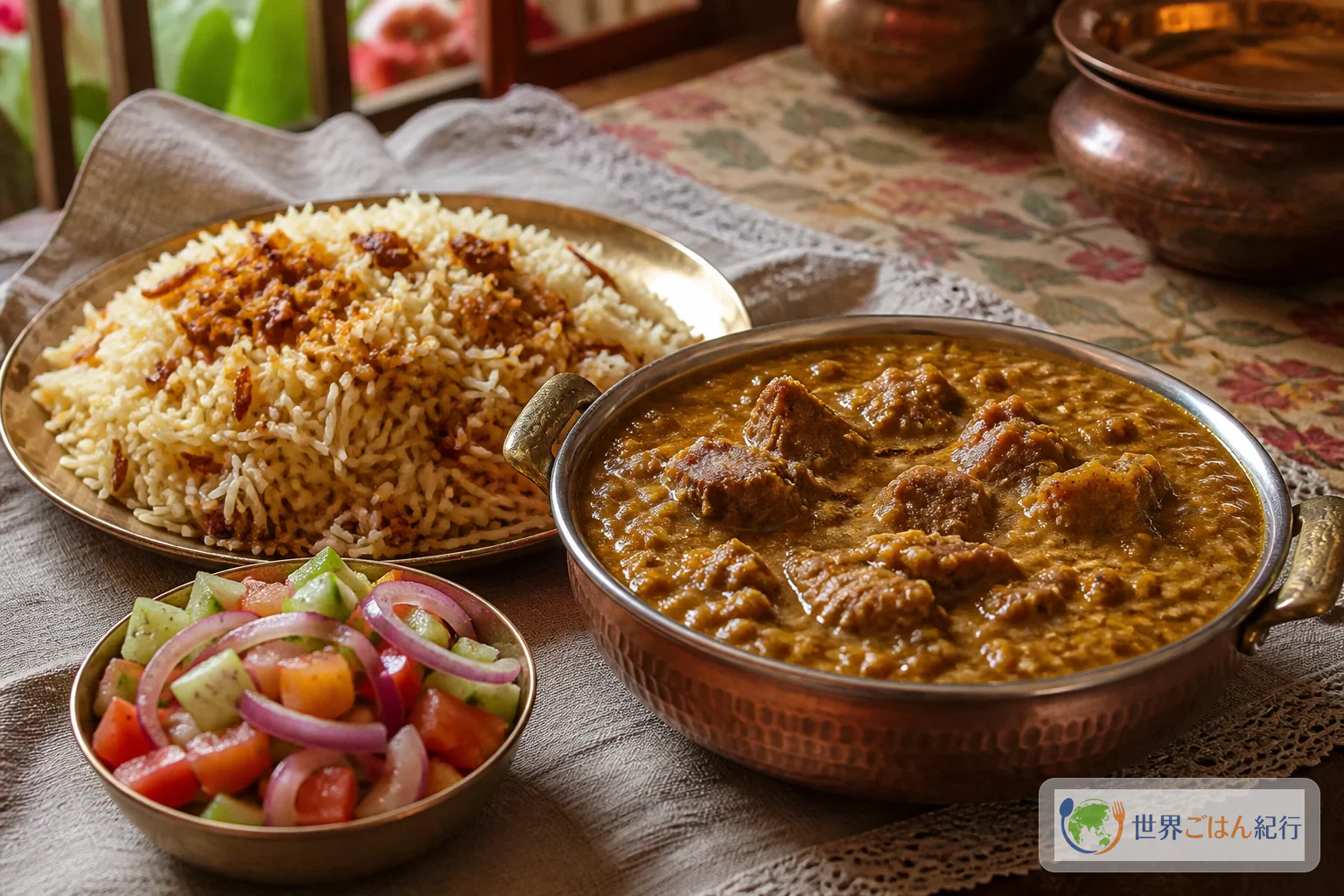
Lift the lid and cardamom and mint reach you first, and then saffron-stained grains show up between the white rice. Before that moment, though, most cooks have a doubt or two. How far should the rice be boiled, and will the chicken really cook through on steam alone? This chicken biryani follows the kacchi approach Hyderabad is known for: you layer raw marinated meat with parboiled rice, seal the pot, and let the rice finish by soaking up the meat juices and steam. You won't rely on the clock alone. Each next step depends on how firm the rice grains are at the center and how hot the chicken is inside.

Chicken Biryani in India
Biryani and pulao
The names biryani and pulao overlap, so the name alone doesn't tell you much. Here, biryani means a dish where the meat isn't first cooked with the rice in a separate pot. Instead, rice and meat are layered and sealed, and the rice finishes in the pot as it takes up the meat juices and steam.
Where biryani comes from
Nobody invented biryani in one go, and calling it "a dish invented by the Mughal Empire" hides today's regional differences. From the Mughal period onward, ingredients and techniques from many places came together in court cuisine. In 16th- to 18th-century South Asia, court-cooking ideas and terms traveled and attached themselves to ingredients that were already there. Indian cuisine as a whole changed not only with dynasties but with religion, social class, available ingredients and regional tables.
In Telangana, home to Hyderabad, the local food brings together Mughal, Arab, Turkish and Iranian influences with Telugu and Marathwada food traditions. That's why biryani changes from place to place: in the meat used, the way the rice is boiled and the strength of the aromatics.
Hyderabad and Lucknow
| Region / style | How it's cooked | How to lean toward it at home |
|---|---|---|
| Hyderabadi kacchi | Marinated raw meat and parboiled rice are layered, sealed and cooked on dum | If you want the meat juices to flavor the rice, use this recipe's single-layer setup |
| Lucknowi (Awadhi) | Lucknow's cooking follows the court tradition, with layered aromatics | For a lighter aroma, cook the meat in a separate pot before layering |
| Home adaptation | Water and timing change with the rice brand, pot thickness and chicken size | Prioritize the rice center and chicken temperature over the regional name |
This version keeps the meat in a single layer, spreads the rice on top and checks the internal temperature. That makes layering raw meat practical in a home pot, even if it isn't an exact copy of Hyderabadi biryani.

Biryani at home
The meat and spices in biryani vary with religion, family habits and what's available locally. Some households avoid beef or pork, and some cook without meat at all. You can leave out cilantro, lower the heat or swap the meat for vegetables too. What's best left unchanged is the order of parboiling the rice before sealing the pot, and checking that the meat is cooked to the center.
Ingredients (serves 4)
| Ingredient | Amount | Substitutes & notes |
|---|---|---|
| Basmati rice | 14 oz (400 g) | Start with Indian or Pakistani basmati. See below for substitutes |
| Water (for soaking) | about 1 quarts (1 L) | Enough to cover the rice completely |
| Water (for boiling) | 2.75 quarts (2.5 L) | Boil in plenty of water |
| Salt (for boiling) | 16 g | Seasons the boiling water |
| Cardamom pods (whole) | 3 | Whole spice for the boiling water |
| Cloves (whole) | 3 | Whole spice for the boiling water |
| Bay leaf | 1 | Whole spice for the boiling water |
Chicken marinade
| Ingredient | Amount | Substitutes & notes |
|---|---|---|
| Chicken thighs (bone-in) | 1.25 lb (600 g) | 1 lb (500 g) if boneless. Cut into even pieces |
| Yogurt (plain, unsweetened) | 5.5 oz (150 g) | See below if avoiding dairy |
| Onions (thinly sliced) | 2 large (about 14 oz (400 g)) | Includes the onions you fry until deep golden |
| Garlic (grated) | 1 tbsp | Optional |
| Ginger (grated) | 1 tbsp | Optional |
| Green chiles | 2 | 1 dried red chile works. Omit for less heat |
| Cilantro (finely chopped) | 10 g | If you dislike it, skip it at the finish only |
| Mint (finely chopped) | 10 g | 2 tsp dried mint works |
| Lemon juice | 1 tbsp | Optional |
| Salt | 1 tsp | If using MDH masala, check the salt on the label and reduce |
Biryani masala (homemade)
| Ingredient | Amount | Substitutes & notes |
|---|---|---|
| Cumin seeds | 1 tsp | Optional |
| Coriander seeds | 2 tsp | Optional |
| Cardamom pods (whole) | 4 | Optional |
| Cloves (whole) | 4 | Optional |
| Cinnamon stick | 1 (2 inches (5 cm)) | Optional. About 2 in |
| Black peppercorns | 1/2 tsp | Optional |
| Mace | 1/4 tsp | 1/8 tsp nutmeg works |
| Star anise | 1 | Optional |
| Ground turmeric | 1/2 tsp | Optional |
| Kashmiri chili powder | 1 tsp | 1 tsp paprika works (not hot) |
| Garam masala | 1 tsp | Store-bought is fine |
Finishing and layering
| Ingredient | Amount | Substitutes & notes |
|---|---|---|
| Saffron | a pinch (about 0.1 g) | The dish still works without it |
| Warm milk | 3 tbsp | For steeping the saffron |
| Ghee (clarified butter) | 1 oz (30 g) | Unsalted butter or vegetable oil works |
| Neutral oil | 1 tbsp | For frying the onions (used with the ghee) |
| Rose water | 1 tsp | Optional. Adds fragrance at the finish |
| Fried onions | 3 tbsp | Homemade takes time, so store-bought is recommended |
With jasmine rice, shorten the soak to 20 minutes and judge the boil by the grains, starting at 4–5 minutes. With short-grain rice, treat it as a different dish rather than a layered biryani, and set the water for your rice cooker or pot according to the package. Don't just reduce the water for short-grain rice to mimic basmati's aroma and separate grains.
Steep the saffron in 3 tbsp warm milk for 10 minutes. If you only want color, 1/4 tsp turmeric works, but you won't get saffron's floral aroma. For a first attempt, it's fine to skip it and focus on cooking the rice and chicken correctly.

What to check before swapping ingredients
Basmati's defining traits are long, slender grains, aroma, and grains that lengthen and stay separate after cooking. The rice here is chosen not only for flavor but because it keeps its shape while absorbing the meat juices in the pot.
Yogurt, milk and ghee contain dairy. To avoid dairy, swap the marinade yogurt for an unsweetened plant-based yogurt, the milk for water and the ghee for vegetable oil. If you use MDH biryani masala, check the ingredients and allergen labeling on each product. Keep hands and tools that touched raw chicken away from the raita vegetables and the finished dish. Cook the chicken until the center reaches 75°C (167°F) for at least 1 minute.
Choosing Spices, Meat and Rice for Chicken Biryani
Homemade masala
Dry-toast the cumin, coriander, cardamom, cloves, cinnamon, black pepper, mace and star anise over low heat for 2 minutes, then crush them coarsely. Mix in 1/2 tsp turmeric, 1 tsp Kashmiri chili and 1 tsp garam masala, and your masala is ready. If you want aroma more than heat, halve the chili.
MDH masala
If you'd rather not buy whole spices, skip the homemade masala and add the amount of MDH shown on the package to the marinade. Some products contain salt, so check the label and hold back part of the salt at the start. Choose MDH if you want one packet to set the flavor; make your own if you want to adjust the aromatics yourself. Using both makes the heat and salt hard to judge, so use only one.
Chicken and other meats
Bone-in chicken holds together better in the pot and is easy to spot when serving. Even so, check the internal temperature near the bone and don't pull it based on time alone. With boneless chicken thighs, reduce to 1 lb (500 g) and cut them to an even thickness.
Mutton and beef cook on a different schedule from chicken. For those meats, look up the cooking time and internal temperature first rather than reusing this recipe's timing.
Vegetable biryani
For a vegetable version, replace the chicken with a total of 1 lb (500 g) of vegetables such as cauliflower, potatoes and carrots. Vegetables release less liquid than chicken, so watch the rice and add a little boiling water as needed. Swapping in plant-based yogurt, milk and ghee keeps the dish dairy-free, but check the label on plant-based yogurts that contain nuts.

Rice other than basmati
Jasmine rice has a good aroma and is the first choice if you can't get basmati. Its grains lengthen differently and it's stickier, though, so soak it for 20 minutes and start with a shorter boil, adjusting as you check the grains. Short-grain rice is stickier still. Treat that as a different rice dish and work out the water from scratch.
You can use store-bought fried onions for the topping, but use onions you've fried and cooled yourself in the marinade. Their moisture and sweetness season the chicken, so replacing them with a topping alone shifts the backbone of the flavor.
- Every time you open the lid, steam escapes, so make the first check after the resting time.
- If the internal temperature is too low, cook on low in 5-minute increments without stirring the rice.
- Even if the rice is soft, keep cooking (and don't eat it) until the chicken reaches the right internal temperature.
- If the bottom scorches, don't scrape it; move only the upper layers to another dish.
Fixing Common Chicken Biryani Problems
When you boil the rice, you want a soft outside with a pinpoint of firmness at the center. After dum, turn off the heat, open the lid and check the rice and the meat separately. It's tempting to stir everything to rescue the rice, but stirring mixes the hard grains in with the soft ones. Check one spot first, and measure the thickest piece of chicken.
| Problem | Fix |
|---|---|
| Rice center is hard | Drizzle 2 tbsp boiling water around the edge, cover and cook on low for 5 minutes. Check again without crushing the rice |
| Chicken center below 75°C (167°F) | Without moving the rice, replace the lid and cook on low in 5-minute increments, measuring the internal temperature each time |
| Rice is soft and wet | Add no water; uncover and let stand 5 minutes. Once the chicken is confirmed safe, serve the soft portion and the meat first |
| Only the bottom is scorched | Leave the burnt part behind; move the upper rice and chicken to another dish. Next time use a heavier pot or set a frying pan underneath |
| Bland | Adjust each plate with salted raita or lemon rather than salting and stirring the pot |
Stop by looking at the center of the rice and the center of the chicken rather than the clock. That is the most reliable judgment in this dish.
Serving Chicken Biryani with Raita and Mirchi ka Salan
Raita
Mix 7 oz (200 g) plain yogurt, 1/2 cucumber, 5 g mint, 1/4 tsp ground cumin and 1–2 g salt. If the cucumber is watery, squeeze it lightly first, then chill the raita in the refrigerator for 20 minutes. If the biryani turns out too spicy, raita lets each person cool down their own plate, which is safer than adding salt or yogurt to the pot. For a dairy-free raita, use plant-based yogurt, but check the ingredients if anyone has allergies, since some are made from nuts.
Mirchi ka salan
For this green chile sauce from Hyderabadi tables, you'll need 1.75 oz (50 g) peanuts, 2 tbsp white sesame seeds, 1 tbsp tamarind paste and ¾ cup (200 ml) water. Dry-toast and crush the peanuts and sesame, combine them with onion fried in oil, add green chiles and simmer for 10 minutes. Serve it on the side, not in the biryani pot. It contains peanuts and sesame, so check for allergies with everyone at the table.

FAQ
Q1. Can I make it in a rice cooker?
Setting raw meat under the rice doesn't carry over directly, because how well it cooks depends on the rice cooker model and the amount of rice. If you use a rice cooker, cook the chicken through in a separate pot first, then combine it with the rice. You'll lose some of the layering and steamed aroma, but judging the meat gets much easier.
Q2. How is it different from curry and rice?
Curry and rice is cooked rice served with a sauce made separately. Biryani layers parboiled rice with marinated meat and steams them in the same pot, so each grain picks up the meat juices and aroma. For more on the cooking and spices, see our introduction to Indian cuisine.
Q3. How should I store leftovers?
Don't let it sit at room temperature for long after the meal. Transfer it to a shallow, clean container, cool it and refrigerate. Reheat until it's hot all the way through, and if anything about the smell or condition worries you, don't eat it. Keep the raita in a separate container in the refrigerator, and don't reuse utensils that touched the chicken.