Chop the onions fine, enough to cover the bottom of the pot, and set them over low heat. Water seeps out, the white pieces turn translucent, and in time they collapse into a heavy paste ready to take on the red of the berbere. That slow stretch of cooking decides the flavor of doro wat (Doro Wat, written ዶሮ ወጥ in Amharic), Ethiopia's stew of bone-in chicken and hard-boiled eggs in a berbere-spiced onion sauce. The red color suggests heat, but chile is only part of it: the sweetness of slowly cooked onion, the aroma of dried spices, and the mellow richness of niter kibbeh layer on one another, so every bite tastes a little different.
Doro Wat in Ethiopia
A dish for breaking the fast
Doro wat is tied to the shift from fasting to feasting. Animal foods such as meat, milk, butter, and eggs are avoided during fasting periods, and the end of a long fast is celebrated with a meal after worship. That is why a rich wat made with animal ingredients belongs to special days.
At one family's Easter table in Addis Ababa, the meal that ended the long fast held a doro wat that had been simmering since the day before. The chicken was divided into 12 pieces and served with 12 eggs, which stand for the apostles.
Berbere and the many wats
Berbere supplies both the red color and the heat. It is a ground spice blend built on dried red chile, with cardamom, ginger, garlic, cinnamon, fenugreek, and more; in Ethiopian households it can contain 21 spices and herbs. The kinds and amounts vary with taste, with what is available locally, and with culture and economic circumstances, so there is no single correct formula or fixed count of spices. The blend below builds the core of aroma and heat in your own kitchen.

"Doro" means chicken, and "wat" (or "wot") means stew, which is why the English spelling wavers between Doro Wat and Doro Wot. Wat is a broad category of stew: with chicken it is doro, with lamb yebeg, with lentils misir, and the center of gravity of the flavor shifts with the main ingredient. At home, tune the thickness of the onions and the strength of the chile to your own table.
Eaten on injera

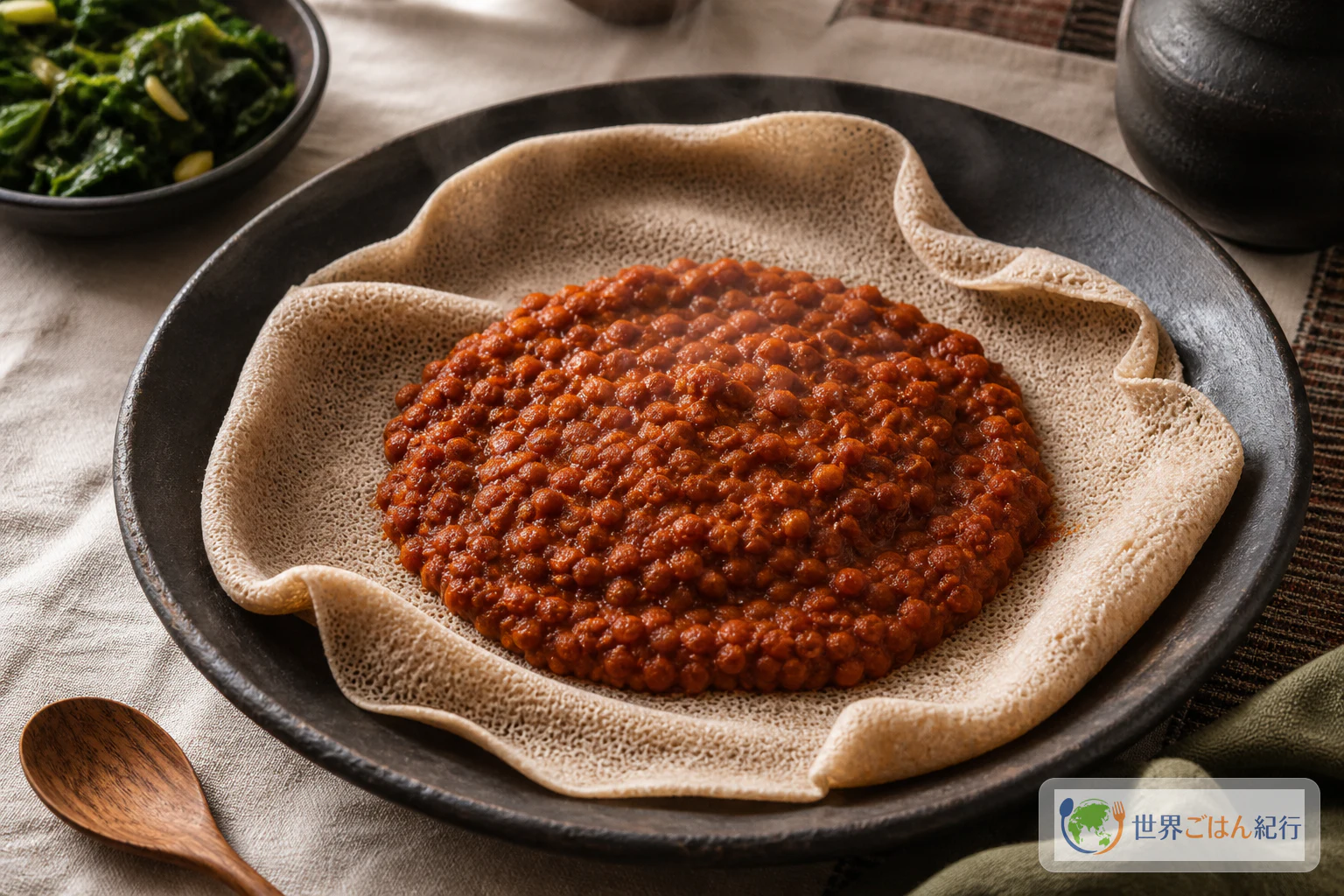
Injera (Ethiopian fermented flatbread) is a sour, spongy flatbread baked from fermented teff flour. It takes the place of a plate: spread on a large platter, topped with meat or legume wats, and torn into pieces to scoop up the dishes and sauce. At that Easter table, the doro wat sat in the center of the injera with meat and legume dishes around it, and after the meal came the coffee roasting ceremony.
At home you can plate one portion at a time instead of gathering around a big platter. If you have injera, though, tear it with your fingertips and scoop up a little sauce first. Its sour dough catches the rich sauce well, and you'll judge the saltiness, thickness, and heat far better than by cutting into the chicken with a knife and fork.
Ingredients (serves 4)
Nutrition (approximate, per serving when the batch is divided into 4)
| Nutrient | Per 1/4 of the batch |
|---|---|
| Calories | about 660 kcal |
| Protein | about 1.25 oz (37 g) |
| Fat | about 1.5 oz (44 g) |
| Carbohydrates | about 23 g |
| Fiber | about 5 g |
| Sodium | about 620 mg |
This dish contains eggs and dairy (butter). Leave out the eggs and you can still eat it as a chicken wat, but the result differs from doro wat made with eggs. For a fasting table, replace the chicken, eggs, and butter with red lentils or chickpeas and vegetable oil. That is a home-style plant-based wat.
Choosing Chicken and Aromatics for Doro Wat
Bone-in meat holds its shape through a long simmer, so the pieces keep their outline when you serve them. Boneless thighs work too, but cook faster: plan on 25–30 minutes after the sauce comes to a boil, and add the eggs once the meat has held 167°F (75°C) for at least 1 minute.
Dried oregano standing in for koseret won't fully reproduce its aroma. Rather than adding more oregano to close the gap, let the cardamom and turmeric in the niter kibbeh lead. Other flavors can be fun as a home variation, but they can't replace berbere, so make the basic blend first and try changes in small amounts.
Method
For a four-serving batch in a home pot, expect 25–40 minutes to cook the onions into a soft paste and 35–45 minutes to simmer the chicken. Pot size and heat change these times, so do not stop by the clock alone; watch the color, the thickness, and how the bubbles behave. Berbere scorches easily if it goes into the oil as dry powder, so make it into a paste with water first.
Getting the Onions Right
The biggest difference at home comes from the state of the onions, not the number of spices. Brown finely chopped onions in a hurry and bitterness takes over; add water too early and the sauce never gains density. Before the chicken goes in, cook the onions until they flow slowly across the bottom of the pot as a paste. That keeps the flavor from going slack, whether you serve the stew on injera or beside white rice.
For a home batch of 4 servings, expect 25–40 minutes until they soften; a big pot with a large quantity takes longer. If the bottom of the pot darkens first, the bitterness stays, so keep the heat moderate rather than pushing for color. Once a spatula trail lingers for a moment and the onion has broken down so finely you no longer feel it on the tongue, you can move on even if it isn't dark brown.
Serving, Storing, and Varying Doro Wat
Sides
If you can get injera, favor scooping the sauce with the sour bread. White rice is a practical substitute on days without it, and its mildness makes the aroma of the berbere easy to taste. With naan or thin flatbread, tear it into bite-sized pieces and top each with a little sauce. None of these reproduces the sourness of injera, so treat the sauce as the main event. Buying teff flour and baking injera yourself is worth it if you want to make the bread as well.
For less heat
Cut the cayenne to 1/2 tsp and keep the paprika at 3 tbsp, which lowers the heat while keeping the red color. With less chile, the outline of the berbere softens too. Rather than filling that gap with extra garlic and ginger, add a little mitmita at the table. For small children, serve their portion first and add heat only to the adults' plates.
Storing leftovers

It's safest to make only what you will finish. Divide leftovers into clean, shallow containers and refrigerate them rather than leaving them at room temperature for long. Eat them within about 2 days, starting the next day, and reheat until they reach 167°F (75°C) or higher at the center. Eggs change texture when frozen, so if you freeze it, take out the eggs and wrap the sauce and chicken in single-meal portions. If there is an off smell, sliminess, or anything odd in appearance, throw it out without eating it.
Yebeg wat (lamb wat)

Use 1.75 lb (800 g) of bone-in lamb in place of the chicken and raise the water to 1¾–2 cups (400–500 ml). Simmer over low heat until the meat is tender, 60–75 minutes, and check that the center is cooked through rather than relying on the clock. With eggs added, it becomes a rich dish for celebrations, with the fat and aroma of the lamb coming forward. Try it after you have made the basic doro wat, and the differences will be clear.
Misir wat (red lentils)
Leave out the chicken and eggs, rinse 7 oz (200 g) of dried red lentils, and add them to the sauce. Pour in 2 cups (500 ml) water, cover, and simmer over low heat for 25–30 minutes, until the lentils break down and thicken the sauce. Replace the niter kibbeh with vegetable oil, and you have a plant-based wat with the same berbere aroma.
FAQ
Do I need every berbere ingredient?
No. For a first batch, 3 tbsp of ready-made berbere, with salt and cayenne adjusted to the label, is less likely to go wrong. If you make your own, the dish works as long as you keep the core of aroma: red chile, paprika, cardamom, fenugreek, and so on. Put your effort into dissolving the powder in water and working it into the onions without scorching it.
How much fenugreek seed should I buy?
This recipe uses only 1/4 tsp, so a large bag will mostly go unused unless you make your own berbere often or use fenugreek in other dishes such as curries. For a single batch, look for a small pack or use ready-made berbere. Stick to the amount given and crush the seeds lightly so they don't turn bitter.
Can I make it with chicken breast?
You can, but it dries out more easily than bone-in thighs, so shorten the simmer to 25–30 minutes. Small pieces overcook, so cook it in large pieces and add the eggs once the center has held 167°F (75°C) for at least 1 minute. If the look of a bone-in stew matters to you, choose thighs.
How spicy is it?
With 1 tsp of cayenne, the stew has real heat while the aroma stays easy to read. Chile strength varies by product, so taste a little berbere before deciding how much more to add.
Sources
The method was checked against recipe sources, the table and way of eating against a field report, the explanation of fasting against materials from the Ethiopian Orthodox Church, and the differences in berbere blends against a household survey paper.
- SAVEUR Editors. "Slow-Cooked Spicy Chicken With Hard-Boiled Eggs (Doro Wat)." SAVEUR, published April 19, 2019 (https://www.saveur.com/slow-cooked-spicy-chicken-with-hard-boiled-eggs-recipe/). Checked for the method, ingredients, and handling of the onions, berbere, niter kibbeh, and eggs. Accessed and checked 7 September 2026.
- Jeff Koehler. "This Epic Meat Feast Is How Ethiopians Celebrate Easter." SAVEUR, published April 19, 2019 (https://www.saveur.com/meat-feast-ethiopian-easter/). Checked for the Easter table, the end of the fast, injera, how doro wat is served, and the coffee after the meal. Accessed and checked 7 September 2026.
- Ethiopian Orthodox Tewahedo Church. "The Ethiopian Orthodox Tewahedo Church — Fasting." (https://www.ethiopianorthodox.org/english/ethiopian/worship.html). Checked for animal foods during fasting periods and the meal that ends a fast. Accessed and checked 7 September 2026.
- Tesfaye Zeru, Temesgen Awoke, Teshome Assefa et al. "Spicy Shiro flour and Berbere powder (an ethnic, indigenous food of Ethiopia)." Journal of Ethnic Foods 10, Article 28 (published August 25, 2023) (https://link.springer.com/article/10.1186/s42779-023-00175-6). Checked for the main berbere ingredients, household and regional differences in blends, and the range of spices surveyed. Accessed and checked 7 September 2026.
- Ministry of Health, Labour and Welfare (Japan). "Food Poisoning Prevention at Home" (https://www.mhlw.go.jp/stf/seisakunitsuite/bunya/kenkou_iryou/shokuhin/syokuchu/01_00008.html). Checked for guidelines on cooking chicken, cooling and storing leftovers, and reheating. Accessed and checked 7 September 2026.