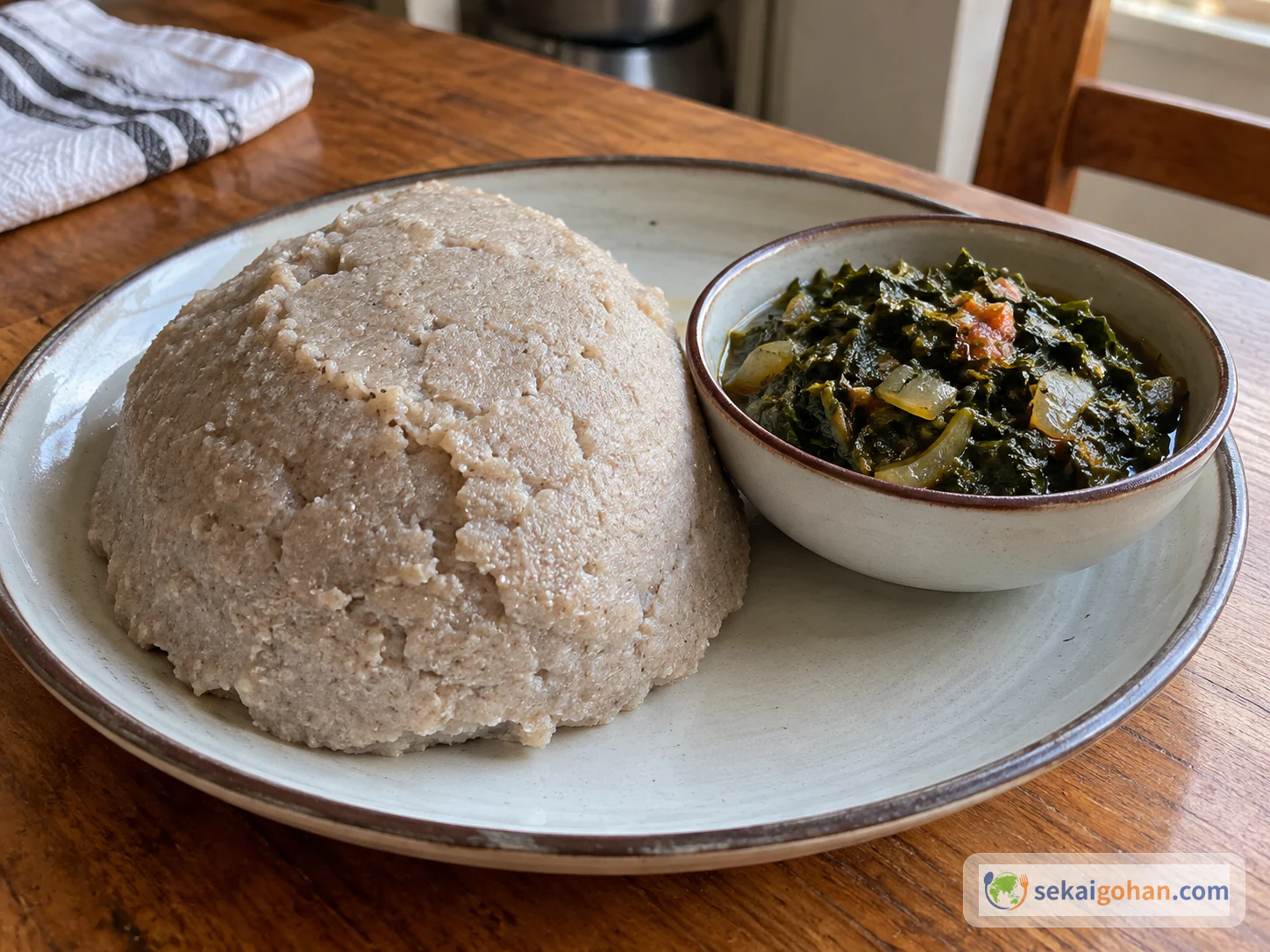
Steam rises from the pot as palm oil warms and its deep red slowly turns clear. Add the onion and a sweet aroma fills the kitchen, then the peanut paste goes in and thickens into a sauce that threatens to stick to the bottom. At the end come the leaves, their bitterness washed out, and the smell of dried shrimp settles over everything. This is ndolé (Ndolé / Ndolè), Cameroon's deep green stew of bitter leaf simmered in peanut paste and layered with shrimp, dried shrimp, and meat or fish. It looks quiet on the plate, but in the mouth the slight bitterness of the leaf, the sweet richness of the peanut and the strong umami of the dried goods arrive one after another.
About ndolé, Cameroon's national dish
Name and origin
"Ndolé" is the name of the dish and also of the leaf in it, a plant of the genus Vernonia. In English the leaf is called bitter leaves; in French, feuilles de ndolé. The dish is tied to the Douala area and to the food culture of southwestern and coastal Cameroon.

The method is to boil the leaves several times to remove the bitterness, combine them with peanut paste, and add meat, fish and shrimp. The interest of the dish lies less in luxurious ingredients than in making a bitter leaf delicious. Wash the leaves too much and they become plain greens; too little and they're hard to eat. The sweet fat of the peanut and the aroma of dried shrimp and crayfish then build the outline, so leaves, nuts and the umami of dried goods are what make ndolé taste like ndolé.
Ndolé has been chosen as one of the dishes to protect and promote in a project linking Cameroon's food culture and tourism. It's a home dish and at the same time the signature dish that carries the country's cooking abroad, though it's still far less known outside Cameroon than Ethiopia's injera or Morocco's tagine.
At the table and from region to region
Ndolé appears in home pots, in restaurants and on tables welcoming guests. It can be made with fish or beef, and there's a luxurious version with shrimp added. On the coast seafood stands out, while inland you'll see it with meat. Households differ a lot, so think of ndolé as a dish that shifts with the ingredients at hand and the occasion.

Locally it's often paired with plantain, with miondo and bobolo made from cassava, or with fufu-type staples. Rice is sometimes chosen in diaspora homes or for household reasons, and plain white rice works fine, but a plantain or cassava staple makes a powerful plate closer to the local table.
Ingredients (serves 4)
Frozen bitter leaf can sometimes be found at African grocery stores. If searching at online shops, try "bitter leaf frozen" and the local-language names. If you cannot find it, a combination of 1 lb (500 g) spinach and 3.5 oz (100 g) crown daisy or similar can reproduce the bitterness and texture. Spinach alone lacks bitterness, so mix in a little of the bitter green.
Palm oil is the oil that creates the aroma of Cameroonian cooking. Its distinctive red-orange color and earthy flavor decide the taste of ndolé. It is sometimes sold as "red palm oil" at import grocers and online shops. If you substitute vegetable oil, add 1 tsp paprika to make up for color and aroma, but the finish becomes much lighter. Try a small amount first, and if the aroma seems too strong, use half palm oil and half vegetable oil.
Choosing ingredients and substitutes for ndolé
Bitter leaf is rarely found at an ordinary supermarket; if you can buy it frozen, use it. Otherwise, mix spinach with a little crown daisy or another bitter green, about 3.5 oz (100 g) of bitter green to 1 lb (500 g) spinach. Spinach alone tastes too round, but too much of the bitter green pushes the dish toward simmered greens and away from Cameroonian cooking. In folk use bitter leaf is also regarded as a tonic for the body; here it's in the pot for its bitterness and aroma.
Plantain is the hard part outside Africa. Green cooking bananas get you closest. If you can't find them, thick slices of slightly ripe banana, pan-fried and accepted as a sweet side, are easy to eat. Exact reproduction matters less than keeping the balance of bitterness and richness.
Palm oil can become semi-solid at room temperature. Before using, set the jar in warm water of about 104°F (40°C) to return it to liquid before measuring. When heating, the Cameroonian way is to heat until it changes from red-orange to clear before adding ingredients. This small step suppresses the characteristic earthiness and brings up a nutty, toasty aroma.
Method
Ndolé is a dish where you take the bitterness out of the leaves and then wrap them in the peanut sauce. If you finish the preparation first, you will not be rushed once the simmering begins. At each step, check the heat of the pot and the look that signals the next step.
Ndolé cooking tips and fixes
The key to removing bitterness from bitter leaf is the strength of the squeeze. Soaking alone leaves the bitterness in; squeeze hard with both hands to push out the bitter components trapped in the fibers. A little baking soda in the boiling water breaks down the cell walls and removes the bitterness more efficiently.
For the first 5 minutes after adding the peanut paste, stir constantly. Left alone, it scorches to the pot bottom and the bitter taste spreads through everything. Draw large circles with the wooden spoon, scraping the bottom. If it separates, add 2 to 3 tbsp hot water and mix well again, and it comes back.
Peeled shrimp simmered from the start turn hard and dry. In Cameroonian households the shrimp usually go in 5 minutes before the heat is turned off and finish in the residual heat. When they turn pink and curl into a C, they're done.
Ndolé variations and nutrition
Vegan ndolé
Leave out the beef and shrimp and use 7 oz (200 g) thick fried tofu and 4 dried shiitake instead. Building the sauce on the shiitake soaking liquid brings deep umami without animal ingredients.
Chicken ndolé
Use 4 bone-in chicken thighs in place of the beef. Skip the parboiling: put the chicken straight into the pot after frying the onion and simmer 15 minutes, and the umami from the bones gives the sauce roundness. If you like spicy chicken dishes such as Jamaican jerk chicken, try it with more habanero.
Fish ndolé (ndolé au poisson)
Use 14 oz (400 g) fillets of white fish (cod or sea bass) instead of beef. Fish breaks up easily, so add it for the last 10 minutes and stir as little as possible. The seafood melts into the peanut sauce and gives a lighter taste than the meat version.
Spicy version
Use Scotch bonnet pepper (or 3 local hot chilies) in place of habanero. It gets quite hot, so start with half the first time. The sweetness of the peanut stands out against the heat, and it goes easily with beer and fizzy drinks.
Komatsuna version (a Japanese-style greens version)
Use 14 oz (400 g) komatsuna (Japanese mustard spinach) in place of bitter leaf and 3.5 oz (100 g) white tahini in place of peanut butter. Replace the dried shrimp with 3 tbsp tiny dried shrimp and the bouillon cube with 2 tsp dashi powder. The structure of ndolé, "leafy vegetable x nut paste x umami of dried goods," connects surprisingly well with Japanese food. Like Indonesia's nasi goreng and the Philippines' adobo, it sits comfortably on the table as a dish to eat with rice.
Nutrition per serving (one of four)
Ndolé layers four protein sources, beef, shrimp, dried shrimp and peanuts, and the bitter leaf adds a good amount of fiber.
| Nutrient | Amount |
|---|---|
| Calories | 620kcal |
| Protein | 1.5 oz (38g) |
| Fat | 1 oz (34g) |
| Carbohydrate | 1.5 oz (42g) |
| Fiber | 0.5 oz (8g) |
| Sodium | 680mg |
The fat comes mainly from palm oil and peanuts. On days you want something lighter, reduce the oil to 2 tbsp and lean toward white rice rather than plantain. The values are estimated from the ingredients, so the amounts of meat and oil you use will shift them.
FAQ
Q1. Where can I buy bitter leaf?
Frozen bitter leaf can sometimes be found at African grocery stores and some online shops. Search for "bitter leaf" and "bitter leaf frozen." If you can't find it, use the spinach and bitter green mix described above.
Q2. Can ndolé be made ahead?
Yes, and it tastes better the next day, once the flavors have settled. It keeps 3 days in the refrigerator; reheat it over low heat while stirring. It also freezes for about 1 month, but shrimp change texture when frozen, so freeze it without the shrimp and add fresh shrimp when reheating.
Q3. What if I have a peanut allergy?
Peanuts are the core ingredient, but almond butter or cashew butter keeps the nutty richness, though the taste changes. If you're allergic to nuts in general, substitute 5.5 oz (150 g) white tahini. Sesame-based ndolé is also made in some parts of Cameroon.
Q4. Is palm oil a health problem?
Red palm oil has a strong aroma and color and changes the impression of a dish even in small amounts, so use only as much as the taste needs. If you're concerned, vegetable oil with paprika can stand in, but the flavor changes considerably.
Q5. What drinks go with ndolé?
In Cameroon the standard is beer, especially local brands such as "33 Export" and "Castel," whose refreshing quality suits the rich flavor of ndolé. For non-alcoholic options, ginger beer (ginger ale) and bissap (hibiscus tea) go very well.
More African dishes
- Jollof rice: Nigeria's national dish, a tomato-based rice that also works as an accompaniment to ndolé
- Thieboudienne: Senegal's fish and vegetable rice, another great rice dish of West Africa
- Ugali: the cornmeal staple of East Africa, which goes well with ndolé too
- Bobotie: South Africa's spicy baked meat dish
- Tô
- Couscous
- Matooke
- Bogobe jwa lerotse