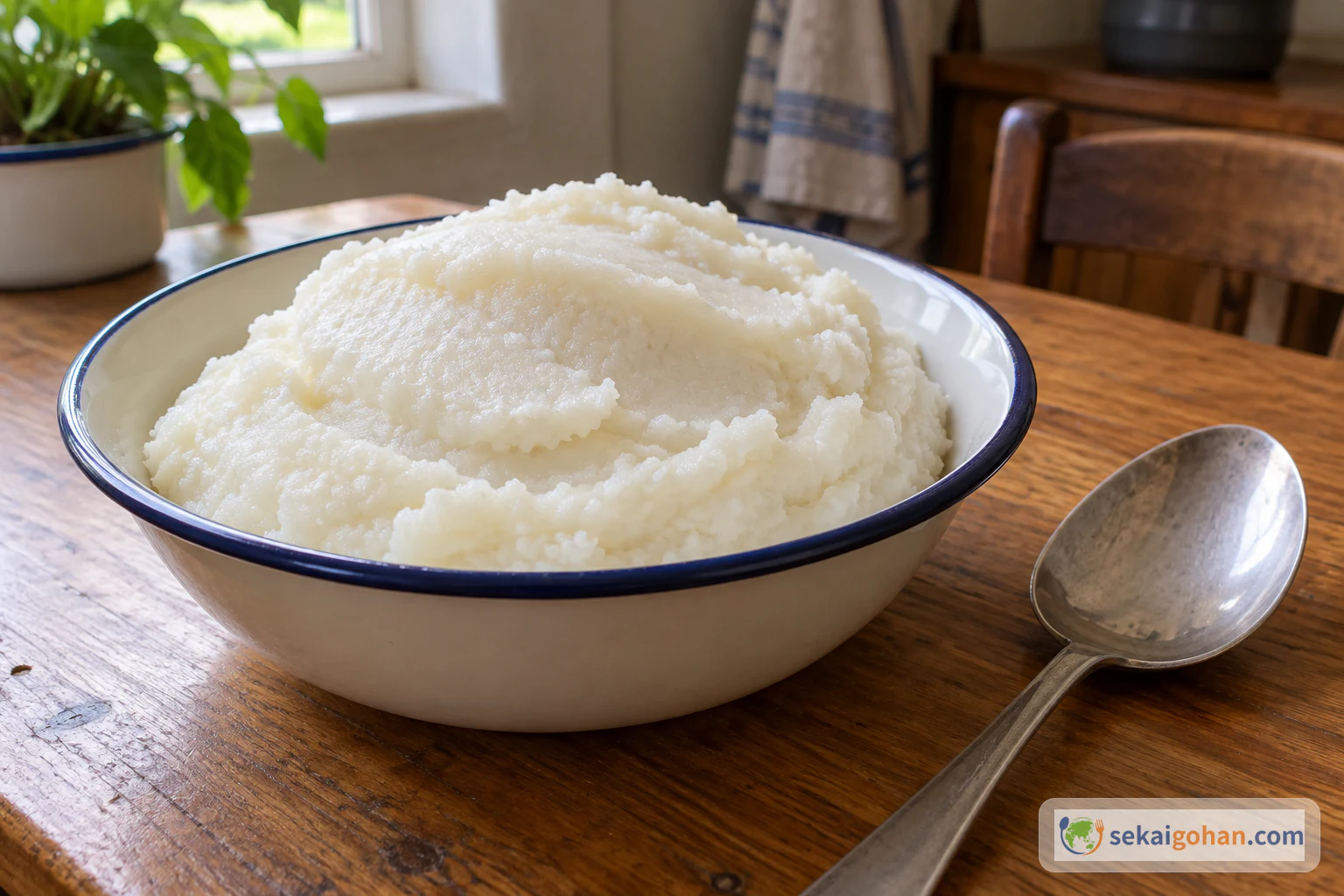
Grate taro in the evening and a little stickiness stays on your hands. Grated taro is white and heavy, and it spreads slowly when you set it on a leaf. Add dried shrimp, red dendê oil and the steam of greens, and it is no longer a plain root dish. Ekpang Nkukwo, called Ekwang on the Cameroonian side, comes from the coast that spans southwestern Cameroon and southeastern Nigeria. Grated cocoyam is wrapped in cocoyam leaves and simmered with smoked fish, crayfish, palm oil, chili and more. When you open a packet, the aroma of red oil rises first.

Ekpang nkukwo and Ekwang: origin and how it is eaten
Origin and names
Its origin is hard to pin to one country. Ekwang belongs to the Oroko, who live in the Ndian Division of southwestern Cameroon. Grating the cocoyam and rolling it into leaves a little at a time is the defining work of the dish. The packets are layered in a pot and cooked without hard stirring, so the stickiness of the root and the handling of the leaves decide the result.
In southern Nigeria, among the Efik and Ibibio, Ekpang Nkukwo is served on special occasions and at traditional weddings. Near the rivers, it can include seafood such as periwinkles, shrimp and crab. Ekpang Nkukwo and Ekwang are one dish with close methods, handed down under different names.
In English you will see this dish spelled Ekpang Nkukwo, Ekpang Nkwukwo and Ekwang. Ekwang is linked to the Oroko of southwestern Cameroon, while Ekpang Nkukwo is linked to the Efik and Ibibio of southern Nigeria.
How it is eaten
It is served hot and eaten by hand. When you unwrap the leaf, the aroma of red palm oil and seafood stock comes first. You eat the soft root by coating it with the sauce a little at a time.
Compared with other Cameroonian dishes
Among Cameroonian dishes, sanga is a stew of leafy greens and corn, ndolé a feast of bitter leaves and peanuts, and achu soup pairs a yellow sauce with pounded root. Ekpang nkukwo adds the handwork of wrapping. Stir the pot too much and it falls apart, so the cook's restraint becomes part of the flavor.
Ingredients (serves 4)

This amount fits a heavy pot about 8.5 inches (22 cm) across. Rolling the leaves takes time, so for a first try, don't cook for a large crowd.
Because dried shrimp is used, if you have a shellfish allergy, omit it and make up the aroma with 1 tsp dried shiitake powder and a little smoked salt. Taro and cocoyam can irritate the hands and mouth when raw. Wear gloves for peeling and grating, and simmer until no white remains in the root and the center is hot all the way through.
Choosing ingredients for ekpang nkukwo
Local cocoyam, cocoyam leaves, crayfish and smoked fish are hard to find elsewhere, and hunting for all of them at once makes shopping heavy. For a first try, focus on four things: the stickiness of the root, the leaf wrapping, the red oil and the dried aroma of seafood. Taro and komatsuna won't fully match the local ingredients, but they hold the structure. If you can get cocoyam and large leaves, use them.
| Element to keep | The local form | A realistic answer elsewhere |
|---|---|---|
| Stickiness of the root | Cocoyam, macabo, water yam | Grate taro and add a little potato starch only when it is loose |
| Wrapping leaf | Cocoyam leaves, collard greens and others | Blanch large komatsuna, outer bok choy leaves or spinach |
| Red oil | Palm oil, red palm oil | Edible dendê oil; the aroma is strong, so don't overdo it |
| Seafood aroma | Crayfish, smoked fish, periwinkles | Crushed dried shrimp; adjust the salt last |
| A no-stir way of cooking | Layer the packets and simmer gently | Low heat once it boils. Shake the pot instead of using a wooden spoon |
Dendê oil, dried shrimp and a heavy pot are easiest to find at a specialty grocer or online; taro, greens, onion and garlic come from any nearby store. Dendê oil gives strong aroma and color even in a small amount. It also goes into acarajé and moqueca baiana, so a bottle won't sit unused.
Dried shrimp doesn't replace local crayfish or smoked fish directly. Still, a little crushed shrimp puts a dried seafood aroma deep in the sauce and stands up to the heaviness of leaves and root.
The pot matters too. In a thin-bottomed pot, the starch of the root sets first and sticks to the bottom; a heavy pot makes it easier to hold a low simmer and cook the packets through without breaking them.
How to make it: simmer gently without breaking the packets
Once the packets are in the pot, don't stir it. When you want to move the flavor around, don't scrape the bottom with a wooden spoon; hold the pot with both hands and tilt it a little. If you move it before the root sets, the filling flows out of the leaves and the whole pot becomes a heavy paste.
Common ekpang nkukwo problems and fixes
| What happens | Cause | Fix |
|---|---|---|
| Packets come unrolled | Stiff leaves, too much root, hard boil | Blanch the leaves 30 seconds and roll thinner. Lower to low heat as soon as it boils |
| The root inside is pasty, white and raw | Not enough simmering, packets too thick | Add ½ cup (100 ml) more water and simmer 10 minutes over low heat. Roll thinner next time |
| The bottom of the pot scorches | Thin pot, high heat, too little water | Use a heavy pot and a heat where only the edge bubbles. Add water along the side of the pot |
| The whole thing turns to paste | Stirred partway, watery root | Don't stir with a wooden spoon; tilt the pot to move the flavor. If the root is loose, add starch |
| Feels oily | Too much dendê oil, no acidity | Reduce the dendê oil to 2 tbsp and add lime at the end |
Serving and storing ekpang nkukwo
Serving and menu ideas
At home a deep dish is easier than eating by hand. Serve it with warm rice, boiled green bananas or steamed potato. Break open a packet and coat a little rice with the red sauce, and the aroma of dried shrimp meets the stickiness of the root.
For a Cameroonian menu, cook sanga on another day to taste the sweetness of leafy greens. Compare it with poulet moambé, also palm-based but meatier, and Central Africa's maboke, which has a close leaf-wrapped structure. Brazil's moqueca baiana shows another side of seafood and red oil.
Storage and reheating
Refrigerate the packets and sauce together in an airtight container and finish within 2 days. To reheat, move them to a small pot, add 2 to 3 tbsp water, and warm over low heat for about 8 minutes. The microwave can leave the center cold, so heat at 600 W for 2 minutes, turn once, and heat 1 minute to 1 minute 30 seconds more.
You can freeze it, though the leaves soften and the root turns slightly floury. Freeze in single portions and warm over low heat in a pot after thawing; any packets that break down make a good sauce over rice.
Frequently asked questions
Can I make it with Chinese yam (nagaimo) instead of taro?
Yam alone has too much water and tends to run inside the leaf. If you use it, keep it to at most 20% of the total and add a little starch. For a first try, taro alone is steadier.
Is it a different dish without cocoyam leaves?
The aroma will differ, but wrapping the root in leaves keeps it together as a home version. Komatsuna leaves are rather small, so mixing them with outer bok choy leaves or large spinach makes rolling easier.
Is it unsatisfying without dried shrimp?
The dried seafood aroma is weaker. To avoid shellfish, 1 tsp dried shiitake powder, a pinch of smoked salt and more scallions fill the gap a little. It won't be the same, but it holds up as a dish of leaves and root.
I don't like dendê oil. Can I make it with ordinary oil?
You can, but the red aroma characteristic of ekpang nkukwo will be weaker. Try just 1 tbsp dendê oil and replace the rest with rice bran oil; starting small is easier to judge than leaving it out entirely.
Can I wrap the packets the day before?
I don't recommend it. Grated taro releases water over time and loosens inside the leaf. If you need to split the work, blanch the leaves, crush the dried shrimp and chop the aromatics the day before, then grate and roll the taro on the day.
- Keng's Kitchen, “Ekwang - The Oroko Way”
- African Food Network, “Ekpang Nkwukwo”
- ConnectNigeria, “Recipe for Ekpang Nkukwo”
- African Journal of Culture, History, Religion and Traditions, “Preserving Indigenous Culinary Heritage through Multilingual Documentation”
- Oroko Cultural Association, “Diversity & Cultural Heritage”