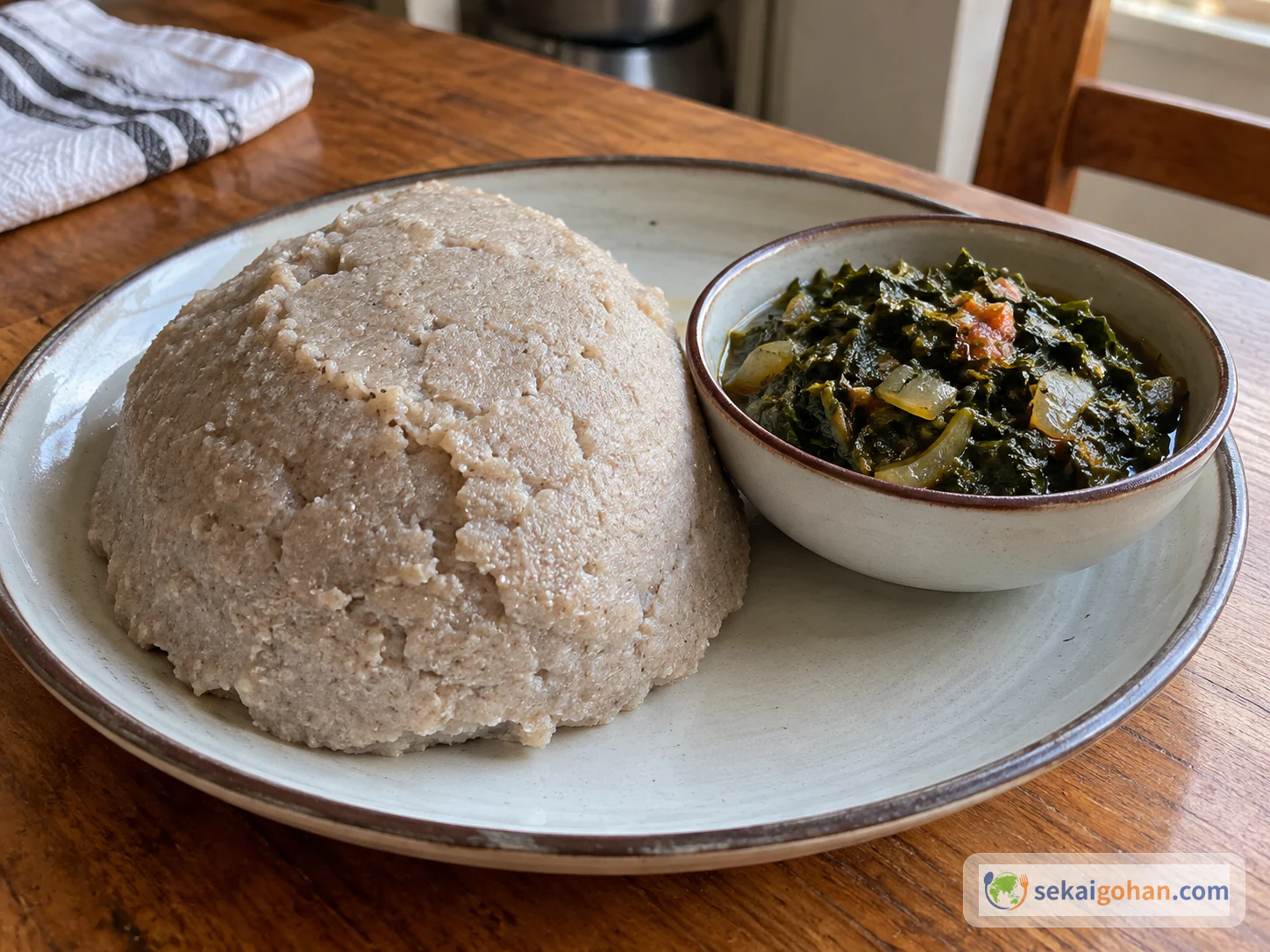
In the pot, the green of the leaves mixes with the yellow of the corn. Sanga (Sanga / Saŋa) is an everyday stew from central and southern Cameroon, where cassava leaves or a leafy green called Nzom are simmered with corn and palm nut into a thick green pot. It tastes of sweet leaves and corn wrapped in the earthy aroma of palm. This version is built from kale and komatsuna, with fresh-tasting corn and red palm oil. It won't be a perfect copy of the local dish, but it's one you can make where you live, and it keeps the parts that make it taste like sanga.

About sanga, Cameroon's leafy-green and corn stew

Sanga is loved in central and southern Cameroon. It's made with Nzom or eggplant leaves, fresh corn kernels and palm nut purée, with a little sugar added, and it's often summed up as "cassava leaves, palm oil, maize." The leaf and the way sweetness comes in can change, but those three pillars stay the same.
| Pillar of sanga | The form you see locally | What to keep elsewhere |
|---|---|---|
| Leafy greens | Cassava leaves, Nzom, eggplant leaves and others | Chop greens fine and simmer until soft so they blend into the whole pot |
| Corn | Fresh corn kernels | Frozen or canned is fine, but add near the end to keep the sweetness and the kernels |
| Palm | Palm nut purée, red palm oil | Don't overdo it; add a little earthy aroma and the outline of red oil |
Cooking Cameroonian food outside Cameroon, the first hurdle is always the leaves: bitterleaf for ndolé, cassava leaves for moambé. Set the two Cameroonian greens dishes side by side and the difference is clear. Ndolé is a feast, rich with peanuts and strong bitterness, while sanga is an everyday pot. If you've made the West African seed stew egusi soup, think of sanga as more corn-leaning, a lighter stew of oil and leaves.
Red palm oil runs through a lot of this cooking. Koki steams beans in leaves, so it shows how the oil changes between a stew and a steamed dish. Achu soup turns it into an emulsified yellow soup poured over a mound of cocoyam, a completely different table from the same country. Once you know palm flavors, move on to Congo's poulet moambé.
Ingredients (serves 4)

This makes four servings, for eating with rice or fufu. If you can get palm nut cream, the dish gets closer to the local one. For your first try, red palm oil and a little coconut milk give the aroma and body.
If you leave out the smoked fish and dried shrimp, use 5 g dried shiitake powder, 1.2 tsp salt and 1/3 tsp white pepper. The umami is a little lighter, but the sweetness of corn and greens comes forward.
Choosing ingredients and substitutes for sanga

What matters is the amount of leaves, the grain of the corn and the aroma of palm. Fresh cassava leaves are hard to prepare safely in most home kitchens, so kale and komatsuna take their place here. If you chase exact ingredient names at the cost of safety and availability, you won't keep cooking it.
| Uncertain ingredient | Closer to the original | Realistic elsewhere | How to think about the substitution |
|---|---|---|---|
| Cassava leaves | Use a processed frozen product | 9 oz (250 g) kale and 5.5 oz (150 g) komatsuna | Make up the slight bitterness and fibrous feel with kale |
| Nzom, eggplant leaves | Use the local leaves | Spinach, komatsuna, Malabar spinach | Don't pick wild plants or unidentified leaves |
| Palm nut purée | Use palm nut cream | Red palm oil and coconut milk | Not the same taste, but you can build the oil aroma and body |
| Fresh corn | Take the kernels off fresh ears | Frozen corn | Don't cook it too long from the start; keep the kernel texture |
| Smoked fish | Smoked fish | Grilled salted mackerel, dried shrimp | Add the fish aroma in small amounts; decide salt last |
Cassava leaves contain cyanogenic glycosides and need proper processing: pound the leaves thoroughly, then wash them or soak them in warm water. Fresh leaves are hard to make safe at home, so don’t pick and use raw cassava leaves. If you have no reliable processed frozen product, make it with kale, komatsuna or spinach.
Corn
Corn trips people up in sanga more than the leaves do. Supermarket corn is very sweet, and if the liquid from canned corn goes in too, the pot turns straight into a sweet-corn stew. Local fresh corn has sweetness, but also a floury bite, the hull still there, and enough weight to sit alongside the leaves.
For a first try, frozen corn is easiest. Add it without thawing: the kernels hold their shape, and the liquid in the pot is easy to judge. Drain canned corn in a sieve for 2 minutes, and if it's very sweet, add a few drops of lime. When fresh corn is in season, cut the kernels off the cob with a knife for better aroma.
| Form of corn | Suited to | How to use | Caution |
|---|---|---|---|
| Frozen corn | First try, weekdays | Add frozen at step 5 | Releases water, so be sure to reduce it at step 6 |
| Fresh corn | Summer, days you want aroma | Cut the kernels off and add at step 5 | Don't put the cob in the pot; at most use it separately to make stock |
| Canned corn | Days you cook from the pantry | Drain, and omit the sugar if sweet | Adding the liquid pushes it toward a sweet side dish |
| Hominy | Days you want less sweetness | Drain and simmer for just 6 minutes at step 5 | Kernels are large, so chop the leaves fine |
Hominy gives sanga a slightly more rustic color, and with less sweetness the red palm oil and the fish come forward. It also links to East African grain dishes such as githeri, which makes the pantry easier to use up.
What to buy
Kale, komatsuna, corn and onion are easy to find at an ordinary supermarket. Look at an African grocer or online for the rest: red palm oil, cassava flour for fufu and eba, and dried shrimp powder for a bit of smoked-fish aroma.
| Buying priority | Ingredient to look for | Role in the dish | What you can get nearby |
|---|---|---|---|
| Top | Red palm oil | Aroma and color that move greens and corn toward a Central African stew | Using only neutral oil moves it toward a different dish |
| High | Cassava flour, fufu mix | Makes sanga a dish scooped with a staple, not a side for white rice | White rice is fine the first time |
| Medium | Dried shrimp powder, dried shrimp | Adds a little ocean umami when there is no smoked fish | Not needed on days you use grilled salted mackerel |
| Low | Palm nut cream | Closest to the local dish, but hard to find at times | Move toward a home version with red palm oil and coconut milk |
Red palm oil is the one to get first. With only neutral oil, sanga is just a stew of greens and corn, so add even a little. Start small with a new bottle, 1 to 4 tbsp per dish, and you'll find it also works in egusi soup and red red. Palm nut cream gets you closer to the local dish, but don't make it essential on your first try.
Cassava flour is for the fufu served beside the sanga, not for the stew itself. White rice is delicious, but scooping the green stew with a sticky staple brings out its body. Serve it with fufu, and sanga moves from "a vegetable side dish" to a Central African table.
Without smoked fish, crush a little dried shrimp and add it for depth, especially when the flavor feels flat with only corn and greens. You won't need it on days you use salted mackerel. If you have a shellfish allergy, skip the dried shrimp and use dried shiitake powder instead.
How to make it: cook the leaves down soft, leave the corn for last
Make sanga in this order: chop the leaves, sauté the aromatics, dissolve the palm, cook the leaves, add the corn, reduce to the right thickness, then serve. Add the corn early and the kernels turn too soft. Add it near the end to keep the yellow grains.
Common sanga mistakes and fixes

Sanga depends less on technique than on how you let the water escape. So many greens go in that it looks watery at first, and that's when people turn up the heat. Don't: the bottom scorches and leaves a grassy smell. Keep the lid on for the first part and off for the rest, at low to medium-low heat.
| Problem | Cause | Fix |
|---|---|---|
| Watery | Water from the leaves, liquid from canned corn, the lid kept shut too long | Remove the lid and reduce 10 more minutes over low heat |
| Bitter | Too many kale stems, scorched palm oil | Remove thick stems, and add the aromatics before the oil smokes |
| Corn too soft | Added from the start and cooked long | Add at step 5 and stop at about 8 minutes |
| Fish is too salty | Didn't account for the salt in the mackerel or dried shrimp first | Salt last. If strong, add 3.5 tbsp (50 ml) water and simmer 5 minutes |
| Palm aroma is heavy | Too much red palm oil | Next time 1.5 tbsp. Cut it with a few drops of lime at the end |
Serving and storing sanga
Serving with fufu or rice
Sanga comes alive with a staple. Scoop it with fufu a little at a time, and the leaf fibers and palm oil come together in each bite. Over white rice, finish it a little looser so it's easier to eat.
| Menu | Suited to | How to combine |
|---|---|---|
| Sanga, rice, grilled fish | Weeknight dinner | Keep the fish out of the sanga on a separate plate so salt is easier to control |
| Sanga, fufu, boiled egg | Weekend Central African menu | Make the fufu the star and reduce the sanga thicker |
| Sanga, poulet moambé, rice | Days you compare palm dishes | Reduce the sanga's red palm oil to 1.5 tbsp to avoid heaviness |
| Sanga, sukuma wiki, rice | Days you use up greens | Stir-fry sukuma wiki lightly and keep sanga a stew |
Storage and reheating

Cool sanga within 30 minutes, divide it into shallow containers, and refrigerate. With fish, eat it by the next day; without fish, within 2 days, since the leafy greens hold a lot of water. Freezing lowers the texture, but sanga without fish keeps up to 2 weeks.
To reheat, put one portion and 2 tbsp water in a pot and warm over low heat for 5 minutes. In a microwave, heat at 600 W for 1 minute 30 seconds, stir, then heat 40 seconds more; the surface gets hot first, so that stir matters. Thawed sanga releases liquid, so reduce it over low heat for 5 minutes with the lid off.
Frequently asked questions
Can I make it without cassava leaves?
Yes. Kale and komatsuna are safer and fail less often in a home kitchen. You won't get the flavor of cassava leaves themselves, but you keep the structure: finely chopped leaves cooked in a palm-type oil.
I don't have palm nut cream
Use 2 tbsp red palm oil and ½ cup (150 ml) coconut milk instead. You'll miss some of the fibrous feel and body of palm nut cream. If you find palm nut cream, palm fruit pulp or palm soup base at an African grocer or online, loosen it with water and use it to get closer.
Is it unsatisfying without fish?
You can make it without fish. For depth, add 10 g dried shrimp if you eat shellfish, or 5 g dried shiitake powder or 3.5 tbsp (50 ml) kombu stock if you avoid it. It won't taste like smoked fish, but it keeps the dish from going flat with only greens and corn.
Is it a sweet dish?
Some Cameroonian recipes add sugar at the end. Here it's only 1 tsp, and if the corn is sweet, skip it. If you want more sweetness, 2 tsp or less still leaves room for the palm and fish aromas.