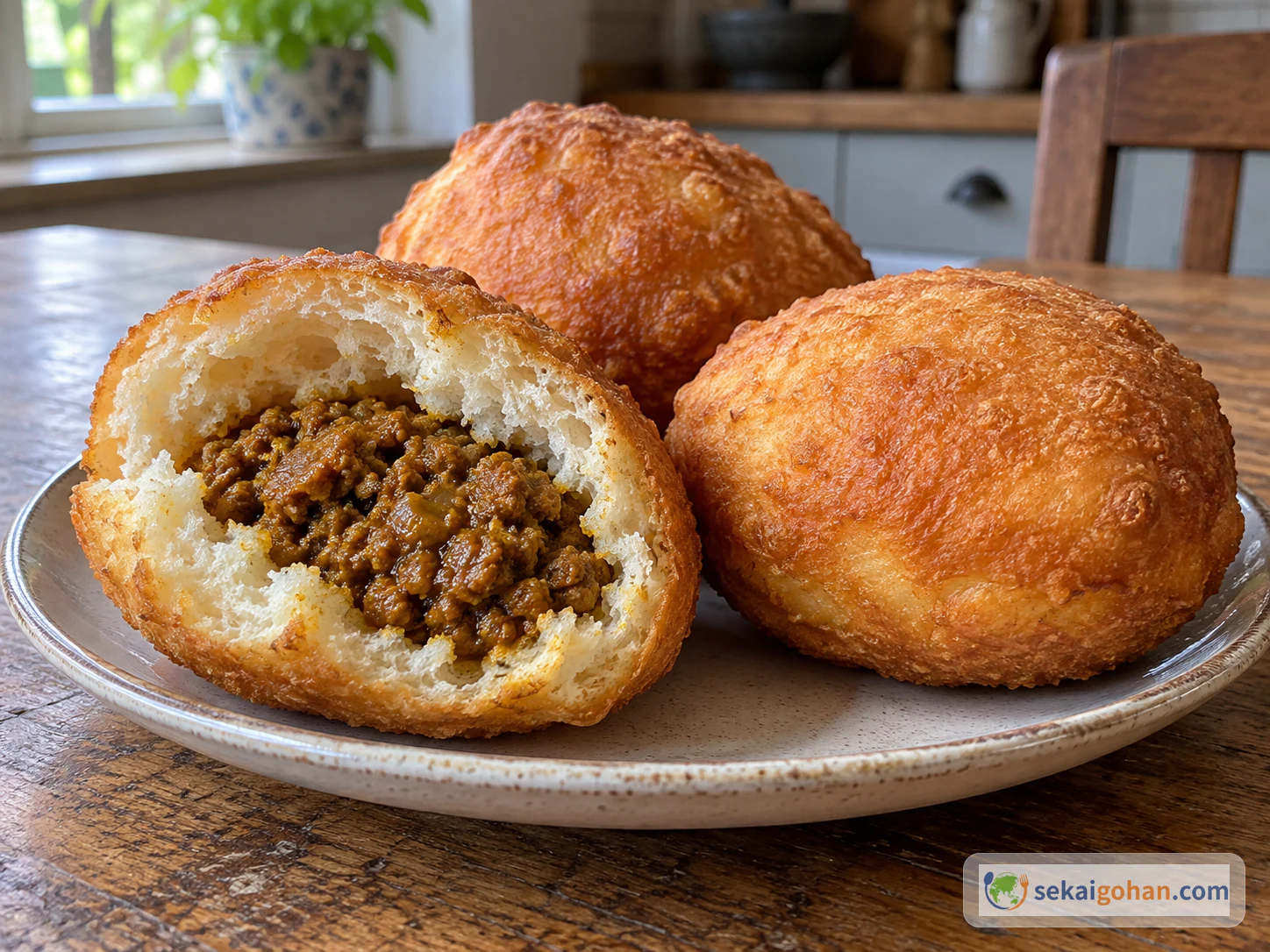
Picture a breakfast in Cairo and the first thing that comes to mind is the sound of frying oil. At a small stall, rounds of green bean batter drop into the oil and set into sesame-flecked crusts in the foam, while flatbread warms alongside and tahini, chopped tomato, cucumber, and pickles wait their turn.

Ta'ameya (طعمية) is Egypt's beloved fava bean falafel: dried fava beans, green herbs, cumin, and coriander, shaped into flat discs and fried. It puts the sweetness of the beans, the green aroma of herbs, and the toastiness of sesame up front, with a crisp outside and a green, light inside.
Ta'ameya and the Egyptian Breakfast
The falafel most people meet outside Egypt is the chickpea version, like the Lebanese-style falafel on this site, which uses dried chickpeas and aims for texture and lightness. Ta'ameya is a different dish. Both are "fried beans," but the bean, the amount of herbs, and the way the meal is put together all change.
In Egypt, ta'ameya goes into morning bread. It sits on the table with ful medames, fried eggplant, pickles, tahini, and salad, and each person builds their own sandwich. At home, bread and something sour bring you much closer to that table than a plate of ta'ameya on its own.
| Comparison | Egyptian ta'ameya | Lebanese-style falafel |
|---|---|---|
| Main bean | Dried fava beans, split fava beans | Dried chickpeas |
| Color | Lots of herbs, deep green inside | Ranges from green to pale beige |
| Shape | Flat disc, often coated in sesame | Ball or small patty |
| How it is eaten | Breakfast bread, ful, pickles, tahini | Mezze, pita sandwiches, salad bowls |
| Main challenge at home | Finding dried fava beans, drying the herbs | Soaking chickpeas, managing moisture |
Mashing beans and frying them is an idea that turns up elsewhere too, in Nigerian akara and Brazilian acarajé. Akara uses black-eyed peas, acarajé uses dendê oil and fillings, and ta'ameya uses fava beans and herbs. Telling them apart by bean, oil, and how they are eaten makes world breakfasts more fun.
Within Egypt, ta'ameya belongs with ful medames, the bean breakfast, and koshari, the street-food carbs. Together they show the Egyptian axis of "cheap and filling" food.
Ingredients (serves 4)

Skinless split fava beans make this easier. If you can only find skin-on beans, remove the skins after soaking. Frozen green fava beans taste fresher and greener, and canned beans carry too much water, so neither should be your first choice.
The patties are built from fava beans, herbs, spices, sesame, and frying oil. If you have a sesame allergy, skip the white sesame and tahini and use a sauce of lemon, olive oil, and salt. Pita and naan contain wheat. If you cannot eat fava beans, or legumes tend to upset you, do not force yourself to try this.
Ingredients and Tools for This Dish
Dried fava beans are worth hunting for at Middle Eastern or international grocers and online. Cumin can be used ground, but toasting whole seeds lightly and crushing them gives the aroma of a morning street stall. Substituting curry powder turns ta'ameya into curry-flavored fried beans.
Ground coriander rounds out the green aroma when you add more herbs. It is also useful in bhindi fry and bean curries.
A thick bean batter is hard for a blender to turn, which leads to adding too much water. A small food processor can be reused for ta'ameya, akara, and sambar-style aromatic pastes.
If you are not used to deep frying, treat the thermometer as a flavor tool. Low heat means the patties soak up oil, and high heat darkens only the outside, so a thermometer protects the lightness of ta'ameya.
Choosing Fava Beans, Herbs, and Substitutes
The one thing to get right is the beans. Ta'ameya uses dried fava beans that are soaked but not cooked, which is what makes the inside light and cohesive when fried. Canned and frozen beans are already cooked and wet, and they fall apart in the oil. Get this right at the start and you avoid half the failures.
When shopping for dried fava beans, look at the state of the bean rather than the product name. Labels such as "skinless," "split," "split fava beans," or "peeled fava beans" can be used right after soaking. "Skin-on," "whole fava beans," or "broad beans" have good flavor but need peeling after soaking (rubbing them in water and rinsing off the loosened skins), so save those for a weekend.
If you use frozen fava beans anyway, you will need chickpea flour or wheat flour to hold them together, and the result is heavier, more a fava-and-herb croquette than ta'ameya. Frozen green fava beans carry a strong spring aroma and go better with salt and lemon than with tahini, so they are better enjoyed as a separate small dish. Cans labeled for ful medames are handy for an Egyptian pantry; just keep them for ful, and the dried beans for ta'ameya.
Herbs are more forgiving. What matters is using enough that green shows in the cross-section; with too few, you just have fried fava beans without the morning aroma of ta'ameya. Beyond the beans, herbs, cumin, coriander, and oil temperature, the rest can be swapped realistically.
| Dilemma | What to preserve | Practical answer |
|---|---|---|
| No dried fava beans | Soak dried beans instead of using canned | Look online for skinless split fava beans. If you can't find them, switch to chickpea falafel |
| Dislike cilantro | Herbs that make the cross-section green | Increase the parsley and add a little dill. Don't drop herbs to zero |
| No leek | The sweetness and green aroma of the allium | Combine scallion whites, green scallion tops, and onion |
| No tahini | Sesame richness and acidity | Thin white sesame paste with water and lemon. For sesame allergy, use a lemon-oil sauce |
| No pita | The eat-it-in-your-hand style | Naan, thin focaccia, toasted sandwich bread, tortillas |
| Frying makes you nervous | Setting the surface quickly | Use a small pot with 1.5 inches (4 cm) of oil, a thermometer, and fry in small batches |
Method
With ta'ameya, soaking the day before and managing moisture matter more than the frying time. The steps look simple, but wet herbs, beans ground too fine, warm batter, or low oil temperature will make it heavy.
Ta'ameya Failures and How to Fix Them
Use dried fava beans soaked but not cooked, drain the herbs thoroughly, don't make the batter too smooth, stir in the baking powder just before frying, and hold the oil at 350°F (175–180°C). Keep these five and you get a crisp outside and a green, light inside.

The causes of ta'ameya failures are clearer than they look, and each one has a direct fix.
| Symptom | Cause | Fix |
|---|---|---|
| Falls apart in the oil | Canned beans, herb moisture, warm batter | Return to dried beans. Dry the herbs. Chill the batter 30 minutes |
| Cracks | Too little moisture, grain too coarse | Take 2 tbsp of batter, mix in 1 tsp water, and see how it behaves |
| Greasy | Oil too cool, too many at once | Bring back to 350°F (175–180°C) and fry 5 or 6 at a time |
| Burnt outside only | Oil too hot, patties too thick | Lower to 350°F (170–175°C) and shape 0.5 inches (1.5 cm) thick |
| Heavy inside | Batter too fine, baking powder added too early | Pulse coarsely and add baking powder just before frying |
| Raw, grassy taste | Too much garlic or leek, underfried | Reduce the leek and fry about 5 minutes until done in the center |
| Sesame falls off | Surface too dry, not pressed enough | Press the sesame on right after shaping and squeeze lightly |
The most common first-time mistake is adding too much water. When the food processor won't turn, it is tempting to add water by the spoonful, but that leaves you with a batter as soft as drop-fry that can't be shaped. Process in two batches, stop to scrape down the sides, and grind the beans coarsely, and you will find you don't need water at all.
For oil temperature, watch the pot as much as the thermometer. If fine, lively bubbles appear the moment the ta'ameya goes in and the surface starts to set in about 10 seconds, you're there. Large, sluggish bubbles mean the oil is too cool; if the patty turns dark brown at once, it's too hot. Without a thermometer, test with a small piece of batter.
Serving and Storing Ta'ameya

Serving and Pairing
Fresh-fried ta'ameya is most fun tucked into bread. Warm pita or naan, spread a thin layer of tahini, and layer 2 or 3 ta'ameya with cucumber, tomato, pickles, and lemon. Go easy on hot sauce at first; tahini and acidity let the bean aroma come through.
For an Egyptian-style breakfast, serve ful medames in a small bowl on the side. Beans with beans may sound heavy, but ful is soft and stewed while ta'ameya is a fried herb bean, and with bread at the center it comes together as breakfast. For lunch, keep it light with more salad and lemon rather than koshari. Set out hummus and tabbouleh and it grows into a Middle Eastern mezze table.
| Occasion | Combination | Result |
|---|---|---|
| Egyptian-style breakfast | Ta'ameya, ful, flatbread, pickles | A filling bean breakfast |
| A casual lunch | Ta'ameya sandwich, salad, lemon | Fried but not too heavy |
| Middle Eastern mezze | Ta'ameya, hummus, tabbouleh, baba ghanoush | Lets you enjoy the difference from Lebanese-style falafel |
| Comparing with West Africa | Ta'ameya, akara, a little red red | Shows the difference in beans and frying |
Storage
Cool the freshly fried patties and put them in a clean container. Plan on eating them the next day if refrigerated, or within about 2 weeks if frozen. The microwave alone leaves the surface damp, so reheat refrigerated ones in a 350°F (180°C) toaster oven for 6 to 8 minutes; half-thaw frozen ones in the refrigerator first, then warm them in a toaster oven or a 350°F (180°C) oven for about 10 minutes.
Don't store the batter. Once salt and baking powder are in, water seeps out over time and the fried ta'ameya loses its lightness. To prepare ahead, shape and freeze the patties instead, then fry them from frozen starting at a lower 350°F (170°C) and raise to 350°F (175°C) at the end to set the surface. They hold together better this way.
Frequently Asked Questions
Q1. I can't find dried fava beans. Can I use chickpeas?
With chickpeas, make Lebanese-style falafel instead. The method is close, but the sweetness of the beans and the green of the cross-section change. For ta'ameya, look for skinless dried fava beans at international grocers or online.
Q2. How far can I reduce the herbs?
You can cut them by half, but at zero you lose the ta'ameya aroma. Leek or scallion alone won't give the body of herbs, so keep the parsley.
Q3. Can I bake instead of frying?
You can, but the texture changes. In the oven, plan on 400°F (200°C) for 15 minutes, then flip and bake 10 minutes, and brush the surface lightly with oil. The crisp shell is weaker, but it's fine for a weekday sandwich. Fry your first batch so you know what ta'ameya should be like; adjusting the baked version is easier after that.
Q4. How do I make the tahini sauce?
Mix 4 tbsp tahini, 2 tbsp lemon juice, 3 to 4 tbsp water, a little grated garlic, and 1/3 tsp salt. It stiffens at first, but keep stirring and add water gradually, and it turns pale and smooth. If you use sesame paste, the aroma goes in another direction, so make the lemon a little stronger.
Q5. What can I do with leftover ta'ameya?
The next day, a sandwich is best: reheat them in the toaster oven, then tuck them into bread with tomato, cucumber, pickles, and tahini. You can also crumble them over a salad.