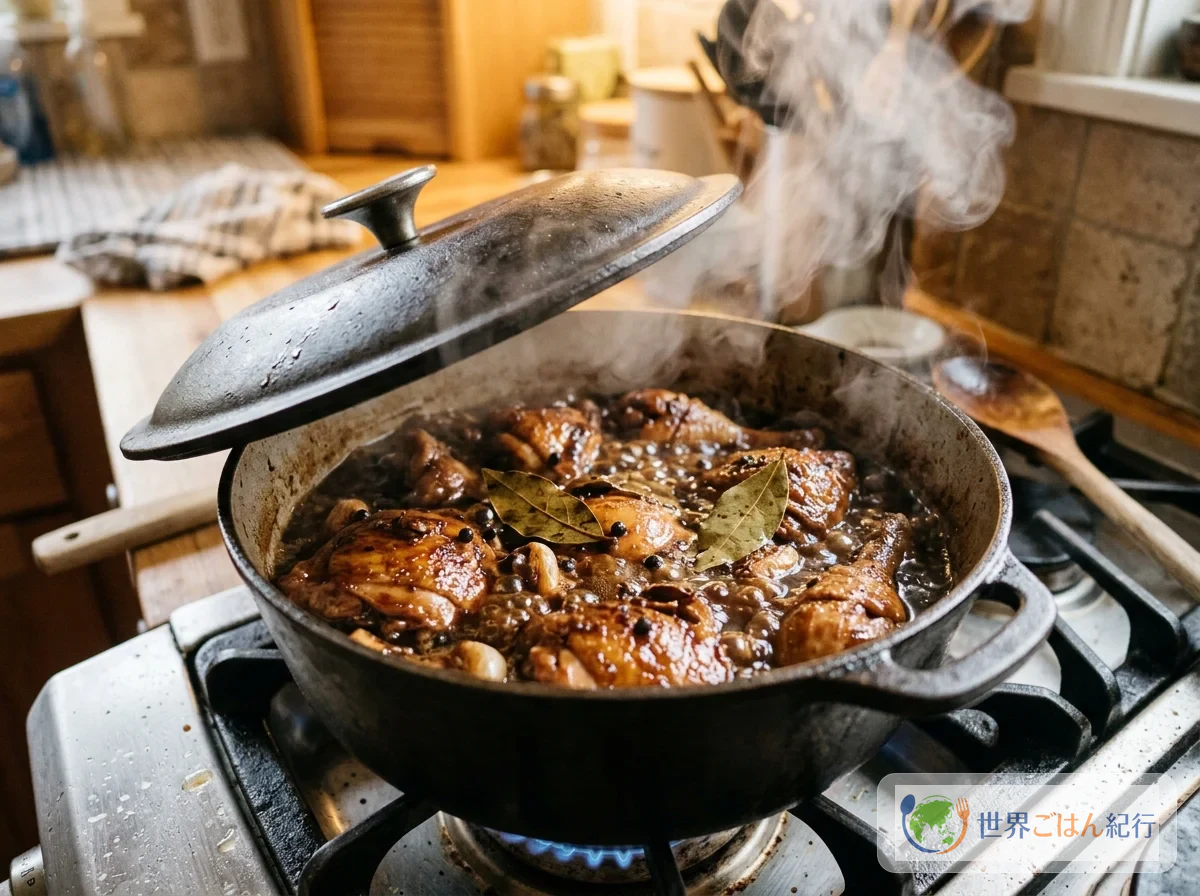

Lift the lid and the garlic reaches you before the vinegar does. The cloves have soaked up the dark braising liquid, and their smell rises with black pepper and rendered chicken fat, the vinegar's sharpness running underneath. Chicken adobo is one of the best-known dishes of the Philippines: chicken braised in vinegar, soy sauce, garlic and black pepper until it tastes sour, salty and rich all at once. The ingredient list is short. What makes it good is three moves at the stove: boiling the vinegar briefly before the lid goes on, keeping the simmer gentle, and deciding at the end how much sauce stays in the pot.
Adobo at the Filipino Table
Adobo is usually the main dish, set out with a pot of white rice and a small dish of vinegar or dipping sauce. The sauce decides how it is eaten. Some households leave plenty to spoon over the rice; others cook it down until it clings to the meat as a dark glaze. Both are adobo, and so is the pot with more or less meat in it. In the Philippines adobo is understood as a cooking technique rather than one fixed recipe: meat braised in vinegar with garlic and pepper, finished the way a family likes it.
Many pots, one method
The best-known versions use chicken or pork. Adobo puti ("white adobo") leaves out the soy sauce, so the meat stays pale. Adobo sa gata, from the Bicol region, adds coconut milk. There are versions with beef, and versions that bring in water spinach (kangkong) or banana blossom. Bay leaves, black pepper, soy sauce, vinegar, coconut milk and atsuete (annatto) all turn up, depending on the region.
| Style | What changes | Cooking it at home |
|---|---|---|
| Basic chicken or pork | Vinegar, garlic, black pepper and bay leaf, with the saltiness of toyo or soy sauce on top | Rice vinegar and regular soy sauce work; adjust the final reduction |
| Adobo puti | No soy sauce, so the meat finishes pale | Leave out the soy sauce and start with ½ tsp salt. Pale does not mean bland |
| Adobo sa gata | Coconut milk softens the sharp edges of vinegar and fat | Make the basic version first, then combine ½ cup (150 ml) of its liquid with ¾ cup (200 ml) coconut milk |
| With vegetables | Water spinach or banana blossom cooked with the meat | Add water spinach only for the last 3 minutes so the leaves keep their bite |

Adobo goes to the table with rice and a sour condiment.
Where the name comes from is not settled; it is often linked to a foreign word, though the word alone does not explain a dish built on vinegar and garlic. In 2021, work began on a Philippine national standard for adobo. It set down the basic cooking technique and kept room for the regional differences, from bay leaves and pepper to coconut milk and atsuete.
Adobo and its neighbours
Adobo puts its sourness into the meat. Sinigang puts it into the broth. Humba braises pork in vinegar and soy sauce all the way down to a sticky glaze, and next to it you can see why adobo usually keeps some liquid for the rice. Follow the coconut milk and add chilies and you arrive at Bicol Express. Vinegar and fermented seasonings meet vegetables in pinakbet and laing, beans take the lead in monggo, and embutido binds pork with vegetables and egg into a baked roll instead of braising it. More dishes are on the Philippines country page.
Ingredients (serves 4)
Most soy sauces, Filipino toyo included, are made with soybeans and wheat. Read the label each time you change brands. For a wheat-free pot, use a wheat-free tamari; it can be saltier and darker, so start with 3½ tbsp (50 ml) and add more only after tasting the liquid.
Equipment
- Heavy pot with a lid
- Small bowl
- Paper towels
- Knife and cutting board, kept for raw meat
- Spatula
- Instant-read thermometer, or a bamboo skewer
- Shallow container for leftovers
Choosing Vinegar, Soy Sauce and Coconut Milk
Vinegar. Filipino cane vinegar is often rounder in aroma than rice vinegar, and it keeps the vinegar's own smell clear in the finished sauce. Rice vinegar is milder and makes a very good first pot. Distilled grain vinegar tastes sharper; if that is what you have, add an extra 1½ tbsp (20 ml) water and taste for sourness after reducing.
Soy sauce. Filipino toyo is also one of the sauces mixed at the table with vinegar, calamansi and garlic, and some brands are darker and saltier than Japanese-style soy sauce. With any regular dark soy sauce, start with 3½ tbsp (50 ml) in the braising liquid and keep the last 2 tsp (10 ml) back until you have tasted it.
Coconut milk. Buy it only when you want to try adobo sa gata. Look for a 1¾-cup (400 ml) can of cooking coconut milk whose ingredients are coconut milk, water and citric acid.
Pepper and sugar. Whole peppercorns release their aroma slowly, so crush them coarsely under a knife or in a mortar. Sugar is not part of the basic adobo; if you want a little sweetness, stir in 1 tsp just before you finish, which softens the edge and keeps the vinegar's aroma.
In your first adobo, the heat changes the result far more than the brand of vinegar does. Make it with rice vinegar, learn the cues, then buy cane vinegar or coconut milk for the next batch and change only that one thing.
Method
The work runs in one pot. About 15 minutes go into drying the chicken, mixing the liquid and browning the skin. Then comes half an hour of quiet simmering under the lid, when you only need to turn the chicken once. The last few minutes, with the lid off, decide how the dish ends up.
The chicken does not need to marinate. If you want to, seal it in the braising liquid and refrigerate for 30 minutes to 8 hours; never leave it out at room temperature.
Taste the liquid as soon as you take the lid off, not after a long reduction. Adjusting is easy at that point; once the sauce is concentrated and the meat has dried, it is not.
When It Goes Wrong
| What you see | Why | What to do |
|---|---|---|
| The sauce tastes too salty | Strong soy sauce, or it reduced too far | Take the chicken out, add 3½ tbsp (50 ml) water and simmer 2 minutes |
| The sourness is sharp | A sharp vinegar, such as distilled grain vinegar | Add 1 tsp sugar and 2 tbsp water and simmer just 1–2 minutes |
| The meat is dry | It stayed in the pot through a long reduction | Next time take the chicken out and reduce the sauce on its own |
| The sauce is cloudy | The skin was blackened over high heat | Brown over medium heat and lower it as soon as the skin darkens too fast |
| The pieces break apart | They were stirred or cut smaller while the sauce was adjusted | Keep the pieces at about 2 inches (4–5 cm) and turn them gently |
Serving, Variations and Storage
At the table
White rice sits at the center, because it soaks up both the sourness and the salt. Next to it, choose something fresh and watery, such as leafy greens or cucumber, or a lighter dish like tortang talong, or a soup such as chicken tinola or sinigang. On an adobo day, skip a second rich meat: grilled chicken inasal, longganisa and dinuguan all compete with it, and a whole spread of fried lumpia Shanghai, pancit bihon and pancit canton piles strong flavor on strong flavor. If you want the punch of pork fat and garlic, a small plate of sisig is enough.
Variations
- Adobo puti. Braise with vinegar, garlic, black pepper and bay leaves only. Without soy sauce to give the sauce its shape, do not reduce it hard; keep the vinegar's aroma and the chicken fat, and salt it at the end.
- Adobo sa gata. Make the basic adobo, then combine its liquid with coconut milk in a separate pot, return the chicken and simmer over low heat for 8–10 minutes. The coconut softens the vinegar and the fat. Adding the whole 1¾-cup (400 ml) can at the start makes the sourness hard to judge.
- Pork. Cut 1.5 lb (700 g) pork shoulder into 2-inch (5 cm) cubes and braise 10–15 minutes longer than chicken, skimming off some of the fat that rises at the end. For more pork braises, look at pochero and lechon.
- Beef, offal and vegetables. Beef takes longer for the liquid to reach the meat and does not fit this 60-minute pot; kare-kare and bulalo show beef with broth. Offal is cooked another way entirely, as in bopis, so the chicken amounts and times do not carry over. Water spinach goes in only for the last 3 minutes; braised from the start, the leaves fall apart and lose their color and bite.

Storing leftovers
Adobo often tastes better the next day, but the vinegar does not make it safe at room temperature. Move leftovers into a shallow container rather than leaving them to cool in the pot, and refrigerate within 2 hours of cooking. Eat them within 3–4 days, reheating only what you will eat until it is hot all the way through. Cold sauce sets with white fat and tastes saltier; warm it slowly over low heat and the fat melts and the vinegar's aroma comes back. If it has thickened overnight, add 1–2 tablespoons of water before warming. Leftover chicken shredded into arroz caldo, a soft rice porridge, or into the soup sopas carries adobo's richness along; save a little sauce with it.

Do not wash raw chicken: the splashes spread bacteria around the sink and counter. Pat it dry instead. Use a separate cutting board and knife for raw meat and for food eaten as it is, and wash your hands with soap before and after handling it. Cook the chicken until the thickest part reaches 165°F (74°C).
Frequently asked questions
Can I make it with chicken breast?
Yes, with a shorter braise. Use 1.5 lb (600–700 g) and check the internal temperature after 18–22 minutes over low heat. Keep the reduction short as well, or lift the meat out and reduce the sauce on its own so the breast stays moist.
Can I use boneless thighs?
Yes. Use 1.5 lb (700 g) and shorten the braising time, since there is no bone to cook through. Start checking the temperature early and stop as soon as the thickest piece is done.
Is adobo spicy?
The basic version has no chili. For heat, add one red chili to the braising liquid, and the same goes for adobo sa gata. Anyone who wants more can add it at the table.