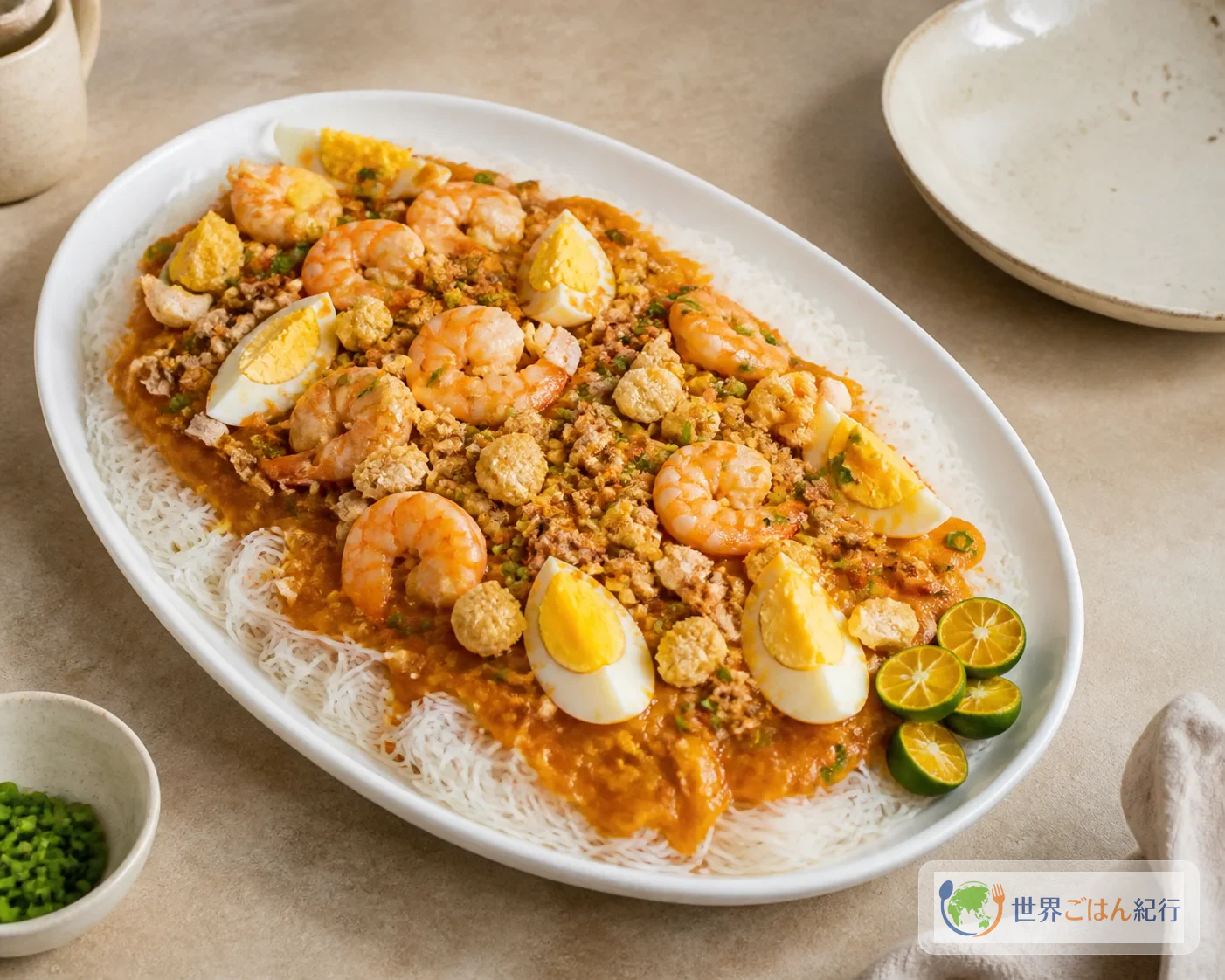
White rice noodles go into the brown broth left in the bottom of the pan. At first they look almost flimsy, but each time you lift them with chopsticks or tongs they darken a little more and start to bind the shrimp, chicken and cabbage together. Squeeze a small calamansi over at the end and the soy sauce suddenly tastes lighter. Pancit bihon guisado is a Filipino noodle dish, and that change in the pan is the reason to make it. It's built on the body of chicken broth, a faint fermented note from fish sauce and fresh citrus at the end.
About Pancit Bihon
Pancit comes in many forms. There's canton made with wheat noodles, sotanghon with glass noodles, palabok topped with a shrimp sauce, and more. Bihon is the one made with thin rice noodles. It's served at birthdays, where the long noodles stand for a wish for long life. It's also an easygoing everyday dish that turns up on a big platter at a weekday lunch or a family gathering, and the mix of meat, shrimp and vegetables changes from household to household.

The long noodles are usually served uncut because of what they mean at birthdays. If there are small children at the table, though, it's fine to cut them so they're easier to eat. The table's comfort comes before the symbolism.
From Chinese noodles to a Filipino platter
The word pancit comes from a Hokkien term meaning something conveniently or quickly cooked. Noodle dishes of Chinese origin grew to suit Filipino tastes and branched into many kinds, bihon, canton and sotanghon among them. Pancit bihon as it's made today is its own dish. Fish sauce, soy sauce, calamansi, cabbage and shrimp layered onto thin rice noodles give it a lightness quite unlike Chinese-style fried noodles.

You can see the mix of outside influence and local life in the way it's eaten, too. The noodles are piled on a big platter, everyone serves themselves, and each person squeezes citrus over their own plate. Because the meat and vegetables change from home to home, it never feels stiff, even as a celebration dish.
Bihon and canton
With wheat noodles, pancit canton is all about chew and that fried-noodle character. Bihon is about the lightness of thin noodles that have soaked up broth. Some households mix the two, but if you stick to one kind the first time, you'll learn faster how to judge the moisture.
Ingredients (serves 4)

This serves 4. It's just right as a main dish; for a birthday or potluck, set it beside fried chicken or lumpiang shanghai and it will stretch to about 6 people. Check the package: if the stated cooking time for your noodles is very short, cut the time they spend in the broth in step 1 by 30 seconds.
This dish contains shrimp, chicken, soy and fish. Store-bought fish sauce, chicken broth and rice noodles vary in ingredients from product to product, so check the labels if you have allergies. Pat thawed frozen shrimp dry; if they smell strong, toss with 1 tsp sake, leave for 5 minutes, and pat dry again. Leftover moisture steams the pan before anything gets a chance to sear.
What you can swap locally, and what to look for if you want to go further
Rice noodles, chicken, vegetables, soy sauce and lemons are easy to find. Not forcing in more specialty ingredients is what makes the first batch go well. The only reasons to visit an international grocer or shop online are wanting to try Filipino fish sauce, or wanting the soft orange color annatto brings.
You don't need patis just to add salt. Make the dish once with Thai fish sauce or soy sauce, and pick up patis if you find yourself wanting to cook more Filipino food. When buying, make sure it really is fish sauce and not a soy-based seasoning.
Annatto seeds tint food without asserting themselves the way paprika does. Warm 1 tsp seeds in 1 tbsp oil over low heat for 1 minute; once the oil turns reddish brown, remove the seeds and sauté the garlic in that oil. The dish works without it. There's no need to buy a big bag just for pancit; it makes sense if you also plan to make arroz caldo or kutsinta. If you only want the color once, use turmeric instead.
Choosing Ingredients for Pancit Bihon
For a first try, ordinary thin dried rice vermicelli from the supermarket and a lemon are plenty. If you can get to a Filipino or Asian grocer, or shop online, look for patis and annatto seeds. Patis brings a fermented aroma along with its saltiness, and annatto adds a soft orange color more than flavor. You can make the dish without either, so let how close to the original you want to get decide what you buy.
These amounts assume dried rice vermicelli about 0 inch (1 mm) thick. Wide pho noodles, mung bean glass noodles and steamed yakisoba noodles won't turn out right with the same amounts and times. Look for thin dried noodles labeled rice, bihon or rice vermicelli.
Getting the Moisture Right
Unfamiliar ingredients aren't the hard part. Moisture is. Stir-fry the noodles dry over high heat like Taiwanese-style fried rice noodles, and the surface dries out while the core stays hard. Boil them to doneness in a big pot of water, and they can't take in the broth you add later, so they break into short pieces as soon as you dig in. Think of it less as rehydrating the noodles and more as letting them absorb the broth little by little, and things stay under control.
You can tell it worked by the noodles on your chopsticks, not by their color, since this isn't a dish you brown. Lift about 10 strands. If the bundle slowly separates and has a slight springiness, you're there. A puddle in the bottom of the pan means the flavor hasn't gone in yet, and noodles stuck in one clump mean they've absorbed too much liquid.
Clumped noodles can be saved. Add 2 tbsp hot water and 1 tsp lemon juice around the edge of the pan and loosen with tongs over low heat for about 30 seconds, and they'll be easy to eat again. If clumps remain, add a few more vegetables to give the moisture somewhere to go. That holds the dish together better than thinning it with water alone.
If it tastes too strong, water alone dilutes the chicken broth and fish sauce too. It's easier to soften 1 oz (30 g) more noodles separately and mix them in. If it's too sour, add 1/4 tsp sugar and a handful more cabbage and stir-fry for 30 seconds. If it needs salt, add patis 1/4 tsp at a time; fish sauce is strong, and a full tablespoon at once is too much.
Stir-fry just the toppings in a frying pan about 12 inches (30 cm) across, let the noodles absorb the broth in a pot, then combine them half at a time at the end. Compared with cramming everything into a small pan, the noodles won't break and the vegetables won't steam.
Serving and Variations
Set the citrus on the side so everyone can season their own plate. If people at the table like different levels of heat, leave the chile out of the pan and put sliced red chiles or sambal in a small dish. A platter that's spicy all the way through makes the calamansi aroma harder to notice.
To go with the platter, pancit canton is another celebration noodle with a distinctly different texture. On days when you want a meat main alongside, adobo, braised in soy sauce and vinegar, or the sour soup sinigang carries the fish sauce and citrus notes into the rest of the meal.
Chicken only
On a day without shrimp, increase the chicken thighs to 12.5 oz (350 g). You lose the shrimp aroma, but the noodles still go into the pan where the chicken cooked, so the broth keeps its character. On a weeknight, this is more practical than buying frozen shrimp.
Tofu and mushrooms

Use 10.5 oz (300 g) drained firm tofu and 5.5 oz (150 g) shimeji mushrooms in place of the shrimp and chicken. Cut the tofu into 1 inch (2 cm) cubes, sear the surfaces first and set aside. If you're skipping fish sauce, add 1 more tsp soy sauce and replace ½ cup (100 ml) of the chicken broth with dried shiitake soaking liquid so the flavor stays full.
Bean sprouts
For a lighter platter, reduce the cabbage to 3.5 oz (100 g) and add 5.5 oz (150 g) bean sprouts in step 5. Mix them in for only 30 seconds after turning off the heat so they don't release much water. If you plan to keep leftovers for the next day, the texture holds up better without sprouts.
Nutrition estimate
Per serving, it comes to roughly 510 kcal, 27 g protein, 14 g fat and 2.25 oz (66 g) carbohydrates. Those numbers change if you add more shrimp, remove the chicken skin or cut the oil to 1 tbsp. Fish sauce, soy sauce and chicken broth all bring sodium, so on days when you're watching it, cut the fish sauce to 1 tsp and use a bit more lemon.
FAQ
Can I soak the noodles in water first?
Yes, but noodles softened in water should not go into the broth in step 1. Soak them in lukewarm water for 5 minutes, drain while the centers are still firm, and start step 4 with ¾ cup (200 ml) broth. If they've gone completely soft, halve the broth you add to the pan.
What's closest if I can't find calamansi?
Sudachi for aroma, lemon for easy-to-handle acidity, and lime if you want a greener scent. None of them tastes quite the same. Squeeze it just before eating rather than simmering it in the pan, and the dish keeps its lightness.
Can I use patis and Thai fish sauce interchangeably?
At the 2 tsp used here, yes. Patis leans the dish more Filipino, while Thai fish sauce gives a slightly different aroma. Both are very salty, so taste first and add 1/4 tsp at a time before reaching for more soy sauce.

How long does it keep?
Let it cool, divide it into shallow containers and refrigerate within about 2 hours of cooking, then finish it by the next day. To reheat, sprinkle with 1 tbsp water, cover loosely and microwave, stirring partway, until it's hot all the way through. Don't leave it out at room temperature for long, since it contains meat, shrimp and cooked noodles. Discard cooked leftovers with meat or seafood that have been above 4°C (40°F) for more than 2 hours.