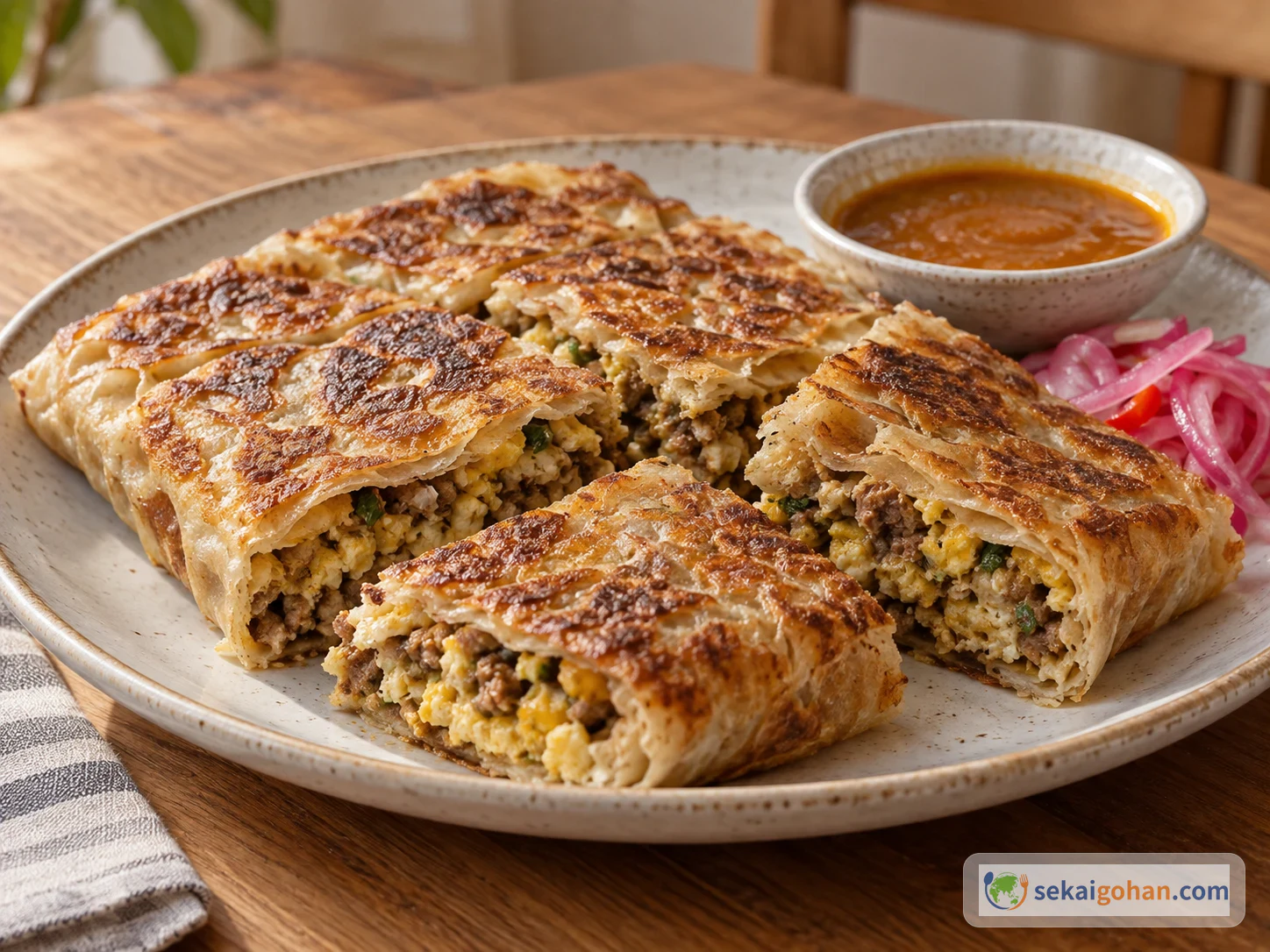
Scorch an eggplant's skin on a quiet morning and the smell is nothing like ordinary grilled eggplant. It is slightly sweet and slightly smoky, and you want a bowl of white rice before you've even peeled it. Coat it in beaten egg and lay it in a pan, and the soft flesh puffs up inside the egg while the edges set thin and crisp. This is tortang talong, the Filipino charred eggplant omelet. Talong means eggplant, and a torta is a flat dish held together with egg. At home it is often eaten at breakfast or lunch with rice, and with banana ketchup, a vinegar-soy dip, calamansi and tomato it becomes a full meal on one plate.
Tortang talong at the Filipino table
Tortang talong is an unpretentious dish you'll find in Filipino eateries and homes. It is roasted eggplant dipped in egg and fried, but it eats nothing like an ordinary omelet, tempura or grilled eggplant. The flesh stays soft and creamy, and the egg sets into a thin, fragrant coating.
The heart of the dish is the charring. Roast the eggplant over an open flame, on a grill or under a broiler until the skin is black, then peel it. You can make it with boiled eggplant, but without the smoky aroma it drifts toward a plain soft-eggplant omelet.
Eggplant is full of water. Charring it first drives off moisture, sweetens the flesh and keeps the egg from turning soggy. Besides adding aroma, it is the step that makes the eggplant easy to wrap in egg.
Every region and family has its own version. Some cooks stir-fry ground meat, onion and tomato and spoon it on top, in the relleno style. On other days it is just eggplant and egg, cooked lightly.
If adobo and sinigang are the doorway to Filipino sourness and braising, tortang talong is the doorway to the family breakfast. It is no celebration platter like pancit canton. Still, it shows what Filipino home cooking does best: one eggplant wrapped in egg becomes a main dish that makes the rice disappear.
In English the dish is usually called a Filipino eggplant omelette. You will also see "tortang talong" and "torta talong," and Japanese spellings such as "torutan taron" and "tōtan taron." "Tortang talong" is the form closest to the local name.
Ingredients (serves 4): the basic version with long eggplant and eggs
This serves 4, with one eggplant per person. The amount is meant as a main dish eaten with rice, not a small side. For breakfast serve it as is; for dinner it sits well next to Bicol Express or chicken inasal.
This dish contains eggs, and depending on the product, soy and fish or shellfish (fish sauce, soy sauce). If you avoid fish sauce, season with salt and a little soy sauce. Because it is an egg dish, do not leave it at room temperature for long once cooked, and refrigerate leftovers promptly.
A small dish with some sourness cuts the richness of egg and oil. Even without banana ketchup, a soy-vinegar dip or coconut vinegar will tighten up the meal.
Because you cook the eggplants one at a time, a 26 cm to 11 inches (28 cm) skillet that keeps the egg in shape is easier to handle than a very wide wok.
Choosing eggplant, sauce and substitutes
A long eggplant and eggs from an ordinary supermarket will take you most of the way to the Philippine version. What matters is charring the eggplant until it turns sweet, then eating it with something sour or sweet-and-sour.

In the Philippines the eggplant is usually the long, slender purple kind. Long Asian eggplants come very close, and they're easier to work with than round, fat ones. If you use a round eggplant, cut it in half lengthwise before cooking, or it will be too thick for the egg to set evenly.
| What you are deciding | Closer to local | Realistic at home | Verdict |
|---|---|---|---|
| Eggplant | Slender talong | Long or medium-long eggplant | Easier to handle than round ones |
| Charring | Charcoal, open flame | Gas flame, broiler, toaster oven | An open flame gives the most aroma. A broiler is plenty |
| Egg mixture | Eggs, salt, fish sauce | Eggs, salt, Thai fish sauce | Use fish sauce sparingly |
| Sauce | Banana ketchup | Ketchup plus vinegar, soy-vinegar | Serve something sweet or something sour |
| Menu | Rice, tomato, vinegar | Ordinary rice, cucumber, lemon | Easy to fit into a breakfast too |

Banana ketchup is the sweet red sauce you often see on Filipino tables. If you can't find it, mix 3 tbsp regular ketchup, 1 tsp vinegar and a pinch of sugar for something a little closer. If you'd rather skip the sweetness, make a small dish of 3 tbsp vinegar, 2 tsp soy sauce, 1 tbsp chopped onion and a little chili.
Method: char over a flame, then coat in a thin layer of egg
Separate the charring from the egg frying. If you rush the eggplant into the egg while it is still hot, the heat sets the egg in patches. Peeling it, letting it cool a little and shaping it first is the more reliable way.
Stir-fry 4 oz (120 g) ground pork, 1.75 oz (50 g) onion and 1.75 oz (50 g) tomato over medium heat for 5 minutes, season with a little salt, and mix into the egg. The meat version is more filling, but it makes the egg mixture heavier, so use about 2 tbsp of filling per eggplant at most.
Common tortang talong mistakes and fixes

Almost every failure comes down to water or heat. With so few ingredients, a watery eggplant, a thick egg mixture or a cold pan shows right away. Keep the egg thin so the shape of the eggplant shows through, cook over medium heat, and once the edge of the egg begins to set, stop poking at it.
| Problem | Cause | Fix |
|---|---|---|
| Egg peels away | The eggplant surface is wet, or the pan is cold | Dry it after peeling, and heat the oil over medium heat before cooking |
| Eggplant is firm | Undercharred | Char until the flesh bends, not just the skin. Add 3 minutes under the broiler |
| Watery | Water not removed after charring | Press lightly with paper towels after peeling |
| Burns | Heat too high, too little oil | Lower to medium heat and add 1 tsp oil |
| Egg is thick and heavy | Too much egg mixture | Aim for a little less than 1 egg per eggplant |
| Bland | Too little fish sauce or salt | Add soy-vinegar, ketchup or lemon at the table |
A strong broiler can blacken the surface while the inside stays firm. Before you peel, press the eggplant with chopsticks: it should bend limply, and the flesh under the skin should look moist and translucent.
Leave out the milk. Tortang talong is charred eggplant held together with a thin coat of egg, not a thick, fluffy omelet. A loose mixture runs off around the eggplant first, and the look and texture fall apart. Egg that's too thin looks poor too, so after you lay the coated eggplant in the pan, spoon just 1 tbsp of the leftover egg over the top. That holds the shape while the edge browns.
Cook egg dishes to an internal temperature of 71°C (160°F). When serving to small children, older adults or pregnant people, don't leave it soft: serve it with the egg set all the way through.
Serving and storing tortang talong
Serving
For breakfast, leave the onion and garlic out of the egg and keep it light. For dinner, make the ground-meat version and set it next to kare-kare or sinigang. It fills the gap between the meat dish and the vegetable dish.
Storage and reheating
It is best fresh, but leftovers keep. Once they've cooled, wrap each one in plastic wrap or lay them in a shallow airtight container and refrigerate. Eat them by the next day, and within 2 days at most. Because this is an egg dish, don't leave it at room temperature for long.

A skillet reheats better than a microwave. Warm it without oil over low heat for 1 1/2 minutes per side, and if the surface dries out, drip 1 tsp water against the side of the pan and cover for just 20 seconds. In a microwave, heat at 600 W for 40 to 60 seconds under loosely laid plastic wrap.
For a lunch box, reheat it right through to the center in the morning, then let it cool before packing. Avoid packing it in summer, or add an ice pack. Pack the ketchup and vinegar sauce in a separate container so the egg doesn't turn watery.
Leftovers cut small and laid over rice with a little soy-vinegar make an easy lunch. In a sandwich, ketchup with a little vinegar suits the sweetness of the eggplant better than mayonnaise does.
Frequently asked questions
Q1. Can I make it without an open flame?
Yes. Cook on a broiler over medium heat, 5 minutes per side, or in a toaster oven at 450°F (230°C) for 12 to 15 minutes. The aroma is milder than over a flame, but it is enough as long as the skin is black and the flesh is soft.
Q2. Do I have to peel off all the skin?
Peel off the thick burnt skin. A few small black flecks add fragrance, but a lot of burnt skin turns bitter and makes the egg harder to coat.
Q3. I don't like fish sauce. Can I make it without?
Yes. Substitute 1/2 tsp salt and 1 tsp soy sauce. That said, just 1 tsp of fish sauce makes an egg dish suddenly suit rice, so if you're wary, try half the amount.
Q4. When do I add the ground meat?
Stir-fry the ground pork, onion and tomato over medium heat first, let it cool a little, then mix it into the egg. If you mix raw ground meat into the egg, the egg sets first and it's hard to tell whether the meat is cooked.
Q5. Can I boil the eggplant instead?
You'll get the shape, but the aroma is weaker. If you truly can't use a flame or a broiler, steam the eggplant, peel it, brown the surface lightly in a skillet to cook off water, and then dip it in the egg mixture.
Q6. What do I serve with it to make it feel Filipino?
It goes well with sour sinigang, soy-and-vinegar adobo and the celebration noodles pancit canton. For breakfast, garlic rice, tomato and a small dish of vinegar are enough.