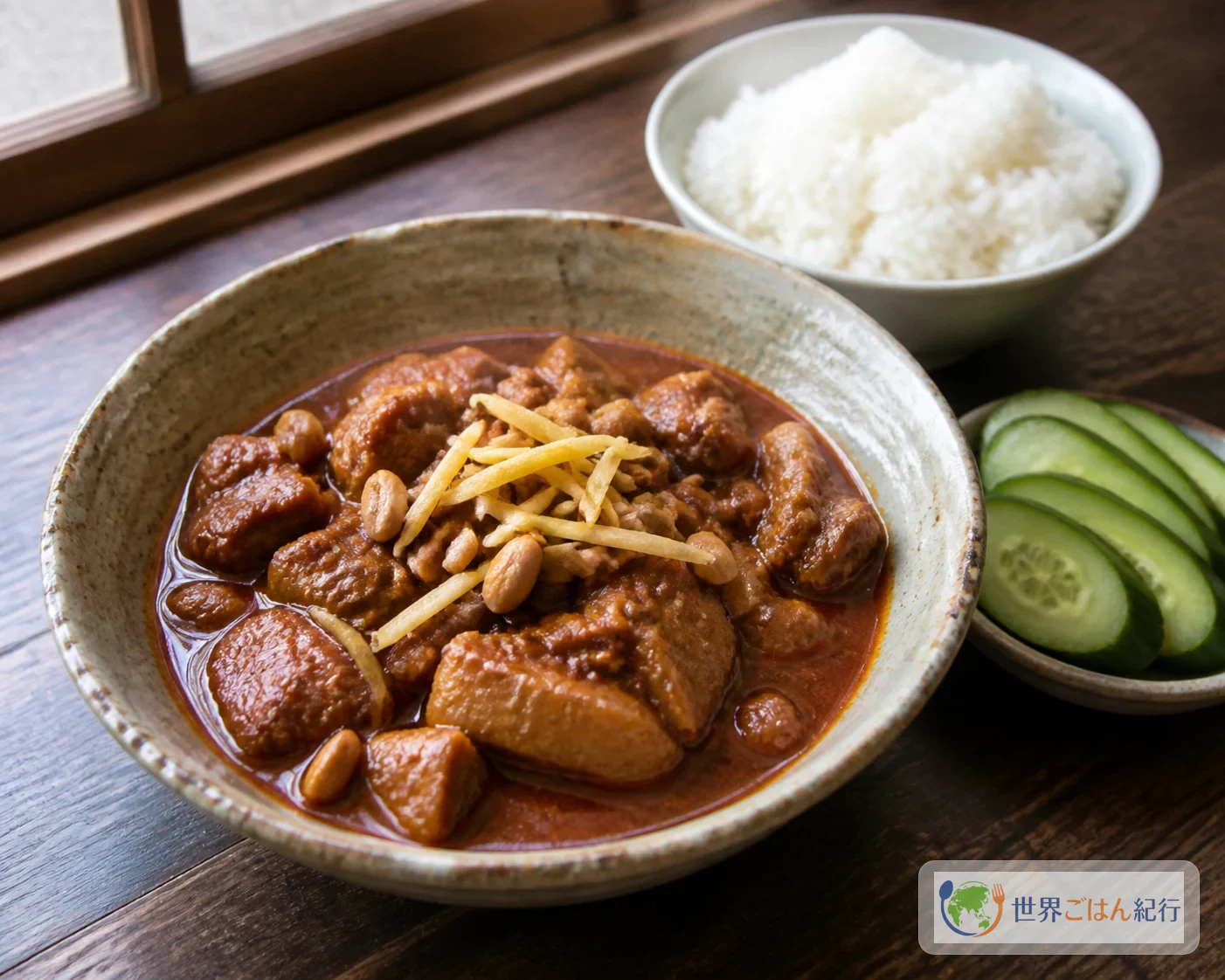
When the pork simmers in vinegar, the steam stings your nose. Then the blood goes in, poured in a thin stream, and the brown broth turns heavy and deep chocolate in color. Plenty of people are put off by how dark it looks, but take one bite and the sourness comes first, with the richness of the blood close behind. This Filipino pork stew, simmered with pork blood, vinegar, garlic and chilies, is a stew whose tang keeps you reaching for rice.
Dinuguan in the Philippines
Dinuguan is a dark Filipino stew of pork, and sometimes offal, simmered with pork blood, vinegar, garlic and chilies. The name comes from words related to dugo, "blood," and in English it is sometimes called "chocolate meat." It is eaten with white rice or puto, a steamed rice cake.
Using vinegar to make meat easy to eat puts it in the same family as adobo and sinigang. But because the blood itself becomes the sauce, it feels much heavier in the mouth, and the sourness stands up to that weight. Among other pork dishes, bopis is offal stir-braised in vinegar, and sisig turns chopped meat crisp and savory. Only dinuguan makes its sauce from blood.

The same blood stew goes by different names, and is made differently, across the regions of the Philippines.
- Ilocos: dinardaraan. Thicker and drier than elsewhere, with the richness of fat and a light sourness.
- Pampanga: tid-tad. Set blood is cut into cubes and added.
- Cebu: dugo-dugo; Waray: rugodugo. In Northern Mindanao it is called sampayna (champayna) and made with lemongrass.
- Bulacan and Nueva Ecija: tinumis. Tamarind is used instead of vinegar.
- Batangas: sinugaok. Made with good-quality pork only, no offal.
- Mariana Islands: brought by Filipino migrants and called fritada.
The saucy version here is the easiest to make outside the Philippines: the blood is loosened with some of the cooking liquid, strained, and thickened over low heat.
Whole-pig cooking and vinegar
The blood stew grew out of using an entire pig, with nothing wasted. Once called daguit in Tagalog, it became an everyday dish that puts even the blood to use. It is often linked to influences from Spain and Mexico, though the exact route isn't known, and it has relatives in Polish czernina and in the black soup of pork, vinegar and blood from ancient Sparta.
The vinegar tames any gaminess in the meat and mellows the blood. Because vinegar cuts the iron taste of the blood, even this dark, heavy sauce finishes surprisingly light.
Ingredients (serves 4)
This serves 4. Use a mix of pork shoulder and pork belly. Shoulder alone tastes a little thin, while belly alone is too fatty. Mixing shoulder and belly gives you a good balance of tenderness and richness. Liver has a strong flavor, so don't overdo it. Keep the pork blood frozen until the end, and take it out only after everything else is ready.

Choosing ingredients for dinuguan
Pork blood and food safety
Pork blood is the one ingredient you can't replace. In the Philippines it's sold by weight at the meat counter of the morning market, but elsewhere you'll rarely see it in an ordinary supermarket. Try a butcher, an Asian grocery, or a shop that sells frozen food-grade pork blood. Use only food-grade pork blood. Liver and black pudding won't stand in for it; on days you can't get it, adobo is the better choice.
If the bag is torn when you thaw it, or the blood smells strongly off or looks foamy, don't use it. Never leave it at room temperature, and use whatever you thaw the same day.
Pork and liver also need to be cooked through. In Japan, serving raw pork and pork offal has been prohibited since June 12, 2015. Cook pork and liver to a core temperature of 63°C (145°F) for at least 30 minutes, or 75°C (167°F) for at least 1 minute. With this recipe, the core of the meat comfortably passes 75°C while it simmers.
Allergens: pork, pork blood, fish sauce and soy sauce. Some soy sauces contain soy and wheat.
Cook pork and liver until the color has changed all the way to the center, aiming for a core temperature of 75°C (167°F) for at least 1 minute. After the blood goes in, never turn the heat up high; keep it at a gentle, low simmer. Store it only from the day it is cooked until the next day.
Vinegar, fish sauce and a thermometer

Pork shoulder and pork belly are easy to find anywhere. The items worth seeking out are coconut vinegar for the sourness, patis for salt and savory depth, and a thermometer for checking doneness. Start your shopping with the vinegar and the fish sauce.
Coconut vinegar is rounder in acidity than rice vinegar and adds a fermented note. As a substitute, combine ¼ cup (60 ml) rice vinegar with 2 tbsp (30 ml) black rice vinegar. If you plan to keep cooking Filipino food, a bottle will also serve you for humba and bopis, and in kinilaw it's very nearly the star.
Patis is Filipino fish sauce; a little Thai fish sauce (nam pla) works if you don't have it. Leave out the fish sauce and the savory depth thins out, leaving only the vinegar and blood up front. Hold a little back for the finish so you can match your household's taste for salt. A large bottle goes well beyond one batch, but it's handy in other Filipino dishes and as a background seasoning in stir-fries.
The thermometer earns its keep after the blood goes in, because once the sauce turns dark it's hard to judge doneness by eye. Seeing the center of the meat pass 75°C (167°F) lets you serve it with confidence, and you'll use the same tool for tinola and offal dishes. Without one, check that a bamboo skewer slides in easily and that the liver has changed color all the way to the center.
Instructions
The flavor of this dish is mostly settled by how you cook the vinegar and the pork. After adding the vinegar, don't stir right away: let it boil for 2 minutes over medium heat so the acidity rises. Boiling it without stirring softens its sharpness. And never boil the blood. Once it's in, move a wooden spatula across the bottom of the pot as if stroking it. Pour it in a little at a time and keep stirring; that is the basic rule. Remember: pour the blood in a thin stream over low heat.
Before the blood goes into the pot, loosen it with 100 ml of the cooking liquid and strain it. Once it's in, if the bubbles start to get large, turn off the heat and wait 30 seconds. Aim for a temperature of around 80–85°C (176–185°F).
Common dinuguan problems and fixes

After the blood goes in, it's tempting to turn up the heat, thinking more cooking must be safer. A hard boil at that point makes the sauce grainy, so get your safety from time and low heat instead. Not using high heat is what keeps it both smooth and safe.
| Problem | Cause | Fix |
|---|---|---|
| Grainy sauce | It boiled hard after the pork blood was added | Turn off the heat, add 2 tbsp water, stir with a wooden spatula and rewarm over low heat |
| Strong iron smell | Freshness of the blood, vinegar not boiled enough, or not simmered long enough | Use fresh, food-grade pork blood and boil the vinegar for 2 minutes over medium heat |
| Too sour | Water added right after the vinegar, or too much vinegar at the finish | Add 1/2 tsp cane sugar and 3.5 tbsp (50 ml) water and simmer for 5 minutes over low heat |
| Watery | Too much liquid before the blood went in | Before adding the blood, reduce over medium heat for 5 minutes until half the meat shows above the liquid |
| Heavy and greasy | Made with belly only, or the fat set as it cooled | Next time, mix in shoulder. Before reheating, lift off the solidified fat on top |
Serving and storing dinuguan
Serving

At home or at a celebration, dinuguan arrives in a big serving dish, the pot of dark sauce in the middle of the table flanked by steaming white rice or puto. It's tempting to drown your rice, but if you pour it over only half the rice, the plain white portion lets you control the sourness yourself.
Fluffy steamed puto has a gentle sweetness, and since the sweetness of puto softens the tang, alternating a spoonful of sauce with a bite of puto keeps you going. Soft steamed buns, rice-flour steamed cakes or soft white bread do much the same; see our puto article for more. On the side, try quick-pickled cucumber, a tomato and onion salad, or lightly stir-fried greens, and skip fried foods, which pile heaviness on heaviness.
Chicken inasal, tinola and lechon share the table well without fighting dinuguan's richness. Leave sinigang for another day, since the sourness would double up. And if you love sweet-savory beef stew with garlic rice, beef pares makes a good next dish.
Storage and reheating

When it's done, move it to a shallow container and cool it quickly rather than leaving it in the pot at room temperature. It keeps in the refrigerator until the next day. To reheat, add 2–3 tbsp water and warm it slowly over low heat, stirring the bottom of the pot, until it reaches a core temperature of 75°C (167°F) or higher.
To freeze, pack it flat in single portions and eat within 2 weeks. Thaw it overnight in the refrigerator; expect it to be a little grainy. If you use a microwave, stir once partway through, then finish it in a pot. It isn't a good packed-lunch dish, because of its color and aroma and the difficulty of keeping it at a safe temperature.
FAQ
If I can't get pork blood, can I use liver instead?
No. More liver just gives you a thick, iron-tasting stew rather than a sauce. On those days, switch to adobo.
What can I use if I don't have coconut vinegar?
Rice vinegar mixed with black rice vinegar works best. If you use only distilled grain vinegar, start with ¼ cup (80 ml) and add 1 tsp at a time at the finish, tasting as you go.
Is it inauthentic without offal?
Not at all. Some regional versions, like the sinugaok of Batangas, are made with good-quality meat only. Keep the liver to 2.75 oz (80 g) at most, or it starts to taste like a liver stew.
Can I make it without the heat?
Yes. Simmer just one whole green chili in the stew and skip the sliced chili at the finish, but keep the 1/2 tsp black pepper. Put a spicy vinegar on the table so everyone can add heat to taste.
My sauce isn't jet black. Did it fail?
No. Depending on the concentration of the blood, the vinegar and how it was cooked, the color ranges from near-black brown to deep chocolate. Check instead that the spatula trail holds for a moment and that the sauce isn't grainy. Don't add soy sauce to darken it.