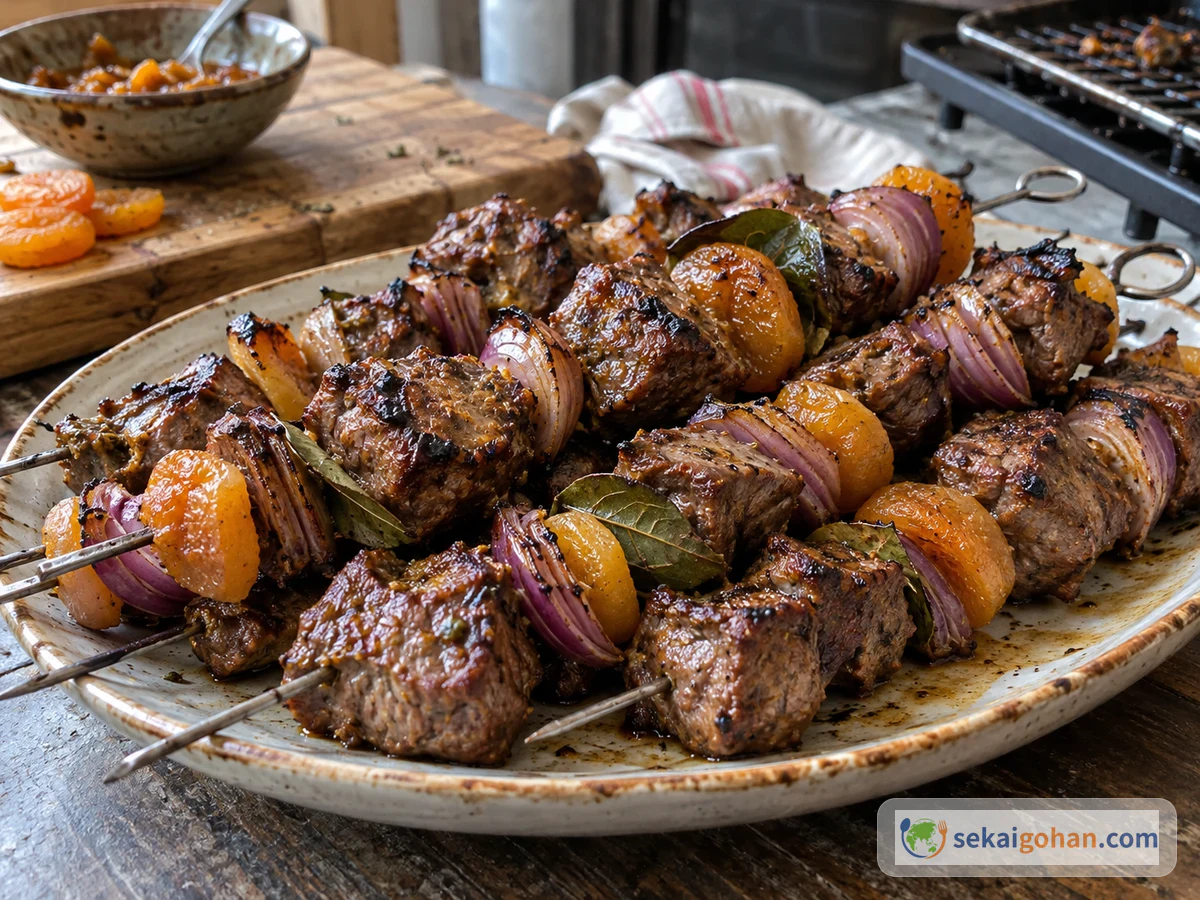
On Friday evenings in Bo-Kaap, the pastel-painted Cape Town neighborhood at the foot of Table Mountain, the sweet scent of curry powder and cinnamon drifts out of one home after another. Often it's bobotie in the oven. This is South Africa's national dish: ground meat spiced with curry powder and turmeric, studded with raisins, apricots and almonds, then baked under a golden egg custard with bay leaves on top. It looks like lasagna or meatloaf, but the first bite surprises you. The heat of the curry, the sweetness of the dried fruit and the mellow custard all melt together at once, sweet, spicy and gentle in the same mouthful.
Bobotie and the Cape Malays
Bobotie belongs to the culture of the Cape Malays, whose traditions are still very much alive in Bo-Kaap. In South Africa it's classically served with yellow turmeric rice and chutney, and today it's eaten by all of the country's peoples, from weeknight family dinners to festive tables.
A dish from a 350-year-old crossing
The story starts in 1652, when the Dutch East India Company set up a supply station at Cape Town. Over the following years, many people from Indonesia, Malaysia and India were brought to the Cape Colony as slaves or political prisoners. Together they came to be called the "Cape Malays."
They cooked with the techniques of their homelands on African soil: Indonesian spicing, Malaysian coconut milk, Indian curry. Blended with Dutch cooking and African ingredients, these became a hybrid cuisine with few equals in the world. Bobotie is its best-known dish. The name already appears in 17th-century cookbooks, which makes it one of the oldest documented dishes in South Africa.
From botok to bobotie
There are several theories about the name, but the leading one traces it to the Indonesian "botok," ground meat or fish paste mixed with spices, wrapped in banana leaves and steamed. The Cape Malays turned it into a Dutch-style oven bake and added the custard topping, giving the dish its present form. That makes it a distant relative of nasi goreng and nasi lemak.
During apartheid, bobotie was passed down quietly within the Cape Malay community. After democratization in 1994, it was embraced as a symbol of the "Rainbow Nation," South Africa as a multiethnic country.

Ingredients (serves 4)

Here is how to substitute if you cannot find mango chutney or dried apricots. In place of mango chutney, 2 tbsp apricot jam gets closest. Dried apricots can be replaced with dried persimmon or dried mango. Raisins alone still make a very good bobotie.
Choosing ingredients for bobotie
Nearly everything for bobotie is at an ordinary supermarket. Mixed ground beef and pork makes a good bobotie, although in South Africa ground beef is the most common, and lamb adds extra flavor.
| Ingredient | Where to buy | Notes |
|---|---|---|
| Ground meat | Anywhere | Mixed beef and pork is the easiest to get |
| Curry powder | Anywhere | A standard supermarket curry powder is the most reliable |
| Turmeric | Anywhere | The spice aisle |
| Raisins | Anywhere | The baking aisle |
| Almonds | Anywhere | Plain roasted almonds from the snack aisle |
| Dried apricots | Specialty grocers | Can be omitted |
| Mango chutney | Specialty grocers, online | Apricot jam can substitute |
| Bay leaves | Anywhere | Dried bay leaves in the spice aisle |
The easiest substitute is 2 tbsp apricot jam mixed with 1 tsp lemon juice. Apple jam works too.
Use lean ground meat (10% fat or less) and replace the milk in the custard with low-fat milk. Together these cut about 80 kcal.
Method (cooking time: about 70 minutes)
Step 1: Soak the bread in milk (5 min)
- Cut the crusts off 1 slice of bread and tear it into pieces about 1 inches (2 cm).
- Soak in ½ cup (100 ml) milk and leave for 5 minutes to soften. It is ready when the milk has soaked through to the center and the bread crumbles at once when pressed with a finger.
- Mash with a fork into a paste. Mix until no large white lumps remain.

This "milk-soaked bread" is the hidden star of bobotie. Mixed into the meat, it gives a moist texture and ties the meat to the custard.
Step 2: Fry the ground meat (15 min)
- Put 1 tbsp vegetable oil in a skillet and warm it for 1 minute over medium heat.
- Add the chopped onion and fry for 5 minutes over medium heat. When it turns translucent and the edges are lightly golden, move on.
- Add the garlic and fry for 1 minute over medium heat, until the pale look is gone and the aroma rises.
- Add 1 lb (500 g) ground meat and fry, breaking it up with a wooden spoon into pieces under 0.5 inches (1 cm).
- When the meat has changed color and the juices run clear, add 2 tbsp curry powder, 1 tsp turmeric and 1/2 tsp each of cumin and coriander.
- Fry for 2 minutes over medium-low heat, and when the spices have blended into the oil and the aroma rises, turn off the heat.
- With the heat off, let it cool for about 5 minutes.

In bobotie, you do not discard the fat that comes out of the ground meat. The flavor of the spices has dissolved into this fat. Moving it into the baking dish along with the fat gives a rich finish. If you want a lighter dish, choose a leaner ground meat.
Step 3: Finish the meat base (5 min)
- Add the milk-soaked bread (as a paste) to the slightly cooled meat and mix well.
- Add 1 beaten egg and work it in until the whole mixture is moist and holds together.
- Add 2 tbsp chutney, 1 tbsp Worcestershire sauce and 1 tbsp lemon juice.
- Add 3 tbsp raisins, dried apricots chopped to about 0.25 inch (5 mm) and the almonds.
- Adjust with 1 tsp salt and black pepper.

This is where bobotie's flavor is put together. Spicy meat with the sweetness of dried fruit, the tang of chutney and the crunch of nuts. All of it comes together as one.
Step 4: Make the custard and bake (45 min)
- Preheat the oven to 350°F (180°C) for 10 minutes.
- Lightly oil a baking dish (about 8 inches x 11 inches (20 cm x 28 cm)).
- Pack the meat base flat into the dish and level the surface with a spoon.
- In another bowl, whisk 2 eggs, ½ cup (150 ml) milk and a pinch of salt well with a whisk. It is enough when no streaks of egg white are visible.
- Pour the custard gently over the meat.
- Lay 3–4 bay leaves on the surface as decoration.
- Bake in a 350°F (180°C) oven for 40–45 minutes.
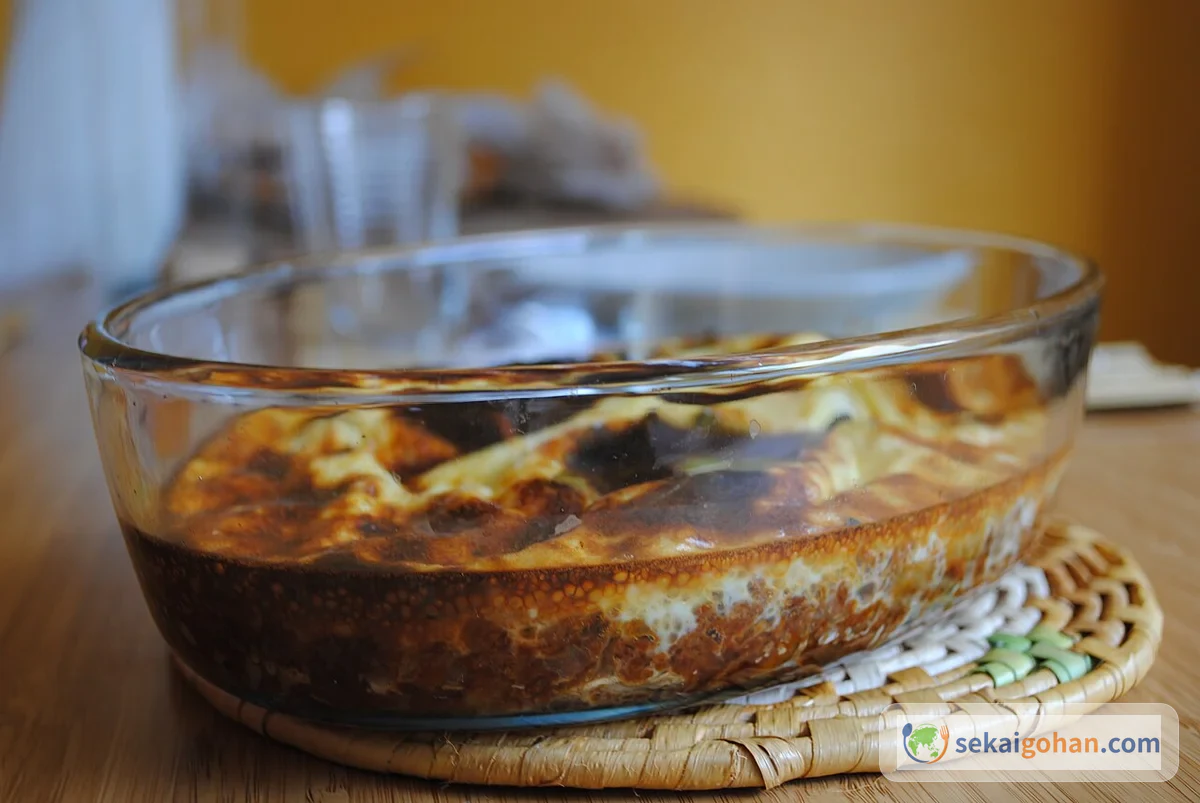
- It is done when the custard has set, the surface is golden, and no liquid runs when you lightly shake the center.

Pour the custard gently and slowly. If you pour it in forcefully, it mixes with the meat and you do not get a clean two layers. Pouring it against the back of a spoon spreads it evenly over the meat.
Step 5: Serving and eating (10 min)
- Take it out of the oven, check that the custard has set and the surface is golden, then let it rest for 5 minutes until the jiggle settles.
- With a large spoon, portion it into pieces about 6–8 cm square and 1.5 inches (4 cm) thick, taking care not to break up the custard layer too much.
- Heap turmeric rice at the back of the plate, set the bobotie in front, and add about 2 tsp chutney at the right edge. Placing the golden custard face up shows the layers neatly.

Common bobotie mistakes and fixes
If the custard won't set, check the oven temperature and the baking time first: it needs 350°F (180°C) for 40 minutes or more. Then check the ratio of ½ cup (150 ml) milk to 2 eggs, because too much milk makes it harder to set. Pour the custard on slowly, too.
The other easy mistake is leaving out the dried fruit. Its sweetness is what makes the flavor work, so don't skip it.
Serving bobotie
Turmeric rice
In South Africa, bobotie comes with yellow turmeric rice (geelrys), and it's surprisingly easy to make.
| Ingredient | Amount | Notes |
|---|---|---|
| Rice | 2 rice-cooker cups (300 g) | Short-grain rice is fine; long-grain works too |
| Turmeric | 1/2 tsp | For yellow color |
| Butter | 10 g | For flavor |
| Raisins | 1 tbsp | A sweet accent. Can be omitted |
| Cinnamon stick | 1 | For aroma. Ground cinnamon also works |
| Salt | a pinch | — |
- Rinse the rice and soak it for 30 minutes as usual.
- Put the rice, water (the usual amount), turmeric, butter, cinnamon stick, raisins and salt in the rice cooker.
- Cook in the standard mode.
- When done, remove the cinnamon stick and fluff gently without crushing the grains.
You get bright yellow rice with a sweet aroma. It goes with biryani and nasi goreng as well as bobotie.
Side dishes and menus
| Side dish | Description |
|---|---|
| Turmeric rice | Essential. See the recipe above |
| Chutney | Mango chutney is the standard. The fruity sweet-sour note suits it |
| Sambal | A South African tomato and onion salsa. A spicy accent |
| Green salad | A simple salad of lettuce, cucumber and tomato |
| Banana slices | Banana dusted with coconut flakes. A distinctly South African accompaniment |
For a weeknight, bobotie with turmeric rice, mango chutney and a salad makes a complete meal. For a weekend South African plate, start with butternut squash soup, then serve the bobotie with turmeric rice, chutney, sambal and banana slices.
Slice 2 bananas thinly on the diagonal and dress with lemon juice. Dust with 2 tbsp coconut flakes and chill in the refrigerator for 10 minutes. It's a sweet palate rest that tempers the spiciness of the bobotie.
Hosting an African food party? Put bobotie alongside thieboudienne, jollof rice and ugali for a trip across the continent in one evening. With the introduction to Ethiopian cuisine as a guide, you could add injera and doro wot too.
Nutrition
For all its richness, bobotie is a well-balanced dish. The ground meat brings heme iron and zinc, the egg custard vitamins A, D and B12, the dried fruit fiber and potassium, and the almonds vitamin E and good fats. Like dal bhat and mujadara, it covers a lot of ground in a single dish.
| Nutrient (per serving, about 10.5 oz (300 g)) | Amount | Notes |
|---|---|---|
| Energy | 480 kcal | — |
| Protein | 1 oz (28 g) | From both meat and egg |
| Fat | 24 g | — |
| Carbohydrate | 1.25 oz (38 g) | Includes sugars from the dried fruit |
| Fiber | 4 g | — |
| Iron | 3.8 mg | Heme iron from the meat |
| Calcium | 120 mg | From the milk and eggs |
Bobotie variations and storage
Variations
As long as you keep the structure of spiced ground meat under custard, bobotie adapts freely. Lamb makes it more authentic, tofu makes it vegan-friendly, and adjusting the curry powder makes it work for children.
Chicken bobotie uses ground chicken breast in place of beef. It's lighter and popular in summer; keep the spices as they are and use more mango among the dried fruit. For a vegetarian bobotie, boil 7 oz (200 g) brown lentils for 15 minutes, mash them, season them like the meat base and bake under the egg custard.
Along the coast around Cape Town, cooks also make seafood bobotie with flaked white fish or coarsely chopped shrimp, holding back on the spices and leaning into lemon. And for a home party, try the pot-pie style: the meat base goes into oven-safe cups under puff pastry instead of custard. The pastry bakes crisp, the spicy filling spills out, and the bite-sized portions look great as a starter.
Storage and reheating
Bobotie is a good make-ahead dish and tastes good the next day. Store it and the turmeric rice in separate containers, since together they make the rice sticky.
In the refrigerator, cool it completely and keep it in an airtight container for 3–4 days. Reheat in the microwave at 600 W for 3 minutes, or cover the custard with aluminum foil and warm it in a toaster oven to bring back the crisp surface.
For the freezer, wrap single servings in plastic wrap and put them in a zip bag; they keep 1 month. Thaw overnight in the refrigerator, and if you reheat in the microwave, sprinkle with 1 tbsp water first to keep it from drying out.
More to cook
- Koesister: Cape Malay spicing in a sweet fried pastry.
- Bunny chow: another dish from the South African table.
- Tagine: north and south Africa have entirely different food cultures, and Morocco's tagine shows the other end.
- Introduction to African cuisine and the introduction to Ethiopian cuisine: overviews of the continent's food cultures.
FAQ
Q1. Is it not authentic unless it uses lamb?
Mixed ground meat is authentic enough. Ground beef is the most common choice in South Africa, and lamb adds flavor but isn't essential.
Q2. Can I adjust the amount of curry powder?
Of course. If you don't like heat, reduce it to 1 tbsp; for children, 1/2 tbsp still gives enough flavor. To make it spicier, you can go up to 3 tbsp.
Q3. Are the bay leaves essential?
The effect on taste is small, but they contribute a great deal to aroma and looks. Dried bay leaves are cheap at any supermarket, and they give the dish an authentic look at once.
Q4. Can it be made for allergies?
Bobotie contains wheat (bread), egg and dairy (milk). For a wheat allergy, replace the bread with rice flour bread. For an egg allergy, there's a variation that omits the custard topping and bakes with cheese on top. For a dairy allergy, oat milk can substitute for the milk.