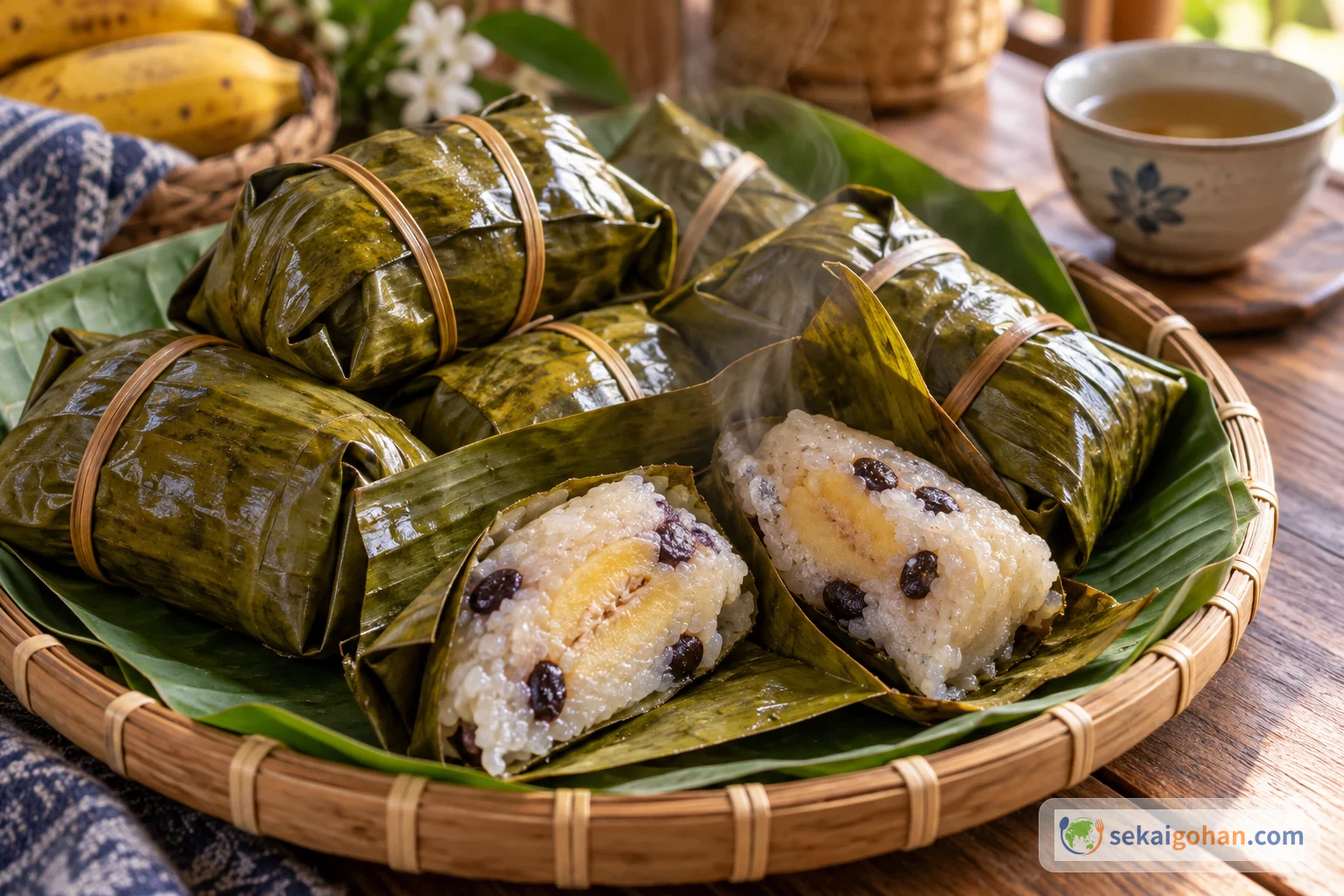
It's 5 a.m. in Kuala Lumpur, and in a back alley that is still dark, motorbikes keep pulling up to a hawker stall. Their riders are buying nasi lemak before work, each portion a small triangular parcel wrapped in banana leaf. Inside is coconut rice with fiery sambal, crispy little fish, peanuts, cucumber and a boiled egg. Heat, sweetness, saltiness and toasty flavor all on one plate is what makes nasi lemak so appealing. This version brings Malaysia's national dish to a home rice cooker, using ingredients that are easy to find.
Nasi lemak, Malaysia's national dish

Nasi lemak translates from Malay as "fatty rice," but lemak here means the rich, mellow quality of coconut milk. The dish spread as a breakfast staple, and those banana-leaf parcels are still a familiar part of the Malaysian morning. Today you can eat it at lunch and dinner too, at restaurants as well as street stalls.
Breakfast in Malaysia and beyond

Nasi lemak is also eaten in Singapore, where many ethnic Malays live, and in Indonesia's Riau province, the Riau Islands and Medan. In Singapore it's a breakfast staple too, sold at hawker centers and roadside stalls.
Within Malaysia, a multiethnic country home to Malays, indigenous peoples, Chinese, Indians and others, nasi lemak is eaten across all communities. What people serve with it, whether fried chicken, curry chicken or rendang, reflects their own tastes.
Part of the fun is that the accompaniments differ from place to place even under the same name, from street-stall parcels to hotel breakfasts.
The history of nasi lemak
Coconut-based dishes appear throughout Southeast Asia, and coconut milk is essential in Indonesian cuisine (in Japanese) as well. Nasi lemak itself originated in the 19th century among people living along the sea on the west coast of the Malay Peninsula, where coconuts and small fish were plentiful. It began as a simple breakfast to fill the bellies of working people, and in the 1970s some vendors went from house to house carrying it wrapped and ready.
Nasi lemak and other rice dishes
Other Southeast Asian rice dishes take a very different approach, such as nasi goreng or pad kra pao over rice. Closer to home, nasi kerabu, from the east-coast state of Kelantan, builds its plate by layering herbs, grilled fish and coconut sambal. And from the forests of Sarawak comes ayam pansuh, chicken steamed in bamboo with lemongrass and ginger, which has a very different character again.

Ingredients (serves 4)
Nutrition (approximate, for one quarter of the batch)
| Nutrient | Per 1/4 of the recipe |
|---|---|
| Calories | 520 kcal |
| Protein | 18 g |
| Fat | 22 g |
| Carbohydrates | 2.25 oz (62 g) |
| Fiber | 3 g |
| Sodium | 680 mg |
This dish contains egg, nuts (peanuts) and shellfish (dried shrimp). If you have a peanut allergy, leave the peanuts out. The dried shrimp can be omitted and the dish still works, but the sambal has a little less depth.
Choosing ingredients for nasi lemak
Coconut milk comes as "first press" and "second press," and its concentration varies by product. Cartons are easier to use up. If you're using a thick canned one, dilute it 1:1 with water to keep the rice from getting too heavy. Leftover coconut milk can be frozen; an ice-cube tray is handy.
Authentic ikan bilis are dried anchovies fried in oil. Japanese shirasu-boshi are the young of the same anchovy family, so stir-frying them in a pan until crisp gives a very similar texture and flavor. Like the sakura shrimp in pad thai, it's a dried ingredient that works well as a stand-in in Southeast Asian cooking.
Frozen banana leaves are sold at Asian grocery stores and online. They add fragrance and presentation but have little effect on flavor, so the dish is perfectly good without them.
Method
Nasi lemak is made in separate parts. Prepare the coconut rice, the sambal and the accompaniments individually, then assemble at the end. With a rice cooker the rice looks after itself, so you can prepare the sambal and accompaniments in the meantime.
Cooking nasi lemak without a rice cooker
Soak the rice in water for 30 minutes, then add the coconut milk, water, pandan leaves and ginger. Bring to a boil over high heat, reduce to low, cover and cook for 15 minutes. Turn off the heat and let it steam for 10 minutes. Stir the bottom of the pot occasionally to prevent scorching.
Serving, storing and varying nasi lemak
Making parts ahead

The Malaysian way is to prepare the sambal and crispy whitebait ahead and keep them in the refrigerator, so in the morning you only need to cook the rice. Coconut rice is best freshly cooked but is still good cold.
Sambal keeps for 2 weeks in the refrigerator or 2 months in the freezer, so it's worth making a double batch. Use the extra to season stir-fries, as a sauce for grilled fish, or as the flavor base for nasi goreng.
If you'd like something sweet after breakfast, a small slice of kuih lapis carries on the coconut fragrance.
Variations

Fried chicken (nasi lemak ayam goreng). This is the most popular variation at Malaysian restaurants. Season chicken thighs with 1 tsp turmeric, 1/2 tsp salt and 1 clove of grated garlic, coat in potato starch, and fry in 170°C (340°F) oil for 8–10 minutes. Crisp chicken with sambal is more filling than breakfast needs to be.
Beef rendang (nasi lemak rendang). Rendang, beef simmered in spiced coconut, is another popular partner in Malaysia, and a ready-made rendang paste makes it easy at home. It needs 2 hours of simmering in a separate pot, so make it the day before.
A mild version for children. Skip the sambal and serve a sweet-savory sauce made from 2 tbsp ketchup and 1 tsp soy sauce. Coconut rice, crispy whitebait, peanuts and cucumber alone make a plate kids love.
Japanese-style. Cook the rice with ¾ cup (200 ml) soy milk instead of coconut milk, serve 2 tsp yuzu kosho (yuzu-chili paste) in place of the sambal, and use the whitebait as is. As with banh mi, blending in Japanese ingredients produces new flavors.
FAQ
Thai rice or Japanese rice?
Thai rice (jasmine rice) gives a more authentic result; its long, loose grains go well with coconut milk. Japanese rice works but comes out a little stickier and closer to porridge, so reduce the water by 10–15%.
Does it work without sambal?
Sambal is central to nasi lemak, and without it the dish becomes something else. If you don't like spicy food, substitute store-bought sweet chili sauce, or use fewer chilies in the sambal and add more sugar. Middle Eastern shakshuka and Turkish köfte are also useful references for adjusting heat.