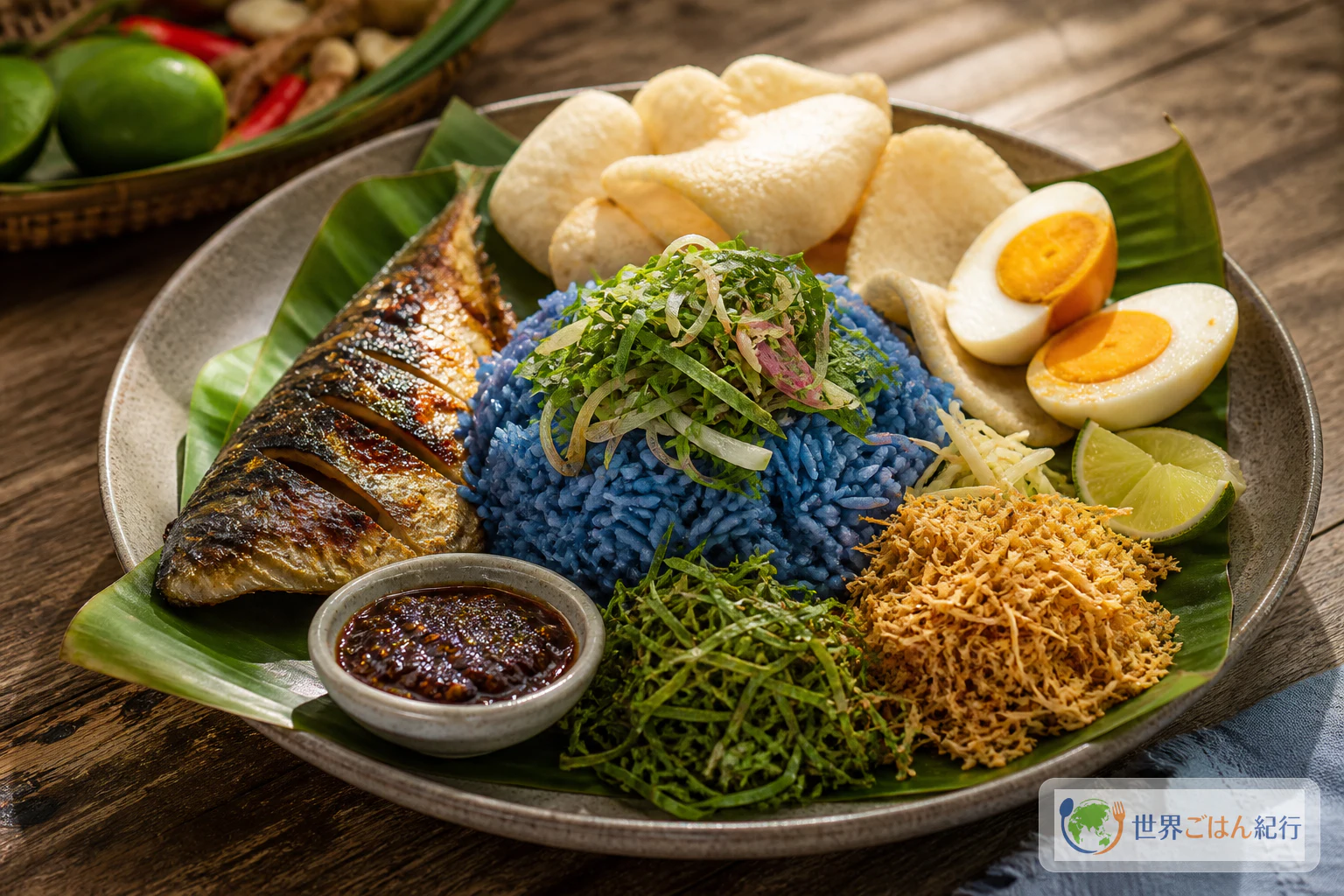
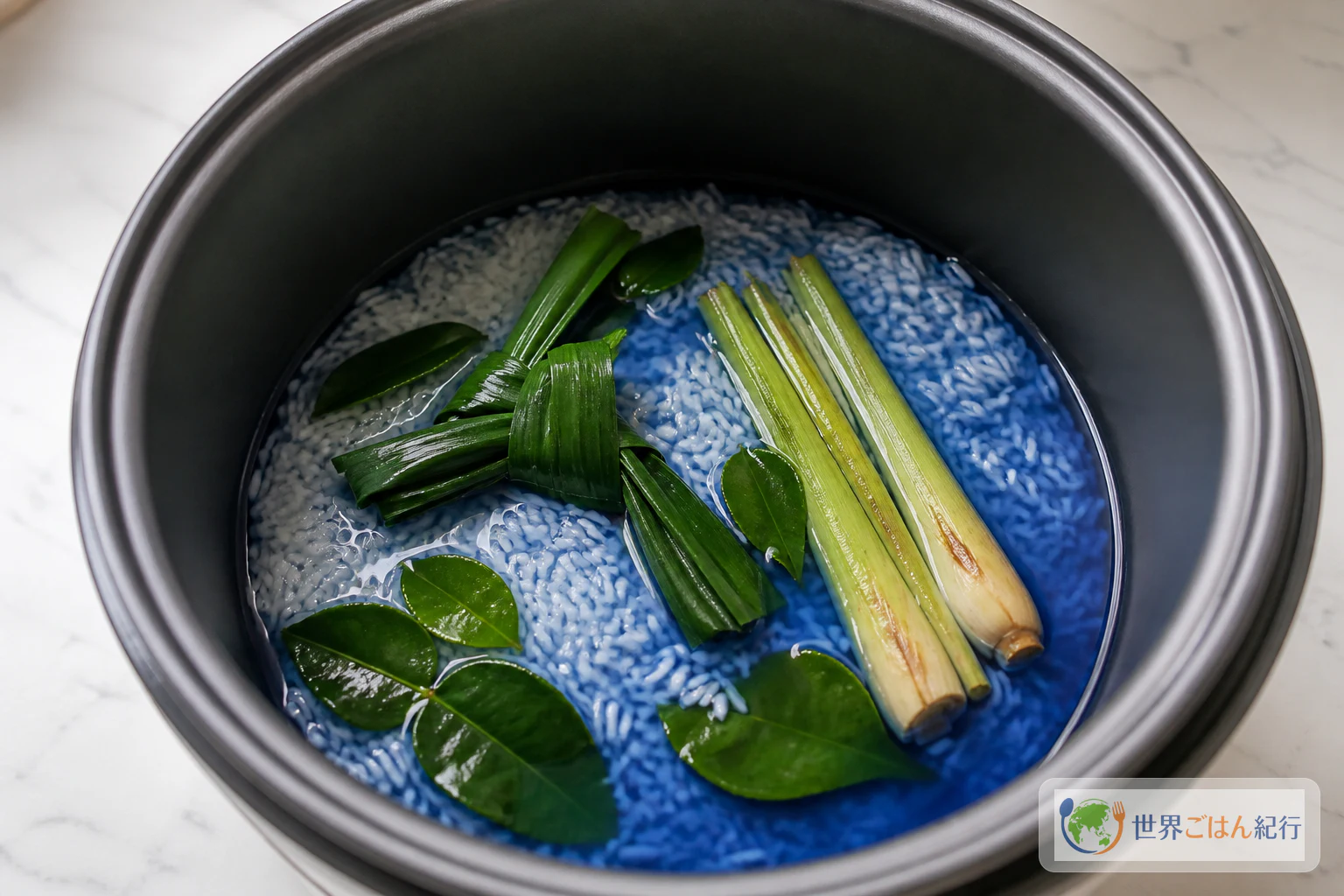
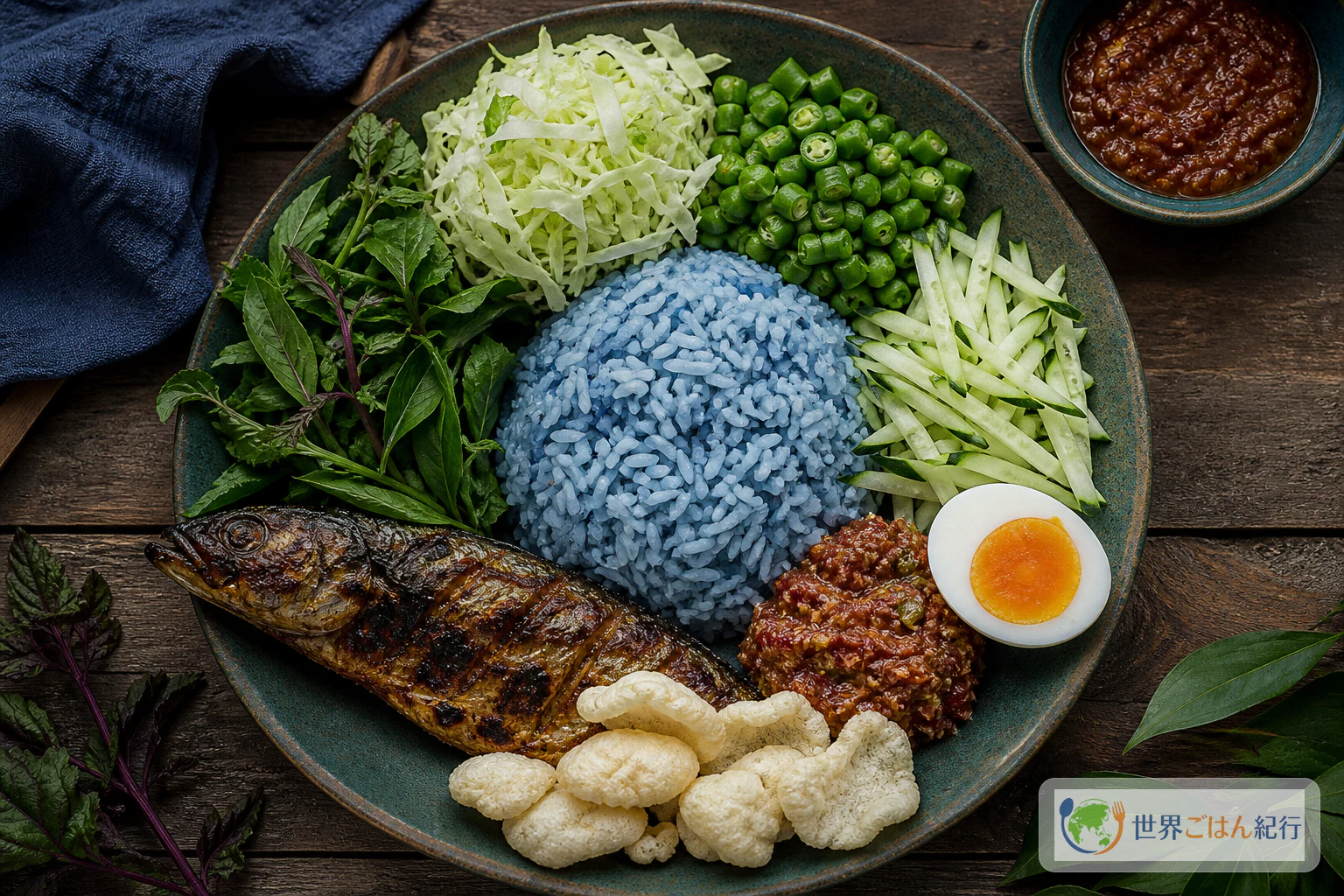
Lift the lid of the rice cooker and the butterfly pea flowers you tucked in beside the white rice have turned the grains a deep blue. Flake grilled fish over it, pile on finely shredded vegetables, scatter toasted coconut and finish with a little fish sauce dressing. The plate looks calm, but sourness, saltiness, heat and the green smell of herbs move through your mouth one after another. Nasi kerabu comes from Kelantan and Terengganu on the east coast of Peninsular Malaysia. The blue rice is only the start. The dish is built from small layers around it: the savoriness of fish, the roundness of coconut, the salt of fish sauce and the sourness of lime. The star is not the blue rice but the structure of the plate that receives it.
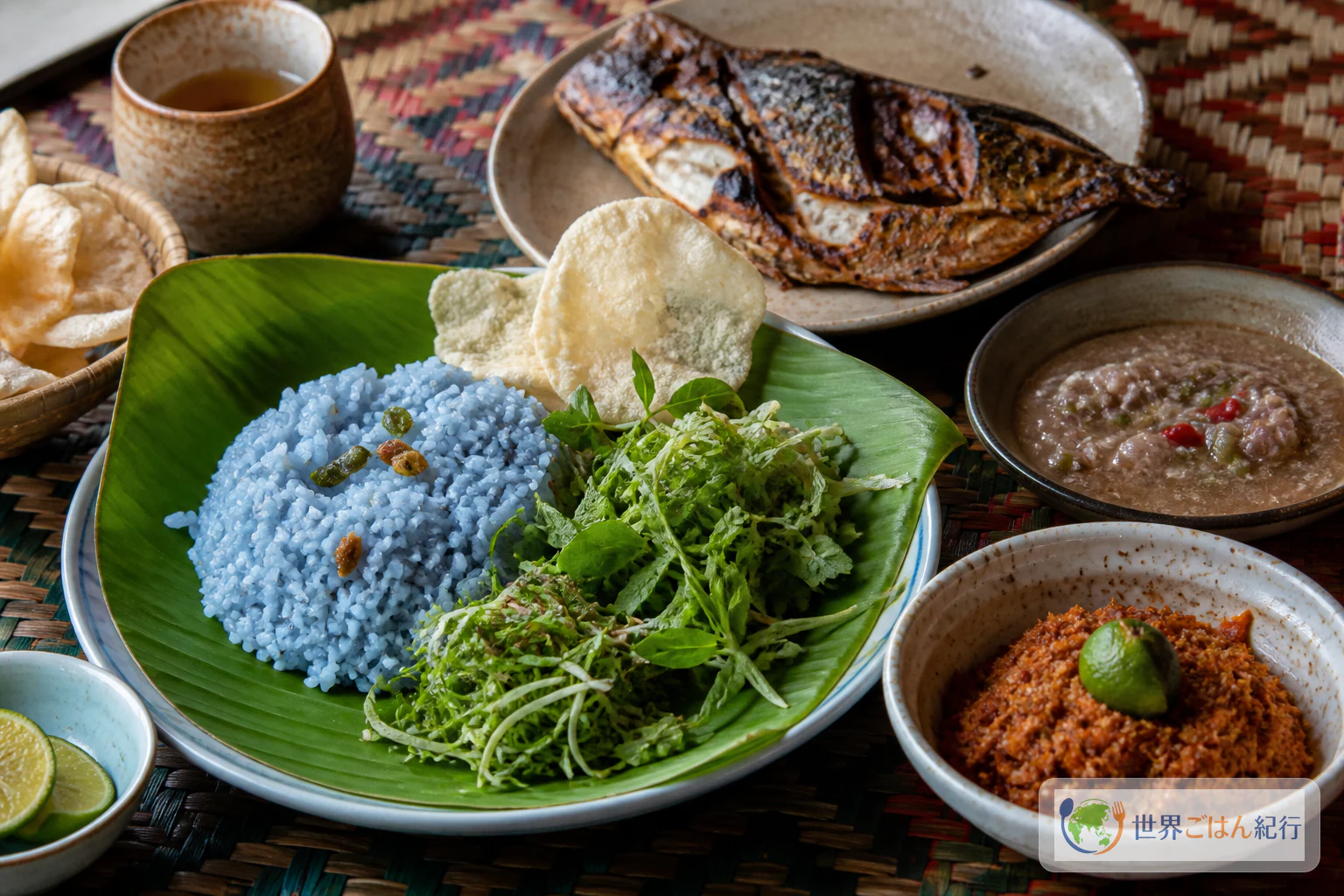
Nasi kerabu on Malaysia's east coast
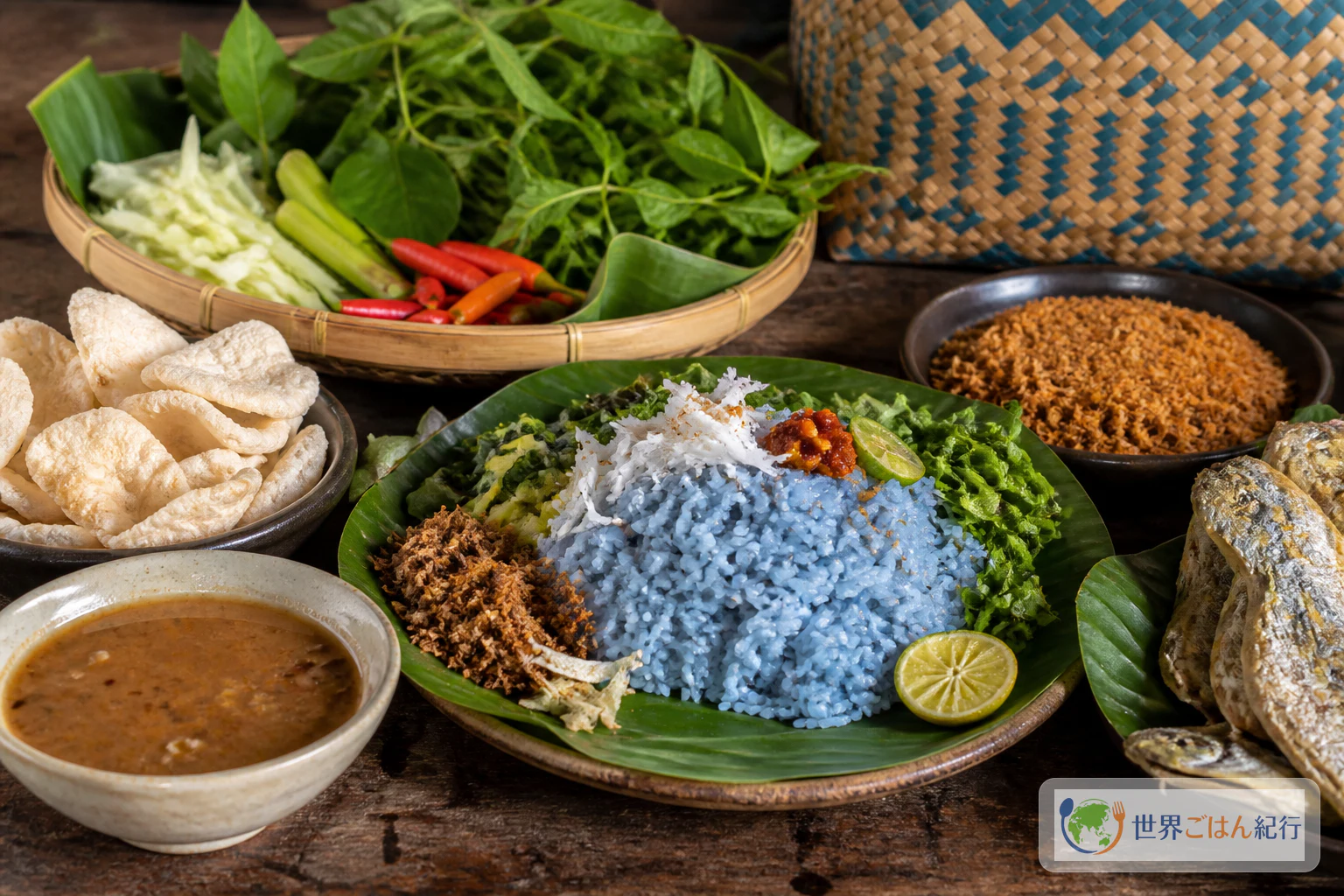
In the name, "kerabu" refers to mixing herbs and raw vegetables together, and that idea runs through the whole dish. The rice is colored blue with butterfly pea flowers and served with fish or chicken, crackers, a salted egg, coconut sambal and more. Beyond that core, the color of the rice, the herbs, the fish and the sauce change from home to home and stall to stall across Kelantan, Terengganu and the rest of the east coast. That range is why you can swap ingredients at home and still keep the center of the dish.
Kelantan is close to southern Thailand, and Thai and Siamese influences show in its cooking. Sourness, heat, sweetness and the saltiness of fermented fish all share one plate, which makes sense for a food culture that crosses borders. Still, calling nasi kerabu "Thai blue rice" misses what makes it its own dish: the kerabu habit of mixing herbs, and fish and sauce served separately.
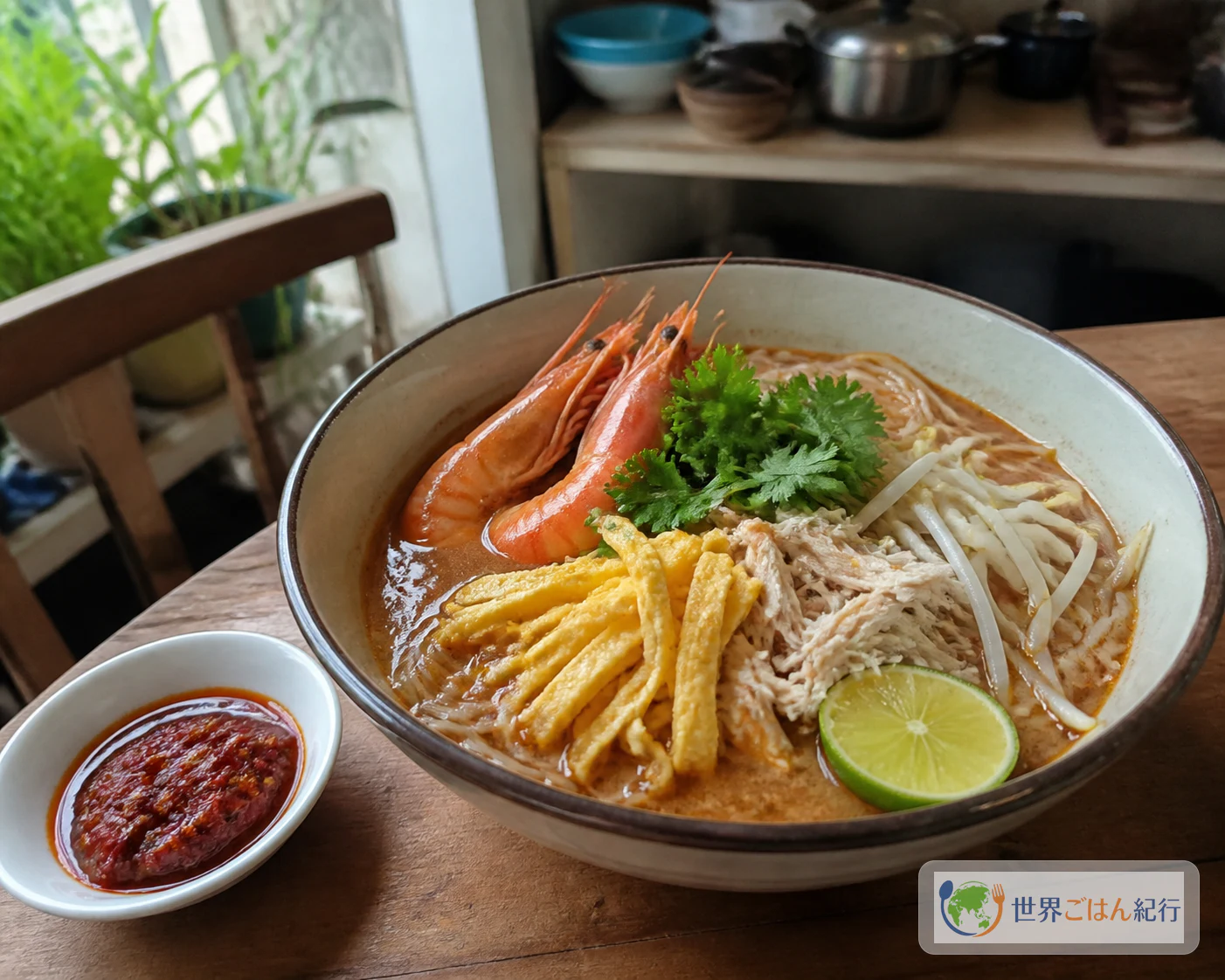
To see Malaysia's staples from another angle, compare it with nasi lemak, coconut milk rice served with sambal; laksa, which brings seafood and noodles together with sourness; and roti canai, the dough that is slapped and griddled at morning stalls.
Adapting the ingredients to a home kitchen
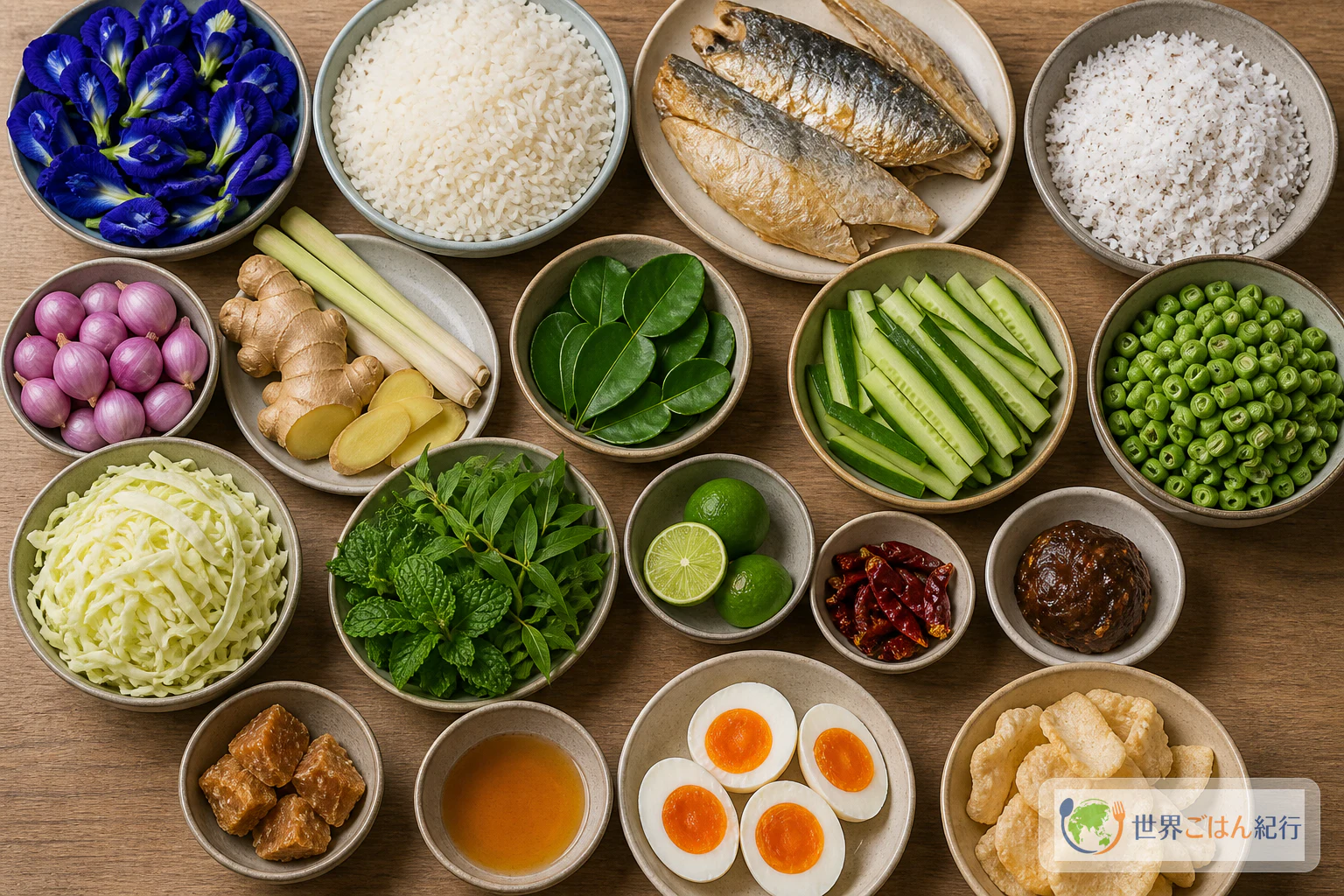
Nasi kerabu (serves 4)
Look for butterfly pea flowers, pandan leaves, makrut lime leaves and tamarind at an Asian grocery or online. But you don't need to give up the whole dish without butterfly pea flowers. You can return the blue to plain white rice. As long as the herbs, grilled fish, coconut sambal and sourness stay on the plate, its character holds. If you focus on the blue and leave out the herbs or the sauce, it looks close but tastes like a different dish.
Thinking about budu and fish sauce separately
Budu is a strongly salty sauce made by fermenting small fish. It is hard to leave out when making Kelantan's nasi kerabu. Thai fish sauce (nam pla) also has the savoriness and salt of fish, but it is a different thing. This recipe uses 2 tbsp (30 ml) of fish sauce, considering the availability and the strong smell of budu, and shapes the outline with sourness and sweetness. If you want the fermented aroma to lead, look for budu. If you want a sauce to reuse in other Southeast Asian cooking, choose fish sauce.
If you buy a bottle, check the size and the ingredient list. It makes sense if you will also use it in Thai or Vietnamese cooking, and you have a place to store it once opened. If it is only for this one plate, use the fish sauce you already have or a small pack, and accept the difference in aroma as a 'substitute for cooking outside Malaysia.'
Choosing ingredients and substitutes for nasi kerabu
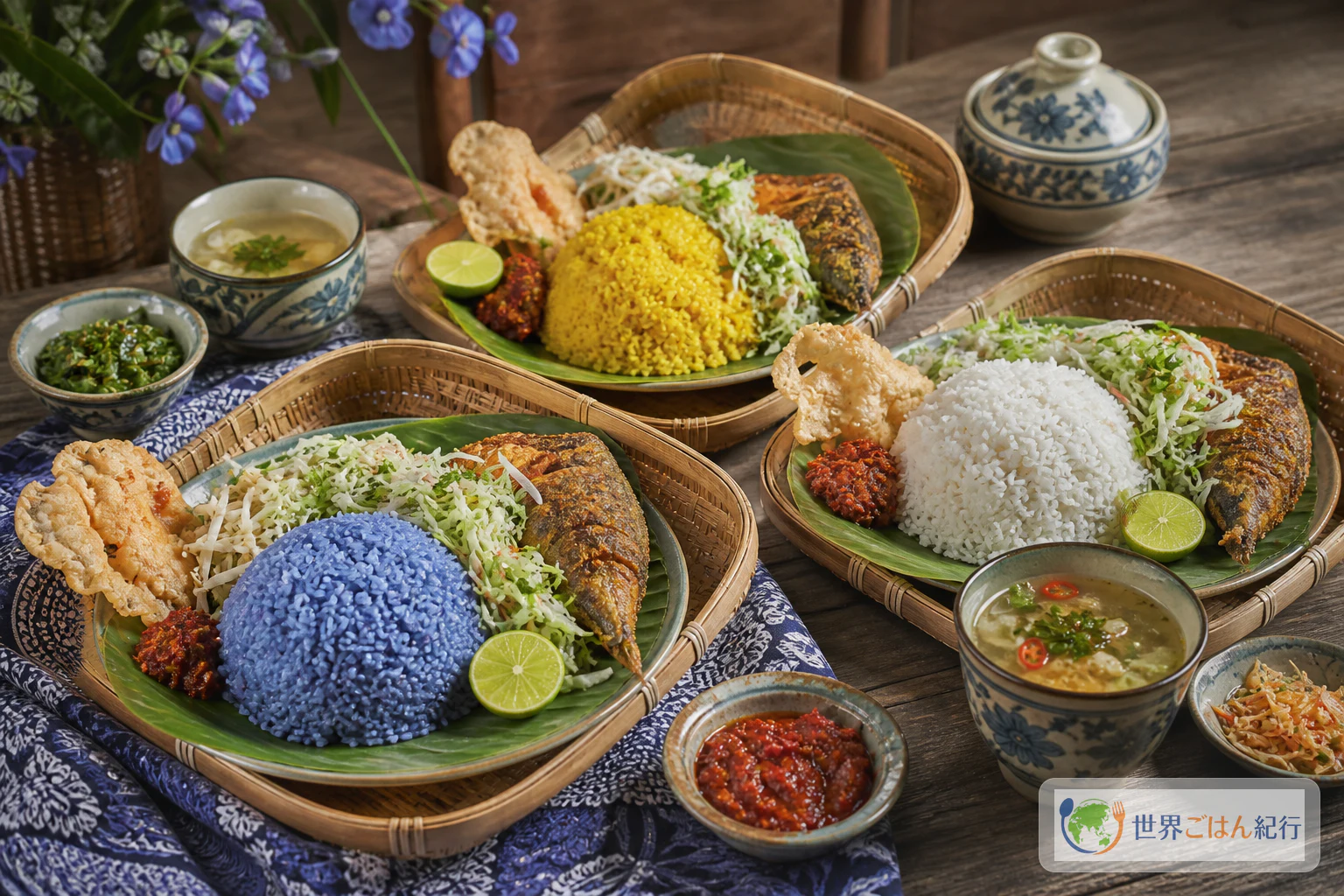
Butterfly pea flowers, turmeric or white rice
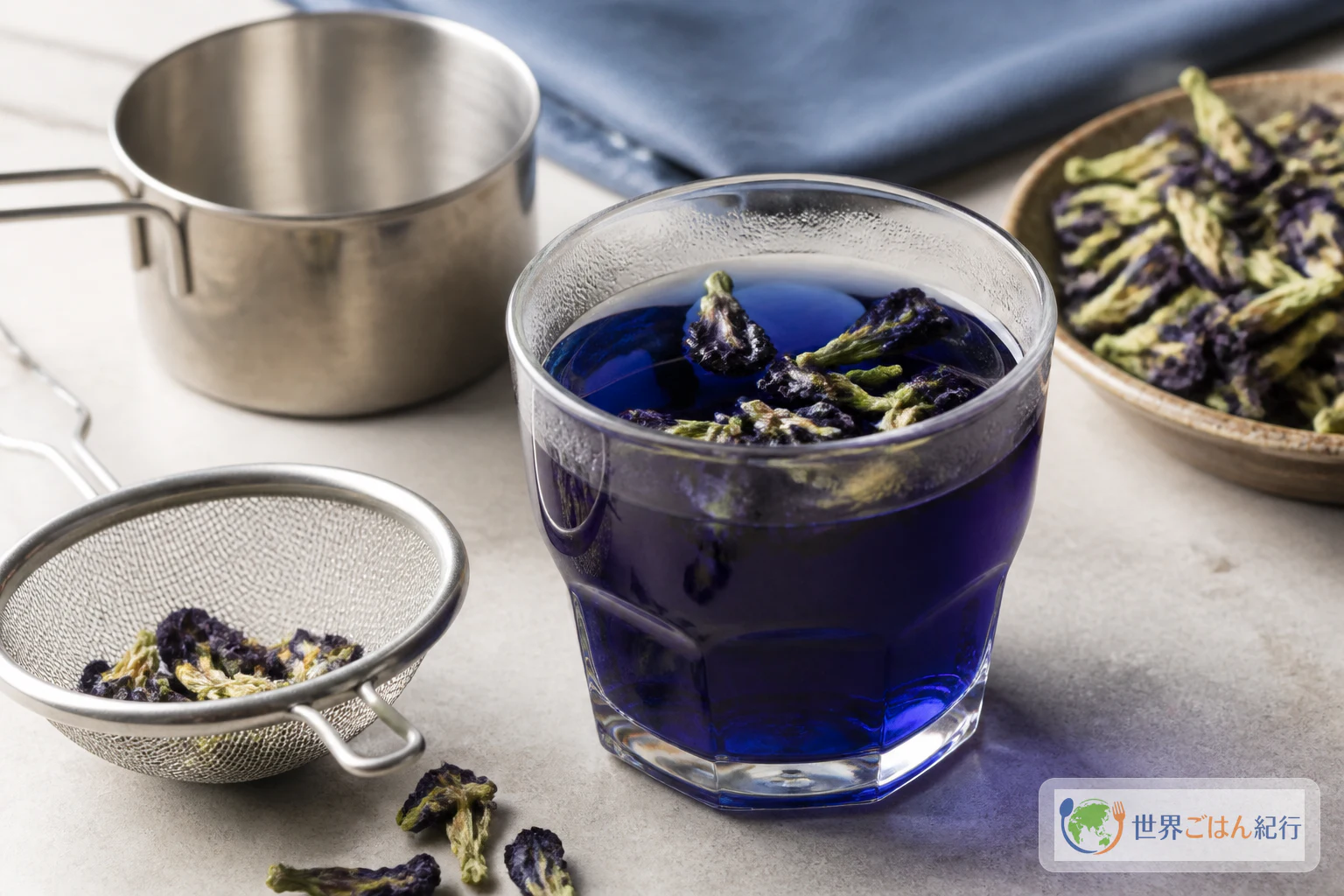
The butterfly pea flower is there mainly to color the rice. Adding more flowers for a stronger aroma only makes the infusion harder to handle and leaves the flavor the same, so make the blue with 8 g the first time and adjust the depth after that. Dried flowers are worth buying when you want the surprise of blue on the table. If you're making the dish only once, want to try the herbs and fish together first, or don't want leftover flowers, start with white rice. For yellow rice, dissolve 2 g of turmeric in water and take care that its aroma doesn't get too strong. Whatever the color, keep the sauce and herbs and the taste stays close.
Herbs
Rather than swapping in a single kind of leaf, choose by what you want to keep: bitterness, coolness or crunch. Mint gives a cold fragrance, myoga a light heat, and cabbage moisture and bite. Daun kesum or Vietnamese coriander, if you can find them, bring the plate closer to the local aroma, but 2–3 herbs from nearby shops also give it dimension.
Budu and fish sauce
If you find budu, don't swap it in for the full 2 tbsp (30 ml) of fish sauce. Start with 1½ tbsp (20 ml), taste for the fermented aroma and saltiness, and add 1 tsp (5 ml) at a time if needed. With fish sauce alone, make the lime and chile a little stronger to round off the edges of the salt. You get a different version of the dish, and a good one.
Chicken, tofu or tempeh instead of fish
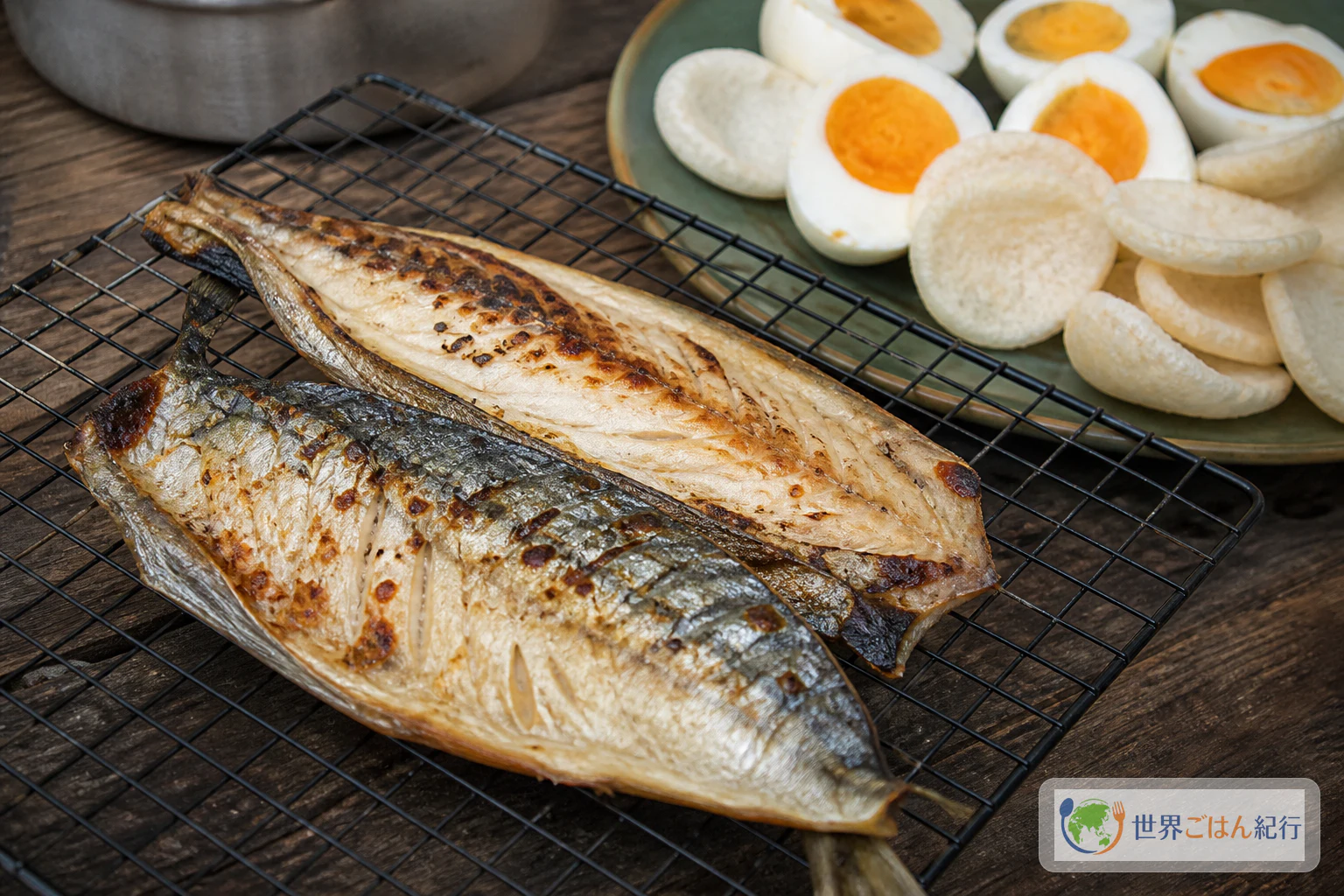
If you don't eat fish, cook 9 oz (250 g) of chicken thigh skin side down until it reaches 165°F (74°C) at the center. For a plant-based version, grill 7 oz (200 g) of thick fried tofu or 7 oz (200 g) of tempeh. Leave out the fish sauce, fish and fish crackers, and season with salt, lime and mushroom soy sauce. It's a home version, but it still works as a plate for herbs and coconut.
Method
Run the six steps together, and the sambal and garnishes come together while the rice cooker runs. Using aroma, thickness and the state of the center of the fish as your signals, rather than the color of the rice, makes it easy to correct even if the ingredients differ.
Getting the dressing and sambal right
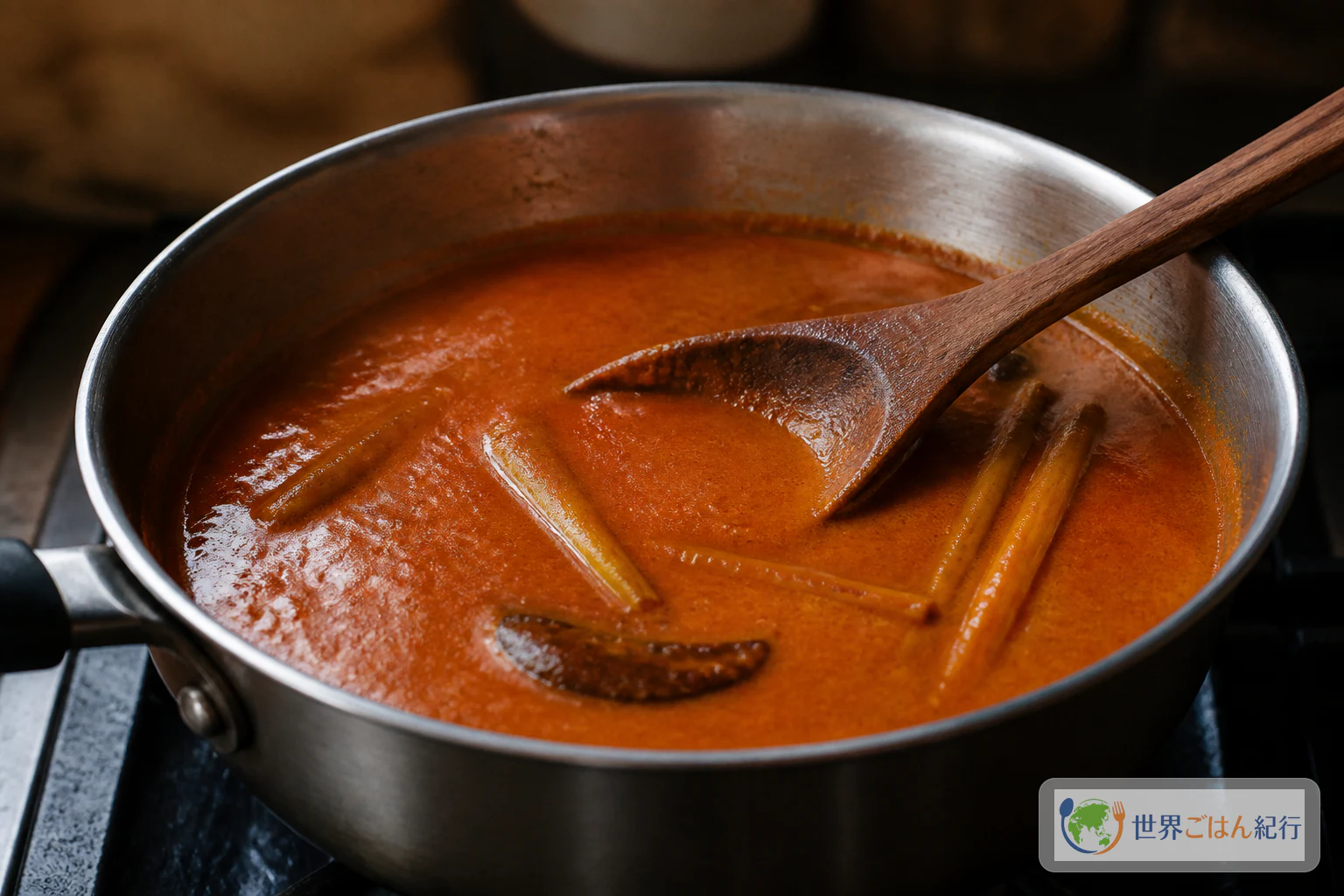
Set the saltiness of the fish sauce dressing after you turn off the heat. Water evaporates while it simmers, so extra fish sauce added at the start can't be taken back. Adjust the water, lime and sugar by 1 tsp (5 ml) or 5 g at a time, until the dressing runs off the back of a spoon in a thin stream.
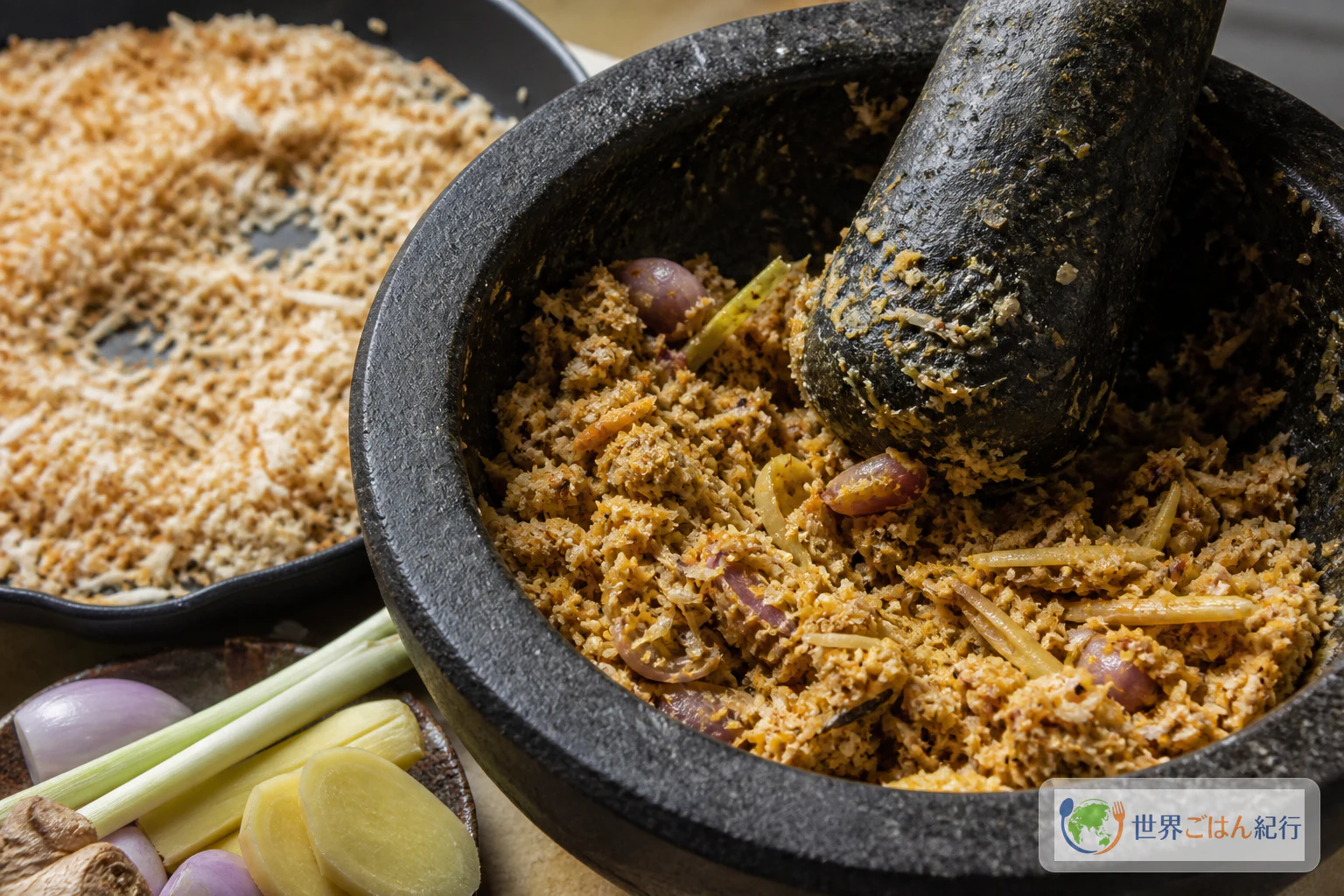
For a coarse sambal, a stone mortar helps. A food processor makes it smooth and easy to eat, but you lose the feel of fish and coconut grains on your tongue. If you buy a mortar, check that the granite mortar and pestle come as a set. It pays off if you'll keep making sambal, curry pastes and crushed aromatics. For a one-time try, a heavy bowl and the back of a spoon work fine, with a slightly less fine grain.
Serving nasi kerabu
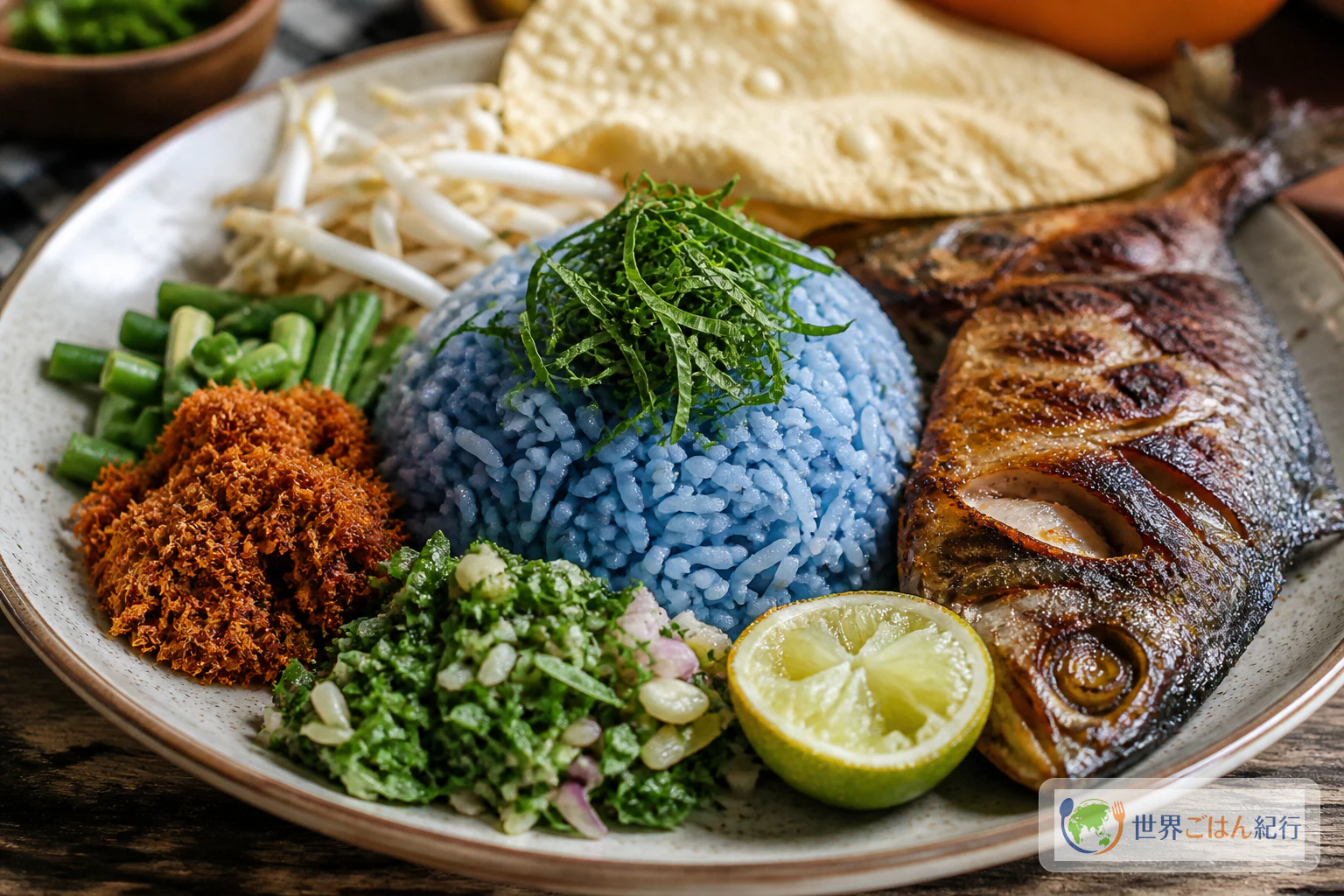
Add the chopped herbs last, and serve the fish and sambal on the side rather than building everything around the blue rice. Then each bite can be different. The first might be fish and sauce, the second herbs and lime, the third toasted coconut and rice. Because everyone at the table changes the combinations as they go, the conversation keeps going, even over rice of an unfamiliar color.
Frequently asked questions
Is it a failure if the blue is pale?
No. The color changes with the amount of flowers, the steeping time and the type of rice, so taste before you judge. Next time, steep the infusion 5 minutes longer. Or go back to white rice and keep the same amounts of herbs and sauce, which gives more consistent results. If you add acid early, the rice turns from blue to purple, but it's still fine to eat.
Can I make it with ordinary short-grain rice?
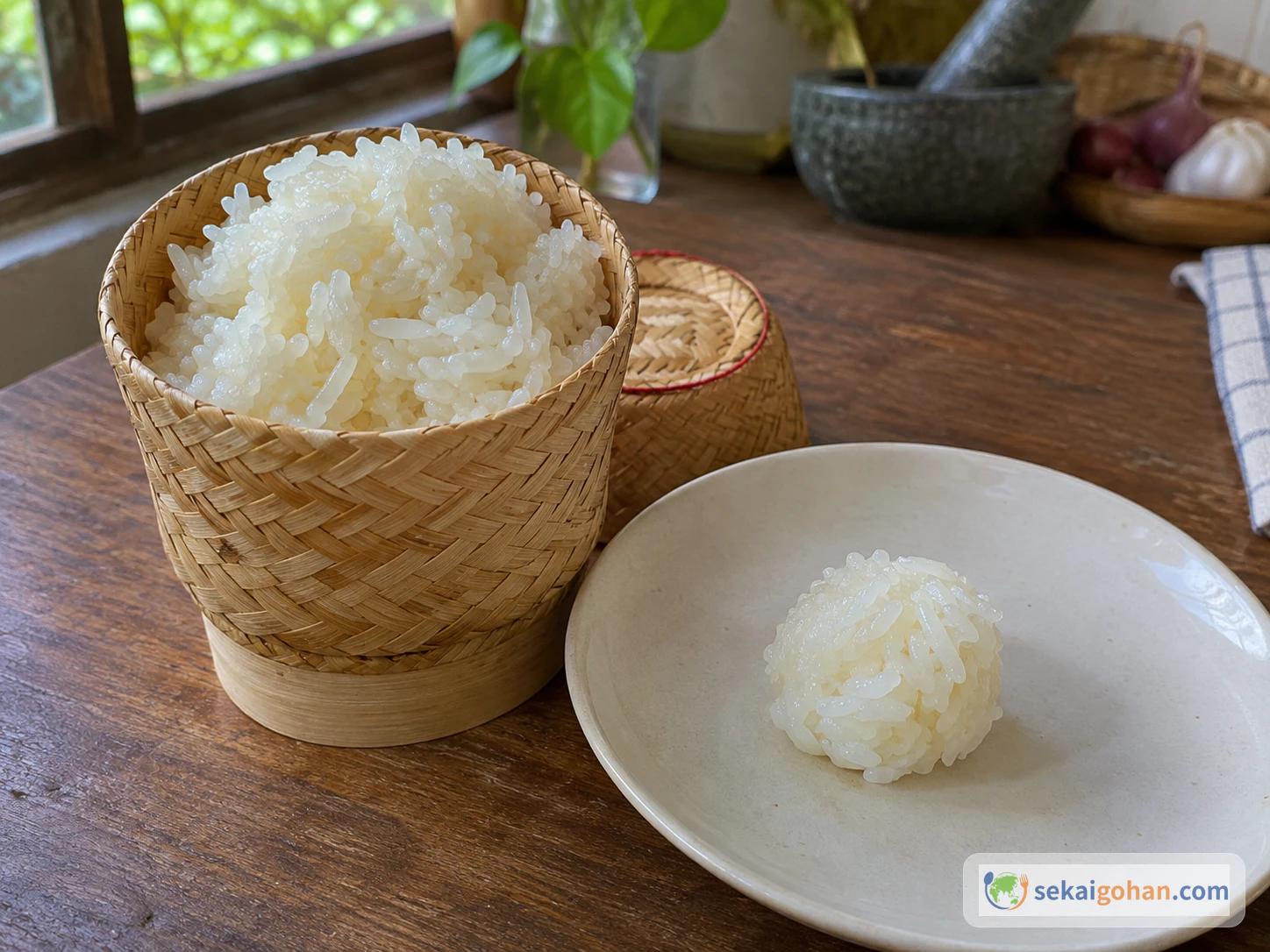
Yes. It's stickier than long-grain rice, so drain the washed rice in a colander for 10 minutes and don't add extra cooking liquid. If the bottom is damp when it finishes, open the lid, turn the rice with a paddle, switch off the warming and let the steam escape for 5 minutes. If you cut back the water next time, reduce it by only 2 tsp (10 ml) at a time.
Are budu and fish sauce the same?
No. Budu is a fermented fish sauce with a strong aroma and saltiness. Fish sauce stands in with the savoriness and salt of fish, and with lime, chile and sugar the dressing comes together with a different character. When choosing a product, check the ingredient label and how to store it after opening, not just the size.
Can I make it ahead?
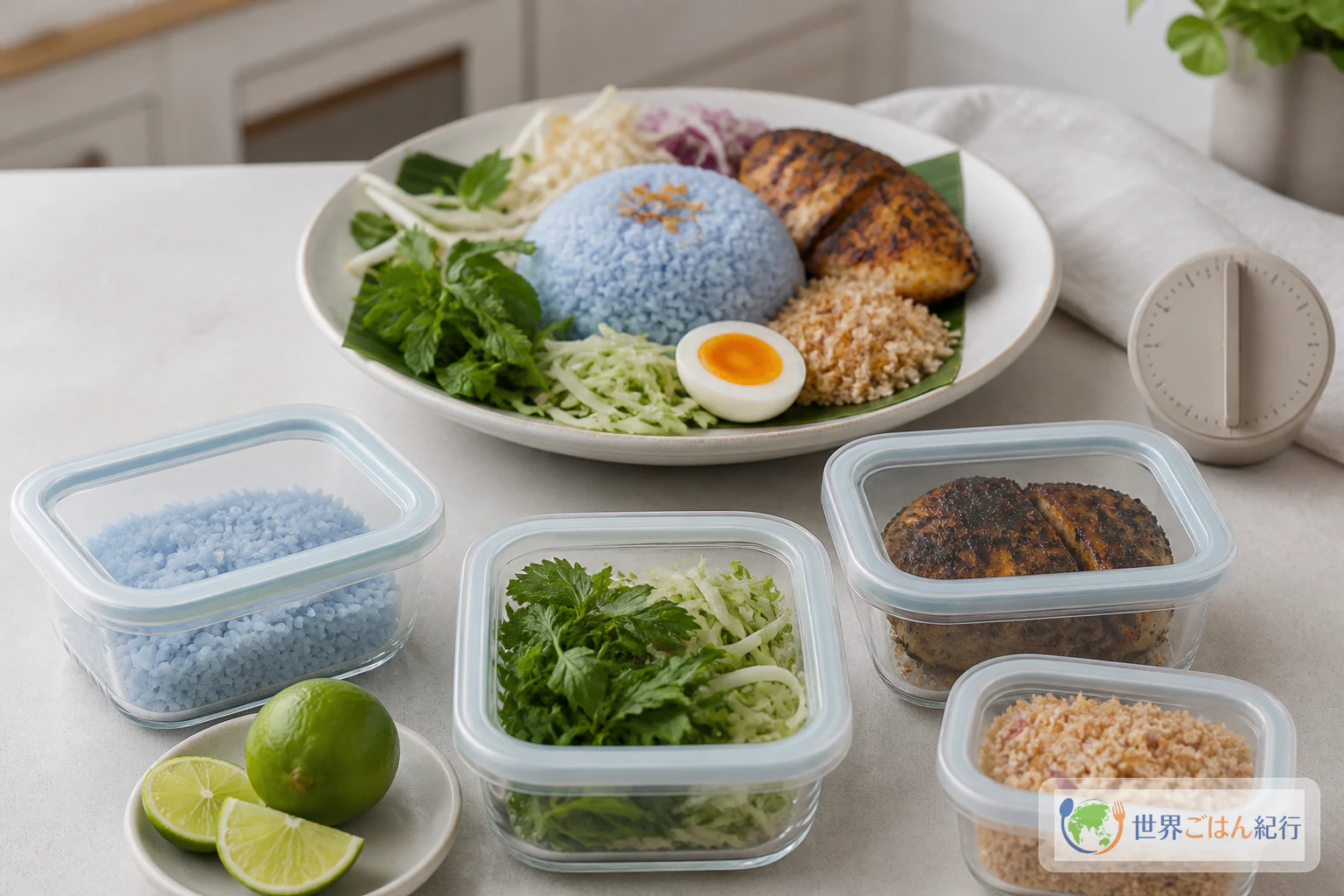
Divide the rice, grilled fish, sauce, herbs and fish crackers into separate airtight containers and refrigerate them within 2 hours of cooking. Pat the herbs dry and use them the same day, and finish the fish and rice by the next day. When reheating, heat the fish and rice thoroughly to 165°F (74°C) at the center. Don't eat anything that has sat at room temperature for a long time, or anything that smells off or has turned sticky.
I'm worried about allergies to shrimp crackers and fish sauce.
Fish sauce, budu and fish or shrimp crackers can contain fish or crustaceans. For salted eggs, check for egg. For coconut milk and coconut, check each product's ingredient label and production line. Read the ingredient and allergen labels every time, and if you can't avoid cross-contact on shared utensils, don't force a substitute.
Sources
The position of the dish, the ingredients and the cooking temperatures discussed here were checked by opening the following sources on 5 August 2026. The regional differences of the dish and the home substitutes are editorial judgments made in moving the structure found in these sources into a home kitchen.
- Nasi Kerabu Kelantan (National Department for Culture and Arts Malaysia, JKKN) (checked for the region of nasi kerabu, butterfly pea flowers, herbs, sambal and steps. Accessed and checked: 5 August 2026)
- Quaker Cookbook Malaysia 2020 (Nutrition Society of Malaysia) (checked for ingredient composition, coconut sambal, herbs and plating. Accessed and checked: 5 August 2026)
- Safe Minimum Internal Temperatures (FoodSafety.gov) (checked for core temperatures of fish, eggs, chicken and leftovers. Accessed and checked: 5 August 2026)
- Traditional Nasi Kerabu Business at Pasir Pekan, Kelantan (UiTM Institutional Repository) (checked for records on a Kelantan restaurant and its spread beyond the region. Accessed and checked: 5 August 2026)
- Malaysian Food by Region (Tours Malaysia) (supplementary check of the composition of the Kelantan plate, the place of budu and east-coast food culture. Accessed and checked: 5 August 2026)