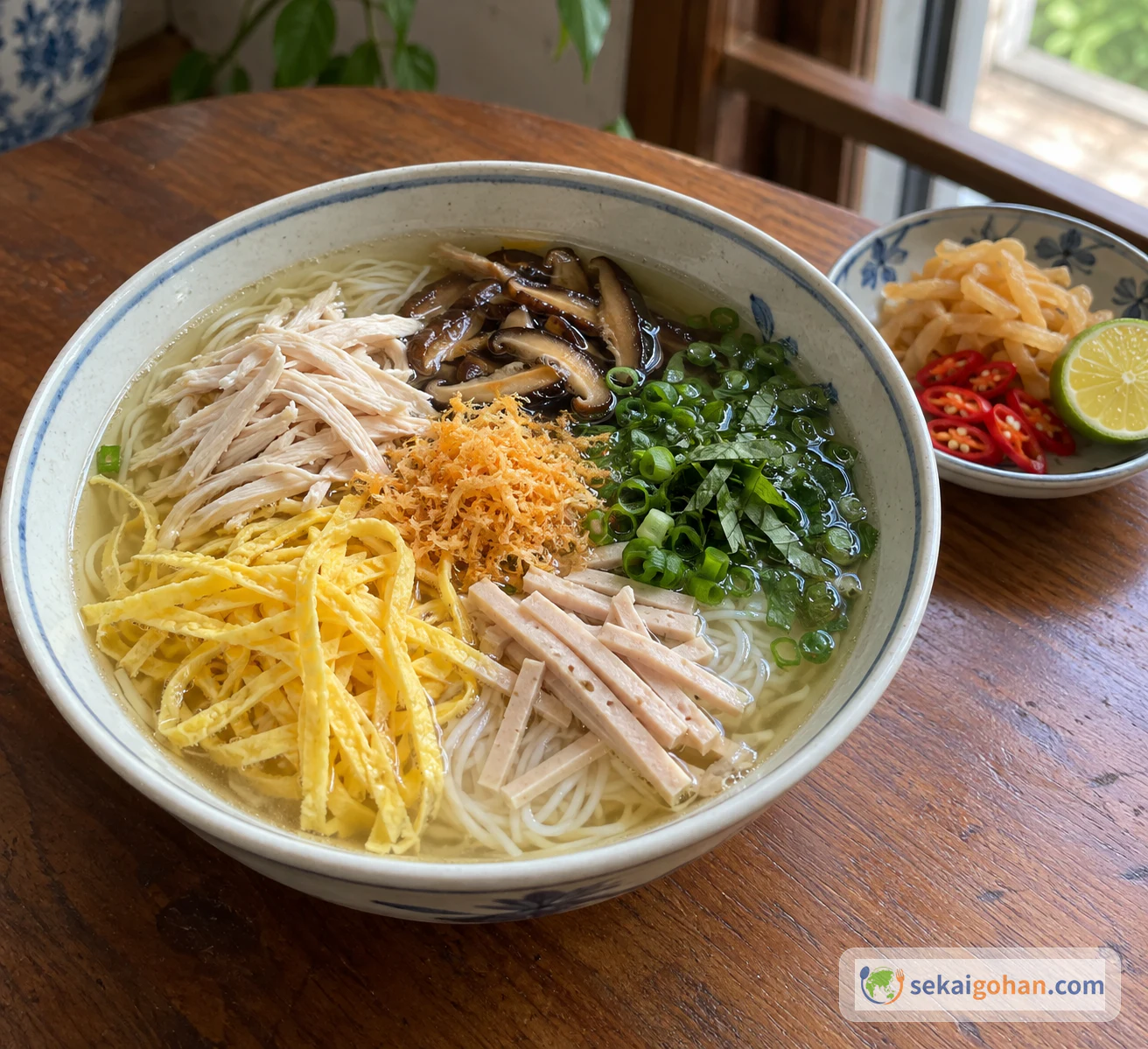
Creamy coconut milk, the sharp heat of chilies, the fresh scent of lemongrass and the deep savor of shrimp paste all arrive in the same spoonful. One sip and the heat of Southeast Asia spreads through your mouth. Laksa is a signature noodle dish of Malaysia and Singapore: rice noodles in a curry soup built from a spice paste and coconut milk, with roots in Peranakan (Straits Chinese) cooking. You'll find it at Thai and Singaporean restaurants in many countries, and people often say that spicy, creamy flavor is hard to recreate at home. It's simpler than it looks: once you make the laksa paste, the rest comes together in a single pot.

Laksa in Malaysia and Singapore
Peranakan origins
Laksa grew out of Peranakan culture, which took shape when Chinese immigrants, mainly from Fujian and Chaozhou, began settling on the Malay Peninsula from the 15th century. Many of the men married Malay women, and the mixed community that followed developed its own language (Baba Malay), its own dress (the nyonya kebaya) and its own cuisine (Nyonya cuisine). Laksa is one of that cuisine's best-known dishes, joining Chinese noodle traditions with Malay spices and coconut milk.
From the 15th to the 17th century the Strait of Malacca was one of the world's leading trading hubs. Under Portuguese, Dutch and British rule it remained a place where Chinese, Indian, Arab and European food cultures met, and laksa came out of that mix. In Malaysia today it is one of the few dishes loved by Malays, Chinese, Indians and Indigenous peoples alike.
Where the name comes from is still debated. The leading theory points to the Sanskrit "laksha" (many, ten thousand), for the many ingredients in the soup; some link it to the Malay word for "ten thousand." Another theory traces it to the Persian "lakhsha" (noodles), which would mean it arrived from Central Asia along the Silk Road.
The food made by Peranakan women (nyonya) is considered one of the world's oldest fusion cuisines. Combining Chinese pork, soy sauce and tofu with Malay lemongrass, galangal and belacan, it has a history of more than 500 years. Just as banh mi is a French and Vietnamese fusion, laksa is a Chinese and Malay one, centuries ahead of today's "fusion cooking" boom.
Regional styles of laksa
"Laksa" covers an astonishing range in Malaysia and Singapore. Just as ramen differs entirely between Sapporo miso and Hakata tonkotsu, laksa changes from region to region.
| Name | Region | Soup base | Characteristics |
|---|---|---|---|
| Curry laksa | Kuala Lumpur, Malacca | Coconut milk and curry spices | The most popular; the style made here |
| Assam laksa | Penang | Tamarind and fish (sour base) | Clear, sour soup |
| Sarawak laksa | Borneo | Coconut milk and sambal belacan | A distinctive sambal paste is the key |
| Katong laksa | Singapore | Coconut milk and shrimp paste | Noodles cut short and eaten with a spoon |
| Johor laksa | Johor | Fish base | A unique style that uses spaghetti |
| Kelantan laksa | Kelantan | Fish and coconut milk | Sweeter seasoning |
The most famous is Penang's assam laksa. Its clear soup uses no coconut milk at all and is built on the strong sourness of tamarind and fish stock, so it has little in common with curry laksa. In 2011 it was ranked 7th on CNN's list of the world's 50 best foods.
What Singaporean restaurants abroad serve as "laksa" is mostly curry laksa (or Katong laksa). That creamy, spicy coconut-milk soup suits many palates and makes a good first laksa.

Where laksa is eaten
In Malaysia, laksa is eaten at every hour, from breakfast to a late-night snack. Air Itam Laksa in Penang is famous for assam laksa, and the lines never end. Madras Lane in Kuala Lumpur has a concentration of curry laksa stalls, and the alleys of Chinatown bustle with tourists and locals.
Singapore's Katong district is known as the "holy land of laksa," where 328 Katong Laksa, Sungei Road Laksa and Janggut Laksa compete. Here the noodles are cut short and eaten with just a spoon, no chopsticks.
Much like Lebanon and Israel over hummus, Malaysia and Singapore argue over whose dish laksa is. In reality both countries have developed their own laksa cultures, and Penang assam laksa and Katong laksa are different enough to count as separate dishes, so each country has good reason to be proud of its own.
Laksa and other curry noodles
Plenty of dishes around the world combine spiced curry and noodles.
| Dish | Country | Soup base | Noodles | Characteristics |
|---|---|---|---|---|
| Laksa | Malaysia | Coconut milk and spice paste | Rice noodles | Peranakan fusion |
| Khao soi | Northern Thailand | Coconut milk and curry paste | Egg noodles (topped with fried noodles) | Burmese influence |
| Curry udon | Japan | Dashi and curry roux | Udon | A Japanese-Western blend from the Meiji era |
| Soto mie | Indonesia | Turmeric and chicken stock | Rice or egg noodles | An everyday dish of Java |
Khao soi is the closest relative, with noodles in a coconut-milk curry soup. It comes from Chiang Mai in northern Thailand and carries Burmese influence, though, so it belongs to a different lineage. Japan's curry udon looks nothing like laksa, yet it shares the same structure of curry spices, stock and noodles.
Ingredients (serves 2)
The single most important seasoning that determines the taste of laksa is belacan. You can find it at Asian grocers or online. If you cannot, grind 1 tbsp dried shrimp in a food processor as a substitute. Fermented small-shrimp pastes from other cuisines give a similar flavor.

Choosing laksa ingredients
Lemongrass
Lemongrass carries laksa's aroma, and you can find it fresh at Asian grocers, as a tube paste, frozen or dried. Fresh lemongrass smells best, but tube paste works well enough. Dried lemongrass won't blend into a paste, so save it for simmering in soup.
If you can't find lemongrass at all, 1 tsp grated lemon zest can stand in. It brings back some of the citrusy freshness, though not the grassy aroma.
Coconut milk
Always use full-fat. Light and low-fat coconut milk has too little fat to give laksa its creaminess, so choose one with 17% fat or more.
Store-bought laksa paste
When there's no time to make your own paste, a store-bought one is a strong ally. Homemade still has far richer lemongrass and galangal aroma.
| Brand | Country of origin | Characteristics |
|---|---|---|
| Prima Taste | Singapore | The most authentic. A set of paste and soup base |
| AYAM | Malaysia | Good value. Paste only |
| MAE PLOY | Thailand | Easy to find. Slightly sweet |
Prima Taste comes closest to the local taste. It comes with both paste and soup base, so you only need coconut milk and noodles to finish.
A food processor (a mortar can substitute) and a pot are all you need.
Method
Making the laksa paste
Nine-tenths of laksa's flavor is decided by the paste. Store-bought laksa paste works, but homemade smells overwhelmingly richer.
Remove the seeds from the dried chilies and rehydrate them in warm water for 15 minutes. Slice the lower 4 inches (10 cm) of the lemongrass thinly. Peel off 2 or 3 of the hard outer layers and use only the tender inner part.
Put all the paste ingredients in a food processor and blend until it becomes a smooth paste. Adding 1 to 2 tbsp water makes blending easier. If you have no food processor, patiently crush everything in a mortar.
Laksa soup problems and fixes
Raw-tasting or bitter paste
The most important step in homemade laksa is frying the paste slowly over low heat. Raw paste dissolved straight into the soup leaves a harsh, raw taste. Fry it over low heat for 5 to 8 minutes, until the oil separates, red oil floats and the spice aroma peaks.
In Malaysia this step is called "tumis," a basic technique of Malay cooking. The paste sticks to the bottom of the pot easily and turns bitter if it scorches, so keep stirring with a wooden spatula.
Oily, separated soup
Never boil it. The protein and fat in coconut milk separate at high temperature, and a creamy soup turns oily. Once the soup is added to the fried paste, keep the heat at medium-low.
Shake the can before opening. The fat (coconut cream) and water separate during storage, and 30 seconds of shaking evens them out. If it still hasn't recombined, stir it slowly over low heat once it's in the pot.

Serving, storing and varying laksa
Drinks
The best drinks soften laksa's heat while bringing out its flavor. Teh tarik, Malaysia's national drink, is black tea with condensed milk, poured from a height until frothy; that's why it's called "pulled tea." Its sweetness tempers the heat, and you can come close at home by adding 2 tbsp condensed milk to black tea and frothing it.
Lime juice, freshly squeezed lime with sugar and water, sets off the spices and refreshes the mouth. Beer works too: a light lager such as Malaysia's Tiger or Singapore's Singha. Cold, bitter beer against laksa's heat is a classic combination.
Side dishes
Otak-otak is a Malaysian fish cake: fish paste mixed with spices, wrapped in banana leaf and grilled, and often ordered alongside laksa at stalls. Popiah, Malaysia's fresh spring rolls of vegetables, egg, tofu and shrimp in a thin skin, cleanses the palate between rich spoonfuls. Roti canai, a flaky flatbread brought by Indian Malaysians, is great dipped into the soup.
Storage
| State | How to store | How long | Point |
|---|---|---|---|
| Laksa paste | Refrigerator | 2 weeks | Put in a jar and cover the surface with oil |
| Laksa paste | Freezer | 3 months | Freeze in small portions in an ice-cube tray |
| Soup (without noodles) | Refrigerator | 2 to 3 days | Add a little coconut milk when reheating |
| Finished bowl (with noodles) | — | Not recommended | The noodles absorb the soup and swell |
The best storage strategy is to make the laksa paste ahead. Make a double batch on the weekend and freeze it in an ice-cube tray; the aroma hardly fades. When you want laksa, put 2 or 3 cubes in a pot with coconut milk and stock, and dinner for 2 is ready in under 15 minutes.
Variations
For vegan laksa, leave out the shrimp paste and shrimp and use 1 tbsp miso and 1¾ cups (400 ml) kombu stock instead. Plenty of mushrooms (shimeji, king oyster, shiitake) make up the umami, fried tofu becomes the main protein, and the coconut milk stays as is.
For chicken laksa, use 7 oz (200 g) chicken thigh in place of the shrimp. Fry it for 3 minutes after the paste, then pour in the soup; the chicken makes it richer. Marinated chicken from shawarma gives you double the spice.
For a Japanese-style miso laksa, stir 1 tbsp white miso into the soup and top with menma, a marinated egg and scallions. The heat and the mellow miso work surprisingly well together, and you can eat it like ramen. Adding cooked rice to the last of the soup for a risotto-like finish is delicious, too.
Instant noodles can get the treatment as well. Malaysia's "MyKuali Penang White Curry Mee" regularly ranks high in world instant-noodle rankings, and with 3 tbsp coconut milk, boiled shrimp, fried tofu, bean sprouts and cilantro it becomes street-stall-level laksa.
Nutrition
| Nutrient | Per bowl (half of the 2-serving recipe) | Role |
|---|---|---|
| Calories | about 620 kcal | Fairly high in fat from the coconut milk |
| Protein | about 1 oz (28 g) | From the shrimp and fried tofu |
| Fat | about 1.25 oz (35 g) | Medium-chain fatty acids of coconut milk |
| Carbohydrates | about 1.75 oz (52 g) | From the rice noodles. Gluten-free |
| Vitamin C | Present | From the lime and bean sprouts |
| Iron | Present | Abundant in shrimp paste |
| Lauric acid | Present | From coconut milk. Antibacterial action |
Much of the fat is the medium-chain fatty acids (MCT) in coconut milk, which are digested and absorbed faster than ordinary fats and readily used as energy. Still, 620 kcal is substantial; if you're watching your weight, try a lighter version with half the coconut milk and more chicken stock. Research has shown anti-inflammatory effects of curcumin in turmeric, and citral in lemongrass has antibacterial and antifungal action.
Like nasi lemak, laksa is a national food of Malaysia, and along with pad thai and nasi goreng, it's drawing attention as a gluten-free option.
More dishes to explore
From Malaysia, nasi lemak is the classic coconut-milk rice, and char kway teow sears flat rice noodles over high heat, a contrast to laksa's soup. Elsewhere in Southeast Asia, try Thailand's pad thai and som tam, Vietnam's banh mi, Indonesia's nasi goreng, and the Philippines' adobo, whose vinegar sourness contrasts with laksa's heat. For a Southeast Asian table, pair laksa with gapao rice and nasi goreng.
Laksa's spices also turn up in South Asia's biryani, and the overview of Middle Eastern cuisine traces how spices traveled along the Silk Road. Senegal's thieboudienne and Ethiopia's doro wat are just as generous with spice. Eastern Europe's borscht takes a completely different approach to a one-bowl soup, and the overview of South American cuisine is another good entry point into spices and food cultures.
Frequently asked questions
I'm allergic to coconut milk. Is there a substitute?
Soy milk plus 2 tbsp tahini (sesame paste) gives you some of the creaminess. The coconut flavor typical of laksa won't be there, so expect a quite different dish.
It's too spicy for me. How can I adjust the heat?
Reduce the chilies (from 6 to 2 or 3) or remove all the seeds. More coconut milk (+½ cup (100 ml)) also helps, and a generous squeeze of lime when you eat softens the heat with its acidity.
How spicy is laksa compared with curry and rice?
Curry laksa runs about "hot" to "extra hot" on a Japanese curry roux scale. The coconut milk adds mellowness, though, and many people find it milder than an extra-hot curry. Start with fewer chilies and add as you taste.
Can I use other noodles instead of rice noodles?
Udon or somen work, but the smooth texture of rice noodles is part of laksa's charm. In Malaysia a variation called curry mee uses Chinese-style noodles, so yellow wheat noodles are a good option too.
Can I make laksa that children can eat?
Yes: leave the chilies out completely and add 2 tsp paprika powder to keep the color. The sweetness of coconut milk and the aroma of the spices carry the dish on their own, and children tend to welcome it as a creamy curry noodle soup.