Walk down a back alley in Bangkok and you'll hear som tam before you see it: a steady "pok, pok, pok" as a vendor pounds green papaya in a clay mortar with a wooden pestle. You hear it again with every order. It's one of the classic sounds of Thai street food. The dish itself is a green papaya salad from Isan, in northeastern Thailand. Restaurant menus abroad often just call it "papaya salad," but it has much more going on than that. You get the heat of chiles, the sourness of lime, the deep sweetness of palm sugar, the salt of fish sauce and the savory depth of dried shrimp, and all five tastes hit your tongue at once. It's hard to forget the first time.

About Som Tam
Name and origin
Som tam (ส้มตำ) says what it is in its name. Som means sour and tam means to pound, so it's literally a "pounded sour dish." It comes from Isan and is eaten all over Thailand as a national favorite. Next door in Laos it's an everyday dish too, called tam mak hoong. For a proper Isan-style meal, serve it with sticky rice and herb-marinated grilled chicken, kai yang (in Japanese).
From Isan to Bangkok
Som tam starts with Isan. The region covers 20 of Thailand's 76 provinces on a vast plateau, and historically it has been the poorest part of the country. The laterite soil of the Mekong basin is poor for growing rice, the gap between rainy and dry seasons is severe, and getting enough water has always been hard. So people learned to use every ingredient without waste.
Green papaya fit that life well. It's a hardy fruit that bears all year in the tropics. Picked green, before it ripens, it can be used as a vegetable, and because the fruit keeps coming it was cheap. In Isan villages it was everyday food: pick a papaya from the yard, pound it in a mortar, season it with chiles from the field and fish sauce, and eat it with sticky rice.
From the 1960s, large numbers of Isan people migrated to Bangkok for work. They worked on construction sites and drove taxis, and some started selling the food of home on Bangkok's streets. That's how som tam spread across the country. At first people looked down on it as "country food," but its big flavor won over city dwellers. By the 1980s it was one of the defining dishes of Bangkok street food. In 2011, som tam came in at number 46 in a ranking of the world's most delicious foods. Another Thai dish, pad Thai (in Japanese), ranked fifth.
Isan cooking is known for getting as much flavor as possible out of a few ingredients. Fermented fish (pla ra), fermented sausage (sai krok Isan) and insect dishes (jing mut) all came from the need to preserve food and boost its flavor. Som tam does the same thing, packing all five tastes around one cheap ingredient. Like Senegal's thieboudienne (in Japanese) and Brazil's feijoada, it grew out of a cuisine shaped by poverty.
Types of som tam
Thailand has more than 14 kinds of som tam. If you don't say which one you want, the vendor will ask, "Which som tam?"
| Name | Character | Heat |
|---|---|---|
| Som tam Thai | The standard version, with peanuts and dried shrimp. The recipe on this page | ★★★☆☆ |
| Som tam pu | Made with salted freshwater crab (pu khem). Rich savory flavor. Use only thoroughly cooked crab; see warning below | ★★★★☆ |
| Som tam pla ra | Made with fermented fish (pla ra). The true Isan favorite. Intense fermented aroma | ★★★★★ |
| Som tam phonlamai | Fruit version with mango, apple and grapes. Mild heat | ★☆☆☆☆ |
| Som tam kor moo yang | Served with grilled pork neck (kor moo yang) | ★★★☆☆ |
| Som tam khao phot | Made with corn. The sweetness makes it milder | ★★☆☆☆ |
Som tam Thai is built on fish sauce and fairly mild. Visitors love it, and it's the version most Thai restaurants abroad serve. Som tam pla ra is all about the strong smell of fermented fish, and many people in Isan call it "the real som tam." If you're new to som tam, start with the Thai version and work up to pla ra.
Som tam pu, made with salted freshwater crab, carries a risk of parasitic infection. At home, use only fresh crab that has been thoroughly cooked, or skip this version entirely. Do not eat raw or lightly cured crab.

Ingredients (serves 2)
Look for green papaya at Asian or Southeast Asian grocery stores, or order it online. If you cannot find it, shredded daikon is the closest substitute in texture. Cucumber is watery, so sprinkle it with salt, let it sit for 15 minutes, and squeeze out the liquid before using; that improves the texture.

Som Tam Ingredients, Substitutes and Equipment
Substitutes for green papaya
Green papaya can be hard to find in ordinary supermarkets. Good news: the pounding and the seasoning matter more than the papaya. If the five flavors are balanced, a substitute still makes a very good som tam.
| Substitute | How close | Pros | Cons |
|---|---|---|---|
| Daikon (shredded) | 80% | Closest texture; easy to find | Has a pungent edge, so it must be soaked in water |
| Cucumber | 65% | Refreshing; easy to find | Very watery, dilutes the flavor easily. Salting is a must |
| Green mango | 90% | Adds sourness; closest to the authentic flavor | Hard to find in some places |
| Carrot (shredded) | 60% | Sweet and colorful | Too hard; texture does not come out even with pounding |
| Kohlrabi | 85% | Texture very close to papaya; mild | Only some stores carry it |
| Dried daikon (kiriboshi daikon, rehydrated) | 70% | Distinctive chew; keeps for a long time | Strong umami, so use less fish sauce |
Daikon is the easiest to find and the one I recommend. Peel it, cut it into matchsticks, soak it in water for 5 minutes and drain. It's a little softer than papaya, so pound it 1–2 times fewer. And in northeastern Thailand, versions made with cucumber (som tam tang kwa) or corn (som tam khao phot) are common anyway.
Choosing fish sauce
| Brand | Origin | Character |
|---|---|---|
| Megachef | Thailand | Well balanced and versatile. Mellow umami |
| Tiparos | Thailand | Slightly saltier. Widely available at Asian grocery stores |
| Squid | Thailand | Strong fish flavor. For those who want a bolder taste |
| Shottsuru | Japan (Akita) | Made from sailfin sandfish (hatahata). Mellow, with little off-flavor |
| Ishiru | Japan (Ishikawa) | Made from sardines and squid. Rich in body |
If you're not sure, start with Megachef. Tiparos, the bottle you'll see most often in Asian grocery aisles, is perfectly good too.
Substitutes for prik kee noo (bird's eye chiles)
Authentic som tam uses prik kee noo (พริกขี้หนู), which are 3–5 times hotter than Japanese takanotsume chiles. Shima togarashi comes closest, and you can find it at shops that sell Okinawan ingredients or online.
| Substitute | Heat multiplier | Amount guide |
|---|---|---|
| Takanotsume (dried red chiles) | ×1 | 2 prik kee noo → 4–5 takanotsume |
| Habanero | ×10 | A very small amount; 1/4 is enough |
| Shima togarashi (Okinawan island chile) | ×2 | Heat closest to prik kee noo. Sold at Okinawan food shops |
| Ichimi togarashi (ground chile) | n/a | Not suitable as a substitute; lacks fresh texture and aroma |
Alternatives to a Thai clay mortar
A Thai clay mortar can be hard to find outside Southeast Asia, but these work well. Skip the food processor, though. It will pulverize the papaya.
| Substitute | Suitability | Notes |
|---|---|---|
| Large suribachi (Japanese grinding bowl) | ◎ | The closest option. The ridges inside hold the ingredients in place |
| Sturdy plastic bag + rolling pin | ○ | Put the ingredients in the bag and pound. Surprisingly efficient. Watch for leaks |
| Bowl + end of a rolling pin | △ | The bowl is unstable. Put a towel underneath to keep it from slipping |
| Granite mortar | ◎ | Heavy and stable, but harder than Thai clay, so ingredients can get over-crushed |
If you make som tam often, a Thai clay mortar is worth buying. Southeast Asian grocery stores and online sellers carry them.
Instructions
Prep
Som tam cooks quickly, but careful prep makes the dish. Shredding the green papaya is the most important part.
First peel the papaya, halve it lengthwise and scoop out the seeds with a spoon. Next, make fine lengthwise cuts across the surface with the blade of a knife. Bangkok street vendors use a technique where they tap the surface of the papaya with a cleaver to score it, then slice off thin shreds.
If you are not used to that, slice the papaya about 0.125 inch (2 mm) thick first and then cut it into matchsticks. What matters is that the strips are uniformly thin; uneven strips take up the dressing unevenly.
Soak the shredded papaya in water for 5 minutes to crisp it up, then drain it thoroughly in a colander.
Cut the green beans raw into 1.5 inches (4 cm) pieces. In Thailand they are used raw. Beans grown elsewhere can be tougher, but the pounding step breaks down the fibers and makes them easier to eat. If they are still too tough, blanch them in hot water for just 30 seconds.
Seasoning and Pounding Som Tam
Good som tam depends more on how you season than on how you pound. Thais call the fine-tuning of flavor prung rot (ปรุงรส), and street vendors spend decades perfecting it.
The five-flavor balance
| Taste | Ingredient | If it is lacking |
|---|---|---|
| Spicy (phet) | Chiles | Add chiles. Leaving the seeds in doubles the heat |
| Sour (priao) | Lime | Add lime juice, 1/4 lime at a time, tasting as you go |
| Sweet (wan) | Palm sugar | Add a little palm sugar. Too much turns it into dessert |
| Salty (khem) | Fish sauce | Add fish sauce a few drops at a time. Adding it all at once makes it too salty |
| Savory (umami) | Dried shrimp, fish sauce | Pound in more dried shrimp |
The most important balance is between sour and spicy. The name starts with som, sour, and sourness is the star. It only tastes like the real thing when the sourness can stand up to the heat.
At a Thai street stall you'll be asked how spicy you want it. These are the usual answers:
- Mai phet (not spicy): 0–1 chiles
- Phet nit noi (a little spicy): 2–3 chiles
- Phet mak (very spicy): 5 or more chiles
- Phet Thai (spicy the way Thai people eat it): 10 or more chiles. Not recommended for visitors
Palm sugar won't take the heat away. The best fix is to add more green papaya to dilute the overall heat. Lime makes the heat feel softer, but it doesn't reduce the capsaicin itself. Eating sticky rice (khao niao) alongside also calms your mouth.
Pounding vs. mixing
The most common mistake is pounding too much. The mortar has two motions. Pok brings the pestle straight down to crush, and you use it at the start to turn the garlic and chiles into a paste. Khluk is the tossing motion. Once the papaya goes in, keep pounding and it turns to mush, and the crisp texture is the whole point. So switch to khluk and limit yourself to 2–3 pok.
Why a mortar works
A pestle crushes and tears the papaya's fibers instead of just cutting them, so the seasoning soaks in through tiny tears and every piece gets flavored. Pounding also breaks open more cells than slicing does, and that releases more of the allicin in garlic and the capsaicin in chiles. The mortar's deep shape lets you pound and toss in one motion. Its tall walls also keep in liquid that would slop out of a bowl.
Serving, Storing and Varying Som Tam
Sticky rice (khao niao)
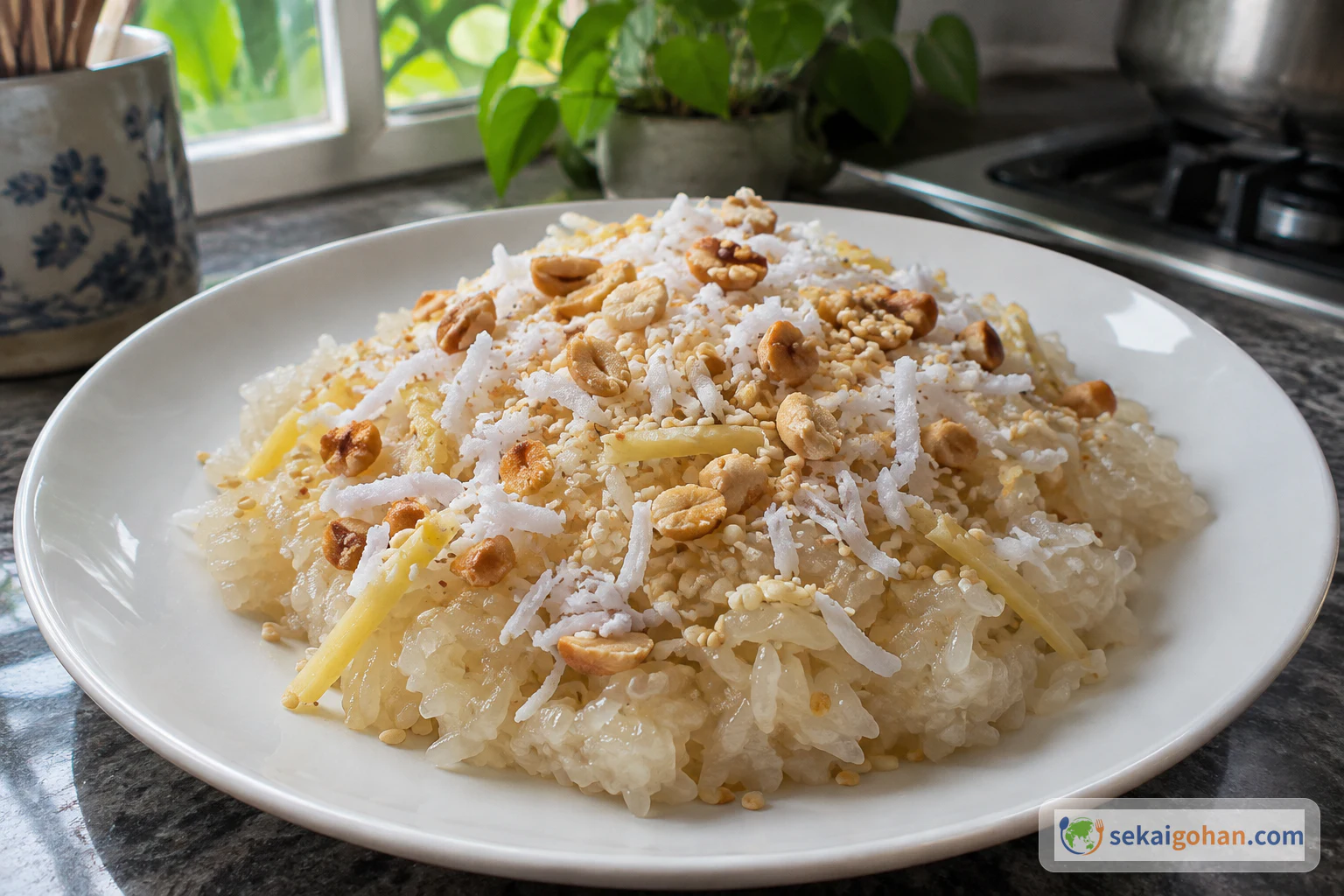
Som tam's partner is khao niao (ข้าวเหนียว), Thai sticky rice. In Isan it's a more common staple than jasmine rice, and it comes to the table in a bamboo basket (tip khao). Locals tear off a piece by hand, roll it into a ball and dip it in the som tam juices. The rice softens the heat and soothes a mouth made raw by capsaicin.
- Wash the sticky rice and soak it in plenty of water for at least 4 hours (overnight is best).
- Drain, line a steamer with parchment paper, and spread the rice over it.
- Steam over high heat for 20–25 minutes, turning the rice over halfway so it cooks evenly.
- When done, loosen gently with a rice paddle and keep warm in a lidded container.
Plain cooked white rice works. For the real experience, look for Thai glutinous rice at Asian grocery stores or online.
Green papaya contains papain, an enzyme that helps break down protein. That's one reason Thai meals pair som tam with meat dishes like gapao rice (in Japanese) and grilled pork neck (kor moo yang).
Storage
| State | Storage | Shelf life | Notes |
|---|---|---|---|
| Finished salad | Refrigerator | Same day | The papaya loses crispness quickly. Make it fresh |
| Finished salad | Freezer | Not recommended | The papaya collapses completely. Do not freeze |
| Shredded papaya only | Refrigerator | 1–2 days | Drain well and wrap. A few drops of lemon juice prevent browning |
| Dressing mix | Refrigerator | 3 days | Garlic, chiles, fish sauce, lime and sugar combined |
| Dried shrimp and peanuts | Room temperature | Several months | Airtight container, away from moisture |
Som tam is best eaten right after making it. After 30 minutes the papaya releases water, the flavor turns muddy and the texture goes limp. That's why Bangkok vendors make each plate to order. To save time, keep shredded papaya and the dressing mix in the refrigerator separately, then pound and toss just before eating. The actual cooking comes to under 5 minutes.
Nutrition
A serving (half the recipe) has about 220 kcal, 8 g of protein from the dried shrimp and peanuts, 5 g of fiber, 60 mg of vitamin C and 350 mg of potassium. The chiles and tomatoes add vitamin A. There's almost no oil and no cooking, so few nutrients are lost. Compared with Southeast Asian dishes built on coconut milk, like nasi lemak (in Japanese), or tamarind sauce, like pad Thai (in Japanese), som tam is one of the lightest and most vegetable-heavy. Capsaicin has been studied for small effects on metabolism, but it can also irritate the stomach lining, so go easy on the chiles if you have a sensitive stomach.
Variations
Som tam noodles have caught on in Bangkok in recent years. Boil rice noodles (sen lek), cool them in cold water and toss them in the dressing. It's a cold noodle dish, the opposite of stir-fried pad Thai (in Japanese), and it's especially popular in summer. Japanese somen or hiyamugi work too: just use the fish sauce, lime and chile dressing instead of the usual dipping sauce.
Som tam tacos are a popular street food at Bangkok night markets. Fill taco shells with som tam and serve with cilantro and lime, and the sour heat cuts through the richness. You could also wrap it in empanada (in Japanese) dough and fry it.
Japanese-style som tam is the easiest version for a Japanese home kitchen. Use shredded daikon, add myoga and shiso for aroma, and add 1 tbsp of ponzu in place of the fish sauce. It's a great side for grilled fish or fried chicken and holds up to strongly flavored dishes like adobo (in Japanese).
A som tam salad bowl turns the salad into a meal. Add grilled chicken, avocado and quinoa to shredded green papaya (or daikon) and toss with the som tam dressing. You get protein, healthy fats and fiber in one bowl, and at about 400 kcal it's a satisfying lunch. Swap in the chicken from shawarma (in Japanese) for a Middle East–meets–Thailand version.
More dishes to try
For more Thai classics, try pad Thai (in Japanese), a stir-fried noodle dish, and gapao rice (in Japanese), a basil stir-fry over rice. Elsewhere in Southeast Asia there's Vietnam's banh mi (in Japanese), Indonesia's nasi goreng (in Japanese), Malaysia's nasi lemak (in Japanese) and the Philippines' adobo (in Japanese).
Hummus (in Japanese) and tabbouleh are light, vegetable-centered dishes like som tam, and som tam also makes a good side for shawarma (in Japanese). Our overview of Middle Eastern cuisine (in Japanese) covers meze culture in depth. Senegal's thieboudienne (in Japanese) comes with a fresh salad, and our overview of South American cuisine (in Japanese) covers dishes made with raw vegetables and raw fish, such as Peru's ceviche (in Japanese).
Frequently Asked Questions
Where can I buy green papaya?
Asian grocery stores are your best bet, and you can often order it online. If you can't find it, shredded daikon is the closest substitute.
It is too hot for me. How can I tone it down?
Use just one chile, or take out the seeds, and the heat drops by about half. If it's already too hot, add more papaya, or eat it with sticky rice or cabbage. Milk and yogurt also help calm the burn of capsaicin.
Can children eat it?
Yes. Leave out the chiles and add a little more palm sugar for a mild version. In Thailand, people often make a zero-heat version for children called "som tam mai phet."