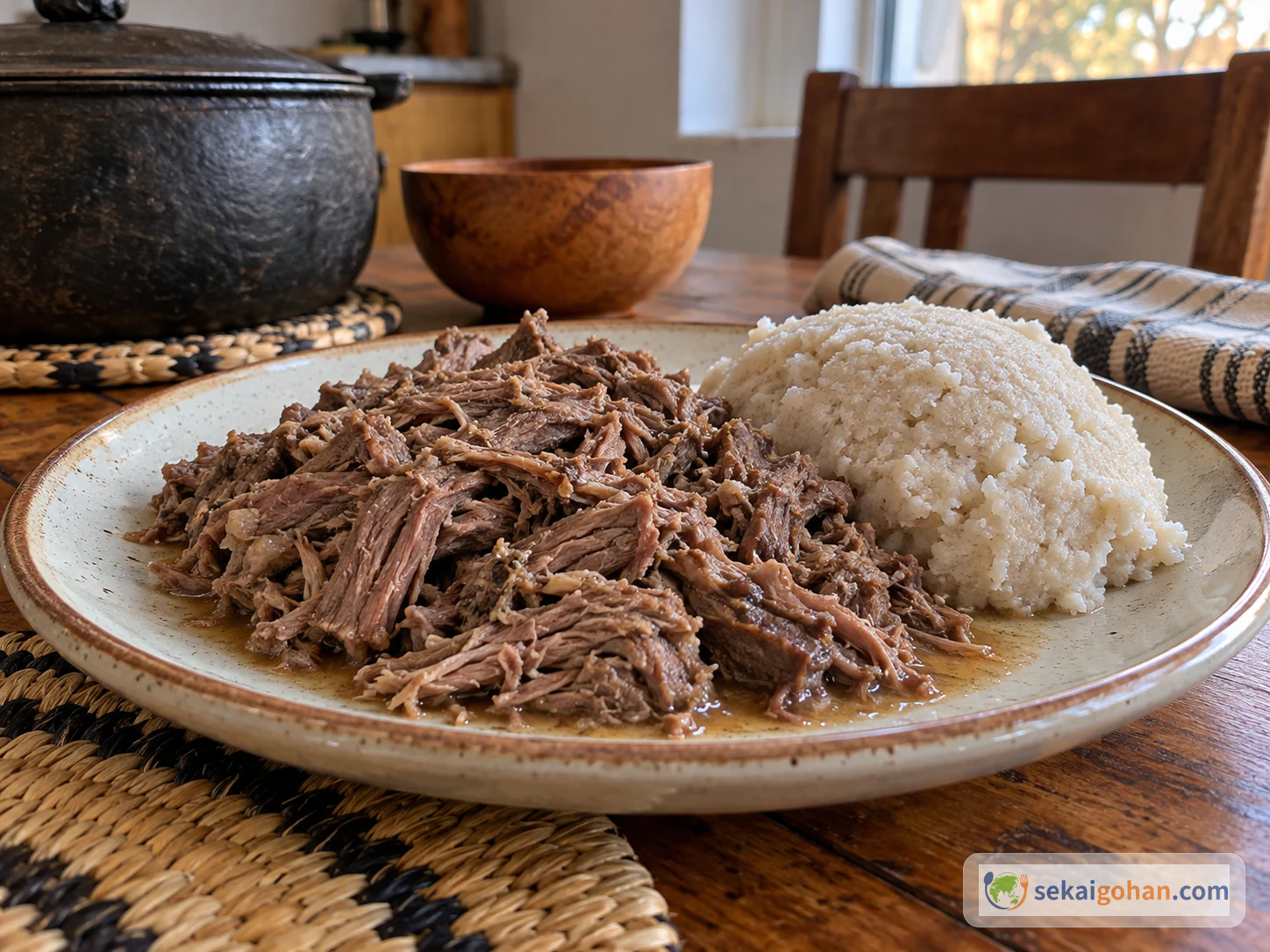
The edge of the pot trembles, and when you draw a wooden spoon through, a yellow path stays open for just a moment before it closes. Watching these small changes is half the pleasure of bogobe jwa lerotse, a stirred porridge from Botswana. Toasty sorghum flour is cooked with lerotse, an orange melon, and each serving comes with madila, a sour fermented milk. The result is a quiet, savory staple that anchors the table, good at breakfast and just as good at lunch with greens or a stew.
Bogobe jwa lerotse and the lerotse melon
Lerotse looks a lot like a watermelon, but it isn't very sweet, and raw it has a green aroma close to cucumber. You won't find it in a supermarket outside the region. In this version, pumpkin supplies the color and body, a small amount of cucumber brings back the aroma, and unsweetened yogurt stands in for madila. It isn't a perfect substitute, but it keeps the core of the dish: the grain of the sorghum, a faint melon note, and something sour on the side.
Bogobe belongs to the big family of African stirred staples. Tanzania's ugali is white corn flour worked with force, and in Burkina Faso's tô the sauce picks up the aroma of sorghum. Bogobe jwa lerotse adds the softness of Botswana's melon. It is less springy than Ghana's fufu and lighter on leaves than Cameroon's sanga. If you're new to porridges made by stirring flour, start with this soft one and then try ugali and tô, and you'll feel how the heat changes things. If you like a sweet root porridge, Nigeria's asaro gives a similar kind of pleasure.
Ingredients (serves 4)

Skip the madila-style accompaniment if you have a milk allergy, since it uses dairy. The bogobe itself uses no wheat, but depending on the flour's production line, wheat can be present. If you avoid gluten strictly, check the product labels.
Ingredients that give you pause when shopping
The flour and the pot are what is worth seeking out for this dish, not the vegetables. Pumpkin, cucumber and yogurt are easy to find at a nearby supermarket. Do not replace the sorghum flour with only corn flour, or the porridge becomes a different dish. Look for sorghum flour and cornflour at a health-food or specialty grocer or online. A heavy two-handled pot of about 8.5 inches (22 cm) makes it easy to keep a low heat.
Choosing ingredients and substitutes for bogobe
On paper, bogobe jwa lerotse looks like pumpkin porridge, but the dish depends on four things together: lerotse, sorghum, madila, and the way you stir. When you substitute, decide what each one has to keep before you reach for whatever is at hand.
| Element | The local idea | Where to land elsewhere |
|---|---|---|
| Lerotse | An orange melon. Faint aroma and moisture matter more than sweetness | Pumpkin for color and body, a little cucumber for green aroma |
| Sorghum flour | The star that makes grain aroma and stickiness | Use white sorghum flour. Don't make it entirely corn flour |
| Madila | The sourness of fermented milk lightens the porridge | Loosen unsweetened yogurt with milk and add no sweetness |
| Stirring | Cut lumps with a wooden spoon or traditional whisk | Make a slurry first and turn from the bottom over low heat |
Pumpkin is convenient, but a very sweet variety pushes the porridge toward dessert, so watch the sweetness when you taste. Go easy on the cucumber, too: it should be just a hint of aroma, and at 1.5 oz (40 g) or more it starts to smell grassy.
How to make it
If you put the flour directly into the pot, it tangles with the fibers of the pumpkin and lumps tend to remain. Smoothing the pumpkin first and adding the flour after dissolving it in water makes it easy to handle even on a home burner.
Common bogobe problems and how to fix them
The tricky part of bogobe is knowing when to stop. Each pumpkin variety holds a different amount of water, and each sorghum flour absorbs it differently, so follow the amounts and then adjust at the end by eye: the track the wooden spoon leaves, the way the bubbles rise, and the shape the porridge holds when dropped onto a plate.

| Condition | How it looks in the pot | How to fix |
|---|---|---|
| Lumps remain | White flour grains hit the tongue, small clumps cling to the spoon | Add 2 tbsp boiling water and stir 2 minutes over low heat. Strain large clumps through a sieve and return |
| Too firm | Falls in a crumbly way when scooped, corners stand on the plate | Add 2 tbsp boiling water at a time and stir 1 minute each over low heat |
| Too loose | Spreads on the plate and won't mound | Remove the lid and stir 2 minutes at a time over low heat to evaporate moisture |
| Too sweet | The pumpkin's sweetness leads and it doesn't feel like a meal | Add 1/6 tsp salt and increase the lemon juice in the yogurt sauce by 1/2 tsp |
| Grassy | Cucumber aroma comes first and the porridge's toasty note is weak | Halve the cucumber next time. This time serve more yogurt sauce |
Large clumps of flour are faster to strain out than to crush in the pot. To avoid them next time, always mix the flour with water into a slurry before it goes in.
If the bottom starts to scorch, leave the burnt layer where it is so the taste stays clean. Move only the clean porridge on top to another pot, add 2 tbsp boiling water, and bring it back over low heat. With stirred porridges, it's better to rescue the good part early than to fight with the same pot to the end.
Serving and storing bogobe jwa lerotse
Bogobe is softest while hot; as it cools, the flour tightens and the porridge firms up. Mound it in the center of a plate, with the madila-style yogurt on one side and greens or a bean stew on the other, and each bite moves from sour to grain to salt. To eat it the way it's often eaten locally, pinch up a mouthful with your fingertips and dip it in a little sauce. At home, a spoon is fine.
Leftovers keep up to 2 days in the refrigerator. Spread the porridge in a shallow container to cool and press plastic wrap against the surface so it doesn't dry out. To reheat, add 2 tbsp water per serving, microwave at 600 W for 1 minute 30 seconds and stir, adding 30 seconds at a time if needed. On the stove, use low heat and add boiling water 2 tbsp at a time while stirring with a wooden spoon. You can freeze it, but after thawing it turns a little grainy, so it's better in a soup than served as a staple.
Frequently asked questions
Can I buy lerotse elsewhere?
It almost never turns up at ordinary supermarkets or import grocers. You may find seeds or plants, but finding the fruit reliably for cooking is difficult, which is why pumpkin and cucumber recreate its color, moisture and faint melon aroma here.
Can I make it with pumpkin alone, without cucumber?
Yes. The cucumber is only there for aroma, so the porridge holds together without it. Pumpkin alone tends to taste sweet and round, though, so bring back the feel of a staple with salt and the sourness of the yogurt sauce.
If I have no sorghum flour, is cornflour alone fine?
You'll get an edible porridge, but it drifts away from bogobe jwa lerotse and toward ugali or polenta. For a first try, I recommend adding at least a little sorghum flour so you can taste its grain aroma.
Can I stir yogurt into the pot in place of madila?
Yogurt tends to separate when heated, so serving it on the plate is the safer choice. Some local recipes fold fermented milk into the stew, but in a small home pot the sourness fades and the porridge tends to look grainy.