
Cassava Leaf Stew: Sierra Leone's Rich Leaf Stew with Rice

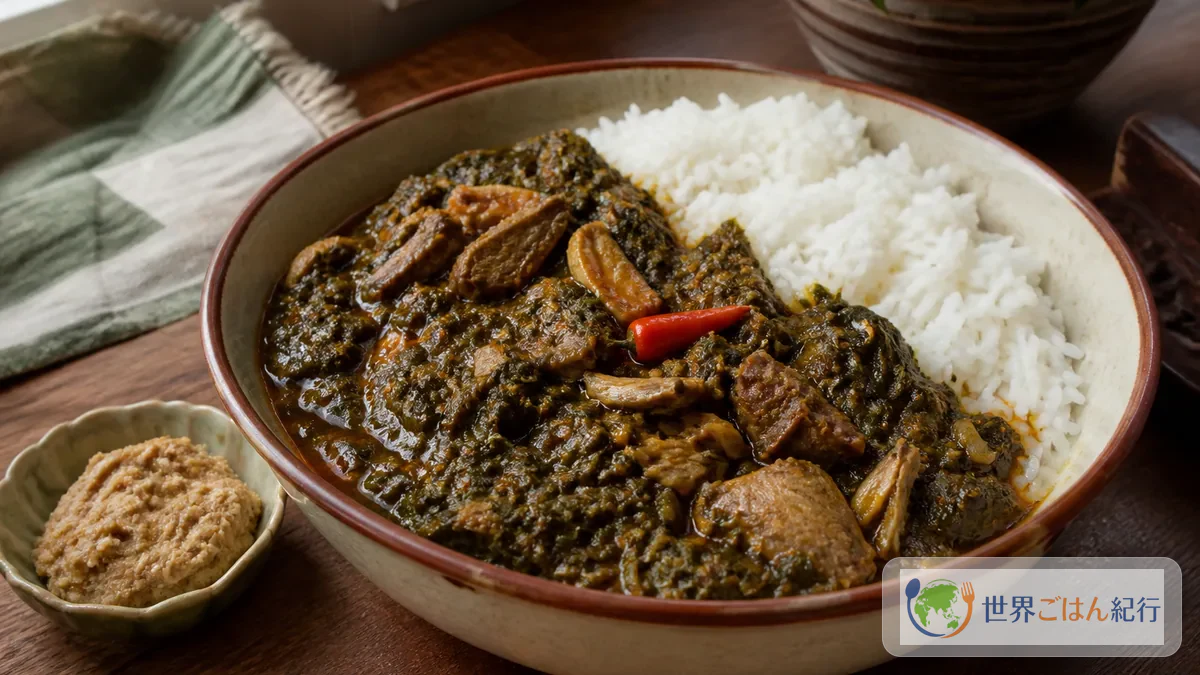
Sierra Leonean dish: dark green cassava leaf stew beside white rice, with the color of red palm oil floating on the surface
Prep
30 min
Cook
1 hr 15 min
Total
1 hr 45 min
Serves
4 servings
Level
Intermediate
Cuisine
Sierra Leonean

Cassava leaf with rice is a Sierra Leone stew served over rice, with cassava leaves, red palm oil, peanuts and smoked fish. Covers substitutes and cooking.

Cooking flow

Cooking steps

STEP11 / 6

Simmer the beef and collect the cooking liquid

35–45 min

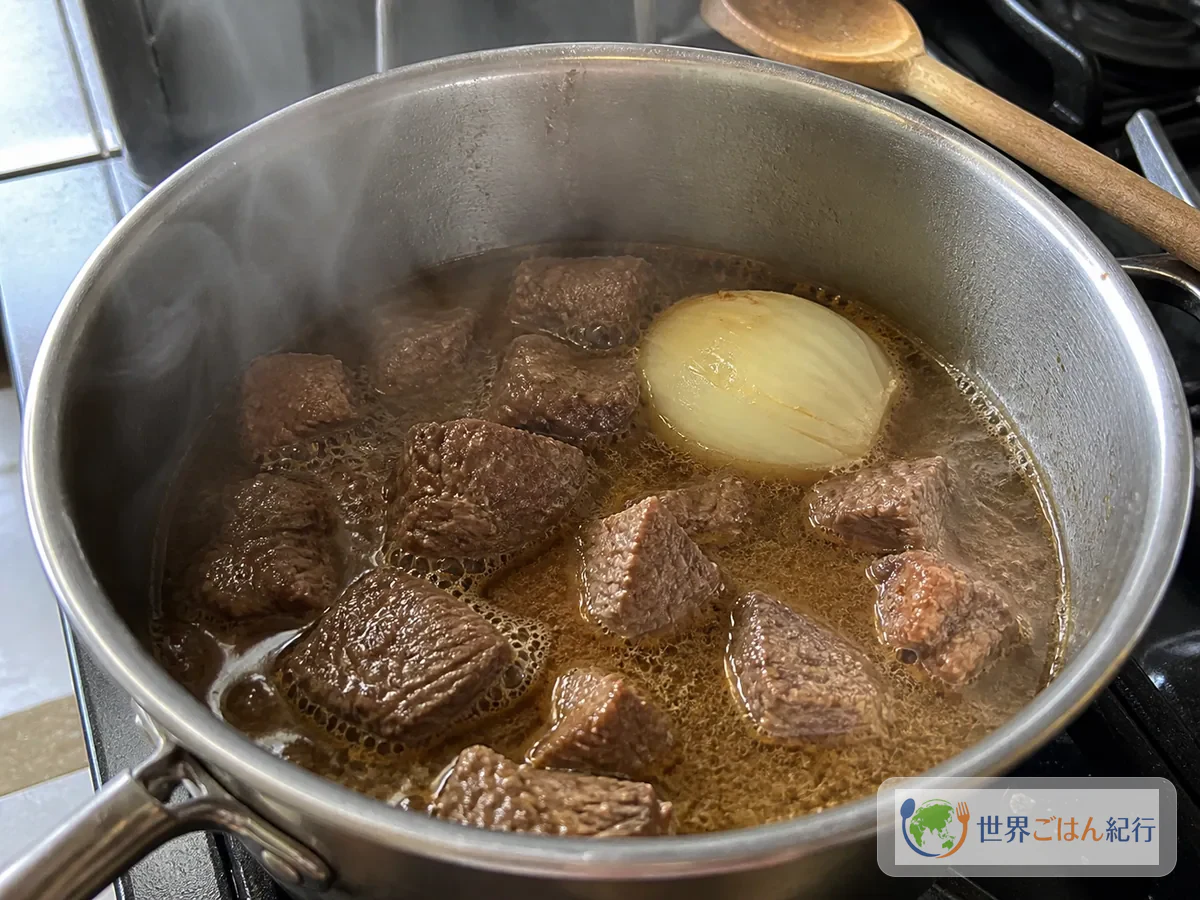
A pot with beef simmered with onion and water, the meat removed and the cooking liquid left
Simmer the beef until tender and use the savory cooking liquid in the leaf sauce

Cut the beef into 1 inches (3 cm) cubes and put it in a pot with 2 g salt, 1.75 oz (50 g) onion and 2 cups (500 ml) water. Bring to a boil over high heat, lower to low heat, and simmer with the lid slightly ajar for 35–45 minutes. Turn off the heat when chopsticks go into the center of the meat and the liquid shows cloudy fat and the aroma of meat. Take out only the meat, strain the liquid, and add water to make 2½ cups (600 ml).

If beef round is still tough, don't rush it into the leaf pot; add liquid and extend 10 minutes at a time. Getting the meat fully tender at this point keeps you from extending the leaf-simmering time more than necessary at the end. The fat floating on the cooking liquid mixes with the red palm oil, so you can leave about 1 tbsp.

STEP22 / 6

Check the label and condition of the cassava leaves

10 min

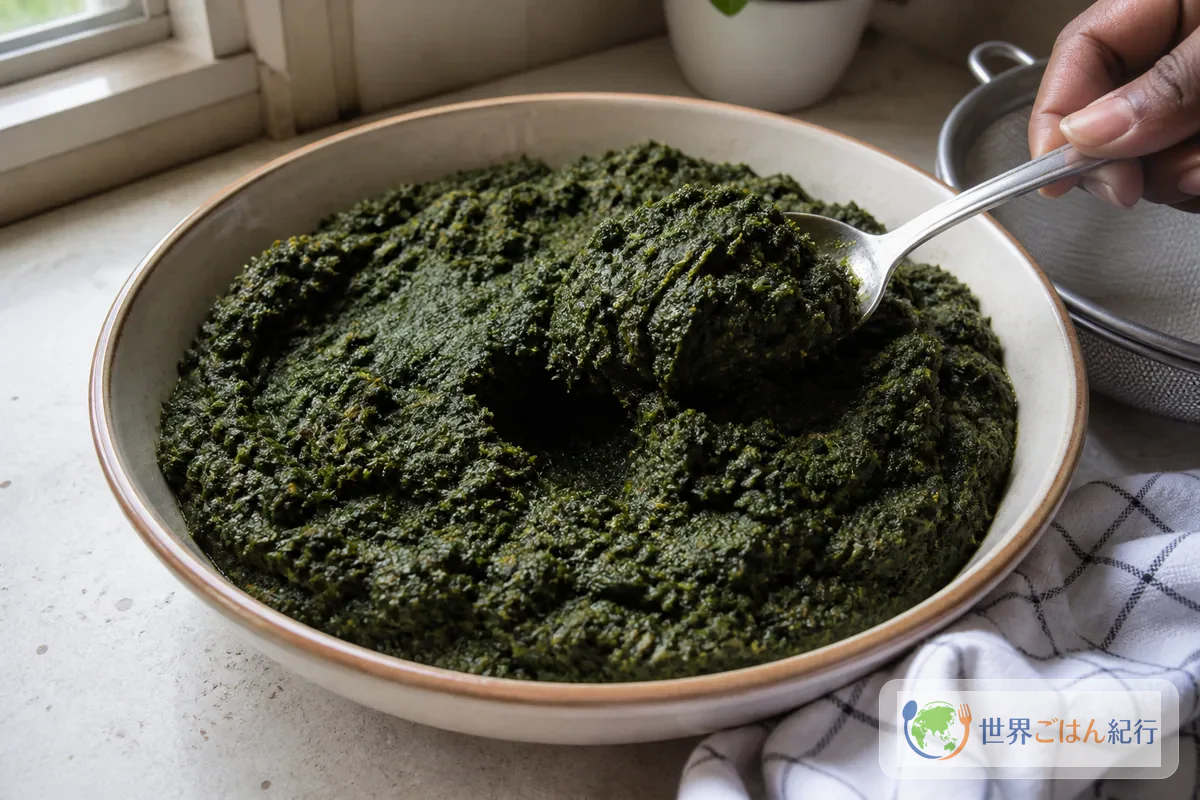
A bowl of processed frozen cassava leaves with the label checked, thawed to a fine green paste
Use edible, processed frozen cassava leaves and check their coarseness after thawing

Thaw the frozen cassava leaves in the refrigerator and check that the bag is labeled edible, processed, pounded, minced or similar. After thawing, if the leaves are not a frozen lump but an even paste that loosens with a spoon, check the moisture. If there is a lot of water, drain lightly in a strainer. If large leaf veins remain, chop to 0.25 inch (5 mm) widths with a knife. Do not use leaves whose bag gives no processing method or whose seller you can't confirm; replace them with spinach.

If making it with spinach, cook 1 lb (500 g) as the label says, squeeze out the water well and chop to 0.25 inch (5 mm) widths. The green fades faster than with cassava leaves and it comes together in a 20–25 minute simmer, but the stickiness and fibrousness are lighter. Raw cassava leaves cannot be handled like leaves thawed in this step.

STEP33 / 6

Crush the onion, eggplant and chili

10 min

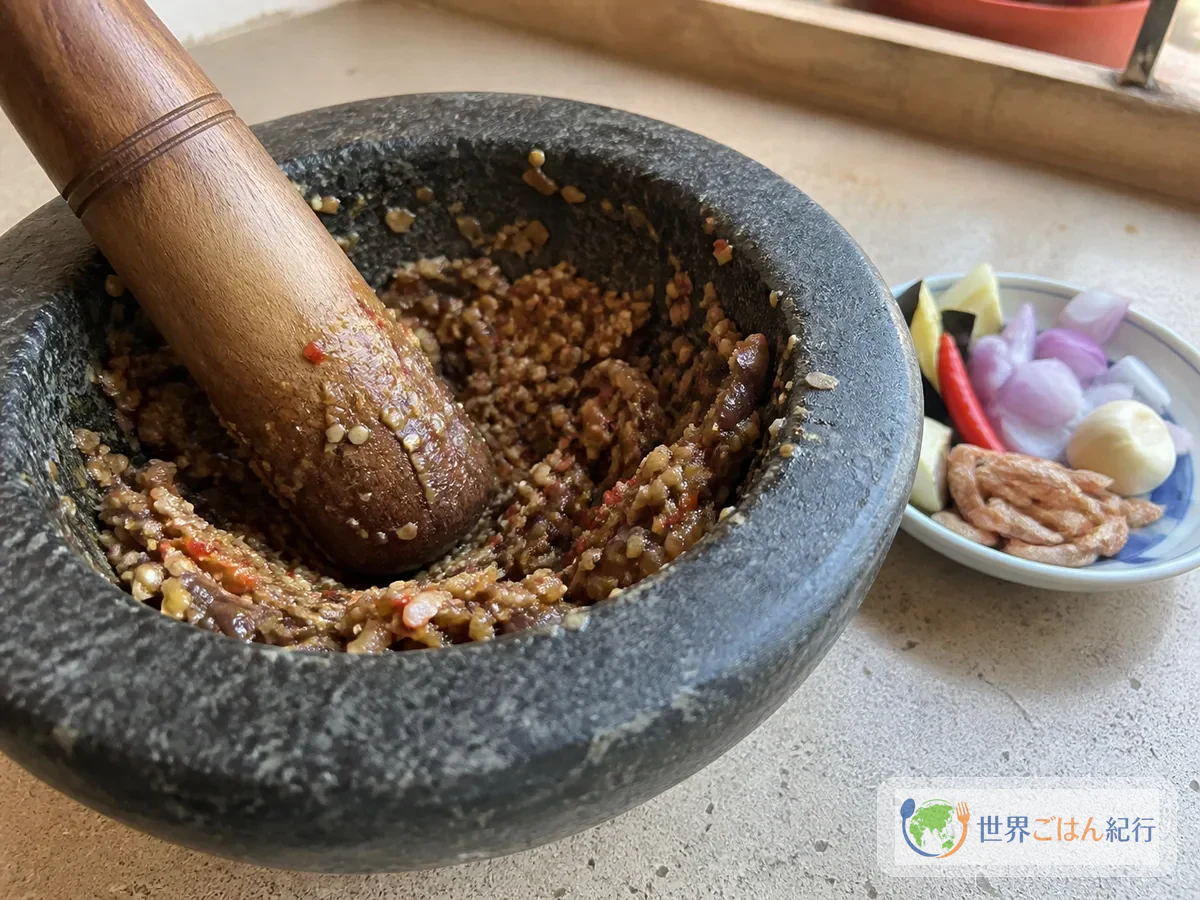
A bowl of onion, eggplant, garlic, chili and dried shrimp made into a fine green aromatic paste
The aromatics should be a slowly falling paste, not a complete liquid

Put 5.5 oz (150 g) onion, 5.5 oz (150 g) eggplant, the garlic, chili and 10 g dried shrimp in a blender, add ½ cup (100 ml) of the beef cooking liquid, and make a coarse green paste. Don't make it completely liquid; it should be thick enough to fall slowly from a spoon. If your blender is small, do it in two batches.

If you want to keep the aromatics in pieces, crush the onion and eggplant a little at a time in a mortar and add the chili and dried shrimp last. Pieces left large burn easily on the bottom of the pot, so make them fine, about 2–3 mm. Even if you reduce the heat, cut back only the chili and keep the water from the onion and eggplant.

STEP44 / 6

Cook the aromatic paste in red palm oil

12–15 min

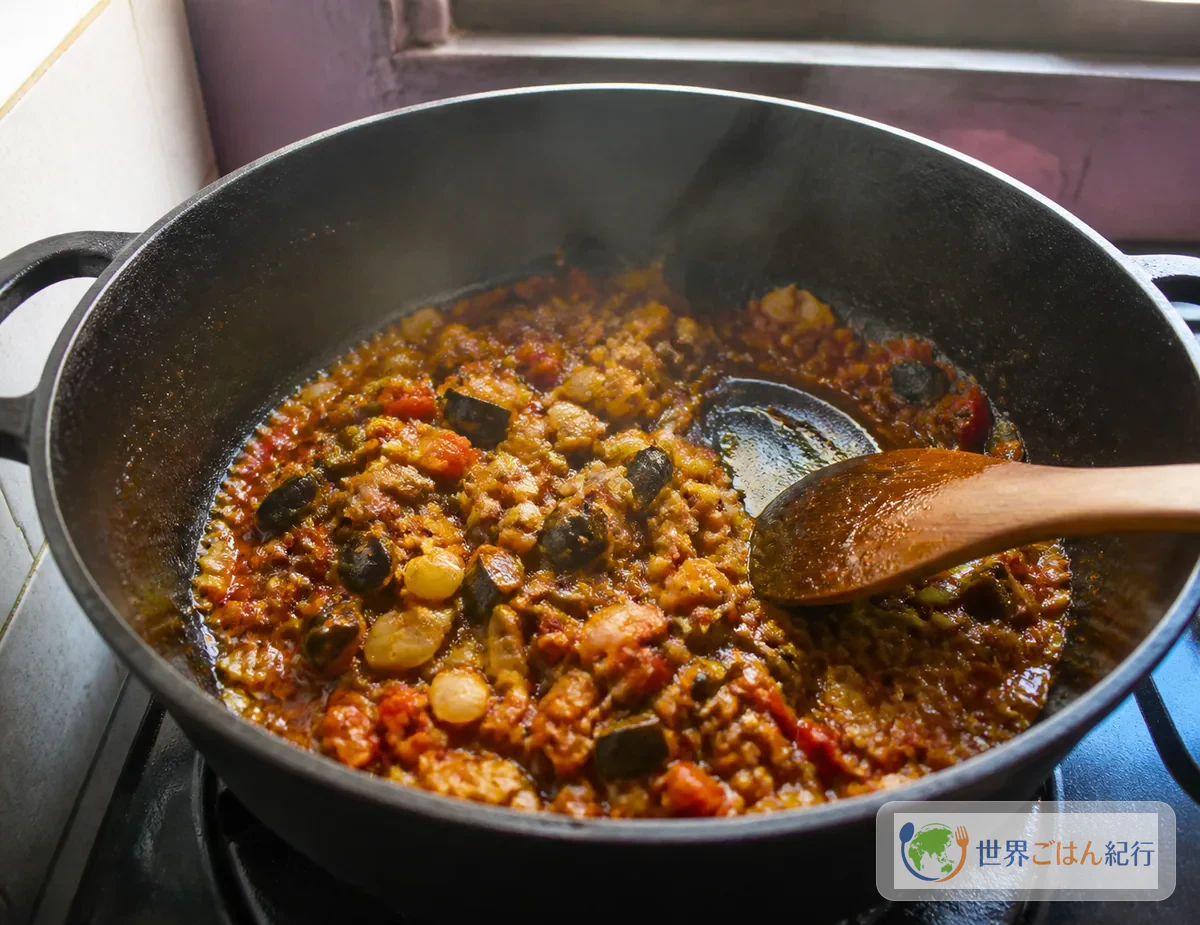
Cooking an onion and eggplant paste in red palm oil until the oil begins to return to the edge of the pot
Cook over medium-low heat until the raw smell of the paste is gone and the oil returns to the edge

Put 2 tbsp (30 ml) red palm oil in a heavy pot and warm it over medium-low heat. Add the aromatic paste and cook 12–15 minutes, tracing the bottom of the pot with a wooden spatula. Keep the paste pieces at 2–3 mm, and aim for a thickness where the trail of the spatula stays about 2 seconds. At first the water spatters; it is enough when the raw onion smell is gone, the paste has taken up the oil and come together evenly, the color has darkened and the oil begins to return to the edges. If it threatens to burn, lower the heat and add the beef cooking liquid 1 tbsp at a time.

Because the eggplant gives off water, trying to fry it through in a short time only burns the surface and leaves the aroma inside. Keep a heat that forms a thin film on the bottom of the pot, and don't stir in any black burnt bits. If bitter burnt flavor spreads, move the paste to a new pot and discard the burnt bottom.

STEP55 / 6

Add the leaves, peanuts and cooking liquid and simmer

35–50 min

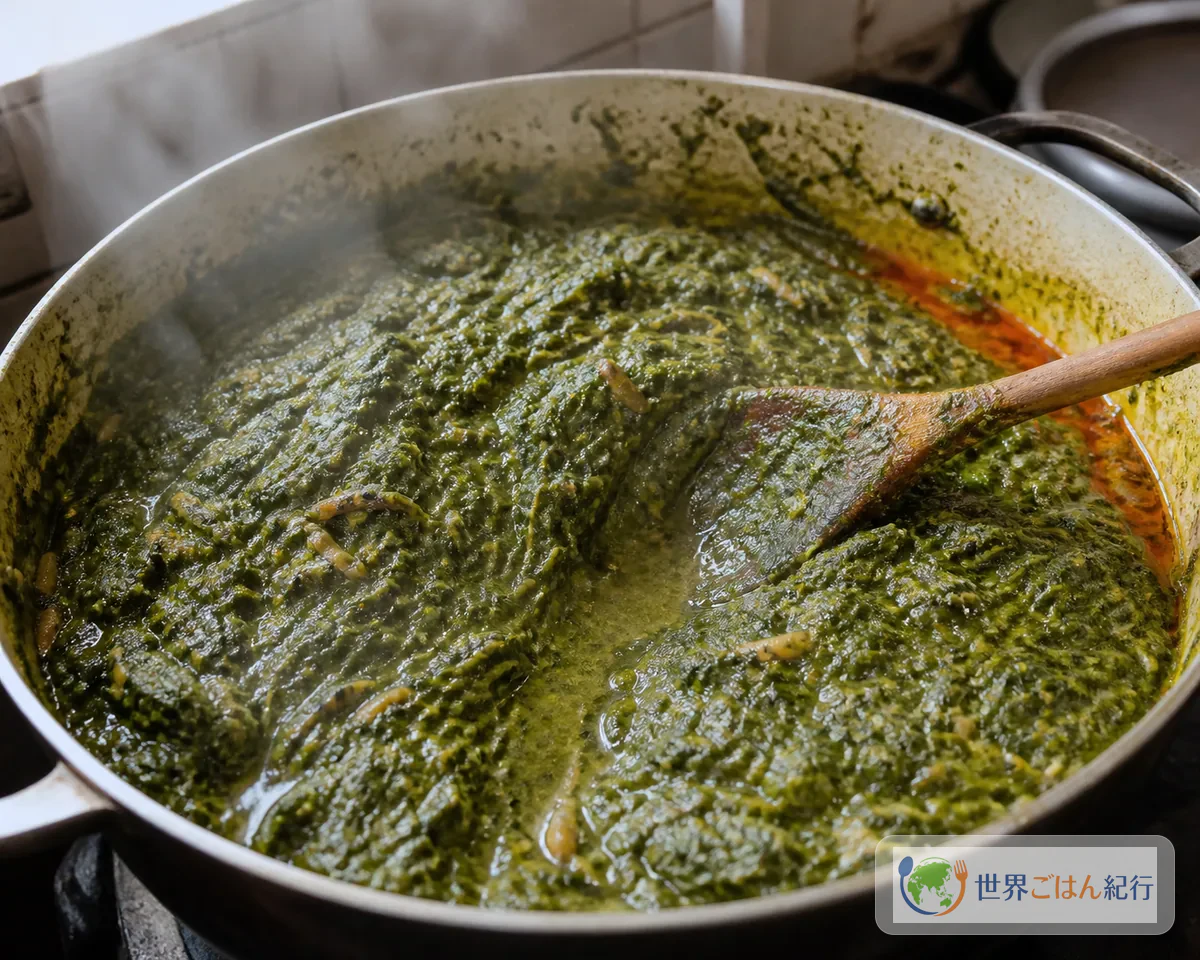
A pot simmering a deep green sauce after adding cassava leaves, peanuts, dried shrimp and red palm oil
The leaves take up the cooking liquid and peanuts; simmer until it is thick enough to leave a trail from a spoon

Lower the heat and add the cassava leaves, the remaining 20 g dried shrimp and 1¾ cups (400 ml) of the beef cooking liquid. Dissolve the peanut butter with ½ cup (100 ml) cooking liquid in a separate bowl before adding it to the pot, then add the remaining 3.5 tbsp–¼ cup (50–70 ml) red palm oil and stir. When it boils, set the lid slightly ajar and simmer over low heat for 35–45 minutes, until the leaf fibers are no longer noticeable on the tongue.

Turn it from the bottom once at the 20-minute mark, and if there isn't enough liquid add 3.5 tbsp (50 ml) of hot cooking liquid at a time. As it nears done, the color goes from bright green to deep green, and the trail left by tracing the bottom of the pot with a spoon stays 2–3 seconds. If it is runny, take the lid off for 5–10 minutes; if stiff and heavy, add a little hot cooking liquid.

If the green raw smell of the leaves remains, simmer 10 minutes more over low heat. A longer simmer does not make leaves of unknown processing safe. Do not eat cassava leaves without a label; make it again with spinach.

STEP66 / 6

Return the beef and smoked fish and serve over white rice

10–15 min

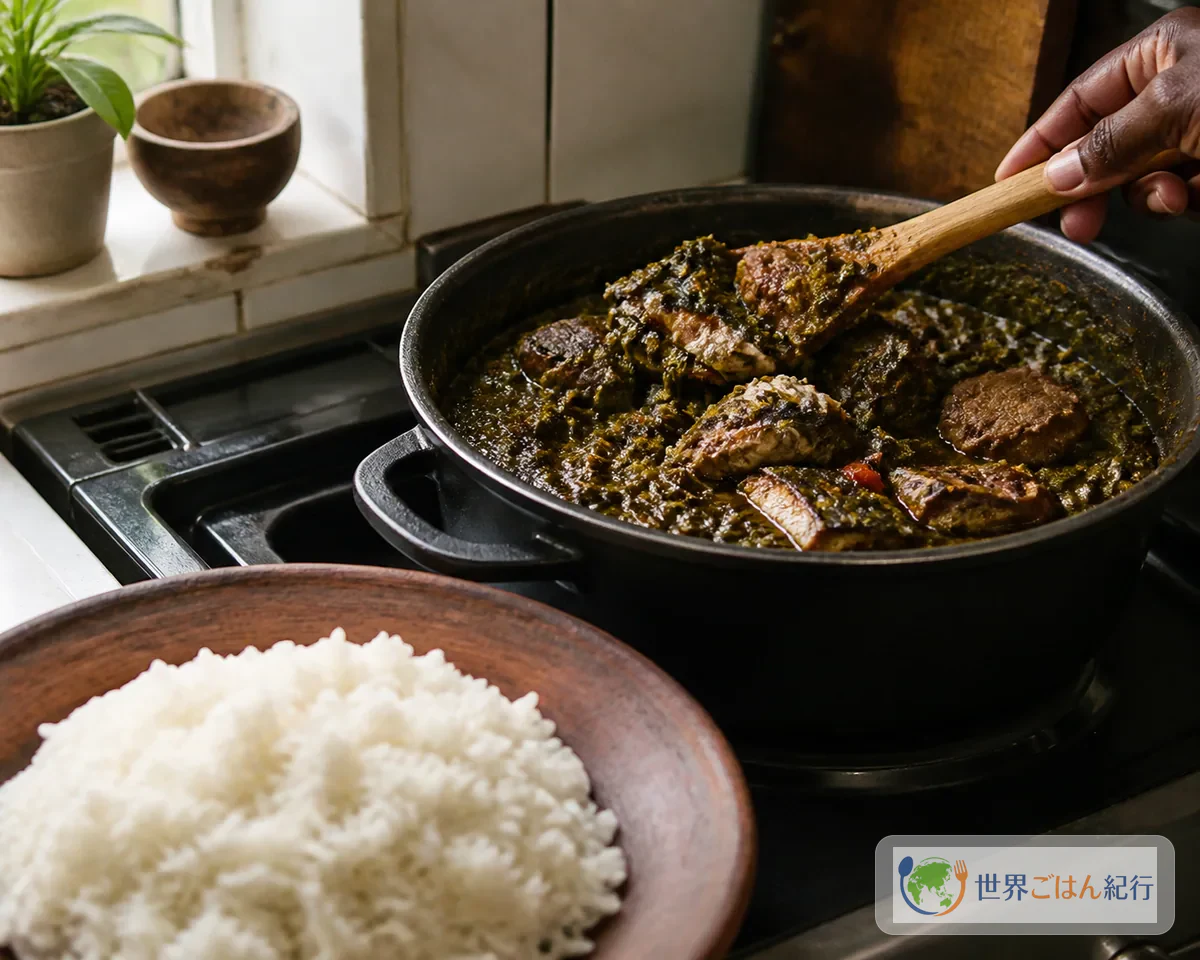
A pot just before finishing, with deep green cassava leaf stew over white rice and the smoked fish and beef visible
Return the beef and smoked fish at the end, and eat with the sauce beside white rice

Remove the bones and skin from 5.5 oz (150 g) smoked fish and flake it into 2–3 cm pieces. Return the beef and smoked fish to the leaf sauce and simmer 10–15 minutes over low heat. A hard boil breaks the fish into small bits, so keep a heat at which the center of the pot just trembles gently. Add salt a little at a time and stop before the saltiness of the fish and dried shrimp takes over.

Mound freshly cooked white rice on a large plate or a deep bowl, and put plenty of sauce beside it. It is done when a thin line of red palm oil floats on the surface, there is no raw green smell from the leaves, and the sauce stays on top of the rice without running off. To vary the heat, don't add more chili at the end; mix a little chili powder into each portion in the individual bowl.

0 / 0
Ingredients

Ingredients

1 / 1

Ingredients

Ingredient Amount Substitutes & notes
Frozen cassava leaves (edible, processed) 500 g Finely chopped frozen product. If unavailable, replace with 500 g frozen spinach
Beef shoulder or beef round 400 g 3 cm cubes. Chicken thighs or bone-in goat also work
Smoked fish (smoked mackerel or similar) 150 g Flesh with bones and skin removed. If using dried fish, soak out the salt
Dried shrimp 30 g 10 g for the aromatic paste, 20 g for the stew. Shrimp powder also works
Unsweetened peanut butter 80 g Avoid kinds with sugar or honey. For coarse ground peanuts, 90 g
Red palm oil 80–100 ml Mild rapeseed oil also works, but color and earthy aroma are weaker
Onion 200 g For the aromatic paste. One large onion, roughly chopped
Eggplant 150 g Builds a thickness close to the local garden egg. Ordinary eggplant is fine
Garlic 2 cloves Can be omitted
Scotch bonnet or habanero 1/2 to 1 Can be replaced with 1–2 g chili powder. Adjust the heat at the end
Water or unsalted beef stock 600 ml Includes the beef cooking liquid. If the stock is salty, reduce the salt
Salt About 5 g Decide after tasting the smoked fish and dried shrimp
White rice 2 rice-cooker cups About 360 ml uncooked. Serve freshly cooked. If replacing with fufu, prepare it separately
0 / 0

You spoon the deep green sauce over freshly cooked white rice, and a thin line of orange red palm oil floats on the surface. The simmered leaves give off an earthy aroma rather than a raw green smell. This is cassava leaf stew from Sierra Leone: pounded cassava leaves cooked with palm oil, peanuts, fish or meat, and spices. The more you chew, the more the saltiness of smoked fish and the roundness of groundnuts soak into the rice.
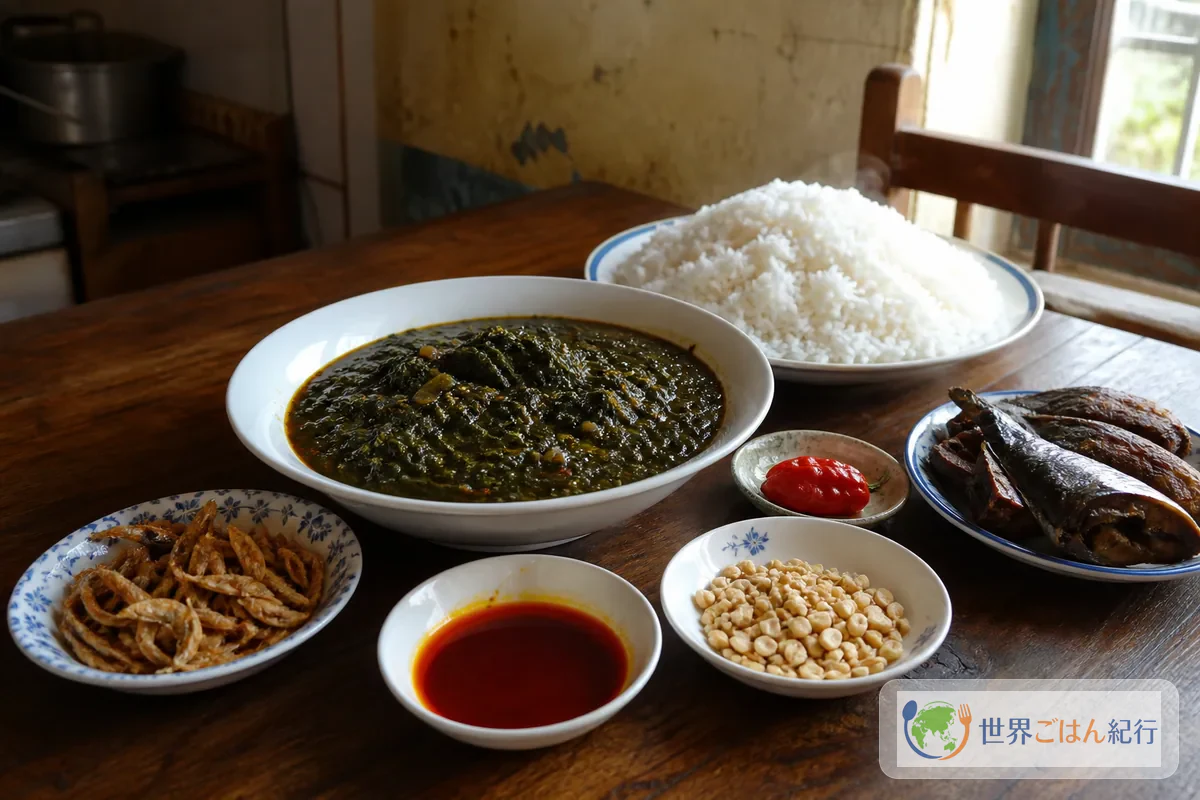
A Sierra Leonean table: white rice with plenty of deep green leaf sauce and a thin line of red palm oil floating on top
Sierra Leone's cassava leaf stew, served with a rich leaf sauce over rice

Cassava leaf stew in Sierra Leone

In English it often goes by cassava leaf soup, but it is really a thick stew. Plasas is a broader name for any dish of crushed leaves simmered this way, not only cassava leaves. Plasas has links to the Mende people, while cassava leaf stew itself is an everyday food across Sierra Leone.

Rice is the staple served with most fish, meat and vegetable dishes in Sierra Leone. Sauces made with cassava, yam, groundnuts and leafy greens are eaten with it, taken up by plain white rice or by fermented staples such as fufu. Cassava does double duty in this kitchen. The root goes into stews and flour, and the leaves are simmered long to remove bitterness and made into sauces for grains, meat and fish. Cooking with the leaves, not just the root, is what defines this dish.
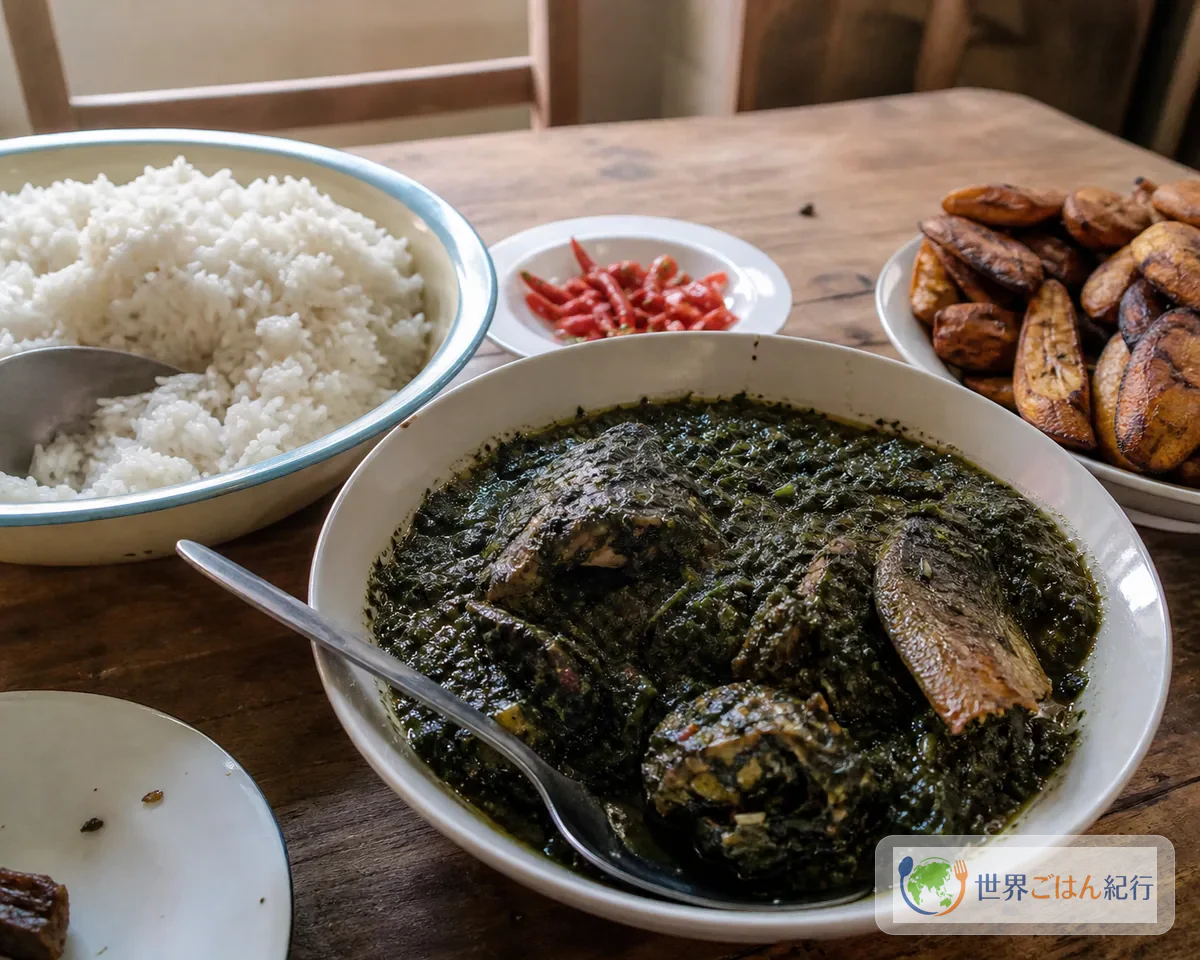
A table evoking West African home cooking: a platter of white rice, a deep green leaf stew, chili and a wooden spoon
A table for cassava leaf stew, with a rich leaf sauce over rice

Leaf stews called saka saka or pondu are found in Liberia, Guinea and Central Africa. The leaves may come from the same plant, but change the oil, fish, groundnuts, kind of leaf or staple and you get a different home dish. So think of cassava leaf stew as a dish that regions and households reshape with their own ingredients, not as one family's or one ethnic group's fixed recipe.

Groundnut is the English term for peanuts. Peanut butter or crushed peanuts give the leaf sauce its body, and red palm oil carries its orange color alongside the aroma of smoked fish. As long as you keep the oil and peanuts, the dish holds its character even if you switch to spinach. Ghanaian groundnut soup is another peanut stew, but there tomato and meat come to the front. The mouthfeel is quite different from this pot, where the leaves are the star.

Ingredients | Serves 4, with substitutes
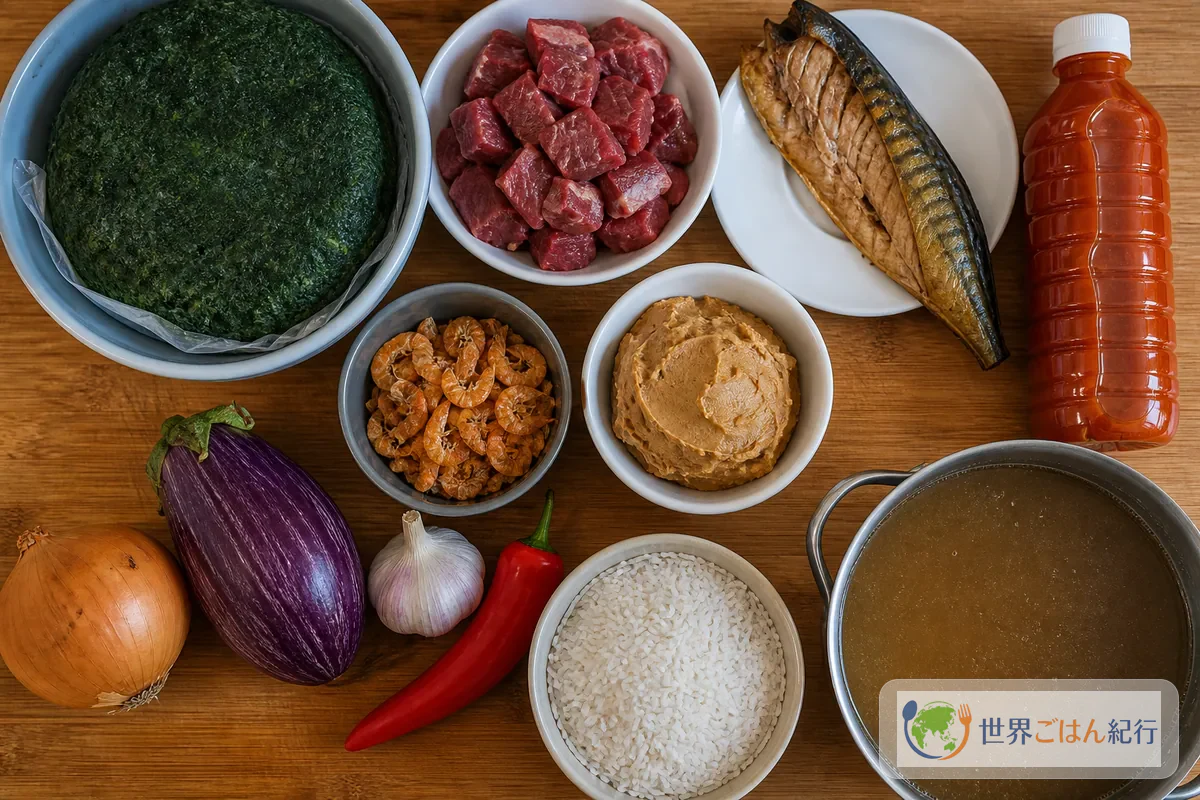
Ingredients: processed frozen cassava leaves, beef, smoked fish, dried shrimp, red palm oil, peanut butter, eggplant and onion laid out
Ingredients for cassava leaf stew. Use edible, processed frozen cassava leaves

Cassava, the local name, is also called yuca. What is used in this dish is the leaf, not the root, so buying cassava flour or tapioca flour is not a substitute. When searching an import grocer, look for pounded cassava leaves or minced cassava leaves as well as cassava leaves.

Do not use raw cassava leaves, leaves with no stated processing method, or leaves sold as ornamental plants. Pounding the leaves for 10 minutes or more and washing them in twice their weight of water, or soaking them in 122°F (50°C) water and changing the water, does not guarantee safety at home, since results vary with variety, leaf condition and processing environment. So this recipe uses the commercial processed frozen product.

Red palm oil does more than add red color. It rounds the faint bitterness of the leaves and places an earthy, nutty aroma between the smoked fish and the peanuts. When you buy it, check the label for edible, red palm oil or red palm, and check the volume. If you will try the dish only once, or dislike a strong oily aroma, skip it; the dish still works with rapeseed oil.

Peanuts here are not for adding sweetness but for thickness that ties the leaf fibers to the cooking liquid. Choose one whose ingredients are mainly peanuts, with no sugar or honey. If you are unsure how much to buy, about 5.5 oz (150 g) is enough. If you crush peanuts yourself, use raw unsalted ones, and loosen them with warm stock before adding to the pot so no lumps remain.

Choosing cassava leaves and other ingredients

If you are unsure about getting leaves, don't keep searching for untreated fresh leaves; use a processed frozen product labeled as edible, or replace them with spinach. Cassava leaves have a higher concentration of cyanide compounds than the root, and heat alone does not reliably make them safe. The main method here uses a frozen product whose bag is labeled minced, pounded or processed, from a seller you can confirm.

Some versions use potato leaves instead of cassava leaves. Use them only if you can confirm they are sold as food, and never from a home garden. Otherwise, stick to spinach sold as food as your substitute.

Red palm oil runs from ¼–½ cup (80–100 ml). The first time, start with ¼ cup (80 ml) and add more after watching the aroma and how the oil floats. Choose unsweetened peanut butter. The nutrition values include the white rice, and they shift with the saltiness of your smoked fish, dried shrimp and stock.

A blender turns the aromatics smooth, and the sauce comes together quickly. For a result closer to the local texture, crush the onion, eggplant and chili in a mortar, leaving a few pieces. A mortar is worth buying if you often cook with dried chilies and dried shrimp; otherwise, a blender is enough.

Instructions | Unwind the bitterness into a rich sauce
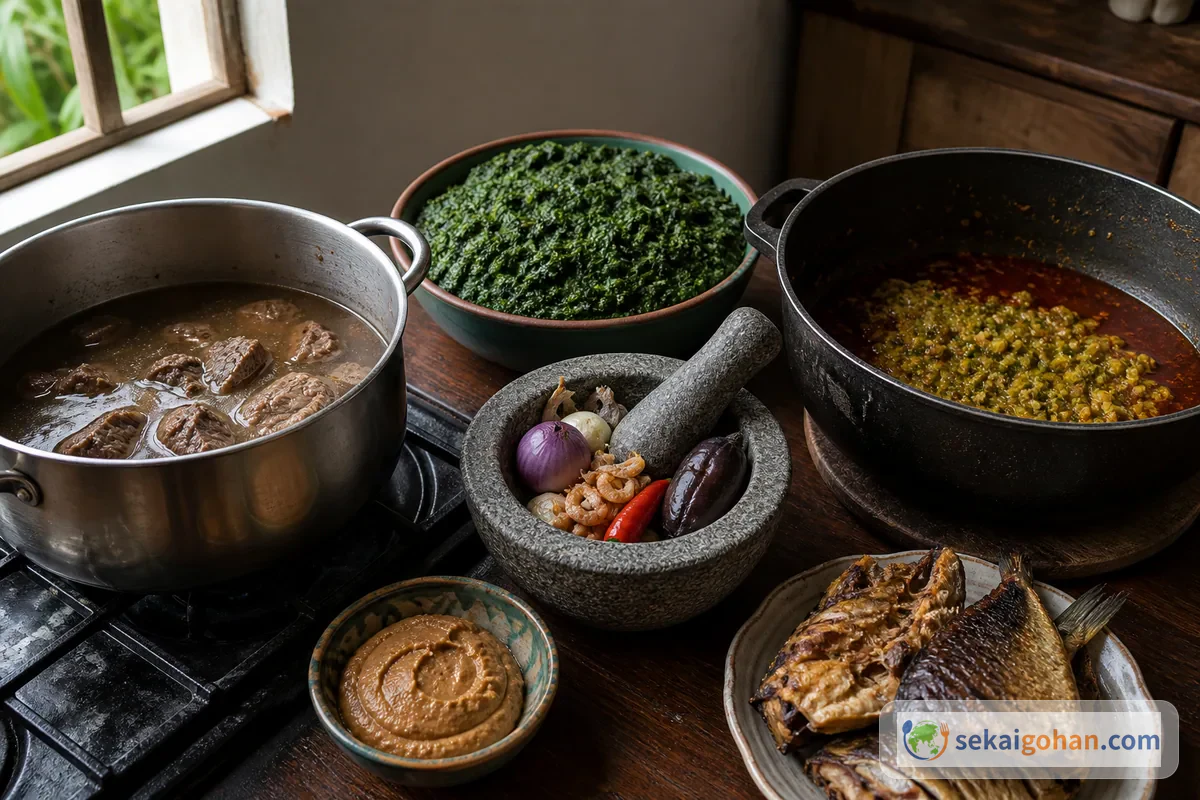
The pot and tools for finishing cassava leaf stew with beef cooking liquid, green leaves and red palm oil
Cassava leaf stew layers beef cooking liquid, leaves and the aromatic paste in turn

You do not need two pots. Simmer the beef first, thin the leaf sauce with that liquid, and put the meat and fish back at the end. Because cooking time changes with how fine the leaves are, watch the aroma, color and the trail of a spoon, not just the clock.

Judging the heat and texture of cassava leaf stew
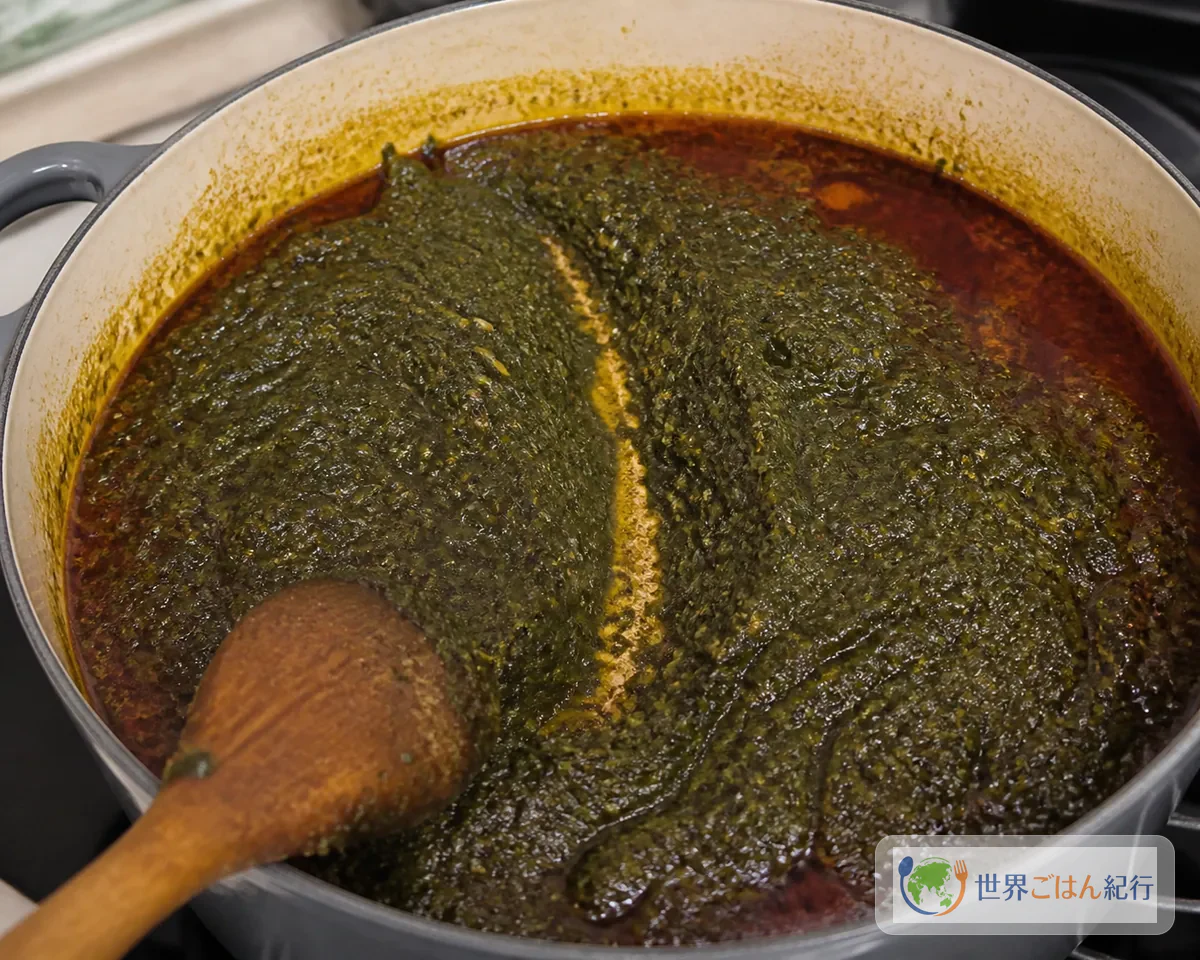
Tracing the bottom of the pot with a spoon, the dark green sauce slowly closing back in on cassava leaf stew when finished
The sign of done is a trail on the pot bottom that stays for a few seconds and oil returning to the edge

The pot behaves a little differently every time, depending on the moisture in the leaves and the saltiness of the dried fish. Check these three things before you extend the time or add cooking liquid.

The coarseness of the leaves goes straight into the cooking time

With finely crushed leaves, the fibers loosen in 35–45 minutes. Coarse leaves, old leaves, or leaves that held a lot of water when thawed can take nearly 50 minutes. If you boil off the liquid while hard strings still remain on the tongue, the bitterness gets stronger, so add a little hot cooking liquid and keep the heat low.

Always dissolve the peanut butter in cooking liquid

Cold peanut butter dropped straight into the pot leaves small lumps floating on the surface. Mix it with hot cooking liquid in a separate bowl until it is an even light brown, then add it. The sauce thickens not right away but after 15–20 minutes of simmering, once the leaves' water and the oil have blended.

If you want less oil, cut at the end, not the start

With less red palm oil from the start, the aromatic paste sticks to the bottom of the pot. Cook the paste in 2 tbsp (30 ml) first, and once the leaves and liquid are in, add the rest a little at a time; that way you control the amount of oil and keep the aroma. If a thick layer of oil collects on the surface, cut 1.5 tbsp (20 ml) from the last portion next time.

A long simmer does not solve the problem of raw leaves

If a cassava leaf has no processing label, do not eat it, and do not judge it done by its bitterness or green smell. A home pot cannot be relied on to make leaves as safe as processed ones. If you can't find processed frozen leaves, use spinach instead.

Fillings, staples and household variations
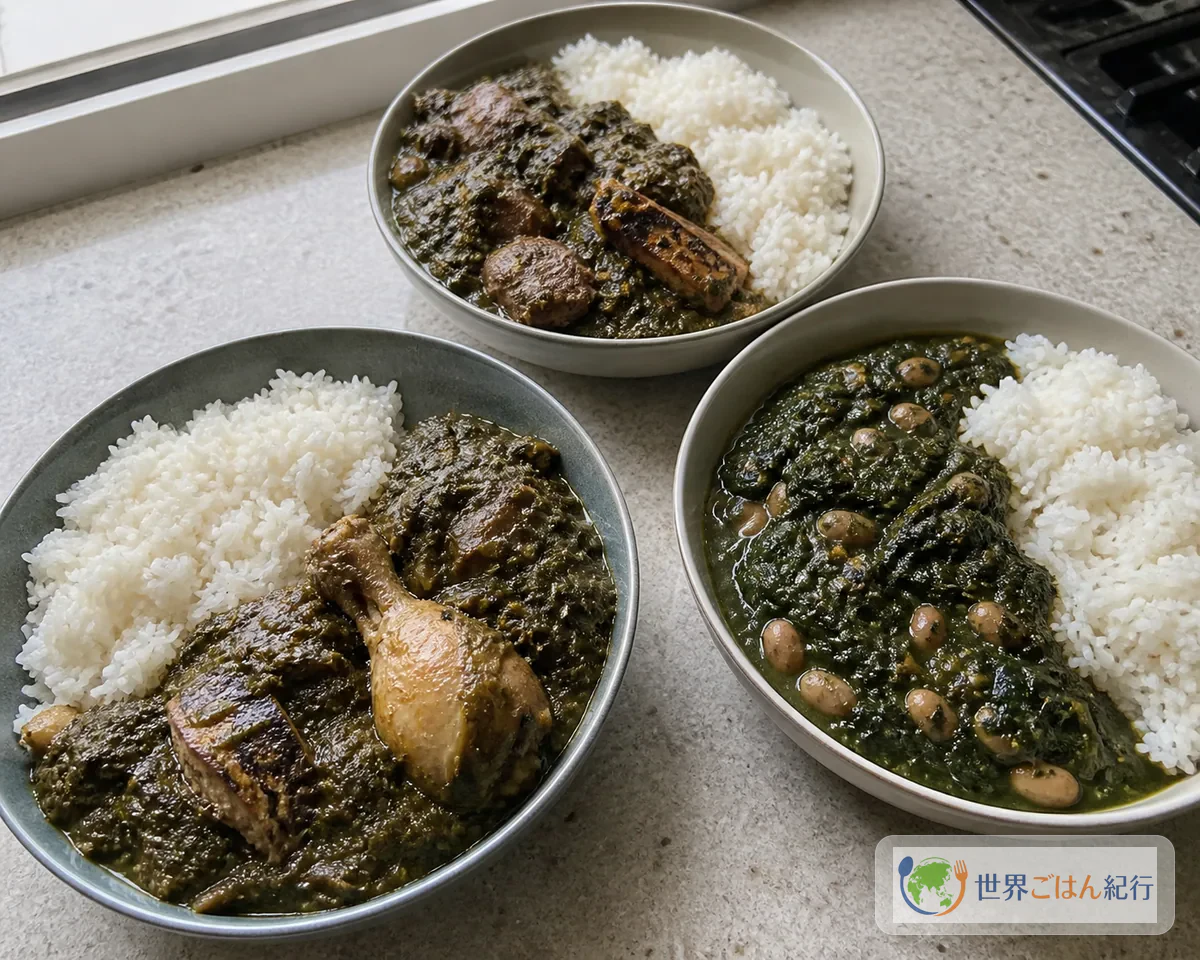
A Sierra Leonean table where beef, smoked fish and dried shrimp are layered in one green leaf stew
Cassava leaf stew is built on leaves, oil and groundnuts, and the combination of meat and fish varies

Cassava leaf stew is easier to adjust once you think of it as a leaf sauce with savory ingredients layered on top. Beef or chicken with salted fish, shrimp and so on are common, and smoked fish shows up in coastal cooking.

Combination Change in taste and texture Judgment for a home kitchen
Beef + smoked fish + dried shrimp Meat cooking liquid, smoke and the saltiness of the sea layer up and cling strongly to the rice The basic form here. Decide on salt last
Chicken thighs + smoked fish Lighter than beef, with the aroma of the leaves in front Simmer chicken with the skin on and cook it through
Goat + dried fish More fat and gaminess, a thicker cooking liquid Try when you can get bone-in meat at an import store
Chickpeas + eggplant + peanuts No meat or fish; the starchiness of the beans builds body Switch to vegetable stock and shorten the leaf simmering time
Spinach + smoked mackerel Lighter greenness and fiber, easy to make with home ingredients A substitute for when you have no cassava leaves. The texture that the dish name implies changes

Meat and fish in one pot work because of timing. Keep the water the meat was cooked in and add the saltiness of the fish and dried shrimp later, and the separate savory notes come together in one sauce. Fish simmered for a long time falls apart, leaving only the dried shrimp to stand out, so add it back at the end.

Serve it first with white rice, which makes the thickness of the stew and the texture of the leaves easy to judge. Switching to fufu, a springy staple pounded from starchy crops such as cassava, plantain and yam, turns the meal toward scooping up the sauce. Save that for another time so the cooking steps don't pile up.

Frequently asked questions

What changes if I make it without buying red palm oil?

You can make it with rapeseed oil or peanut oil, but the red color and earthy aroma will be weaker. For a single try, a substitute oil is fine. If you plan to cook West African stews often and can reuse it in fish, bean and leafy-green dishes, buy red palm oil after checking the edible label and volume. Palm nut cream is a different ingredient, so don't swap it in at the same amount.

What if I am allergic to peanuts, fish or dried shrimp?

Rather than forcing another nut in, leave out the peanuts and make a slightly thinner leaf stew. Fish and dried shrimp can be replaced with chicken, mushrooms or unsalted vegetable stock, though the smoky aroma and saltiness will change. People with severe allergies should not share utensils or oil, and should check the ingredient list and manufacturing-line labeling of purchased items.
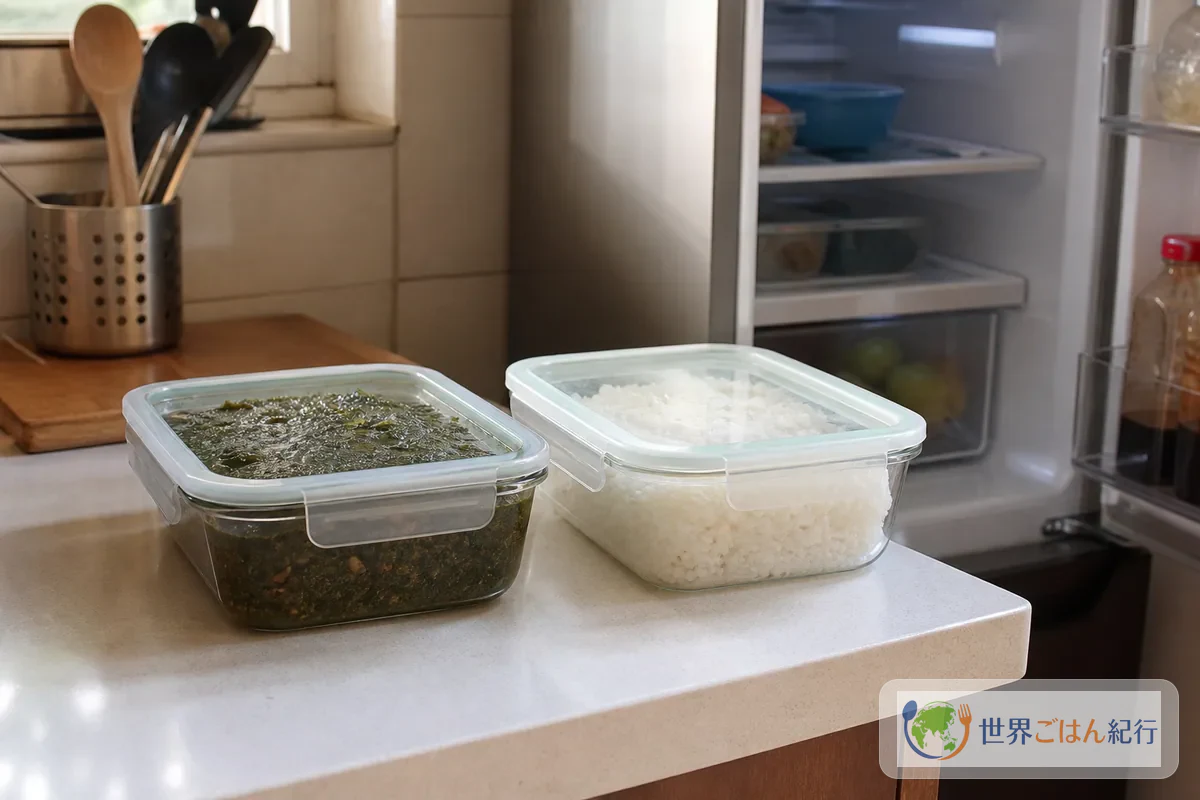
Cassava leaf stew divided into storage containers, with white rice in a separate container
Divide leftover leaf stew into shallow containers and store it apart from the rice

How should I store leftover stew and rice?

Keep the stew and rice separate, divide them into shallow containers, and refrigerate or freeze within 2 hours of cooking. For the best quality, use refrigerated stew within 3 to 4 days and frozen stew within 2 to 3 months. Reheat until hot in the center. Rice dries out easily, so wrap and freeze it in single portions. Throw away any stew or rice left out at room temperature for a long time, or any that smells off or feels slimy; never taste it to decide.

Can I fix it if it stays bitter or comes out watery?

If you used a processed leaf and it is only slightly bitter, extend the simmer 10 minutes at a time over low heat with the lid ajar. If it is watery, take the lid off and simmer 5–10 minutes to reduce, adding hot cooking liquid if it threatens to burn. If it is very bitter and you can't confirm the leaf label or processing, don't keep simmering or eat it; make it again with spinach.
Sources

  1. Sierra Leone Tourism, Traditional Sierra Leonean Dishes: Our Favorite Cassava Leaf Soup Recipe. Checked for combinations of ingredients, beef cooking liquid, frozen spinach as a substitute, and serving over rice. Accessed and checked 28 August 2026
  2. Ministry of Tourism and Cultural Affairs, Sierra Leone, Gastronomy. Checked for the place of plasas, cassava leaves, palm oil, peanuts, fish and meat, and rice and fufu. Accessed and checked 28 August 2026
  3. Sierra Leone Tourism, 5 Must Try Dishes in Sierra Leone. Checked for the description of cassava leaf stew as thicker than soup, served with rice or fufu. Accessed and checked 28 August 2026
  4. Sierra Leone Tourism, 8 Delicious Food and Drink to Try in Sierra Leone. Checked for rice as a staple served with stews of leafy greens, fish and dried meat, the variation using potato leaves, and the step of using the liquid from cooking meat and fish. Accessed and checked 28 August 2026
  5. Food and Agriculture Organization of the United Nations / Slow Food Foundation for Biodiversity, Sierra Leone, pp. 3–4. Checked for rice, the bitterness of cassava leaves, the method of crushing and simmering the leaves, and the food culture of serving with meat, fish and grains. Accessed and checked 28 August 2026
  6. Food Standards Australia New Zealand, Cassava and bamboo shoots. Checked for cyanide compounds in cassava leaves, processing methods, and the safety caution against using unprocessed ingredients. Accessed and checked 28 August 2026
  7. Recipes From A Pantry, Cassava Leaf {Sauce} + Tutorial. Checked for the name used at Sierra Leonean diaspora tables, crushing aromatics in a mortar or blender, simmering time by fineness of the leaves, and handling of storage containers. Accessed and checked 28 August 2026
  8. National Geographic Traveller, 4 essential West African dishes and how to make them. Checked for the explanation of Sierra Leonean origins, coastal smoked fish, peanuts, the link between plasas and the Mende, and names in neighboring countries. Accessed and checked 28 August 2026
  9. FoodSafety.gov, 4 Steps to Food Safety and Cold Food Storage Chart. Checked for cooling within 2 hours of cooking, dividing into shallow containers, refrigerator and freezer storage, and guidelines for storage periods and reheating of stews. Accessed and checked 28 August 2026