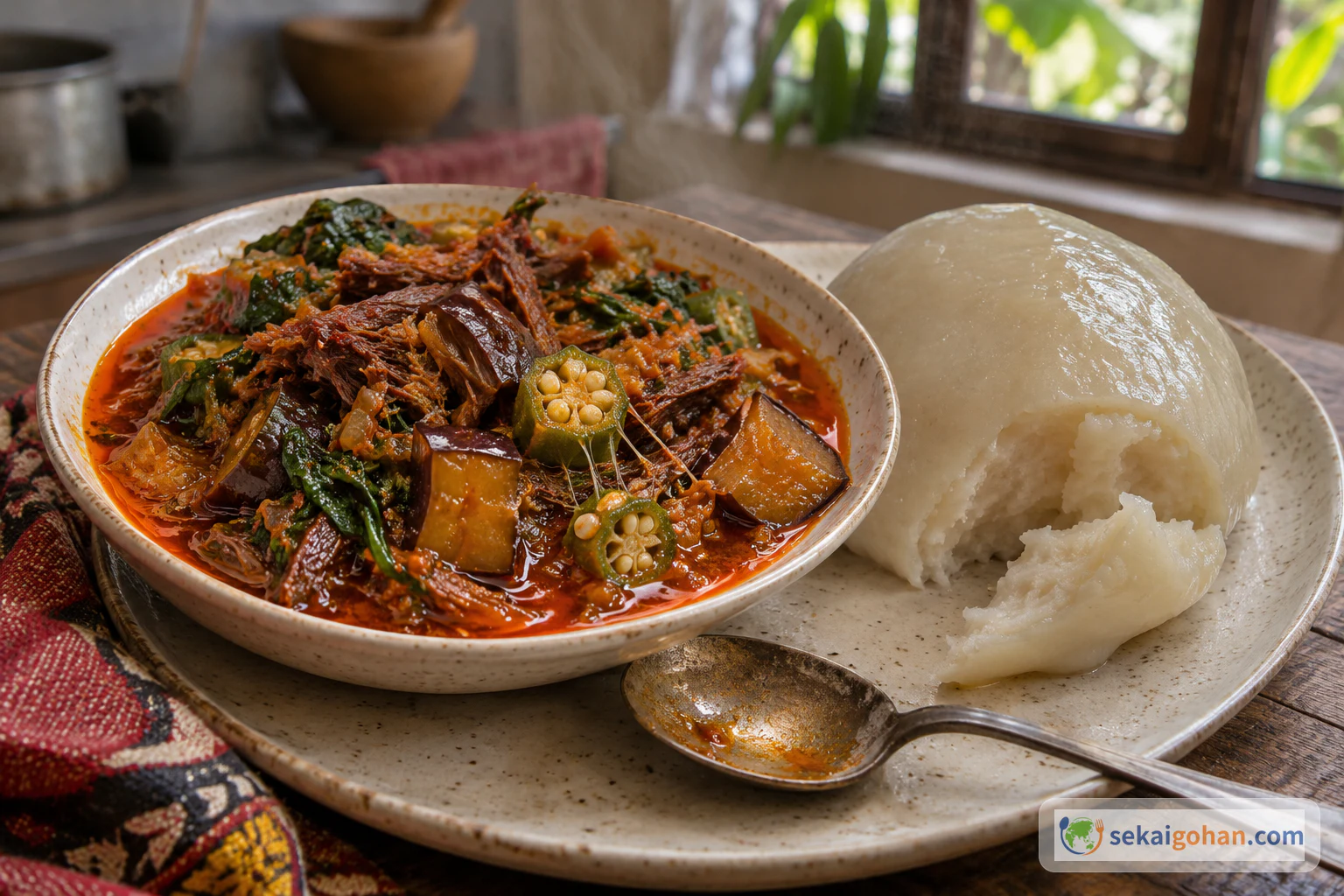
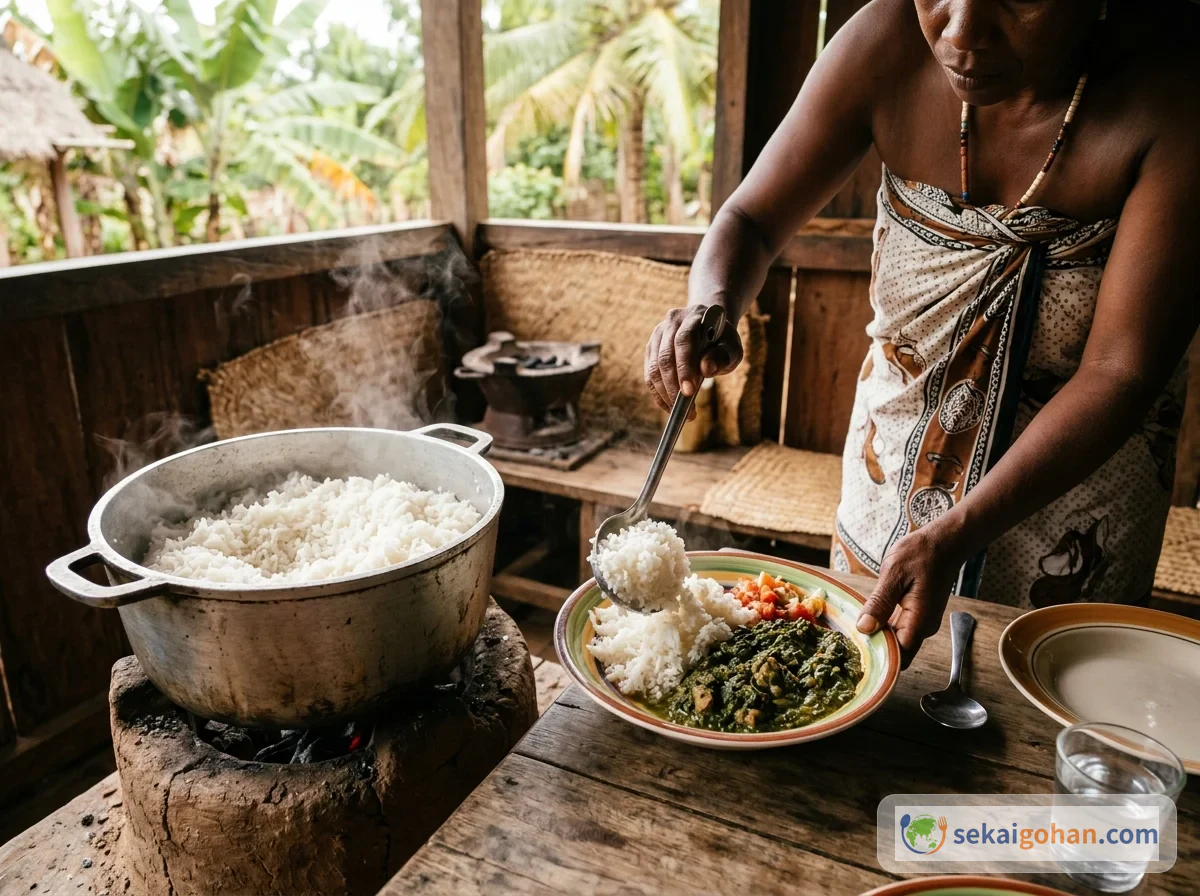
It looks like a plain green soup. Then the first spoonful arrives: the bitterness and sweetness of the greens, the savor of the meat, the heat of ginger and the acidity of tomato layer into something with real depth, and the taste changes with each bite. This is romazava, the dish that anchors the table in Madagascar. It is a soup of several leafy greens and beef (or pork or chicken), simmered with ginger and tomato, and on the island it is spooned over white rice almost every day.
Romazava, Madagascar's national dish
Madagascar, the world's fourth-largest island, lies in the Indian Ocean off the southeast coast of Africa. Most people know it for lemurs and baobab trees, but at mealtime it is known for romazava. In Malagasy, "ro" means soup or broth and "mazava" means clear or clean. True to that name, "clear soup" is a simple stew with no cream or coconut milk, where only the color of the greens stands out.
Madagascar's national dish, eaten almost daily across the whole island and always served with white rice (vary). Unlike a special-occasion dish such as Ethiopia's doro wat, it is everyday food.
African home cooking is gaining recognition through dishes like Cameroon's ndole and Tanzania's ugali, and romazava deserves to be better known too.
Madagascar, "the Asia of Africa"
Madagascar sits east of the African continent, yet its food culture is closer to Asia than to Africa. The ancestors of the Malagasy crossed the sea from Southeast Asia (around present-day Borneo in Indonesia) about 1,500 years ago, and the Malagasy language belongs to the Malayo-Polynesian family.
That Southeast Asian origin still shows at the table. Madagascar is one of the world's leading rice-consuming countries, and romazava brings two traditions together: the Asian habit of pouring soup over rice, and the African habit of combining many kinds of greens.
Vary sy laoka, rice and its accompaniment
The basic structure of a Malagasy meal is "vary sy laoka": "rice and accompaniment." Every accompaniment (laoka), romazava included, exists to help you eat plenty of white rice with pleasure. It is a rice-centered system much like Nepal's dal bhat.
Brèdes, the leafy greens of Madagascar
In Madagascar, leafy greens are collectively called "brèdes" (a word from French). Markets display more than 20 kinds, and home cooks change the flavor of their romazava according to mood and whatever greens are on hand. The main ones include:
- Anamamy: a bitter leaf. The core of romazava
- Anatso: a leaf resembling watercress
- Ravembesara: a fragrant leaf
Combining many kinds of greens is a piece of African kitchen wisdom shared with the bitter leaf of Cameroon's ndole and the soups served with Ghana's fufu.
Ingredients (serves 4)
Authentic romazava uses a bitter Malagasy leafy green called anamamy. It is nearly impossible to find elsewhere, but a three-way blend of the bitterness of garland chrysanthemum, the peppery bite of watercress and the sweetness of spinach recreates a close flavor.

This dish uses beef. If you have a beef allergy, chicken thighs can be substituted. All ingredients are ordinary vegetables and meats, and none of the seven major allergens (wheat, milk, egg, buckwheat, peanut, shrimp, crab) are included.
Ginger is easy to buy at any regular grocery store. Grating fresh ginger gives a stronger aroma than tube ginger, but on a busy day tube ginger still does the job.
Choosing ginger and meat for romazava
Ginger matters in Malagasy cooking the way lemongrass does in Southeast Asia. Use a bit more ginger (2 to 3 pieces). Its heat and warmth set the tone of the whole soup and soften the bitterness of the greens.
Beef (from zebu cattle) is the most common choice in Madagascar, but pork, chicken and fish all work. Beef gives the deepest richness, chicken a lighter touch and fish a delicate finish. If it's your first time, start with beef.
Common romazava mistakes and fixes
Greens simmered from the start lose their color and texture. Add them staggered, stems first and then leaves, with the last leaves going in just before you turn off the heat. Unlike long-simmered dishes such as Eritrea's zigni, romazava wants its greens only briefly cooked.
If you've overdone the ginger and the heat is too strong, add 1.75 oz (50 g) more spinach and simmer. The sweetness of the spinach softens the sharpness, and 2 tbsp coconut milk mellows it further.
Serving romazava and variations
Serving over rice
Skip the separate side plate. The Malagasy way is to pour romazava over the rice and mix it, since every dish is seasoned with rice in mind. Like Sri Lanka's kottu, it is a meal built around the staple.
Chicken romazava
Use 4 bone-in chicken thighs instead of beef. Don't parboil the chicken; brown it and simmer it as is. The result is lighter than the beef version, and a small splash of vinegar to freshen it, as in Philippine adobo, is also popular.
Fish romazava
This version is common on Madagascar's coast, where the delicate savor of fish sits nicely with the greens. Use 14 oz (400 g) fillets of white fish (cod or sea bass). Fish breaks up easily, so add it in the last 10 minutes and don't stir much.
Tofu romazava (vegetarian)
Use 2 blocks of firm tofu instead of beef. Press out the water, cut into 1 inches (3 cm) cubes, brown the surface and then simmer. Mushrooms (7 oz / 200 g shimeji) round out the savor.
East Asian-style romazava
Increase the ginger (3 pieces) and use sesame oil instead of vegetable oil. A final seasoning of 1 tbsp light soy sauce turns it into a side-dish soup that feels right at home with rice, as soup over rice does in Nepal's dal bhat.
Coconut milk romazava
Adding ½ cup (100 ml) coconut milk at the end gives you the coastal romazava of eastern Madagascar. The mildness of coconut softens the bitterness of the greens and broadens its appeal. As with Malaysia's nasi lemak, coconut blends in naturally in island cooking.
Romazava nutrition (per serving, one of 4)
Romazava is on the light side of African dishes: little oil goes in and the greens are the star, which keeps calories modest.
| Nutrient | Amount |
|---|---|
| Calories | 340 kcal |
| Protein | 1 oz (28 g) |
| Fat | 14 g |
| Carbohydrates | 26 g |
| Fiber | 6 g |
| Sodium | 580 mg |
Spinach is an excellent source of iron and vitamin K, and watercress is rich in vitamin C. Garland chrysanthemum contains a lot of beta-carotene, which cooking with oil helps you absorb, so three kinds of greens give you a wider range of nutrients than one.
More African stews and dishes
- Ndole (in Japanese) — Cameroon's bitter-leaf stew of leafy greens and peanuts
- Doro wat — Ethiopia's spiced chicken stew
- Maafe (in Japanese) — Mali's peanut stew, a leading example of West African stews
- Zigni (in Japanese) — Eritrea's spiced stew from East Africa
- Introduction to African cuisine
- Introduction to Ethiopian cuisine
- Introduction to Moroccan cuisine
Frequently asked questions
Q1. Do I need three kinds of greens? Is two okay?
You can make it with two, but the depth of flavor definitely drops. At minimum, pair a bitter leaf (garland chrysanthemum) with a sweet leaf (spinach). Ideally use three: bitter, peppery and sweet. A fourth such as komatsuna or bok choy makes the flavor even more complex.
Q2. How long does romazava keep?
It keeps 3 days in the refrigerator, and it tastes better the next day once the flavors settle. The greens do dull over time, so if color matters, add greens only to the portion you'll eat and store the rest of the soup without them. It also freezes for 1 month.
Q3. What other dishes are there in Malagasy cuisine?
A famous one is ravitoto, finely chopped cassava leaves simmered with coconut milk and pork. Achard, pickles of mango or papaya, is another standard. All of them are meant to be eaten with vary (white rice).
Q4. What drink goes with romazava?
In Madagascar the traditional partner is ranon'apango, made by pouring water onto the crust of rice left in the pot and boiling it until it infuses. Roasted green tea or barley tea also go well. For beer, choose a light pilsner.
Sources
Recipes and cooking
- "Romazava: Madagascar's National Dish." (2024). 196 Flavors. https://www.196flavors.com/madagascar-romazava/ — an explanation of romazava from a site introducing traditional dishes of the world
Culture and history
- Beaujard, P. (2019). The Worlds of the Indian Ocean: A Global History. Cambridge University Press. https://doi.org/10.1017/9781108631365 — settlement from Southeast Asia in Madagascar and the spread of food culture