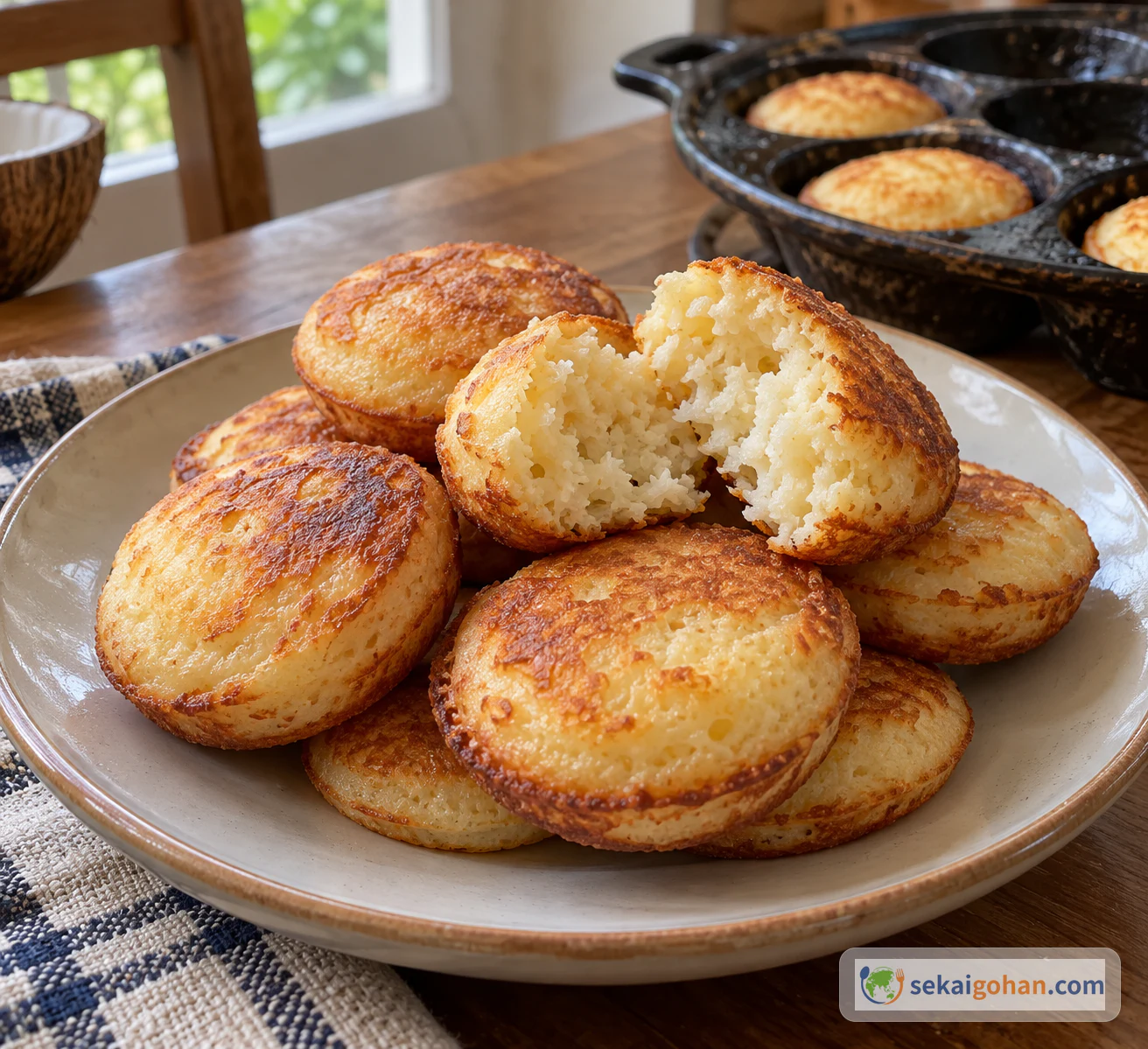
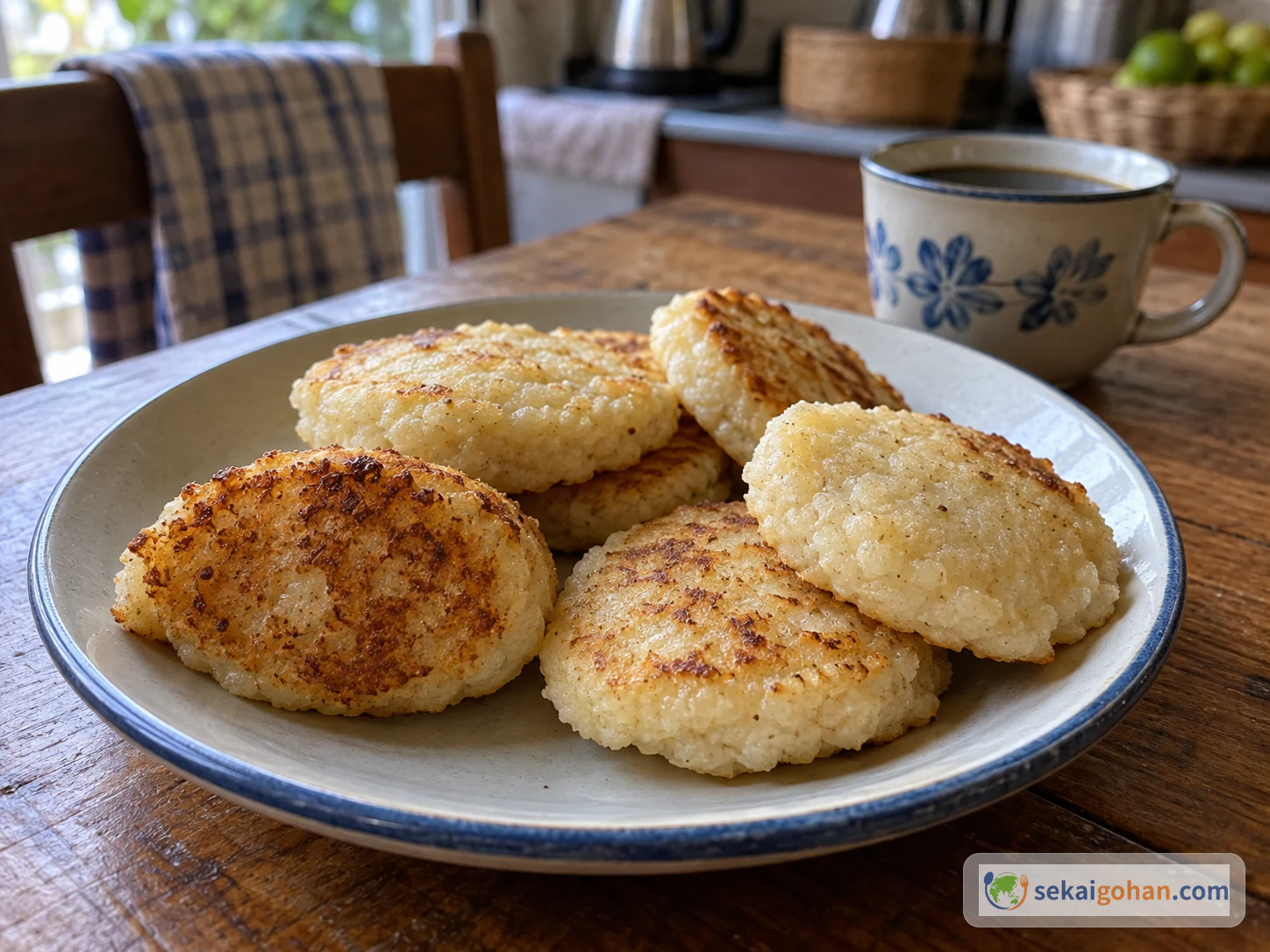
When you lift the steamer lid, the first thing that reaches you is the smell of green leaf, not sweet steam. A moment later brown sugar, roasted peanuts and the floury note of rice come up together, and for an instant your kitchen feels like the side of a street stall. Koba (koba ravina / kobandravina) is a sweet from Madagascar: peanuts, brown sugar and rice flour wrapped in banana leaf, and unwrapping that leaf is the part you remember. What you get is a dense, chewy slice with coarse bits of peanut and the scent of the leaf. You cook it slowly, let it cool and then slice it.

Koba in Madagascar
Madagascar is an island that lives on rice, so even its sweets have the weight of rice flour. Koba doesn't rise like a cake. It's a dense dough, somewhere between mochi and a nut confection, and it's eaten in slices.
In Madagascar it's wrapped into a large log, boiled or steamed for a long time, and sometimes sold in round slices. A log that big takes many hours, which isn't realistic at home, so a home version is made in small logs.
| What to look at | Characteristics of koba | Notes for making it at home |
|---|---|---|
| Local name | Koba ravina, kobandravina and other spellings | The name ravina is tied to the leaves |
| Main ingredients | Rice flour, peanuts, brown-sugar-type sugar, banana leaf | A little glutinous rice flour makes slicing easier |
| How it is eaten | Sliced into rounds as a snack or sweet | Pair with hot tea, coffee or unsweetened milk tea |
| Cooking | Wrapped in leaf and boiled or steamed for a long time | Wrap small and steam for 4 hours |
To see what peanuts do in other dishes, look at West Africa's mafe and groundnut soup. The same peanut tastes different in each one.
Ingredients (makes 8 pieces)
This amount makes two logs about 7 inches (18 cm) to 8 inches (20 cm) long and 2 inches (5 cm) across. Cutting each log into 4 pieces gives a thickness that goes well with strong tea or coffee. For a first try, don't make them too large; the center will cook through and the cake will be less likely to crumble when cooled.

This recipe uses peanuts, bananas and rice flour. If anyone has a nut allergy, do not make it. If you use honey, do not give it to infants under 1 year. Because it steams for a long time, check the water every 30 minutes so the pot doesn't run dry.
Choosing ingredients for koba
Three things matter most: the mix of flours, how you crush the peanuts, and a steamer that can run for 4 hours. Look for banana leaf at import grocers and Asian grocery stores, often in the frozen section. If you can't find any, the FAQ below explains how to wrap with parchment and foil.
Pick a fine rice flour that won't stay powdery after a long steam. You're not after the springiness of shiratama dumplings, just a little of rice flour's firmness. Too much glutinous rice flour pushes the cake toward a dumpling. At about a third of the total flour it holds together when sliced cold and still has the heft koba should have.
Peanuts can be chopped with a knife, but crushing 8 oz (220 g) by hand takes a while. If you use a food processor, stop well before it turns to flour, when you have a mix of pieces from the size of a grain of rice to an adzuki bean. For the sugar, use brown sugar rather than white, because that's where much of the aroma comes from.
A two-tier steamer that's easy to top up with water keeps the 4-hour steam steady. If the water at the bottom runs out, the leaf aroma turns to burning, so go for depth and capacity.
Method: shape small logs and steam them long
Koba firms up after steaming and cooling, more than right after mixing. You will want to cut it open to check partway, but it looks soft while hot, so don't rush the judgment. It is done when, pressing from outside the leaf, the center feels evenly springy, and after cooling it doesn't stick too much to the knife.
Common koba problems and fixes
Koba has so few ingredients that problems are easy to trace. The two most common mistakes are making the dough too loose and cutting it right after steaming. Let it cool completely before you slice.

| Condition | Cause | Fix |
|---|---|---|
| Flows when cut | Too much water, or cooling time too short | Mix in 1–2 tbsp rice flour. After steaming, cool for 2 hours or more |
| Crumbles | Too little water, or peanuts too large | Add water 2 tsp (10 ml) at a time. Crush peanuts to a mix of coarse powder and pieces |
| White floury taste remains | Steam time too short, or dough too thick | Keep to 2 inches (5 cm) across. Steam 4 hours without letting the boiling water run out |
| Leaf aroma burns | Heat too high, or water ran dry | Lower to medium-low and add boiling water every 30 minutes |
| Sweetness too heavy | Brown sugar alone is too strong | Next time split it into 4 oz (120 g) brown sugar and 1.5 oz (40 g) light brown or cane sugar |
Serving and storing koba
How to eat it
Koba is a sweet, not something to eat alongside the staple. In Madagascar you'd have a little while walking through town or at tea time. The cut face is dense, so a thick slice eaten slowly gives you more aroma than a thin one.
For a Malagasy meal, serve rice with savory romazava, then bring out small slices of koba afterward. For more island sweets, try Sri Lanka's bibikkan and Indonesia's kue satu. Vietnam's com lam, rice cooked in a wrapping, comes from a similar idea.
Storage and reheating
You cut koba once it has cooled, so it's actually easier to handle the day after you make it. After slicing, put parchment paper between the slices and keep them in an airtight container.

| Storage | Time | When eating |
|---|---|---|
| Room temperature | half a day | Cool seasons only. Avoid in summer |
| Refrigerator | 3 days | Bring to room temperature for about 15 minutes |
| Freezer | 3 weeks | Wrap each piece; thaw naturally, then re-steam |
| Reheating | 5 min | Steamer on low heat. A microwave tends to make it hard |
Straight from the refrigerator, the rice flour tightens and the cake feels a little hard. A gentle steam brings the leaf aroma back, but it also makes the cut face sticky, so let it rest for 5 minutes before moving it to a plate.
Nutrition (approximate)
With peanuts and rice flour doing most of the work, koba is more filling than it looks. After a meal, one piece is plenty.
| Approximate per piece | Value |
|---|---|
| Energy | about 380 kcal |
| Protein | about 10 g |
| Fat | about 14 g |
| Carbohydrates | about 2 oz (56 g) |
| Fiber | about 5 g |
| Salt equivalent | about 0.3 g |
FAQ
Can I make it without banana leaf?
Yes, though the aroma changes a lot. Wrap the dough in parchment paper, then in aluminum foil, and steam. Without the green scent of the leaf, use a little less brown sugar. Up to 1 tsp of vanilla keeps it from tasting flat.
Can I use peanut butter instead?
I don't recommend it. Peanut butter is oily and makes the cut face heavy and sticky. If you have to, use no more than 2.75 oz (80 g) of unsweetened peanut butter and add 4 oz (120 g) of crushed peanuts separately for texture.
Can I make it with rice flour alone?
Yes, but it breaks easily when cold and the cut face tends to taste floury. Glutinous rice flour at about a third of the total gives a good balance of firmness and chew after the long steam.
Can I shorten the steaming time?
Thinner logs, about 1 inch (3 cm) across, set in 2.5 hours, but the deep koba aroma is weaker. The thicker the log, the longer the heat takes to reach the center, so for a first try, stick to 2 inches (5 cm) across and 4 hours.
What if it's still soft after cooling?
Wrap it again in leaf or parchment paper and steam it over medium-low heat for 30 to 60 minutes more. If the dough was so loose that it ran, next time use 1.5 tbsp (20 ml) to 2 tbsp (30 ml) less hot water and add 2 tbsp more rice flour.
Can I make it less sweet?
You can cut the sugar to 4 oz (120 g). Sugar does more than sweeten, though: it also keeps the cake moist after steaming. If you cut it, keep the 1 oz (30 g) of honey or molasses and use a very ripe banana.