Pull a pot of melting brown sugar off the heat and what rises from it smells less like sugar than like a slightly smoky syrup. Stir in the coconut and the dry white strands turn brown all at once, and suddenly the kitchen smells like a South Asian sweet shop. That moment is the best part of making Sri Lankan bibikkan (බිබික්කන් / Bibikkan), a dense baked sweet of grated coconut, jaggery, semolina and spice. It's moist and heavy, built to be cut small and eaten with strong tea.
About bibikkan
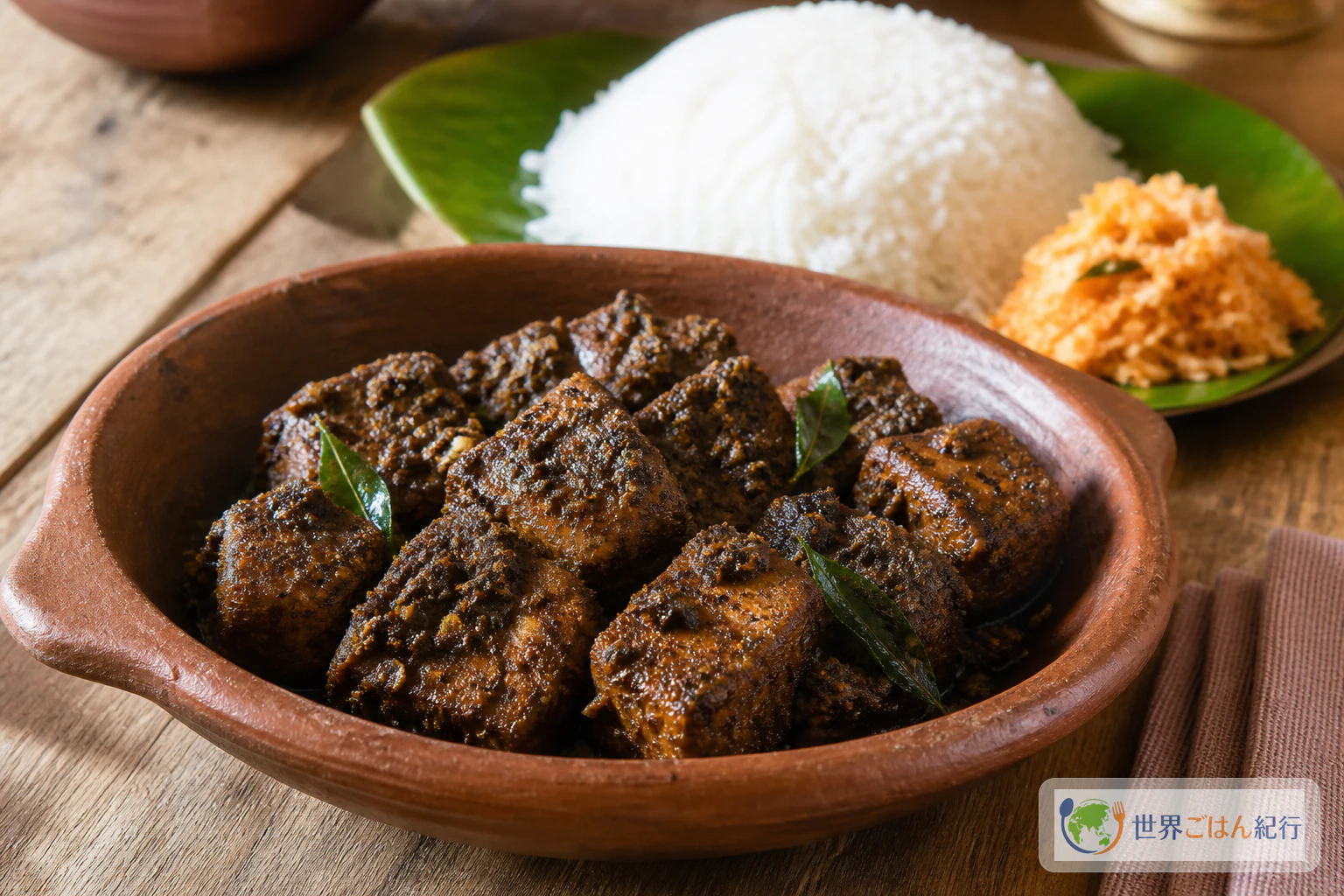
In English-speaking countries bibikkan also goes by pol cake or Sri Lankan coconut cake. It shows up at celebrations: Christmas, the year-end and New Year holidays, and the Sinhala and Tamil New Year. If kiribath is the white rice dish cut into pieces on a celebration morning, bibikkan is the brown sweet you set out beside the tea. A small slice after hoppers or kukul mas curry eases the last of the chili heat.
Its local character comes from jaggery and treacle made from kithul palm sap. Both are hard to find in many places, so here brown sugar, dark syrup and a little molasses stand in for that aroma. On brown-sugar days the flavor leans a little toward Japanese confectionery. What matters most is the dark, heavy molasses that keeps the coconut moist, which the light sweetness of white sugar can't give you.
Next to a sweet like Thailand's khanom tan, which carries a gentle steamed coconut scent, bibikkan is much richer, and the syrup keeps spreading through the cake the longer it sits. Like many South Asian sweets, it isn't really meant to be eaten fluffy and fresh. It's at its best once the sweetness and aroma have settled.
Ingredients (makes 8 pieces)
This amount fills one 7 inches (18 cm) square pan or 7 inches (18 cm) loaf pan. Cut into 8 equal pieces, they are small portions that go well with tea. If you want it sweeter, still bake the first time at this sweetness and adjust only with the syrup brushed on at the end. That way it is less likely to fail.

Thinking about substitutes
| Local-style ingredient | Realistic substitute | Caution when substituting |
|---|---|---|
| Kithul jaggery | 6.5 oz (180 g) brown sugar and 1.75 oz (50 g) dark syrup | White sugar alone makes the aroma thin |
| Kithul treacle | 1.5 oz (40 g) dark syrup and 10 g molasses | Molasses alone tends to turn bitter |
| Fresh grated coconut | 6.5 oz (180 g) unsweetened desiccated coconut and ½ cup (100 ml) coconut milk | Coconut milk alone gives no shreds |
| Semolina | Finely ground durum wheat flour | Couscous grains are large and tend to stay firm in a baked sweet |
| Melon preserve | Increase the dates and raisins by equal amounts | Sweeter, but loses the candied feel of the local version |
This recipe uses wheat, eggs, dairy (or coconut oil), cashews and coconut. If you are worried about nuts, replace the cashews with an equal weight of raisins and check the product labels. If the coconut molasses is hot when the eggs go in, the eggs will set, so be sure to cool it to body temperature or below before mixing.
Choosing ingredients for bibikkan
Look at the cardamom, the cinnamon sticks and the canned coconut milk first. Brown sugar and eggs are easy to find anywhere, but if the spices and coconut are weak, you end up with a plain brown sugar cake.
You'll find semolina at import grocers and baking-supply shops; look for a package labeled "durum wheat semolina." A fine, pasta-grade grind is easy to work with and bakes with less of a hard core than couscous grains used as they are.
Method: cool the molasses before baking
Bibikkan is not a sweet that rises on whipped air. The order is: cook the molasses, let the coconut absorb it, bind with flour and egg, and bake slowly in a low oven. Fresh from the oven it still crumbles easily, so don't plan to cut it the same day. Allow time to cool.
Common bibikkan problems
Most failures come down to one of five things: too sweet, hard, crumbly, set eggs, or burning. Usually the cause is the temperature or moisture of the molasses.
| What happened | Cause | How to fix it next time |
|---|---|---|
| Crumbly | Coconut stayed dry, or overbaked | Rehydrate the coconut with the milk and stop where the skewer has damp crumbs |
| Bits of egg visible | Eggs went into hot molasses | Cool to 40°C (104°F) or below and add the egg in 2 additions |
| Only the surface burns | Strong top heat in the oven | Lay on aluminum foil after 30 minutes and bake on the middle rack |
| Center sinks | Batter too loose, underbaked | Make the batter thick enough to hold its shape 3 seconds, and bake 5 minutes more at a time |
| Turns out like a brown sugar steamed cake | Spices and coconut too weak | Crack whole cardamom and use enough unsweetened coconut |
Some Sri Lankan versions brush treacle over the cake after baking to make it moister. Since this batter already has a little dark syrup in it, skip that the first time. If you want it sweeter, dilute 2 tsp dark syrup with 1 tsp water right after baking and brush it thinly over the surface only.
Serving and storing bibikkan
Serving

Eat bibikkan once it has cooled. Cut big straight from the oven, it smells wonderful, but the crumb falls apart and the semolina grains come loose. Cut it small and serve it with strong unsweetened Ceylon tea or milk tea, and the weight of the brown sugar and coconut feels just right.
It's a good finish after the strongly spiced kukul mas curry or griddle-fried kottu. For a celebration breakfast, serve kiribath with lunu miris and end with a thin slice of bibikkan.
Storage

Once the cake has cooled completely, cut it into squares of about 1.5 inches (4 cm) and loosely wrap each one in parchment. Keep them in an airtight container in a cool place at room temperature until the next day, or in the refrigerator for up to 3 days. The fridge firms up the fat and makes the cake hard, so take it out 20 minutes before eating to come back to room temperature.
To freeze, put the wrapped pieces in a storage bag and keep for up to 2 weeks. Thaw in the refrigerator for half a day, then bring to room temperature. The microwave brings back the aroma, but the coconut oil seeps out and the texture breaks down, so give it no more than 10 seconds at 600 W.
FAQ
Can I make it without kithul jaggery?
Yes. With 6.5 oz (180 g) brown sugar and 1.75 oz (50 g) dark syrup, the aroma gets quite close. You'll miss kithul's slightly floral scent, but as long as you're generous with the coconut and cardamom, it won't taste like a white sugar cake.
Can I use long-thread coconut instead of desiccated coconut?
You can, but chop it and rehydrate it first. Left long, the fibers show on the cut face and the cake doesn't hold together when you bite into it. Chop it with a knife to 0.25 inch (5 mm) or smaller, rehydrate it with coconut milk, then toast.
What if I can't find semolina?
Use durum wheat flour or finely ground semolina. Cake flour alone will bake, but you lose the grain and the weight, and the result is closer to an ordinary brown sugar coconut cake. Couscous grains are large and tend to stay firm in a short bake, so this recipe doesn't use them.
Can I make it without eggs?
Without eggs the binding is weak and the cake crumbles when cut. If you want to try, replace the 2 eggs with 2.5 oz (70 g) unsweetened yogurt and 1.75 oz (50 g) drained silken tofu blended smooth, and increase the cake flour by 20 g. The texture will be different from the egg version.
How sweet is it?
It's heavier than pound cake and less sweet than a brown sugar yokan, meant to be cut thin and small and eaten with unsweetened tea. You can reduce the brown sugar to 5.5 oz (150 g), but any lower and the coconut won't come together moistly.
Is it better on the day it's baked or the next day?
The next day, once the syrup has soaked back into the crumb and the cake is moist. The spices smell strongest on baking day, and by the next day the sweetness has mellowed. For guests, bake it the evening before and cut it the next morning, when it's also easier to handle.