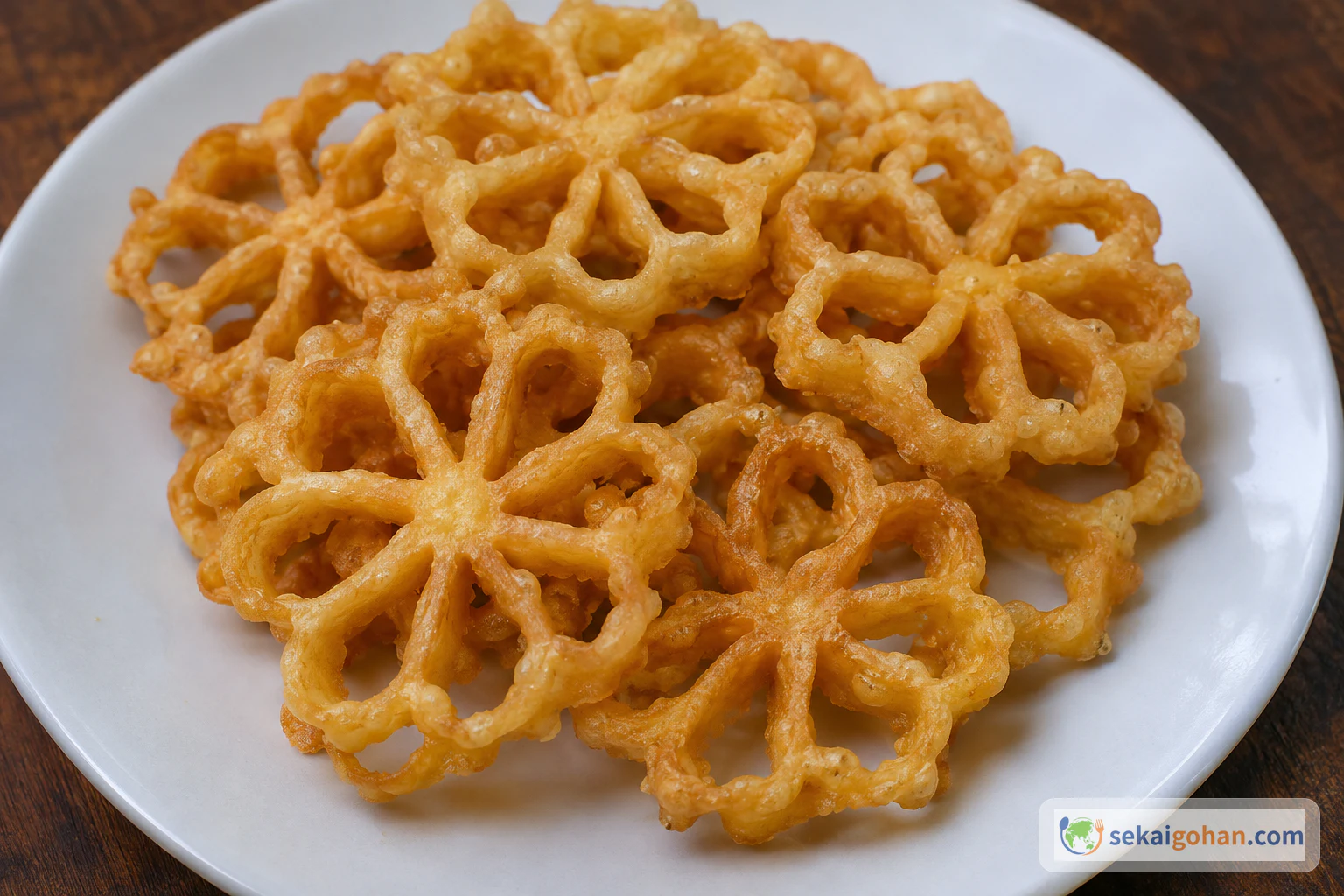
Aasmi is fried, yet the first thing you watch is not the bubbles but thin white lines. Rice-flour batter falls from between your fingers, wavers across the hot oil and knits into a fine net within a few dozen seconds; fold it over, and small pieces of white lace stack up on the plate. Last come thin lines of pink syrup, and only then does it look like a Sri Lankan celebration sweet. Aasmi, written ආස්මි in Sinhala, is light and crisp, made from rice flour and coconut milk, and you can see the movement of the cook's hands in every piece. At home, the hard part isn't the ingredients. It's getting the stickiness and the oil temperature right.
Aasmi at the Sri Lankan Celebration Table

Aasmi belongs on the Sinhala and Tamil New Year table, and it turns up at weddings and birthdays too. The batter is rice flour and coconut milk. Juice from a cinnamon leaf, called dawul kurundu locally, gives it stickiness. The batter is dropped in thin streams into oil, rested, fried a second time and finished with colored syrup.
The texture comes from the lines. The thinner they are, the more holes the net has, and the second fry makes it lighter still. Pour the batter thick and it looks much the same, but the first bite is chewy and heavy. You're close to real aasmi when it comes out white, light and full of holes.
Next to bibikkan, a heavy baked sweet of jaggery and coconut, aasmi is the lighter one. It shares a base of rice and coconut with kiribath and hoppers, but the texture is something else entirely. If you know Southeast Asian rice-flour sweets, compare it with Thailand's khanom tan. Khanom tan is steamed and fluffy, while aasmi is fried to make holes. Both carry the aroma of rice and palm, but aasmi shows the handwork more clearly.
This recipe uses rice flour, coconut, okra, sugar, food coloring and frying oil. If you have allergies, check the labels on rice flour and food coloring, since some lines also handle wheat, dairy and nuts. Keep the oil at 165°C or higher, and keep your hands and clothing away from the oil surface. In a kitchen with children, set the pot toward the back.
Ingredients (makes 8 pieces)

This makes 8 pieces of aasmi, each 5.5 to 6.5 inches (14 to 16 cm) across. Making them large from the first time makes folding hard, so keep them small. Some traditional methods rest the once-fried pieces for several days before the second fry. For a one-day job at home, rest them 30 minutes or more to let the surface settle before frying again.
Where to draw the line on substitutes
| Ingredient in question | Why it is used | Limits of the substitute |
|---|---|---|
| Dawul kurundu leaves | Gives the batter stickiness and keeps the lines | Hard to find outside Sri Lanka. Okra mucilage puts the shape first |
| Okra | The mucilage makes the batter easy to drop in threads | Too much leaves a green aroma, so use only the extracted liquid |
| Coconut milk | The whiteness and aroma of the rice flour, and lightness when fried | With cow's milk or soy milk the aroma is something else |
| Food coloring | Makes the lines look like a celebration sweet | Optional. Does not affect flavor |
Choosing Ingredients and Substitutes for Aasmi
Three things decide how often aasmi fails: the rice flour, the coconut milk and the oil temperature. Sugar and okra from any local store are fine.
| What to protect | Local ingredient or method | Practical method at home |
|---|---|---|
| Flour | Fine rice flour | Rice flour for baking. If using joshinko-type regular rice flour, sift it first |
| Liquid | Coconut milk | Thick canned coconut milk |
| Stickiness | Juice of dawul kurundu leaves | Mucilage from okra rubbed in water |
| Shape | A special perforated tool, or fingers | Fingers, a piping bag or a fine-spouted bottle |
| Finish | Colored syrup | Made with sugar, water and a little food coloring |
Rice Flour and Coconut Milk
Finer rice flour falls in thinner lines and clogs the holes less. If you use regular rice flour, sift it once through a strainer. That removes the large grains, so the lines are less likely to break on the oil.
For the coconut milk, use the thick canned kind sold for cooking. A thin drink-type lets the rice flour dominate and weakens the sweet, fatty aroma of Sri Lankan sweets.
Okra in Place of Dawul Kurundu
Dawul kurundu leaves are hard to find, so use okra mucilage instead. Some local recipes use okra too, and in a home kitchen it's the most realistic choice. You lose some of the leaf's aroma, but the okra's stickiness makes the shape come out much more reliably.
Tools and a Thermometer
A special funnel makes it easy to drop the lines, but dropping the batter from between your fingers is the easiest way to start at home. A deep-frying thermometer earns its place with lines this thin, because the workable oil temperature range is narrow. Below 325°F (165°C) the batter soaks up oil, and near 350°F (180°C) the lines color before they set white. Without a thermometer, drop in a little batter: it should give off fine bubbles right away without turning brown.
Why Aasmi Fails and How to Fix It

The shape tells you most of what went wrong. Few holes means the batter or the lines are too thick, tearing means too much water or folding too early, and oiliness means the oil is too cool. Fix the batter thickness and the oil temperature before you touch the flavor.
| Condition | Cause | How to fix it |
|---|---|---|
| Lines are thick with few holes | The batter is thick, or too much was dropped from the fingers | Add 2 tsp water and move your fingers in smaller motions |
| Lines break in the oil | Not enough stickiness, or too much water | Add 2 tsp okra mucilage. Mix in 2 tsp rice flour |
| The white net tears | Folded too early, or the net is too thin | Wait 20 seconds before folding. Overlap the lines a little more |
| Oily and heavy | The oil temperature is low | Bring it back to 325°F (165°C) before frying the next one |
| Yellow and hard | The oil is too hot, or it was fried too long | Lower below 350°F (170°C) and shorten the second fry |
| The syrup sets and crushes the white net | Boiled down too far | Add 1 tsp hot water and return to low heat |
| A green aroma remains | Okra pieces got in | Use only the mucilage and don't put in chopped okra |
You're working over hot oil, so on a first try keep the circles small, around 5.5 inches (14 cm) across. An uneven shape is fine as long as there are plenty of holes and the oil drains well.
Before you commit all the batter, fry one small test net about 2 inches (5 cm) wide. Check that the lines connect, the holes stay open and it doesn't soak up oil, then adjust the batter a little before frying the real 8 pieces.
Serving and Storing Aasmi
Serving
Aasmi isn't eaten hot from the fryer. It's a celebration sweet, cooled and then drawn with lines of syrup. Let it rest about 10 minutes until the syrup settles on the surface, and it won't stick to your hands when you break it. With strong Ceylon tea, milk tea or unsweetened black tea, the sweetness doesn't feel heavy.
For a Sri Lankan celebration meal, start the morning with kiribath and lunu miris and bring out aasmi as the sweet plate. It also makes a good dessert, broken into small pieces after kukul mas curry, fragrant with coconut and curry leaves, or griddle-chopped kottu.
Storage and Making Ahead

Store aasmi only once the syrup is completely dry. If you stack it while damp, the net goes soft and the holes collapse. Lay it in a single layer in a container lined with parchment paper. It keeps until the next day in a cool place, or 2 days in the refrigerator.
The fridge firms the fat and makes the texture a little heavier, so take it out 20 minutes before eating. If humidity has softened it, dry it for just 3 minutes in a low oven at 100°C (210°F). Skip the toaster oven, whose strong top heat tends to scorch the syrup.
For guests, finish the second fry the day before. Store the pieces with paper between them, and draw the syrup on the day for a cleaner look. Freezing doesn't work: frost gets into the holes and the aasmi turns sticky after thawing.
Frequently asked questions
Can I make it without dawul kurundu leaves?
Yes. Okra mucilage gives you the shape, though the local aroma will be weaker. If you'd like a little aroma back, mix a tiny pinch of cinnamon powder into the syrup rather than the batter.
I'm afraid to drop it into the oil with my fingers.
Use a fine-tipped piping bag, a dressing bottle or a thick bag with a small hole cut in it, but keep the hole small or the lines come out thick. At first, stay about 6 inches (15 cm) above the oil and don't hold your hand over the pot for long. Hot steam and oil spatter, so keep your hands and tools dry.
Do I need to rest it for several days after the first fry?
Traditionally, it rests for several days before the second fry, but you can make it in one day at home. This recipe rests it 30 minutes, drains the surface oil and then fries it again. If you rest it for days, you'll need a dry place and clean paper to keep humidity and oily smells away.
Is food coloring necessary?
No. A clear, uncolored syrup tastes good too. When you want the look of a celebration sweet, use red about the size of a toothpick tip. More coloring adds nothing to the flavor and tends to look artificial.
Can I make it with wheat flour in place of rice flour?
I don't recommend it. Gluten makes the lines heavy and the light holes hard to get. If you're out of rice flour, put off making aasmi until you can buy rice flour for baking or regular rice flour.
What frying oil should I use?
Rice bran oil, canola oil or a neutral vegetable oil are easy to work with. Coconut oil has a strong aroma and is hard to keep at the right temperature, so avoid it the first time. The used oil holds fine bits of rice flour, so cool it, strain it and use it up soon in stir-fries.