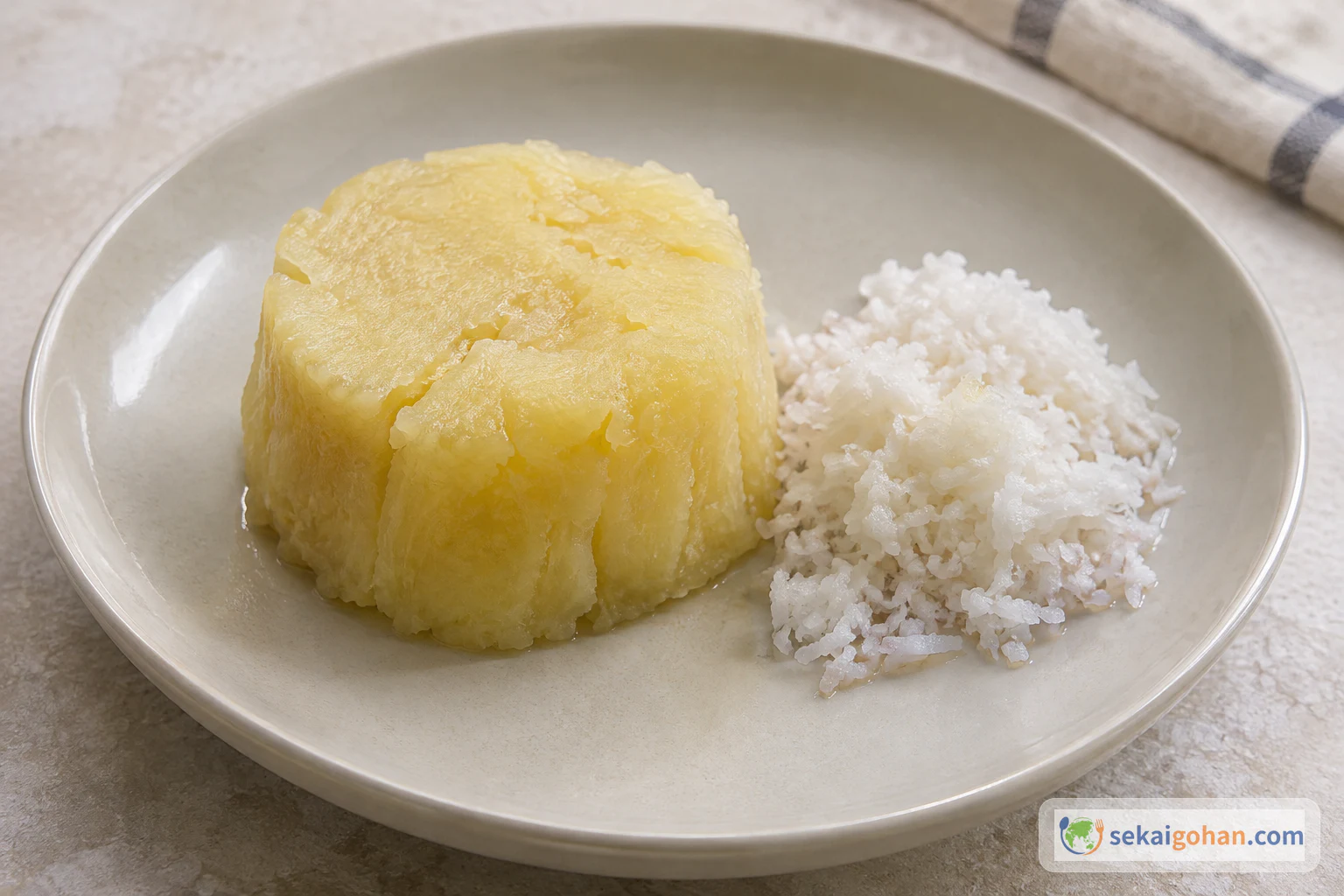
Lift the lid of the steamer and a sweet coconut aroma rises with the steam, along with a hint of slightly overripe fruit. Khanom tan (ขนมตาล / Khanom tan) is a plain yellow cake sold at Thai markets in rows of small banana-leaf cups. It isn't a showy cream pastry. Ripe palmyra palm pulp goes into a rice-flour batter, the batter rests until it turns light, and then it steams into a soft sponge that tastes of coconut, gentle sweetness and the fruity scent of palm.

About Khanom Tan
Khanom means a sweet or snack, and tan in this dish means the palmyra palm, or more exactly its fruit. In English the cake is called palmyra palm fruit cake, and it is sometimes romanized as Kha-nom-dtaan. The traditional version uses ripe pulp, rice, sugar, coconut and salt. The batter ferments for anywhere from several hours to half a day, and the cakes are served in small banana-leaf cups.
The Philippines' sapin-sapin is another steamed sweet, built on layers of glutinous rice flour and coconut. Khanom tan is much lighter. Fermentation or resting fills the batter with small bubbles, and steaming turns it into a soft sponge. If you've ever bought the palm sugar used in pad thai or som tam, you already know that Thai sweetness comes from more than white sugar.
Ingredients: Makes 8 Pieces
This makes 8 pieces in small cups about 5 cm in diameter. The sweetness is a little lighter than a Thai market sweet, so it is easy to eat after a meal. For a more local flavor, replace the unrefined cane sugar with palm sugar.

This recipe uses coconut, rice flour, and tapioca starch. Pulp paste and coconut products can be made on lines that also process wheat, milk, peanuts, or tree nuts, so check the labels. After steaming, move the cakes to a clean rack or plate, don't leave them at room temperature for long, and once they have cooled slightly, store them as described below.
Substitute table for days without pulp
Palmyra palm pulp is the star of khanom tan. The substitutes won't match it exactly, but they keep the lightness of the rice flour and the coconut aroma.
| Situation | What to use | How to make it | Result |
|---|---|---|---|
| You have frozen pulp paste | 4 oz (120 g) pulp paste | Thaw and strain out the fibers | Closest in aroma |
| Only canned pulp is available | 4 oz (120 g) pulp and 1.5 tbsp (20 ml) of canning liquid | Blend and strain through a sieve | Sweeter, so reduce the sugar by 10 g |
| You can't buy anything nearby | 2.75 oz (80 g) steamed pumpkin, 1.5 oz (40 g) steamed sweet potato, 2 tbsp (30 ml) coconut milk | Remove the skins and press through a sieve | Color is close but the palm aroma is weak |
| You want to add a little sweet aroma | 10 g palm sugar added to the substitute above | Subtract 10 g from the batter's sugar | Leans toward a brown-sugar aroma |
Pulp paste and banana leaves are the first things to look for when shopping. Stock changes often, so search for terms like "toddy palm pulp", "palmyra palm fruit", and "frozen banana leaf" rather than a fixed product name. To lower the risk of failure the first time, the flour and coconut can also go into other Southeast Asian sweets. Tapioca starch can also go into the noodles of khao piak sen, and coconut milk into tom kha gai and gaeng phet.
Choosing Ingredients and Substitutes for Khanom Tan
Palm pulp and its stand-ins
The hardest part outside Thailand is the ripe palmyra palm pulp at the heart of the dish. Ordinary supermarkets almost never sell it fresh. Frozen or jarred palm fruit paste is the closest substitute, and if you can't find that, pumpkin or sweet potato will give you the color and sweetness. What you get then is a home version made with rice flour and coconut, without the true palm aroma.
You'll have an easier time if you decide which parts matter most to you than if you try to match every ingredient. Your shopping list depends on what you prioritize: pulp, flour, mold or sweetness.
| Point to decide | If making it Thai-leaning | If making it realistically in a Japanese kitchen |
|---|---|---|
| Pulp | Strain ripe palmyra palm pulp and use it | Sieved pumpkin and sweet potato for color and sweetness |
| Flour | Grind soaked rice and drain off the water | Fine joshinko or baking-grade rice flour |
| Resting | Ferment for several hours to half a day | Rest 45 to 60 minutes with 1 g of dry yeast |
| Mold | Small banana-leaf cups | Silicone cups lightly brushed with oil |
| Sweetness | Properly sweet, like a market sweet | Light with 75 g of sugar, bringing the aroma forward |
| Topping | Freshly shredded coconut | Frozen shredded coconut or fine desiccated coconut |
Flour and molds
Stick with rice flour. Pancake mix is convenient, but the milk, wheat and baking powder flavors take over and you end up with a steamed bun instead of khanom tan. If your rice flour is coarse, a little tapioca starch brings back some of the airy spring of the Thai original.
Banana leaves add aroma and look lovely. Still, using them on your first try means sourcing pulp, preparing leaves and fermenting batter all at once. Start with silicone cups so you can learn the batter's thickness and the steaming, then move to banana leaves the second time around.
Method: Rest, Then Puff With Strong Steam
Steam it right after mixing and it packs down like a sweet rice-flour dumpling. Rest the batter in a warm place for at least 45 minutes, and steam it after small bubbles appear on the surface. Bring the steamer water to a full boil first, and wrap a cloth around the lid so condensation does not drip onto the batter.
If you rest the batter but the steam is weak, it spreads sideways, and if the steam is strong but the rest was too short, it comes out heavy. Think of it this way: make small bubbles by resting, then push them up all at once with strong steam at the start of steaming, and it fails less.
Common Khanom Tan Problems and Fixes
With so few ingredients, it's easy to see what went wrong. A heavy cake usually means too little resting, big cracks point to how the steam hit, and a weak aroma comes down to the pulp or the sugar.
Keep the rice flour from weighing the batter down, make the pulp or substitute paste smooth, rest the batter somewhere warm until bubbles form, and puff it all at once over strong steam. These steps matter just as much with a substitute. Skip them and the cake turns dense and chewy, like a steamed bun.

The batter is heavy
Either the resting temperature was too low, or coarse rice flour soaked up too much liquid. Next time, rest the batter at 28 to 30°C and wait until fine bubbles appear on the surface. If coarse joshinko is all you have, cut it to 4 oz (110 g) and raise the tapioca starch to 1.25 oz (35 g) to lighten the cake a little. Over-mixing also knocks out the bubbles, so stop at 20 seconds once the baking powder is in.
The surface cracks wide open
Check the strength of the steam, and check whether water is dripping onto the cakes. Wrap a cloth around the lid and don't crowd the cups into the middle of the steamer. Medium-high heat is fine, but if the water boils so hard that the cups shake, turn it down to medium. Small cracks are part of the handmade look and nothing to worry about.
The palm aroma is weak
A substitute will always smell less of palm. To bring back some of the rounded flavor of Southeast Asian sweets, add 10 g of palm sugar and use canned coconut milk. Leave out vanilla extract, which pulls the flavor toward Western pastries.
It turns watery
The pulp paste or frozen coconut is carrying too much moisture. After straining the pulp, leave it in the sieve for 5 minutes. Thaw frozen coconut and press it lightly with paper towels. A plate straight from the steamer also makes the bottoms soggy, so cool the cakes on a rack for 5 minutes before plating.
Serving and Storing Khanom Tan
How to serve it
Khanom tan is easiest to eat once the steam has settled a bit. In small leaf cups, the way markets sell them, you can just pick them up. If you used silicone cups, loosen the edges with a bamboo skewer, turn the cakes out onto a small plate and add a little more coconut so they look neat.
Hot Chinese tea, unsweetened black tea or light coffee all go well with it. After spicy Thai food, the coconut and rice flour soften the heat of som tam or gaeng phet. After strongly herbal dishes like khao soi or tom yum goong, slightly restrained sweetness suits best. It also makes a good dessert on a gapao rice night, because the salt in the coconut keeps your mouth from feeling heavy.
| When to serve | How to serve it | Reason |
|---|---|---|
| After spicy Thai food | One per person with warm tea | Coconut fat rounds off the lingering chili heat |
| Weekend morning | Rewarm refrigerated cakes in a steamer for 3 minutes | The rice flour softens again and the coconut stays moist, better than in a microwave |
| Potluck | Cool them in their cups and line them up in a box | Banana leaves or silicone cups keep them from collapsing |
| Eating with children | Keep the 75 g of sugar and cut into half-moons | Not too sweet, and easy for small hands to hold |
Storage
The cakes keep for half a day at room temperature and up to 2 days in the refrigerator. Let them cool slightly, wrap each one in plastic wrap and put them in a storage container. To reheat refrigerated cakes, steam them over medium-low heat for 3 to 4 minutes, until the surface turns moist again. In a microwave, heat for 20 seconds at 600 W, then in 10-second bursts. Heating too long makes the rice flour hard.
You can freeze them, though the texture suffers a little. Wrap each one in plastic wrap, put them in a freezer bag and use within 2 weeks. Steam them straight from frozen over medium heat for 7 to 8 minutes. They're ready when they're warm all the way through and the coconut on top is moist.
Frequently Asked Questions
Can I still call it khanom tan without pulp paste?
Strictly speaking, it's only khanom tan if it contains palmyra palm pulp, which is what the tan in the name refers to. Made with pumpkin and sweet potato, it's a khanom tan-style rice flour and coconut steamed sweet. It's still a good way to learn the steps and the texture before you track down real pulp.
Are banana leaves required?
No. Silicone cups work too. If you do use banana leaves, warm them first so they don't crack when you fold them: microwave them at 600 W for 20 seconds, or hold them over steam for 30 seconds, then fasten them.
Won't dry yeast make it taste like bread?
At just 1 g, the bread aroma stays faint. The yeast is there to make small bubbles in the batter, not to add a fermented flavor. If your room is warm and the pulp paste already smells strongly fermented, you can cut the dry yeast to 0.5 g and rest the batter for 60 minutes.
Can I make it with baking powder alone?
You can, but the texture will lean toward a steamed bun. Without the dry yeast, raise the baking powder to 7 g and rest the batter for 20 minutes before steaming. The bubbles will be light, but you'll get less of the fermented aroma of the Thai version.
How sweet is close to the local version?
Some market sweets in Thailand are quite sweet. This recipe holds back so the cakes work after a meal in Japan. For a sweeter, market-style cake, raise the sugar to 3.25 oz (90 g) and keep the salt at 2 g. More sugar on its own tastes heavy, so always mix 1 g of salt into the coconut for finishing.
- JIRCAS Database of Fermented Foods of Thailand: Kha-nom-dtaan - checked the ripe palmyra palm pulp, rice, sugar, coconut, salt, fermentation of several hours to 12 hours, and shelf life of about 2 days.
- Thailand Foundation: Khanom Tan: A Classic Thai Dessert You Shouldn’t Miss - checked the meaning of the name, the pulp, rice flour, coconut milk, sugar, salt, banana-leaf cups, and the connection with Phetchaburi.
- Chiang Mai University Library Lanna Food: Khanom tan - checked, as northern Thai information, the ripe pulp, rice flour, coconut, banana-leaf cups, 20-minute steaming, and the tip of fermenting in a warm place.
- Wikipedia: Khanom tan - used to cross-check the English spelling, Thai spelling, and name of the dish.