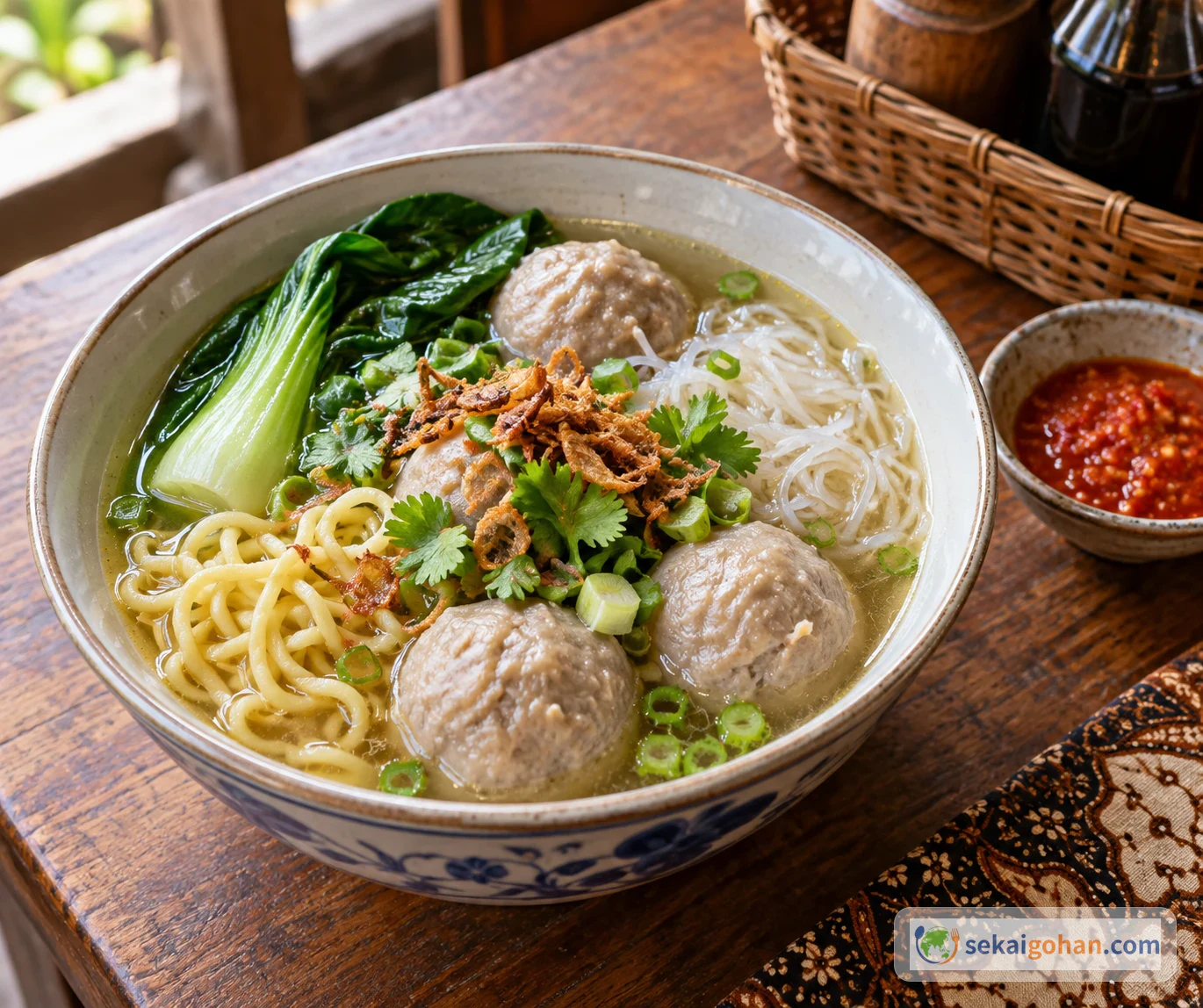
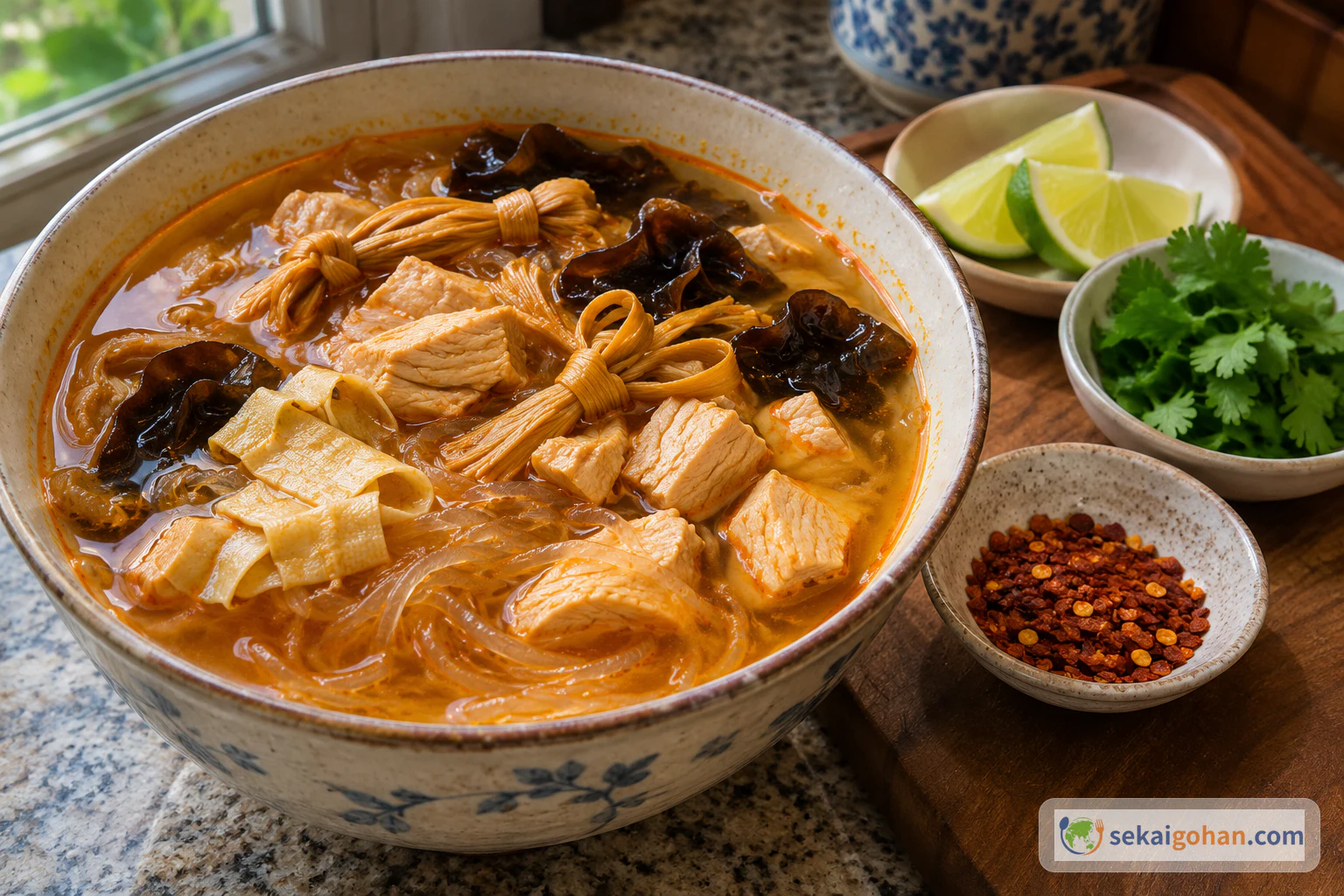
In the early-morning markets of Laos, the steam hanging over the street stalls comes from khao piak sen (ເຂົ້າປຽກເສັ້ນ). It is a noodle soup of thick hand-cut rice and tapioca noodles simmered in chicken broth, and the starch from those noodles dissolves into the pot until the soup turns silky and slightly translucent. Laotians eat it for breakfast, lunch, or dinner, but a bowl steaming at a street stall in an early-morning market is the picture most people carry with them. Here is how to make the whole dish at home, from cutting the noodles by hand to building the broth.
About khao piak sen
In Lao, "khao" (ເຂົ້າ) means rice, "piak" (ປຽກ) means wet or soft, and "sen" (ເສັ້ນ) means noodles, so the name translates literally as "soft rice noodles." It is eaten all over Laos, and the area around Vientiane is especially known for it. Outside Laos and its diaspora it is still little known, though it deserves a place next to Thai pad thai and Vietnamese banh xeo as a Southeast Asian classic.
The broth's body is what sets it apart. Vietnamese pho has a clear broth, and Thai kuaitiao is a different dish again, while khao piak sen gets its gentle thickness from fresh noodles cooking right in the soup. It is traditionally made from dough, by hand, at each home and each stall, which also separates it from noodle soups built on dried or bought noodles.
The Mekong and Lao noodle culture
Laos is landlocked, stretching north to south along the Mekong River between Thailand and Vietnam, and the Mekong and its tributaries are its lifeline. Rice grows on the fertile lowlands along the river, and Laos is among the world's biggest consumers of glutinous rice. In an ordinary meal, glutinous rice (khao niao) is the staple, while noodle dishes use flour from non-glutinous rice. Where khao piak sen itself came from is not clear.
Choosing ingredients and substitutes for khao piak sen
Lao cooking makes frequent use of dill, and adding it to khao piak sen brings out the Lao flavor at once. If you can't find dill, leave it out rather than swapping in another herb; the balance holds better that way.
Galangal and lemongrass are basic aromatics of Southeast Asian cooking, but galangal in particular can be hard to find. 2 slices of ginger plus a little lemon zest partly reproduces its citrusy fragrance. Lemongrass can be replaced with the zest of 1 lemon plus 1 slice of ginger. Asian grocers often carry both aromatics frozen or dried, so check there first.

Common khao piak sen mistakes and fixes
What makes khao piak sen is cooking the noodles directly in the broth. Boil them separately and the soup never gets its body, and you end up with a plain chicken noodle soup.
The soup should be "just a little silky," nowhere near as rich as Malaysian laksa. If it turns too thick, the noodles have simmered too long. Add 100–200 ml hot water to taste, and next time cut the simmering to about 3 minutes, turning off the heat while you check the texture. If the soup lacks body, stir in 2 tsp tapioca starch dissolved in 2 tbsp water.
Variations and nutrition
Khao piak kai (with egg)
Drop 1 raw egg into the bowl after ladling in the soup. It sets to soft-cooked in the residual heat and melts into the broth, adding richness. At Lao stalls this is a standard customization; you simply ask for an egg added.
Khao piak mu (with pork)
Simmer 10.5 oz (300 g) pork belly in the broth instead of chicken. The fat dissolves into the soup for a stronger flavor, and thin slices of the pork go on top at the end. Pork soups like Malaysian bak kut teh are loved across the Chinese-influenced food cultures of Southeast Asia.
Vegetarian version
Leave out the chicken and use 7 oz (200 g) mushrooms, 1 block of tofu, and 2 quarts (2 L) kombu or vegetable stock. In place of fish sauce, use 2 tbsp light soy sauce plus 1 tsp kombu tea powder. The mushrooms bring enough savory depth to stand in for chicken broth.
Quick version with store-bought rice noodles
When there's no time to cut noodles, use 7 oz (200 g) dried wide rice noodles (pho type). Dried noodles must be boiled separately and then added to the soup, so make up for the missing body with 1 tbsp tapioca starch dissolved in 2 tbsp water. You won't get the chew of hand-cut noodles, but you'll get the feel of khao piak sen with little effort.
Nutrition (per serving, from 4 servings)
| Nutrient | Amount |
|---|---|
| Calories | 420 kcal |
| Protein | 1 oz (28 g) |
| Fat | 12 g |
| Carbohydrates | 1.75 oz (48 g) |
| Fiber | 2 g |
| Sodium | 850 mg |
Sodium runs a little high because of the fish sauce. Chicken protein and rice-noodle carbohydrates together give lasting energy, which is part of why this bowl suits breakfast.
More Southeast Asian dishes to try
- How to make laab: another dish from the Lao table
- How to make amok: ingredients and aromas from the same region
- Indonesian cuisine overview (in Japanese)
- How to make bubur ayam
- Laksa: Malaysia's coconut curry noodles, a rich contrast to khao piak sen
- Pad thai: Thailand's stir-fried noodles, the same rice noodles taken in a completely different direction
- Mohinga: Myanmar's fish-broth noodles, another breakfast noodle dish
- Banh mi: a way into Vietnamese food culture and how it relates to pho and khao piak sen
FAQ
Q1. I don't have time to make hand-cut noodles. Can I substitute?
Dried wide rice noodles (pho type) are the closest substitute; use them as in the quick version above. Another option is fresh wide, flat noodles. Their shape resembles khao piak sen noodles, and 3 minutes in the broth is enough for them to release starch and thicken the soup.
Q2. Can I store the soup and noodles?
Yes, but store them separately. The soup keeps 3 days refrigerated and 1 month frozen. But noodles left in the soup soak it up and turn mushy, so add them just before eating. Hand-cut noodles tossed with dusting flour keep 1 day in the refrigerator.
Q3. I don't like fish sauce. Can I use something else?
Use 2 tbsp light soy sauce plus 1 tsp granulated stock to stand in for its savory depth. The flavor differs, but the soup is still delicious. Fish sauce is central to Southeast Asian cooking, as in Thai som tam, but there's no need to force it.