Pour the yellow rice-flour batter into a pan with a thin film of oil and it hisses right away. The edge dries first and starts to curl like thin paper. If you panic and cook it thick, you get an ordinary soft crepe. If you wait for that sound and spread the batter in one go, the edge lifts lightly into a bánh xèo that cracks when you wrap it in lettuce.
The dish gets its name from that sizzle: xèo is the sound of batter hitting hot oil. It's a thin Vietnamese crepe made with rice flour and turmeric. You fold it into a half-moon around shrimp, pork and bean sprouts. At the table, everyone wraps pieces in lettuce and herbs and dips them in nước chấm, a sweet-and-sour dip made with fish sauce.
Bánh xèo in Vietnam
Bánh is the Vietnamese word for dough-based foods made of flour or rice, and xèo is the sound of cooking. In English it is also called Vietnamese sizzling crepe or Vietnamese pancake, but it is made of rice flour, baked thin and eaten with herbs.

In the south, bánh xèo is often a large, thin crepe 10–12 inches (25–30 cm) across, with a hint of sweet coconut milk. Shops around Ho Chi Minh City make them even bigger than a 10-inch (26 cm) home frying pan. The table is set with plenty of lettuce, mustard greens, mint and a fish-sauce dip.

Around Huế in the center, the same name covers a smaller, thicker version. It's more filling per bite, and the filling often centers on small shrimp. People often mention it in the same breath as bánh khọt, the small round rice-flour cakes from around Vũng Tàu in the south. In bánh khọt the filling shows more on top, and the cake is toasty outside and a little thicker inside. Once you're used to bánh xèo, small ones like bánh khọt are a good next step.
Each Vietnamese favorite has its own pleasure: phở gà is about the aroma of a clear broth, bánh mì is about putting bread and filling together, and bún chả is about charcoal-grilled pork and rice noodles. Bánh xèo is about breaking the crepe while it's fresh and wrapping it. The cook bakes in the kitchen while the diners wrap at the table, so it's a slightly busy meal.
Ingredients: serves 4, 6–7 pieces in a 10-inch (26 cm) frying pan
This uses shrimp, pork and fish sauce. If you avoid shrimp, cut 4 oz (120 g) of chicken thigh into strips and cook it over medium heat for 3 minutes or more until cooked through. If you can't use fish sauce, combine 2 tbsp light soy sauce, 1 tsp rice vinegar and 2 tsp sugar, and treat it as a separate sauce.

For bánh xèo, use non-glutinous rice flour. Glutinous rice flour is derived from sticky rice, so it becomes gummy when cooked and doesn't crack crisply. When buying, choose rice flour or joshinko whose ingredients list non-glutinous rice. If you use a special mix, check whether the bag already contains turmeric or coconut flour, and start with a little less salt and water than this recipe.
Choosing ingredients for bánh xèo
Shrimp, pork, bean sprouts and lettuce from a nearby supermarket are fine. The ingredients worth seeking out are the ones that set the aroma: coconut milk, turmeric and fish sauce.
Coconut milk gives the southern style its sweet aroma and makes the edge light. The fat can separate in the can, so shake it well before opening. If it has set, stir it in a bowl before you measure.
Turmeric is mainly there for color. Curry powder isn't a good substitute: its cumin and coriander push forward and take you away from the lightness of bánh xèo. A small jar won't go to waste, since you can use it again to color dal bhat or japchae.
Fish sauce varies widely in saltiness and aroma, and that changes how the nước chấm tastes. If you don't have any, a small bottle will also see you through chả giò and bún chả. Because the dip is sweet and sour, keep the salt in the batter low. Let the dip carry the flavor at the end, so the taste stays balanced when you wrap the crepe in leafy greens.
Method: keep the batter thin and don't overfill
Bánh xèo is a dish you cook and eat piece by piece, so organization matters. First put 7 oz (200 g) rice flour, 1 tsp turmeric and 1/2 tsp salt in a bowl. Mix in ¾ cup (200 ml) coconut milk and 1 cup (230 ml) cold water in 3 portions. The batter is right when it flows from the whisk in a thin stream and leaves a mark for about 2 seconds before vanishing. Add the scallions and rest in the refrigerator for 30 minutes. Meanwhile, pat the shrimp dry, cut the pork belly into 1.5-inch (4 cm) lengths, and wash and thoroughly dry the bean sprouts and herbs. Once the prep is done, focus on one piece at a time.
Bánh xèo troubleshooting
At home, the hard part is the cooking, not the ingredients. Rice-flour batter has no wheat gluten, so it turns heavy when poured thick and sticks when there's too little oil. Keep to three rules: don't overfill, spread the batter within 30 seconds, and finish by cooking the edge dry. Follow them and even a home stove gives you a very satisfying crack.

The most common first-time failure is batter that makes no sound when it hits the pan and then sticks to the bottom. The cause is usually a pan that isn't hot enough, not too little oil. Rice-flour batter holds together less well than wheat batter, and on a cold pan it turns pasty before it can spread thin. Treat the first piece as a test: watch the sound, the spread and how the edge dries.
| Failure | Likely cause | What to change in the next piece |
|---|---|---|
| Sticks to the bottom | Pan is lukewarm, oil film has broken | Extend preheating by 30 seconds and spread 1 tsp oil thinly |
| Batter is thick and heavy | Too much per ladle, batter too thick | Keep to ¼ cup (80 ml) or less per piece and add 1 tbsp water |
| Goes limp | Bean sprouts too wet, cooked through too briefly | Remove the lid and cook 30 seconds longer over medium heat |
| Bitter yellow color | Too much turmeric, oil scorched | Use 2/3 tsp turmeric and wipe the pan bottom before the next |
| Oily | Absorbed oil at low temperature, steamed when stacked | Cook at a temperature that sizzles and stand pieces on the plate without stacking |
Choosing the pan
Street stalls use big griddles or special flat pans. At home, a nonstick frying pan of about 10 inches (26 cm) is the easiest to handle. A crepe as big as the shop ones is hard to flip and leaves the center damp, so make thinness the priority, even if your crepes come out a little smaller. An iron pan works too, but rice flour sticks the moment the oil film breaks, and the first few pieces are hard even in a well-seasoned pan. Learn to spread the batter thin in nonstick first, using only a little oil and never overfilling, then move to iron.
Serving and storing bánh xèo

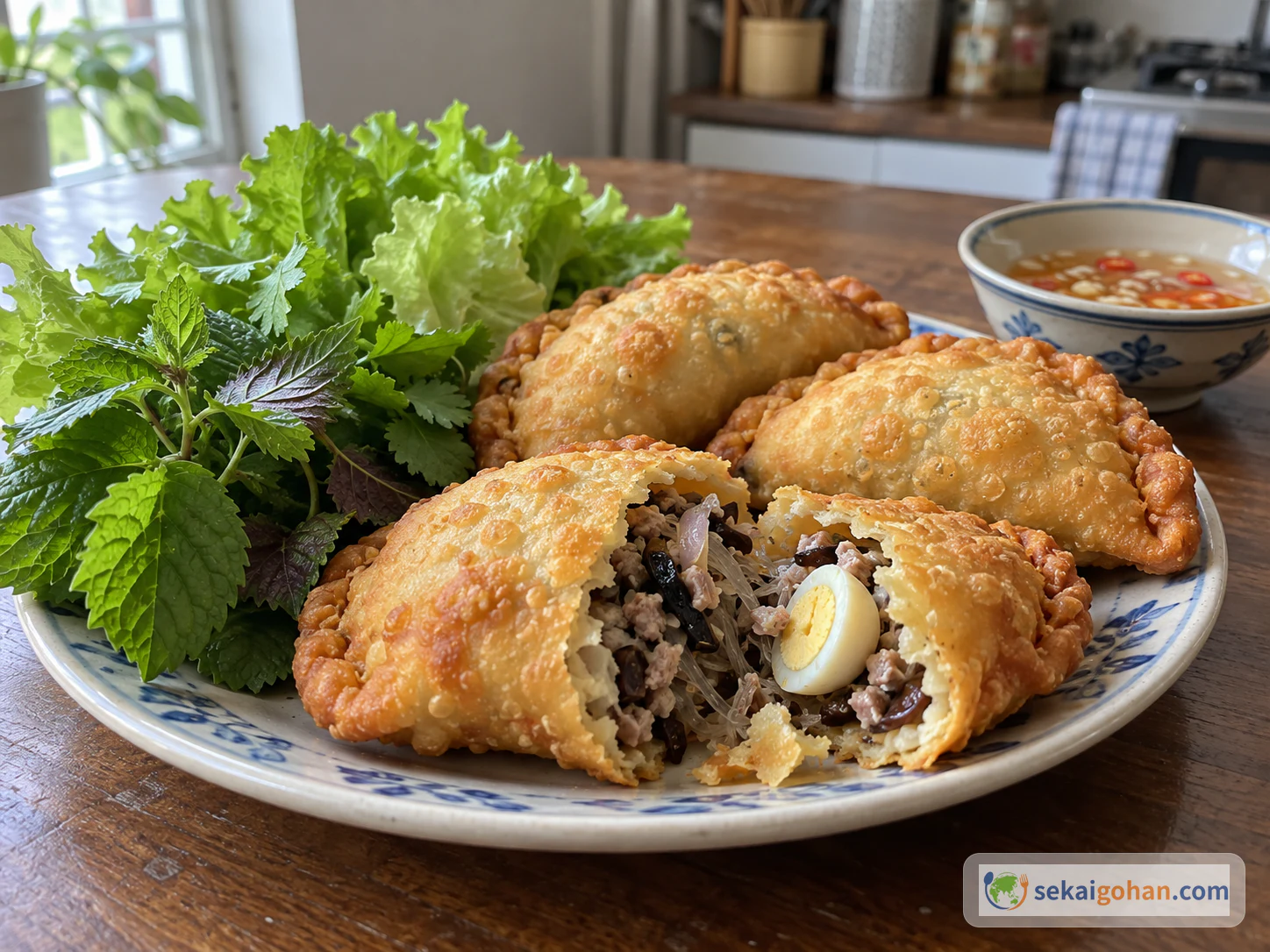
The dish isn't finished when the crepe hits the plate. Break the fresh crepe into bite-size pieces, set them on lettuce or sangchu, top with perilla, mint and cilantro, and roll. Dip just one side lightly in the nước chấm instead of dunking the whole thing, so some of the edge stays crisp. Herbs make the oil feel lighter, so put out plenty of leafy greens and you won't tire of it.
Make-ahead and leftovers
You can make the batter the day before. Overnight in the refrigerator it settles and becomes easier to spread, but stir it well from the bottom just before cooking. Scallions left in the batter for long get a strong aroma, so stir them in at the last minute.
Cooked bánh xèo doesn't store well. If you do have leftovers, let them cool uncovered, put them in a shallow container in the refrigerator and eat them by the next day. To reheat, brush a frying pan thinly with oil and heat over medium for 90 seconds per side. The microwave alone softens the crepe with moisture from the sprouts.
Huế style and other rice-flour dishes
Once you know the southern style, try the Huế style in a small pan: use about 2.5 tbsp (40 ml) of batter and steam it for about 1 minute. For bánh khọt, a takoyaki pan gives a similar feel, though the oil and heat reach the batter differently. Get a feel for the moisture and oil of rice-flour batter with bánh xèo first, then move on to bánh khọt.
If you'd like to go from rice flour baked in a pan to rice flour steamed into thin sheets, try bánh cuốn next. In both, the thickness and moisture of the batter decide the texture. The difference is how you read the pan: one dish builds browning, the other uses steam to make translucent sheets.
Frequently asked questions
Is it harder to tear if I add wheat flour?
It tears less easily, but the texture changes. For the light, cracking texture of bánh xèo, use rice flour alone. If it's really hard to handle the first time, replace just 20 g of the 7 oz (200 g) rice flour with all-purpose flour, then go back to plain rice flour next time and compare.
Are nước mắm and fish sauce the same?
Both are fish sauce, but saltiness and aroma differ by product. Vietnamese nước mắm is easy to use if you have it, but Thai fish sauce is easier to find. Start the dip with 2 1/2 tbsp, taste, and add more if needed, and it's less likely to turn out too salty.
Can I make it without shrimp?
Yes. Cut 4 oz (120 g) of chicken thigh into strips and, in step 3, cook it over medium heat for 3 minutes or more, until cooked through, before pouring in the batter. For mushrooms only, fry shimeji or king oyster mushrooms over medium heat for 2 minutes first to drive off the water they release.
Is lettuce alone enough for wrapping?
You can eat it with lettuce alone, but herbs do much of the work of lightening the oil. Try to have two of perilla, mint and cilantro. If you don't like cilantro, use perilla, mint, thin scallions and cucumber.
Related recipes
- Bánh mì - a street-food staple combining baguette with Vietnamese fillings
- Bánh khọt - small round rice-flour cakes, also eaten with herbs and a fish-sauce dip
- Chả giò - fried spring rolls wrapped in leafy greens, eaten in a similar way
- Bún chả - a rice noodle dish served with a nước chấm-style dip and herbs
- Pad Thai - a Thai staple that brings rice noodles together with fish sauce and sourness