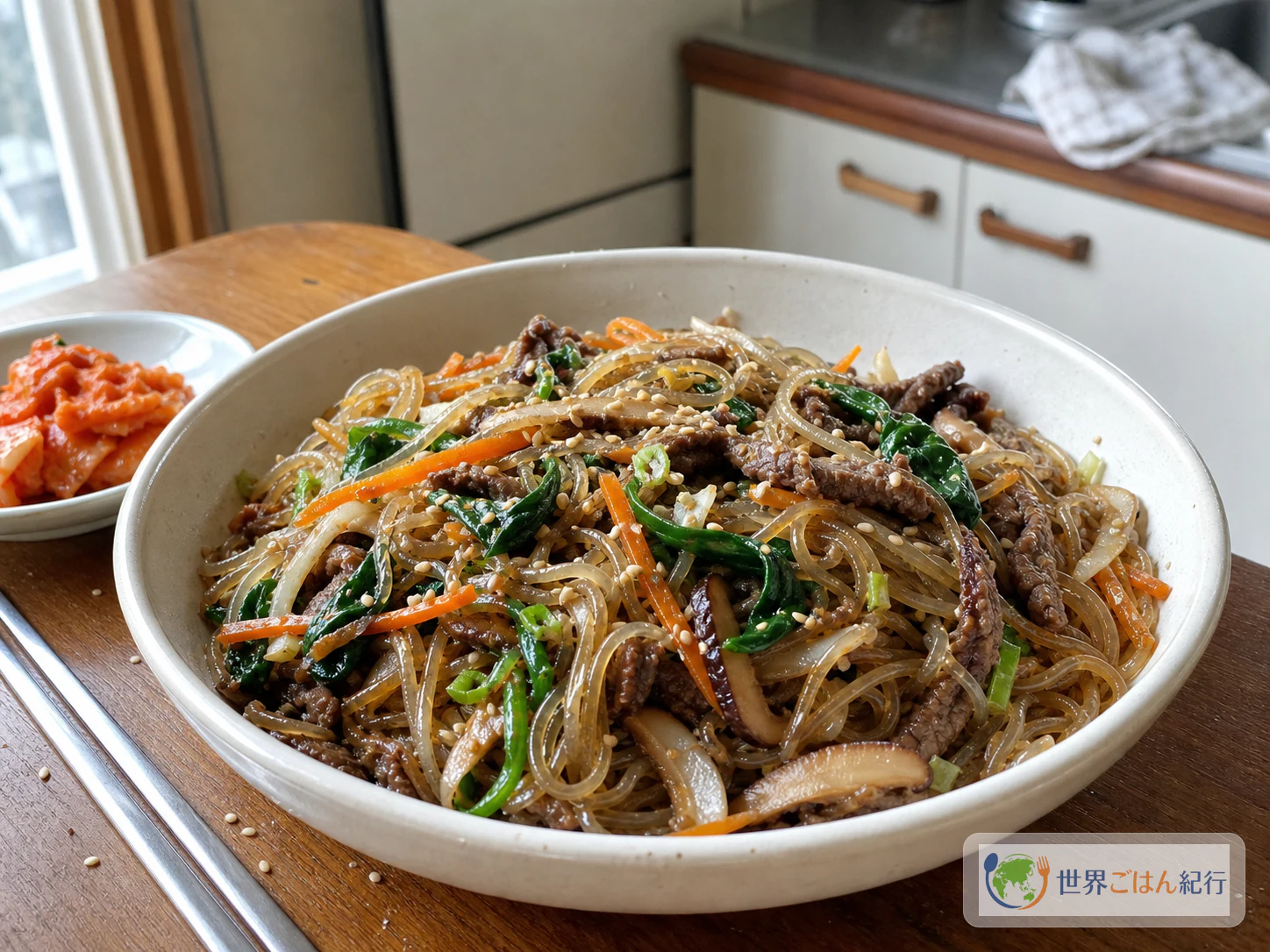
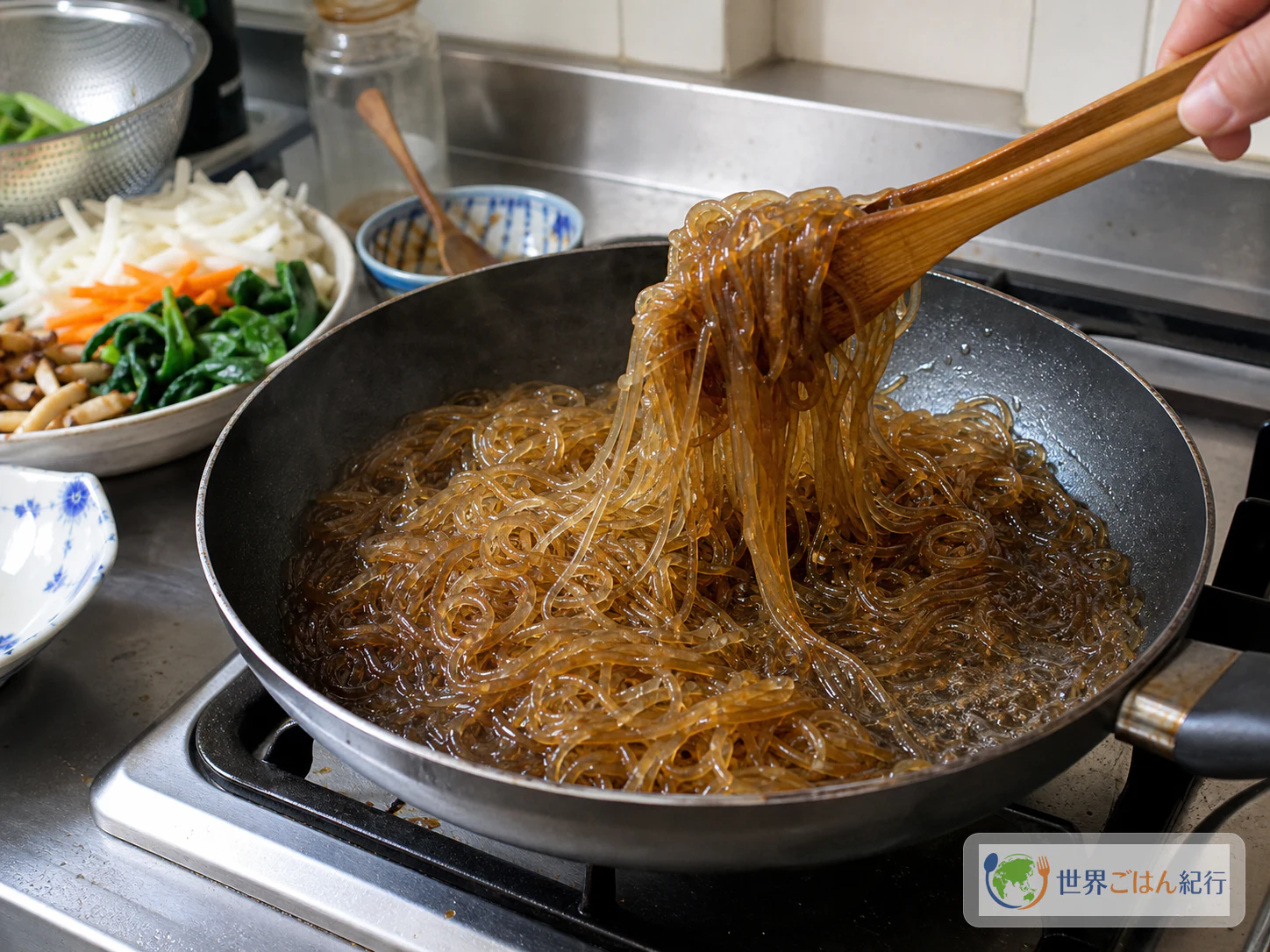
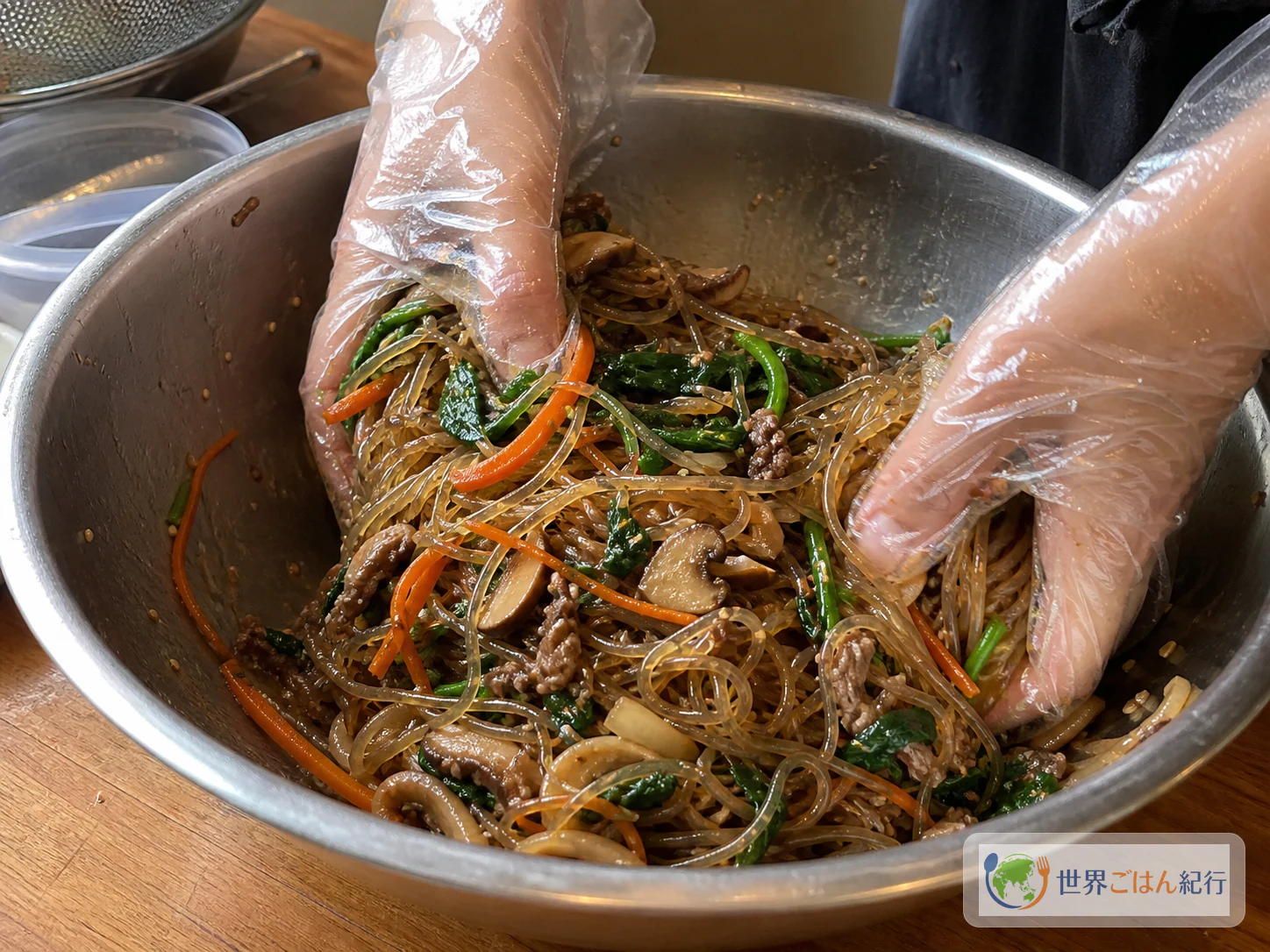
When you warm sesame oil in the kitchen in the early evening, the first scent to rise is not garlic but the smell of dry noodles softening in the steam. Clear noodles turn the color of soy sauce, and once carrot, spinach, shiitake, and beef are folded in, the long strands shine as you lift them with chopsticks. Japchae is a big Korean platter more than a stir-fry: each ingredient is cooked on its own, then everything is tossed together at the end. It is sweet-salty, mild, and glossy, and it holds up well even at room temperature on a crowded table.
What japchae is and how it is eaten in Korea
The name 잡채 (Japchae) is often explained as meaning "mixed vegetables," though today the version made with Korean glass noodles, dangmyeon (당면), is the best known. In Korean homes it shows up at celebrations, potlucks, and family gatherings. Because it isn't spicy, it gives the table a place to rest beside red dishes such as tteokbokki or kimchi jjigae (in Japanese: /recipes/east-asia/korea/kimchi-jjigae).
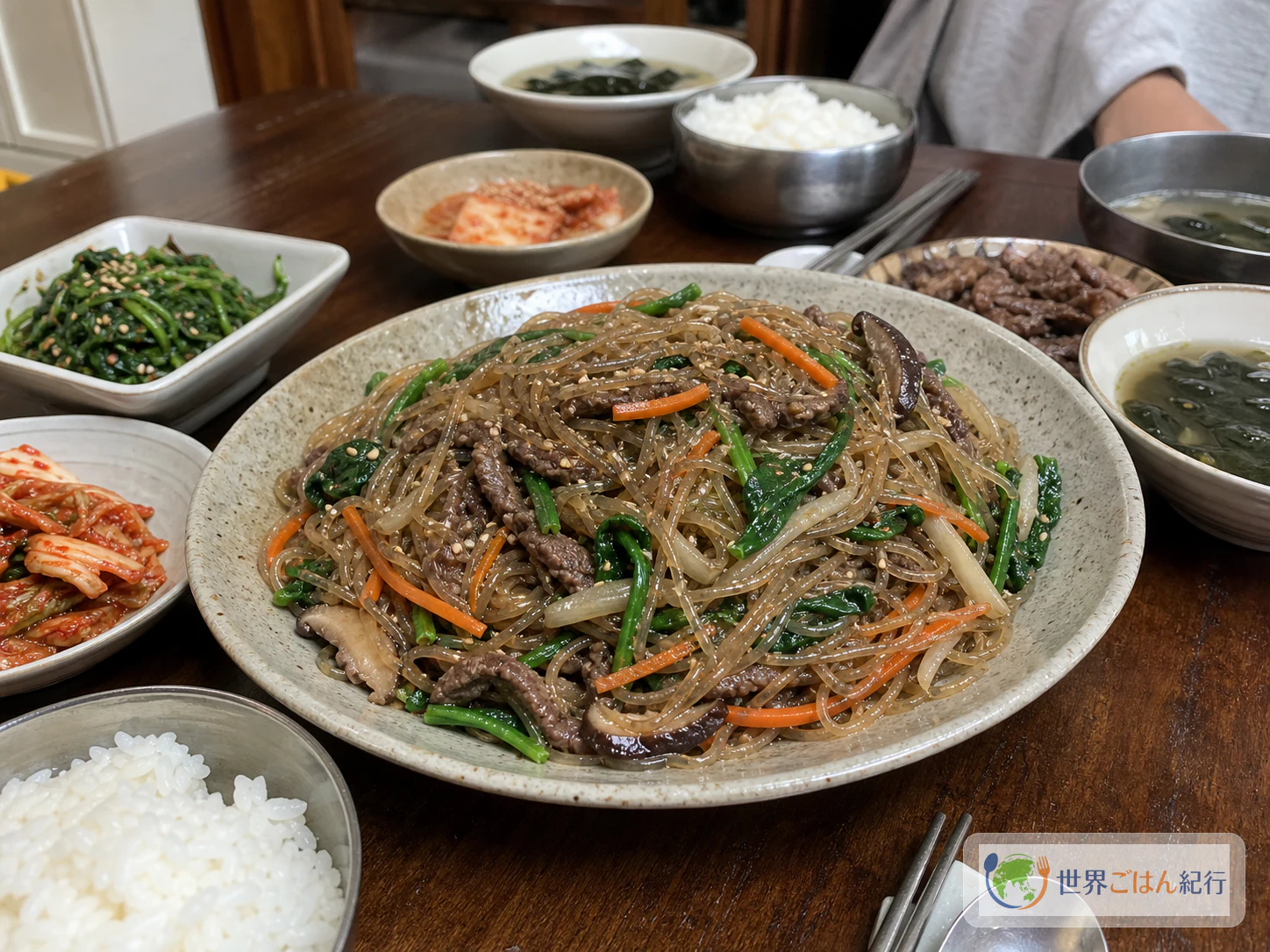
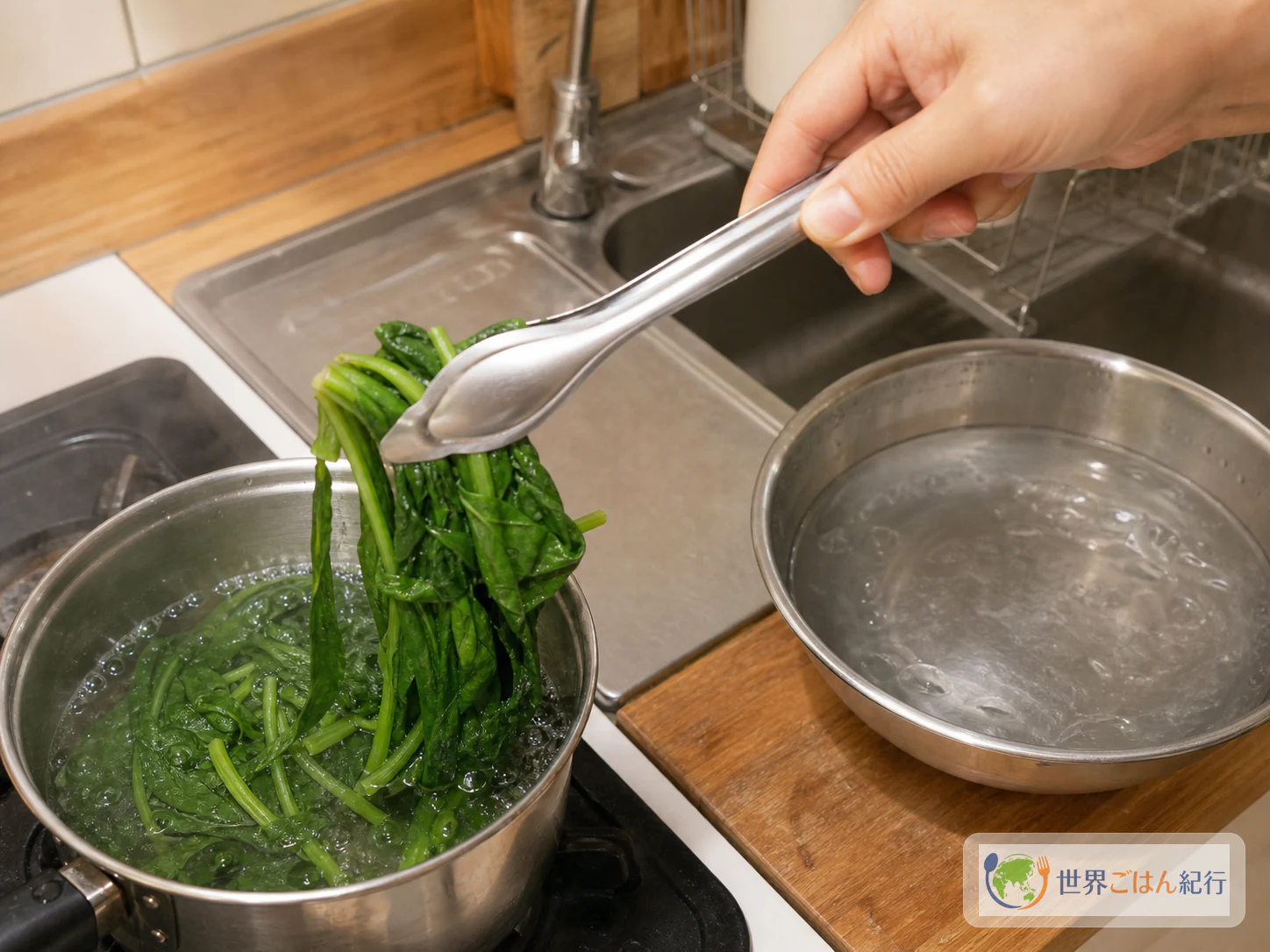
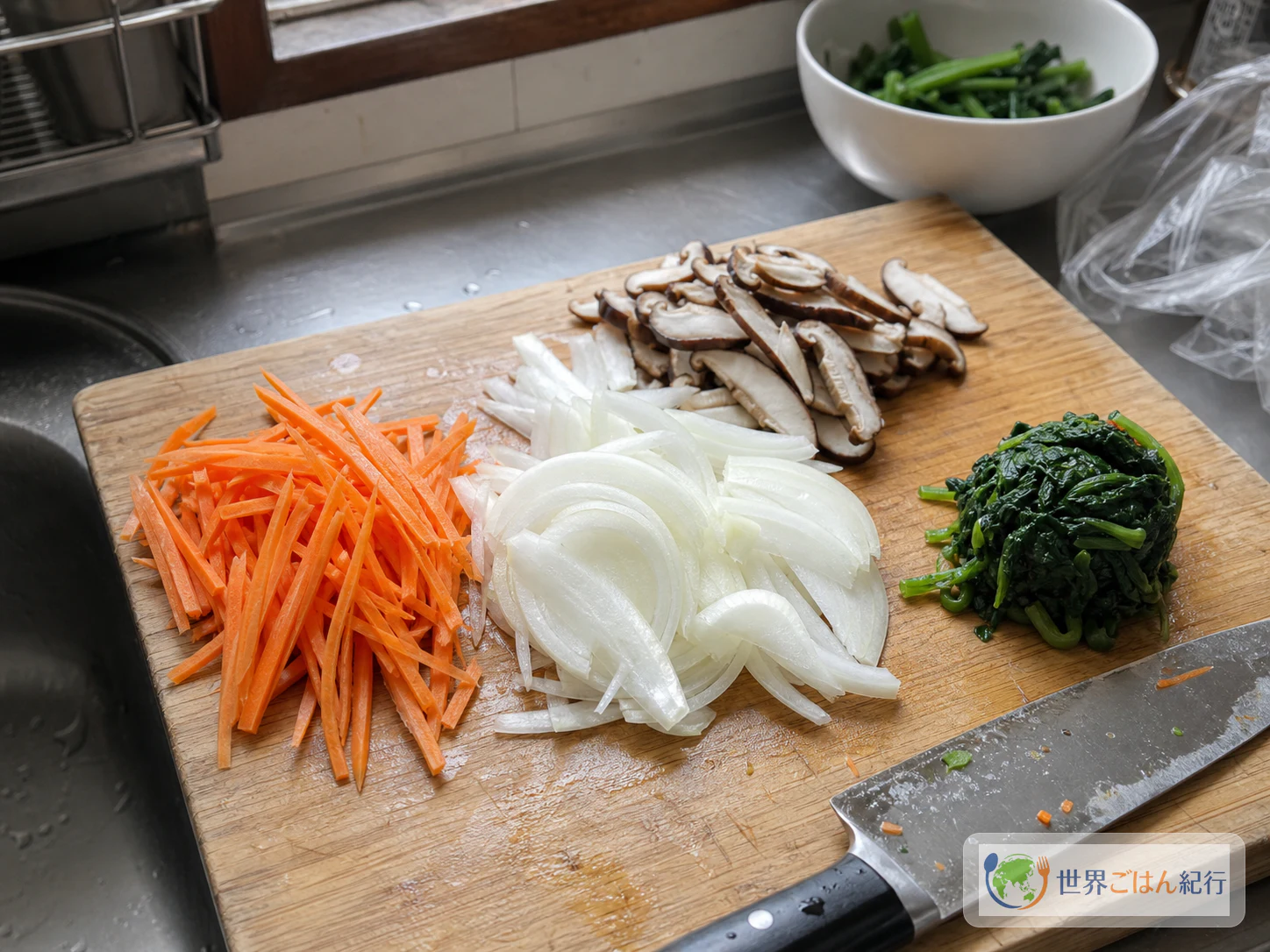
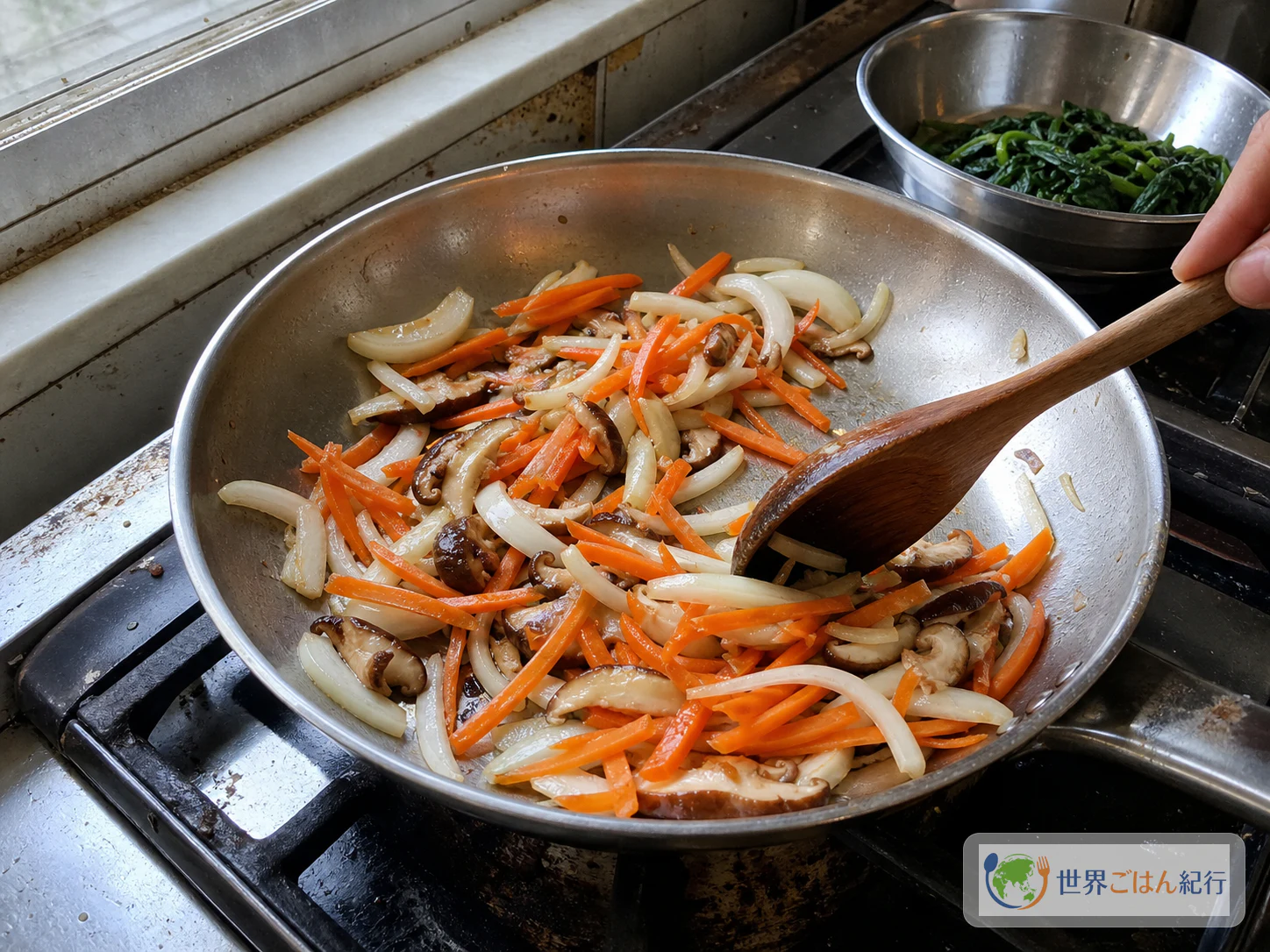
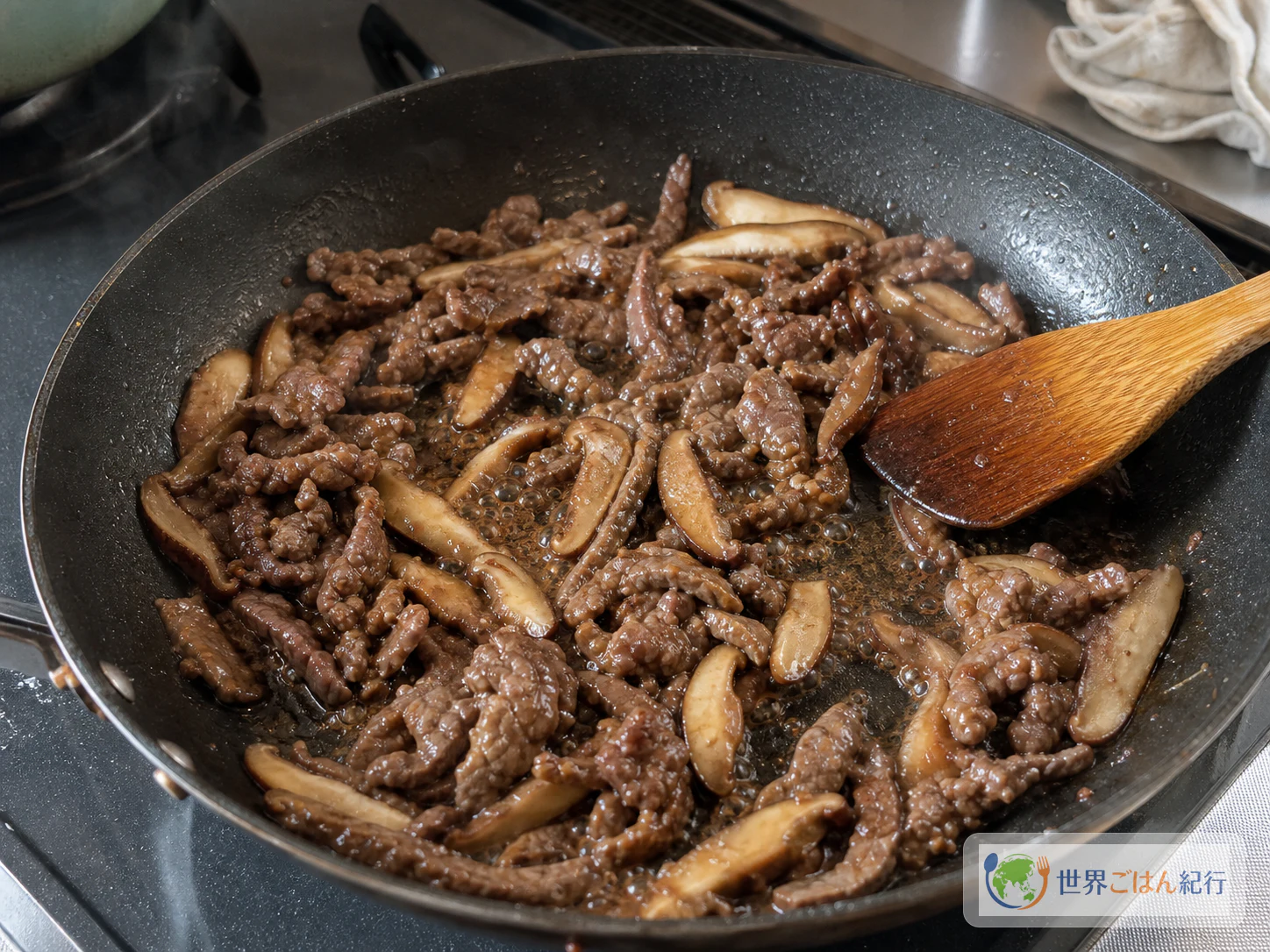
The method is what sets japchae apart. Stir-frying everything at once is faster, but the carrot stays hard, the onion turns watery, and the noodles break easily. Preparing each ingredient separately and tossing at the end keeps every color and texture distinct.
In Korean it is written 잡채, and in English it is spelled Japchae. You will also see chapchae; this site uses "japchae." Korean glass noodles, dangmyeon, are written 당면 and are thick noodles made mainly from sweet potato starch.
Ingredients: think of the noodles and the vegetables separately
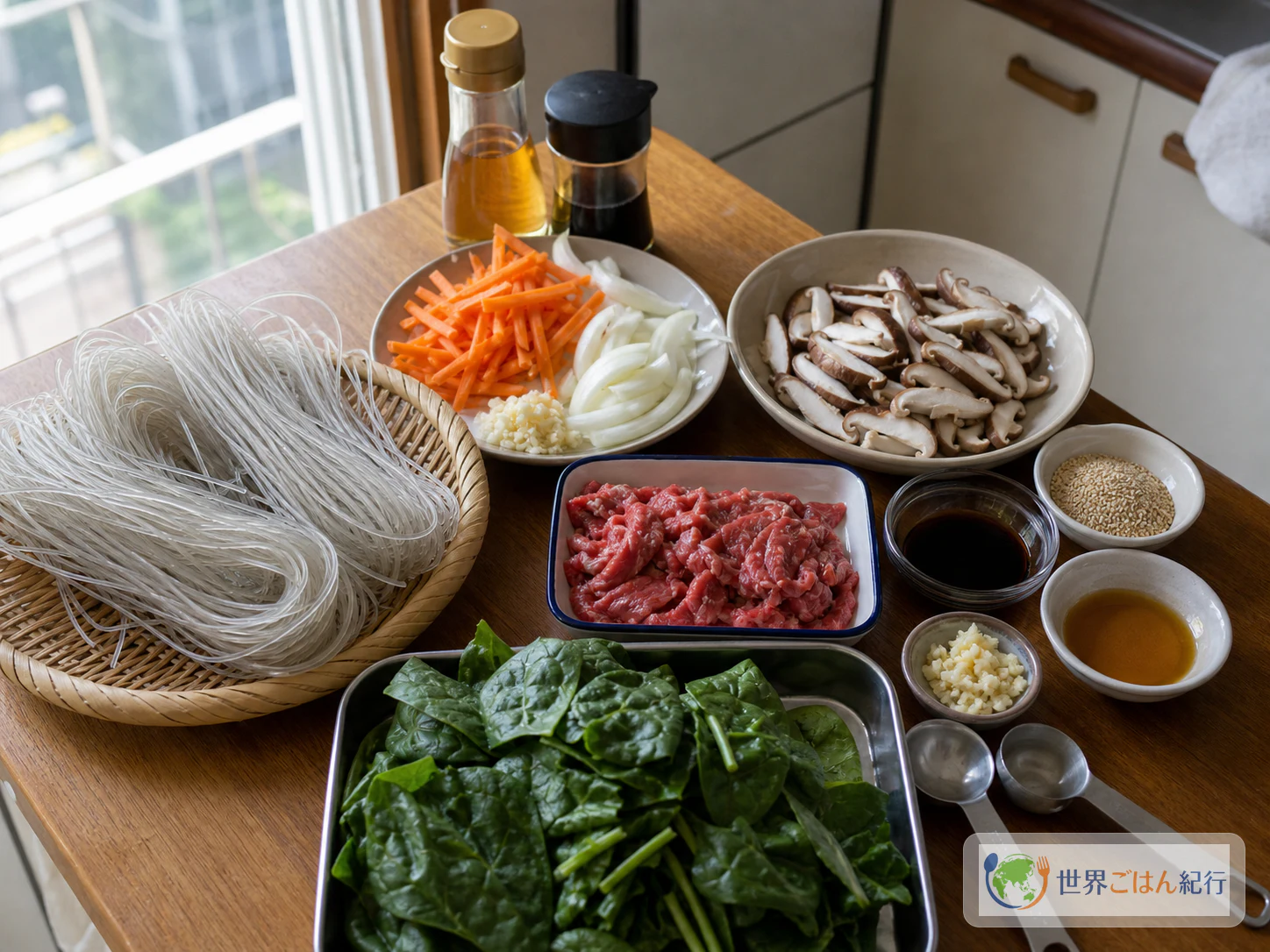
This serves 4. As a main dish this amount fills one large platter; as a side among Korean dishes it serves about 6. Beef adds a deeper aroma, but with more mushrooms the dish works without meat. The biggest difference is using Korean dangmyeon rather than thin glass noodles.
Ingredients (serves 4)
The allergens to watch for are beef, soy, wheat, and sesame. Most dangmyeon is made from sweet potato starch, but ingredients differ by product, so read the label. Many soy sauces contain wheat, so if you need to avoid gluten, use gluten-free soy sauce and check the label.
If you substitute thin glass noodles, the key is not to soak them for too long. Thin noodles soften before they absorb the seasoning and break easily when mixed. If you cannot find dangmyeon, look for thicker glass noodles or dried noodles sold for Korean restaurants. Rice vermicelli and shirataki change both texture and how the seasoning goes in, so treat them as a different dish.
Choosing ingredients for japchae
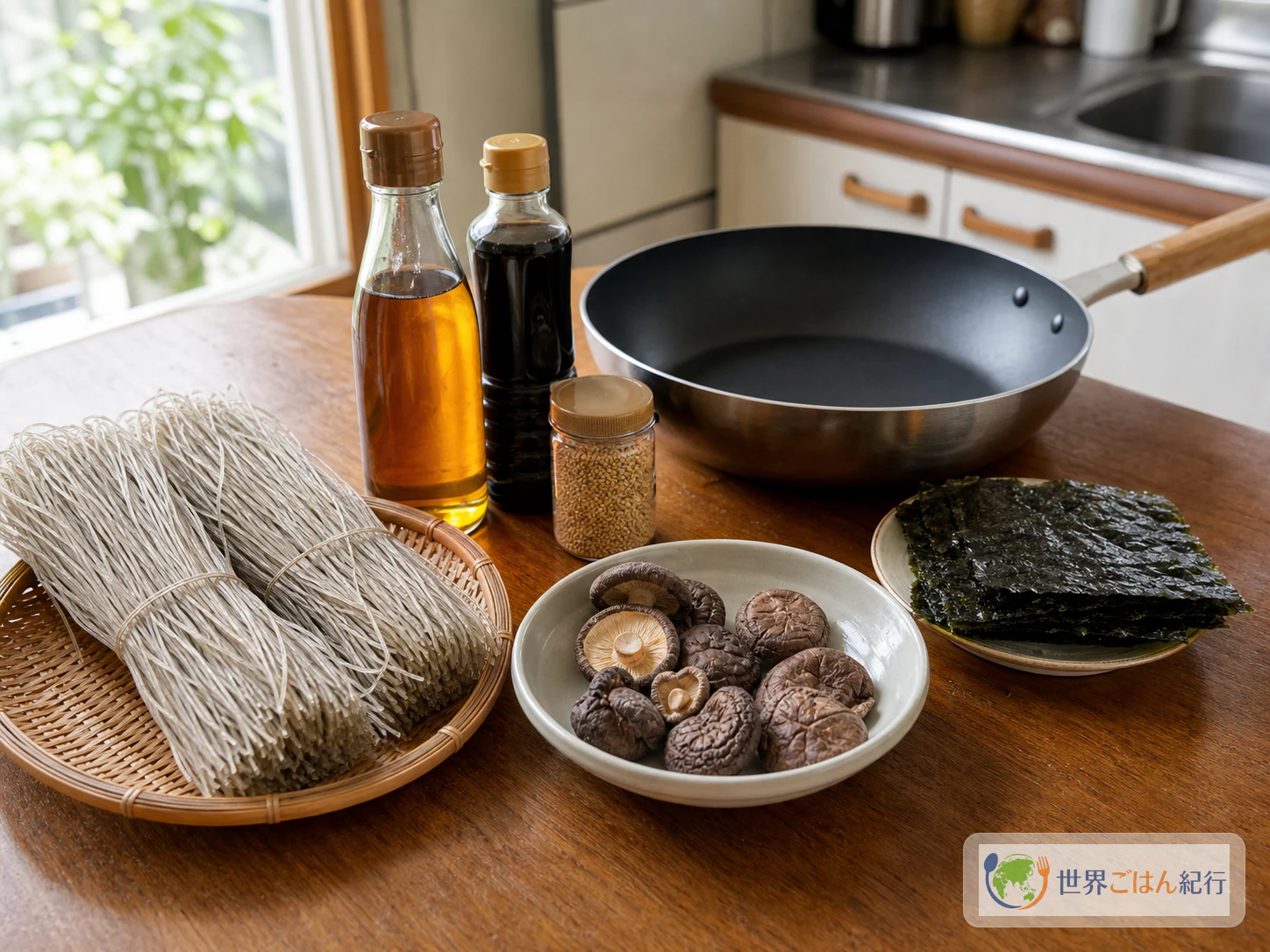
Spinach, carrots, onions, and beef are fine from an ordinary grocery store. Shopping makes a difference for the dangmyeon, Korean sesame oil, strongly aromatic dried shiitake, and the Korean seaweed for finishing.
| What to buy | Priority | Reason |
|---|---|---|
| Korean sweet potato starch noodles (dangmyeon) | High | The chewy bounce and ability to absorb the soy dressing are the center of the dish |
| Korean sesame oil | High | A small amount carries strong aroma and keeps the dish from tasting flat when cold |
| Dried shiitake | Medium | Supports the savory depth when making it without meat |
| Korean seasoned seaweed | Medium | Served at the table, its saltiness and oil aroma make it feel like a platter dish |
| Wide wok or deep frying pan | Medium | Makes it easy to stir-fry ingredients separately and drive off moisture |
Dangmyeon
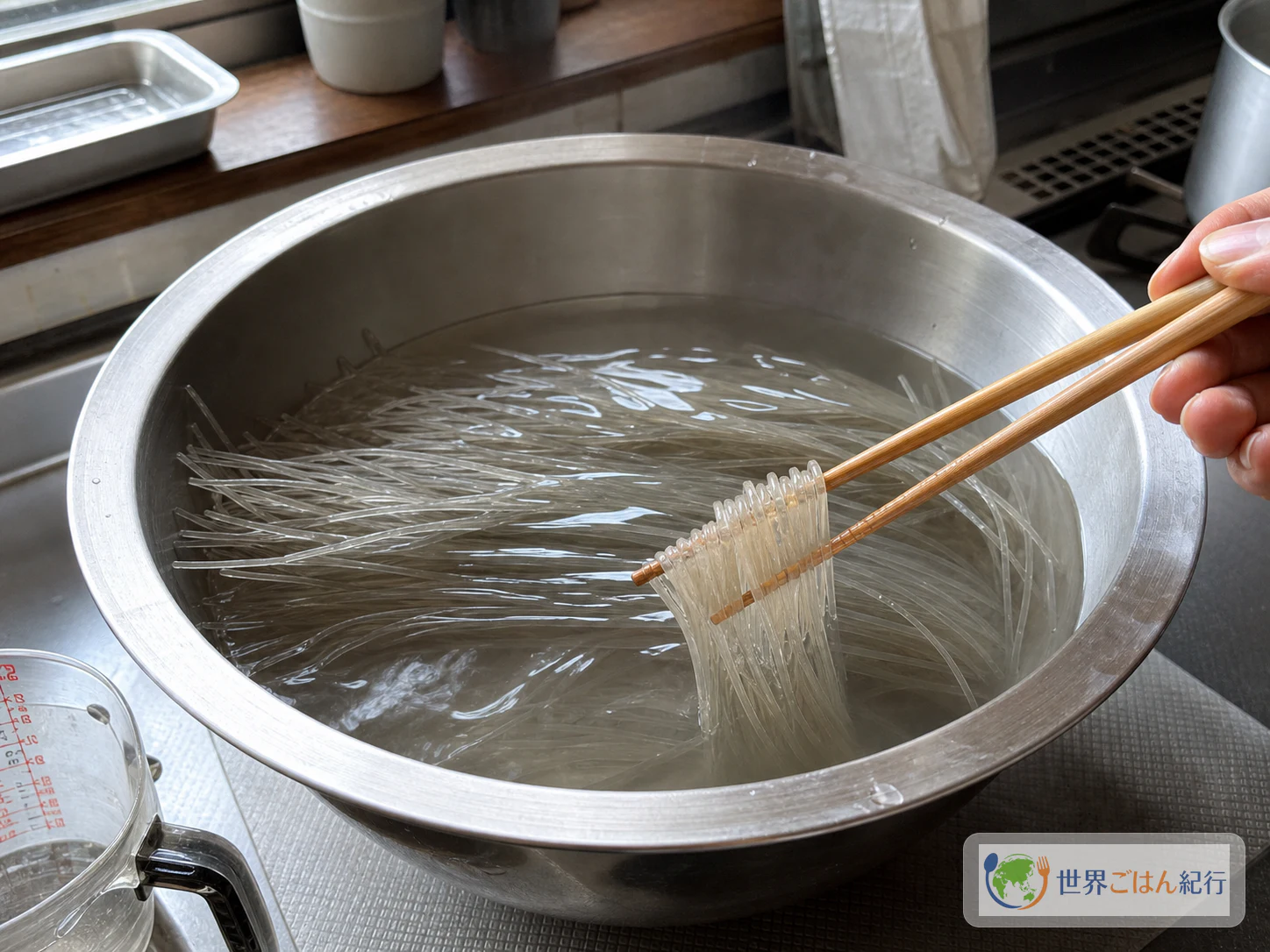
Dangmyeon is usually on the dried noodle shelf of Korean and Asian grocery stores, bundled in white inside the bag. Choose noodles thicker than ordinary glass noodles, the kind that turn from pale gray to a translucent brown after boiling. Mung bean noodles can make a similar dish, but their thickness, chew, and hold on the soy dressing are quite different. For a first purchase, it helps to see the actual package at a Korean grocery.
If you are unsure about a bag, look for the characters 당면 or 자른 당면. 자른 당면 is dangmyeon cut short in advance, which means fewer snips with kitchen shears after boiling; long bundles look good on a platter but tend to tangle in a home bowl. Start with the round, thin standard type, since flat, wide types change the texture. A bag of around 1 lb (500 g) is a good first buy: use half for japchae and the rest in hot pots or soups.
Sesame oil and seaweed
Use freshly opened sesame oil. In japchae it goes into three places, the meat marinade, the noodle seasoning, and the finish, so old oil makes the whole dish dull.
Seaweed gives aroma even in small amounts. Korean seasoned seaweed already carries salt and oil, so leave the final salt as is and tear the seaweed over the japchae at the table to keep the taste from getting heavy.
Pan
Stir-frying a large amount at once leaves moisture behind. A deep frying pan works, but if you often cook Korean or Southeast Asian stir-fries, a wide carbon steel wok is worth a look. It needs seasoning, so it suits someone who stir-fries often more than someone buying it for a single dish.
When cold, the sweetness and sesame oil aroma come forward in japchae. If it is exactly right warm, it can taste a little weak in a lunch box or as a make-ahead dish. If you eat it warm from a big platter, keep the salt at 1/3 tsp; if you are saving it for the next day, add 1 tsp of soy sauce at the finish.
Japchae problems and fixes
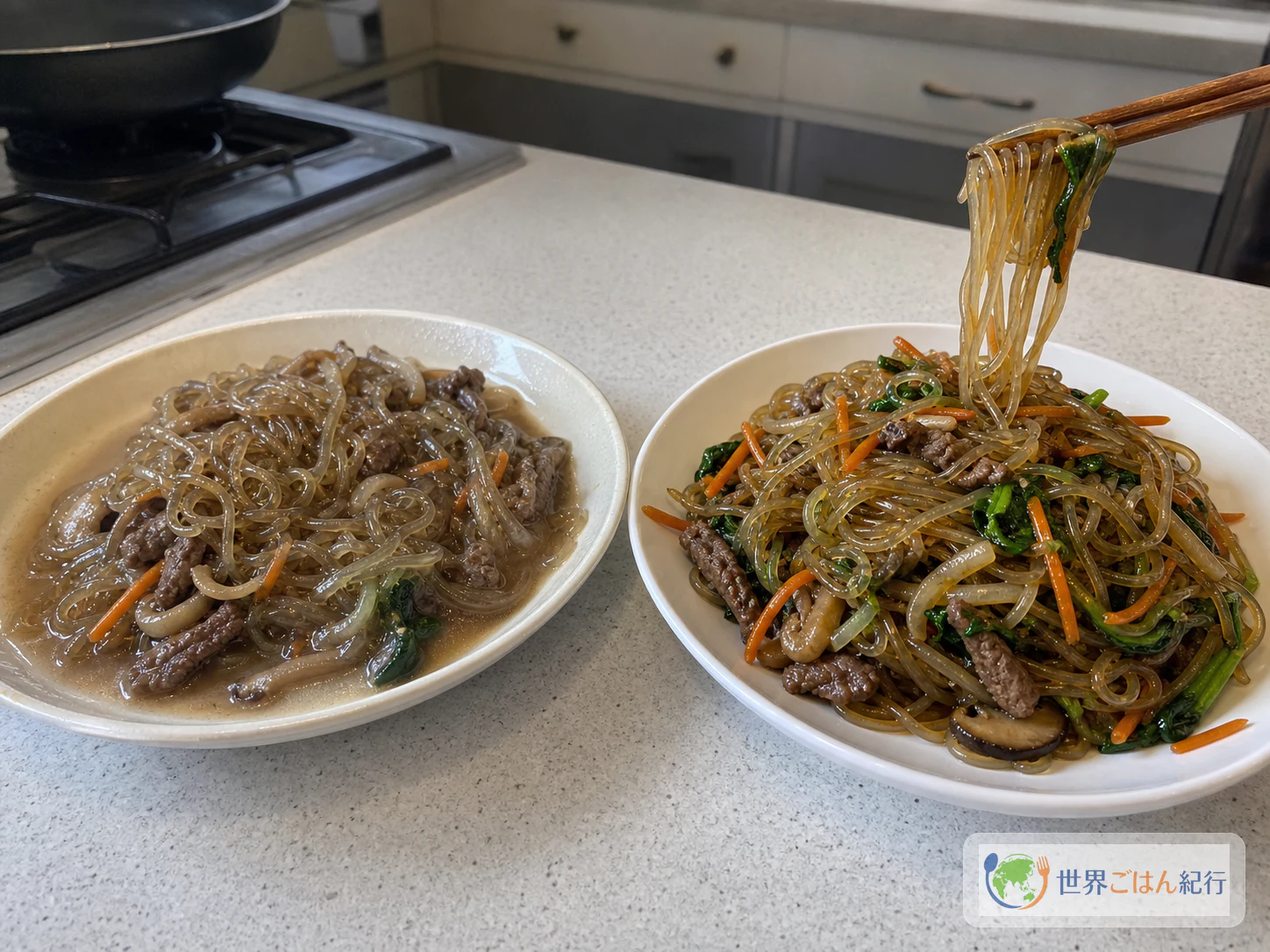
Watery japchae
Watery japchae means moisture from the vegetables remains. Before moving to the finishing bowl, return just the vegetables and meat to the frying pan and stir-fry over medium heat for 2 minutes to drive off the water, then add the noodles back last; stir-frying hard with the noodles in the pan makes them snap. If everything is already mixed, spread it out in the pan and warm it over medium-low heat for just 2 minutes, stopping when no water remains at the bottom.
Broken noodles
Noodles that snap were boiled too long or mixed too roughly. Check the dangmyeon 1 minute before the package time and lift them out as soon as the white core is gone. When tossing, lift from the bottom and let it fall rather than stirring around with chopsticks. Cutting long noodles to 18 to 20 cm (8 inches) after boiling makes them easier to eat and less likely to break.
Blurry flavor or weak aroma
When the flavor is blurry, look at salt and moisture separately before reaching for soy sauce. If liquid pools at the bottom of the plate, drive off the moisture first. If it is still weak with no liquid, combine 1 tsp soy sauce, 1/2 tsp sesame oil, and a little black pepper, and toss with the heat off. Adding sugar first leaves only sweetness once it cools.
Weak aroma usually comes down to the sesame oil. Using a lot of it as cooking oil from the start lets the aroma escape. Divide it among the marinade, the noodle seasoning, and the finish, adding the last portion after the heat is off, and even a small amount gives a Korean-style aroma.
Making it without meat
If it feels lacking without meat, rehydrate 4 dried shiitake and replace the water in the noodle seasoning with 3 tbsp of the soaking liquid. Slice the shiitake 0.25 inch (5 mm) wide, stir-fry over medium heat for 2 minutes, and combine once the surface moisture is gone. For fried tofu, cut 3.5 oz (100 g) into 0.5-inch (1 cm) strips and grill 2 minutes per side over medium heat before adding it, so it won't turn watery.
Serving and storing japchae
What to serve with it
For more meat, serve it with bulgogi (in Japanese: /recipes/east-asia/korea/bulgogi). For a rice meal, add bibimbap (in Japanese: /recipes/east-asia/korea/bibimbap), and for soup, doenjang jjigae or a gentle samgyetang.
Storage and reheating
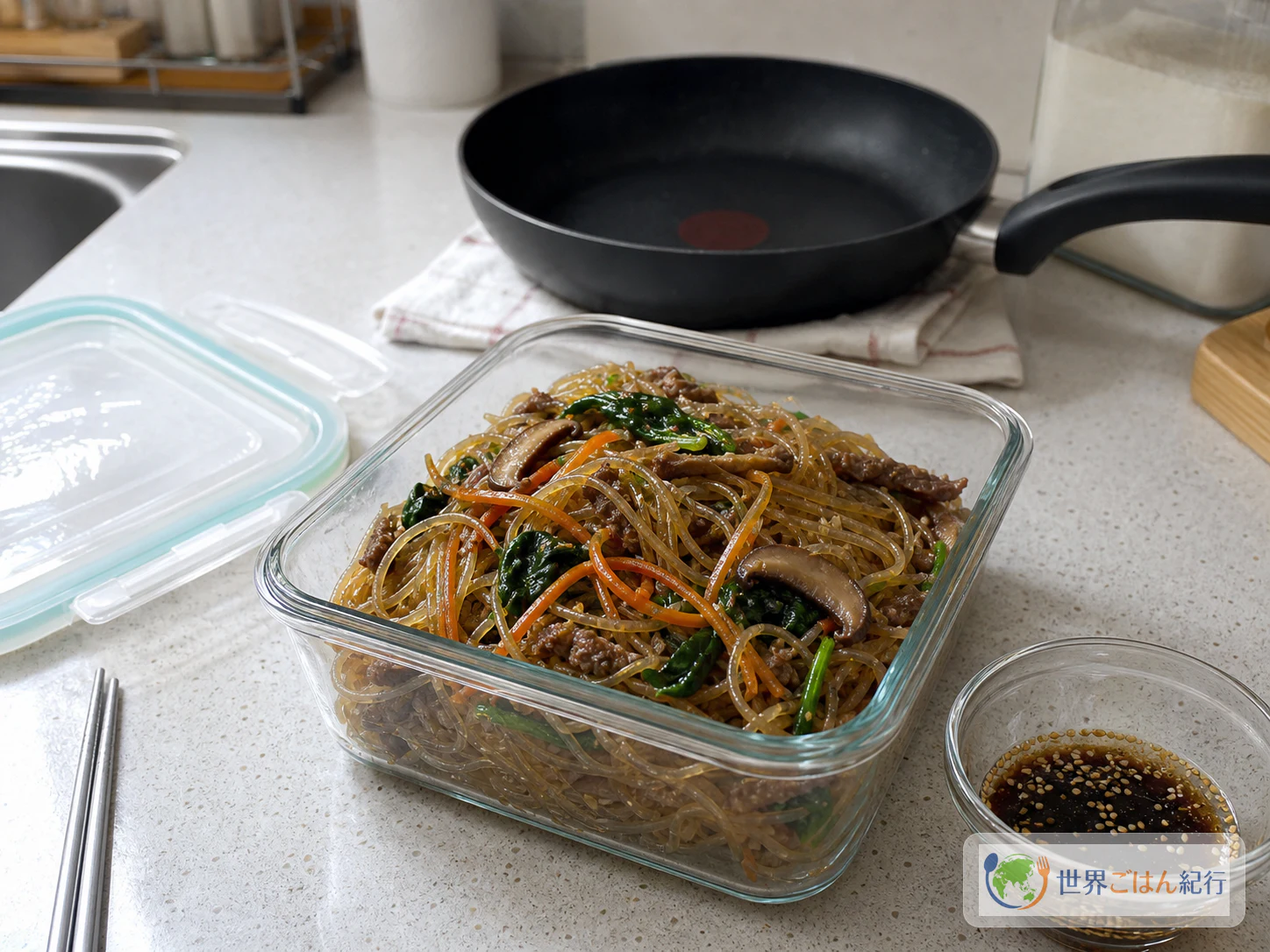
Japchae can be eaten cold, but don't leave it on the big platter at room temperature for hours. Spread the leftovers in a shallow container, let them cool, and refrigerate within 2 hours; it keeps in the refrigerator for up to 2 days. For a lunch box, reheat it thoroughly in the morning, then cool it, and keep it apart from cucumbers and raw vegetables that release water.
To revive it the next day, mix 1 tbsp water, 1/2 tsp soy sauce, and 1/2 tsp sesame oil per serving. Warm the japchae and this mixture in a frying pan over low heat for 3 minutes, and when the noodles loosen, raise the heat to medium-low and turn for just 1 minute to drive off the moisture. In a microwave, put it in a heatproof container, sprinkle with 2 tsp water, cover loosely with plastic wrap, heat at 600 W for 1 minute 30 seconds, stir, and heat 30 seconds more.
Making ahead and freezing
Avoid freezing finished japchae: dangmyeon cracks at the surface when frozen and thawed, feels dry, and breaks short when revived. If you must make it ahead, stir-fry just the vegetables and meat the day before and refrigerate them (these can also be frozen). Boil the noodles on the day, let them absorb the seasoning, and toss at the end, and the noodles stay glossy while the vegetables keep their color.
Keeping the spinach separate helps too. Add the cold spinach to the reheated noodles, meat, and vegetables at the end and toss for 1 minute; the green stays bright and the platter keeps its good looks.
Frequently asked questions
Can I use ordinary glass noodles if I do not have Korean ones?
You can, but the texture will not be the same. With ordinary mung bean noodles, reduce to 7 oz (200 g), boil in hot water for 3 to 4 minutes, and then let them absorb the seasoning. Thin noodles break easily, so shorten the time tossing with the ingredients by 1 minute. Rice vermicelli take up the soy dressing differently, and the result is closer to fried vermicelli than to japchae.
Can I make it without beef?
Yes. Add 2.75 oz (80 g) more shiitake and use the soaking liquid and fried tofu as described in the fixes above. Raising the black pepper to 1/3 tsp keeps the flavor from blurring.
Can I stir-fry all the ingredients together?
When you are in a hurry, yes, but moisture comes out of the onion and mushrooms and the noodles tend to turn watery. Cook the vegetables over medium heat for 4 minutes first to drive off the water, then add the noodles and seasoning. For a platter that shows off the dish, cooking the ingredients separately preserves color and texture.
Why does the flavor get weaker when I make it ahead?
The noodles absorb the seasoning over time, and the vegetables release water too. Drive off the moisture before storing, and when reviving it, add a little soy sauce and sesame oil rather than only water. Seasoning it strongly before refrigerating makes it too salty when cold, so adjust when you reheat.