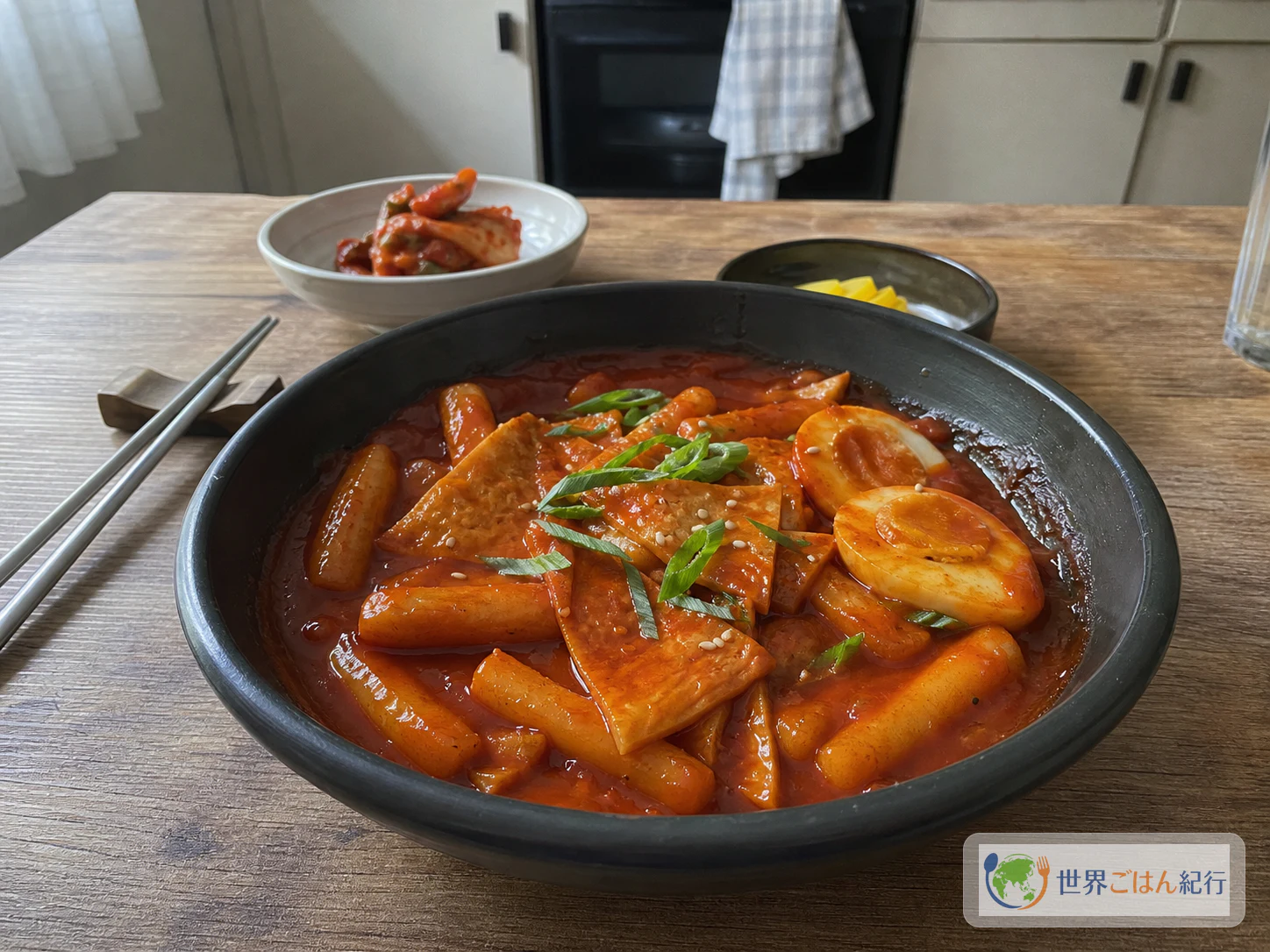
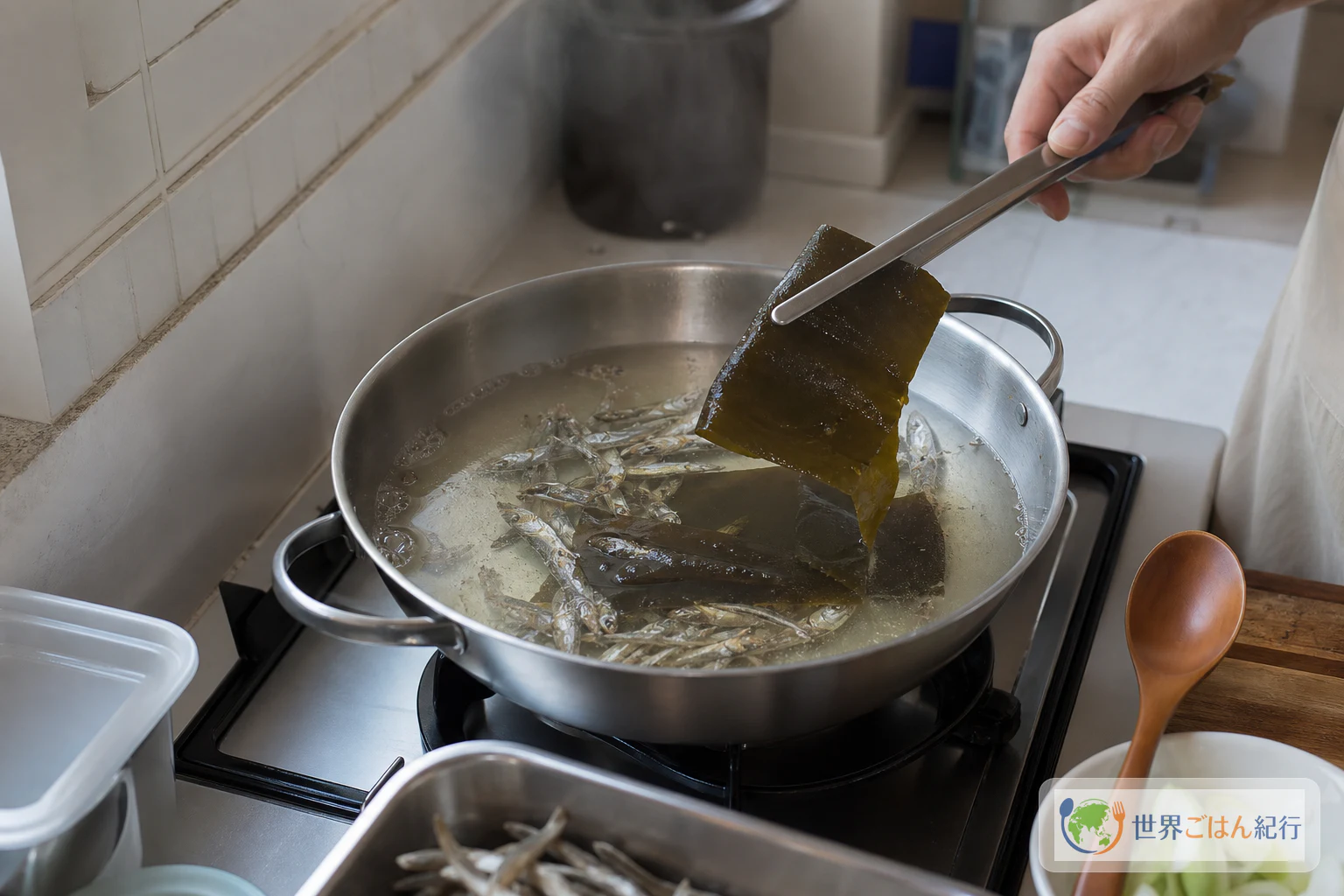
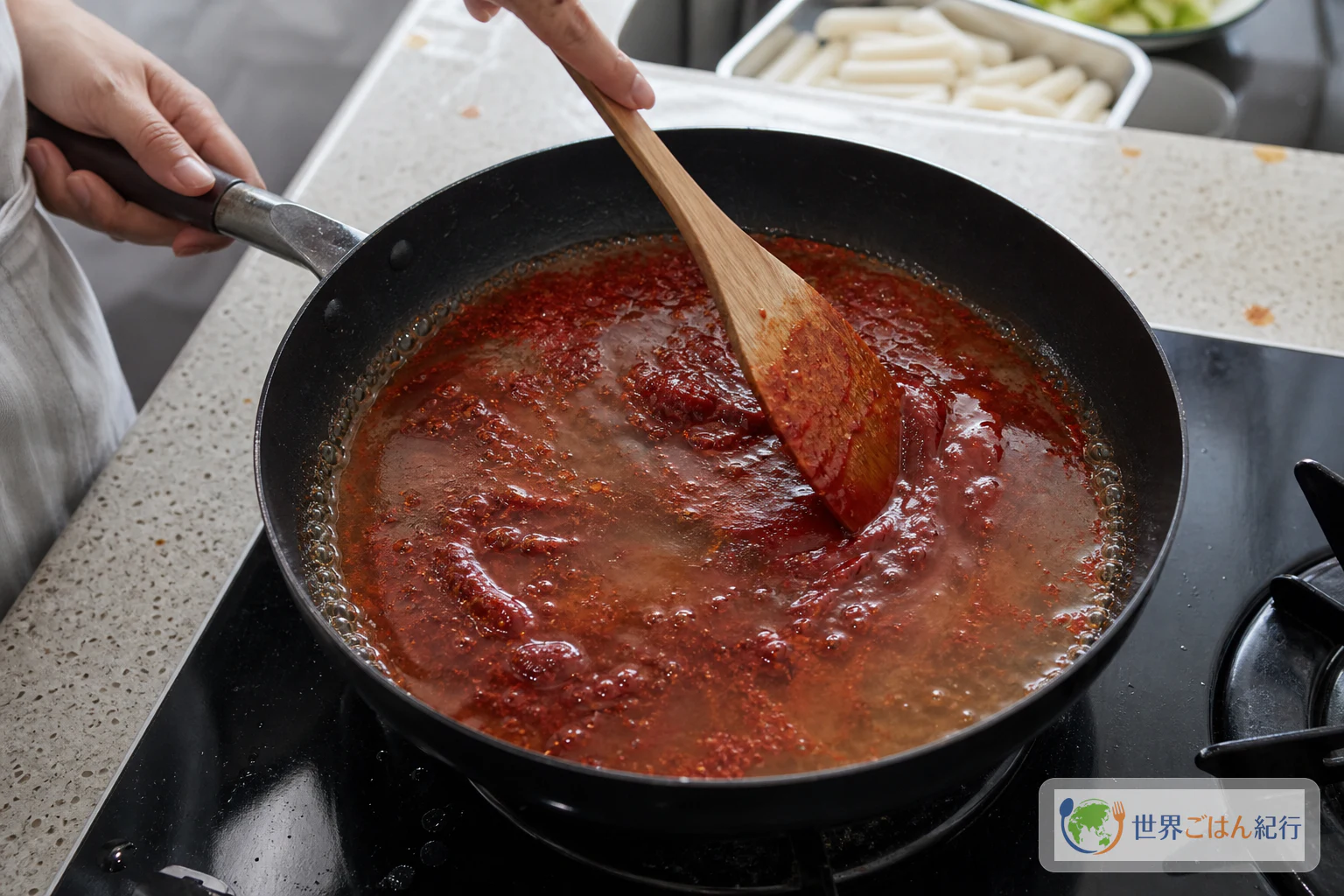
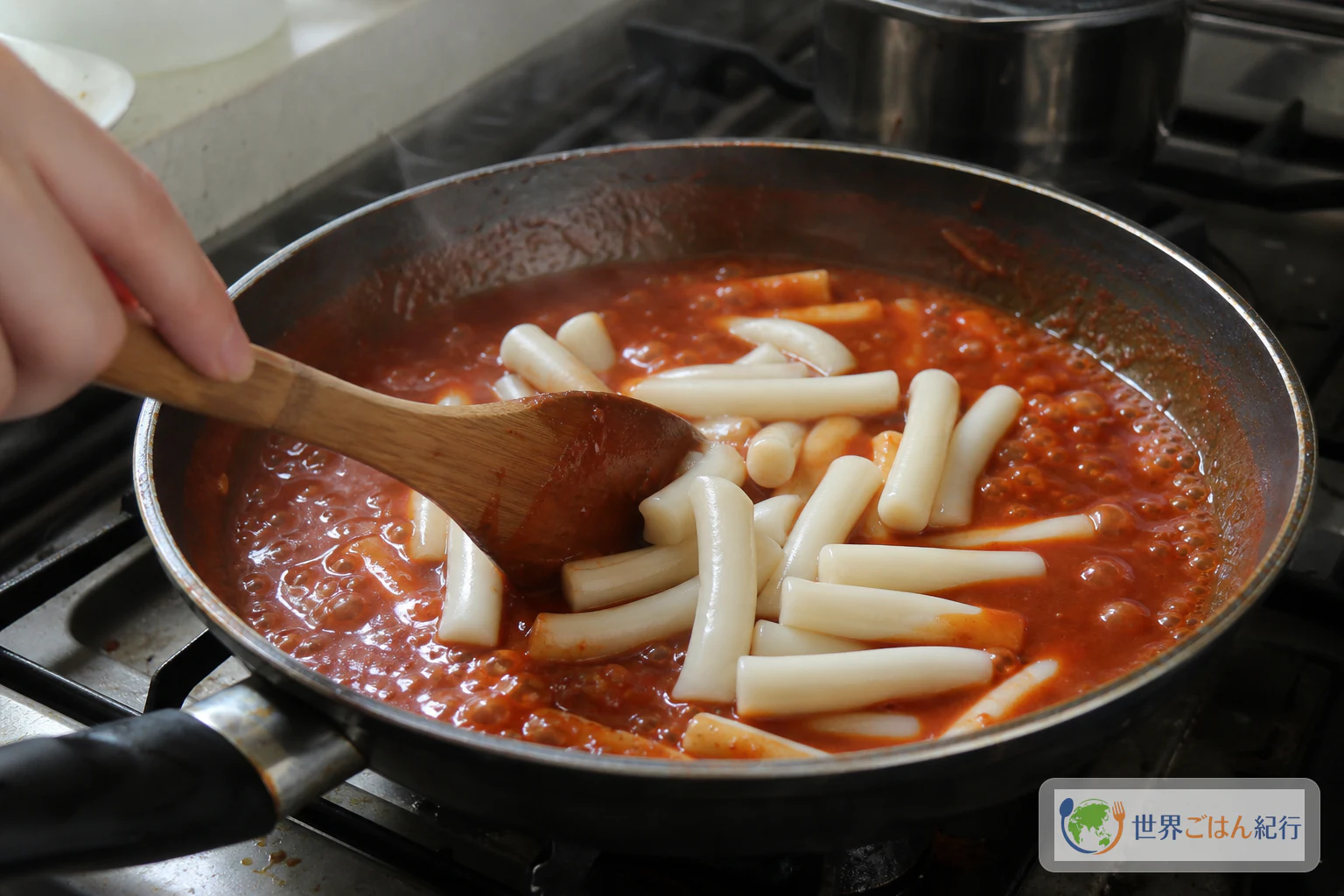
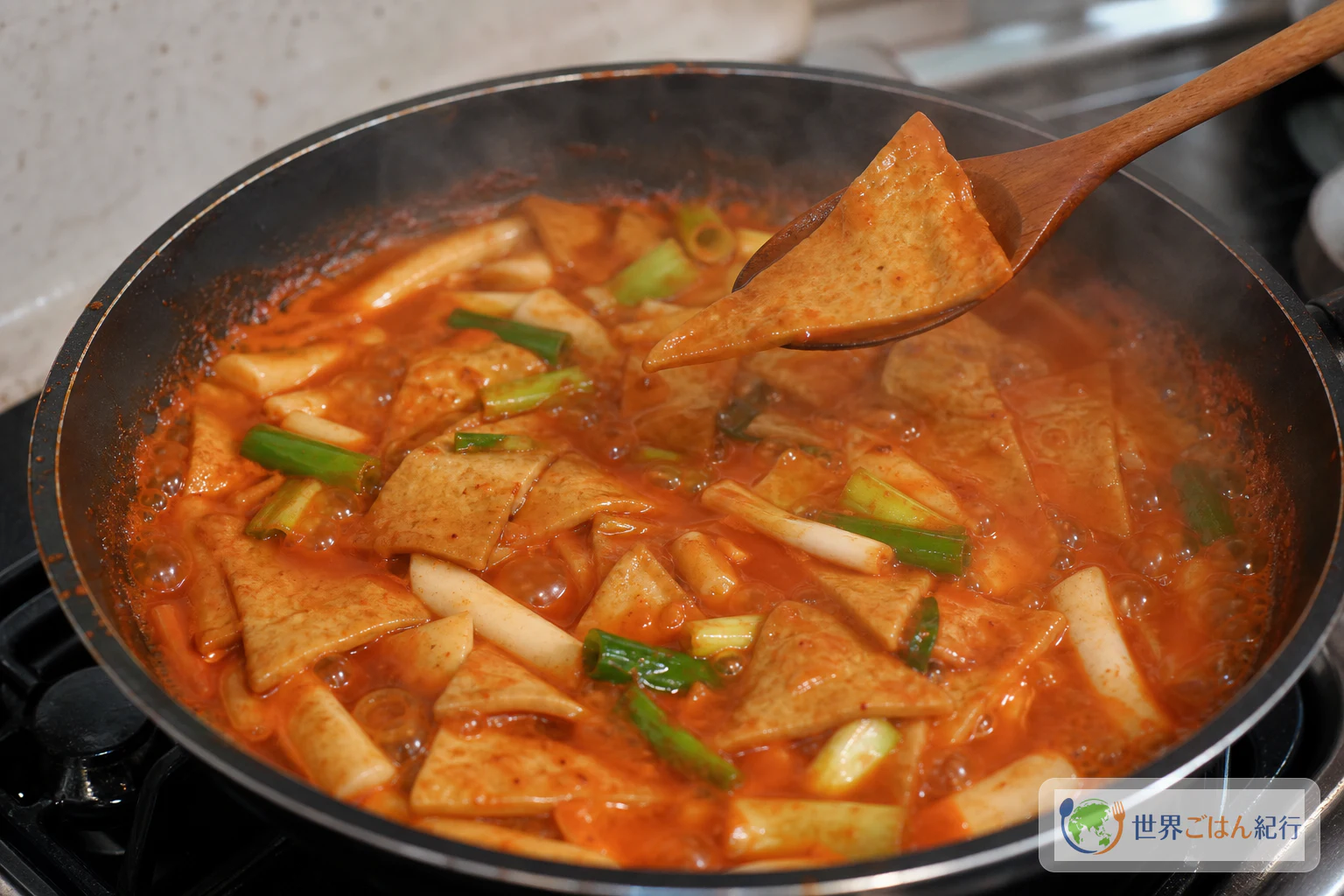
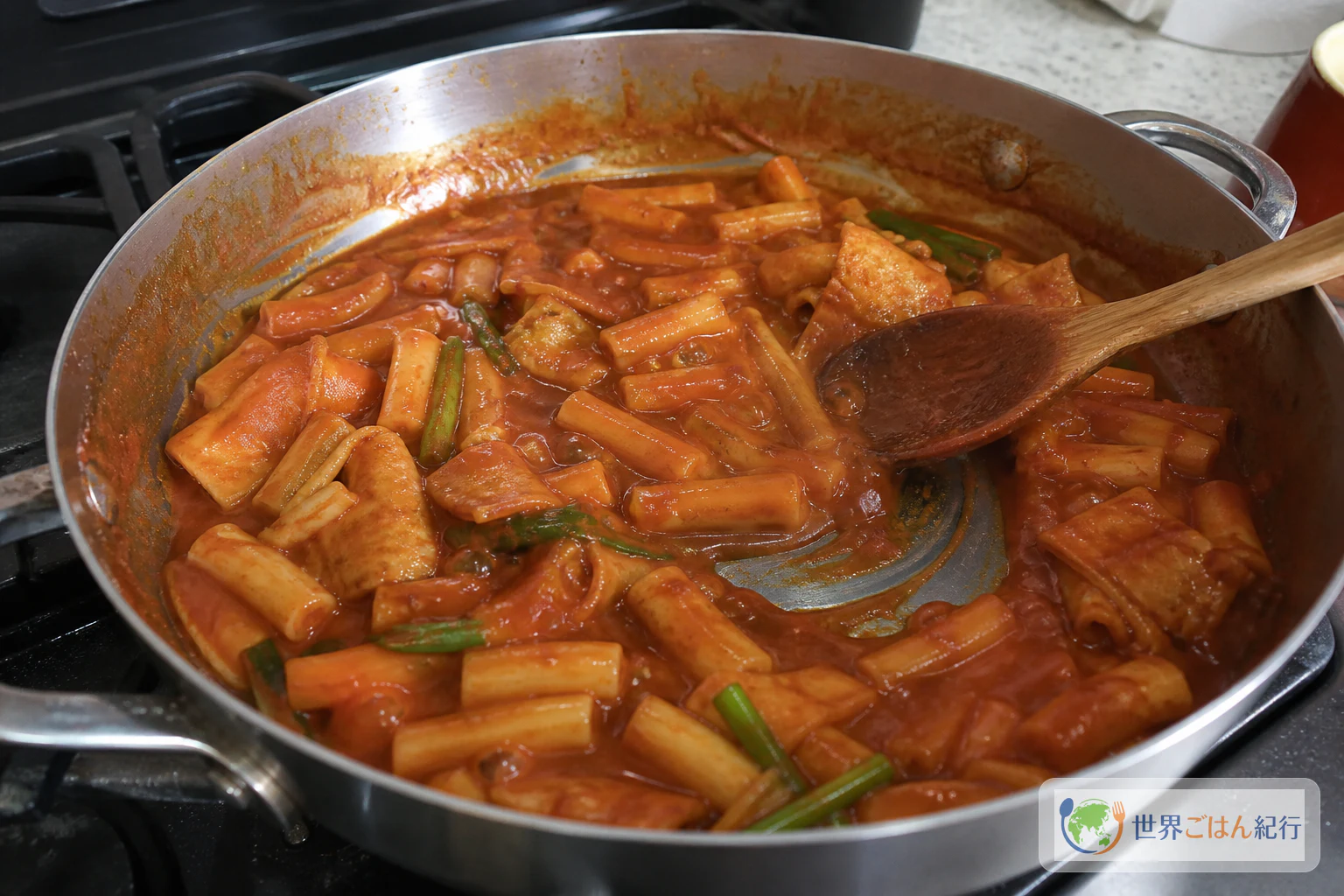
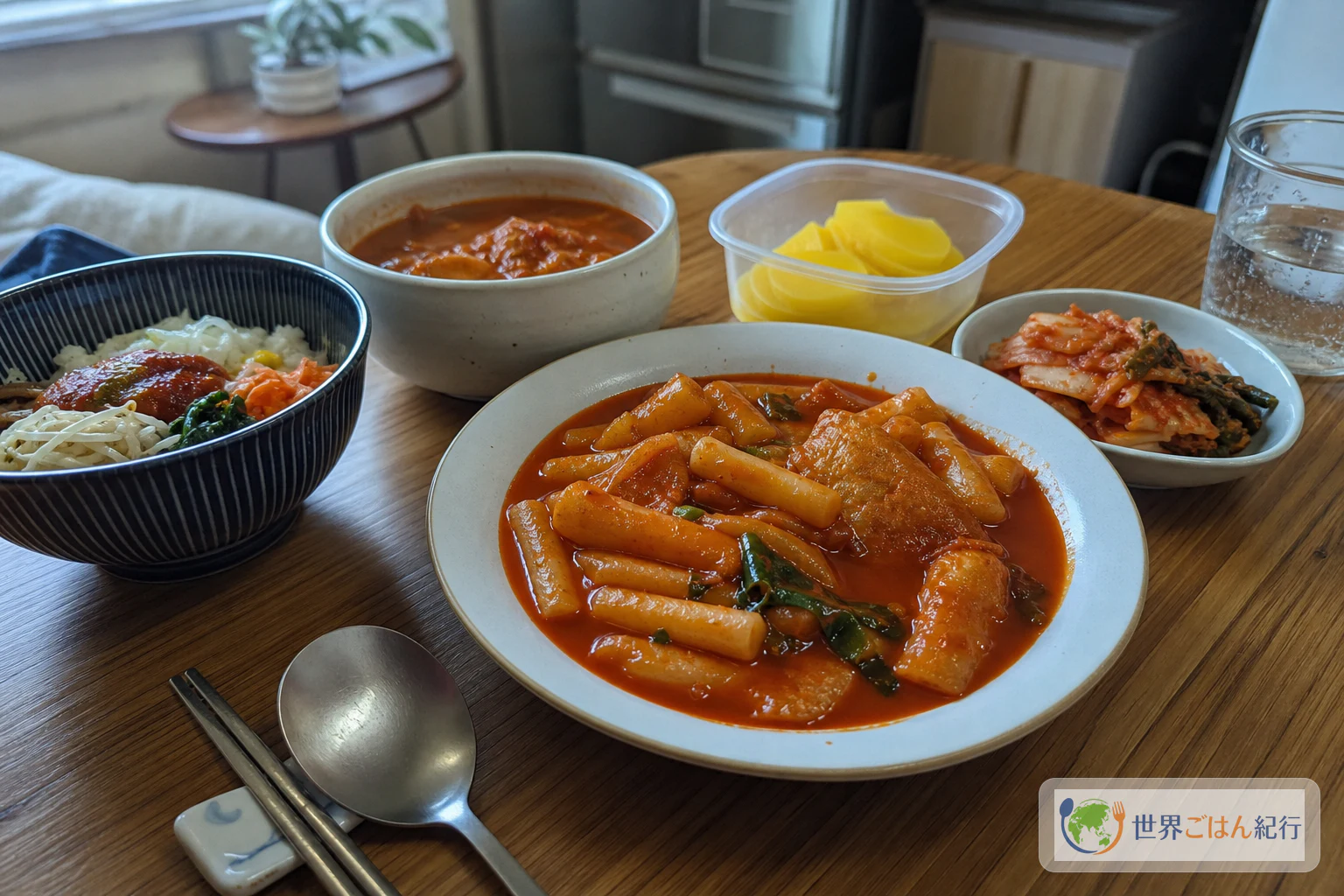
Stir gochujang into stock in an evening kitchen, and the sweet fermented-bean aroma gives way to the red smell of chile. Add white rice cakes: at first they slide around the pan, but within minutes they start to take on the red sauce. Tteokbokki is Korea's sweet and spicy street rice cake dish, built on a stock of dried anchovies and kelp, and its real pleasure is the moment the rice cakes hold the sauce. On the street it comes in a paper cup. At home, with boiled eggs and fish cake, it goes with rice too.
Where and How Tteokbokki Is Eaten
It is written 떡볶이 in Korean. 떡 means rice cake, and 볶이 is a word used in the names of stir-fried or braised dishes. In English it is Tteokbokki, and sometimes written ddeokbokki.
In Korea, tteokbokki turns up in many settings beyond the home. At a street stall, kids poke at a paper cup on the way home from school. A snack shop serves it with gimbap and fish cake skewers, and at a table-top pot restaurant you add ramyeon or mandu as it simmers. It is always 떡볶이, but the setting changes the thickness of the sauce, the amount of ingredients, and even the softness of the rice cakes a little.
| Setting | Form often seen locally | What to keep at home |
|---|---|---|
| Street stalls and markets | Paper cup, rice cake focused, rich sauce | Don't overcook the rice cakes; reduce only at the end to coat |
| Snack shops | Served with gimbap, fish cake, and sundae | Put out a rice dish or eggs to give the heat somewhere to go |
| Table-top pots | Ramyeon, mandu, or cheese added | Add extras last, putting the cooking of the rice cakes first |
| Royal court style | Soy sauce, beef, vegetables, not spicy | Plan it as a separate dish for family who dislike spice |
The red tteokbokki most people know is tied to the postwar street stall culture of Seoul, especially Sindang-dong. Royal court tteokbokki (궁중떡볶이, gungjung tteokbokki) is a separate, mild dish stir-fried with soy sauce, beef, and vegetables, with no chile in the lead. Today, snack shops and chains have widened the range with rose tteokbokki, cheese tteokbokki, and rabokki with ramyeon added. If this is your first time, start with the basics of rice cakes, seafood stock, gochujang, and gochugaru; the variations are easier once you have those down.
Ingredients and Substitutes: Measure the Rice Cakes, Stock, and Red Sauce
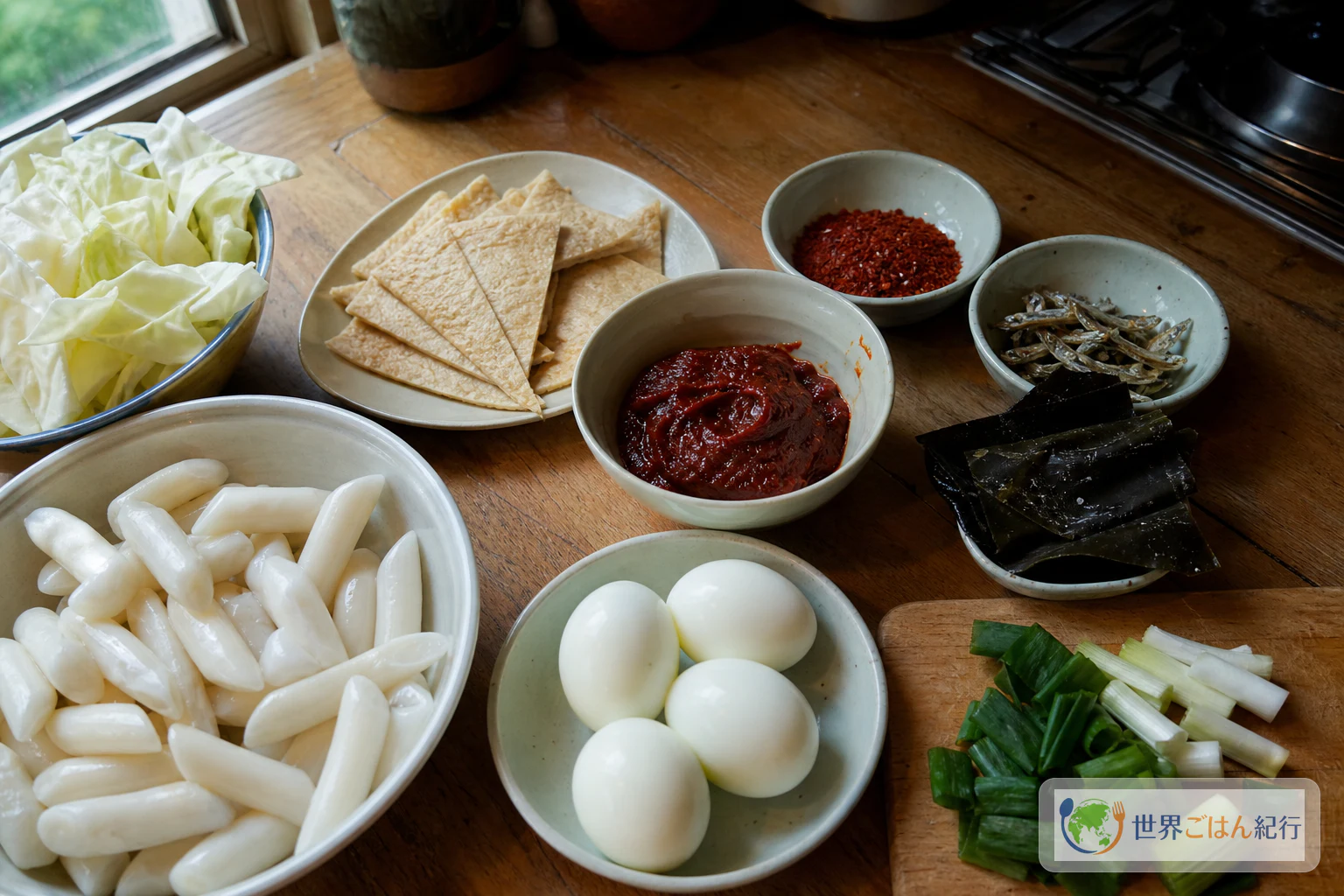
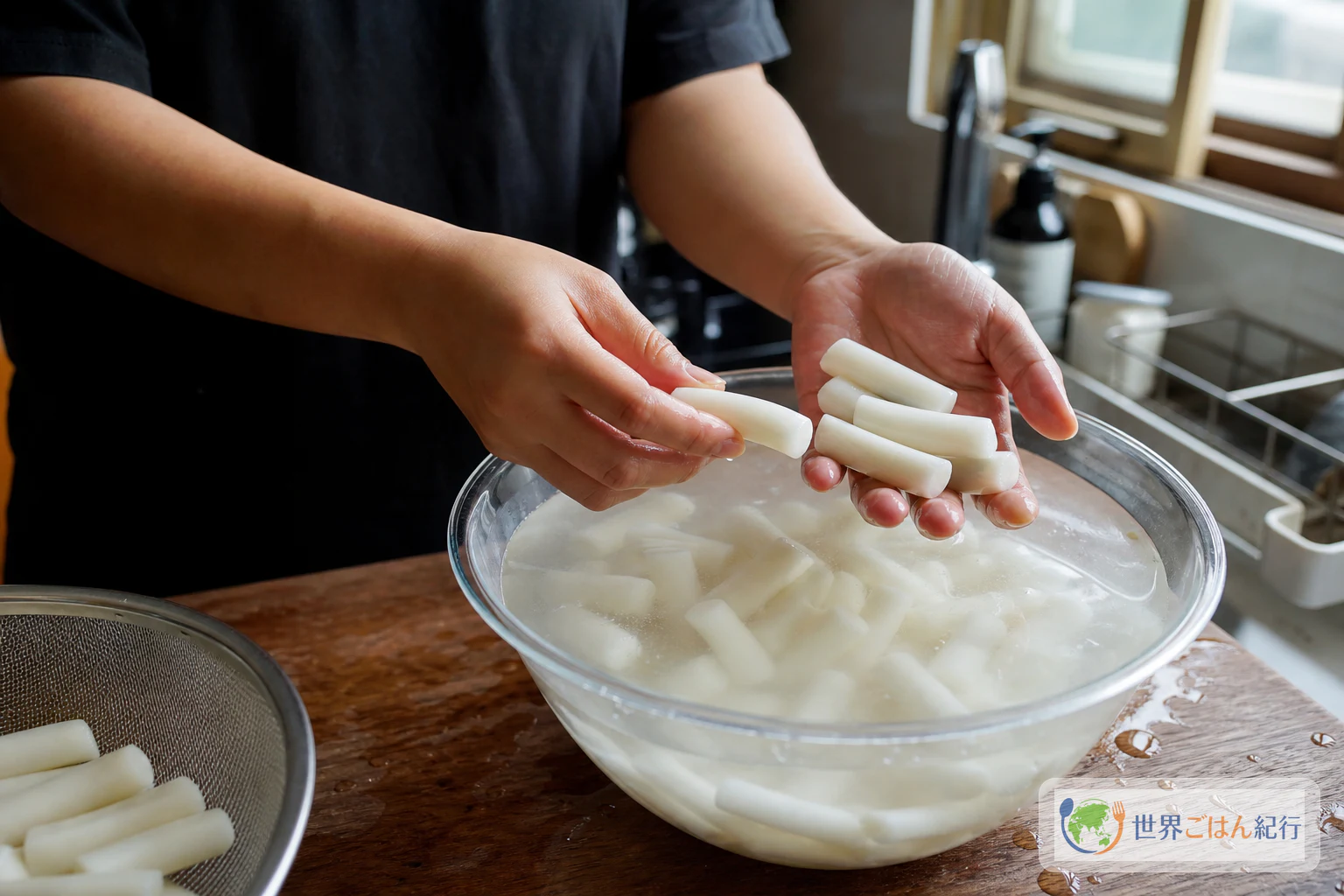
This recipe serves 4. The amounts favor the rice cakes, street-stall style. If serving it as a side for rice, add more boiled eggs and serve the vegetables on a separate plate to make it easier to eat. Use stick-shaped Korean rice cakes, sold refrigerated or frozen. If substituting other rice cakes, cut them thin and soak them in water to keep them from breaking down or leaving hard centers.
Tteokbokki can include rice cakes, fish paste, wheat, soy, and sesame. Some Korean fish cakes and gochujang contain wheat, soy, and seafood. If you have a food allergy, always check the ingredient labels on the rice cakes, fish cake, and seasonings.
Choosing the Rice Cakes
| Type of rice cake | Suitability | How to use |
|---|---|---|
| Refrigerated stick Korean rice cakes | The easiest to work with | Soak in water 10 minutes and rinse off the surface starch |
| Frozen Korean rice cakes | Suitable | Thaw in the refrigerator for half a day and soak 10 minutes |
| Japanese-style sliced rice cakes | A substitute | Cut 0.5 inches (1.5 cm) wide and soak 15 minutes. Dissolve easily if overcooked |
| Round rice cakes | A bit harder to handle | Cut in half through the thickness. If the center stays hard, parboil 2 minutes |
Choosing Ingredients and Substitutes for Tteokbokki
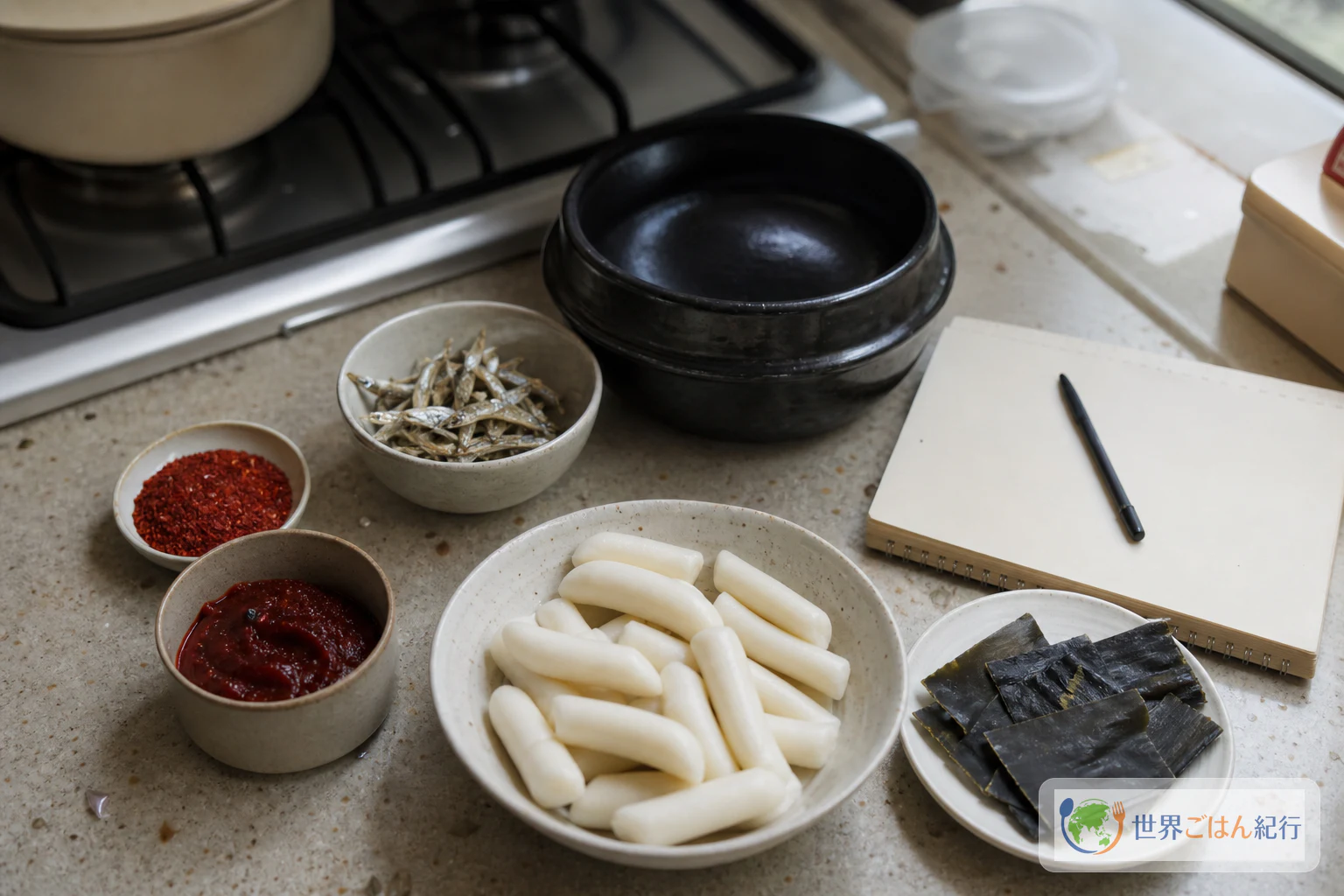
Cabbage, scallions, eggs, dried anchovies, and kelp are easy to find at any neighborhood supermarket. The items that make the difference are Korean rice cakes, gochujang, gochugaru, and Korean fish cake. Korean rice cakes are in the refrigerated or frozen section, and the pieces may stick together in the bag. Choose ones with a smooth surface that are not too dried out, and pass over bags with many cracks.
| What to buy | Priority | Why |
|---|---|---|
| Korean rice cakes | High | They keep more bounce than other rice cakes and take the sauce well |
| Gochujang | High | The center of sweetness and fermented flavor. Hard to replace with miso |
| Gochugaru | High | Rounder than plain chile flakes and gives a red aroma |
| Korean fish cake | Medium | Brings the sweetness and oil of fish into the sauce |
| Small pot for direct heat | Medium | Handy when eating it hot at the table |
Redder is not better. Gochujang alone makes the sauce sweet and heavy, while too much gochugaru, or plain chile flakes standing in for it, leaves only sharp heat. Without Korean cylinder-shaped rice cakes, other rice cakes work, but expect a different texture and shorten the simmering time. Without Korean fish cake, use mild fish cake or fish sausage; the sweetness and oil of the fish will differ, so cut the sugar a little.
Gochujang also goes into kimchi jjigae and bibimbap, so a tub won't sit idle. Korean sesame oil has a strong aroma even in small amounts, and just 1 tsp at the end gives a street-stall roundness. A small pot is optional, but one you can set over direct heat and carry straight to the table suits tteokbokki, which cools quickly. If you cook Korean food often, the chile seasoning and the pot are worth buying; for rice cakes and fish cake, check the refrigerated goods first so less goes to waste.
Method: Don't Let the Rice Cakes Get Hard, Reduce the Sauce
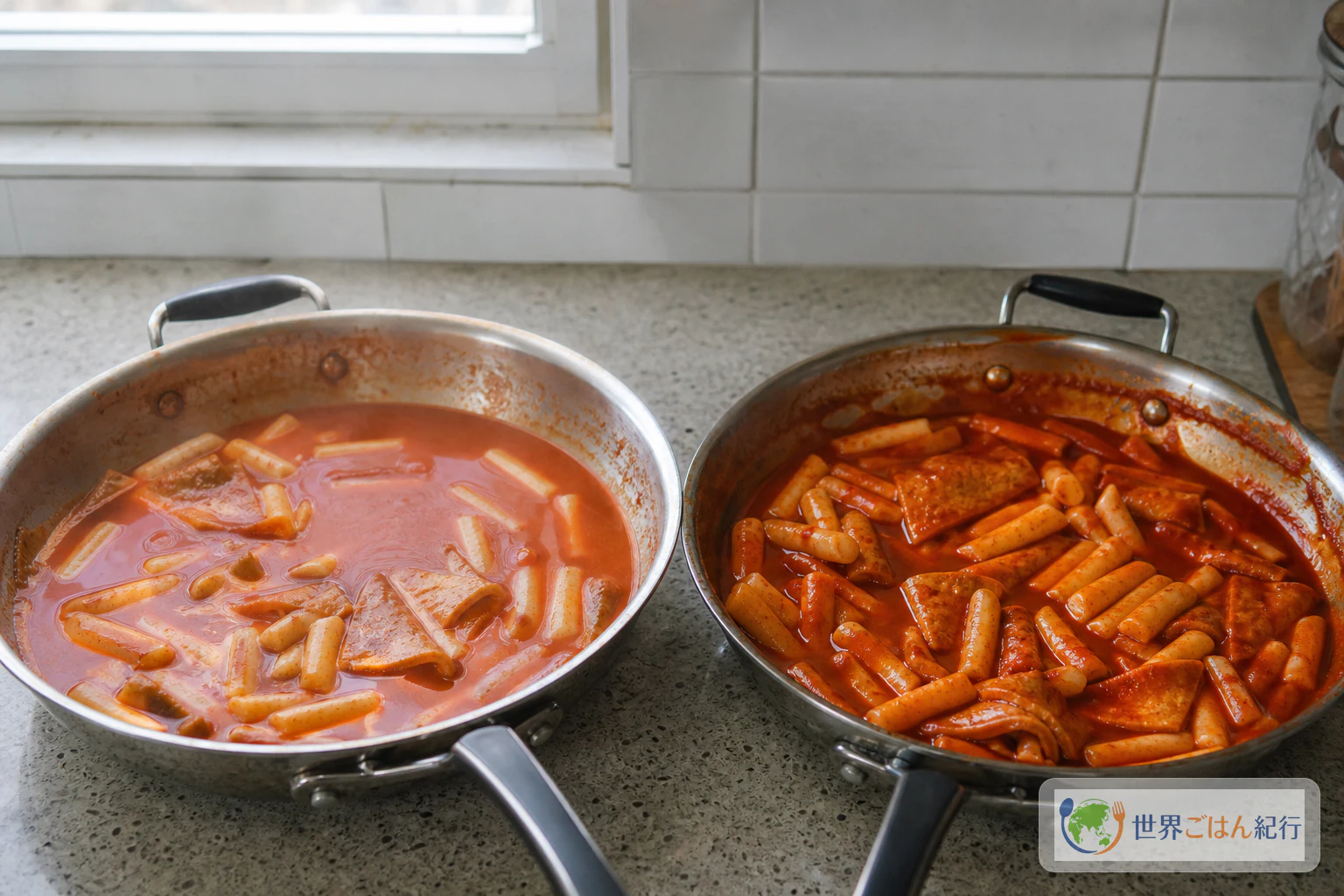
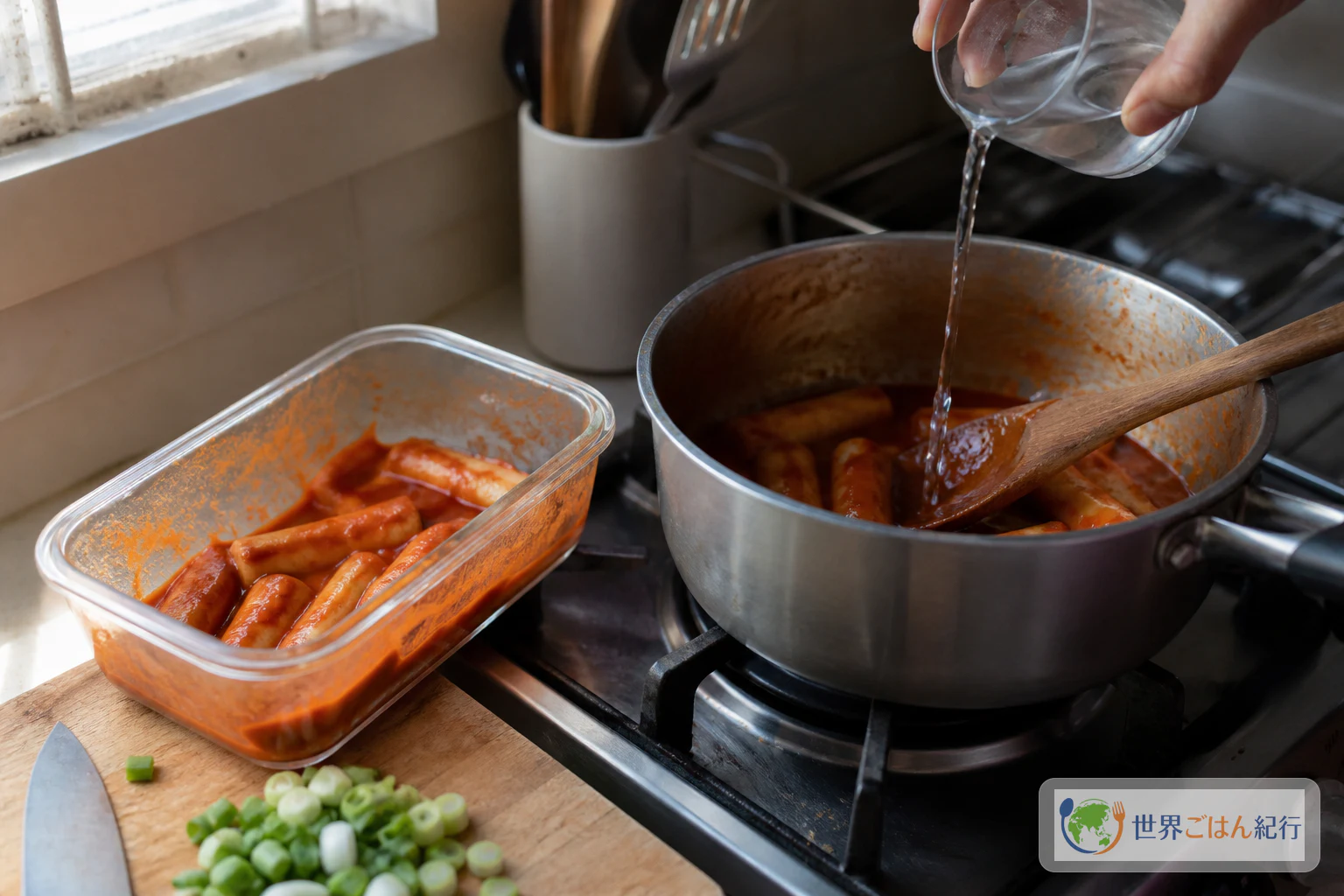
Tteokbokki has 'stir-fry' in its name, but at home, braising in a shallow pot is more reliable. After the rice cakes go in, don't reduce quickly over high heat. Keep a gentle simmer so the heat reaches the center of each rice cake. Cook off moisture only at the end, so the red sauce clings to the outside.
If you keep tasting the rice cakes, there will be fewer in the pot and only sauce left. Put 1 tsp of sauce on a plate, cool it 10 seconds, and taste. You should sense sweetness, heat, fish stock, and garlic, in that order. If it is too spicy, add 2 tbsp water and 1/2 tsp sugar; if too sweet, add 1 tsp soy sauce and 2 tbsp stock and warm for 1 minute.
Tteokbokki Troubleshooting
Thin sauce
If it tastes thin, reduce it before reaching for more gochujang. Take off the lid and warm over medium-low heat for 3 minutes. If the trail drawn along the bottom with a wooden spatula closes right away, there is too much liquid; reduce until the trail stays about 1 second, then taste. Adding gochujang first only makes the sweetness heavy.
Too spicy
Water alone blurs the whole dish. Instead, add ½ cup (100 ml) stock, 1 tsp sugar, 1 boiled egg, and 1.75 oz (50 g) cabbage, and warm over low heat for 4 minutes. Dairy can also cool the heat, but in tteokbokki it easily changes the aroma of the sauce, so egg and vegetables are the better fix.
Hard rice cakes
Hard rice cakes mean only the surface has cooked and heat has not reached the core. Add 4 tbsp water, cover, and warm over low heat 3 minutes, then take off the lid and reduce 2 minutes over medium-low heat. Heating the rice cakes alone in a microwave first tends to tear them in places; restoring moisture in the pot is more reliable.
Rice cakes dissolving
If the rice cakes dissolve, the substitute rice cakes were cut too thin or simmered too long over high heat. Next time keep to 0.5 inches (1.5 cm) width and finish within 8 minutes of adding the rice cakes. Other rice cakes release starch more easily than Korean ones, and stirring while scraping the bottom breaks down the surface, so stir gently and keep an eye on the clock.
Scorched bottom
A scorched bottom means the pot is too small in diameter or the heat is too strong after the rice cakes go in. In a shallow pot about 9.5 inches (24 cm) across, the rice cakes overlap less and the sauce's moisture cooks off more easily. If you smell scorching, turn off the heat without scraping and move only the clear liquid and ingredients to a clean pot. Stirring in the scorched part turns the sweet and spicy aroma bitter.
Serving Tteokbokki
Tteokbokki fits easily into a full Korean meal: pair it with bulgogi (in Japanese) for a meat dish, bibimbap (in Japanese) for a mixed rice, or kimchi jjigae (in Japanese) or doenjang jjigae for a soup. On its own, though, the sweet and spicy rice cakes get heavy partway through.
For the feel of a snack shop, add a light rice-and-seaweed starch like gimbap, steamed dumplings like mandu, and refreshing soybean sprout namul. When you want a break from the heat, a small bowl of gentle chicken soup like samgyetang keeps the rice cakes enjoyable to the last bite.
Storing, Restoring the Next Day, and FAQ
Tteokbokki is softest just made. Cool leftovers slightly, move them to an airtight container within 2 hours, and refrigerate. The rice cakes harden and the sauce sets in the cold. Store boiled eggs whole rather than halved, sunk into the sauce, and they dry out less.
A pot is best for reheating. Add 3 tbsp water per serving and warm over low heat for 4 minutes; when the rice cakes start to move, change to medium-low and reduce for 2 minutes. In a microwave, use a deep heatproof container, add 2 tbsp water, cover loosely with plastic wrap, and heat at 600 W for 1 minute 30 seconds, stir, and heat 1 minute more. Heating in short bursts keeps the rice cakes from bursting.
Skip the freezer for finished tteokbokki. Frozen in the sauce, both Korean and other rice cakes tend to crack on thawing or leave only the center hard. If you must keep some, finish the rice cakes and freeze just the sauce and fish cake, then add fresh rice cakes when reheating.
Can I make it with only other rice cakes?
Yes, though it will not have the bounce of Korean rice cakes. Cut 1 lb (500 g) into 0.5 inches (1.5 cm) wide, 2 inches (5 cm) long pieces and soak 15 minutes. After adding them to the pot, heat for 6 minutes, and finish before they start to dissolve.
Can I make it without gochugaru?
You can, but the red aroma is weaker. Rather than increasing the gochujang by 20 g, combining 1/3 tsp plain chile flakes and 1 tsp paprika powder gets closer.
What should I use if I don't have Korean fish cake?
160 g mild fish cake is the easiest substitute to handle. If using fish sausage, use 120 g and cut on the diagonal. Both bring out a lot of sweetness, so reducing the sugar by 1 tsp keeps the whole from getting heavy.
How do I make it milder?
Reduce the gochugaru to 5 g and keep the gochujang at 2.5 oz (70 g). Cutting too much heat leaves a sweet rice cake dish, so increase the dried anchovies to 20 g for fish savoriness. People who like spice can add gochugaru at the table.
What should I serve with it?
White rice, toasted nori, salted cucumber, and soybean sprout namul all go well with the sweet and spicy rice cakes. If adding a soup, a small serving of gentle chicken samgyetang calms the heat better than the fermented doenjang jjigae.