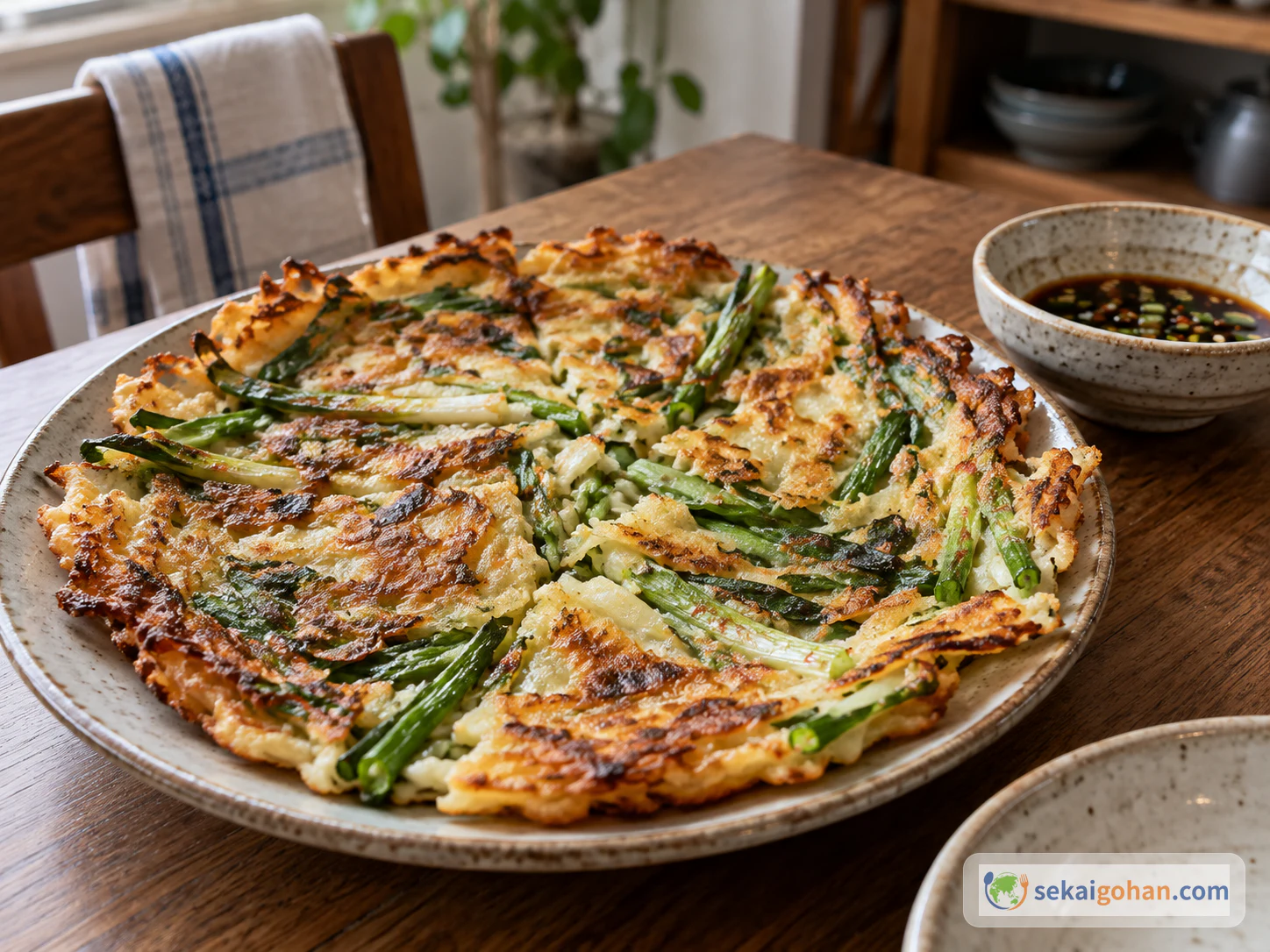
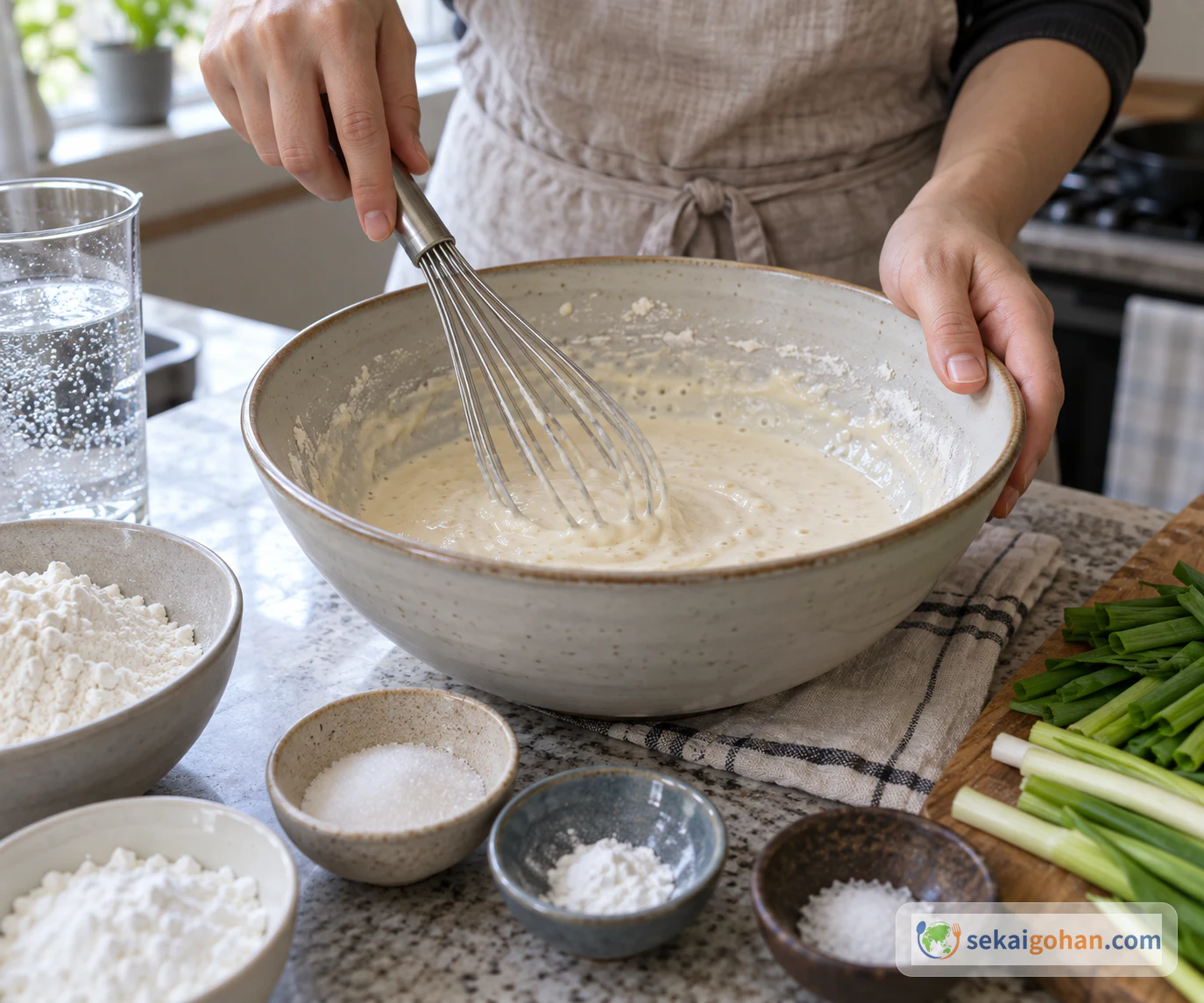
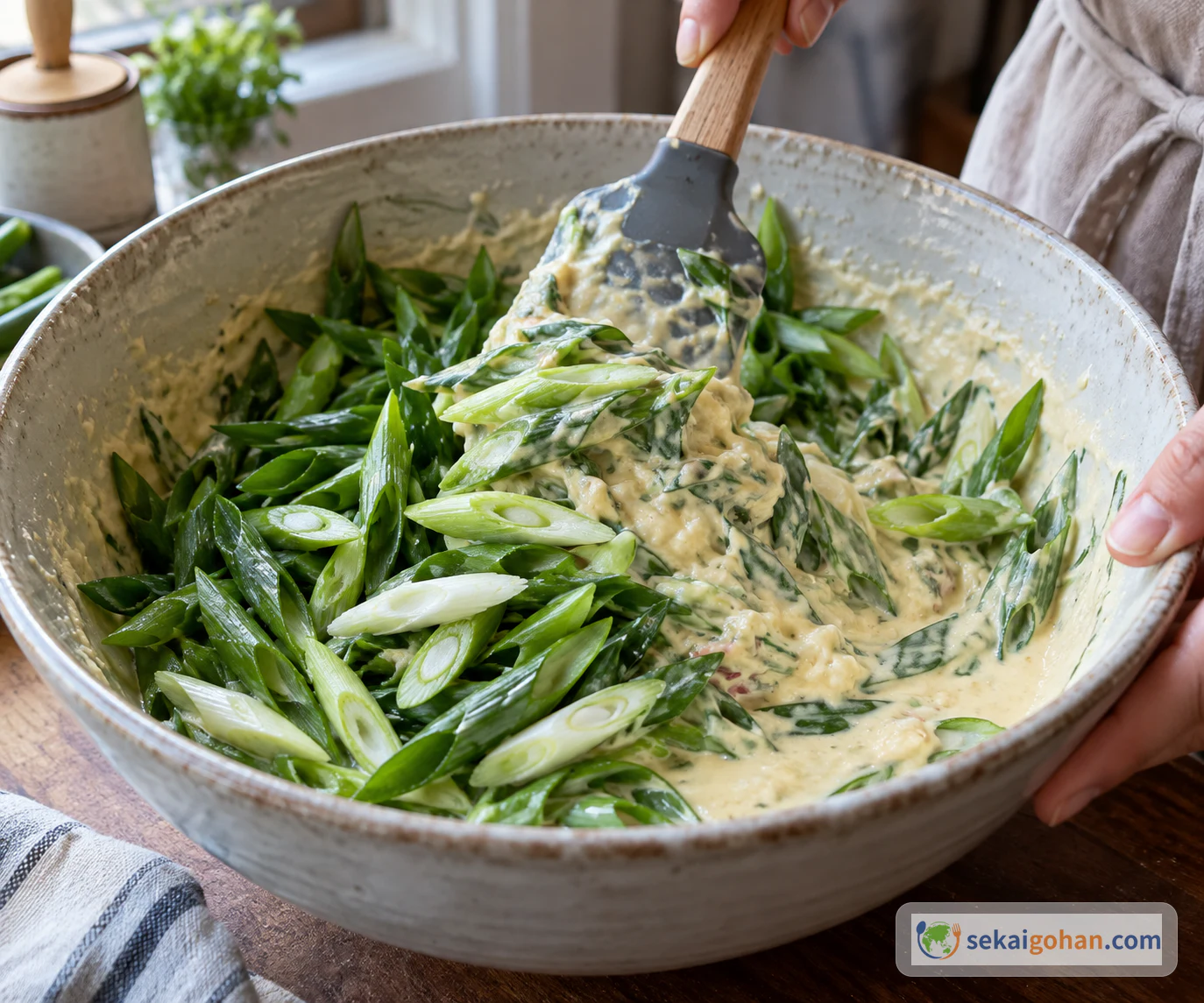
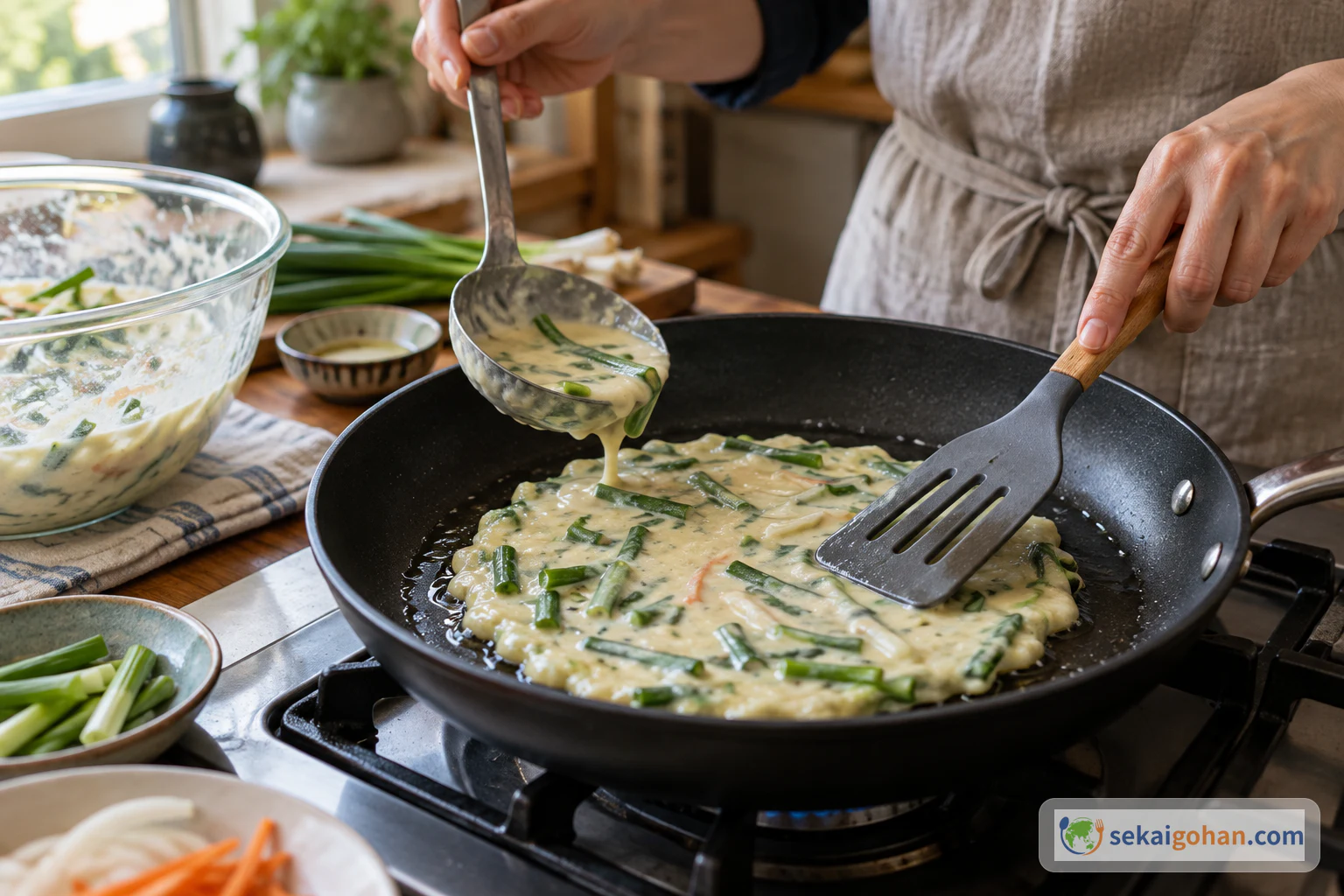
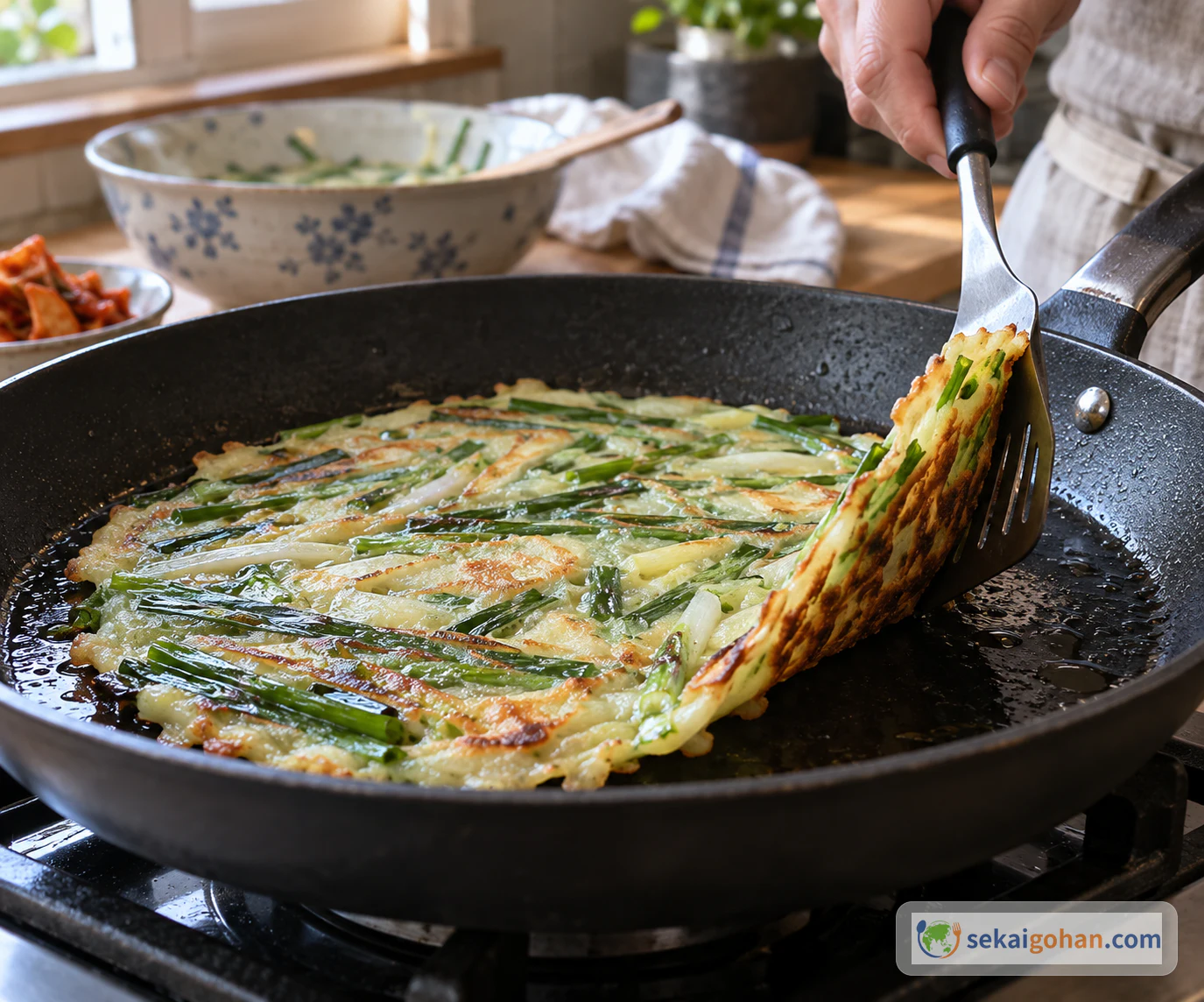
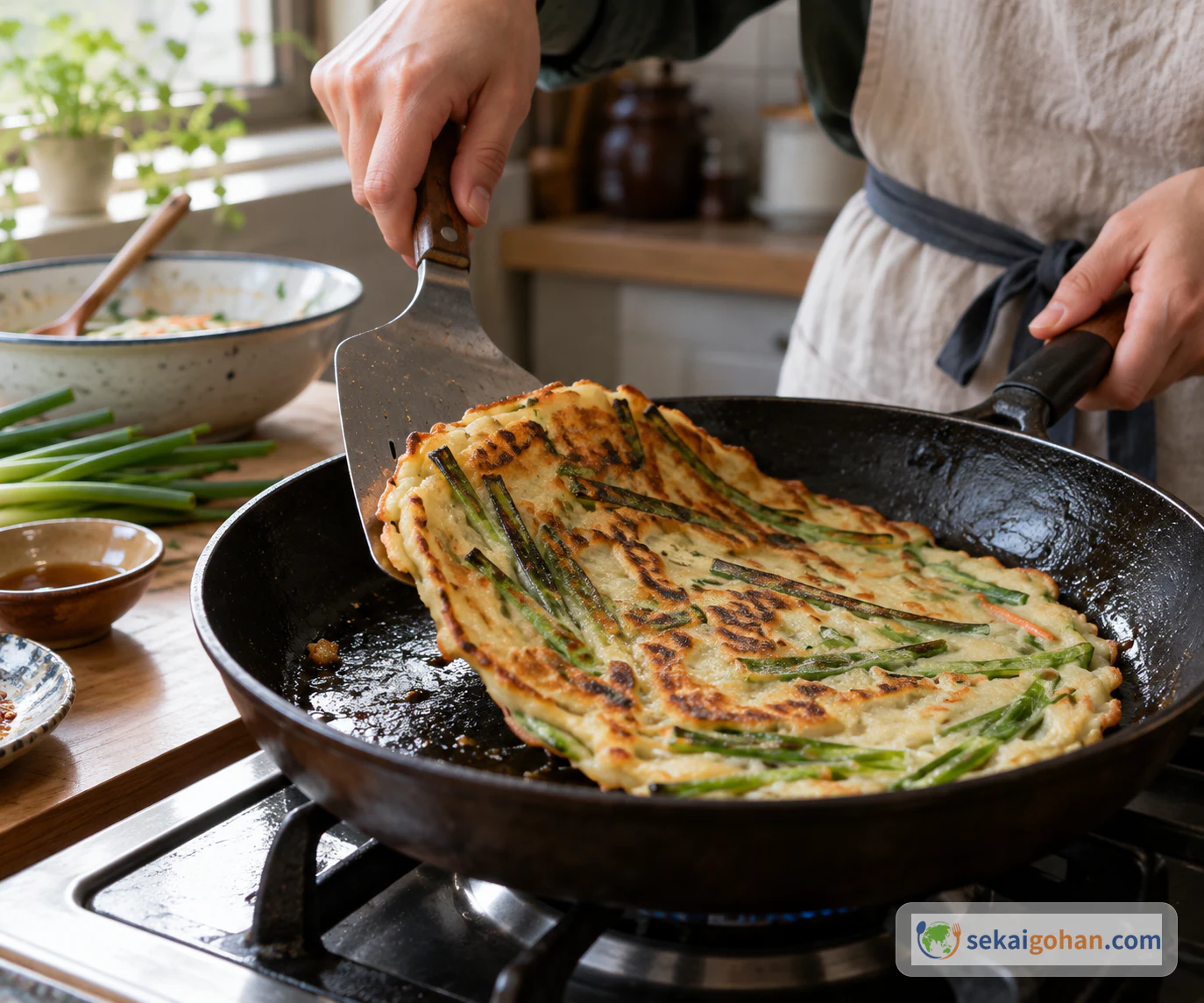
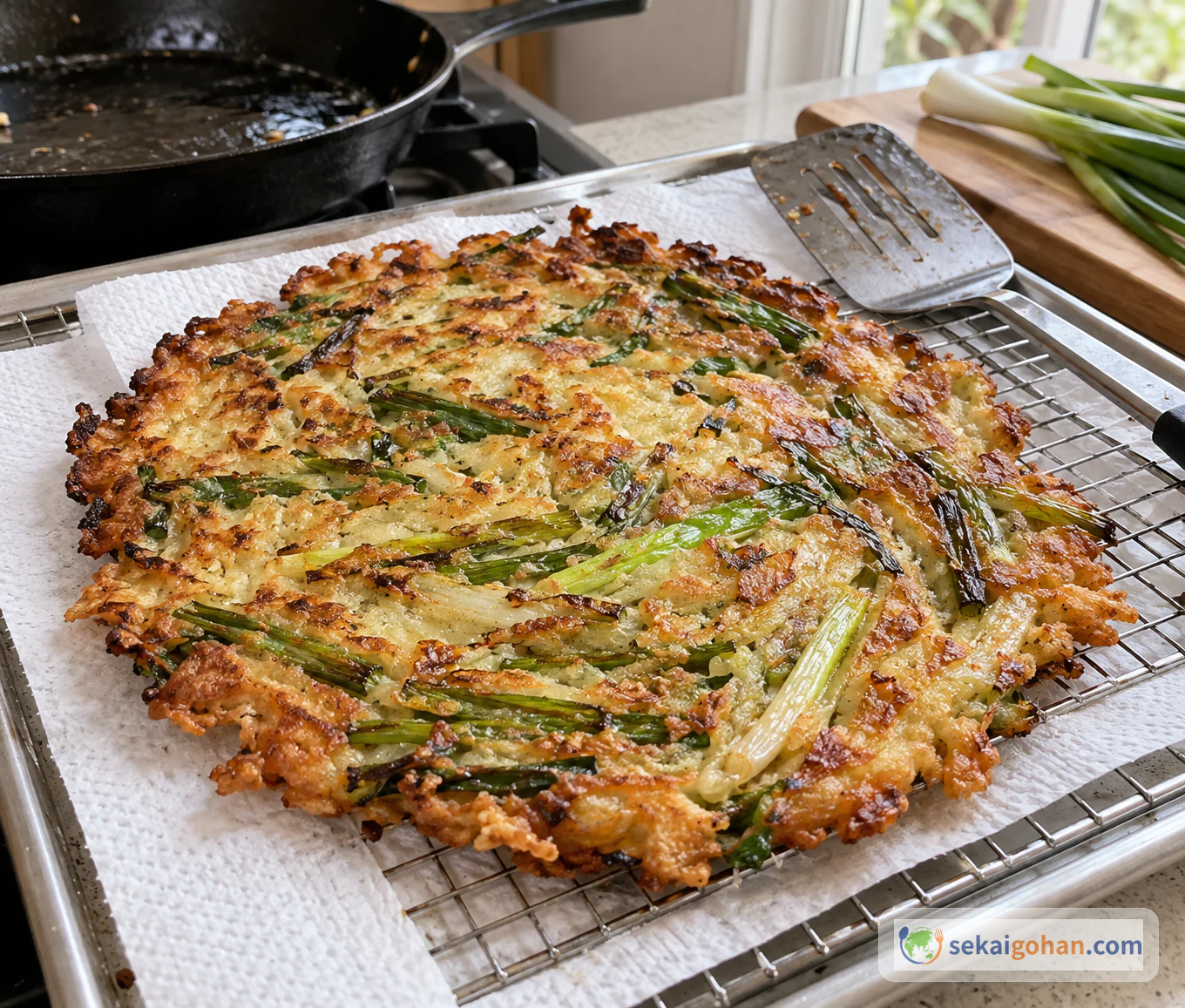
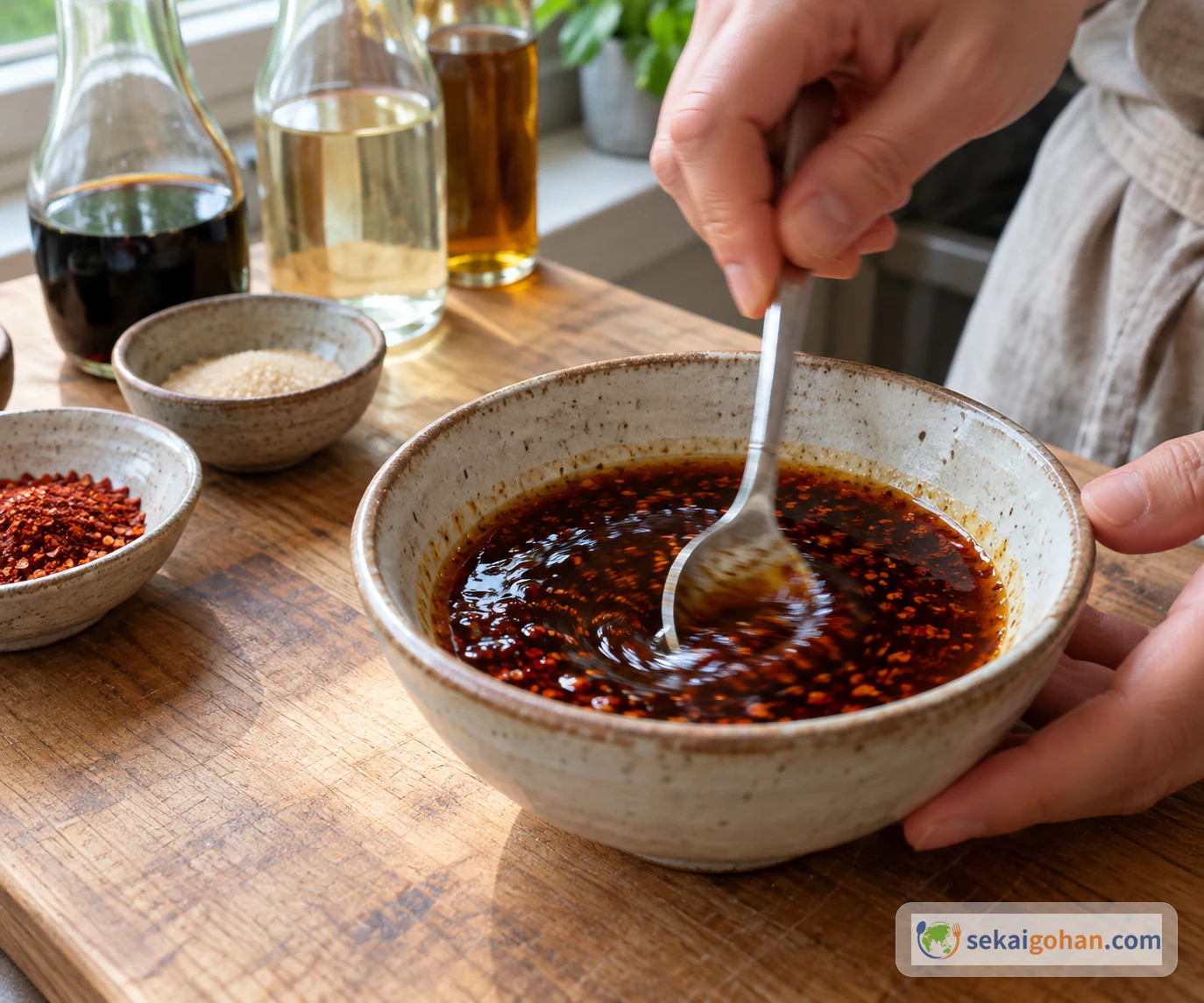
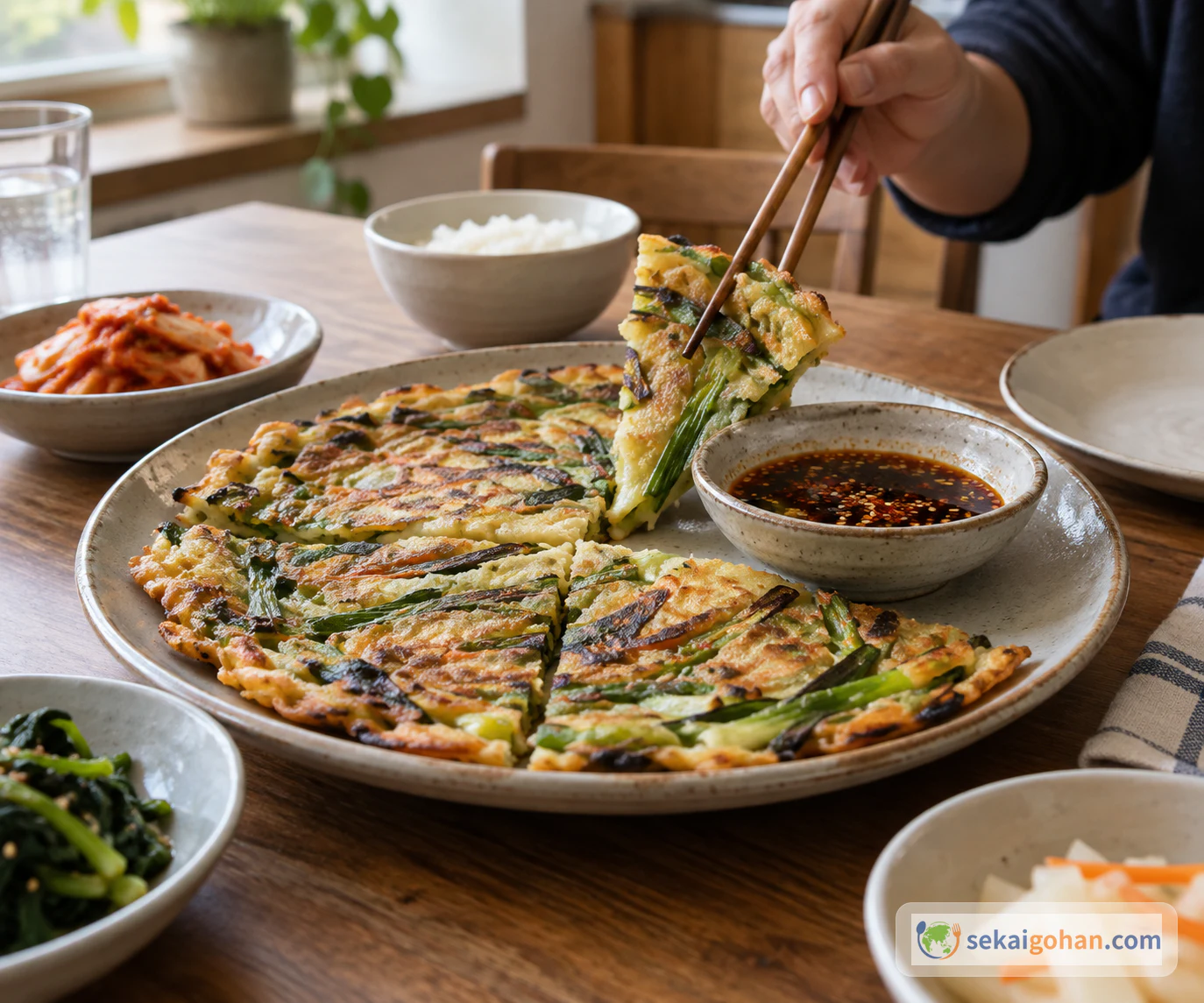
A thin layer of batter spreads across a hot pan, the green of the scallions showing through as the edges begin to set. Once both sides are golden, you tear off a piece of the hot pancake and dip it into a small dish of soy sauce sharpened with rice vinegar. That's pajeon (파전), the Korean green onion or scallion pancake. The name points straight to the main ingredient, so this version takes it seriously: about 12.5 oz (350g) of scallions in a light batter, enough for 4 large pancakes with crisp, golden sides.
Pajeon and Dongnae Pajeon
In Korean the pancake is 파전, and in English it goes by green onion pancake. This version is thin, with a lot of scallions folded through a wheat-flour batter.
The clearest contrast is Dongnae pajeon, a regional type from Busan's Dongnae district. It's made with rice flour, glutinous rice flour and stock, and the ingredients and batter are layered on a thick griddle, then finished under a lid. It uses wild green onions, which are tender in spring, though grocery-store green onions also work.
| This recipe | Dongnae pajeon | |
|---|---|---|
| Batter | Wheat flour, cornstarch and cold sparkling water | Rice flour, glutinous rice flour and stock |
| Assembly | Scallions folded into the batter | Ingredients and batter layered |
| Cooking | Nonstick skillet, thin round, flipped | Thick griddle, finished with a lid |
Local oral tradition says Dongnae pajeon was once offered to a king, and links it to the year 1707. From the late Joseon period onward it became a commercial local dish, eaten with alcohol at the Dongnae market and in gisaeng houses.
For more dishes from the same country, browse our Korean recipes.
Ingredients: 4 Large Pancakes, with Scallions in the Lead
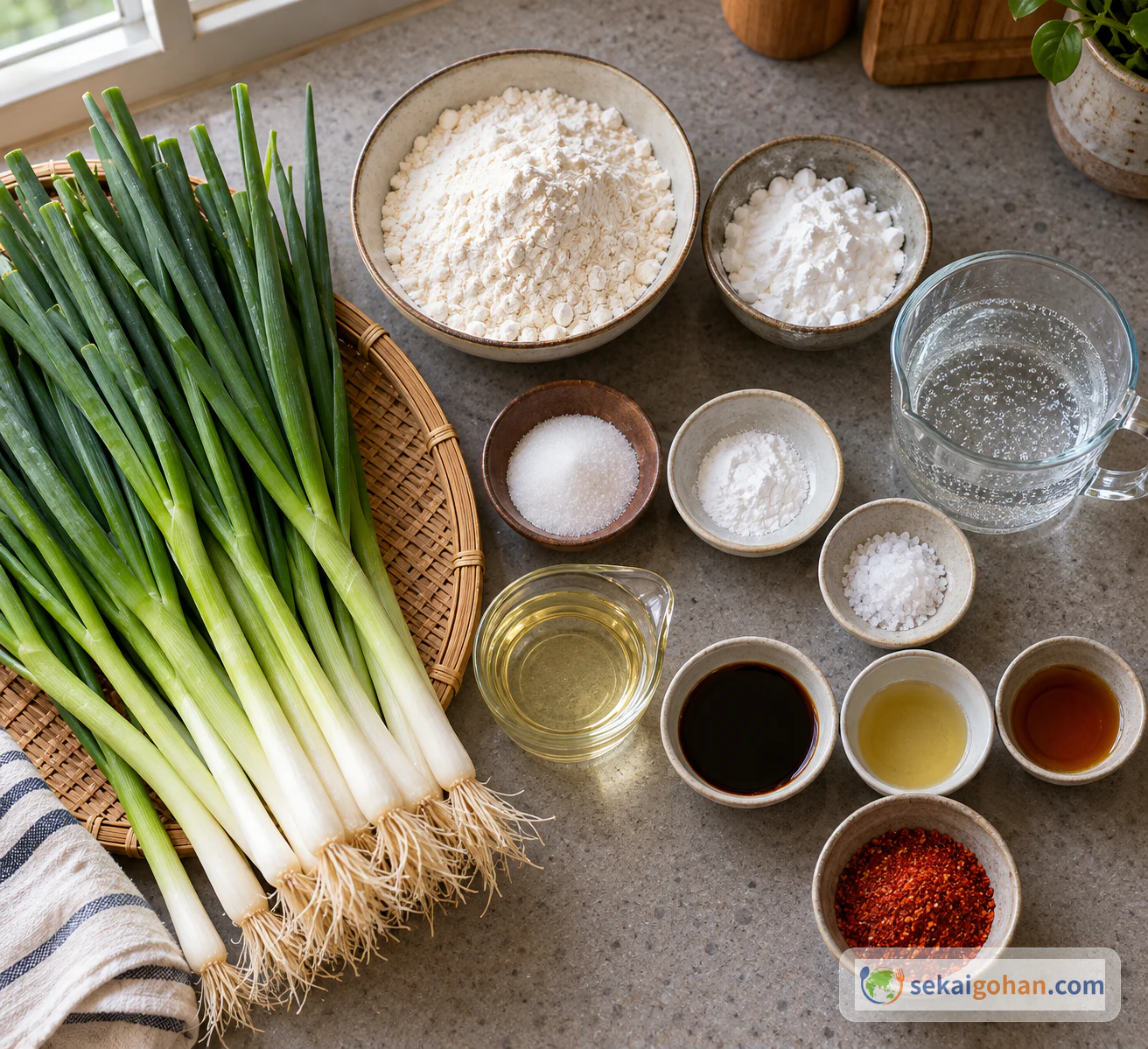
This recipe contains wheat. Soy sauce may contain soy and wheat, so check the label. Sesame oil contains sesame. If you have an allergy, check the label of every product you use, including any substitute.
Equipment
- Knife and cutting board
- Mixing bowl
- Whisk and flexible spatula
- 1/2-cup measure or ladle
- Nonstick skillet
- Wide spatula or turner
- Wire rack lined with paper towels, or a plate
- Small bowl and spoon for the sauce
Pajeon Ingredients and Substitutes
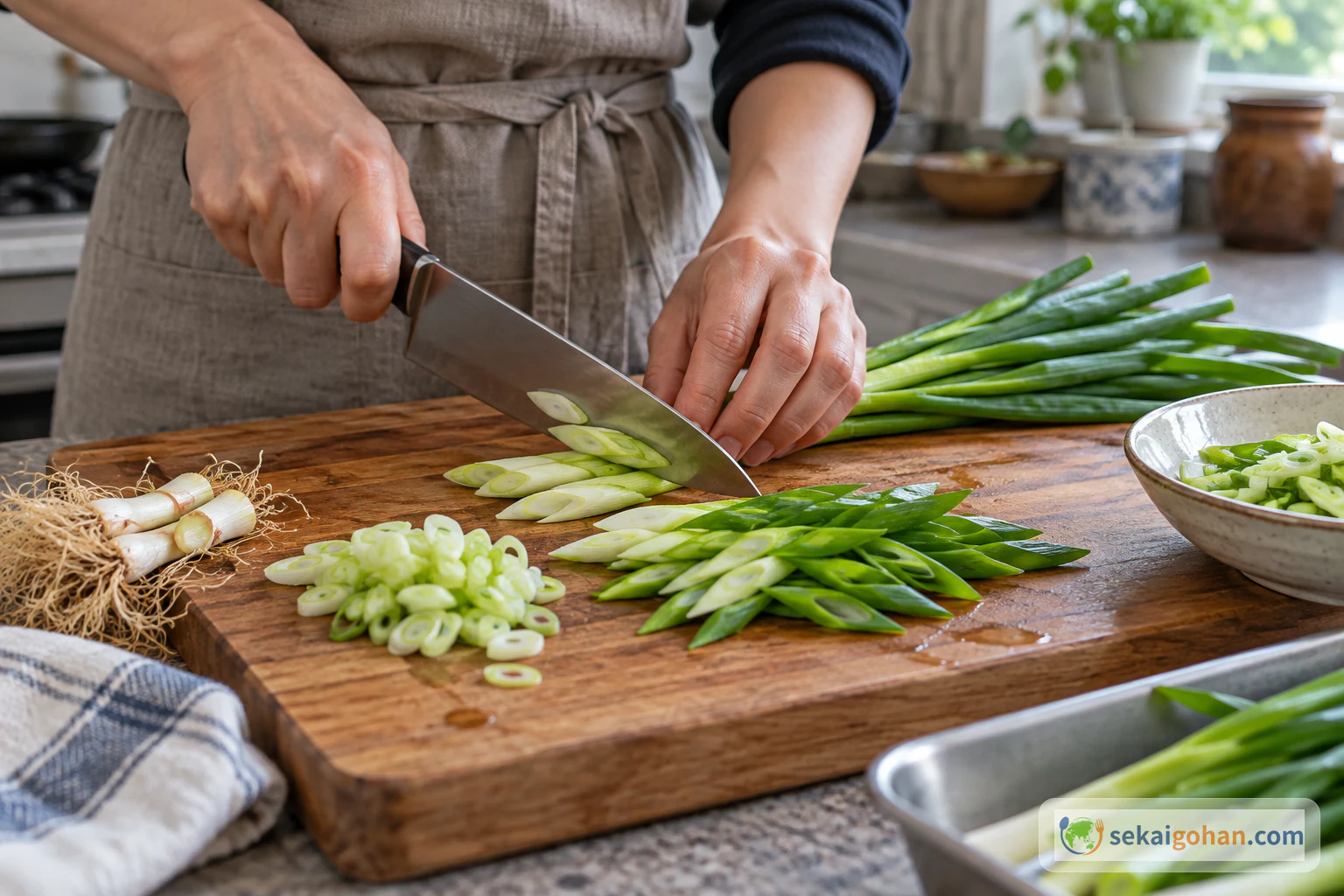
Scallions are the easiest part to get right. Ordinary grocery-store green onions work, and so do thicker ones if you slice them thinly on the diagonal and keep the width even. Expect a little difference in flavor from bunch to bunch.
The other swaps change the formula, so treat them as your own variations:
| Ingredient | If you change it | What to expect |
|---|---|---|
| All-purpose flour | Cake flour | Works, but changes the formula |
| Cornstarch | Potato starch | Not the same as cornstarch; try it as a separate experiment |
| Cold sparkling water | Water | The texture changes, and the pancake is less light |
| Soy sauce | Another style of soy sauce, such as Japanese dark soy sauce | The sauce tastes different |
| Gochugaru | Leave it out | The sauce gets milder and loses its red color and chili heat |
Any ordinary rice vinegar is fine for the sauce. Gochugaru is only worth seeking out if you want its color and heat in the dipping sauce.
Pajeon Troubleshooting
Keep the scallions in the lead, spread the batter thin, and let the underside turn golden and crisp before you flip.
Most problems come down to batter that's too thick or a flip that comes too soon. Your pan and burner will also change the timing, so go by color and crispness as well as the clock.
| What you see | Likely cause | What to do |
|---|---|---|
| The center stays soft even after the full time | The batter went on too thick | Spread the next pancake thin right away, to 6 to 8 inches across |
| The pancake breaks when you flip it | The bottom hadn't set yet | Slide the spatula under and check that the edge is firm and the bottom has browned before turning |
| It looks like a pancake with a few scallions in it | Too much batter for the scallions | Stick to the scallion and batter amounts in the table |
| The batter feels sticky | The scallions went in wet | Pat them dry before folding them in next time |
| The color isn't there when the time is up | Pans and burners vary | Raise the heat a little at the very end if needed |
The oil is divided because each pancake needs fresh oil in the pan. About 2.75 oz (75g) is what goes into the pan, not what the pancakes absorb.
Serving, Storing and Variations
Pajeon is best fresh and hot, with the soy dipping sauce alongside. Refrigerate leftovers in an airtight container for up to 2 days. Reheat them in an oven or toaster oven on a rack set over a baking sheet, and keep an eye on them as they warm.
For a different shape, try laying the scallions out in the pan and pouring the batter over them. Use 10 stalks of green onion, 1/2 cup flour, 1/2 cup water, 1 tsp soybean paste, 1/2 tsp sugar and 3 tbsp oil for one 6×7 inch rectangular pancake. Keep these amounts separate from the recipe above.
Frequently Asked Questions
Why sparkling water?
The recipe calls for it cold, and it's what brings the batter together. Plain water changes the texture, so it's a variation rather than an equal swap.
Can I add seafood?
You can make a seafood pancake, but it's a separate version. Seafood isn't part of this formula, so it needs its own amounts and timing.
How long does the whole batch take?
The 3 to 4 minutes per side applies to one pancake, and you'll cook about four in turn. Plan on 40 minutes of hands-on time and 1 hour overall.