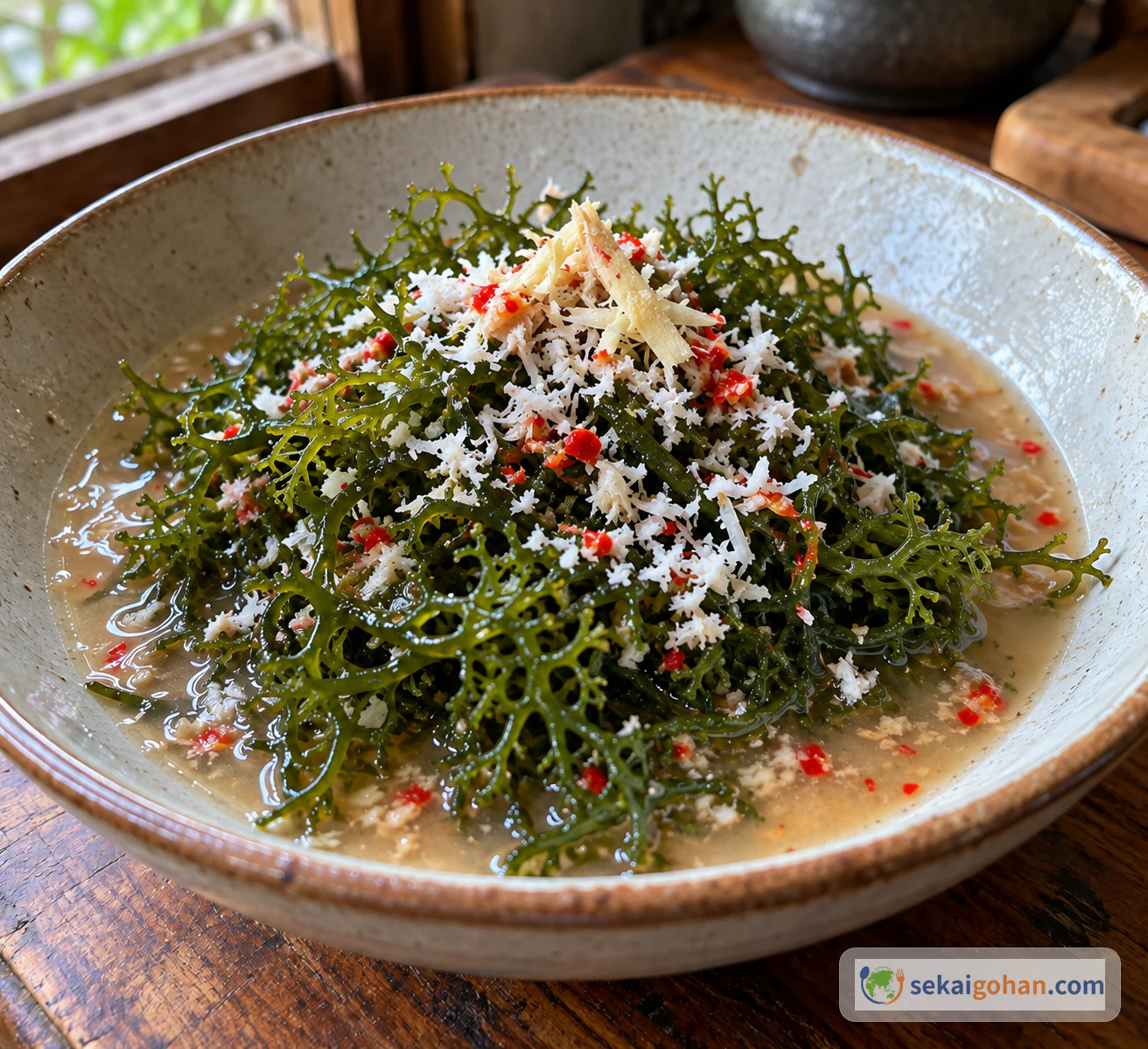
Five a.m. in Yangon, and stall lights are flickering on in alleys that are still half dark. Steam rises from huge pots, and the smell of a golden broth drifts down the street. Office workers on their way in, monks heading out on their alms round, kids hurrying to school: everyone lines up for the same bowl. That bowl is mohinga (မုန့်ဟင်းခါး), a rich soup built on catfish broth, perfumed with lemongrass and turmeric, served over thin rice noodles. It's cheap, it comes out fast, it fills you up, and in Myanmar it is widely regarded as the national dish.
Mohinga, Myanmar's national dish
What goes into the bowl
In Burmese, mont (မုန့်) refers to rice noodles and snacks, and hinga (ဟင်းခါး) to a soup or broth, which is why you'll also see the name written "mont hinga." The broth is made from catfish (or another freshwater fish of the catfish family) and seasoned with lemongrass, turmeric and fish sauce. Chickpea flour (besan) gives it body. On top go fried split-pea fritters (pe kyaw), boiled eggs, cilantro and lime.
In English it is sometimes introduced as "Burmese fish noodle soup," but the Burmese name, mohinga, is the one widely used.
A street-stall breakfast
Walk through any town in Myanmar and you'll find mohinga stalls everywhere. In big towns like Yangon they open early, and many are simple affairs: little plastic tables and stools set out on the sidewalk, where people sit and eat or take their soup home in a bag. Mohinga is still the classic breakfast, but these days people eat it at lunch and dinner too.
Mohinga history
Mohinga's origins are not clearly known, but there are clues. Among the early written mentions, it appears in a poem from the Konbaung era, and in the reign of King Bagyidaw another poem refers to the dish as mont di. No formal recipe shows up in court records or cookbooks, which suggests it was most likely a dish of ordinary people before the colonial period.
The rice noodle tradition behind it may go back much further: tools for fermenting rice have been found at the ancient Pyu city sites. Some trace mohinga's origins to the southern coast and delta, home to the Mon people.
Geography helped make it the national dish. Myanmar has a vast river network centered on the Irrawaddy (Ayeyarwady), freshwater fish are plentiful, and catfish is among the cheapest and easiest to get. The country also grows a great deal of rice, so there's no shortage of raw material for noodles. Mohinga's main ingredients are things Myanmar's land provides naturally.
Choosing mohinga ingredients and substitutes
Apart from a few items, mohinga ingredients are easy to find. The biggest hurdles are catfish and banana stem, and substitutes make a very good soup.
| Ingredient | Where to find it |
|---|---|
| Catfish (frozen) | Southeast Asian grocers, online |
| Lemongrass | Supermarkets, Asian grocers |
| Chickpea flour (besan) | Indian grocers, online |
| Fish sauce | Supermarkets |
| Rice noodles (rice vermicelli) | Supermarkets, Asian grocers |
| Ground turmeric | Supermarkets |
Catfish can be hard to find in ordinary supermarkets, though some online shops sell it frozen. The best substitute is sea bream heads and bones: a mild white fish that makes good stock. Sea bass or cod also work. Oily fish like mackerel or sardines are too rich for this soup.
| Ingredient | Substitute | How it differs |
|---|---|---|
| Catfish | Sea bream heads and bones, sea bass | The stock is less intense but still delicious |
| Banana stem | Lotus root (thinly sliced) | Similar texture, different flavor |
| Rice noodles (mont di) | Rice vermicelli, somen | Rice vermicelli is closest. Somen isn't made from rice, but the texture works |
| Pe kyaw (split-pea fritters) | Fried fish cakes | Not a close substitute, but the texture fits |
How to make it
Mohinga broth has two layers: fish stock plus a chickpea-flour thickener. Make the fish stock first, then thicken it.
Mohinga cooking tips and common mistakes

Use the fish in two stages
Poach the catfish (or substitute) first to make stock, then flake the flesh and return it to the soup. This two-stage method gets the most depth out of the stock; fry the flesh at the start and the stock ends up weak. The shrimp stock in laksa works on the same principle, using the shells and the meat in separate steps.
Keep the chickpea flour from scorching
Chickpea flour gives the soup both body and a toasty aroma, but it turns bitter if it burns. Mix it with water first, add it to the soup gradually so it doesn't form lumps, and keep stirring over low heat.
Bruise the lemongrass
Crush the lemongrass with the flat of a knife before it goes into the pot. This breaks the fibers so the aroma comes out more readily. You can chop it instead, but the woody pieces will need fishing out later; tying the stalks in a knot makes them easy to remove. Nasi lemak calls for bruised lemongrass too.
Add fish sauce at the end, too
The Burmese way is to season the soup with fish sauce and then add a few drops right before eating. Cooked and uncooked fish sauce smell different, and that final splash adds depth, much like the nuoc mam (Vietnamese fish sauce) served with banh mi.
Make your own fried garlic chips
Store-bought fried garlic works, but homemade smells far better. Slice garlic thinly and fry it slowly over low heat until golden brown, then drain it on paper towels; it crisps as it cools. Drizzle the leftover garlic oil over the soup.
Serving mohinga and regional variations
Half of mohinga's appeal is in the toppings: boiled eggs, fried tofu, cilantro, lime, chili flakes, fried garlic. Street stalls in Myanmar set out 6–8 kinds, so have at least 4 ready at home. Because mohinga is easy to make in a big pot, it's often served when people get together, and the Burmese way is to set out the toppings and let everyone add what they like.
Mohinga across Myanmar

Every region makes mohinga its own way. This recipe follows the Yangon style, which is often treated as the standard: a rich, thick broth with plenty of chickpea flour and abundant fried toppings. Yangon belongs to the Lower Myanmar family of the Irrawaddy Delta, the best-known style, made with catfish, chickpeas and peanuts. In delta towns such as Bogale, Myaungmya, Pyapon and Pathein, the common form is called tawkyet (country-style) mohinga.
Elsewhere the fish changes. In Bago Region, Hinthada uses hilsa (a fish of the herring family), Madauk uses salted shrimp and Nyaunglebin uses fermented fish, while the Taungoo version has little broth and is closer to a noodle salad. In western Rakhine, mohinga uses more fish paste and less broth. Upper Myanmar has the Anya style, which combines chicken, fish and chickpea flour, and the Intha style from around Inle Lake, made with catfish and scallions.
FAQ

Q1. Is mohinga spicy?
Basic mohinga isn't spicy; the fish stock and lemongrass are the stars, and each diner adds heat with chili flakes. It's gentle enough for kids and much milder than laksa.
Q2. Can I make the soup a day ahead?
We recommend it. The flavors come together better the next day. The soup keeps for 3 days in the fridge and 2 weeks in the freezer, so a big batch frozen in portions is efficient. Cook the rice noodles just before eating.
Q3. Where can I eat mohinga out?
Look for Burmese restaurants. They tend to cluster in neighborhoods with Myanmar communities (Tokyo's Takadanobaba area is one example), and some serve mohinga. Opening days and menus vary, so check before you go.
Q4. Is it different from khao soi from northern Thailand?
Completely. Mohinga is catfish stock thickened with chickpea flour; khao soi is a coconut-milk curry soup from the north of Thailand, around Chiang Mai. Dishes differ by region within Thailand, just as som tam comes from the northeast (Isan).
Q5. How can I adapt it for kids?
Cut the fish sauce in half and leave out the chili flakes. A little extra chickpea flour makes the soup richer and easier for kids to enjoy. With boiled eggs and somen, it becomes something close to a mild Japanese noodle soup (nyumen), which kids tend to accept readily.
Sources
We referred mainly to the following English-language sources.
- Mohinga - Wikipedia (English) — A comprehensive overview of mohinga's history, regional variations and cultural significance
- Mohinga - SBS Food — A home recipe and ingredient list (accessed 22 October 2026)
- Mohinga: The Ultimate Guide - Taste Atlas — An entry and description from a world food-culture database
- Thanegi, Ma (2004). An Introduction to Myanmar Cuisine. Myanmar Book Centre. — A systematic introduction to Burmese cuisine
Related recipes: Southeast Asian noodles and breakfasts
Other Southeast Asian noodle dishes: Laksa is Malaysia's spicy coconut-milk noodle soup, a contrast to mohinga's fish stock. Pad thai is Thailand's sweet-and-sour stir-fried noodle dish. Banh mi is Vietnam's sandwich, shaped by French colonial influence.
Southeast Asian breakfasts: Nasi lemak is Malaysia's national breakfast: rice cooked in coconut milk, served with sambal. Nasi goreng is Indonesian fried rice, also eaten for breakfast. Together with mohinga, they make up the taste of a Southeast Asian morning.
One more Burmese dish: in contrast to warm, fish-based mohinga, lahpet thoke is a cold salad of fermented tea leaves, beans and cabbage. Comparing how each dish layers fish sauce, lime and toasty beans shows how wide Burmese cooking ranges.
Fish dishes around the world: Thieboudienne is Senegal's fish and rice, from West Africa's seafood tradition. Ceviche is Peru's seafood dish; not a soup, but it shares the culture of putting fish front and center.
Wrap-up: the taste of "good morning" in Myanmar
Mohinga layers the body of chickpea flour and the aroma of lemongrass over a stock drawn from a humble freshwater fish, the catfish. Add rice noodles and a spread of toppings, and you have a complete, nourishing, satisfying meal.
In Myanmar, the morning begins with mohinga; it is the bowl many people reach for first thing. Its power can't be explained by flavor alone. It is culture, identity, and the glue that holds people together. When you make catfish stock in your own kitchen, thicken it with chickpea flour and breathe in the lemongrass, a little of Yangon's early-morning air should come through.