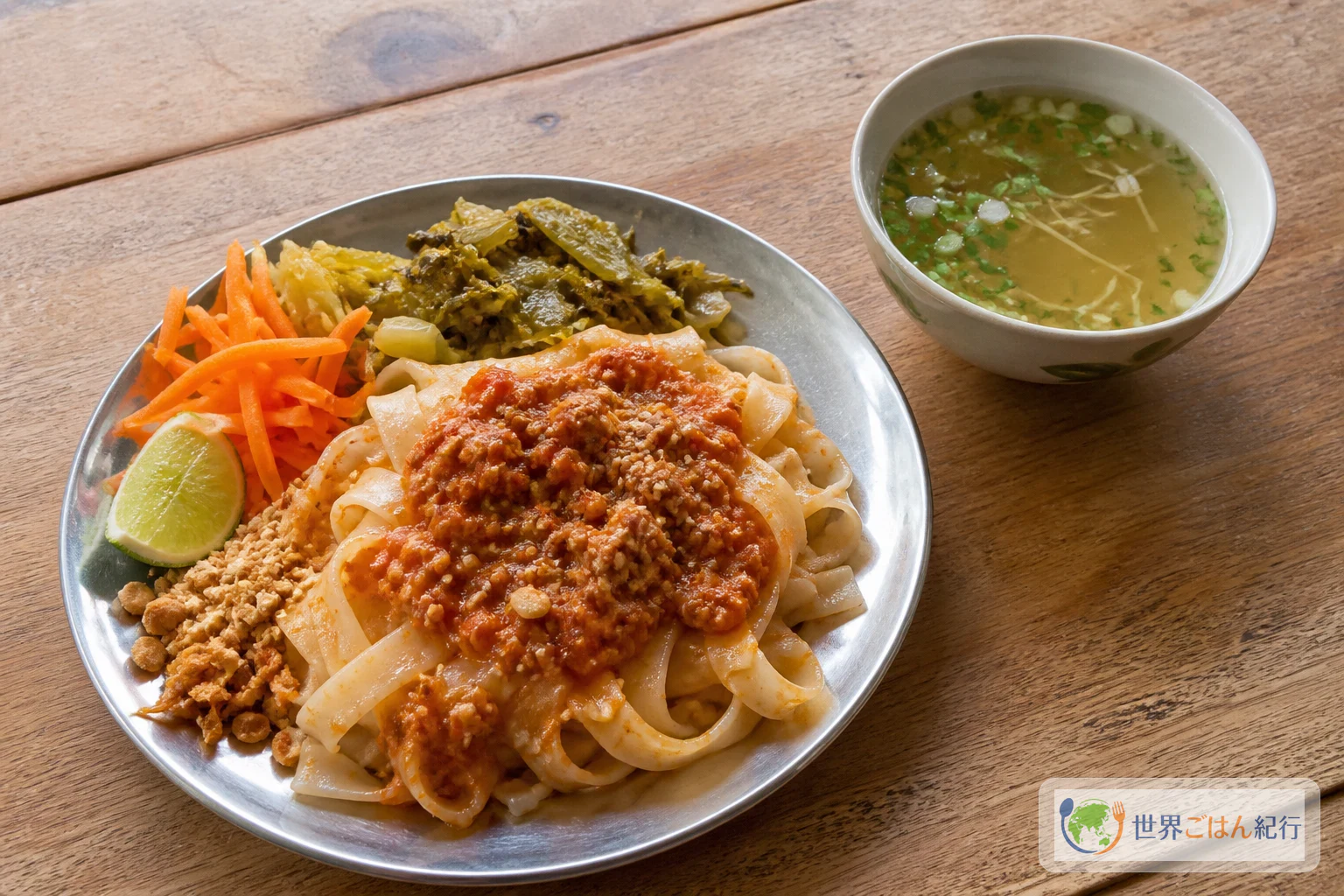
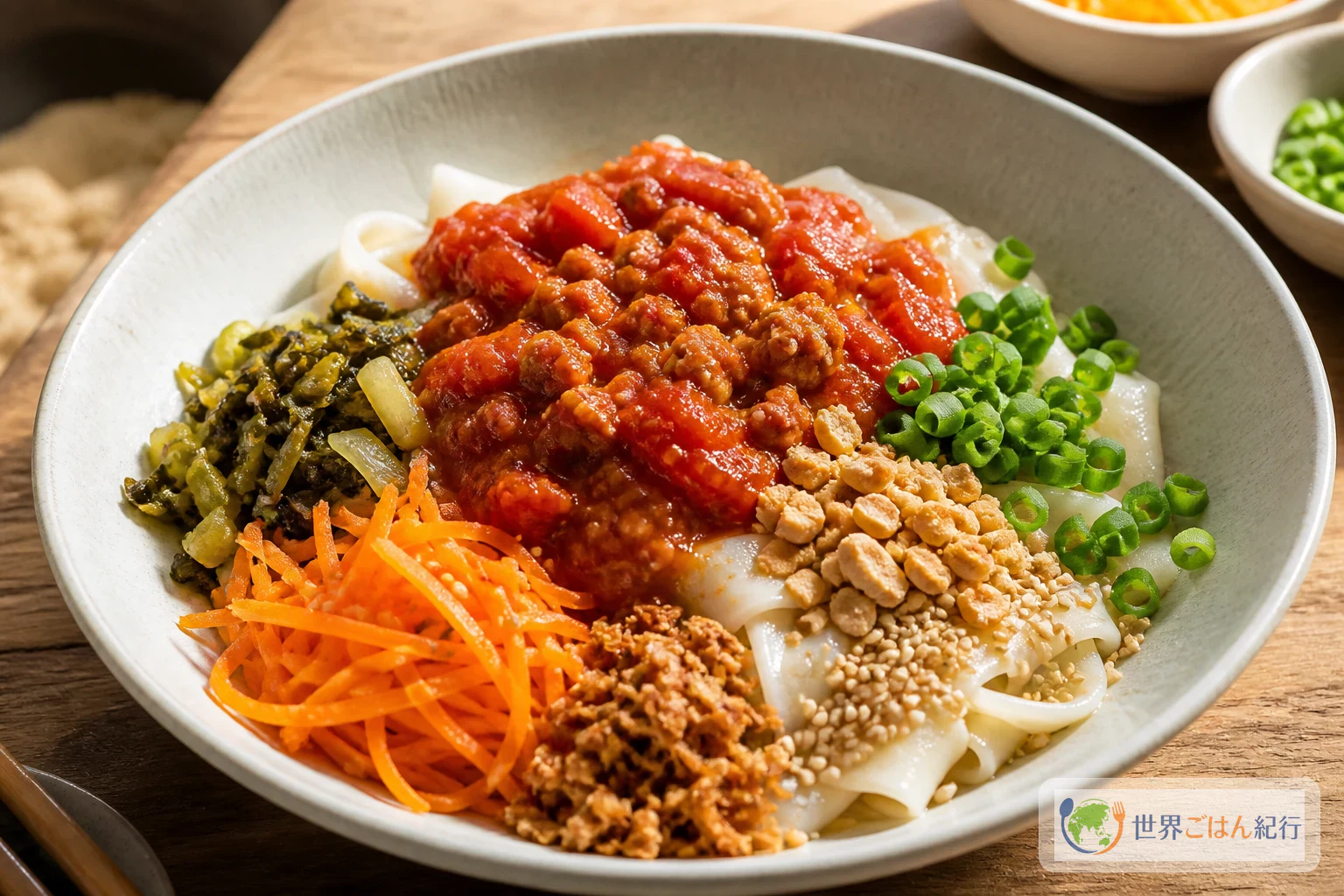
In a bowl of dry Shan khauk swe, no soup goes in at the start. Wide rice noodles are layered with a tomato-simmered meat sauce, garlic oil, pickles, and peanuts. Each time you toss them, a little more of the red sauce, the sourness, and the toasty aroma passes into the noodles. A clear soup comes in a separate bowl, or gets poured over later by anyone who wants broth. Written ရှမ်းခေါက်ဆွဲ in Burmese, Shan noodles come from Shan State and are now eaten in tea shops and homes all over Myanmar. This recipe makes 4 servings of the dry version, and you can divide the same pot into soup servings.
What Are Shan Noodles?
Shan noodles, called Shan khauk swe (also spelled Shan kauk swe or Shan khaut swe), are a Burmese dish of wide rice noodles topped with a tomato-simmered meat sauce. They come from Shan State in eastern Myanmar and are eaten in tea shops and homes across the country. The usual dry version is finished with pickles, peanuts, and garlic oil, with a clear soup on the side. The same pot also makes a soup version. For another noodle bowl from Myanmar, compare mohinga.
Shan Khauk Swe in Shan State and the Tea Shop
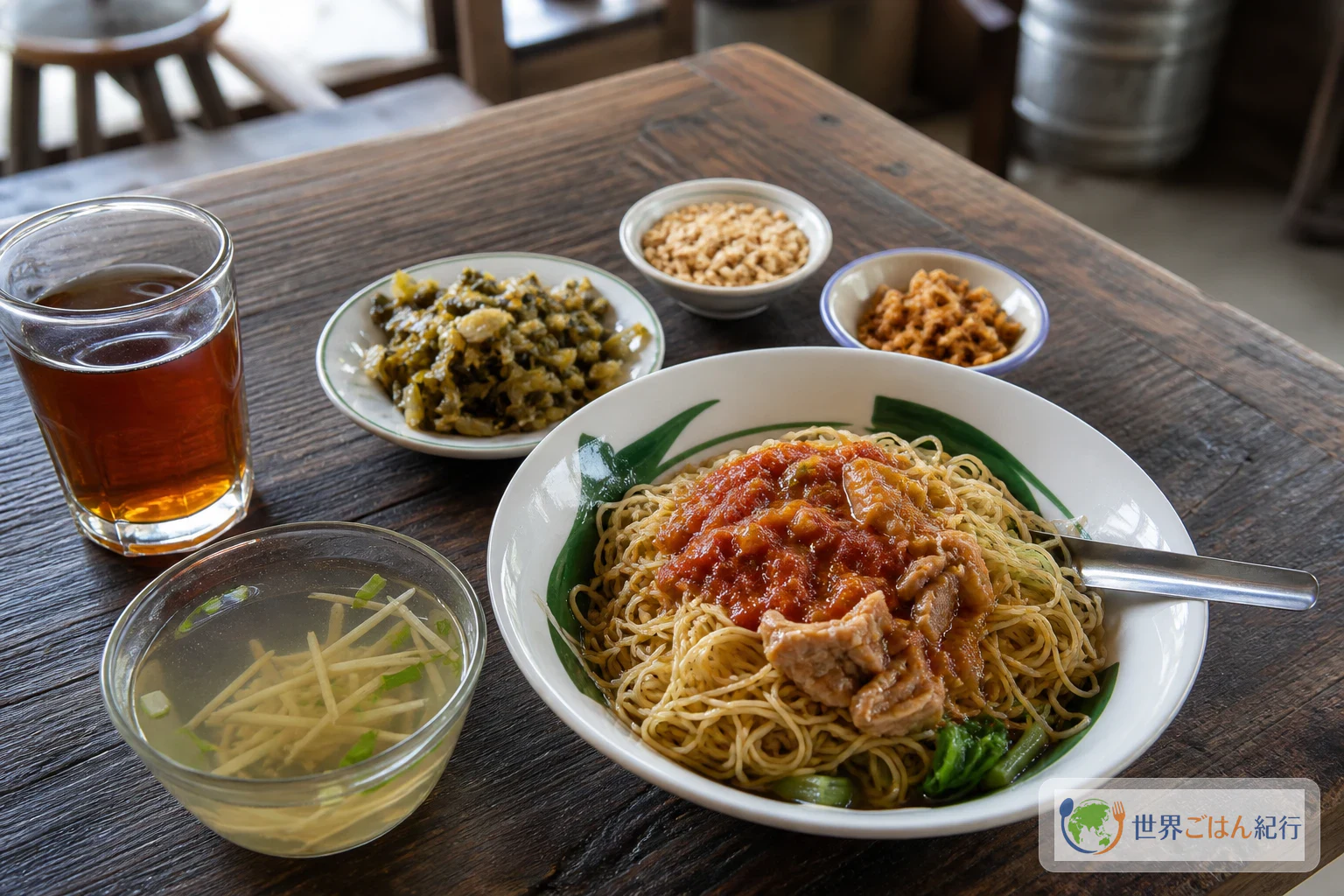
Where the name comes from
The "Shan" in the name refers to Shan State in eastern Myanmar and the Shan people who live there. The dish spread across the whole country and changed to fit the ingredients on hand and the time of day people ate it. That's why the noodles and the meat sauce differ from shop to shop. Some versions use chicken and some use pork. Some add a fermented soybean seasoning, and some serve the soup on the side.
In Shan State, people eat it at lunch, at dinner, or as a light snack. Toss in just a little of the tomato-meat sauce and it works as a full meal or as a tea-shop bite. If the noodles alone feel heavy, add pickles and nuts.
How it's eaten in tea shops
Myanmar's tea shops are everyday gathering places. People come for sweet milk tea and snacks, and to talk, sometimes about business. You don't eat Shan khauk swe alone in a hurry. You add pickles, fried garlic, and chili from separate plates to taste, and you eat while talking with the person next to you.
To eat it this way at home, don't toss the noodles in a strong-flavored sauce at the start. Spoon meat sauce onto each serving and put the pickles and peanuts on a separate plate, so everyone can set their own heat and sourness. Each eater finishes the flavor, not the cook, and that is what "dry" really means here.
Tomato and fermented soybean versions
Some home versions are built on tomato, garlic, fish sauce, and peanuts. Others add a fermented soybean seasoning for a deeper bean aroma. The first uses ingredients that are easy to find outside Myanmar, and the second takes some hunting. Both are authentic, and the flavor shifts by region and by shop.
Ingredients: Prepare the Tomato Sauce and Garnishes Separately
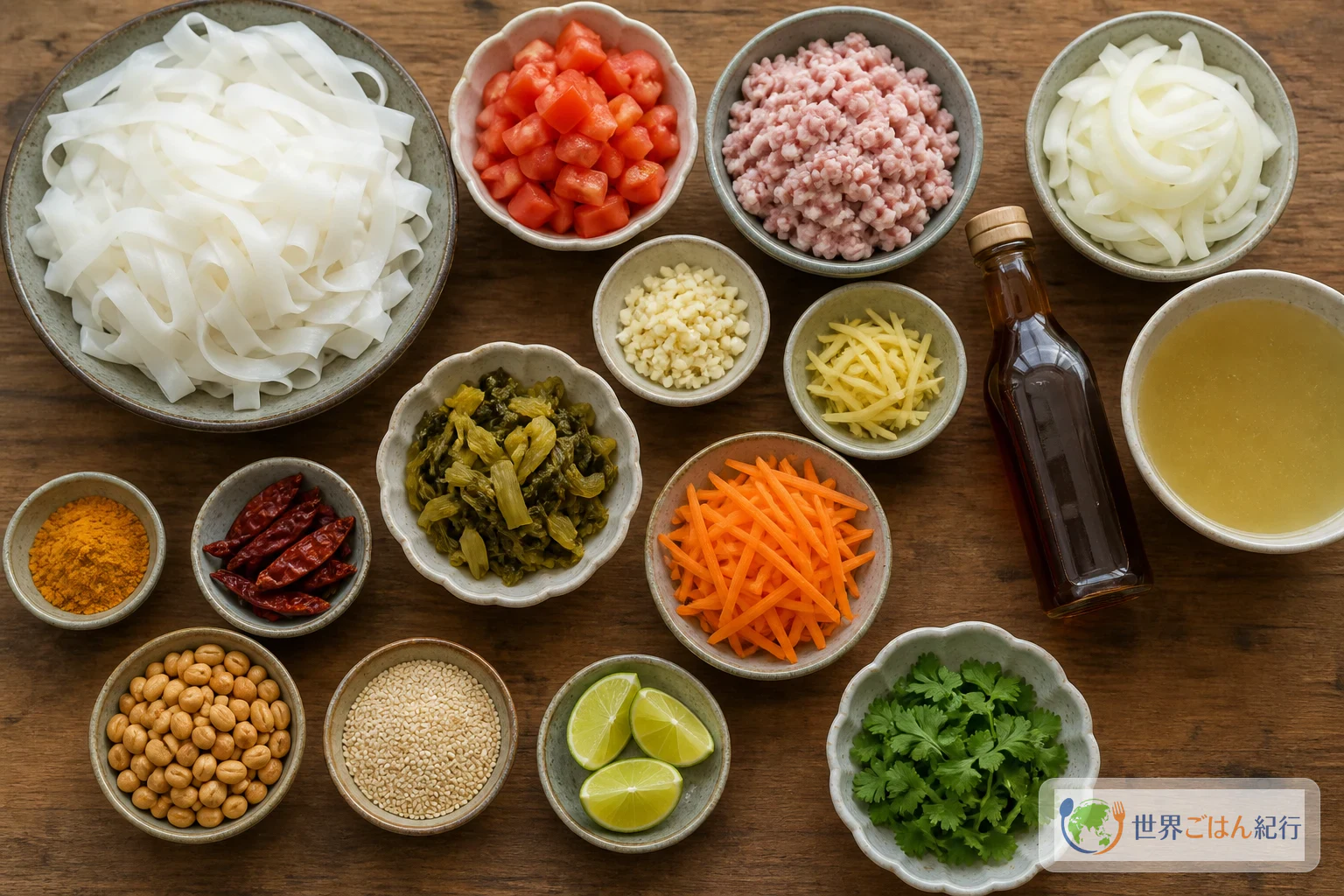
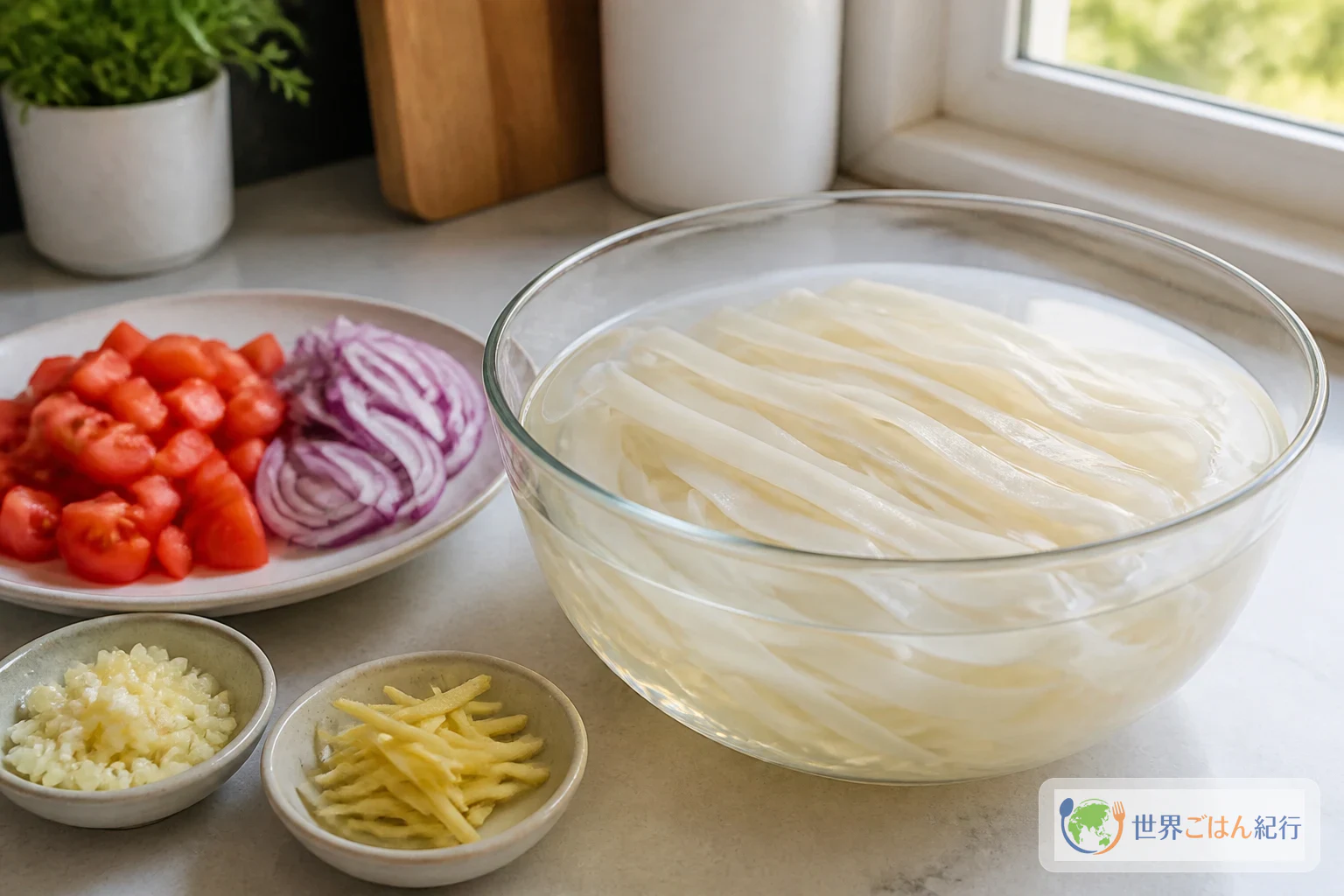
Serves 4. Dried rice noodles soak differently by brand, so follow the package. For wide dried rice noodles in room-temperature water, soak for 30 to 45 minutes. If using fresh wide rice noodles, use about 1.75 lb (800g) and skip the soaking in step 1.
:::ingredients
Rice noodles and tomato-meat sauce
| Ingredient | Amount | Role and substitutes |
|---|---|---|
| Dried wide rice noodles | 11.5 oz (320g) | 2.75 oz (80g) per person. For fresh wide rice noodles, use about 1.75 lb (800g) |
| Ground pork | 10.5 oz (300g) | Ground chicken gives a lighter flavor. For a plant-based version, use 7 oz (200g) firm tofu and 3.5 oz (100g) mushrooms |
| Tomatoes | 1 lb (500g) | Fully ripe ones give a rounder sourness. If canned, use 14 oz (400g) including the juice |
| Onion | 4 oz (120g) | Half an onion. Cut into 0.125 inch (2 mm) slices |
| Garlic | 20g | Divided into 12g for the meat sauce and 8g for the garlic oil |
| Ginger | 15g | Finely chopped. Lightens the meat aroma |
| Nam pla (fish sauce) | 2 tbsp (30ml) | Add 1.5 tbsp (20ml) first, then add 2 tsp (10ml) at the end after checking the saltiness |
| Light soy sauce | 1 tbsp (15ml) | Adds savoriness without darkening the color too much |
| Sugar | 8g | Rounds the sourness of the tomato |
| Turmeric | 1g | Color and an earthy aroma. The meat sauce can be made without it |
| Dried chili | 2g | Powdered or coarsely crushed. Heat can be added at the table |
| Vegetable oil | 2 tbsp (30ml) | Divided into 1 tbsp (15ml) for the meat sauce and 1 tbsp (15ml) for the garlic oil |
Pickles, toasty toppings, and a separate bowl of soup
| Ingredient | Amount | Role and substitutes |
|---|---|---|
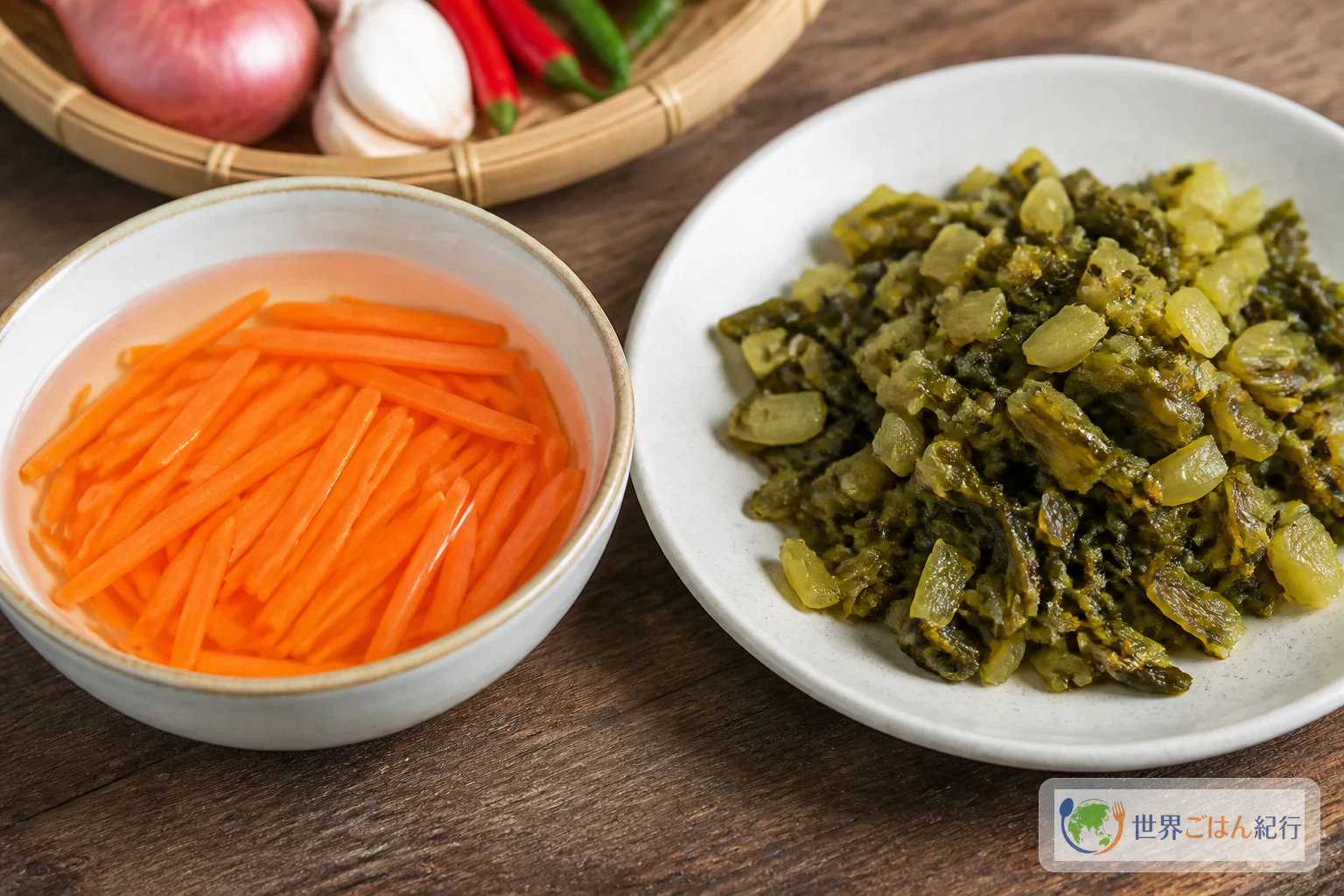
| Pickled mustard greens | 4 oz (120g) | 0.25 inch (5 mm) slices. If too salty, rinse in ½ cup (100ml) water for 2 minutes |
| Carrot | 3.5 oz (100g) | Cut into 1.5 inches (4 cm) matchsticks. Adds a sweet crunch to the saltiness of the pickles |
| Rice vinegar | 2 tbsp (30ml) | For a quick sweet-sour pickle of the carrot |
| Sugar | 8g | For the carrot pickling liquid |
| Salt | 1g | For the carrot pickling liquid |
| Peanuts | 1.5 oz (40g) | Unsalted, unoiled. Coarsely chopped |
| White sesame seeds | 10g | Dry-toast to bring out the aroma |
| Green onion or cilantro | 1 oz (30g) | 1 inches (2 cm) lengths. You can choose the strength of the aroma |
| Lime or lemon | 1 (about 2 tbsp (30ml)) | For adjusting the sourness after plating |
| Chicken broth or water | 2½ cups (600ml) | For the separate bowl of soup. For dry only, reduce to ¾ cup (200ml) |
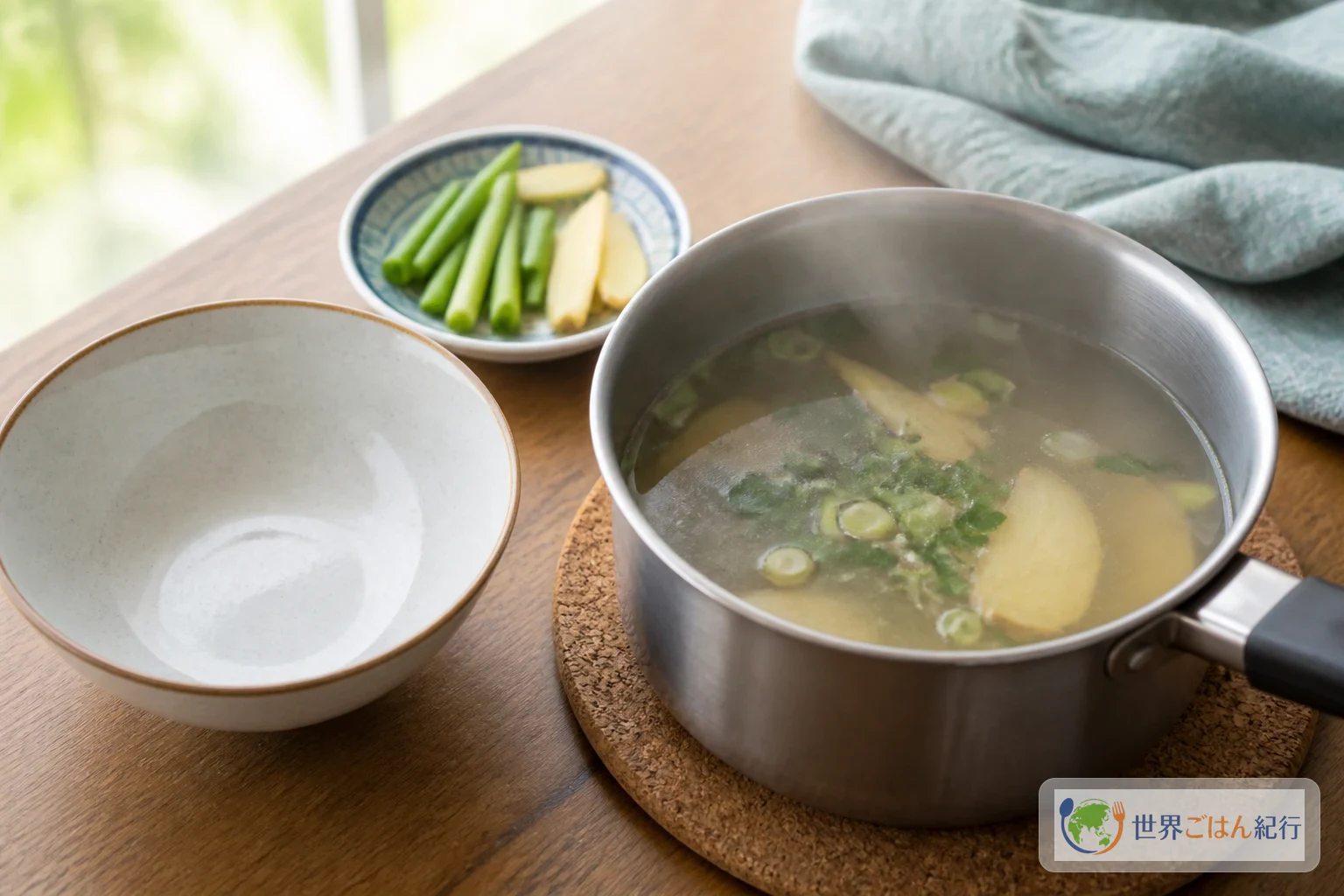
| Ginger | 10g | For the soup. Thinly sliced |
| Salt | 2g | For the soup. Fish sauce may be added at the end instead |
Nam pla is an easy-to-find stand-in for Myanmar's fish sauce. Salt level and fermented aroma differ by brand, so check the label. If you use fish sauce in several Southeast Asian dishes, you can try 2 tbsp (30ml) at a time; if you will make this dish only once, you can still build the flavor by starting with 1 tbsp (15ml) nam pla and 1 tbsp (15ml) light soy sauce.
Choosing Ingredients for Shan Noodles
You can cook this without every local ingredient. The parts that matter are the spring of the rice noodles, a meat sauce that keeps the tomato's sourness, the saltiness of the pickles, and the aroma of fried garlic. If the meat sauce is too wet for you, use less tomato.
Without a fermented soybean seasoning, the saltiness of the fish sauce and pickles still gives the noodles a clear flavor. If you can get some, start with 1 tsp in the meat sauce. Stop adding it while you can still taste the tomato's sourness, because the saltiness comes forward first.
If the pickled mustard greens are too strong, rinse them briefly in water. You can also switch to a milder pickled leafy green, which softens the saltiness, and make up the sourness with lime.
Method
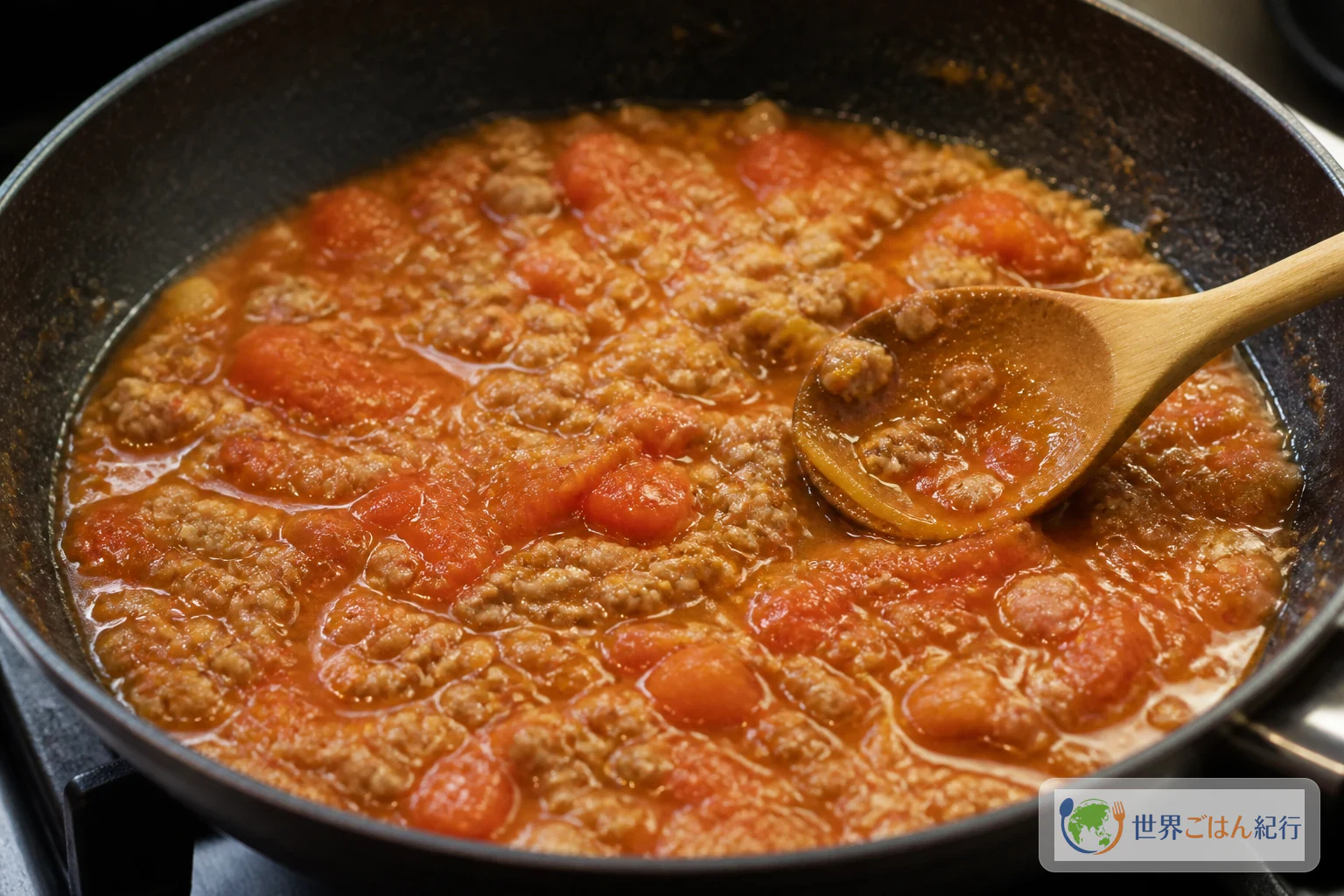
The star is not the meat sauce but how well it clings to the noodles. If the tomato is watery, the noodles absorb the liquid and turn heavy. If it's reduced too far, there is no room to take up the saltiness of the pickles and fish sauce. Stop when a faint trail from the wooden spoon remains.
Rice noodles keep softening from residual heat after you lift them from the water. If you boil them completely soft, they break easily when tossed with the meat sauce. Lift them just after the core disappears, and plate the dry version right after draining.
Fixing Common Problems with Shan Khauk Swe
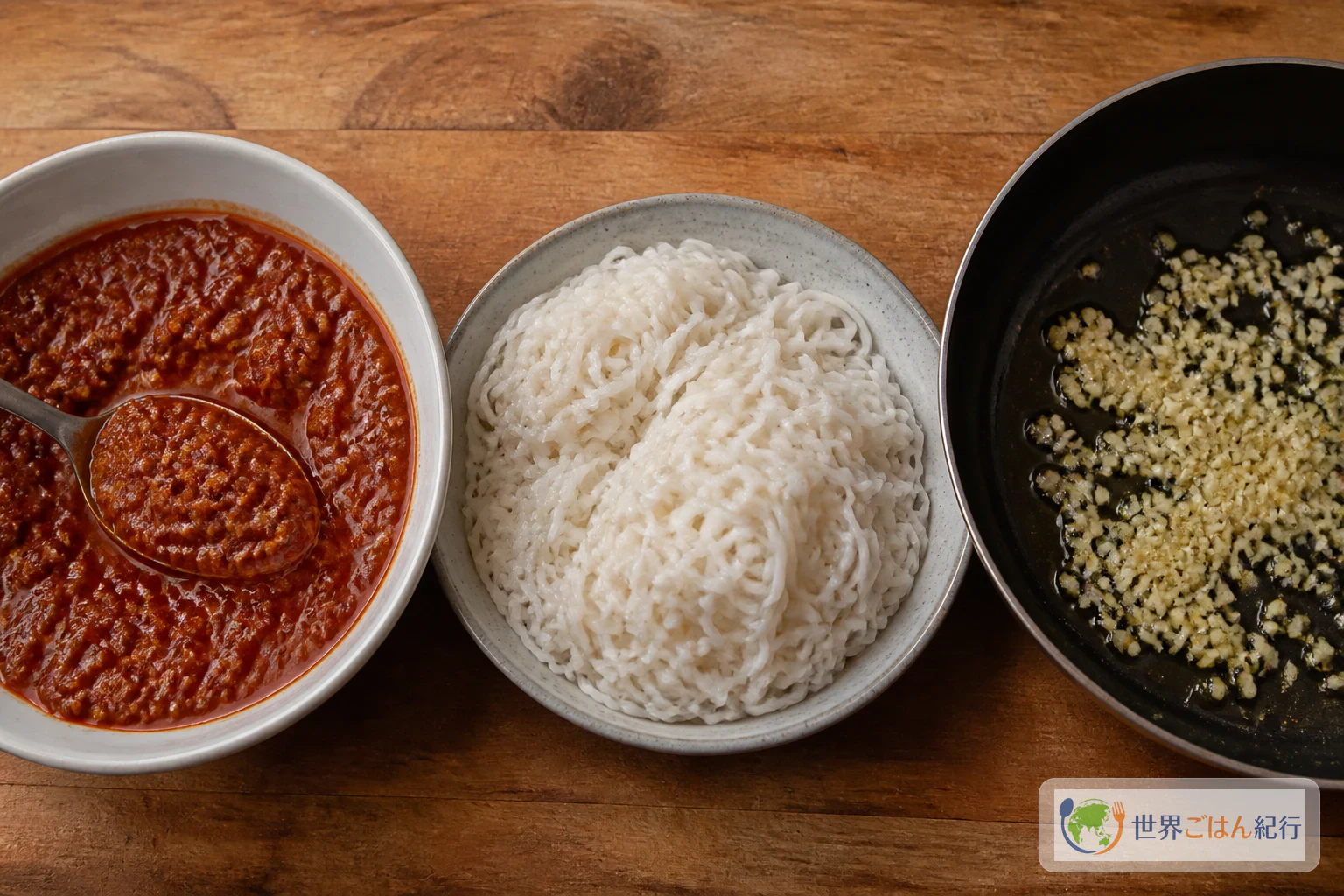
The meat sauce is "the sourness of tomato and the savoriness of meat," the garnish is "the saltiness and sourness of pickles," and the finish is "the toastiness of garlic oil and nuts." Tasting the three separately before combining them avoids the failure of putting in too much fish sauce and making the whole thing too strong.
The meat sauce is watery
A lid traps the tomato's moisture, and then the sauce runs when you spoon it over the noodles. Take the lid off and reduce over medium-low heat in 3-minute steps. It's done when a trail from the wooden spoon stays for 2 seconds and the sauce falls from the spoon in a thin ribbon. If you've already mixed it with the noodles, don't try to reduce it. Add extra pickles and nuts to soak up the liquid.
The fish sauce is too strong
Water alone only blurs the flavor. Chop 1 oz (30g) tomato, add it, and simmer over medium-low heat for 2 minutes. Or add the hot water meant for the soup 1 tbsp at a time to spread out the salt. Sugar can help, but too much wipes out the tomato's sourness, so use no more than 2g at first. Next time, put only 1.5 tbsp (20ml) nam pla in the meat sauce and hold back the last 2 tsp (10ml) until you taste.
The rice noodles break or clump
Noodles that soaked too long need the shortest boiling time on the package. Divide them into bowls as soon as they come out of the colander. If you mix all four dry servings at once, the salt in the meat sauce draws out water and the noodles clump, so plate one serving at a time. If cooled noodles have clumped, dip them in a separate pot of hot water for just 10 seconds to loosen them, then toss with a little more meat sauce.
The garlic is bitter
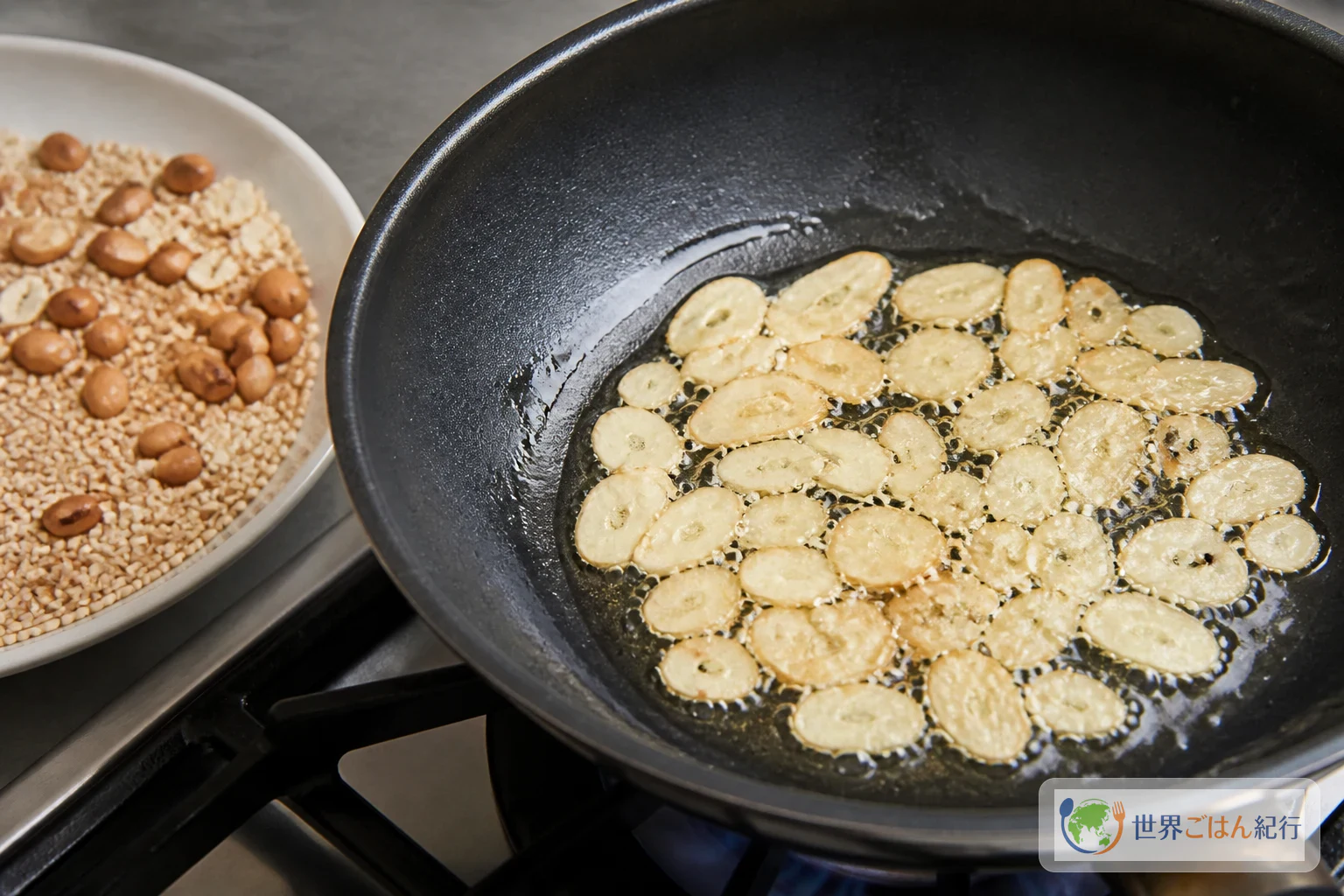
Garlic fried to dark brown turns the oil bitter. Don't use that oil in the meat sauce. Make a fresh batch with 1 tbsp (15ml) oil and 8g garlic. Take the garlic out when it's pale golden and let the heat of the plate finish it.
Serving and Variations
Dry and soup versions
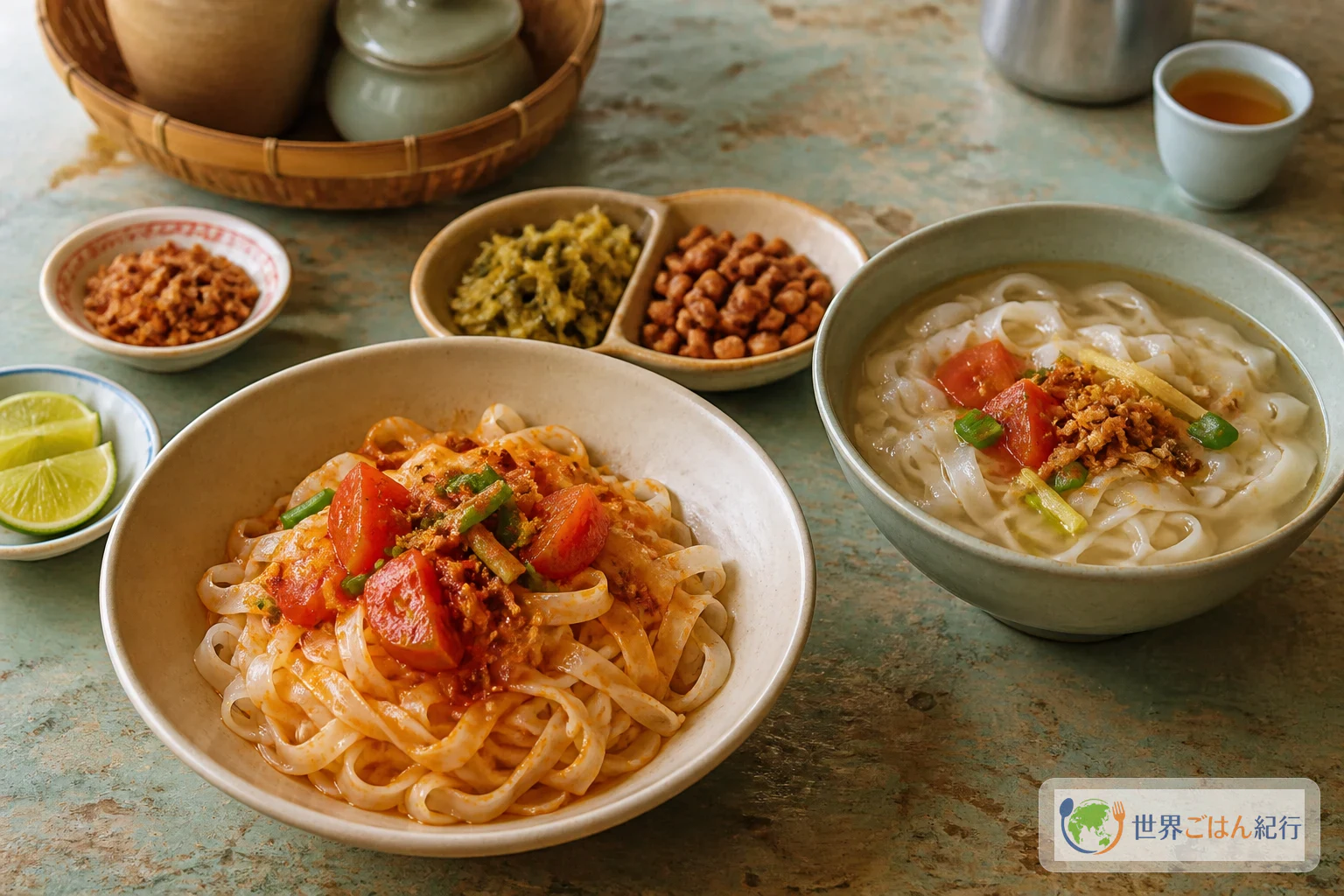
For the dry version, you don't need to turn every noodle red. Leave some white noodle showing, so each bite gets its own mix of tomato sourness, pickle saltiness, and garlic oil. After 5 minutes the noodles soak up the meat sauce and turn heavy, so toss each bowl right before eating instead of all 4 servings at once.
For a soup version, adding soup by itself makes the flavor thin. For each serving of noodles, combine ½ cup (150ml) of ginger soup with 2.75 oz (80g) of meat sauce, then add the pickles and nuts last. Pickles simmered in the soup lose their sharp sourness, along with the saltiness you notice on top of the noodles. If you make the meat sauce a little strong for the dry version, it still has enough flavor when you divide it for soup.
Adding Shan chickpea tofu
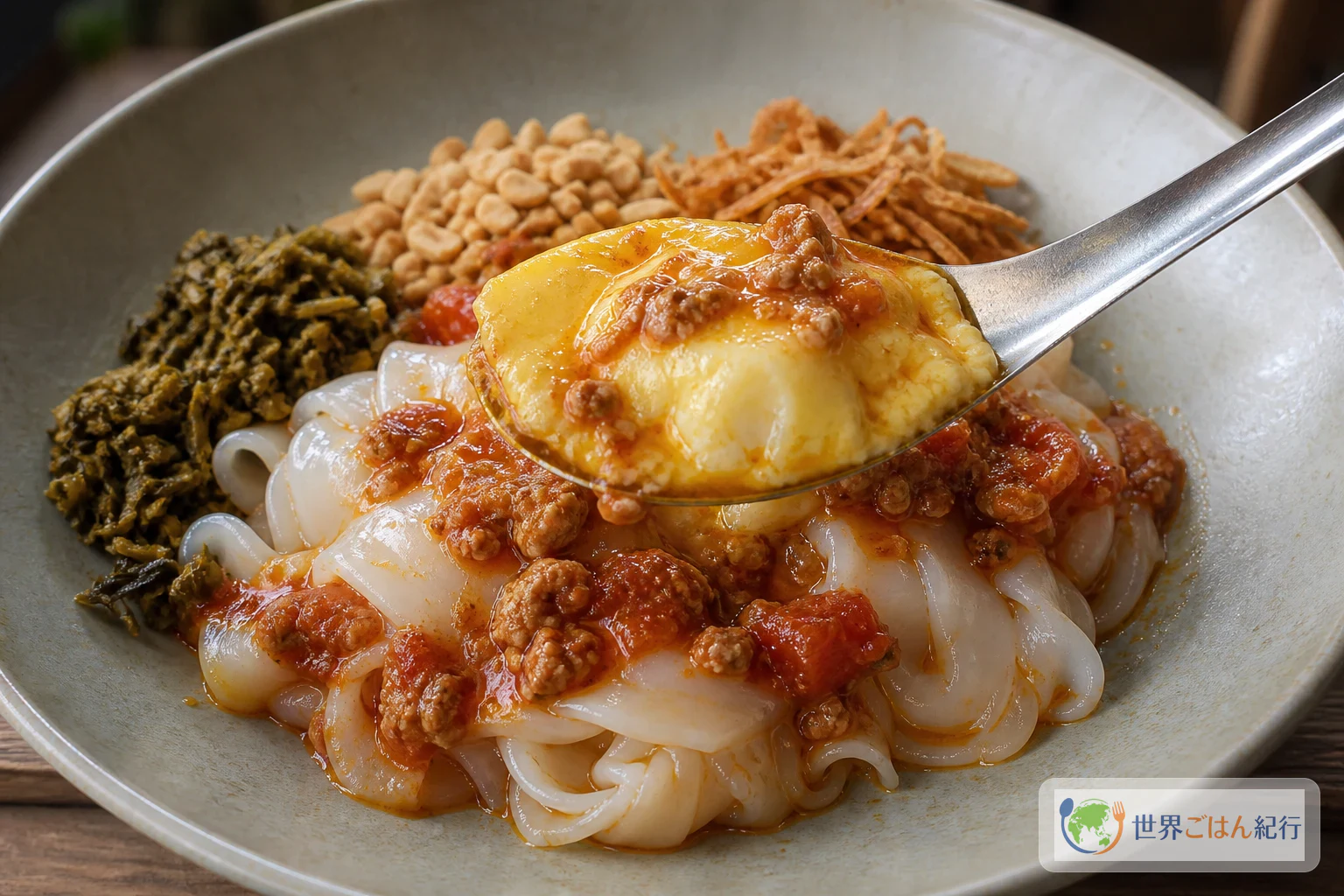
Japanese tofu is set from soy milk with nigari. Shan chickpea tofu is made by heating and stirring chickpea flour with water until it forms a yellow dough that keeps the aroma of the beans. A small warm spoonful on top adds a soft bean texture against the spring of the rice noodles. It's an extra, good for a tea-shop-style small plate or a day when you serve several Shan dishes. For the full method, see tohu thoke.
To make just enough for topping, mix 1.5 oz (40g) chickpea flour, 1 cup (240ml) water, and 1g salt in a pot. Warm it over medium heat, then stir over low heat for 6 to 8 minutes. It's ready when a trail from the wooden spoon along the bottom stays for 2 seconds and the dough falls from the spoon in a thick ribbon. Put about 2 tbsp on each serving of dry noodles. The beans add sweetness, so a squeeze of extra lime keeps the meat sauce from tasting muddy. You can cool and set the tofu and cut it into pieces, but warm and soft, it mixes into the meat sauce better.
When you buy chickpea flour, check that chickpeas are the only ingredient. If you won't also use it for tohu thoke, fried tofu, or batter, skip buying it for this dish. Potato starch has neither the bean aroma nor the texture, so if you have no chickpea flour, leave the tofu out.
Other ways to change it
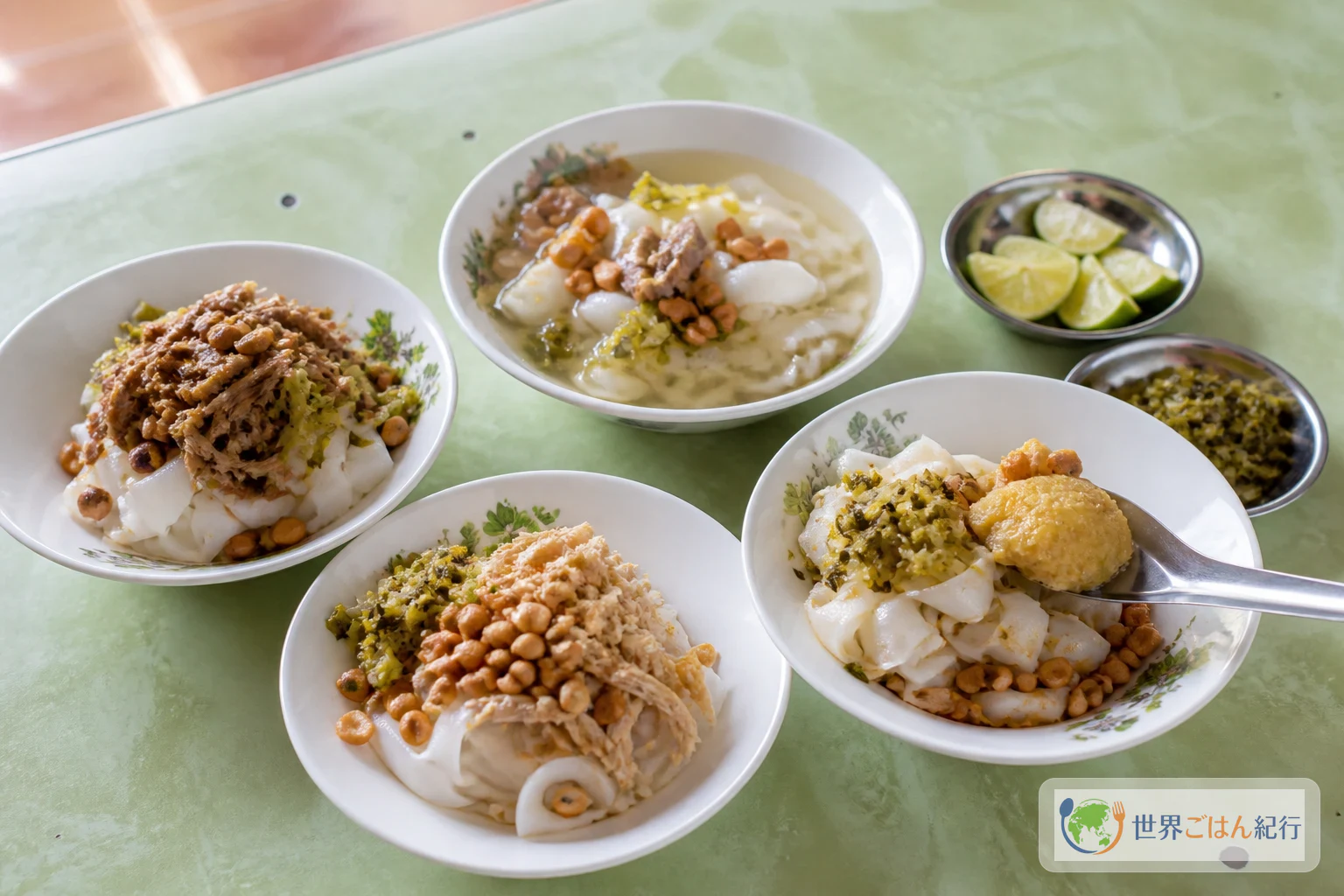
The tomato-meat sauce and rice noodles stay the same, and the rest can change with the time of day and what you have on hand. Change one thing at a time so you can tell what moved the flavor.
- Lighten it with chicken: Switch to 10.5 oz (300g) ground chicken. It gives off more liquid than pork, so reduce 2 to 3 minutes longer after adding the tomato to get a slightly firmer sauce.
- Divide the heat at the table: Instead of putting all the dried chili in the meat sauce, set out coarsely crushed chili in a small dish. That makes it easy to keep bowls mild for children or anyone sensitive to heat, and people who only want the aroma can stir a little into the oil.
Frequently Asked Questions
Q1. Is Shan khauk swe a dry dish?
Noodles tossed with meat sauce are the simplest form, but some versions serve soup on the side or put the noodles in soup. This recipe makes the meat sauce a little strong, so it covers 4 servings of dry noodles or 1 to 2 servings with soup.
Q2. I can't find wide rice noodles.
Flat rice vermicelli, sen yai, or wide pho noodles all work. With thin rice vermicelli, the meat sauce sits on the surface and the noodles soften quickly, so boil them for the shortest time on the package and use less sauce. Wheat noodles make a different dish, but they still work in the dry style.
Q3. Can I make it without nam pla?
Yes. Replace the 2 tbsp (30ml) nam pla with 1.5 tbsp (20ml) light soy sauce and 1g salt. You lose the fermented fish aroma, but the pickles, tomato, and garlic oil are still there. If you must avoid soy, season with salt and mushroom stock, and check the ingredients of your pickles and soup.
Q4. Can I make it ahead?
Cool the meat sauce and soup, divide them into clean containers, and refrigerate. Reheat them before using and use them by the next day. Keep the rice noodles, pickles, nuts, and garlic oil separate and combine them just before eating. Noodles refrigerated after tossing soak up the sauce and break easily. Because the sauce contains pork, don't leave it out at room temperature for long, and eat the portions you set aside soon.
Q5. What is the difference between Shan noodles and meeshay?
Both are Burmese rice noodle dishes with a tomato-pork sauce, but Shan khauk swe is the dry, tea-shop style with pickles, peanuts, and a separate bowl of soup. See meeshay for the Mandalay version.
Q6. Are Shan noodles served as a soup?
Both ways exist. The dry version is tossed with meat sauce and served with soup on the side, and the soup version combines ginger soup with meat sauce in each bowl.
Q7. What else is Shan khauk swe called?
It is also written Shan kauk swe or Shan khaut swe in English, and ရှမ်းခေါက်ဆွဲ in Burmese. The "Shan" refers to Shan State and the Shan people, and the dish is often just called Shan noodles.
Related Burmese Dishes
- Tohu thoke: chickpea tofu salad: How the chickpea dough should look as you stir it in the pot, plus its sour dressing.
- Ohn no khauk swe: coconut milk noodles: A rich soup noodle to compare with dry Shan khauk swe.
- Mohinga: rice noodle soup in fish broth: A Burmese breakfast soup with a different pairing of rice noodles and broth.
- Lahpet thoke: fermented tea leaf salad: For anyone curious about tea-shop small plates and sharing fermented foods at the table.