Sapin-Sapin: Filipino Layered Rainbow Sticky Rice Cake

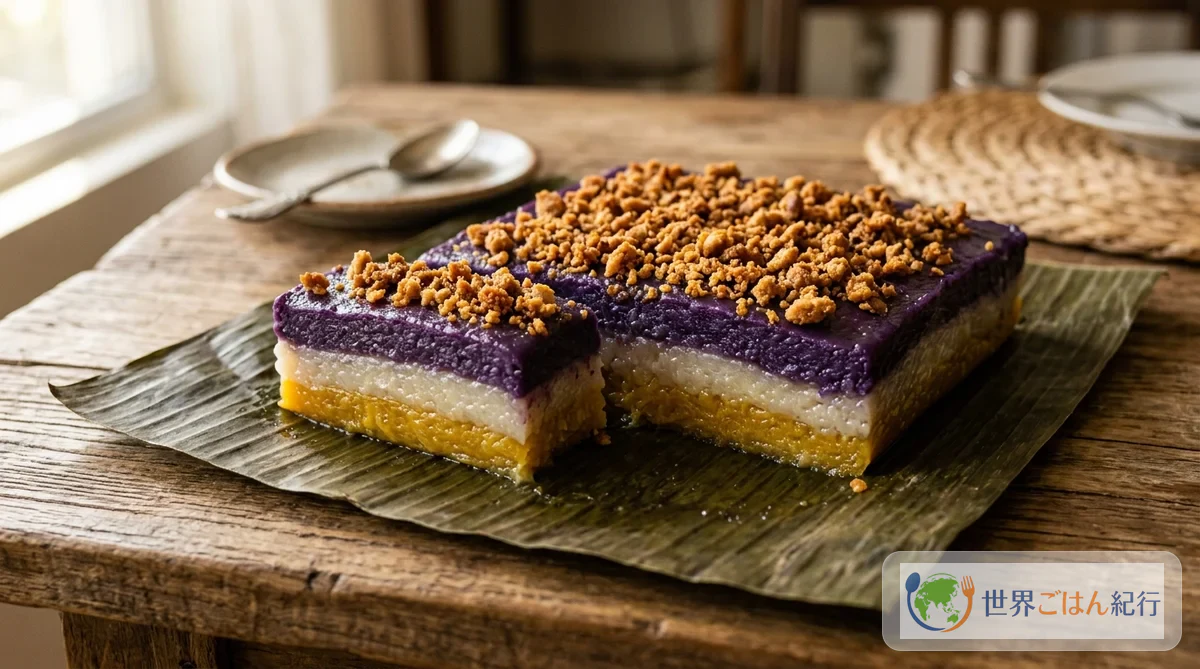
Sapin-sapin, the Filipino sticky rice cake, in three layers of purple, white and yellow
Prep
35 min
Cook
1 hr 5 min
Total
2 hr 40 min
Serves
8 servings
Level
Intermediate
Cuisine
Filipino

Sapin-sapin is a steamed Filipino layered dessert of glutinous rice flour, coconut milk, ube and langka. Shows how to steam layers without mixing them.

Cooking flow

Cooking steps

STEP11 / 9

Make the latik

25 min

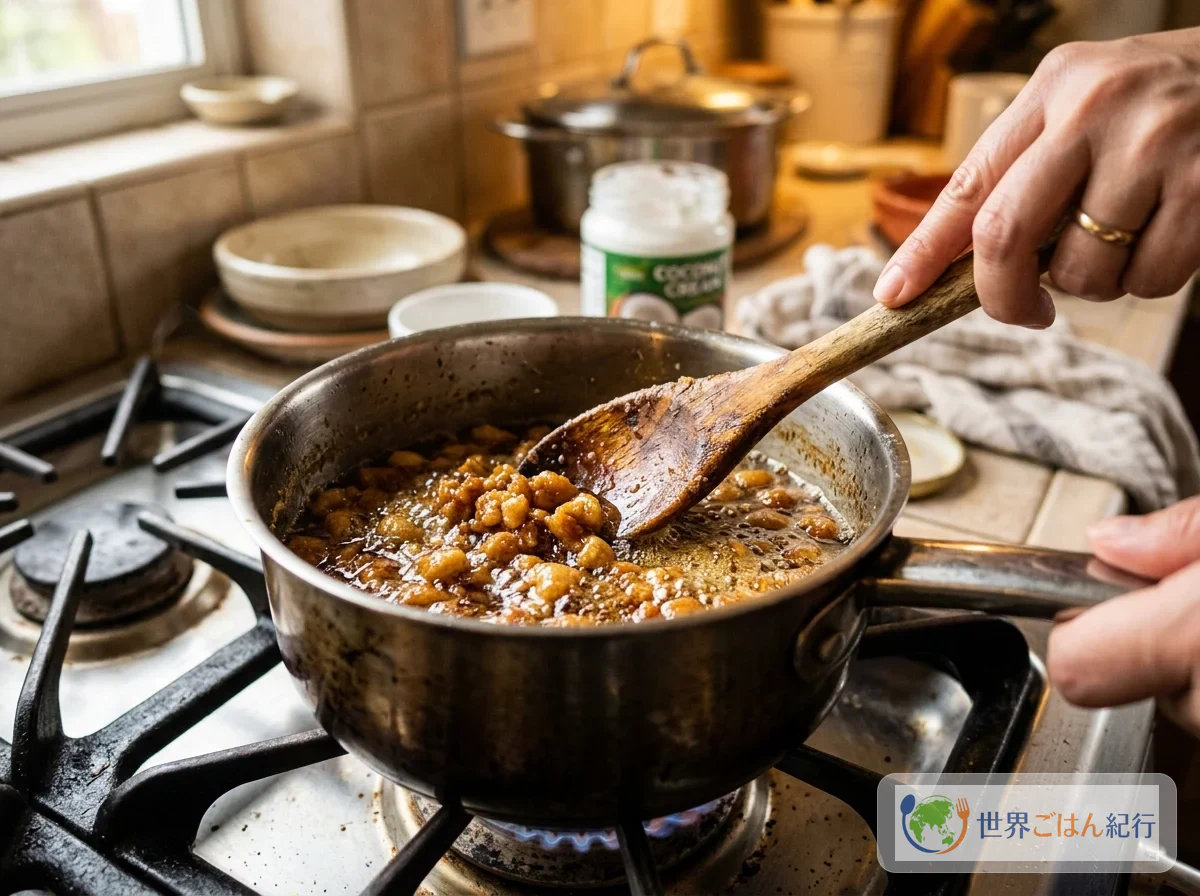
Cooking coconut milk down to brown latik
Cook the latik over low heat, watching the color, and take it out before it gets dark

Put ¾ cup (200 ml) coconut cream in a small pot and warm over medium heat for about 3 minutes. When it starts to bubble, lower the heat to low and cook for 18 to 22 minutes, tracing the bottom of the pot with a wooden spoon. Turn off the heat when the white liquid separates into oil and solids and the solids are a light golden brown. The color keeps deepening from residual heat, so take it out before it turns dark brown. Drain the oil with a sieve or paper, and keep the oil too, for greasing the pan.

STEP22 / 9

Mix the glutinous rice flour batter

8 min

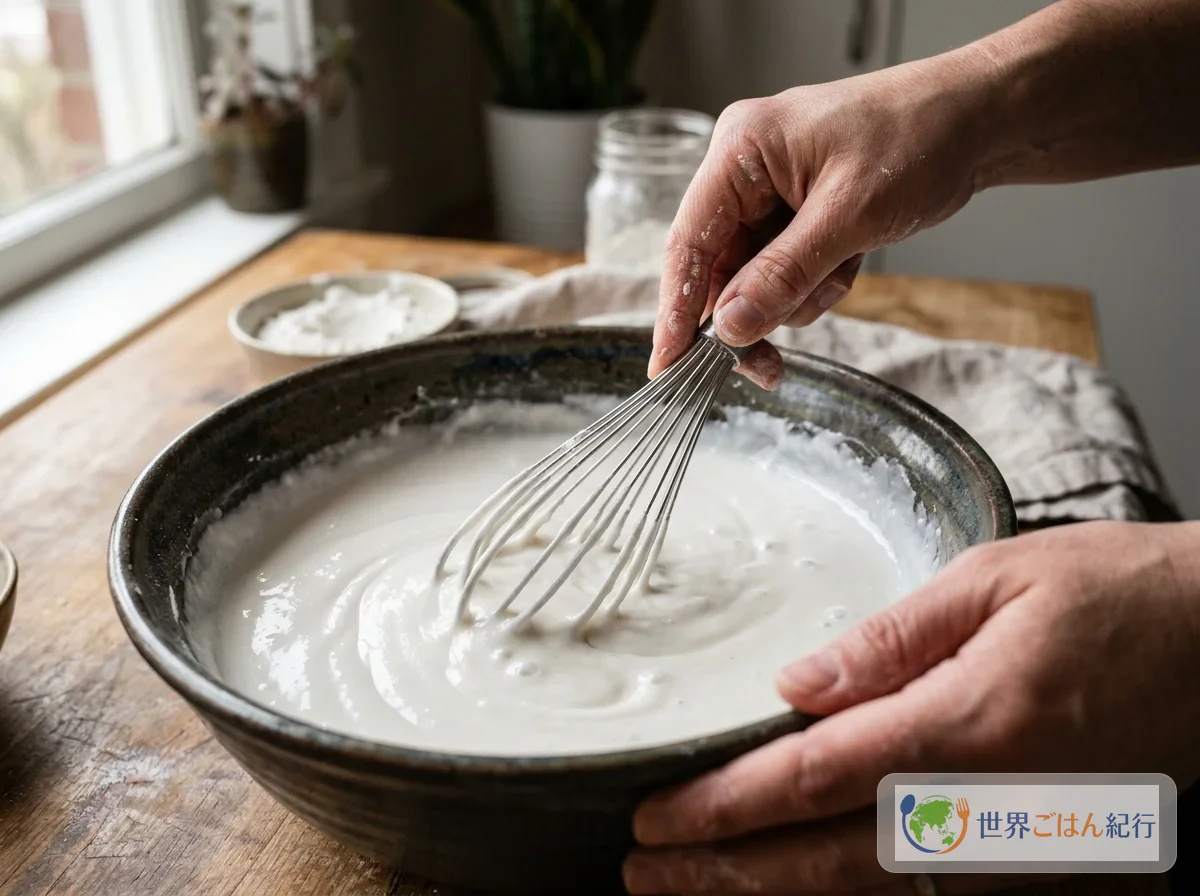
Mixing glutinous rice flour and coconut milk in a bowl to make a white batter
Do not add all the liquid at once to the glutinous rice flour; add the coconut milk in portions

In a large bowl put 10.5 oz (300 g) glutinous rice flour, 2.75 oz (80 g) unrefined sugar and 1.5 g salt and loosen the flour with a whisk. Add 1¾ cups (400 ml) coconut milk in 3 portions, mixing about 1 minute each time. This step uses no heat. Mix until no dry flour remains; the batter should fall in a thick ribbon when you lift the whisk. If you use shiratamako, crush the lumps with your fingers before mixing.

STEP33 / 9

Add the sweetness and strain the batter

7 min

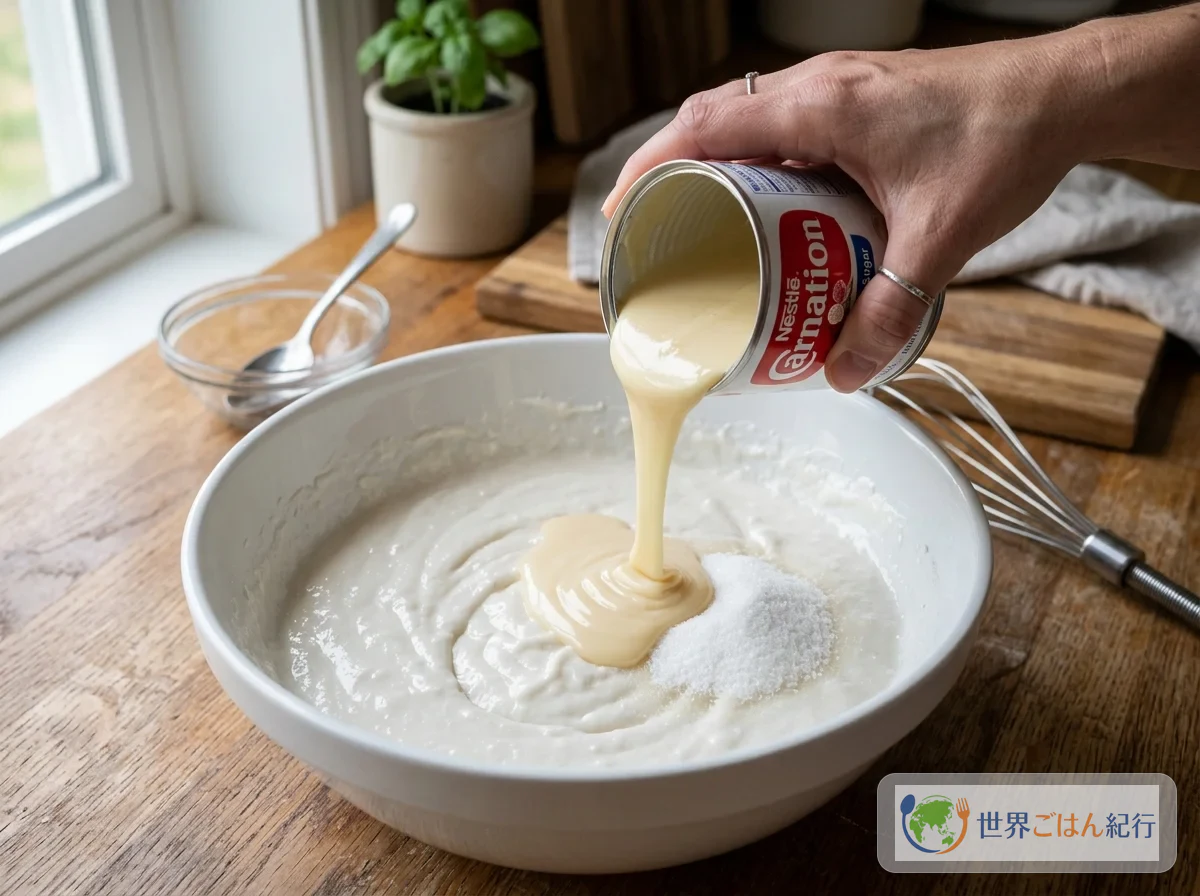
Adding condensed milk to the white batter
After adding the condensed milk and water, strain the batter to remove small lumps

Add 3.5 oz (100 g) condensed milk and ½ cup (100 ml) water and mix for 2 more minutes without heat. Once the graininess of the sugar is gone, strain the batter through a fine sieve. Do not force small lumps left in the sieve through; crush them with a spoon and return them. The batter should be a little thicker than drinking yogurt, with the whisk streaks remaining for about 2 seconds before vanishing. Go on when the surface is smooth and no small flour lumps are visible.

STEP44 / 9

Divide into three colors

10 min

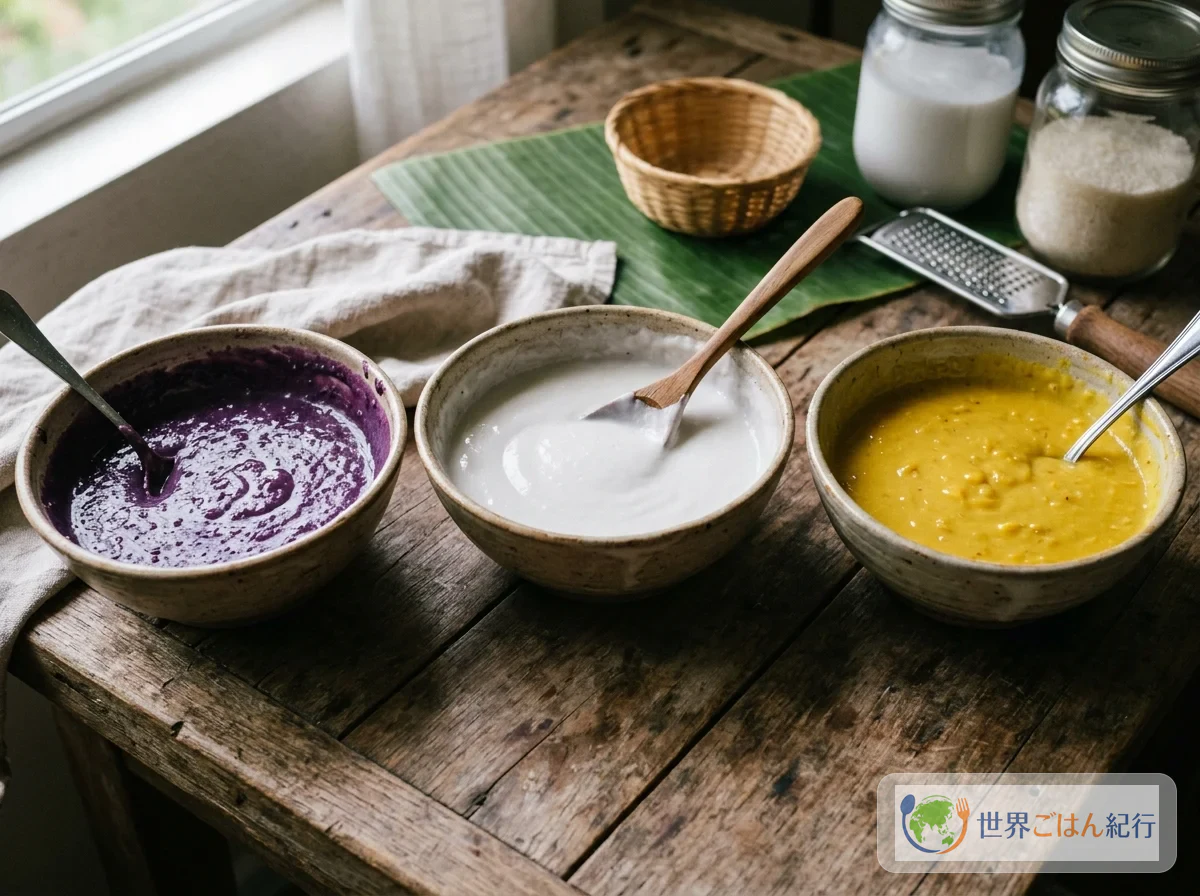
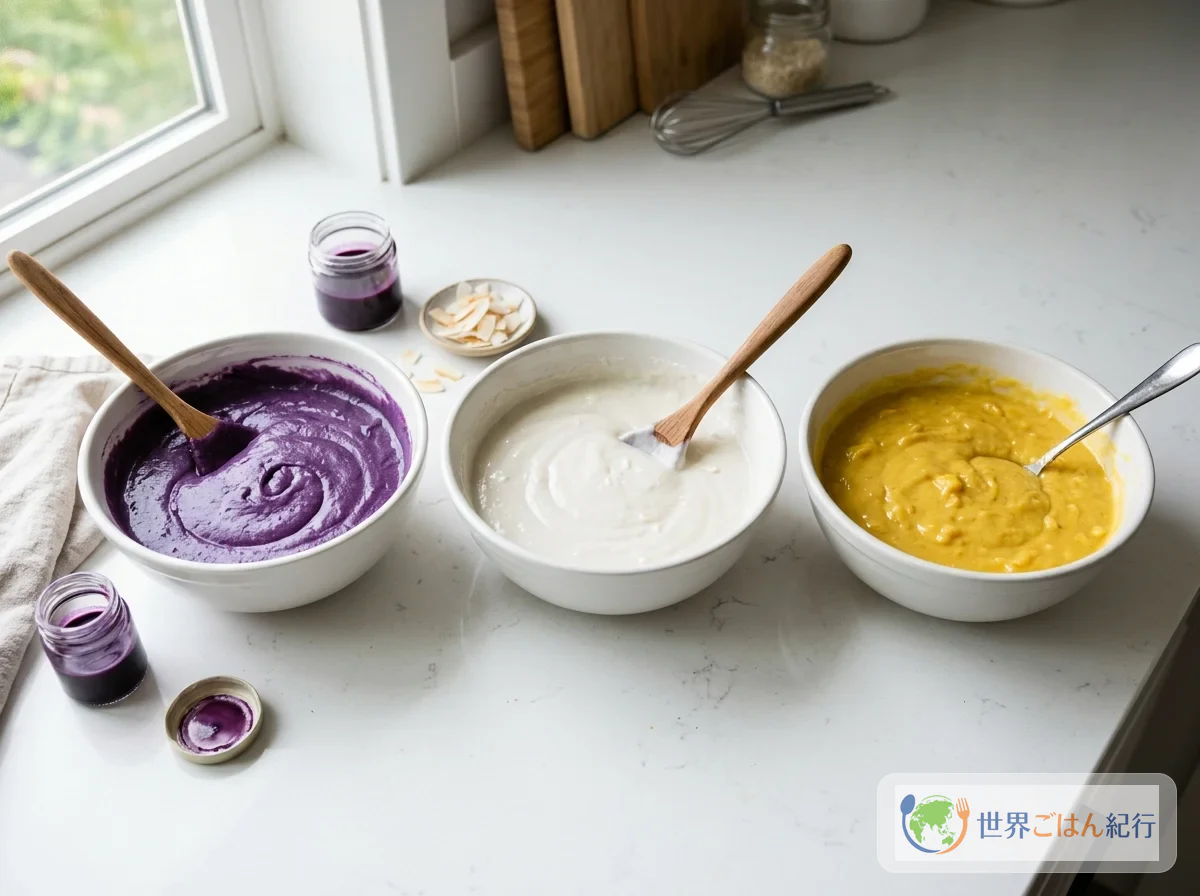
Sapin-sapin batter divided among three bowls of purple, white and yellow
Keeping the three batters equal in amount makes the layers stable when cut

Divide the batter into 3 equal parts with a measuring cup, about 260 ml each. Into the first put 80 g ube halaya and 1 tsp ube extract for the purple layer. Into the second put 30 g coconut flakes for the white layer. Into the third put 70 g jackfruit chopped into 5 mm pieces and 0.4 g turmeric for the yellow layer. This step also uses no heat. Large pieces would crack the layer boundary, so chop the jackfruit small.

STEP55 / 9

Prepare the pan and the steamer

8 min

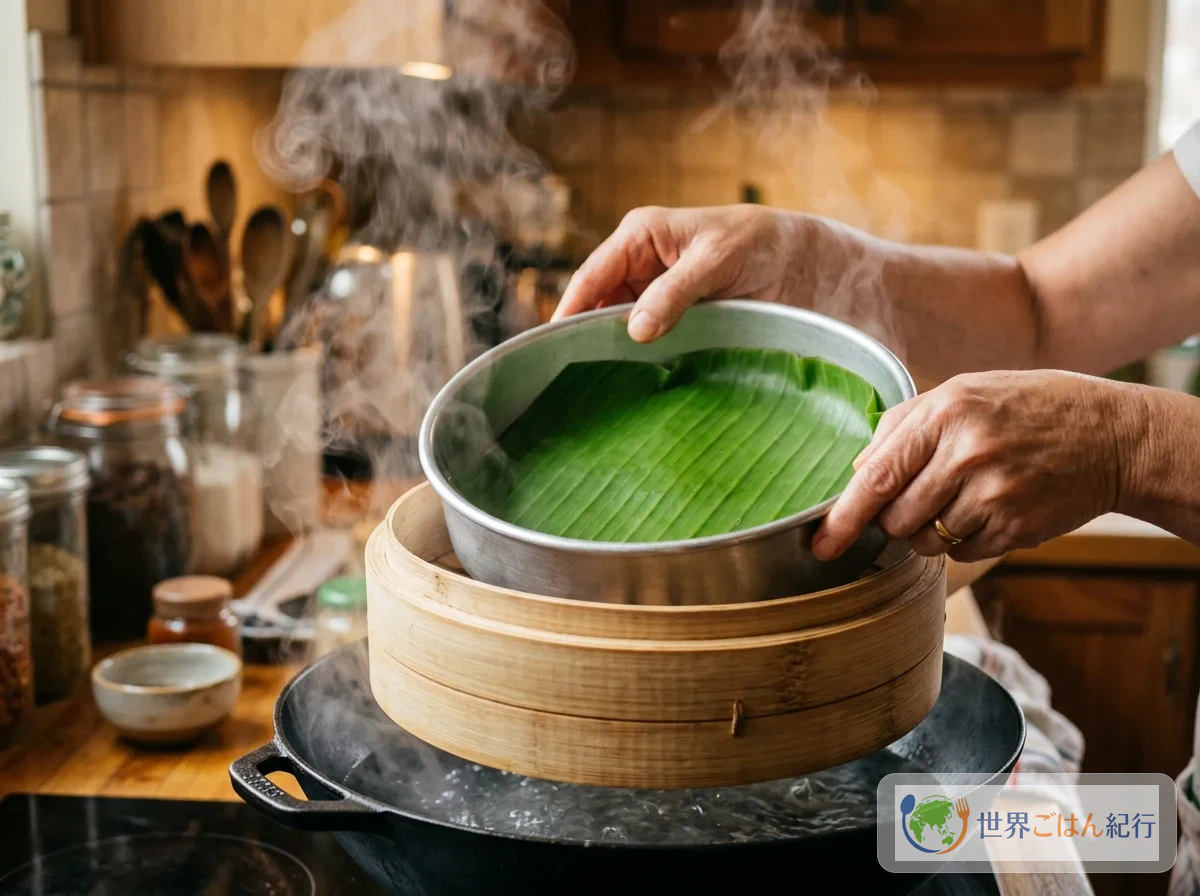
Putting the banana-leaf-lined pan into the steamer
Grease the pan, line it with banana leaf or parchment paper, then put it in the steamer

Grease an 8-inch (20 cm) round pan with the oil from the latik or 2 tsp rice bran oil. Pour boiling water over the banana leaf or hold it over low steam for 10 seconds, and when it is pliable lay it in the pan. Bring the steamer water to a boil over high heat, and when steam is rising firmly, lower to medium-high. Keep at least 1 inch (3 cm) of water from the bottom of the pot. Set it at a height where the water does not touch the pan once it is in.

STEP66 / 9

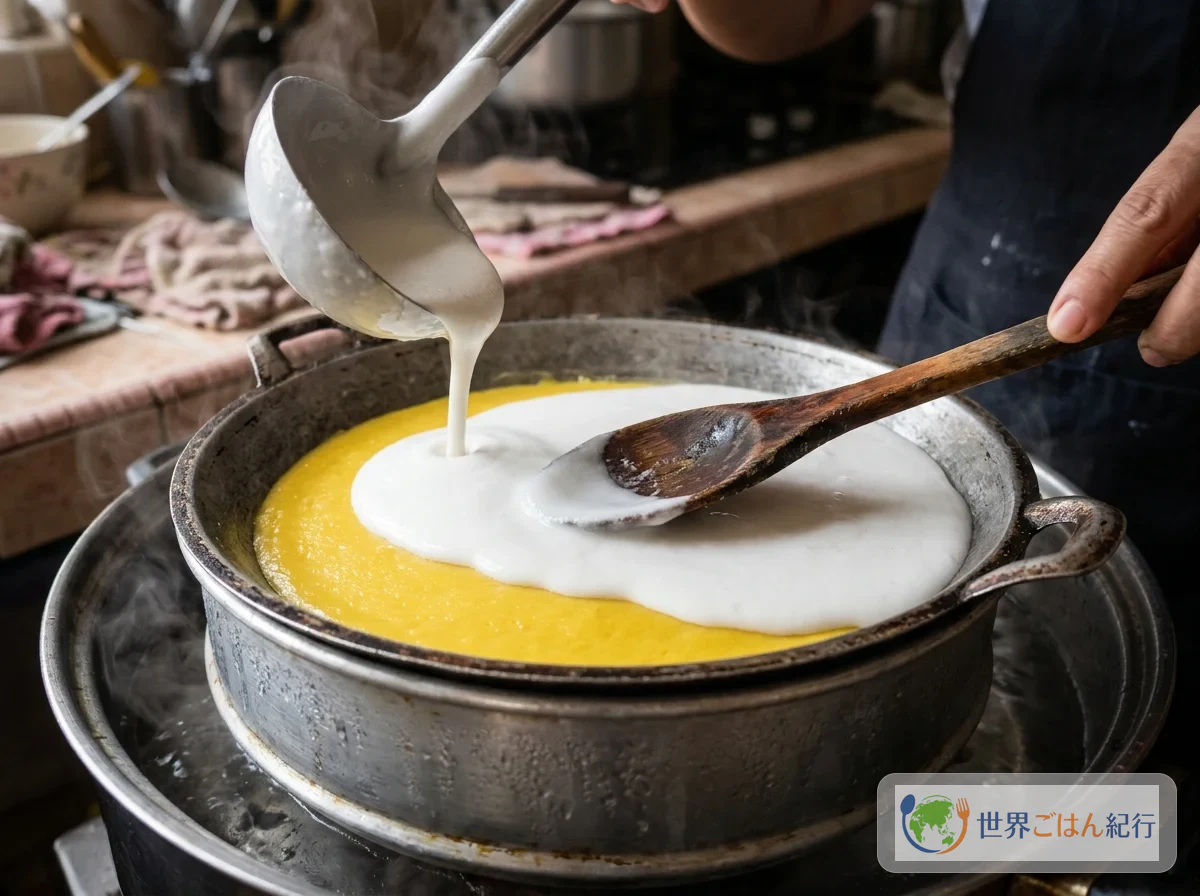
Steam the yellow layer

13 min

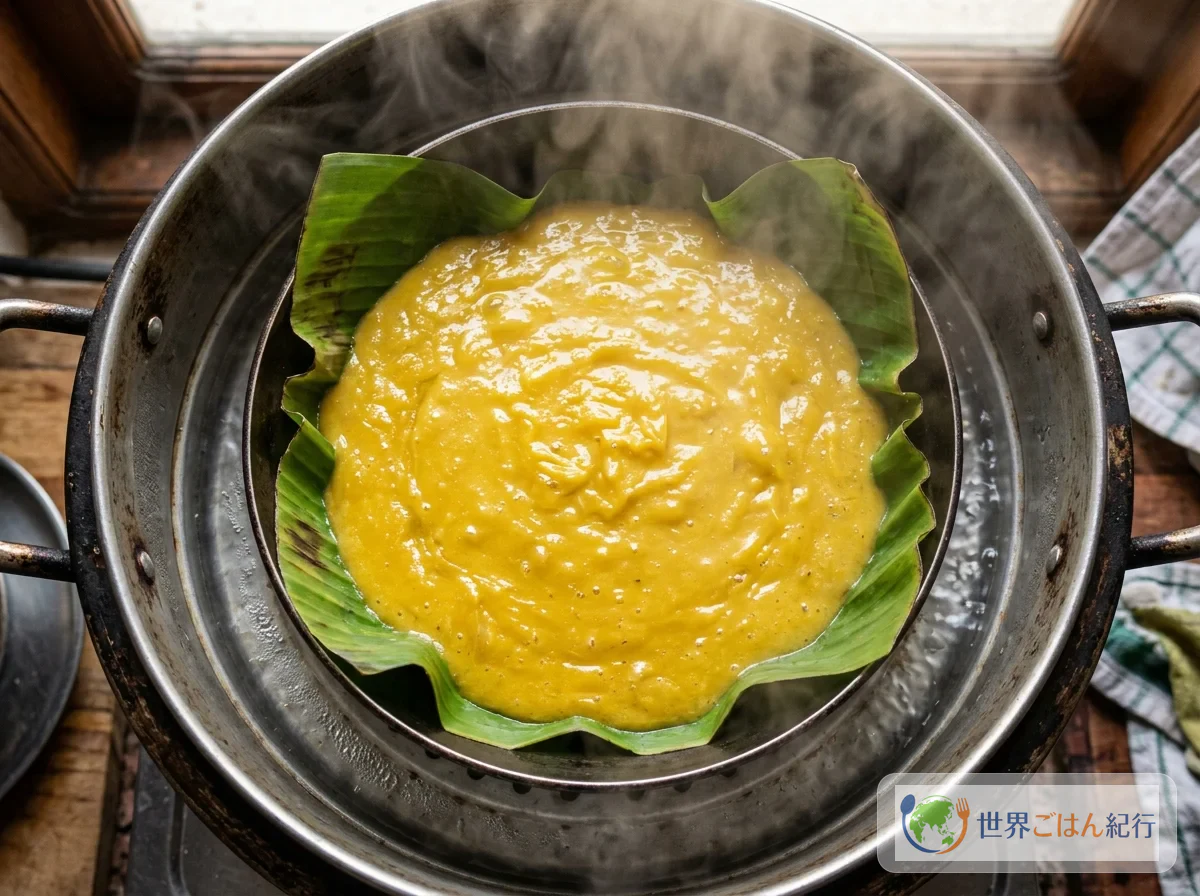
Steaming the yellow sapin-sapin batter in a pan lined with banana leaf
Steam the yellow layer over medium-high heat until the surface no longer flows

Pour the yellow batter into the pan and pop large surface bubbles with a bamboo skewer. Make the layer about 0.5 inch (1.2 cm) thick with a flat, smooth surface. Steam over medium-high heat for 10 minutes, and go on when the surface does not flow and the center does not ripple much when you shake the pan lightly. If liquid still moves, add 2 to 3 minutes at the same heat. If you keep steaming over high heat, drops of water fall from the lid and leave holes in the surface.

STEP77 / 9

Add the white layer

13 min

Steaming the white batter layered on the yellow layer
Pour the white layer along the back of a spoon so the layer below is not disturbed

Pour the white batter gently against the back of a spoon. Dropping it directly would make holes in the yellow layer. Steam over medium-high heat for 10 minutes; it is cooked when the surface is white and opaque and a bamboo skewer inserted shallowly comes out without liquid. If your lid tends to drip, wrap the lid in a kitchen towel, tying the ends on top so the towel does not touch the flame.

STEP88 / 9

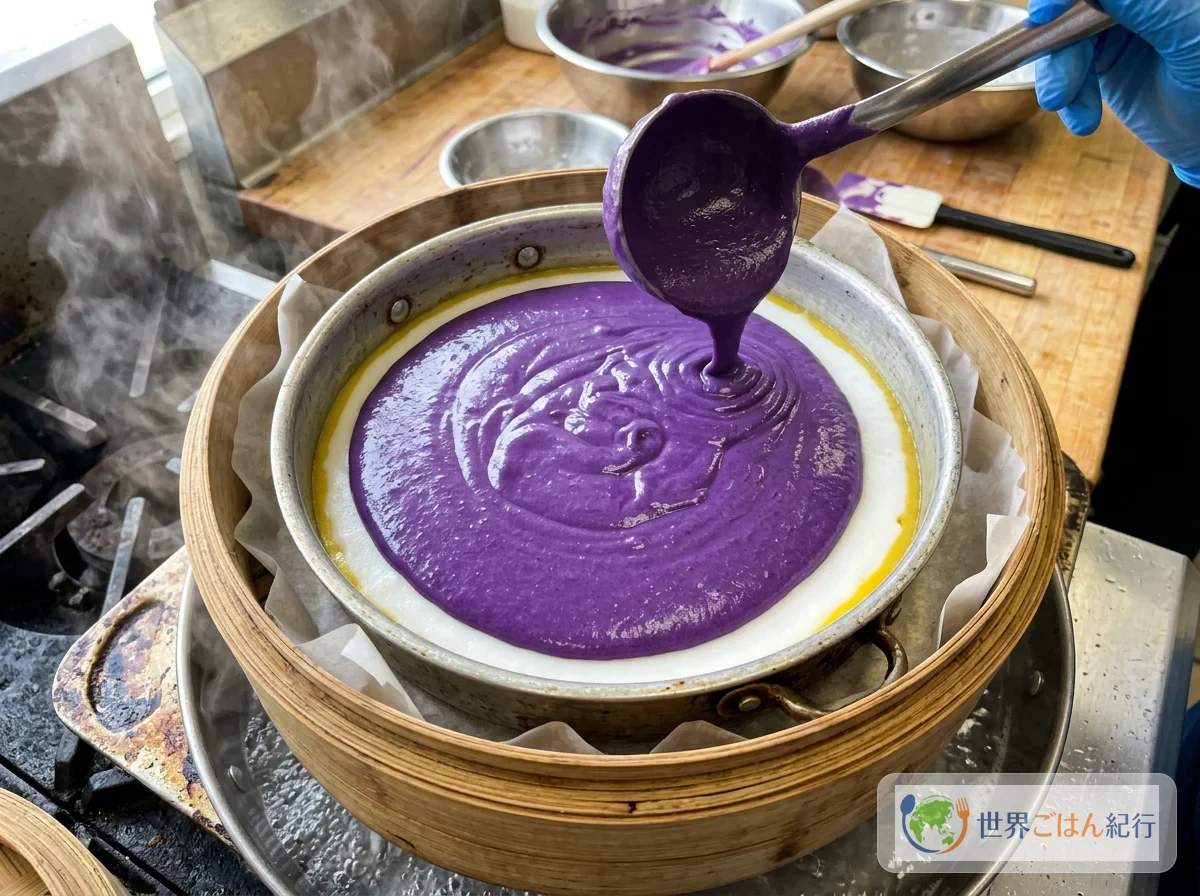
Steam the purple layer to finish

18 min

Checking sapin-sapin steamed through the purple layer with a bamboo skewer
Cook the purple layer through to the center and stop when no liquid clings to the skewer

Pour the purple batter gently in the same way. Spread the purple layer to about 0.5 inch (1.2 cm) too, lightly level the surface with a spatula and steam. Steam over medium-high heat for 12 minutes; it is done when a skewer in the center comes out without raw liquid. If the skewer picks up only a little translucent glutinous dough, add 3 minutes without turning off the heat. If the surface dries and looks about to crack, the heat is too high. Lower it toward medium, within a range where steam does not stop.

STEP99 / 9

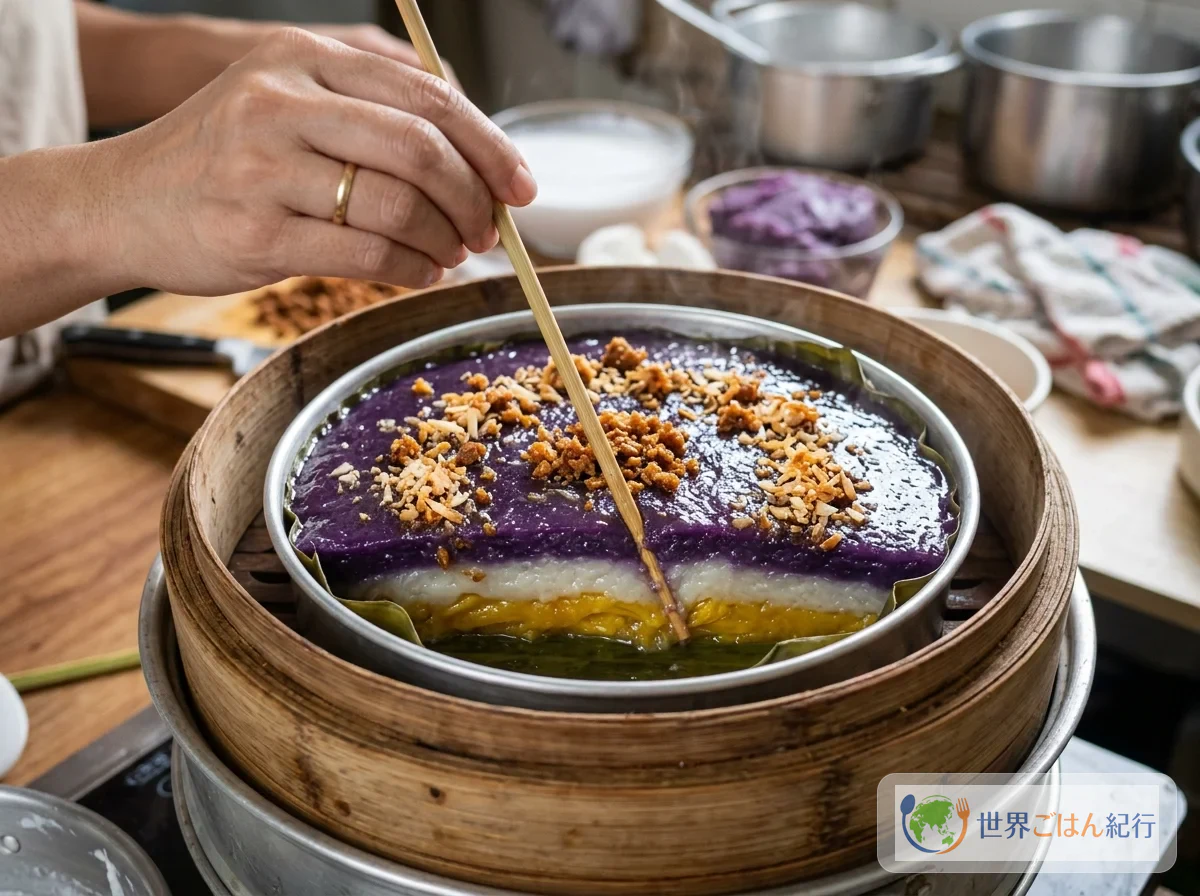
Cool and cut

1 hr 30 min

Checking the steamed sapin-sapin with a bamboo skewer and scattering the latik
Turn out sapin-sapin after it has cooled and cut with a wet knife so the layers hold

Turn off the heat, take out the pan and cool on a rack for 30 minutes. Covering it while hot returns steam and makes the surface watery, so once the heat has eased, cover loosely with plastic wrap and chill in the refrigerator for 1 hour. Run a wet knife around the edge of the pan and turn it out onto a plate. Cut into 8 pieces, wetting the knife with water, and scatter with the latik. If it is too cold and hard, take it out to room temperature 20 minutes before eating.

0 / 0
Ingredients

Ingredients

1 / 1

Ingredients

Ingredient Amount Role and substitutes
Glutinous rice flour 10.5 oz (300 g) If using shiratamako (glutinous rice flour dumpling flour), crush it fine first. Regular rice flour lacks stickiness
Coconut milk 1¾ cups (400 ml) For the batter. Shake the can well before using
Sweetened condensed milk 3.5 oz (100 g) Sweetness and the roundness of milk. Keep at least 2 oz (60 g) even to reduce sweetness
Light brown (unrefined) sugar 2.75 oz (80 g) White sugar also works. Avoid dark brown sugar, which muddies the color
Water ½ cup (100 ml) To adjust the thickness of the batter
Salt 1.5 g Tightens the sweetness
Ube halaya 2.75 oz (80 g) For the purple layer. 2.5 oz (70 g) purple sweet potato paste also works
Ube extract, or purple sweet potato powder 1 tsp An aid for color. You can make it without
Canned jackfruit 2.5 oz (70 g) For the yellow layer. Chop into 0.25 inch (5 mm) pieces
Turmeric 0.4 g An aid for the yellow. Too much shows in the aroma
Coconut flakes 1 oz (30 g) For the white layer. Replace with the same amount of macapuno if you have it
Coconut cream ¾ cup (200 ml) For the latik. If none, use coconut milk
Rice bran oil 2 tsp To grease the pan. Use the oil released from the latik if you have it
Banana leaf 1 sheet (for an 8-inch (20 cm) round pan) Thaw if frozen. Parchment paper if none
0 / 0

When you lift the steamer lid, the sweet smell of coconut milk comes out first. Inside the round pan sit layers of yellow, white and purple, still trembling while hot. As they cool, the glutinous rice flour sets, and when the knife goes in, the boundaries between the colors show cleanly. Sapin-sapin is a Filipino sticky rice cake: a batter of glutinous rice flour, coconut milk and sugar, divided in three and steamed one layer at a time with ube, langka and coconut, each bringing its own color and aroma.
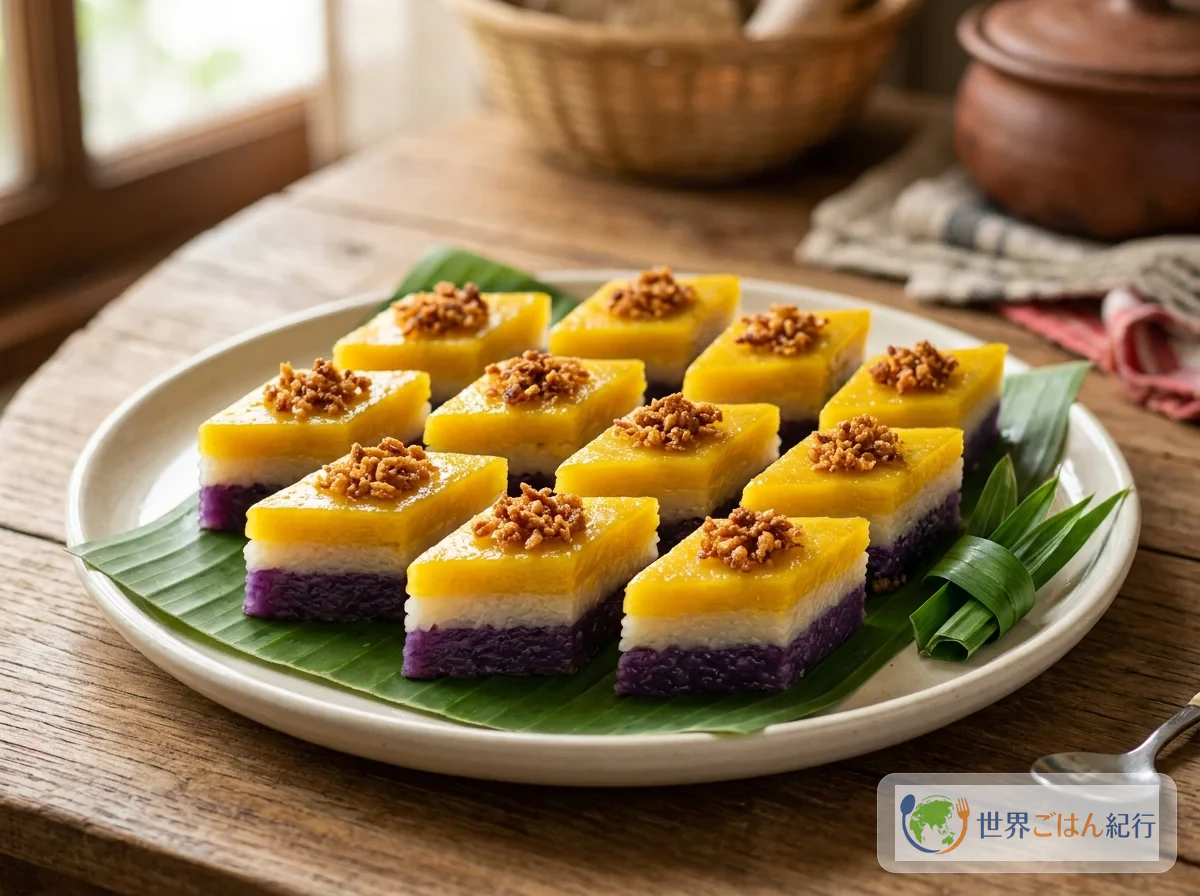
Sapin-sapin served on a plate, with purple, white and yellow layers scattered with latik
Cut sapin-sapin after it has cooled, and the boundaries between the three layers show clearly
A note on terms

Ube is purple yam, langka is jackfruit, and latik is the brown bits left when coconut milk is cooked down.

Sapin-sapin at the Filipino table

A Filipino festive table with sapin-sapin and other sweets laid out
Because of its bright color and how easily it is cut, sapin-sapin suits celebrations and potlucks

Sapin-sapin belongs to the kakanin, the Philippines' big family of rice sweets and snacks, alongside suman, puto, kutsinta and biko. In Tagalog "sapin" means a layer or a lining, so the doubled name is easiest to remember as "layer upon layer." Kakanin turn up at breakfast, as snacks, at feasts, on cemetery visits and after church events, and sapin-sapin, with all its color, is the one people bring to gatherings.

Colors and regional versions

The layers differ by region and by shop. The easy standard, common in Manila bakeries, is purple from ube, yellow from langka and white from coconut. In the Visayas and in home kitchens you'll also see green pandan, white macapuno, chocolate and pink layers. Every extra color means another round of steaming, so three layers are plenty for a first try.
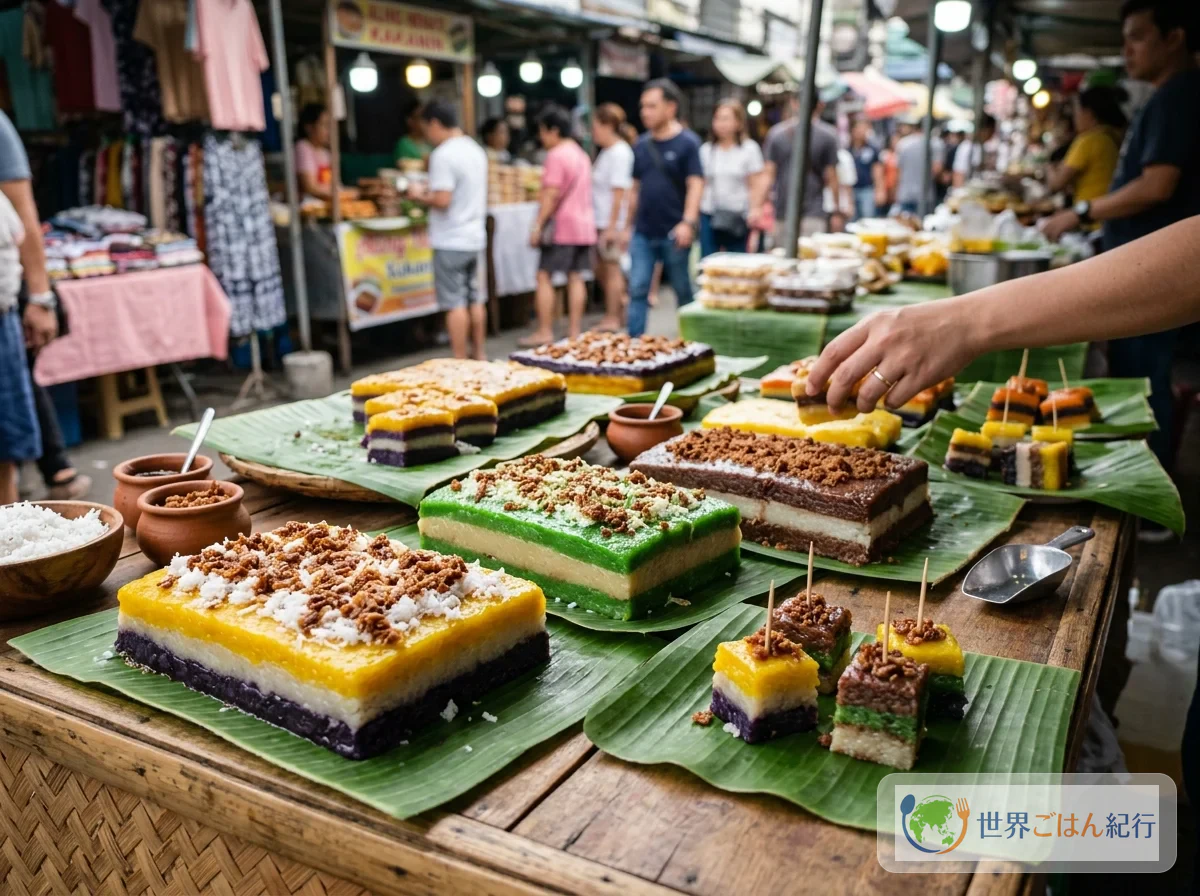
Variations of sapin-sapin in different colors laid out together
Sapin-sapin is based on ube, langka and coconut, and color and aroma change by region and shop

Similar layered sweets

Southeast Asia has a whole run of layered steamed sweets: kue lapis in Indonesia and Malaysia, kanom chan in Thailand, bánh da lợn in Vietnam. Sapin-sapin fits right in, with a distinctly Filipino aroma from the pairing of ube and latik. It may look a lot like Japanese uiro, but take a bite and the coconut fat and the stickiness of glutinous rice flour come to the front, so the sweetness spreads quite differently from a wagashi.

Ingredients and how to think about shopping
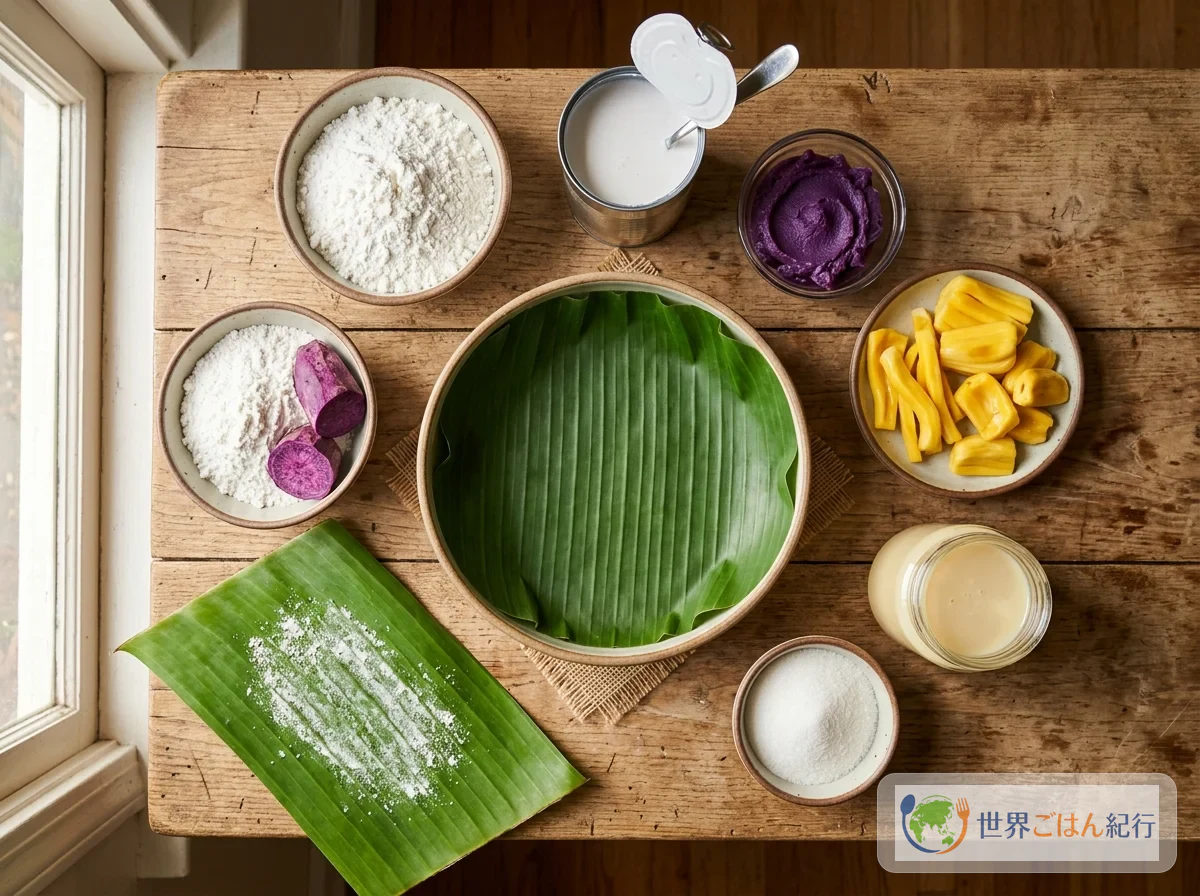
Sapin-sapin ingredients: glutinous rice flour, coconut milk, ube, jackfruit, sugar and banana leaf
Measure the glutinous rice flour, coconut milk, ube, langka and sugar first, then begin steaming

This makes one 8-inch (20 cm) round pan, 8 pieces. Because it has height, use a pan at least 2 inches (5 cm) deep. If you only have a shallow pan, use an 8.5-inch (22 cm) pan and make the layers thinner.

Allergy and food safety

This recipe uses dairy and coconut. If you swap the condensed milk for a plant-based one and the batter is loose, add glutinous rice flour 1 tbsp at a time. After steaming, do not cover it while it is still hot, or water collects on the surface. Store only after it has cooled completely.

Look for glutinous rice flour, coconut milk and a steamer that keeps up steady steam. Check Asian grocers for ube halaya and canned langka. If you cannot find something, use the substitute in the table above instead of searching for it.

Glutinous rice flour is the base of the texture. With ordinary rice flour you will get layers, but not the chewy, springy bite of sapin-sapin.

Coconut milk gives the batter its aroma and fat. Replace it with cow's milk and only the glutinous rice flour comes to the front, and the round aroma typical of Filipino kakanin thins out.

The steamer keeps the layer boundaries clean. A microwave cooks the edges and center unevenly, so do not use one.

Choosing ingredients and substitutes for sapin-sapin

Three things matter most: the stickiness of glutinous rice flour and coconut milk, steaming one layer at a time, and the toasty note of latik. Beyond that, there's room to adapt. Extracts can add color, but for real flavor put ube halaya in the purple layer, chopped jackfruit in the yellow and coconut in the white, so each layer tastes of its own ingredient.

Ube

Ube is the Philippines' purple yam, and its aroma is a little different from beni imo or Japanese purple sweet potato. Ube halaya is the easiest to use. Purple sweet potato paste works as a substitute (see the FAQ), but skip products with a lot of water. Beet powder can supply the color alone, though the flavor drifts away from sapin-sapin.
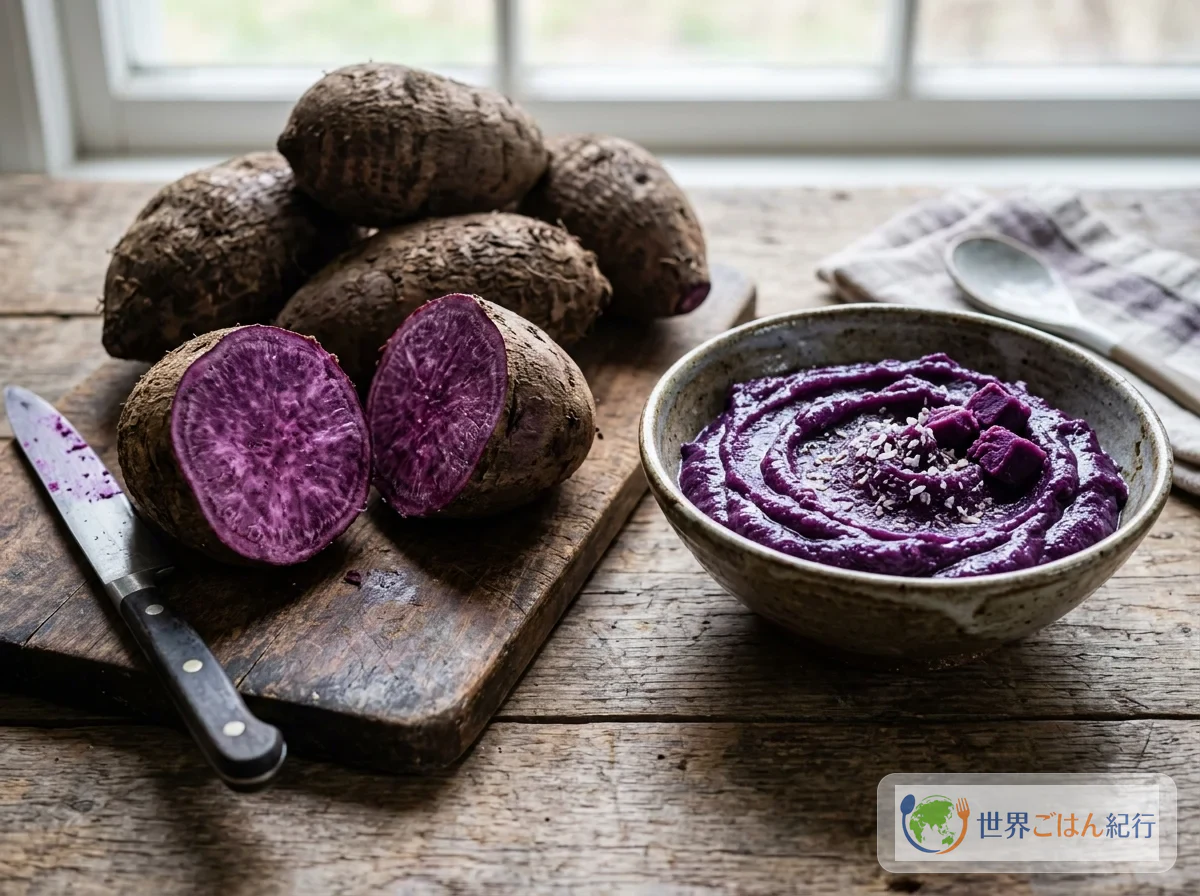
Purple batter made with ube beside purple yam
If you have no ube halaya, purple sweet potato paste can substitute, but adjust the batter by its moisture

Langka

Langka is jackfruit. Canned jackfruit in syrup is sweet and strongly scented, so chop it and blot off the liquid before mixing it in. Mango is close in aroma, but it releases water when heated and loosens the layer. If you have no langka, a little canned yellow peach or 1 oz (30 g) pumpkin paste with a pinch of turmeric keeps the yellow and holds its shape better.

Macapuno

Macapuno is a mutant coconut flesh, sometimes sold as thin strands in jars. If you can't find it, rehydrate coconut flakes in hot water and add them to the white layer. A plain white layer also works, as long as the coconut milk's aroma comes through.

Method: set each layer before adding the next

With sapin-sapin, the waiting matters more than the mixing time. Do not hurry; pour the next layer only after the surface of each layer no longer flows.

Common sapin-sapin failures and fixes
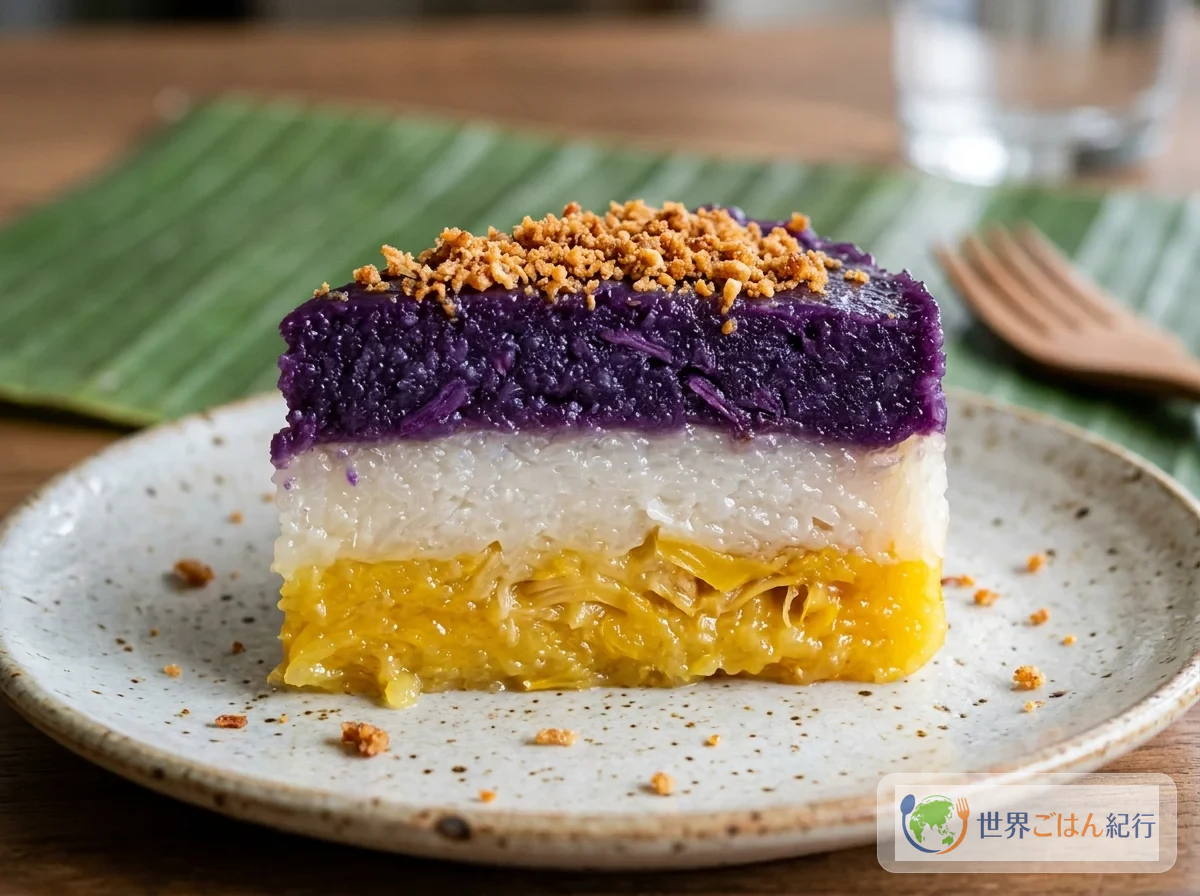
A cross-section of sapin-sapin, the purple, white and yellow layers clearly separate
When the layer boundaries bleed, check whether the previous layer was undercooked or how the next batter was poured

With sapin-sapin, mistakes show on the outside. If the layers bleed, you poured the next one while the previous layer could still flow; next time, steam until the surface goes matte and barely ripples when you shake the pan. A batch that bled is still fine to eat. Chill it well before cutting and it breaks less.

If the center is raw, suspect thickness before heat. When the skewer comes out with white liquid on it, put the whole pan back in the steamer and add 5 minutes at a time over medium heat. A dry surface over a raw center means the pan is too deep or the batter too heavy, so next time use an 8.5-inch (22 cm) pan with the same amounts, or add 1 tbsp water.

State Cause Fix
Layers mix Lower layer undercooked, or poured too forcefully Do not go by 10 minutes; steam longer until it does not flow. Pour the next layer along the back of a spoon
Many holes in the surface Drops from the lid, heat too high Use a lid wrapped in a towel. Lower from high to medium-high heat
Powdery center Flour lumps, batter too heavy Strain the batter. Crush shiratamako before use
Falls apart when cut Not cooled enough Chill at least 1 hour in the refrigerator and cut with a wet knife
Latik is bitter Cooked too long after it colored Take it out at a light golden brown, allowing for residual heat

Cutting, storing and serving sapin-sapin
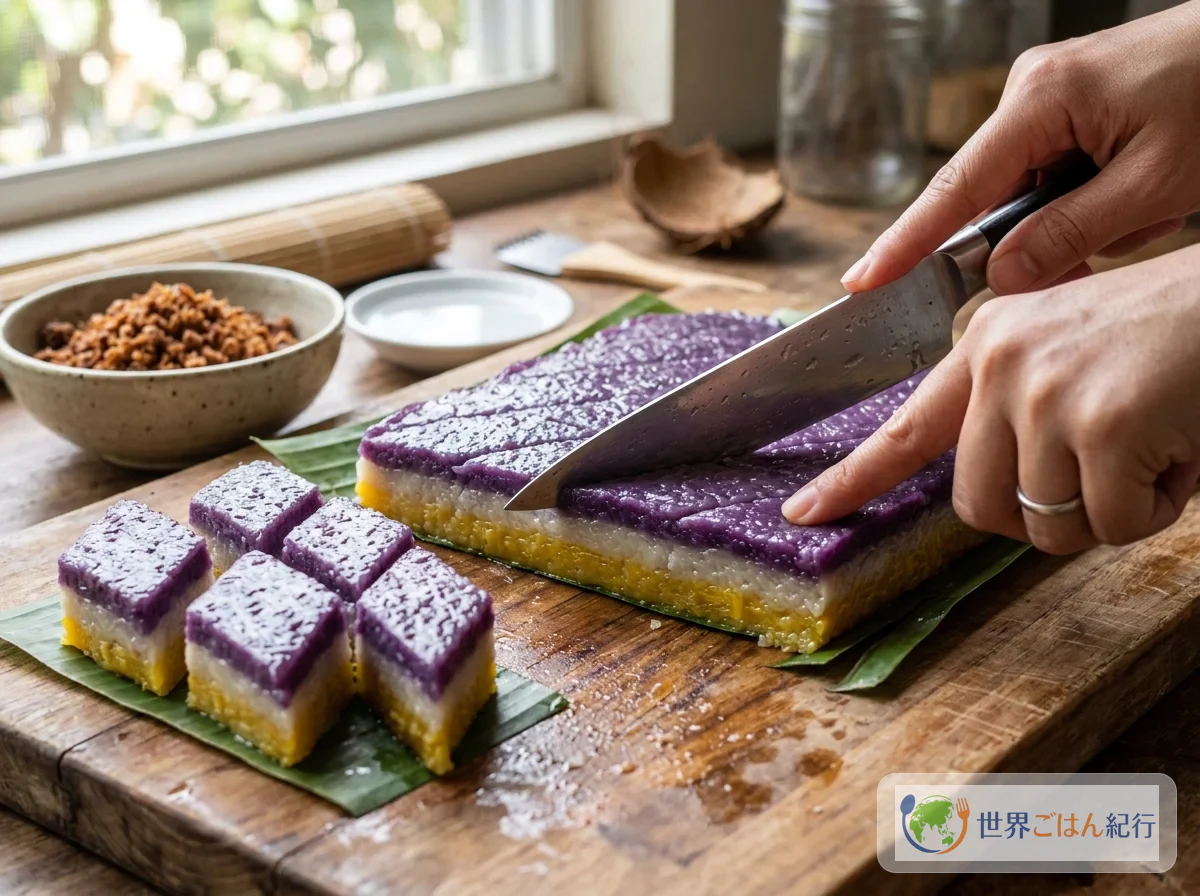
Cutting sapin-sapin with a knife
Wetting the knife with water as you cut keeps the glutinous dough from sticking to the blade

Wait until it has cooled to cut. While hot, the layers are soft and the knife drags purple into white. Chill it for 1 hour in the refrigerator, then take it out 20 minutes before cutting; the cross-section shows clearly and it isn't too firm to eat.

It keeps about 3 days in the refrigerator, each piece wrapped in plastic wrap and stored in a container. You can freeze it for up to 2 weeks, though the surface dries a little after thawing. Warm a refrigerated piece in the microwave at 600 W for 10 seconds; thaw a frozen piece overnight in the refrigerator, then microwave at 600 W for 15 seconds. Stop when it's just barely soft, because overheating loosens the layers.

Serve it with strong coffee, unsweetened tea or hot chocolate. In a Filipino menu it works well after a sweet-sour sinigang or an adobo, whose lingering soy and vinegar keeps it from feeling heavy. For more kakanin, try kutsinta, with its strong brown sugar aroma, or puto, which is closer to a steamed cake.
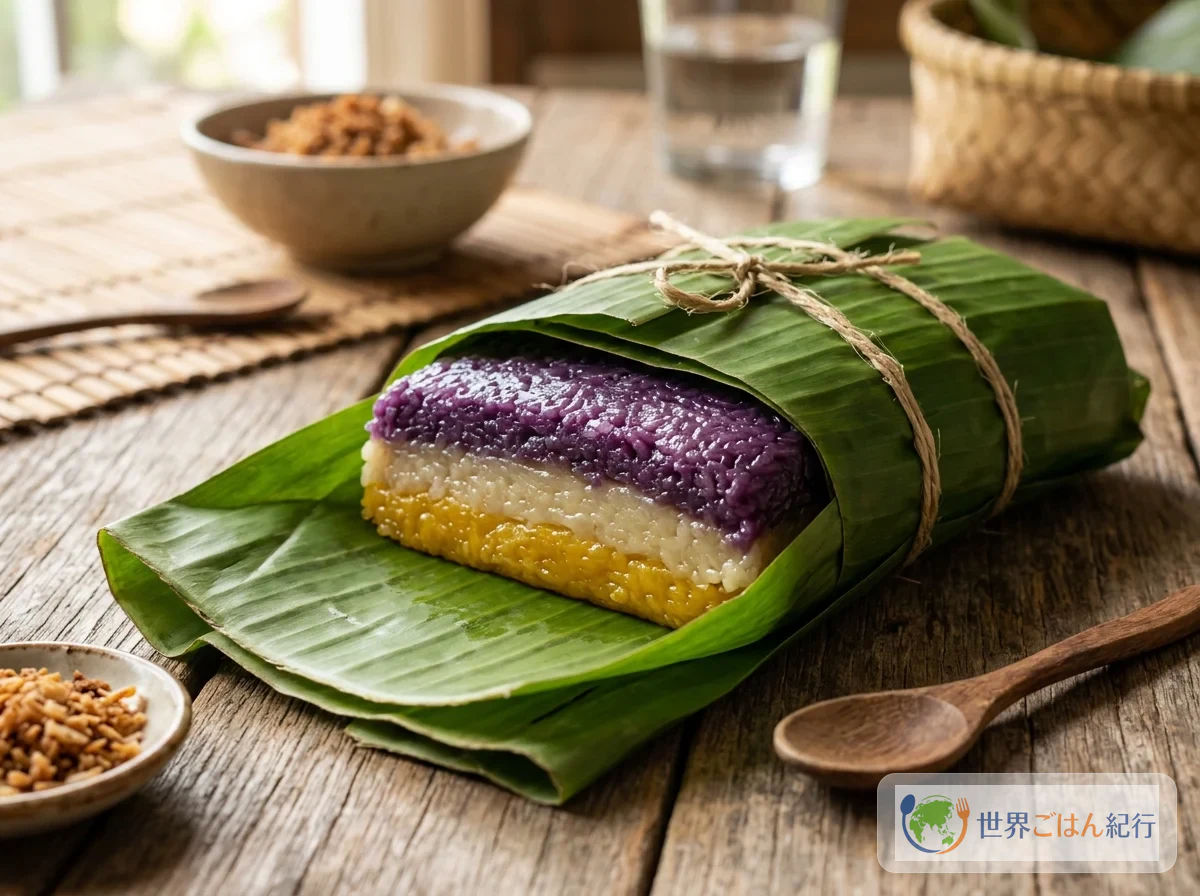
Sapin-sapin wrapped in banana leaf
The banana leaf is for aroma, not a storage container. Use plastic wrap and a container for storage

Frequently asked questions

Sapin-sapin batter divided into purple, white and yellow in three bowls
For common failures, think about whether it happened in the flour, the coloring, the steamer or the storage

Can I make it with regular rice flour instead of glutinous rice flour?

Not recommended. Regular rice flour alone will set, but it won't give sapin-sapin its sticky chew. If you do use some, replace only part: 9 oz (260 g) glutinous rice flour and 1.5 oz (40 g) regular rice flour keeps the texture from breaking down.

What if I do not have ube halaya?

Substitute 2.5 oz (70 g) purple sweet potato paste. If the paste is watery, add 1 tbsp glutinous rice flour to the purple layer only. With purple sweet potato powder, dissolve 10 g in 2 tbsp of the batter before adding it, or it will form lumps.

Can I make the color paler?

Yes. Clean layers matter more than color. Without extracts the purple and yellow will be pale, but as long as you can taste the ube, jackfruit and coconut, it's a fine home version.

Can I make it without a steamer?

Yes, with a steaming rack set in a large pot. Keep the bottom of the pan above the water, cover, and steam over medium-high heat. Skip the microwave: it cooks the center and edges unevenly and the layers bleed.

Can I make it vegan?

Yes, if you use coconut condensed milk instead. If the batter is loose, add glutinous rice flour 1 tbsp at a time. Make the latik with coconut cream alone.

Can I make it ahead?

It's well suited to making the day before. Cool it completely, wrap it in plastic wrap and refrigerate, then scatter the latik after cutting so it keeps its aroma.
Sources consulted